CBD and Stress: What Human Evidence Can Actually Show
Human evidence does not show that consumer CBD reliably reduces everyday stress. This guide compares direct trials, placebo effects, product limits, and safety.

CBD is widely marketed for calm, but the closest human studies do not establish that consumer CBD reliably reduces everyday stress. The most direct randomized trial found that CBD oil did not outperform placebo. Two other controlled studies in healthy adults also found no benefit on perceived stress. That is a more useful starting point than a promise, a testimonial, or a personal-use routine.
Does CBD reduce everyday stress? The short answer
The best answer available in July 2026 is not proven. A direct 2025 randomized trial tested a commercial full-spectrum CBD oil for 30 days in 180 highly stressed university students. Stress improved in both the CBD and placebo oil groups, but CBD did not perform better than placebo on stress or any other measured outcome.
Two other controlled studies point in the same cautious direction. A 12-week trial of 100 mg of CBD per day in 54 healthy adults found no CBD effect on perceived stress. An eight-week beverage trial in 102 generally young, healthy adults found no stress benefit from beverages containing 30 or 60 mg of CBD compared with L-theanine alone or a vehicle placebo. Those trials do not prove that every CBD product is ineffective. They do show that a reliable everyday-stress effect has not emerged from the better direct tests.
This conclusion is narrower than a yes or no headline. Different studies used different products, populations, amounts, routes, and outcomes. A null result for one oil or beverage cannot settle every formulation. A positive signal in an acute anxiety experiment cannot settle daily perceived stress either. Our broader CBD evidence overview uses the same rule: a result applies to the product and question that were actually tested.
Stress is not the same question as an anxiety disorder
Stress is a response to demands. It can rise before a deadline, during family conflict, or when sleep and workload stop fitting into the same week. Anxiety can also be a normal response, but an anxiety disorder involves symptoms that are more persistent, intense, difficult to control, or disruptive. The FDA's anxiety resource describes anxiety disorders as conditions that can interfere with work, school, relationships, and daily wellbeing.
That distinction matters because the evidence gets blurred at exactly this point. A study of people diagnosed with social anxiety during a public-speaking task is not a study of ordinary work stress. A study that measures a few minutes of laboratory anxiety is not a test of whether a retail product changes a month of real life. A brain-imaging result is not a clinical outcome.
The boundary also protects care. If worry or fear is persistent, hard to control, or interfering with life, the next step is not to rename it everyday stress and shop around it. It deserves a conversation with a qualified health professional.
Four evidence questions that should not be merged
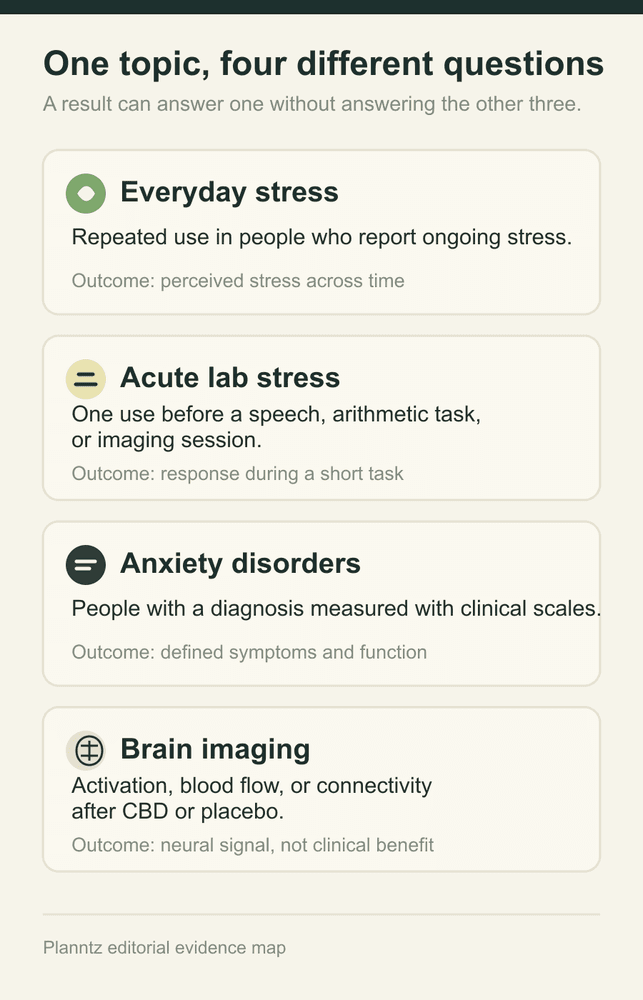
CBD and stress research contains at least four different questions. They overlap. They are not interchangeable. Before accepting a claim, identify which row the source actually answers.
| Question | Typical study | What it cannot establish by itself |
|---|---|---|
| Everyday perceived stress | Repeated use in people who report ongoing stress | Treatment of an anxiety disorder or one universal product effect |
| Acute laboratory stress | One use before a speech, arithmetic task, or imaging session | A dependable effect across ordinary weeks |
| Anxiety disorder symptoms | People with a diagnosis measured with clinical scales | A claim for general stress or a consumer tincture |
| Brain mechanism | Imaging, blood flow, or neural activation after CBD | That a person feels better or functions better |
A 2026 systematic review of human neuroimaging shows why mechanism claims need restraint. It included 12 studies representing 146 participants in seven cohorts. Reported brain effects varied in location and direction, no region or network changed consistently, and behavioral or physiological changes did not reliably accompany the imaging findings. The reviewers rated the certainty low to very low. Human research therefore does not support a simple story that CBD resets the stress system, balances the brain, or works through one confirmed pathway.
What the direct ongoing-stress trials found
A 2025 full-spectrum oil trial found no advantage over placebo
Start with the closest match. The 2025 trial enrolled 180 German university students with high perceived-stress scores and randomized them to a commercial 10% full-spectrum CBD oil, a matched placebo oil, or no treatment. The two oil groups received the same evidence briefing and used their assigned oil for 30 days. The CBD schedule gradually increased from 0.02 mg/kg to 1 mg/kg.
Stress, depressive symptoms, and physical-symptom scores fell more in both oil groups than in the no-treatment group. The key comparison is CBD versus placebo. There was no significant difference between those two groups for stress, anxiety, sleep, wellbeing, or any other measured outcome. The authors concluded that they could not find a CBD-specific effect and that the pattern suggested a substantial placebo response.
This was a useful design because the no-treatment group helped researchers see change that could occur without either oil. It was not a universal verdict. The sample was young, highly educated, and 81 percent women. People with diagnosed mental or physical illness, regular medication use, or recent CBD use were excluded. The observed CBD-versus-placebo differences were small, and the study had limited power to detect small effects. The result applies most directly to this population, product, stepped schedule, and 30-day outcome.
Two healthy-adult trials also reported null stress results
In the 12-week US trial, participants used a brand-specific oil containing 50 mg/mL of CBD. The active group used 1 mL twice daily. Researchers measured perceived stress, sleep, mood, pain, and several biological markers. They found no CBD effect on perceived stress, sleep quality, overall mood disturbance, or the measured immune and inflammatory markers. The study was funded by the product company, dosing happened at home, and the sample contained healthy young adults. Funding does not erase a result, but it makes independent replication especially valuable.
The beverage trial randomized 102 healthy adults to four groups: 60 mg CBD with L-theanine, 30 mg CBD with L-theanine, L-theanine without CBD, or a vehicle placebo. All beverages also contained vitamins C and E. After eight weeks, CBD did not improve perceived stress, wellbeing, sleep, cortisol, activity, or performance. Because the formulation combined ingredients, it cannot answer what the same amount of CBD oil would do. Ocean Spray funded the study and formulated the beverages. The result still provides another controlled test in which adding CBD did not improve the stress outcome.
| Study | Population and intervention | Perceived-stress result | Main boundary |
|---|---|---|---|
| Winkler 2025 | 180 highly stressed students; full-spectrum oil for 30 days | CBD did not outperform placebo | Selective sample; stepped low amount; excluded regular medication and diagnoses |
| Mastrofini 2024 | 54 healthy adults; 100 mg/day oil for 12 weeks | No CBD effect | One brand-specific product; industry funded; home use |
| Townsend 2024 | 102 healthy adults; 30 or 60 mg/day in a beverage for eight weeks | No CBD effect | CBD combined with L-theanine and vitamins; young sample |
Why acute anxiety studies do not settle everyday stress
Positive CBD headlines often trace back to small acute experiments. The NCCIH overview notes one study of 24 people with social anxiety disorder who reported less anxiety during a simulated public-speaking test after CBD than after placebo. Other small experiments have tested different amounts in healthy volunteers during speeches or imaging sessions.
These studies can show a signal worth testing. They cannot establish that a person with ordinary work or family stress will benefit from repeated consumer-product use. The participants, outcome, setting, and often the CBD formulation differ. A single use before a deliberately stressful task also says little about what happens across weeks, whether function improves, or whether any change outweighs safety concerns.
This is not a technicality. Moving from a research-grade CBD dose in a controlled speech task to a retail tincture marketed for daily calm changes almost every part of the claim. The product may contain other cannabinoids. The actual contents may differ by batch. The route and food context can change exposure. The reader may take medicines or have a health condition that the trial excluded. The experiment and the shopping claim are not equivalent.
Expectation can change what people notice
Placebo is sometimes used as a polite way to say nothing happened. That is not what placebo-controlled research means. Symptoms and experiences can change for many reasons: expectation, attention, a new routine, natural fluctuation, regression toward a usual baseline, and the meaning attached to taking something. A placebo group helps separate those changes from the specific pharmacological effect of an active ingredient.
A 2024 randomized expectancy experiment makes the distinction visible. All participants received CBD-free hempseed oil. Half were told it contained CBD. The group told CBD reported more sedation and showed a borderline trend toward less subjective stress while anticipating another laboratory task. No one received CBD, so those differences cannot be attributed to CBD pharmacology.
That result does not prove that every response to CBD is placebo. It shows why a personal impression cannot identify the cause on its own. Someone can sincerely feel different while the active ingredient is not the reason, or not the only reason. The same caution applies to testimonials, app ratings, and before-and-after notes without a blinded comparison. Our guide to what CBD can feel like treats subjective experience as real information while keeping it separate from proof of efficacy.
A 2023 quasi-experimental study illustrates the other side. Its 374 self-selected participants rated an isolate oil and then a broad-spectrum oil favorably, with higher ratings during the broad-spectrum period. But everyone used isolate first, there was no placebo, use was at will, and the study did not collect standardized before-and-after stress scores. The result may reflect product differences, order, time, expectation, preference, or several factors together. It does not establish that broad-spectrum CBD reduces stress better than isolate.
A study is not a personal-use protocol
Research schedules are designed to answer research questions under a defined protocol. They are not instructions to copy. The stress studies used a stepped full-spectrum oil, a fixed twice-daily brand product, and two CBD-plus-L-theanine beverages. Acute anxiety studies used still other products and settings. There is no evidence-based consumer amount, timing, spectrum, or two-week test that can tell an individual whether CBD works for stress.
- Do not convert a study amount into a personal amount. Screening, formulation, monitoring, and population matter.
- Do not treat full-spectrum, broad-spectrum, isolate, prescription CBD, and a finished retail product as interchangeable.
- Do not use a change in a stress score as proof that cortisol, brain function, sleep, or an anxiety disorder improved.
- Do not use consistency language to imply that an unproven effect will appear after enough days.
- Do not stop, replace, or adjust mental-health care because of a CBD article or testimonial.
If sleep is the real concern, treat it as a separate question. The evidence and safety boundaries in CBD and sleep do not become proof that CBD reduces daytime stress, just as a calmer evening would not establish treatment of an anxiety disorder.
Safety belongs before experimentation
The FDA's cannabis and CBD Q&A says only one cannabis-derived CBD drug is FDA-approved, for specific seizure disorders. No consumer CBD product is FDA-approved to treat stress or anxiety. Unapproved products have not gone through FDA review to establish that they work, what amount may work, how they interact with medicines, or what safety concerns apply.
CBD is not risk-free because it is sold without a prescription or does not create the classic THC high. FDA notes potential medication interactions and liver effects. In a randomized FDA safety trial, healthy adults received CBD oral solution at 2.5 mg/kg twice daily for 28 days. Eight CBD-assigned participants developed liver-enzyme elevations above three times the upper limit of normal, a source-reported Kaplan-Meier estimate of 5.6 percent, compared with none receiving placebo. Participants did not have clinical liver symptoms, and enzymes returned to normal after CBD stopped.
That trial used 250 to 550 mg per day, depending on body weight. Its 5.6 percent estimate is not an incidence estimate for lower amounts, other products, or longer use. It does show why feeling fine is not proof that a biological effect is absent and why a supervised research amount should not be copied. People who use prescription or over-the-counter medicines, have liver concerns, or do safety-sensitive work need a product-specific and medicine-specific review with a qualified clinician or pharmacist.
The direct source is FDA's pregnancy and breastfeeding guidance. This avoidance advice is separate from a medication review and is not changed by a product label, spectrum, or amount.
Product contents add another uncertainty. A label or certificate of analysis can describe the sample that was tested. It cannot prove a stress effect, guarantee every bottle is identical, eliminate interaction risk, or transfer results from a research product.
When stress needs more than an article
Stress does not have to become a crisis before support is reasonable. Consider professional help when worry or fear feels persistent or uncontrollable, when sleep and concentration keep deteriorating, when work or relationships are being disrupted, or when coping increasingly depends on alcohol, cannabis, or another substance. These signs do not diagnose an anxiety disorder. They are reasons to discuss what is happening with someone qualified to assess it.
Evidence-based care for anxiety disorders can include psychotherapy, stress-management techniques, FDA-approved medicines, or a combination, according to the FDA. A CBD product has not been approved as a substitute. Do not start, stop, or change prescribed treatment based on this page.
If stress has become emotional distress or a crisis, the US 988 Suicide & Crisis Lifeline is available by call, text, or chat. Immediate danger requires emergency help. A supplement decision can wait.
Questions people still ask
Current human evidence does not establish a reliable benefit. The most direct 2025 randomized trial found CBD oil did not outperform placebo, and two other controlled studies in healthy adults found no effect on perceived stress.
Research does not establish a consumer amount for stress. Study amounts and schedules belong to specific products, populations, screening rules, and outcomes. They are not personal instructions.
No evidence supports using a consumer CBD product as a replacement for prescribed anxiety treatment or psychotherapy. Do not stop or change treatment without the clinician responsible for your care.
No. Symptoms can change because of expectation, attention, routine, natural fluctuation, regression toward a usual baseline, and other real contextual effects. A placebo comparison asks whether CBD adds a specific effect beyond those changes.
There is no universal safety answer. Product contents, amount, duration, medicines, liver health, pregnancy, and other factors matter. FDA has identified interaction and liver concerns, and advises avoiding CBD during pregnancy and breastfeeding.
No controlled evidence establishes one spectrum as better for stress. A favorable quasi-experimental comparison used a fixed isolate-first order, no placebo, at-will use, and self-selected participants, so it cannot prove superiority.
The bottom line
CBD and stress is not a story where a promising mechanism automatically becomes a dependable daily effect. The direct controlled trials available today do not show that consumer CBD reliably reduces perceived stress. Small acute anxiety studies remain interesting, but they answer different questions. Expectancy experiments show that context can change what people report even without CBD, which is why testimonials and personal notes cannot isolate the ingredient's effect.
Read any claim by asking five things: who was studied, what exact product was used, what outcome changed, what comparator was used, and what the study could not rule out. If the claim jumps from a speech task to ordinary life, from purified CBD to a retail blend, or from a stress score to treatment of anxiety, it has crossed the evidence boundary.
Then put the practical boundaries first. Review medicines and liver concerns with a qualified clinician or pharmacist. Follow FDA pregnancy guidance. Treat persistent or disruptive anxiety as a care question, not a product-selection problem. Honest uncertainty may feel less satisfying than a two-week routine, but it is a much safer answer to what the evidence can actually show.
Writing about hemp, wellness and the small rituals that keep us balanced.