
What Does CBD Feel Like? Expectations and Red Flags
CBD does not have one predictable feeling. Learn what controlled studies found, why products and people differ, and what to do if you feel unexpectedly impaired.
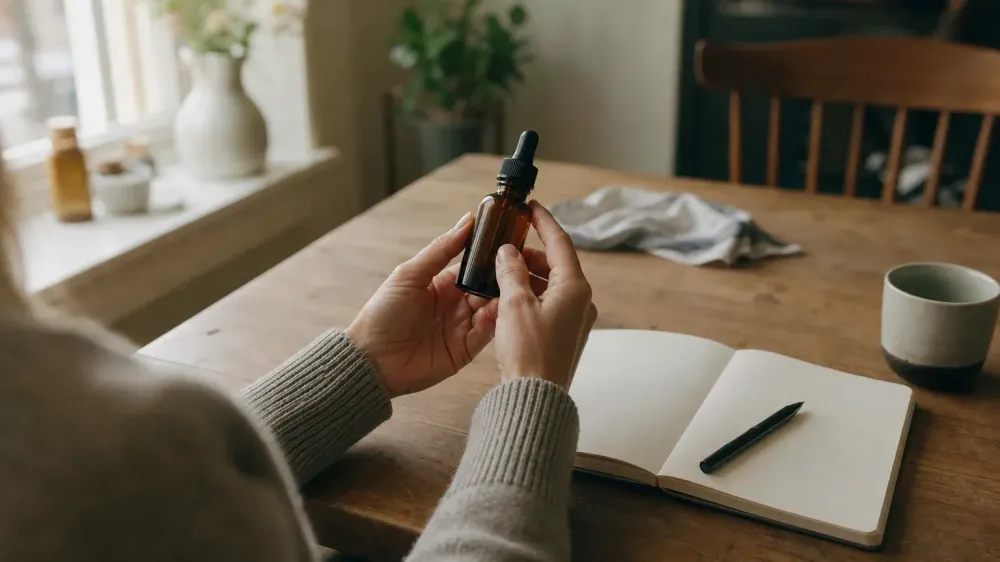
CBD does not have one predictable feeling. In small controlled studies of defined CBD formulations, researchers have not found a consistent wave of calm, euphoria or body sensation that everyone can expect. Some people notice nothing obvious. Others report drowsiness, digestive changes or a shift in alertness. A strong high or marked impairment calls for a closer look at the entire product, not an assumption that CBD alone explains it.
That answer is less exciting than the promises scattered across wellness marketing, but it is more useful. A sensation cannot verify that a bottle contains the labeled amount, and the absence of a sensation cannot prove that nothing is happening. Expectations, product composition, other ingredients, medications, food, route and the situation in which a product is used can all shape what someone notices.
This guide focuses on expectations and response, not treatment. For the basic compound and plant terminology, start with what CBD is. If your main question is timing, how long CBD may take to work covers that separate issue without using onset as proof of benefit.
CBD is not THC, but the bottle matters
THC is the cannabis compound most closely associated with feeling high, including euphoria, altered perception and impaired attention. CBD is biologically active, but that does not mean it creates the same pattern. In a small randomized crossover trial, 16 healthy men received 600 mg of purified oral CBD, 10 mg of THC and placebo in separate sessions. THC produced clear subjective intoxication and other behavioral effects. CBD did not differ from placebo on the measured symptoms or physiological variables (PMID 22716148).
That trial helps distinguish the molecules. It does not prove that every retail item labeled CBD will feel neutral. The study used a defined, purified dose under controlled conditions. A tincture, gummy, drink or inhaled product may contain different cannabinoid amounts, flavor ingredients or other active substances. Even the word “hemp” does not tell you the finished product's exact THC content.
The CDC notes that products labeled as hemp or CBD may contain THC or contaminants, and that THC-containing products can cause psychoactive effects (CDC). Laboratory research on online CBD extracts has also found label inaccuracies and detected THC in some samples (PMID 29114823). Those findings do not diagnose any specific bottle. They explain why “CBD can never make you feel high” is too broad when the person actually consumed a finished product.
Controlled studies do not reveal a universal CBD feeling
A second randomized trial helps show why a confident list of expected feelings would be misleading. Forty healthy college students received either 300 mg of CBD oil or placebo. After two hours, self-reported anxiety had not changed, and most cognition, mood and performance results were similar between groups. Researchers did observe a small difference in one attention-lapse measure and a mixed set of reaction-time findings, then concluded that larger studies were needed (PMID 36625844).
This was a feasibility study in a young, healthy group after one 300 mg dose. It cannot tell a shopper how a different formulation will feel, and it does not establish a relaxation benefit. Its value here is narrower: even with controlled conditions and formal measurement, the study did not produce a simple subjective signature that can be presented as “the CBD feeling.”
Personal stories can still be sincere. Someone may describe feeling quieter, sleepier, less tense or unchanged. But an anecdote cannot separate the product from expectation, setting, normal fluctuation or another ingredient. It also cannot be turned into a promise for the next person. If the goal is to judge an experience responsibly, record what happened instead of trying to match someone else's description.
What a noticeable reaction can mean
CBD can have noticeable adverse effects. The FDA identifies changes in alertness, most commonly drowsiness or sleepiness; gastrointestinal distress, especially diarrhea or decreased appetite; and mood changes such as irritability or agitation. The agency also warns that CBD can interact with medications and that combining it with alcohol or other substances that slow brain activity can increase sedation and drowsiness (FDA consumer update).
Prescription cannabidiol data show that these are not concerns created only by contaminants. In controlled trials summarized in the current Epidiolex label, somnolence, diarrhea, decreased appetite and fatigue occurred among common adverse reactions in the studied seizure populations (FDA prescribing information). Those patients used a prescription formulation, often at high weight-based doses and with other antiepileptic drugs. The rates must not be copied onto a consumer tincture, but the evidence shows why CBD itself should not be described as free of effects or risk.
| What someone notices | What it can tell you | What it cannot prove |
|---|---|---|
| Nothing obvious | No distinct sensation was noticed | That the product is ineffective, correctly labeled or risk-free |
| Sleepiness or lower alertness | A known possible adverse effect deserves attention | That CBD is treating sleep or stress |
| Digestive upset or appetite change | The reaction may be product-related and should be tracked | Which ingredient caused it without further assessment |
| A high, confusion or marked impairment | The product, amount, THC and other substances need review | That purified CBD alone caused the experience |
| A desired mood or body change | A personal observation occurred | A repeatable therapeutic effect for that person or anyone else |
Taste and mouthfeel are separate from systemic effects. Carrier oils, botanical extracts and flavoring can taste earthy, bitter, sweet or oily. Reading the full ingredient list prevents a sensory effect from being automatically attributed to the cannabinoid.
Why two people can describe the same label differently
The label is only the beginning. Full-spectrum, broad-spectrum and isolate products are intended to contain different cannabinoid profiles. Our CBD spectrum guide explains those categories and their limits. Batch testing can add useful evidence about the sampled product, but it is still important to match the report to the lot on the package. How to read a CBD lab report shows what to compare.
Route also changes the question, but the CDC says it is not yet known how different modes of using CBD affect a person (CDC). Swallowed, oromucosal, inhaled and topical products should not be assigned one shared onset or feeling timeline. Because products vary, a timeline borrowed from a competitor or friend is not a reliable test of whether your product did something.
Context adds more variables. Food, alcohol, other sedating substances, prescription and over-the-counter medicines, fatigue and the activity happening at the time can all complicate interpretation. Expectation matters too. When a person actively scans for a promised sense of calm or relief, ordinary changes can feel more meaningful. That does not make the experience imaginary. It makes a one-time subjective report poor evidence for cause and effect.
Individual health factors may also matter, but this is not a reason to guess at a personalized regimen. Pregnancy or breastfeeding, liver concerns, medication use, a history of strong reactions to cannabis products and use by a child all deserve professional guidance before exposure, not an internet prediction of how CBD should feel.
A better way to evaluate an experience
Do not chase a sensation or repeatedly take more because nothing feels obvious. Feeling is not a measurement of content, and this article cannot set an individual amount. If you are evaluating something that already happened, the useful evidence is concrete: the exact product, lot, labeled cannabinoid amount, ingredient list, time used, other substances or medicines involved, and what changed.
- 1Save the package and identify the exact product, spectrum claim, lot number and expiration or best-by date.
- 2Match any certificate of analysis to the lot and review the cannabinoid results rather than relying only on a front-label phrase.
- 3Write down the time, route, labeled amount and any food, alcohol, medicines or other products used around it.
- 4Describe observable changes, such as drowsiness, nausea, diarrhea, irritability, confusion or no noticeable change. Avoid converting the note into a treatment conclusion.
- 5If the reaction was unexpected, stop using the product while you seek appropriate advice. Do not test the reaction again by driving or combining it with another substance.
A pharmacist or healthcare professional can review medicines and health context. The manufacturer can answer batch and ingredient questions, but a sales representative should not diagnose a reaction. For a broader discussion of known concerns, read CBD side effects and safety limits.
When the feeling is a red flag
If you feel drowsy, dizzy, confused, unusually agitated or otherwise impaired, do not drive, cycle in traffic, operate machinery or take on another safety-sensitive task. Stop using the product and check the label, lot, ingredients and other substances involved. Unexpected impairment deserves a cautious response even when the package says CBD.
For an adverse effect that creates immediate danger, the CDC directs people in the United States to call a local or regional poison control center at 1-800-222-1222, call 911 or seek emergency care. Bring or photograph the package so clinicians know what was reportedly consumed. A child who may have swallowed a CBD or THC product also needs prompt poison-control guidance rather than observation based on an adult article.
The most honest expectation
The most defensible expectation is not “you will feel calm” or “you will feel nothing.” It is that purified CBD is different from THC, a finished product may not be identical to purified CBD, and a person's response cannot be predicted from marketing copy. Some people notice no clear change. Some notice adverse effects. A pronounced high or impairment should trigger product and safety questions rather than a reassuring slogan.
That framework protects against two common mistakes: treating a desired feeling as proof of a health benefit, and treating the word CBD as proof that an unexpected reaction is harmless. Check the product, preserve the context and respond to what actually happened.
Purified CBD did not produce the THC-like subjective intoxication measured in a small controlled trial. A retail product can contain THC or other ingredients, so an unexpected high should not be dismissed based on the front label alone.
It is possible to notice no distinct sensation. That does not prove the product works, does not work, contains the labeled amount or is free of risk. Feeling is not a content test.
Yes, drowsiness and sleepiness are recognized possible adverse effects. Sleepiness is not proof that CBD is treating a sleep problem. Avoid driving or other safety-sensitive activity if alertness changes.
Possible explanations include a CBD adverse effect, THC or another ingredient, an interaction, another substance, or an unrelated change. Stop using the product while you review the package and seek appropriate advice. Immediate danger warrants Poison Control, 911 or emergency care.
Writing about hemp, wellness and the small rituals that keep us balanced.