Should You Take CBD With Food? What Research Means
Food can change how much swallowed CBD reaches the bloodstream, but the result depends on the formulation, dose, meal and route. Here is what the research does and does not support.
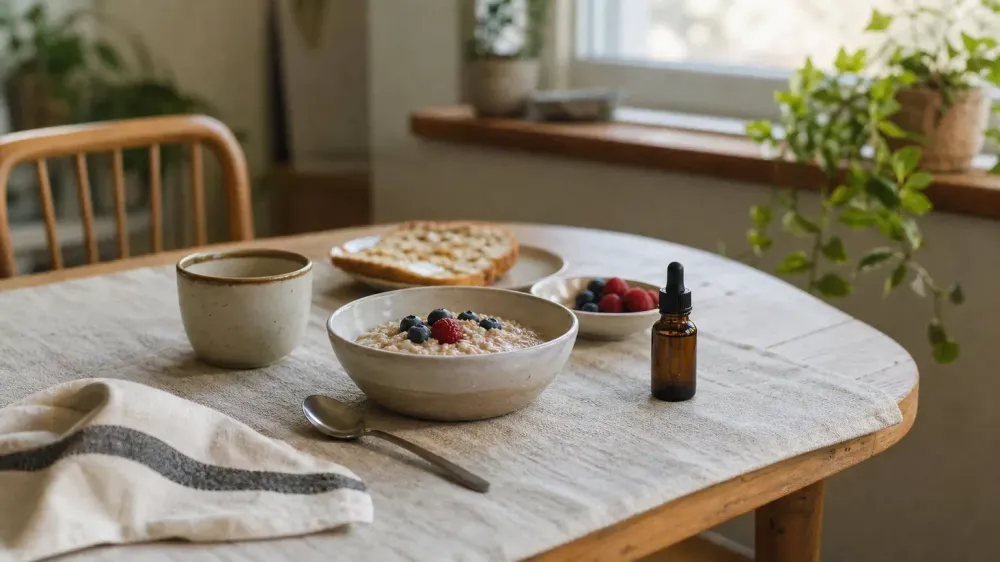
Should you take CBD with food? Research shows that a meal can materially change how much CBD reaches the bloodstream after some swallowed products. It does not show that everyone should pair every retail CBD product with a fatty meal, or that more CBD in the blood produces a better result.
That distinction is the whole article. Food-effect trials measure pharmacokinetics: what the body does to a substance over time. They do not automatically answer whether a consumer product works, what amount a person should use, or whether a larger exposure is desirable. If the word itself is new, begin with what CBD is and what it is not. Here, the question is narrower: how meals change exposure and how to interpret that without turning a laboratory result into personal instructions.
Should CBD be taken with food?
There is no single answer that fits prescription cannabidiol, a swallowed capsule, a gummy and an oil held in the mouth. In several controlled studies, food increased systemic exposure after oral CBD. High-fat meals produced the largest changes in the pharmaceutical studies, but lower-fat meals and milk also increased exposure. A newer small trial of a CBD-rich extract found an even larger food effect than the earlier purified-CBD studies.
The careful conclusion is that fed versus fasted conditions can be an important source of variability. The careless conclusion is that a high-fat meal makes any CBD product work better. The second statement skips over formulation, dose, route, study population, safety and the fact that the trials measured blood levels rather than a consumer wellness outcome.
What the food-effect studies actually measured
Two measures appear repeatedly. Cmax is the highest measured concentration in plasma. AUC, or area under the concentration-time curve, summarizes total exposure across the sampling period. A third measure, Tmax, is the time to the measured peak. These are useful for comparing fed and fasted conditions within a trial. They are not scores for effectiveness.
| Study | What was tested | Participants | Observed fed/fasted result | Important limit |
|---|---|---|---|---|
| Taylor 2018 | 1,500 mg highly purified pharmaceutical CBD oral solution, high-fat meal | 12 healthy adults | Cmax 4.85x; AUC 4.2x | High pharmaceutical dose and one oral solution |
| Birnbaum 2019 | 99% pure CBD capsule, 840-860 calorie high-fat meal | 8 adults with refractory epilepsy | Mean Cmax 14x; AUC 4x | Very small clinical sample; corrected PubMed record used |
| Crockett 2020 | 750 mg pharmaceutical CBD oral solution with high-fat, low-fat or milk conditions | 30 healthy adults enrolled | High-fat: Cmax 5.2x, AUC 3.8x; lower increases with low-fat meal and milk | Incomplete-block crossover; moderate-to-high PK variability |
| Saals 2025 | 70 mg CBD-rich extract in MCT-oil capsules, about 800 calorie high-fat meal | 11 healthy adults completed | Cmax GMR 17.4; AUC GMR 9.7; median Tmax 5 to 10 hours | Small study of one extract and capsule formulation |
The 2018 phase 1 trial and 2020 meal-composition trial both used a highly purified pharmaceutical oral solution at doses far above the amount in many consumer servings. The 2019 capsule study enrolled eight people with refractory epilepsy. The 2025 extract study used 70 mg in MCT-oil capsules but included only 11 completers. Every number belongs beside its formulation, dose, population and meal.
The current FDA prescribing information for Epidiolex, revised May 2026, reports that a high-fat, high-calorie meal increased its Cmax about fivefold and AUC about fourfold compared with fasting. It also reports smaller but still material increases with a low-fat meal and bovine milk. Those are facts about the approved prescription oral solution. They do not establish equivalence with a Planntz tincture, a gummy, a capsule from another maker or a mixed-cannabinoid product.
Why do the numbers differ so much?
CBD is lipophilic, meaning it mixes more readily with fats than with water. A meal can change bile secretion, digestion, movement through the stomach and intestine, and the pathways available for absorption. Those processes can change how much swallowed CBD reaches circulation. But that broad explanation does not predict one fixed multiplier for a bottle on a kitchen counter.
The formulation matters before the meal enters the picture. An oral solution containing highly purified CBD is not the same test material as a capsule containing a CBD-rich extract in MCT oil. The studies tested different finished formulations and were not designed to isolate which product feature caused the difference between their results. The amount administered also matters because CBD exposure has not always increased in a simple dose-proportional way.
The meal itself is another variable. The high-fat test breakfasts were standardized, large meals designed to probe a worst-case food effect. Crockett and colleagues also found increased exposure with a lower-fat meal and with whole milk, but the changes were smaller than after the high-fat meal. That makes “with food” an incomplete description. A light snack, a mixed dinner and a standardized 800-1,000 calorie research meal are not interchangeable conditions.
What the studies do not prove
First, they do not prove that more exposure is better. AUC and Cmax tell researchers how much CBD appeared in plasma and for how long. The food-effect studies were not designed to establish that a higher value improved sleep, stress, pain or any other consumer goal. Converting a fourfold AUC into “four times more effective” would be scientifically wrong.
Second, they do not establish a universal onset rule. In the Taylor and Crockett pharmaceutical studies, food did not produce an important change in the measured time to peak. In the small Saals extract study, median Tmax shifted from five hours fasted to ten hours fed and a second concentration peak appeared. That disagreement is a reason to preserve formulation context, not a license to promise that an empty stomach is faster or a meal lasts longer. For the broader timing question, see why CBD onset varies.
Third, the trials do not tell a consumer to lower or raise an amount. A meal-dependent exposure change can make self-directed adjustments harder to interpret. It also means that a routine that alternates between a substantial meal and a long fast may create a different exposure pattern even when the labeled amount stays the same. The appropriate response is not a formula copied from a blog.
Does the form of CBD change the answer?
The strongest food-effect evidence applies to CBD that was swallowed as an oral solution or capsule. Gummies and swallowed capsules also travel through the gastrointestinal tract, but their ingredients and release behavior differ from the studied products. A carrier oil inside a product does not prove that the surrounding meal has no additional effect, and a published multiplier from one capsule does not predict another.
An oil held under the tongue introduces a different route question. The food-effect trials above did not test a typical consumer tincture routine or quantify how much of such a serving followed each absorption path. It is therefore too strong to say that food never matters for a tincture, or that the oral-solution ratios apply in full. Our guide to taking CBD oil explains the mechanics without pretending that the route makes every exposure predictable.
Topical products are outside this question. A cream applied to skin is not taken with a meal, and oral food-effect data should not be used to explain topical exposure. Products containing meaningful THC or other cannabinoids also raise different impairment and interaction questions that a CBD-only food study cannot settle.
Consistency matters more than maximizing absorption
For prescription Epidiolex, the official instruction is to take it consistently with respect to meals. The National Library of Medicine's MedlinePlus cannabidiol guidance states that prescription cannabidiol can be taken with or without food, but in the same way each time. That instruction belongs to a medicine with a defined formulation, indication and clinical monitoring. It should not be repackaged as a dosing claim for consumer CBD.
Still, the underlying lesson is useful: changing several variables at once makes any repeated routine harder to understand. If the product, labeled amount, time and meal context all change from one day to the next, a person cannot tell which variable contributed to a different experience. Consistency is an observation principle, not a promise of benefit and not an instruction to use CBD.
- Follow the prescription label or consumer-product label rather than a meal hack from social media.
- Do not copy a fed/fasted ratio into an amount calculation.
- Do not assume a carrier oil cancels the effect of a meal or makes two products equivalent.
- If you are documenting a routine for a clinician, record meal context along with the product and labeled amount.
When to ask a clinician or pharmacist
The FDA consumer update on CBD identifies drug interactions and potential liver injury among its safety concerns, and the approved prescription product carries warnings that require clinical monitoring. A meal that increases CBD exposure may also increase the relevance of an interaction or adverse effect for an individual, but a blog cannot predict who will be affected. Review the broader CBD side-effect and interaction considerations, then bring the actual label, ingredient list and medication list to a pharmacist or clinician.
That conversation is especially important for someone using prescription cannabidiol, taking other medicines or supplements, managing liver disease, or noticing drowsiness, diarrhea, appetite changes or another unwanted effect. The FDA advises against CBD during pregnancy or breastfeeding. Do not stop or alter a prescription based on a consumer article. If a product contains THC, do not assume CBD food studies answer impairment, driving or drug-testing questions.
A practical way to read the evidence
When someone says “food increases CBD absorption,” ask four follow-up questions: Which formulation? What amount? What meal? What outcome? If the answer is a specific high-dose oral solution, a standardized high-fat breakfast and a plasma concentration, the statement may be accurate within that trial. It still does not tell you that a retail tincture should be paired with that meal or that a larger exposure would help.
The most defensible summary is modest. Food can be a major variable for swallowed CBD, high-fat meals have produced the largest exposure increases in several trials, and the size and timing of the effect depend on the product and study. Keep the number attached to its evidence. Keep prescription guidance attached to the prescription product. Keep personal dose decisions out of a blog.
No universal rule covers every product and route. Food increased exposure in several studies of swallowed CBD, but the magnitude varied by formulation, dose and meal. Prescription cannabidiol users should follow the label and prescriber and take it consistently relative to meals.
The studies show higher plasma exposure, not a better consumer wellness outcome. More CBD in the bloodstream is not the same as proven greater effectiveness and can also make side effects or interactions more relevant.
The available food-effect trials do not support a universal claim. Some pharmaceutical studies found no important food-related change in time to peak, while a small extract study found a later peak with a high-fat meal. Product and study context matter.
Do not calculate a personal amount from fed/fasted study ratios. If you use prescription cannabidiol, follow the prescription instructions. If you use CBD alongside medicines or have safety concerns, ask a pharmacist or clinician before changing the routine.
The bottom line
Food is not a footnote in oral CBD research. It can change systemic exposure by severalfold, sometimes more, under controlled conditions. But the honest answer is not “always take CBD with fat.” It is to respect formulation differences, avoid turning pharmacokinetics into a benefit claim, and keep the routine consistent enough for a qualified professional to interpret when safety or medication use is involved.
Next, use the CBD dosage guide to separate bottle strength, serving size and prescription dosing, then review how to take CBD oil for route-specific mechanics. Neither guide substitutes for a clinician when medicines, adverse effects or a health condition are part of the decision.
Writing about hemp, wellness and the small rituals that keep us balanced.