CBG explained: what the mother cannabinoid actually does
CBG is the cannabinoid every other cannabinoid comes from, and one of the hardest to produce. What it is, how it differs from CBD, what early research suggests, and why the two work better together.
Every cannabinoid you've heard of started life as this one. CBG, short for cannabigerol, is the chemical parent of THC, CBD and the rest of the family, which is why botanists call it the mother cannabinoid. For decades it was little more than a footnote in plant chemistry. Now it headlines daytime formulas, and people who take it describe something CBD alone doesn't quite deliver: a clearer, more focused kind of calm.
This guide covers what CBG actually is, why so little of it survives in a mature hemp plant, how it works differently from CBD in the body, what the research does and doesn't show yet, and how to try it sensibly. As always on this blog, the claims stay inside what the evidence supports.
What CBG is, and why there's so little of it
In a young hemp plant, the dominant cannabinoid is CBGa, cannabigerolic acid. As the plant matures, enzymes convert that CBGa into the acidic forms of THC, CBD and CBC. By harvest time the mother molecule has mostly given itself away: a typical mature plant retains less than 1% CBG, compared to 15-20% CBD in a high-CBD strain.
That scarcity is why CBG long stayed a specialty product. Producers either harvest plants early, sacrificing total yield to catch the CBGa before it converts, or grow newer hemp cultivars bred specifically to keep their CBG. Either way it takes a lot more biomass to extract a gram of CBG than a gram of CBD, which is also why a suspiciously cheap CBG product deserves a careful look at its lab report.
How CBG works differently from CBD
Both cannabinoids talk to your endocannabinoid system, the receptor network involved in regulating mood, sleep, appetite and stress. The interesting part is how they talk to it. CBD mostly works indirectly: it slows the breakdown of your own endocannabinoids and influences receptors outside the classic pair. CBG, by contrast, binds CB1 and CB2 receptors directly, though gently, and laboratory work also shows activity at alpha-2 adrenergic receptors, which are involved in alertness and the body's arousal dial.
Receptor charts aside, the practical translation people report is consistent: where CBD leans toward settling and unwinding, CBG leans toward clear-headed steadiness. It's the difference between an evening cannabinoid and a morning one, which is exactly how most formulas position them.
CBG vs CBD at a glance
| CBG | CBD | |
|---|---|---|
| Where it comes from | The plant's precursor molecule, harvested early or from special cultivars | Abundant in mature hemp |
| Receptor style | Binds CB1/CB2 directly, gently | Mostly indirect modulation |
| Typical use case | Daytime focus, alert calm | Evening wind-down, everyday balance |
| Research maturity | Mostly preclinical | Preclinical plus early human trials |
| Typical cost | Higher per mg | Lower per mg |
What the research suggests so far
Honesty first: CBG research is younger than CBD research, and most of it is preclinical, meaning lab and animal work rather than human trials. Within that limit, studies have explored its interaction with receptors tied to mood and alertness, and survey research of CBG users reports perceived help with focus, stress and discomfort. What's missing are large placebo-controlled human trials, so the responsible phrasing is that CBG may support a calm, alert baseline, and that individual results vary. If you want the wider context of how cannabinoid evidence gets built, our plain-language guide to CBD's benefits walks through the same caution flags.
Why CBG and CBD work as a pair
Cannabinoids tend to behave better in company, the synergy usually called the entourage effect, and the CBG plus CBD pairing is one of the most popular expressions of it. CBD brings the well-studied steadying base; CBG adds the direct receptor activity and the daytime character. That's the thinking behind our full-spectrum CBD+CBG tincture, which keeps the plant's minor cannabinoids and terpenes alongside the two headliners. If the spectrum vocabulary is new to you, our guide to full vs broad spectrum covers it in five minutes.
“CBD in the evening felt obvious from day one. CBG is what made the mornings make sense.”
How to try CBG sensibly
- 1**Take it in the morning or early afternoon.** Its alert-calm character fits the front half of the day; leave the evenings to CBD or CBN.
- 2**Start low, same as CBD.** 10-20 mg is a sensible opening serving. [Our dosage guide](/blog/cbd-dosage) applies to CBG-containing blends too.
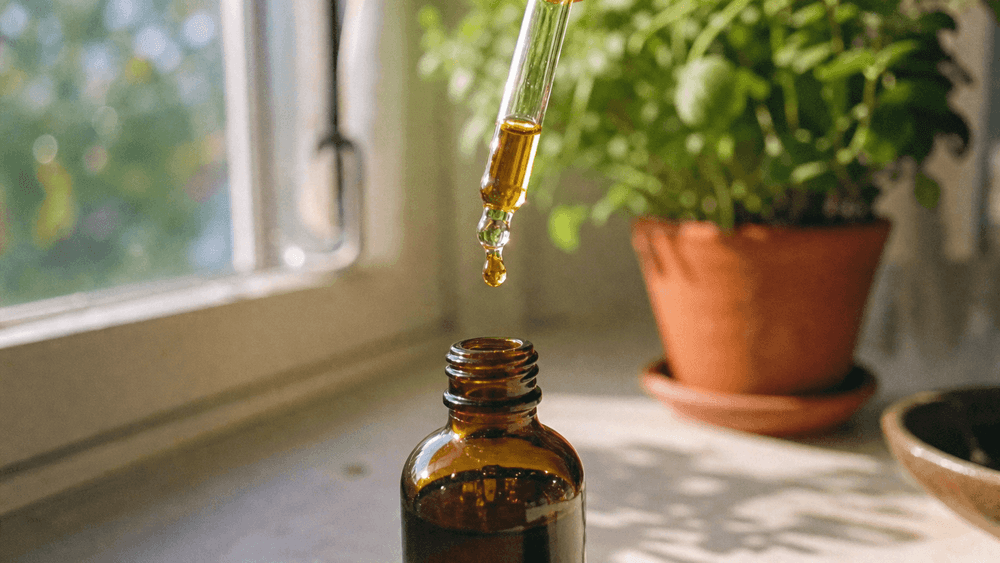
- 3**Hold it under the tongue** for 30 to 60 seconds; expect first effects within 15-45 minutes.
- 4**Run a two-week trial with notes**, the same protocol we lay out in [our everyday stress guide](/blog/cbd-for-stress). Trends beat impressions.
- 5**Verify the COA.** CBG is expensive to make, which gives weak products an incentive to fudge. The lab report should quantify CBG specifically, not bury it in a total.
Questions, answered
No. CBG is non-intoxicating. It binds CB1 receptors only weakly, nothing like THC, and at typical servings produces no high and no fog.
Yes, and most people do exactly that. The pairing is popular enough that combined tinctures exist for it, including ours. The two appear to complement rather than compete.
Scarcity. A mature hemp plant keeps less than 1% CBG, so producers harvest early or grow special cultivars, and either path takes far more plant material per milligram extracted.
It's not the natural first pick. Users describe CBG as alert calm, which suits mornings. For nights, CBD and especially CBN are the cannabinoids people reach for.
The batch COA should list cannabigerol as its own line with a real concentration. A product sold as CBG whose lab report shows only CBD is answering your question for you.
Meet the morning formula
Our full-spectrum CBD+CBG tincture pairs the two cannabinoids with the plant's supporting cast, lab-tested with the COA published on the product page.
Shop CBD+CBGWriting about hemp, wellness and the small rituals that keep us balanced.