What Are Cannabinoids? An Evidence-Led Atlas
A clear map of plant, body-made and synthetic cannabinoids, how CB1 and CB2 fit, what common abbreviations mean, and where the evidence stops.
Cannabinoids are chemical messengers linked by a scientific history, not by one guaranteed effect. The family includes THC, CBD, the signals your own body makes, research compounds, approved medicines and unpredictable street drugs. The useful question is never just whether something is a cannabinoid. It is which compound, from where, in what product, studied how.
In everyday conversation, cannabinoid often means a compound from cannabis. That is a reasonable starting point, but it leaves out other parts of the map. Researchers also use the word for body-made signals that engage cannabinoid receptors and for laboratory-made compounds developed to study or act on the same system. Those categories overlap in pharmacology, yet they are not interchangeable.
This guide stays with classification, mechanisms, evidence boundaries and label literacy. It does not rank compounds by claimed benefit. That choice keeps a durable scientific map separate from health questions that require their own population, formulation and outcome evidence.
The National Center for Complementary and Integrative Health says THC and CBD are the main cannabinoids people know and that more than 100 others have been identified in cannabis. The exact count changes with definitions, analytical methods and new discoveries. A growing number is interesting chemistry, not proof that every newly named compound has a useful human effect.
The three cannabinoid families
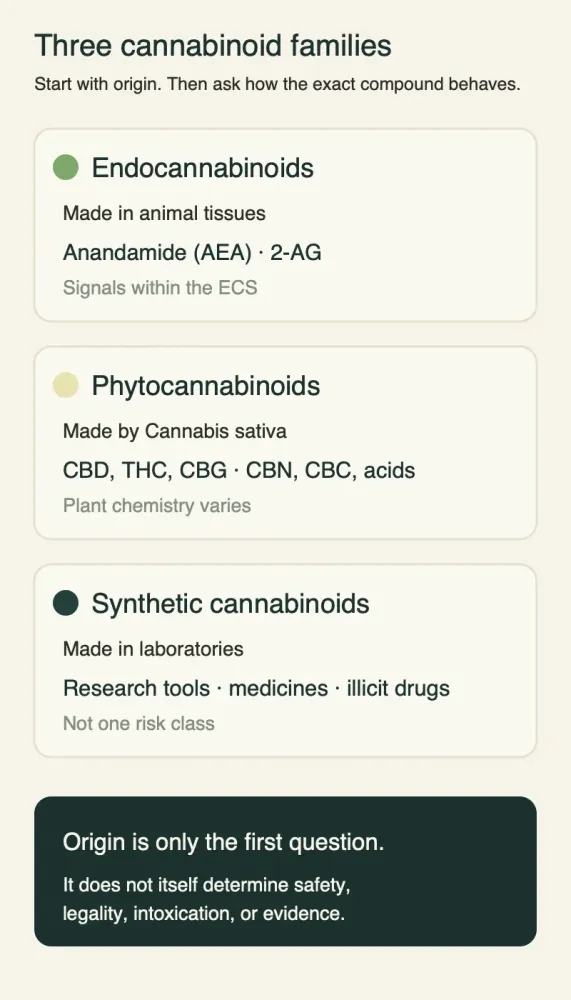
The cleanest first sort is by origin. Phytocannabinoids come from plants, especially Cannabis sativa. Endocannabinoids are lipid signals made within animal tissues. Synthetic cannabinoids are produced in laboratories. This origin map avoids a common category error: calling every cannabinoid cannabis, or assuming every laboratory-made cannabinoid is the same as K2 or Spice.
| Family | Where it comes from | Examples | What the label does not tell you |
|---|---|---|---|
| Phytocannabinoids | Cannabis sativa and related plant chemistry | CBD, THC, CBG, CBC, CBN, cannabinoid acids | Safety, legality, intoxication or benefit |
| Endocannabinoids | Made in animal tissues | Anandamide (AEA), 2-AG | A supplement dose or a wellness effect |
| Synthetic cannabinoids | Made in laboratories | Research ligands, specific medicines, illicit K2 or Spice chemicals | A single potency or risk profile |
Origin is a filing system, not a verdict. A plant-derived compound is not automatically safe. A synthetic compound is not automatically illicit or harmful. A body-made molecule is not automatically a useful supplement. Each compound still needs its own chemistry, exposure, evidence and product context. That simple discipline does more work than a list of claimed benefits ever could.
Why the word cannabinoid is slippery
Definitions moved as the science moved. Researchers first recognized that THC-like compounds produced specific effects. In 1988, William Devane and colleagues reported a specific, saturable binding site in rat brain membranes. In 1990, Lisa Matsuda and colleagues cloned and functionally expressed the brain receptor now called CB1. A second receptor, now called CB2, was cloned from a human cell library in 1993.
The receptor discoveries created a new question: if animals have cannabinoid receptors, what signals normally use them? The 1992 isolation of anandamide from porcine brain and 1995 receptor work on 2-arachidonoylglycerol, or 2-AG, helped answer it. Cannabinoid science was no longer only about a plant. It had become a field of endogenous signaling, receptors, enzymes and structurally diverse ligands.
Even receptor activity is not a perfect one-line definition. The expert-curated IUPHAR/BPS Guide to Pharmacology recognizes CB1 and CB2 as the two established cannabinoid receptors, while also noting that cannabinoid ligands can act at other receptors and channels. CBD is the practical reminder: it belongs to the cannabinoid family, but it does not behave like a simple THC copy at CB1.
Phytocannabinoids: the compounds made by cannabis
Phytocannabinoids are plant-made cannabinoids, and Cannabis sativa is their best-known source. NCCIH discusses cannabinoids and terpenes as separate groups of substances in cannabis. A report that lists a terpene has not therefore identified another cannabinoid.
The plant mostly produces cannabinoid acids first. Fresh plant material may contain CBDA, THCA and CBGA rather than only the neutral abbreviations that dominate product marketing. The letter A in these full names marks an acid form. It is part of the molecule's name, not a quality grade. This atlas avoids calling the neutral form activated because acid-to-neutral conversion describes chemistry, not a clinical ranking.
The plant mostly makes cannabinoid acids first
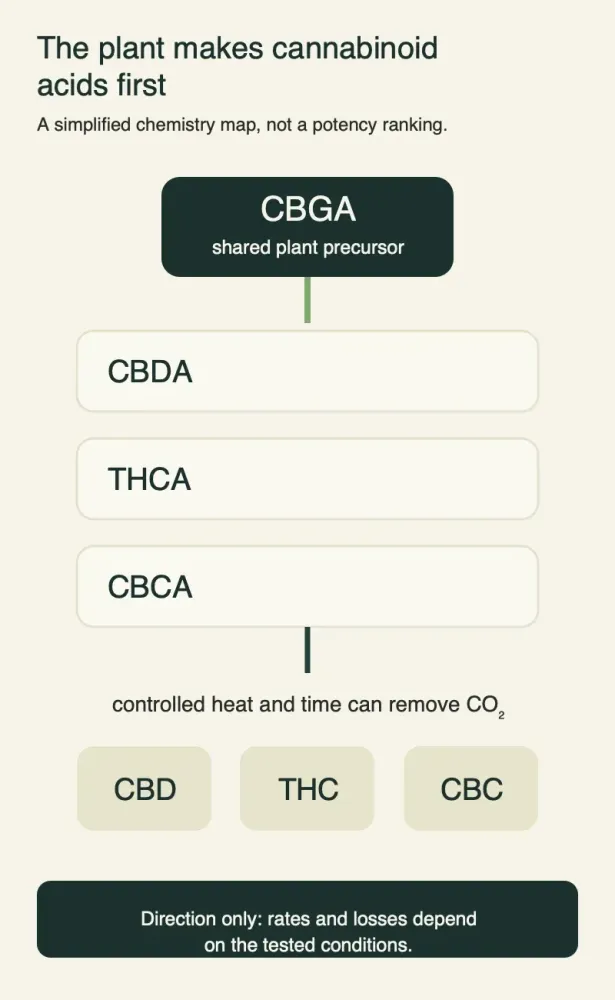
Cannabigerolic acid, CBGA, sits at an important branch in the plant pathway. In a 1996 biochemical study, Taura and colleagues purified CBDA synthase from Cannabis sativa and showed that the enzyme converted CBGA to CBDA. Related plant enzymes can direct CBGA toward THCA or CBCA. That is why CBGA is often called a shared precursor, though the phrase mother cannabinoid can hide the real enzyme chemistry.
Controlled heat and time can remove carbon dioxide from cannabinoid acids in a reaction called decarboxylation. A 2024 primary experiment measured CBDA to CBD, THCA to THC, and CBCA to CBC conversion across specified temperatures and time points. Those pressurized-extraction results support the direction of the arrows, not a universal conversion rate for every plant or product. The study also observed losses and degradation at some conditions, so a real test can show both acid and neutral forms.
This chemistry also explains one specific regulatory calculation. USDA hemp laboratory guidance requires total delta-9 THC testing for covered crop samples to consider the potential conversion of THCA into delta-9 THC and to report measurement uncertainty. That rule is limited to the USDA hemp-testing context. A total THC result is a composition measurement, not a prediction of what a person will feel.
Major and minor cannabinoids are abundance labels
Major and minor sound like rankings, but they are not standardized evidence grades. NCCIH uses minor cannabinoids to mean cannabinoids other than THC in one research description. An analytical discussion may instead be describing abundance in a named sample. This atlas therefore uses lower concentration only when a source or measurement supplies that context.
CBN shows why context matters. In a four-year primary storage study, researchers repeatedly measured six high-THC herbal and resin materials stored under four light and temperature conditions. THC declined and CBN formed under the room-temperature conditions, with light changing the conversion pattern. This supports saying CBN can form as THC-containing material degrades under those tested conditions. It does not make CBN a universal age marker, abundance category, safety grade or effects prediction.
| Name | Plain description | Common relationship | Do not infer from the name |
|---|---|---|---|
| CBD / CBDA | Cannabidiol and its acid form | CBDA can convert toward CBD during processing | A clinical effect for a consumer product |
| THC / THCA | Delta-9 tetrahydrocannabinol and its acid form | THC is the cannabis compound primarily associated with intoxication | Any product with THCA or THC has a predictable effect |
| CBG / CBGA | Cannabigerol and its acid form | CBGA is a branch precursor in plant biosynthesis | CBG is a universal daytime or focus compound |
| CBC / CBCA | Cannabichromene and its acid form | Another branch of CBGA-related plant chemistry | CBC has established human benefit |
| CBN | Cannabinol | Can appear as THC-containing material degrades | CBN is a proven sleep treatment |
| Acid and neutral names | CBDA/CBD, THCA/THC and CBCA/CBC are different chemical forms | Controlled heat experiments can convert an acid toward its paired neutral form | A universal conversion rate or human effect |
The most useful atlas does not force every rare abbreviation into its own benefits profile. It asks whether the compound is securely identified, whether its concentration is meaningful, what model was studied, whether controlled human evidence exists, and whether a finished product matches that evidence. When those answers are missing, unknown is a complete and honest entry.
Endocannabinoids: signals made within the body
Endocannabinoids are not plant compounds stored inside us. They are lipid signaling molecules made by animal tissues. Anandamide, formally N-arachidonoylethanolamine, and 2-AG are the best studied. Their chemistry differs sharply from THC and CBD even though the compounds share parts of the same pharmacological story.
Devane and colleagues isolated anandamide from porcine brain, determined its structure with mass spectrometry and nuclear magnetic resonance, confirmed it by synthesis, and tested receptor-related activity. Sugiura and colleagues later studied 2-AG binding in rat brain membrane preparations. These were discovery experiments in animal tissue and laboratory systems. They did not show that changing anandamide or 2-AG will produce a desired wellness result in a person.
The endocannabinoid system has three working parts
- 1Signals: endocannabinoids such as anandamide and 2-AG are synthesized within tissues.
- 2Receptors: CB1 and CB2 are the two established cannabinoid receptors, with different expression patterns and roles.
- 3Enzymes: biosynthetic and degradative enzymes help make and clear endocannabinoid signals.
This three-part description is more precise than calling the ECS a switch for balance. The discovery and receptor sources establish signals, receptors and laboratory mechanisms. They do not establish that a finished cannabinoid product can create a branded feeling or beneficially control a human outcome.
The detailed receptor, enzyme and tissue story belongs in a dedicated endocannabinoid-system guide. For this atlas, the key point is narrower: the body had cannabinoid signaling before anyone consumed a tincture. Plant and laboratory compounds can intersect with that signaling in different ways, which is why cannabinoid is a family name rather than an effect label.
How cannabinoids can act differently at the same system
A common illustration shows a cannabinoid as a key and CB1 or CB2 as a lock. The image is memorable and incomplete. Some ligands activate a receptor, some block or change its response, some bind weakly, and some act at other molecular targets. The same compound can also produce different results as concentration, tissue, timing and experimental model change.
THC is the clearest consumer example of why compound identity and exposure both matter. The FDA's consumer overview identifies THC as the cannabis component associated with the high. That does not mean any detected amount creates the same experience. Finished-product concentration, route and exposure remain essential.
CBD is the useful counterexample to a simple direct-activation story. In cell-based experiments, Laprairie and colleagues found that CBD reduced several CB1-dependent responses to THC and 2-AG and behaved as a negative allosteric modulator under the tested conditions. That is precise laboratory evidence. It does not prove that CBD reliably cancels THC in people, makes an unknown product safe, or creates a predictable feeling.
The difference matters when reading phrases like interacts with the ECS. That phrase could mean direct receptor activation, allosteric modulation, altered enzyme activity, action at a non-CB receptor, or simply a result observed in a complex model. If a page never names the compound, target, study system and outcome, interacts may be hiding more uncertainty than it explains.
Cannabinoid names are a family tree, not a menu
A cannabinoid abbreviation identifies a compound or chemical form, not a user guide. The primary synthase studies name CBDA, THCA and CBCA as cannabidiolic acid, tetrahydrocannabinolic acid and cannabichromenic acid. Controlled decarboxylation experiments measure those acids separately from CBD, THC and CBC. Those labels do not state the amount present, manufacturing history, human evidence or what a person will experience.
Similar abbreviations can still create false confidence. CBDA and CBD, THCA and THC, and CBCA and CBC must be reported as separate measurements before a stated total is interpreted. Delta-8 THC and delta-9 THC are also distinct names; the FDA's delta-8 notice does not treat them as interchangeable. When a label uses an unfamiliar abbreviation, find the full chemical name, measured concentration and source-specific evidence.
A name also does not prove how a compound entered a finished product. FDA says delta-8 THC occurs naturally only at very low levels and that concentrated amounts are typically manufactured from hemp-derived CBD, sometimes with chemical conversion concerns. That is a documented delta-8 example, not a claim about every cannabinoid or manufacturing process. It shows why identity, concentration and production context are separate questions.
Cannabinoids, cannabis, hemp and marijuana are not synonyms
A cannabinoid is a compound category, while Cannabis sativa is a plant. Hemp and marijuana are also legal terms whose meaning depends on the rule and date being applied. NCCIH explains that cannabis and marijuana are not exact synonyms. This chemistry atlas does not determine legality under federal or state law.
Federal wording is time-sensitive. At this article's July 19, 2026 cutoff, the existing federal definition still applies, but Congress has enacted a revised hemp definition that takes effect on November 12, 2026. The Congressional Research Service reports that the revision changes the definition to total THC, including THCA, and excludes some hemp-derived cannabinoid products. State rules, FDA status and product facts remain separate questions.
Hemp-derived also does not mean non-intoxicating. FDA states that concentrated delta-8 THC is typically manufactured from hemp-derived CBD and that delta-8 THC has psychoactive and intoxicating effects. This supports a narrow warning about delta-8, not a legal or safety conclusion for every hemp product. The exact compound, measured batch composition, date and applicable rule still matter.
Synthetic cannabinoids are not one category of risk
Synthetic cannabinoid can describe a carefully characterized research tool, an active ingredient in a regulated medicine, or an illicit chemical sprayed onto plant material. Those contexts share laboratory manufacture, not quality control, dose, legal status or safety. Treating them as one substance is like treating every laboratory-made pain medicine and every counterfeit pill as the same product.
Some synthetic ligands were built to reveal how CB1 and CB2 work. Specific cannabinoid medicines have also passed product-specific review for defined indications. That approval belongs to the exact ingredient, formulation, dose, manufacturing controls and use. It does not transfer to cannabis, CBD as a broad category, or a retail tincture.
Illicit products sold as K2 or Spice are a different safety problem. The CDC's cannabis FAQ says these man-made chemicals are not cannabis or cannabinoid medicines, may have unpredictable contents, and can cause dangerous health effects. Synthetic marijuana is therefore a misleading nickname. Dried leaves may be the carrier, but the active chemicals and risk profile are not a standardized version of the cannabis plant.
What a label and COA can actually tell you
A product label may name cannabinoids or use spectrum terminology, but front-label words do not replace product-specific measurement. A certificate of analysis, or COA, reports results for the sample a laboratory tested. NIST's cannabis laboratory program shows why the method, reported analytes, units and calculation choices matter when comparing cannabinoid measurements.
The step-by-step COA guide explains that verification process. For an atlas reader, two boundaries matter. A reported result is tied to the sample, method and reporting limit, and a measured cannabinoid does not by itself establish a human effect. FDA has also found products whose tested CBD levels did not match their claims, which is why a category word cannot replace batch evidence.
This atlas does not assign a universal composition to full spectrum, broad spectrum or isolate. Our spectrum terminology guide explains those label conventions, but the exact finished-product claim still needs its own batch measurement. Neither a spectrum term nor the presence of several compounds proves synergy or a health effect.
- Match the COA batch or lot number to the exact product.
- Read acid and neutral cannabinoid rows separately before relying on a total.
- Check units carefully. Percent, milligrams per gram and milligrams per milliliter are not interchangeable.
- Look for reporting limits before interpreting not detected.
- Keep composition claims separate from effect, safety and legal claims.
A cannabinoid claim needs an evidence address
Cannabinoid marketing often compresses an entire evidence ladder into one sentence. A compound activates a receptor in cells, an animal study reports a change, and the product page ends with supports sleep or promotes recovery. Each step may be real while the conclusion is still unsupported. The missing information is the address of the evidence.
| Evidence level | What it can answer | What it cannot establish alone |
|---|---|---|
| Receptor or cell assay | Whether a compound changes a measured molecular or cellular signal under test conditions | A useful dose, a human benefit or finished-product effect |
| Animal study | How a compound behaves in a whole-organism model | That humans will experience the same outcome |
| Controlled human study | What happened in the studied people, formulation, route, exposure and duration | A class-wide result for other products and populations |
| Approved medicine | That one product met the applicable standard for defined use and labeling | Approval of cannabis or consumer cannabinoid products as a class |
| Finished consumer product | Its measured batch composition and, when studied, product-specific outcomes | Benefits borrowed from another molecule, dose or formulation |
This is why a study of purified prescription CBD does not automatically substantiate a full-spectrum consumer oil. It is also why a paper on THC, a synthetic receptor agonist or an isolated cell line cannot be cited as if it tested CBG, CBN or a retail blend. Cannabinoid is a family relationship, not an evidence bridge.
A strong claim names the compound, study design, population or model, formulation, route, exposure, comparator, duration and outcome. It also says what was null, uncertain or not measured. That sounds slower than a benefits list because it is. The extra friction is what keeps interesting chemistry from becoming an accidental medical promise.
What the cannabinoid atlas still cannot answer
A complete atlas includes blank spaces. This dossier does not contain controlled human evidence for the less-familiar phytocannabinoids in the naming table, so the article assigns them no human effect. Even when human evidence exists for a cannabinoid, the FTC requires the evidence to fit the studied formulation, route, exposure, population and outcome before it can support a product claim. A family name cannot supply that missing applicability.
Combination claims are an especially large blank space. Finding several cannabinoids in one extract does not establish that they produce synergy, and a receptor experiment cannot prove an entourage effect in a finished product. A defensible combination claim would need the exact mixture, comparator, measured outcome and appropriate human evidence. Without that, the accurate description is composition: the compounds were present together.
Long-term safety also cannot be assigned to the cannabinoid family as a whole. The FDA identifies open questions and known concerns around unapproved CBD products, while the CDC warns about dangerous illicit synthetic cannabinoids. Those sources cover different compounds and contexts. Neither supports the opposite shortcut that one natural or non-intoxicating label makes every amount and product safe.
Finally, taxonomy cannot choose a product, diagnose a problem or replace a clinician, pharmacist, toxicologist or lawyer. It can make the next conversation more precise. Bring the full compound name, product form, batch report, amount used, timing, other substances and the exact question. Precision is not evasive here. It is the difference between discussing cannabinoid science and borrowing certainty from the word cannabinoid.
How to use this cannabinoid atlas
Start with the family. Is the term plant-made, body-made or laboratory-made? Then identify the exact molecule and form. CBD and CBDA are related names, not substitutes. Delta-9 THC and THCA are related, but processing and exposure matter. CBN is not simply sleep THC. A converted or synthetic intoxicant needs its own identity and safety record.
Next, locate the evidence. A COA answers composition. A receptor assay answers a molecular question. A controlled trial answers a narrow human question. An FDA label answers how an approved product must be used and described. None of those documents answers every question, and a brand page should not pretend they do.
Finally, follow the right branch. For a focused introduction to one compound, use the CBD guide. For the difference between purified CBD and a finished product's intoxication risk, read does CBD get you high?. For a bottle in hand, move from the front label to the batch COA. The atlas should shorten the path to a precise question, not offer one answer for every cannabinoid.
Keep dates beside sensitive answers. Compound identity is durable, but product rules, analytical methods, approved labeling and the evidence base can change. A useful atlas records when official guidance was checked and has a reason to return when nomenclature, safety communication or a key study changes. Freshness is not a new date on old copy. It is a documented review of the facts that could have moved.
Questions about cannabinoids
Cannabinoids are a broad family of signaling compounds. Some come from cannabis, some are made inside animal tissues, and some are made in laboratories. They do not all have the same effect.
Yes. CBD, or cannabidiol, is a phytocannabinoid made by Cannabis sativa. It belongs to the cannabinoid family but does not behave like THC at CB1 receptors and does not carry THC's primary intoxication role.
CBD is one cannabinoid. Cannabinoids is the larger family that includes THC, CBG, CBN, CBC, cannabinoid acids, body-made signals such as anandamide and 2-AG, and many laboratory-made compounds.
No. FDA identifies delta-8 THC and delta-9 THC as intoxicating, while CDC says CBD does not cause a high by itself. Other plant-made, converted and synthetic compounds need individual evaluation, so a cannabinoid name alone cannot answer the question.
NCCIH says more than 100 cannabinoids beyond the best-known CBD and THC have been identified. Exact totals vary because researchers use different definitions, separate acids from neutral forms, identify trace compounds and revise structures as analytical methods improve.
Endocannabinoids are lipid signals made within animal tissues. Anandamide and 2-AG are the best studied. They are part of the endocannabinoid system with CB1 and CB2 receptors and the enzymes that make and clear the signals.
Minor is not a standardized evidence grade. NCCIH uses the term for cannabinoids other than THC in one research description, while analytical discussions may refer to abundance in a named sample. The label alone does not establish safety, effect or evidence maturity.
No. NCCIH discusses terpenes and cannabinoids as separate groups of substances found in cannabis. A report may list both, but measuring one group is not evidence that the other was measured.
No. Synthetic cannabinoid is a broad laboratory-origin category. It includes research compounds and specific medicines as well as dangerous illicit chemicals sold as K2 or Spice. Those products are not standardized synthetic cannabis.
Writing about hemp, wellness and the small rituals that keep us balanced.