THCP vs CBD: Where the 33x Number Comes From, and What It Does Not Mean
The 33x everyone repeats about THCP is real, and it is in the 2019 discovery paper. It is also a ratio of binding affinities measured in duplicate on purified receptors, against a delta-9-THC value the authors quoted from other papers. Here is what has actually been published.

THCP is delta-9-THC with a longer tail. The number attached to it everywhere, 33 times, is real, it is printed in the 2019 paper that found the molecule, and it does not mean what most pages repeating it say it means. It is a ratio of binding affinities measured in a tube, against a delta-9-THC value the authors took from other people's papers rather than from the same experiment. That distinction is this whole article.
Almost nobody looking up THCP wants a binding constant. They want to know two things: how strong is it, and is it safe. As of August 16, 2026, nobody has measured the first in a person and nobody has run the study that would answer the second. That is not our editorial opinion. A peer-reviewed paper published in July 2024, a study comparing CBD with its own seven-carbon homolog, states in its introduction that "the human effects of delta-9-THCP have not been studied", and our own dated searches, printed further down with their queries so you can re-run them, return the same picture. What does exist is one discovery paper, a mouse experiment inside it, a handful of chemistry and forensic studies, one survey and one case report. This page walks through all of it and stops where the evidence stops. (The papers write the molecule with a Greek delta; we spell it out as delta-9 throughout, including inside quotations, and change nothing else.)
What is THCP?
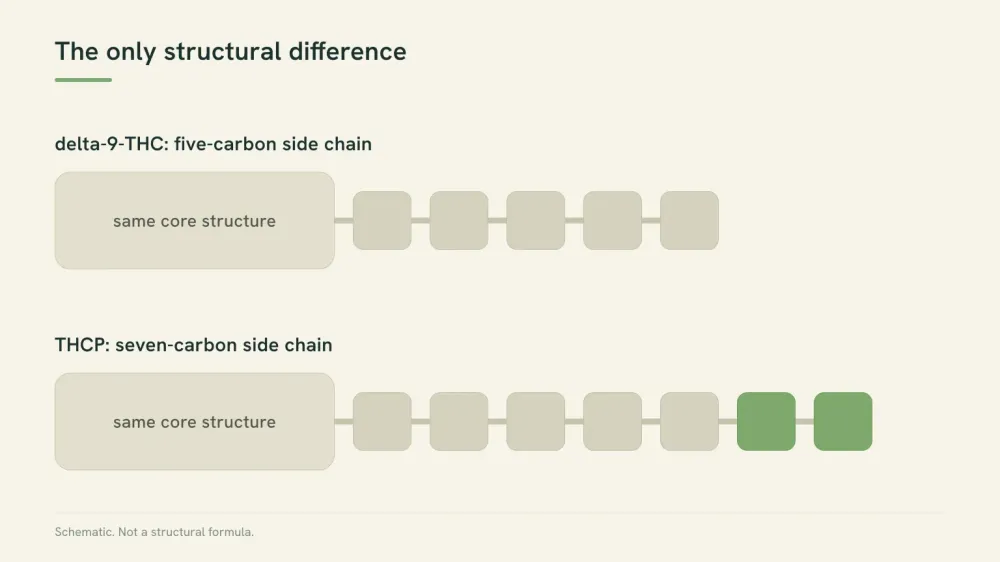
THCP is short for tetrahydrocannabiphorol. Structurally it is delta-9-THC with one change: the alkyl side chain hanging off the ring system is seven carbons long instead of five. Cinzia Citti and colleagues isolated it in 2019 from FM2, an Italian medicinal cannabis variety, and confirmed the structure by nuclear magnetic resonance, circular dichroism and stereoselective synthesis. The paper is open access in Scientific Reports and it is worth having open while you read the rest of this page. The "P" is not a potency grade or a generation number. Phytocannabinoids are traditionally named after the resorcinyl residue in their structure, and the paper says the name is "derived from the traditional naming of phytocannabinoids based on the resorcinyl residue, in this case corresponding to sphaerophorol". The same paper isolated CBDP, the seven-carbon version of CBD, from the same extract, which becomes important later. THCP is also not THCA: THCA is the acid form of ordinary delta-9-THC and its story is heat, which is why the acid forms and what decarboxylation does get their own page. If you want to see where all these molecules sit relative to one another, start with the wider map of the cannabinoid family.
Long-chain THC homologs are not new chemistry either. Synthetic analogs with lengthened side chains were made and tested for cannabis-like activity in the Adams series in the 1940s (Adams R, Loewe S, Smith CM, McPhee WD, J Am Chem Soc 1942;64:694-697, doi 10.1021/ja01255a061), a history that both the 2019 paper and the 2024 CBDP study record. What 2019 added was not the idea of a seven-carbon cannabinoid. It was finding one growing in a plant.
Where the 33x number actually comes from
Start with the abstract, because that is the part most summaries read. Verbatim: "The binding activity of delta-9-THCP against human CB1 receptor in vitro (Ki = 1.2 nM) resulted similar to that of CP55940 (Ki = 0.9 nM), a potent full CB1 agonist." That is an absolute measurement compared against a synthetic research chemical. There is no 33 in it. The multiplier lives one section further in, in the Results, and there it is printed with its comparator: "(-)-trans-delta-9-THCP resulted 33-times more active than (-)-trans-delta-9-THC (Ki = 40 nM), 63-times more active than (-)-trans-delta-9-THCV (Ki = 75.4 nM) and 13-times more active than the newly discovered (-)-trans-delta-9-THCB (Ki = 15 nM) against CB1 receptor." So the number is real, it is the authors' own, and the unit of the claim is "more active" in a binding assay. The full text is linked in the section above; open it and search the Results for "33-times". It takes about a minute and it is the entire basis of a claim that has been repeated across an industry.
Now read the end of that sentence in the original. It carries reference markers 12 and 14, which means the delta-9-THC value of 40 nM was not produced in this experiment. Reference 12 is the same group's own paper on delta-9-THCB, the four-carbon butyl homolog. Reference 14 is a 2016 review of the structure-function relationships of classical cannabinoids, that is, a summary of other people's measurements. The authors make the point themselves in the Discussion, and this is the single most useful sentence available on this topic: their assay "indicated an affinity for CB1 receptor more than thirty-fold higher compared to the one reported for delta-9-THC in the literature". Compared to the one reported in the literature. That is not an error and it is not a criticism, because comparing a new measurement against published values is ordinary practice and the paper is transparent about doing it. It is simply a different claim from "we ran both molecules through the same assay on the same day and one came out 33 times the other", which is what the popular version of this number sounds like.
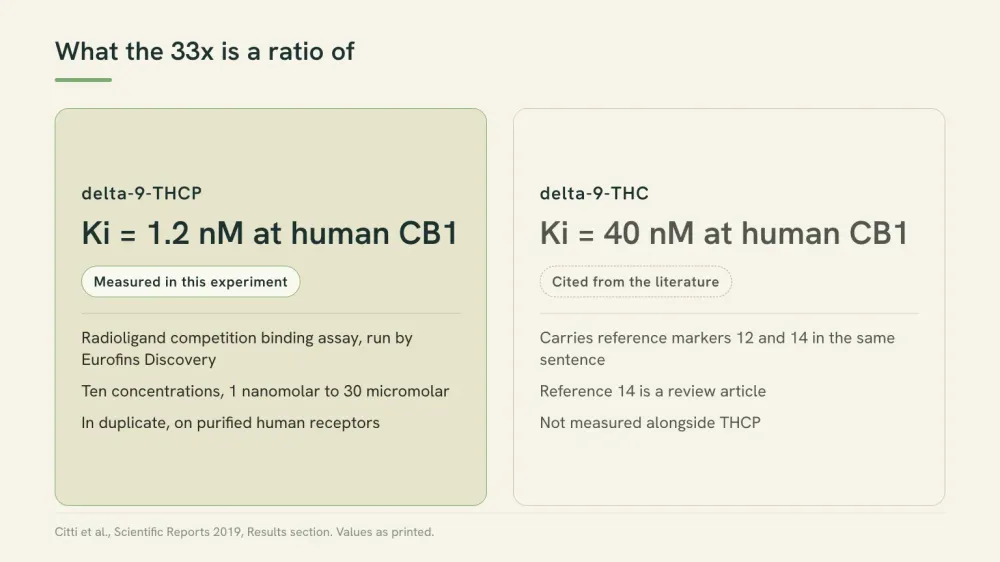
The assay itself is nameable, which is the part no page repeating the multiplier bothers to print. The binding affinity of THCP against human CB1 and CB2 was assessed by Eurofins Discovery in a radioligand competition binding assay. Ten concentrations of the compound, from 1 nanomolar to 30 micromolar, were tested in duplicate. The radioligands were tritiated CP55940 for human CB1 and tritiated WIN 55212-2 for human CB2, and the receptors were purified human CB1 and CB2. Duplicate wells and purified receptor preparations: no cells, no animals, no people. The values themselves are not in dispute, either. The 2024 CBD-versus-CBDP paper restates them in its own introduction, quoting Ki = 1.2 nM for delta-9-THCP and 40 nM for delta-9-THC and noting the similarity to CP55940 at 0.9 nM. Two independent documents, same numbers. It is the interpretation, not the measurement, that has drifted.
| Compound | Human CB1 Ki as printed | Human CB2 Ki as printed | Where the CB1 value came from |
|---|---|---|---|
| (-)-trans-delta-9-THCP | 1.2 nM | 6.2 nM | Measured in this experiment |
| (-)-trans-delta-9-THCB (butyl, 4 carbons) | 15 nM | Not given separately; inside a 36 to 63 nM band | Cited from the literature (refs 12, 14) |
| (-)-trans-delta-9-THC (5 carbons) | 40 nM | Not given separately; inside the same band | Cited from the literature (refs 12, 14) |
| (-)-trans-delta-9-THCV (propyl, 3 carbons) | 75.4 nM | Not given separately; inside the same band | Cited from the literature (refs 12, 14) |
| CP55940 (synthetic reference full agonist) | 0.9 nM | Not given in this comparison | Quoted in the abstract as the comparator |
Binding affinity is not the same thing as potency
Ki answers exactly one question: how tightly does this molecule occupy that receptor, before anything else happens. It says nothing about what the receptor does once occupied. Two molecules can sit in the same pocket and produce very different consequences, which is why pharmacologists keep affinity (how tightly it binds) and efficacy (how much of a response it produces) as separate measurements with separate units. The reference database the field maintains, the IUPHAR/BPS Guide to Pharmacology, records delta-9-THC at human CB1 as a partial agonist with a pKi of 7.3 to 7.4, and CP55940, the comparator in that abstract, as a full agonist at 8.3 to 9.2. Partial and full are different kinds of switch, not different sizes of the same switch. If the receptor side is new to you, how CB1 and CB2 actually work covers it properly, including how to read an affinity figure when a page gives you one.
Somebody has measured activation rather than binding. A 2024 study in Archives of Toxicology ran a panel of 30 THC isomers, homologs and analogs through a beta-arrestin2 recruitment assay and reported that several of them, THCP among others such as THCH, THC-C8, HHC and HHCP, showed "higher potential for CB1 activation than delta-9-THC, based on either higher efficacy (Emax) or higher potency (EC50)". That is cells in a plate, and the authors frame the work around the harm potential of seized drugs rather than around consumer wellness. We are not printing a compound-specific number from it, because the full text is not open access and we did not read it, and a number we have not read is not a number we will put on a page. Then there is a checkable absence. We searched the Guide to Pharmacology's ligand database for tetrahydrocannabiphorol, for THCP and for phorol on August 16, 2026, and all three returned no ligands found. Delta-9-THC has an entry there. CP55940 has an entry there. The molecule being sold as 33 times stronger does not.
The in-vivo evidence in the discovery paper is four measurements in five mice per group
The 2019 paper did not stop at the binding assay, and this is the part of it worth knowing. It ran the cannabinoid tetrad, the standard four-endpoint screen for THC-like activity in rodents: male C57BL/6 mice weighing 18 to 20 g, dosed intraperitoneally at 2.5, 5 and 10 mg/kg, with five mice per dose group, analysed by Kruskal-Wallis with Dunn's post hoc test. THCP produced reduced movement in the open field, catalepsy on the bar test, a reduced pain response on the hot plate and a drop in rectal temperature, with p values from 0.0009 to 0.0051. The authors' own summary of that result is "a THC-like cannabimimetic activity". THC-like. Not 33 times THC.
The paper's own in-vivo comparison against THC is a dose observation in those same mice, five per group and injected into the abdominal cavity, and it is worth quoting exactly because it is routinely inflated on the way to a blog post: "delta-9-THCP proved to be as active as delta-9-THC but at lower doses. In fact, the minimum THC dose used in this kind of test is 10 mg/kg, whereas delta-9-THCP resulted active at 5 mg/kg in three of the four tetrad tests." That is an assay designed to detect whether a compound is cannabinoid-like at all rather than to grade how strong it is. We are not going to turn that into a multiplier, and nobody should map a milligram-per-kilogram figure in a mouse onto a person. The 2024 paper quoted at the top of this article describes that experiment as "the only report on the in vivo activity of delta-9-THCP", and in the same passage states that "the human effects of delta-9-THCP have not been studied".
Here is our own census, so you do not have to take that on faith. Run through the NCBI E-utilities API on August 16, 2026: a PubMed search for "tetrahydrocannabiphorol" returns 17 records, and the same term restricted to clinical trial or randomized controlled trial publication types returns zero. None of the 17 is an interventional study in people; they are the discovery paper, two plant-content measurements, seven analytical or forensic papers, a receptor-activity study, the CBD-versus-CBDP study, one consumer survey, one case report, one in-vitro neuronal model and a microbial biosynthesis review. The ClinicalTrials.gov API returns zero registered studies for tetrahydrocannabiphorol; a search for "THCP" returns exactly one, and that one is a point-of-care lung ultrasound study with a colliding acronym.
"Natural" is true about the molecule and mostly untrue about the product
THCP does occur in cannabis. It occurs in quantities that make a product story impossible. In the FM2 extract where it was first identified, the semi-quantitative estimate was about 29 micrograms per gram of THCP and about 243 micrograms per gram of CBDP, against about 39 milligrams per gram of delta-9-THC and about 56 milligrams per gram of CBD in that same extract. Read the units in those two pairs before you read the numbers, and note that this was one ethanolic extract of one variety, estimated semi-quantitatively. A 2021 screen in the Journal of Natural Products put a firmer number on it: THCP was quantified in all 13 inflorescence samples from THC-dominant chemotypes at 0.0023% to 0.0136% by weight and was not detected in a CBD-dominant chemotype, with the authors noting it may be more prevalent than previously estimated. A 2021 study in Talanta then synthesized the acid precursors as reference standards and ran a targeted analysis across 49 cannabis accessions representing four chemotypes.
You cannot extract commercially meaningful amounts of a compound present at hundredths of a percent. So what is sold is made. A 2024 review describes the market that grew after the 2018 Farm Bill as an unregulated designer drug market built on cannabidiol-derived cannabinoids, naming "novel cannabinoids, likely produced via fully synthetic routes using sidechain variants of CBD, with purportedly greater agonist activity at the human cannabinoid receptor 1 ... than delta-9-THC", and flagging "the unlabeled presence of under-researched cannabinoids formed as reaction side products". We are not going to re-derive that chemistry here: what an acid-catalyzed conversion of CBD actually does is covered on the delta-8 page, along with what laboratory analysis finds in the finished goods. One THCP-specific data point does belong here. A 2025 chemical analysis of eight products bought online, seven oils and one herbal product, identified ten compounds including delta-9-THCP acetate and a THCP butanoate ester, alongside their synthetic by-products. Eight products, one laboratory, a non-US market: that is a demonstration, not a prevalence estimate. The field cannot even agree what to call this category, which is its own tell; a 2023 commentary argues for "derived psychoactive cannabis products" as the accurate umbrella term for delta-8, delta-10, HHC, THC-O, THCP and THCV.
What has actually been reported in people
One published report describes what happened to one person. A 2025 case report in PCN Reports, n = 1, describes a 41-year-old man who took a single oral THCP gummy bought at a dispensary. Psychotic symptoms began roughly an hour later and lasted about 48 hours; he described feeling detached from himself and became convinced he was already dead. Roughly two days after taking it, he was brought to an emergency department with a self-inflicted stab wound. The confounders are in the paper and they belong in any honest summary of it: he had also had one alcoholic drink, he was a regular user of cannabis products, he had no history of psychosis, and he had had a self-harm episode five years earlier. His symptoms cleared after a single dose of haloperidol and he declined further oral antipsychotic medication. He told the clinicians he did not know the product was different from delta-9-THC.
A case report is the weakest design in medicine for showing that one thing caused another, and it is also how most drug safety signals in history first became visible. Both of those sentences are true at the same time, and reading only one of them is how this literature gets misrepresented in both directions. What this report does not show is that THCP causes psychosis: one person, one exposure, several confounders and no comparison group cannot show that. What it also does not show is that THCP is safe, because a literature of 17 records with no controlled trial has not looked hard enough to find out. The authors' own conclusion is the sourced reason this page publishes no amount of anything: "there is even more limited information on the dosing of delta-9-THCP. This lack of dosing guidance may place patients at risk because the effects from THC do not equate to the effects from delta-9-THCP."
If a child swallows any cannabinoid product, call Poison Help at 1-800-222-1222 (free, 24 hours a day, US) with the package in your hand, or 911 if the child cannot be woken or is struggling to breathe. That number and the reason concentrated hemp products belong behind a latch get a fuller treatment in our article on why concentrated hemp products belong out of reach of children. On the federal side, the government has published numbers for the closest documented analogue and none for THCP. The FDA's consumer update on delta-8 THC reports 104 adverse event reports involving delta-8 THC products between December 1, 2020 and February 28, 2022, 55% of which required intervention or hospital admission, and 2,362 delta-8 exposure cases logged by national poison control centers between January 1, 2021 and February 28, 2022, 41% of them in patients under 18, including one pediatric death. Every one of those figures is about delta-8, not THCP, and both reporting windows closed in February 2022; we last read that page on August 16, 2026.
Beyond the case report, two datasets tell you something about circulation rather than about effects. A 2026 cross-sectional online survey of 229 US adults reporting past-year cannabis use found that 44.5% had used at least one semi-synthetic cannabinoid in the past year, with 24.4% reporting tetrahydrocannabiphorol, the highest of the six compounds the survey asked about and ahead of delta-8-THC at 21.8%, and reports that "adverse effects were reported across all semi-synthetic cannabinoids". In this sample: 229 people who already use cannabis, self-reporting, recruited online. That is not population prevalence and it is not a rate of harm. On the supply side, a forensic review of cannabis products seized in Eastern Denmark between 2018 and 2023 found semi-synthetic cannabinoids in 15% of samples (n = 216), led by HHC at about 10%, with HHCP and THCP each appearing in about 1%, and found a semi-synthetic cannabinoid in 56% of the seized e-cigarette products. Denmark, seized material, a six-year window: not the US retail shelf.
So is there a super-CBD? What happened when they tested CBDP
This is the question the 33x story sets up and nobody follows through on. Citti's 2019 paper isolated CBDP, the seven-carbon homolog of CBD, from the same extract as THCP, and did not test its pharmacology. In July 2024 a group did, in the paper quoted at the top of this page: radioligand binding plus beta-arrestin recruitment and receptor internalisation assays in cell lines, at concentrations up to 12 micromolar, across CB1, CB2, 5-HT1A and D2S receptors. Their conclusion, verbatim: "In contrast to what has been observed for THC and THCP, the heptyl chain of CBDP does not improve the reported activities of CBD at the CB1, CB2, 5HT-1A, or D2S receptors." CBD was in fact a slightly more potent CB2 antagonist than CBDP (p < 0.05), neither compound reached a half-maximal value at CB1, CB2 or 5-HT1A within the concentrations tested, and both were significantly weaker than the reference antagonists. The lengthening trick that transforms THC's receptor affinity does nothing comparable for CBD. That work was done in cells, not in people, and the authors describe it as the first publication to investigate CBDP's receptor activity in vitro, so it should be read as a first result rather than a settled one. A PubMed search for cannabidiphorol on August 16, 2026 returns six records in total, which is the size of the file on this molecule. The same paper reports one unexpected in-vitro observation involving the mu-opioid receptor plus a docking model, unreplicated, which the authors themselves file under avenues for future research; we mention it so you know it is there, and we are building nothing on it.
That is a comparison of two molecules, not a recommendation about either. CBD is not on the same axis as THCP, and this page is not making a safety claim about anything we sell: why CBD does not produce a high and how CBD and delta-9-THC differ at the receptor cover that ground on their own terms, with their own limits stated.
Where THCP sits in the law, as of August 2026
This section is dated on purpose, it is not legal advice, and it will need rereading. Federal law is changing. Public Law 119-37, section 781, enacted on November 12, 2025 and effective on November 12, 2026, redefines hemp around "a total tetrahydrocannabinols concentration (including tetrahydrocannabinolic acid) of not more than 0.3 percent on a dry weight basis", and its exclusions reach cannabinoids that are "not capable of being naturally produced by a Cannabis sativa L. plant" as well as cannabinoids that are capable of it but are "synthesized or manufactured outside the plant". Whether a particular THCP product falls inside or outside that language is not something we can tell you, and anyone telling you confidently today is guessing: the provision is pending rather than in force, and FDA has not yet published the cannabinoid lists the section requires. The definition itself, the total-THC arithmetic and what actually changes on that date are covered on the statutory definition of hemp and the total-THC arithmetic; the federal-versus-state layer and what happens when you travel live on the hub covering how federal and state rules interact.
One more document is worth knowing about, for what it shows rather than for what it decides. On May 4, 2026, DEA published a final rule creating a specific schedule I listing for hexahydrocannabinol, reasoning that HHC "is a schedule I controlled substance in the United States under drug code 7370 because it meets the definition of tetrahydrocannabinols, a schedule I hallucinogen". That rule is about HHC. We are not extending an agency's reasoning from one molecule to another, because that is a lawyer's job and not a blog's. The narrow, checkable points are these: "hemp-derived" is not self-executing, and a Federal Register full-text search for "tetrahydrocannabiphorol" run on August 16, 2026 returned no scheduling rule naming it.
What nobody has measured
- No controlled human study of THCP of any design appears in PubMed as of August 16, 2026, and no study of it is registered on ClinicalTrials.gov.
- No entry for the molecule in the IUPHAR/BPS Guide to Pharmacology, the field's reference database, on the same date. Delta-9-THC has had one for years.
- Nothing published on onset, duration, tolerance, dependence, withdrawal, or interactions with prescription medicines. Anyone answering those questions is extrapolating from THC.
- No human pharmacokinetics at all: how much is absorbed, how long it stays, what the body turns it into.
- We found no published US retail survey comparing THCP product labels against contents. The product analyses that exist were run on eight products bought online in a non-US market and on material seized in Denmark.
- No long-term follow-up of anyone who uses it, on any endpoint.
Two things have been measured, and both are narrower than they sound when a summary picks them up. In a 2022 analytical study, tetrahydrocannabiphorol cross-reacted with a THC direct ELISA in whole blood at 0.5%, against 200% for delta-8-carboxy-THC, 25% for delta-9,11-THC, 13% for delta-10-THC and 3% for THC-O-acetate. That is one forensic kit run on whole blood, it is not a workplace urine screen, and it supports no prediction about any individual's test result; what a workplace panel actually screens for is a different question with a different answer. And in a 2026 in-vitro study of alkyl chain length and metabolism, pooled human liver microsomes metabolized delta-9-THCB, delta-9-THCH and delta-9-THCP into hydroxylated and carboxylated products similar to those delta-9-THC produces. That is an analytical finding about which molecules a laboratory should look for, generated in a tube, and it says nothing about anyone's liver.
Questions people actually ask
Phorol, from sphaerophorol. Phytocannabinoids are traditionally named after the resorcinyl residue in their structure, and the 2019 discovery paper says so explicitly when it explains the name. The letter is not a potency grade, a generation number or a product tier, even though it is frequently read as one.
The number is real and it is printed in the discovery paper, but it describes binding affinity, not strength. It is a ratio between a Ki of 1.2 nM measured for THCP in an in-vitro radioligand assay, run in duplicate on purified human receptors, and a delta-9-THC value of 40 nM the authors took from the existing literature rather than from the same experiment. The paper's own living evidence is a mouse tetrad with five animals per dose group, and the authors described that result as THC-like. How strong it is in a person has not been measured.
The molecule does occur in cannabis. One 2021 quantitative screen found it in all 13 inflorescence samples from THC-dominant chemotypes at 0.0023% to 0.0136% by weight and did not detect it in a CBD-dominant chemotype, and in the extract where it was first identified the semi-quantitative estimate was about 29 micrograms per gram. Those quantities are far too small to extract commercially, so THCP products are manufactured from other cannabinoids rather than harvested. Our delta-8 article covers how that class of conversion reaction works and what analysis finds in the products it makes.
No. THCA is the acid form of ordinary delta-9-THC, and its story is decarboxylation, heat converting the acid into the neutral molecule. THCP is a different molecule: the same core structure as delta-9-THC but with a seven-carbon side chain instead of five. Our THCA article covers the acid forms and the certificate-of-analysis line they appear on.
The published record on this is one analytical study, and it measured 0.5% cross-reactivity between tetrahydrocannabiphorol and a THC direct ELISA in whole blood, a forensic setting. That is not a workplace urine screen, and cross-reactivity in one kit and one sample type does not predict any individual result. No detection window for THCP in urine has been published. Our drug-test article covers what workplace panels are actually built to find.
That question does not have a clean answer today. Public Law 119-37, section 781, enacted November 12, 2025 and effective November 12, 2026, rewrites the federal hemp definition around total tetrahydrocannabinols and excludes cannabinoids synthesized or manufactured outside the plant; FDA has not yet published the lists that section requires, so its scope is not knowable yet. Separately, a Federal Register full-text search on August 16, 2026 returned no DEA scheduling rule naming tetrahydrocannabiphorol, while DEA has published one for hexahydrocannabinol. State law varies, and none of this is legal advice. Our hemp and marijuana article tracks the statutory side.
Yes: CBDP, the seven-carbon homolog of CBD, isolated in the same 2019 paper. When its receptor activity was finally tested in 2024, the conclusion was that the heptyl chain of CBDP does not improve the reported activities of CBD at the CB1, CB2, 5HT-1A or D2S receptors. The side-chain change that transforms THC's binding affinity does not do the same thing to CBD. That work was done in cells rather than in people, and its authors describe it as the first publication to test CBDP's receptor activity in vitro, so treat it as a first answer rather than a final one.
Where to go from here
If you take one thing from this page, make it a habit rather than a conclusion. The discovery paper is linked above, it is open access, and the Results paragraph that contains the famous number takes a minute to read. Almost nobody who repeats the number has done that, which is why the assay, the duplicate wells and the cited comparator dropped out of the story somewhere between the journal and the product description. If your real question is about the law, the two pages to read next are what changes in the federal hemp definition on November 12, 2026 and the legal hub covering federal rules, state rules and travel. If it is about the regulator's posture toward cannabinoid products generally, what the FDA has actually said about CBD collects it in one place.
Writing about hemp, wellness and the small rituals that keep us balanced.