CBD vs THC: The Difference, and How Much THC Is Actually in CBD Oil
CBD and delta-9 THC are isomers: same formula, one closed ring apart. Most explainers stop at the pharmacology. This one converts 0.3% into milligrams, shows the Total THC row on a real batch report, and explains why non-detected is not a zero.
CBD and THC are the same handful of atoms arranged two different ways. That is the honest one-sentence answer to CBD vs THC, and it is roughly where every article on this question stops. The thing most people are actually trying to find out is narrower: how much THC is in the bottle in my hand? On one of our own full-spectrum batches the answer is 136 mg across 60 mL, about 0.11 mg in a drop. This page shows you where that number comes from, and how to find the equivalent number on any product's lab report. Information current as of August 6, 2026.
There are really three questions hiding inside CBD vs THC. Are they the same molecule? Nearly: same formula, same molecular weight, one closed ring apart. Why does one alter how you feel and the other does not? Because they are filed differently at the same receptor, and that is a mechanism rather than an opinion. And how much THC is actually in a CBD product? That last one has a number, and the number lives on a certificate of analysis rather than in a statute. CBD and THC are two of the hundred-odd cannabinoids the plant builds, and they happen to be the two that ended up named after each other.
CBD vs THC: same formula, one ring apart
Start with the part that surprises people. Cannabidiol and delta-9 THC are isomers. PubChem's record for cannabidiol and its record for tetrahydrocannabinol both list the molecular formula C21H30O2 and a molecular weight of 314.5. Twenty-one carbons, thirty hydrogens, two oxygens, in both. Same atoms, same count, different arrangement. Whatever separates these two molecules, it is not what they are made of.
You can read the difference straight off their chemical names, which is more useful than it sounds. THC's systematic name ends in benzo[c]chromen-1-ol. Chromene is a closed ring with an oxygen locked into it, and the -1-ol on the end says the molecule carries one hydroxyl group. CBD's name ends in benzene-1,3-diol: that ring is open, and diol says it carries two hydroxyls. One molecule closed a ring and gave up a hydroxyl. That is the entire structural story, and it is enough to change what the molecule can dock into.
Neither of them is what the living plant actually makes. Hemp builds acid forms first. THCA, tetrahydrocannabinolic acid, is C22H30O4 with a molecular weight of 358.5: one extra carbon and two extra oxygens hung off the same skeleton. Heat it and it loses exactly one carbon dioxide, 44 mass units, and becomes THC. Hold on to 44, because it comes back later as the most misquoted constant in hemp testing. Which acid a given plant builds in the first place turns largely on a single genetic locus carrying two versions of the same enzyme, and that is the subject of our piece on hemp and marijuana as legal categories rather than this one.
Why one fits the receptor and the other does not
The difference between these two molecules is a docking problem. In a 2008 review in the British Journal of Pharmacology, the pharmacologist Roger Pertwee describes delta-9 THC as "a CB1 and CB2 receptor partial agonist". Partial is doing real work in that sentence. It switches the receptor on, but not all the way, and the review notes its responses "appear to be strongly influenced both by the expression level and signalling efficiency of cannabinoid receptors and by ongoing endogenous cannabinoid release". How much it does depends on how many receptors are there in the first place. That is a review of cell and tissue experiments, not a description of anybody's evening.
Now look the two molecules up in the same expert-curated database and watch them get filed differently at the same address. The IUPHAR/BPS Guide to Pharmacology lists delta-9 THC at the human CB1 receptor as an agonist, specifically a partial agonist, with a pKi of 7.3 to 7.4, and gives it a CB2 agonist entry as well. It lists cannabidiol at that same human CB1 receptor as an allosteric modulator with a negative action: it binds somewhere other than the site THC uses, and turns the receptor's response down instead of switching it on. There is no CB2 agonist row for cannabidiol at all. Its other catalogued interactions are somewhere else entirely: the ion channels TRPV2, TRPV3, TRPA1 and TRPM8, the orphan receptors GPR18 and GPR55, and eight voltage-gated sodium channels from Nav1.1 to Nav1.8.
This is worth spelling out because the top of this search result gets it wrong. Several of the most-read explainers say flatly that CBD has no affinity for CB1. The curated record lists cannabidiol at CB1, and the 2015 paper that established the description concluded that CBD "behaved as a non-competitive negative allosteric modulator of CB1 receptors" in HEK 293A cells and a striatal-neuron cell model. Those are cell lines, not people, and the correction is small, but it changes the sentence. The reason CBD does not do what THC does is not that it is absent from CB1. It is that it is not a CB1 agonist. The same 2008 review adds that CBD "displays unexpectedly high potency as an antagonist of CB1/CB2 receptor agonists" in cells and tissues, which is a laboratory result and not a promise about what happens in a person.
What that difference looks like in a person
This comparison has been run head to head, which is more than most pages on this topic will tell you. In a randomised, double-blind, cross-over trial published in 2012, sixteen healthy male volunteers took 10 mg of oral THC, 600 mg of oral CBD and a placebo across three sessions a month apart. THC was associated with anxiety, dysphoria, sedation, subjective intoxication and a raised heart rate. CBD, at sixty times the milligram amount, produced, in the authors' own words, "no differences between CBD and placebo on any symptomatic, physiological variable".
The World Health Organization's expert committee reviewed that literature and landed in the same place. Its 2018 critical review of cannabidiol walks through the same trial design in its abuse-potential section and records that 600 mg of oral CBD "did not differ from placebo on the scales of the Addiction Research Centre Inventory, a 16 item Visual Analogue Mood Scale, subjective level of intoxication or psychotic symptoms", while THC at 10 mg oral "was associated with subjective intoxication and euphoria". The line from the report's own summary is the one worth keeping.
“In humans, CBD exhibits no effects indicative of any abuse or dependence potential.”
Now say the limits out loud, because they are large. That trial had sixteen healthy men in it, single doses, one laboratory, and 2012 was a long time ago. 600 mg is far above any consumer serving, and 10 mg of isolated THC is a pharmaceutical-grade amount rather than anything a hemp tincture delivers. A more recent controlled lab study, an 18-person crossover published in 2020, reported that "subjective effects did not differ between oral CBD and placebo" at 100 mg, and found no cognitive or psychomotor impairment in any condition it tested. None of this answers the question you may actually be asking, which is what a full-spectrum product feels like in practice. We wrote that one separately, in whether CBD gets you high.
What 0.3% is actually a percentage of
Here is where the useful half of this article starts. The federal definition is one sentence and it repays reading slowly. 7 U.S.C. 1639o defines hemp as the plant Cannabis sativa L. "and any part of that plant, including the seeds thereof and all derivatives, extracts, cannabinoids, isomers, acids, salts, and salts of isomers, whether growing or not, with a delta-9 tetrahydrocannabinol concentration of not more than 0.3 percent on a dry weight basis." Two things in there get skipped constantly. The extract is inside the definition, so the oil is covered and not only the plant. And the measurement is on a dry weight basis, which is an analytical operation rather than a figure of speech.
Dry weight basis means the material is dried before it is weighed, so water does not dilute the answer. A 2025 study in the Journal of AOAC International ran that conversion on twelve proficiency-testing samples circulated between 2020 and 2022 to as many as 67 laboratories. Moisture ran 5.8% to 11.4%. Total THC ran 0.144% to 0.399% on a wet weight basis. Converting to a dry weight basis moved the result by between 0.002 and 0.027 percentage points, and was statistically significant in exactly one of the twelve. Read that middle range again: some of those samples sat under the line and some sat over it. That is how close this industry lives to 0.3%, and it is also plant biomass rather than oil, so do not carry the phrase across to a tincture.
Now the twist that almost nothing on this topic mentions. The federal test is a crop test. 7 CFR 990.3 requires the sample to be taken within 30 days before the anticipated harvest, from the flowering tops, by a sampling agent rather than by the grower, and since December 31, 2022 it must be analyzed by a laboratory registered with the DEA. None of that touches the bottle. At federal level, testing a finished CBD product is voluntary. That is why the certificate of analysis is the only place this number ever becomes real for a shopper, and why reading one properly is a more useful skill than memorizing the statute.
Total THC, delta-9 THC, and the 0.877 nobody explains
Every potency panel prints a Total THC row, and almost nobody explains it. 7 CFR 990.1 gives the federal formula verbatim: Total THC = (0.877 x THCA) + THC. The 0.877 gets copied around the internet as though it were a regulatory discount, a bit of leniency granted to growers. It is not. Divide THC's molecular weight by THCA's, 314.5 over 358.5, and you get 0.877. It is the mass ratio, and the formula is only asking one question: if all the THCA in this sample were heated and converted, how much THC would it become? The 44 mass units it sheds on the way are the carbon dioxide from three sections ago.
Our own certificates print a longer version of the same idea, because a modern panel counts more analytes: Total THC = Delta-10-THC + Delta-8-THC + (Delta-8-THCA x 0.877) + Delta-9-THC + THC-O-acetate + (THCA x 0.877). On a finished tincture most of those rows read ND, because the extract was already decarboxylated during processing. On Full Spectrum CBD batch 260310, THCA reads ND and delta-8 reads ND, so Total THC and delta-9 THC come out as the same number: 136 mg either way. In raw flower they are nothing like the same number, and that is where people get caught, because a sample can look comfortably compliant on the delta-9 row and fail on the total.
The same regulation also builds a tolerance into the line, which is worth knowing before you treat 0.3% as a knife edge. It defines an acceptable hemp THC level as one where applying the laboratory's measurement of uncertainty to the reported result produces a range that includes 0.3 percent or less, and it prints its own worked example: a result of 0.35% with an uncertainty of plus or minus 0.06% gives a range of 0.29% to 0.41%, which includes 0.3%, so the sample passes. The line has a width, and the width belongs to the laboratory rather than to the grower.
0.3% in milligrams: one real bottle, decoded
Percentages are hard to feel. Milligrams are not. So here is the entire calculation on one real batch, start to finish, with nothing rounded out of sight. The product is Planntz Full Spectrum CBD in Mango & Peach, batch 260310, produced on March 23, 2026, in a 60 mL bottle. Its certificate reports a package size of 56.7 g, a density of 0.95112 g/mL and a delta-9 THC concentration of 0.239%, measured by UHPLC-DAD.
- 1Start where the laboratory starts, which is weight and not volume. The certificate states a package size of 56.7 g, or two ounces. Every percentage on the report is a fraction of that weight, not of the 60 mL on the label.
- 20.239% of 56,700 mg is about 136 mg. That is the whole bottle's total THC, and 136 mg per package is exactly what the certificate prints in its own first column.
- 3Divide by volume: 136 mg through roughly 60 mL of oil is 2.27 mg/mL, which is the certificate's third column.
- 4A standard dropper delivers roughly 0.05 mL, so one drop carries about 0.11 mg of THC. Drop size varies by dropper and technique, so treat that as an estimate rather than a measurement.
- 5The same batch measured 267 mg/mL of CBD, about 13.35 mg per drop. By weight, this bottle is roughly 118 parts CBD to 1 part THC.
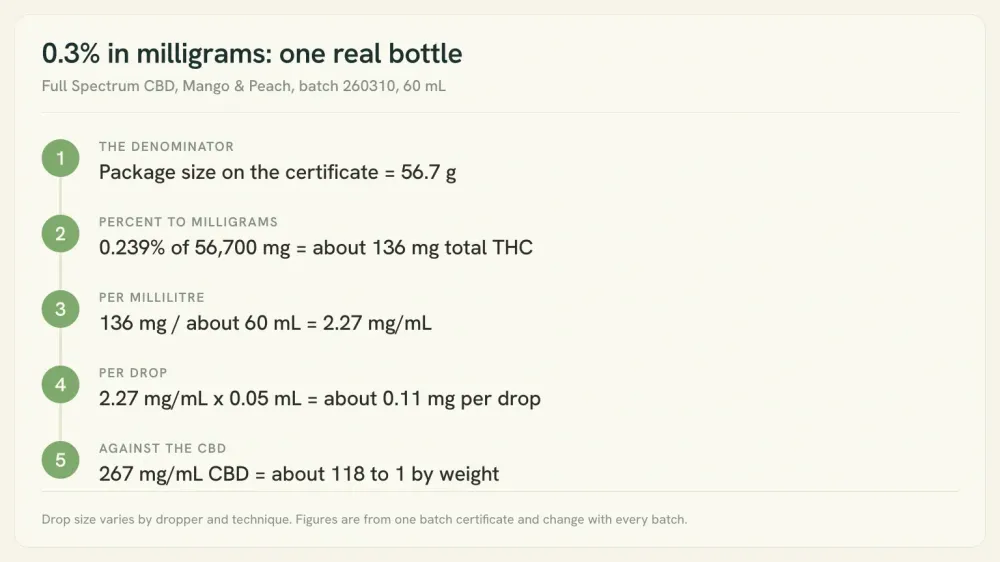
Notice what just happened. The percentage and the milligram figure are the same fact stated twice: 0.239% of the 56.7 g package is 135.5 mg, which is the 136 mg the certificate prints one column to the left. Nothing is hiding in the unit conversion, and you can run the same check on any line of any batch report. The broad-spectrum lemon batch further down this page is even tidier because its numbers are smaller: 0.0189% of the same 56.7 g is 10.72 mg, printed as 10.7. One more number while we are here, since it belongs to the same batch: the label says 250 mg/mL of CBD and this batch measured 267, which is 6.8% above the label claim and inside the plus or minus 10% band the label-accuracy literature uses. Reading concentration off a label is a skill of its own, and it is the one most shoppers are missing.
| Product and batch | Total THC per 60 mL bottle | % by weight | mg/mL | mg per ~0.05 mL drop |
|---|---|---|---|---|
| Broad Spectrum, Mango & Peach (260320) | Not detected, against a limit of detection of 0.0460 mg/mL | ND | ND | Not detected |
| Broad Spectrum, Lemon & Raspberry (260321) | 10.7 mg | 0.0189% | 0.179 | about 0.009 |
| Full Spectrum CBD, Mango & Peach (260310) | 136 mg | 0.239% | 2.27 | about 0.11 |
| Full Spectrum CBD + CBG, Mango (260314) | 88.5 mg | 0.156% | 1.48 | about 0.07 |
| Full Spectrum CBD + CBN, Mango (260311) | 79.4 mg | 0.140% | 1.32 | about 0.07 |
The two broad-spectrum rows are the same product in two flavors, and they do not give the same answer. That is not an error in the table. It is the single most important thing on this page, and it gets its own section below.
Is 136 milligrams a lot?
Both answers are true, and you should have both. In absolute terms, yes, that is a real quantity of THC. A 2021 analysis of 14,234 cannabis samples seized by the DEA between 2009 and 2019 found mean delta-9 THC of 13.88% in 2019, so 136 mg is roughly the THC carried by one gram of that material, and 13.88% is about 58 times the 0.239% on the batch above. Those were seized illicit samples rather than licensed-market product, and the series stops in 2019, so read it as an order of magnitude and not as a market figure.
In practical terms, you never take a bottle. At about 0.11 mg per drop, reaching the 10 mg of oral THC that produced subjective intoxication in that 2012 trial would take roughly 88 drops: about 4.4 mL, around 7% of the bottle in one sitting, carrying roughly 1,180 mg of CBD along with it. For a yardstick from a completely different world, the lowest strength of prescription synthetic THC, approved in the United States in 1985, is a 2.5 mg capsule. That is a prescription medicine with a doctor attached, and it has nothing in common with a hemp tincture's trace THC except the unit of measurement.
What "not detected" does and does not mean
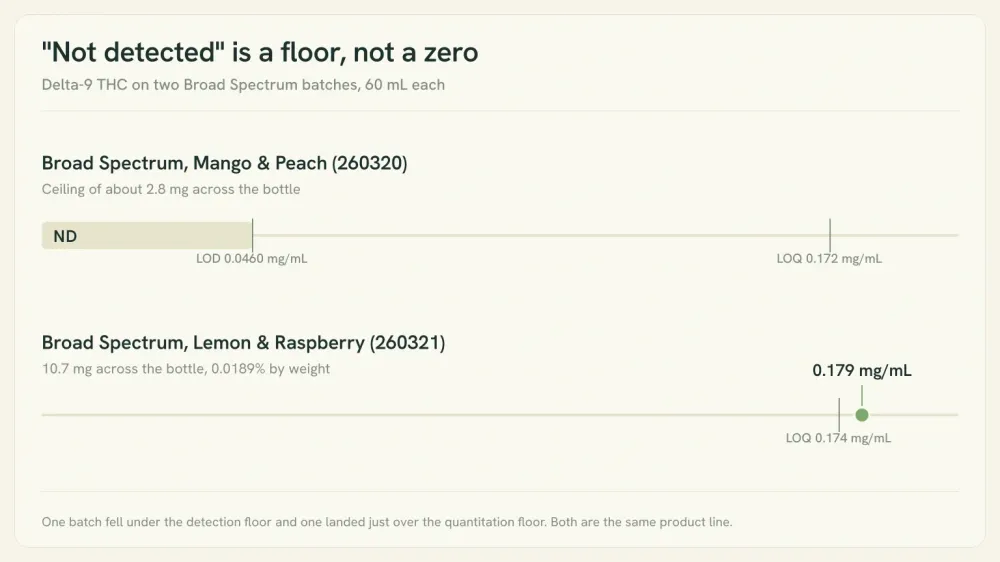
This is the most misleading phrase in the category, and the cleanest way to show why is with two batches of the same product. Our Broad Spectrum Mango & Peach, batch 260320, reports delta-9 THC as ND, not detected, against a stated limit of detection of 0.0460 mg/mL and a limit of quantitation of 0.172 mg/mL. ND does not mean zero. It means below 0.0460 mg/mL on that instrument. Across a 60 mL bottle, that is a ceiling of roughly 2.8 mg. A small number, and not the same thing as nothing.
Now the same product in a different flavor. Broad Spectrum Lemon & Raspberry, batch 260321, reports 0.179 mg/mL, which is 10.7 mg across the bottle, or 0.0189% by weight. It is also barely above that batch's own limit of quantitation of 0.174 mg/mL. Same formulation, same process, same product line: one flavor landed under the detection floor and one landed just over the quantitation floor. That single comparison is the whole argument for why nobody should use the phrase THC-free as an absolute, including us. The accurate sentence is longer: reported as non-detected on this batch's certificate, against a limit of detection of 0.0460 mg/mL. It is also true, which the short version is not.
- Check which analyte the row names. Delta-9 THC alone and Total THC are different rows, and on raw plant material they are very different numbers.
- Find the LOD and LOQ columns. A result of ND with no stated detection limit tells you nothing, because every instrument has a floor and the floors differ between labs.
- See whether Total THC and delta-9 THC agree. In a decarboxylated tincture they usually will. If they do not, the THCA row is doing the work.
- Look for the measurement uncertainty. Our Broad Spectrum Mango certificate prints its CBD figure as 16,300 mg, 28.8% plus or minus 0.285%. Lab numbers come with error bars.
- Match the batch number on the certificate to the batch number printed on the bottle in your hand. A generic report for the product line is not a report for your bottle.
Which spectrum gives which answer
- Isolate: cannabidiol on its own, with the other plant compounds stripped out. THC is not part of the formulation. Planntz does not make one.
- Broad spectrum: the minor cannabinoids are kept and the THC is removed during processing. Expect a THC row that reads non-detected against a stated detection limit, or a small trace just above it. Both happen inside the same product line.
- Full spectrum: the whole extract, including the trace THC that came with it. Expect a real number below 0.3%, printed in milligrams as well as percent, and expect it to move from batch to batch.
Which of those you want is a different question from what is in them, and it depends on why you are buying rather than on chemistry. We argue that one out properly in the guide to CBD spectrum types, including what the entourage-effect evidence does and does not support. The one thing worth carrying over here: spectrum is a claim about a manufacturing process, and the THC row on the certificate is the only place that claim gets checked.
Where these numbers go wrong
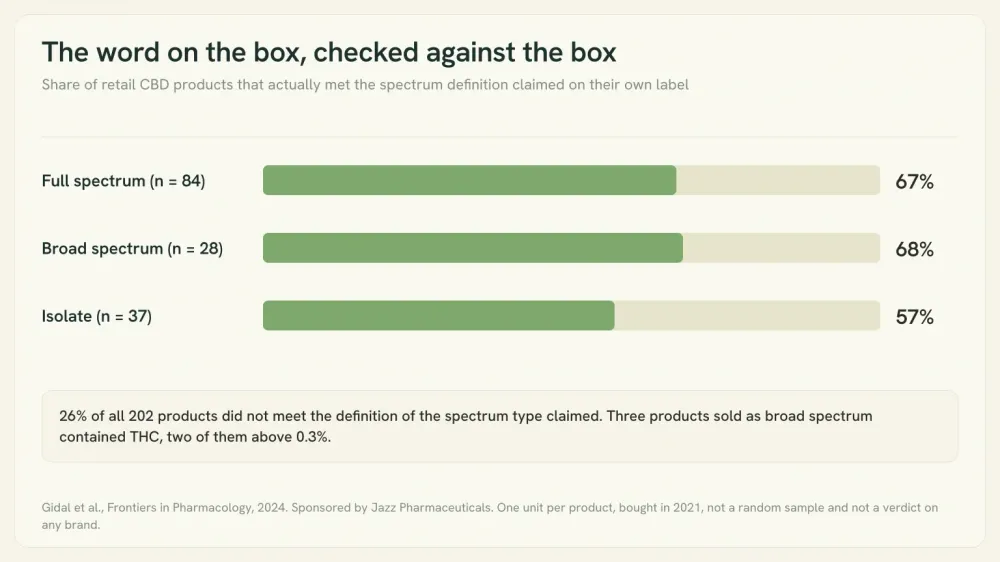
Everything above assumes the paperwork is right, and the market does not always cooperate. In a 2024 analysis of 202 US CBD products bought online in 2021, 74% of them deviated from the CBD potency claimed on the label by at least 10%, and 26% did not meet the definition of the spectrum type printed on the package: 67% of the 84 full-spectrum products matched, 68% of the 28 broad-spectrum, 57% of the 37 isolates. Three products sold as broad spectrum contained THC, two of them above 0.3%. That study was sponsored by Jazz Pharmaceuticals, tested one unit per product, and is not a verdict on any particular brand. It is still the best available snapshot of how often the word on the box and the contents of the box disagree.
Even when the paperwork is honest, laboratories disagree with each other. In the first exercise of NIST's Cannabis Quality Assurance Program, 116 laboratories were sent the same hemp oils. On one sample, 37 of the 65 labs reporting delta-9 THC (57%) landed outside NIST's range of tolerance, and 31 of the 68 reporting CBD (46%) did the same. NIST does not grade participants and this is a strict metrological yardstick rather than an accusation, but it means two competent labs can hand you two different numbers for the same oil. The FDA, for its part, says on its own consumer page that "the agency has tested the chemical content of cannabinoid compounds in some of the products, and many were found to not contain the levels of CBD they claimed." The word on the box is a claim. The batch certificate is evidence, and only to the extent that the laboratory behind it is genuinely independent.
The two consequences, briefly
Two things follow from a real trace of THC, and each has its own article. The first is testing. A full-spectrum product contains real THC, and immunoassay screens look for THC metabolites rather than for cannabidiol. No product can guarantee a drug-test outcome: how much you take, how often, how long you have been taking it and the cut-off the laboratory uses all matter. The adjacent worry, that CBD itself might turn into THC in your stomach, comes from beaker experiments in simulated gastric fluid. A 2017 review in Cannabis and Cannabinoid Research concluded that the conversion "has not been observed to occur in vivo, even after high doses of oral CBD" and called the simulated-fluid result an in vitro artifact. A 2023 study in the Journal of Analytical Toxicology, co-authored by staff of the federal office that administers workplace drug testing, put three CBD products through synthetic gastric fluid and measured conversion of under 0.0006% for the oil, concluding that at ordinary intakes it is unlikely to produce a positive urine test. The long version of the testing question is whether CBD shows up on a drug test.
The second is legality, and one thing on this page has an expiry date. As of August 6, 2026, the federal line is the delta-9 test at 0.3% on a dry weight basis described above. From November 12, 2026, section 781 of Public Law 119-37 replaces that with a total tetrahydrocannabinols test that counts THCA as well, and adds limits aimed at finished consumer products. Executive Order 14370, signed in December 2025, states in its own text that "some full-spectrum CBD products will once again be controlled as marijuana under the CSA" when that section goes into effect. It is pending rather than settled: the Congressional Research Service notes that "it remains unclear if and how federal law enforcement will enforce the new prohibitions". We are not going to predict where any particular product lands, and anyone who does is ahead of the record. The state-by-state layer sits in our legal overview.
Questions people actually ask
Yes, by definition. On our Full Spectrum CBD batch 260310 the certificate of analysis reports 136 mg of total THC across a 60 mL bottle: 0.239% by weight, 2.27 mg/mL, roughly 0.11 mg in a 0.05 mL drop, against 267 mg/mL of CBD. That is a ratio of about 118 parts CBD to 1 part THC. Any full-spectrum product should be able to show you those same three numbers for its own batch, and if it cannot, that is also an answer.
Of weight, on a dry weight basis. Federal law at 7 U.S.C. 1639o defines hemp as the plant and its derivatives, extracts and cannabinoids with a delta-9 THC concentration of not more than 0.3 percent on a dry weight basis. For a crop that means dried plant material, sampled within 30 days before harvest. For a liquid product the ratio is taken against the weight of what is in the package, which is how 0.239% of the 56.7 grams stated on our batch certificate becomes 136 milligrams.
0.3% is a concentration, so the honest answer depends on how much of the thing you consume. Across a whole bottle it is a real number of milligrams. In a drop it is a fraction of one. In the trial that gave healthy volunteers 10 mg of oral THC and 600 mg of oral CBD in the same design, only the THC arm produced subjective intoxication. Reaching 10 mg from a full-spectrum tincture at 2.27 mg/mL would mean about 4.4 mL at once. That is arithmetic rather than a guarantee: people differ, and we cover the felt experience in a separate article on whether CBD gets you high.
No product should be sold to you with that phrase used as an absolute. On our Broad Spectrum Mango & Peach batch the THC row reads ND, not detected, against a stated limit of detection of 0.0460 mg/mL, which caps it at roughly 2.8 mg across the bottle rather than proving zero. The Lemon & Raspberry batch of the same product reports 0.179 mg/mL, or 10.7 mg per bottle. Same line, two different answers, which is exactly why the batch certificate is the only thing worth reading.
They are isomers, which is nearly the same thing and not quite. PubChem lists both with the molecular formula C21H30O2 and a molecular weight of 314.5. The difference is one ring: THC's oxygen closes into a pyran ring and the molecule carries a single hydroxyl group, while CBD's structure stays open and carries two. Same atoms, different shape, and the shape is what decides whether it fits the receptor.
The concern comes from experiments in simulated gastric fluid rather than from people. A 2017 review in Cannabis and Cannabinoid Research concluded that the conversion has not been observed to occur in vivo, even after high doses of oral CBD, and described the beaker result as an in vitro artifact. A 2023 study in the Journal of Analytical Toxicology, co-authored by staff of the federal office that administers workplace drug testing, put three CBD products through synthetic gastric fluid and measured conversion of less than 0.0006% for the oil, concluding that at ordinary intakes it is unlikely to cause a positive urine test. A beaker is still not a stomach, in either direction.
It can. Screens look for THC metabolites, not for cannabidiol, and a full-spectrum product contains real THC. No product can guarantee a test outcome: the amount, the frequency, how long you have been taking it and the cut-off the laboratory uses all matter. If a test is a live concern, a broad-spectrum product with a published detection limit is the more conservative choice, but as above, non-detected describes where an instrument stops reading rather than a guarantee of zero. We have a whole article on the testing question.
Strength is the wrong axis. In the one head-to-head trial, 600 mg of oral CBD was indistinguishable from placebo on every measure while 10 mg of oral THC was not, so on the scale of subjective effect they are not comparable at all. They also act at the same receptor in opposite ways, one as a partial agonist and one as a negative allosteric modulator. Milligram for milligram they do different jobs, so stronger does not resolve into an answer.
Federally, as of August 6, 2026, the line is the 0.3% delta-9 dry-weight definition, and state law varies in both directions. That federal definition is scheduled to change on November 12, 2026 to a total tetrahydrocannabinols test that counts THCA, with limits aimed at finished consumer products. It is pending rather than in force, the Congressional Research Service has said enforcement remains unclear, and none of this is legal advice. Our legal overview covers the state layer.
The pharmacology answer to CBD vs THC fits in a sentence: same formula, one closed ring apart, filed as opposites at the same receptor. The answer that actually changes a purchase is a number, and it is different on every batch. Ours are published in full, with the delta-9 row, the Total THC row, the detection limits behind them and the batch number, at our lab results page.
Read the row, not the adjective
Every Planntz batch publishes its full potency panel: delta-9 THC, THCA, Total THC, the limits of detection and quantitation behind them, and the batch number printed on the bottle. Four formulations, three flavors, one report each.
See the Planntz tincturesWriting about hemp, wellness and the small rituals that keep us balanced.