The Entourage Effect: What the Evidence Actually Shows
The entourage effect is three different claims wearing one name, and they do not have the same evidence. Written by a company that sells full-spectrum CBD: the supporting human trial for each claim, the contradicting one, and the 2025 null missing from the pages we checked.
The entourage effect is the reason most people are given for buying full spectrum, and it is the argument our own product line implicitly makes, because Planntz sells full-spectrum CBD. So here is the version we would want to read. The phrase covers three separate claims with three separate evidence bases. One of them has a real human signal that has not repeated. The honest summary, in 2026, is that human evidence is limited and mixed.
Almost every argument about full spectrum versus isolate rests on one sentence: the compounds in the plant do more together than any of them alone. That sentence bundles three different claims, tested by different methods, in different people, with different verdicts. Separating them is the whole job of this page. If you want the molecules defined first, the cannabinoids the plant actually makes is the background this assumes.
Where the entourage effect actually comes from
The term was coined in a 1998 paper in the European Journal of Pharmacology, and the paper was not about the cannabis plant. Its subject was two fatty-acid glycerol esters that the body makes, 2-linoleoyl-glycerol and 2-palmitoyl-glycerol. Neither binds CB1 or CB2, and neither inhibits adenylyl cyclase on its own. What the authors reported is that both significantly potentiate the activity of 2-AG, one of the body's own cannabinoids, in binding assays and in mouse behavior: motor activity, immobility, hot-plate analgesia and body temperature. That is the original entourage effect. Endogenous molecules, mouse tissue and mice, and not one cannabis constituent tested.
The idea reached cannabis through a 2011 review in the British Journal of Pharmacology by Ethan Russo, titled "Taming THC". It proposes phytocannabinoid and terpenoid synergy for pain, inflammation, anxiety, epilepsy and infection, and it is a review, not a trial. Its abstract states the position exactly: "Phytocannabinoid-terpenoid synergy, if proven, increases the likelihood that an extensive pipeline of new therapeutic products is possible." Fifteen years later, "if proven" is still the operative clause. Russo's affiliation listed on that paper is GW Pharmaceuticals, the company then selling a whole-plant THC and CBD extract. That is an affiliation, not an accusation. It does mean the founding document of the consumer claim is a hypothesis with an interested author, which is a different object from a trial.
Three different claims travel under one name
Once you separate them, one debate becomes three. Claim A is cannabinoid on cannabinoid: usually, CBD taking the edge off THC. Claim B is terpene on cannabinoid: the aroma compounds steer the effect. Claim C is whole plant beats isolate: the same milligrams of CBD do more when they arrive with everything else. Each has a best supporting human study and a best contradicting one, and in two of the three the contradicting study is the more recent and better controlled of the pair.
| The claim | What it would mean for a buyer | Best supporting human study | Best contradicting human study |
|---|---|---|---|
| A. Cannabinoid on cannabinoid | CBD softens THC, so trace-THC products feel gentler | Englund 2013: 600 mg oral CBD before 1.5 mg IV THC cut paranoia and protected memory, n=48 | Englund 2023: 1:1, 2:1 and 3:1 CBD to THC modulated nothing, n=46. Gorbenko 2024 went the other way, n=37 |
| B. Terpene on cannabinoid | The terpene profile decides how a product feels | Spindle 2024: 15 mg inhaled d-limonene with 30 mg THC cut anxious and paranoid ratings, that arm n=12 | Kumar 2025: same lab, alpha-pinene to 15 mg, nothing. Plus two independent receptor nulls in vitro |
| C. Whole plant beats isolate | Full spectrum does more per milligram of CBD | Pamplona 2018: 71% of 447 improved on CBD-rich extract against 46% of 175 on purified CBD, observational | Devinsky 2017: the trial behind the approved cannabis-derived medicine used one purified molecule, n=120 |
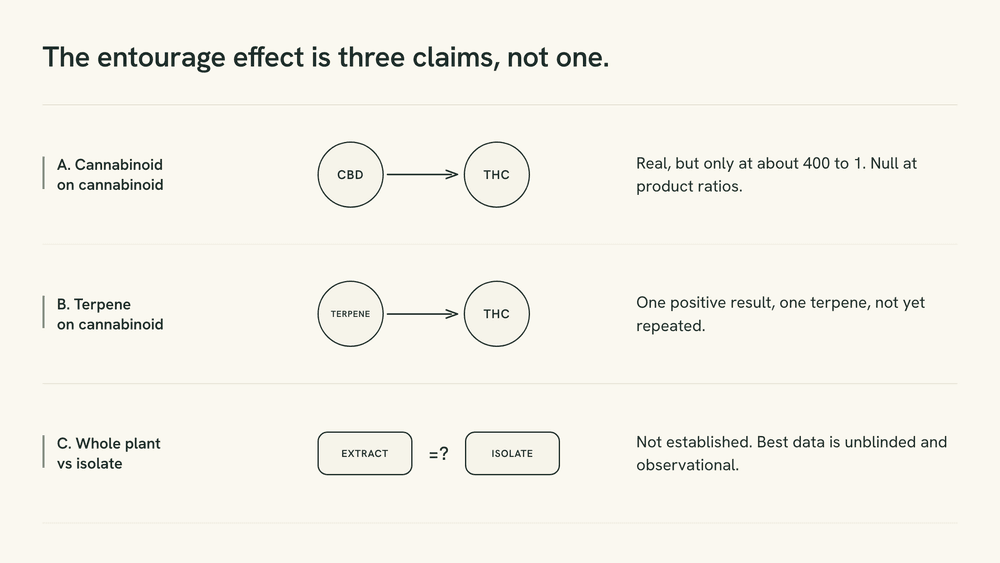
Claim one: does CBD tame THC?
The honest positive is a 2013 trial in the Journal of Psychopharmacology. Forty-eight healthy adults were randomized, between subjects, to 600 mg of oral CBD (22 people) or placebo (26 people), three and a half hours before 1.5 mg of intravenous THC. Clinically significant positive psychotic symptoms were less likely with CBD, odds ratio 0.22, paranoia scores were lower, and episodic memory fell 10.6% on placebo against 0.4% with CBD. Now do the arithmetic the marketing never does: 600 mg against 1.5 mg is roughly 400 mg of CBD for every 1 mg of THC, swallowed, against THC delivered into a vein. Nothing on any shelf resembles that.
At the ratios products actually contain, the picture reverses. A 2023 crossover trial in Neuropsychopharmacology gave 46 healthy infrequent users vaporized cannabis with 10 mg of THC plus 0, 10, 20 or 30 mg of CBD, which is 0:1, 1:1, 2:1 and 3:1. THC impaired delayed verbal recall and raised psychotic symptom scores as expected, and the authors report those effects "were not significantly modulated by any dose of CBD". Their conclusion: "at CBD:THC ratios most common in medicinal and recreational cannabis products, we found no evidence that CBD protects against the acute adverse effects of cannabis." Plasma CBD rose with dose, so it was absorbed. It simply did nothing. A 2016 multi-site trial had already given 31 experienced smokers 0, 200, 400 or 800 mg of oral CBD before smoked cannabis and found no change in how high they got or how much they smoked, and a 2023 trial in Addiction tested 24 adolescents and 24 adults at 3:1 and found no evidence of modulation either.
Then there is the trial that runs the other way. In a 2024 five-way crossover in Clinical Pharmacology and Therapeutics, 37 healthy volunteers took 9 mg of oral THC with placebo, or with 10, 30 or 450 mg of CBD. The 450 mg arm increased the effects: "Feeling High" rose 60.5% (95% confidence interval 12.7 to 128.5), and plasma exposure rose with it, the AUClast ratio reaching 2.18 for THC and 6.24 for its active metabolite 11-OH-THC. Read the smaller arm too, because it is the more relevant one: 30 mg of CBD also raised exposure (AUClast ratios 1.44 for THC and 1.89 for 11-OH-THC) while changing nothing about how the drug felt. The authors write that the findings "do not support the use of CBD to reduce adverse effects of oral THC or enhance THC analgesia". The likeliest mechanism is metabolic, CBD slowing THC's clearance, which is worth keeping as a general rule: an interaction is not automatically a benefit. Claim A survives, narrowly, with the ratio doing all the work, and the ratio that worked is not one anyone sells.
Claim two: do terpenes change what cannabinoids do?
The positive human signal everyone quotes is a 2024 study in Drug and Alcohol Dependence from a research unit at Johns Hopkins. Twenty healthy adults who use cannabis intermittently completed nine or ten double-blind, placebo-controlled sessions, inhaling THC at 15 or 30 mg, d-limonene at 1 or 5 mg, combinations, and placebo. d-Limonene alone was no different from placebo. In a tenth session, 30 mg of THC with 15 mg of d-limonene significantly reduced ratings of "anxious/nervous" and "paranoid" against 30 mg of THC alone. Nothing else moved, and THC pharmacokinetics were unchanged. Three limits come from the authors themselves. That session "was always completed last and was only completed by 12 of 20 participants". Their own analysis of retail samples "suggests this amount of d-limonene and THC:d-limonene ratio is unlikely to be encountered in unadulterated cannabis flower products". And the result is framed as improving the therapeutic index of THC, which makes it a finding about THC, not about CBD.
Read that study's declarations, both halves, because printing only one half is how a disclosure gets misused. It was funded by the National Institute on Drug Abuse (R01 DA043475, T32DA07209 and P50 DA056408), it was double-blind and placebo-controlled, and the paper states that "Minimization of bias was ensured by posting of the trial on ClinicalTrials.gov before it commenced." The same disclosure also states: "A patent application (PCT/US2022/014296) has been submitted by Johns Hopkins University on behalf of Drs. Vandrey, Spindle, and Russo for the use of d-limonene to reduce THC-induced anxiety based on the data presented in this manuscript (the submission occurred after the trial had concluded and data was analyzed)." Federally funded, pre-registered, rigorous, and patented afterwards for three of its authors. Both facts are true and neither cancels the other.
In 2025 the same unit published the same experiment with a different terpene, and it is absent from every consumer page we checked. Nineteen healthy adults, double-blind, placebo-controlled, six randomized sessions: alpha-pinene alone at 15 mg, THC alone at 30 mg, THC with alpha-pinene at 0.5, 5 and 15 mg, and ambient air, tracked for six hours. Co-administration did not mitigate the memory impairment THC produced, and in the authors' words it did not "significantly alter other acute subjective, cognitive, or physiological effects". They write, plainly, that this is "inconsistent with some cannabis industry claims and speculation by some cannabis researchers". Ethan Russo, who wrote the 2011 review that made the entourage effect famous, is an author on both the 2024 positive and the 2025 null, so this is not a hostile replication by a rival lab. A null in one terpene does not refute a positive in another. It does mean the strongest version of Claim B is one result, in one terpene, not yet repeated.
Underneath the human work, the mechanism has been looked for in the obvious place and not found. A 2020 study in Frontiers in Pharmacology applied myrcene, alpha-pinene, beta-pinene, beta-caryophyllene and limonene at 10 micromolar to human CB1 and CB2 receptors, alone and mixed, with and without THC and CBD, and found no change in binding or in cAMP signaling, bar one weak exception for beta-caryophyllene at CB2. Its conclusion: the putative entourage effect "cannot be explained by direct effects at CB1 or CB2". An independent 2019 study in Cannabis and Cannabinoid Research, different lab and different assay, agreed: with THC at CB1, the response was 59% plus or minus 7% alone against 55% plus or minus 4% with six terpenes added. Both are cell-culture experiments, so they rule out a mechanism rather than an effect. Pointing the other way, a 2021 mouse study in Scientific Reports found four terpenes produced cannabinoid-like behaviors and were selectively additive with a synthetic cannabinoid agonist. Mice, a synthetic drug, and receptor findings that contradict the two human-receptor studies. That disagreement is the actual state of the field. For the receptors themselves, what CB1 and CB2 are and where they sit covers them properly.
The dose problem nobody prints
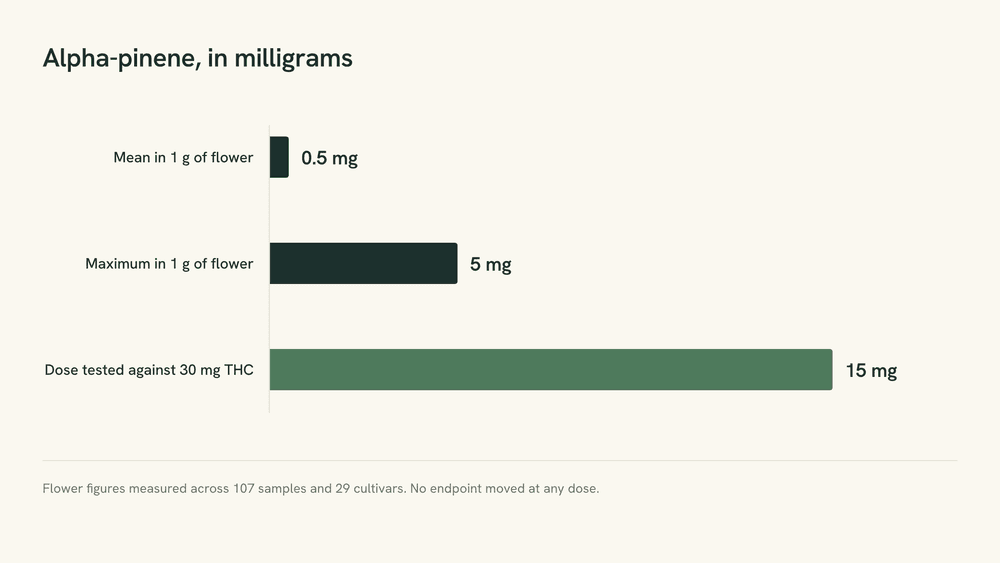
Most of this argument is settled by a question almost nobody asks: how much terpene is actually in the thing you are holding? The 2025 alpha-pinene study is useful here, because the researchers chose their doses by measuring real material. They analyzed 107 cannabis samples across 29 cultivars from a licensed Canadian medical producer, and report that 0.5 mg and 5 mg are the mean and the maximum alpha-pinene in 1 gram of flower, roughly the plant material in a single cannabis cigarette. Then they added a 15 mg dose, far above anything on a shelf. Nothing happened at any of the three.
- 0.5 mg: the mean alpha-pinene content of 1 gram of cannabis flower, measured across 107 samples and 29 cultivars.
- 5 mg: the maximum in that same sample set, which is what a whole gram of an unusually pinene-rich cultivar carries.
- 15 mg: the inhaled dose of a single purified terpene at which limonene moved two anxiety ratings in 12 people, and at which alpha-pinene moved nothing at all.
Those numbers describe alpha-pinene in smokable flower. They do not transfer to limonene and they do not transfer to an oil, so nobody should carry them across. You can still run a plausibility check on a tincture. A Planntz certificate of analysis prints the density of the finished oil: 0.95112 g/mL. At the usual convention of about 0.05 mL per drop, and drop size genuinely varies with the dropper and your technique, one drop weighs roughly 47.6 mg in total, of which about 12.5 mg is CBD at the 250 mg/mL label strength. For one drop to carry the 15 mg terpene dose those trials used, terpenes would have to be about a third of the drop's entire mass. A hemp extract in coconut MCT oil is not that. Treat this as arithmetic about plausibility rather than a measurement, because that is what it is: we do not measure terpenes. So the conclusion is not "terpenes do nothing". It is that nobody, us included, can tell you the terpene dose in a serving, and the doses that have moved a human endpoint are larger than a drop of oil.
There is a counterweight, and leaving it out would be the same mistake in the other direction. The in-vitro studies that found nothing applied terpenes at 10 micromolar. Russo's 2011 review says terpenoids "affect animal and even human behaviour when inhaled from ambient air", at serum levels it puts in the single digits of ng/mL. Those two concentrations are roughly a thousandfold apart. So the dish experiments may have tested the wrong concentration, and the behavioral claim rests on a concentration at which no receptor interaction has been demonstrated. That gap is still open. Naming it is more useful to you than picking a side.
Claim three: whole plant versus isolate
The strongest published support for whole plant over isolate that we found is a 2018 meta-analysis in Frontiers in Neurology pooling observational data from 11 studies and 670 patients with refractory epilepsy. Seizure frequency improved in 318 of 447 patients (71%) on CBD-rich extracts against 81 of 175 (46%) on purified CBD, at a mean dose of 6.0 against 25.3 mg/kg/day. The authors add that "this remains to be confirmed in controlled clinical studies". Note also that the paper carries a published corrigendum, and it is not cosmetic: the correction revised patient counts, adverse-event totals, mean doses and p values, and the 46% quoted above is itself the corrected figure, up from the 36% the original printed. It also prints its own conflict of interest, worth quoting in full rather than in part: "FP is responsible for the development of Cannabis-based products at Entourage Phytolab. AC received monetary compensation for consulting work performed for Entourage Phytolab. LdS works at Bedrocan." None of that makes the numbers false. It means an unblinded, uncontrolled, non-randomized pooling of heterogeneous studies was reported by people who develop the kind of product it favors, which is exactly the combination a randomized trial exists to settle.
Now notice what the trial behind an approved medicine actually tested. The 2017 New England Journal of Medicine trial that led to the cannabis-derived medicine the FDA has approved used purified cannabidiol: one molecule, no terpenes, no minor cannabinoids, in 120 children and young adults with Dravet syndrome at 20 mg per kilogram per day for 14 weeks. Median monthly convulsive seizures fell from 12.4 to 5.9 against 14.9 to 14.1 on placebo, with more diarrhea, vomiting, fatigue, somnolence and abnormal liver-function results. That is a prescription drug, at a prescription dose, in a rare childhood epilepsy, and it has nothing to do with a wellness tincture. It is here for one structural reason: the one cannabis-derived medicine approved on randomized evidence does not use the entourage effect. Separately, a 2025 crossover in eight beagles compared isolates against full-spectrum extracts at 1 mg/kg twice daily and reported, in its own words, "No evidence supported enhanced absorption from full-spectrum products, suggesting the 'entourage effect' may involve receptor-level interactions rather than absorption." Quote the second half as well as the first: those authors are not dismissing the idea, they are relocating it. Eight dogs, and absorption is not an effect, but it is the direction of the head-to-head comparison we found.
What our own certificates can and cannot tell you
We sell full-spectrum CBD, so it is fair to ask what our own paperwork shows. Below are two Planntz certificates of analysis, both Mango & Peach, produced nine days apart in spring 2026 (the full-spectrum batch on March 23, the broad-spectrum batch on April 1), issued by Infinite Chemical Analysis Labs in San Diego. Each carries three panels: potency by UHPLC-DAD, heavy metals by ICP-MS, and microbial. Neither has a terpene panel. That is the first useful fact and it is not a small one: the compound class the terpene half of this argument rests on is not measured on the document the industry points to as proof of quality. That is true of most certificates in this category, not only ours.
| Reported on the certificate | Full Spectrum, batch 260310 | Broad Spectrum, batch 260320 |
|---|---|---|
| CBD | 15,900 mg per package (28.1%) | 16,300 mg per package |
| Delta-9 THC | 136 mg per package (0.239%) | Non-detected, total THC 0.000 mg |
| CBG | Non-detected | 145 mg per package |
| CBN | Non-detected | 31.0 mg per package |
| CBDV | 75.4 mg per package | 65.2 mg per package |
| CBT | 107 mg per package | Not among the detected cannabinoids |
| THCV | Non-detected | 17.7 mg per package |
| Total cannabinoids | 16,300 mg per package | 16,600 mg per package |
| Terpenes | No terpene panel is run | No terpene panel is run |
Read the columns before drawing a conclusion from them. On these two batches, the broad-spectrum run, the one with the THC removed, reports four detected minor cannabinoids while the full-spectrum run reports two. Those are two production runs, not a rule, and turning them into "broad spectrum is richer" would be the same error in reverse. The point is narrower and more useful: "full spectrum means more of everything" is a sentence about marketing, and a certificate is a sentence about a batch. For the method, read a certificate of analysis in five minutes walks each panel, how much THC is actually in a full-spectrum bottle does the arithmetic on that 0.239% row, and CBG has its own page if you are wondering why it shows up on one certificate and not the other.
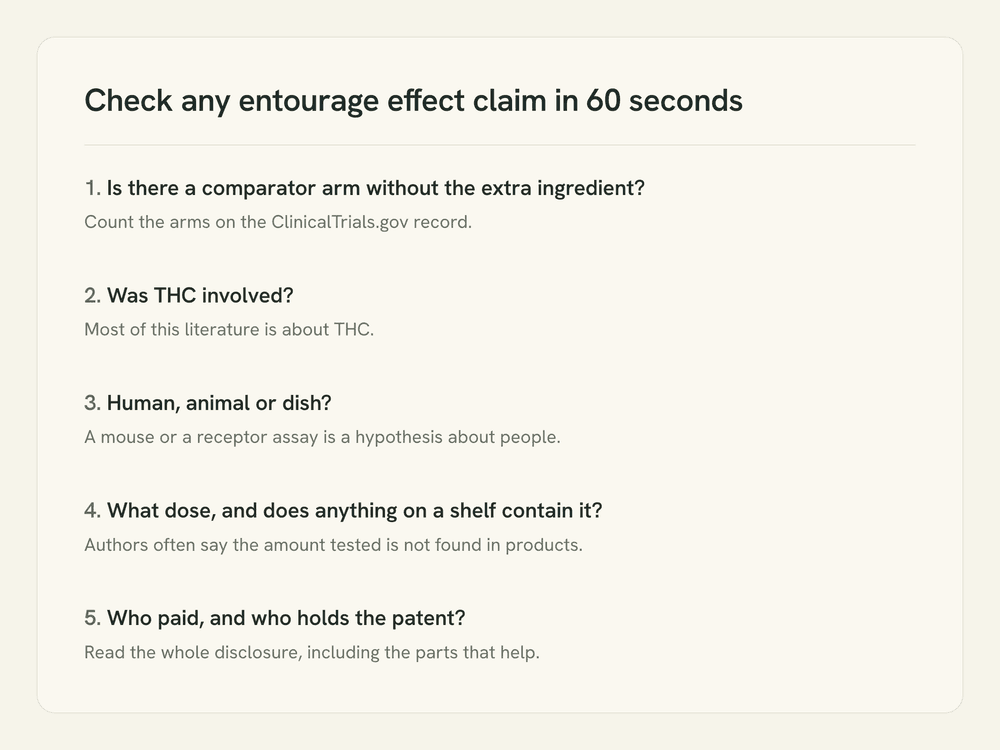
How to check an entourage effect claim in 60 seconds
You do not need to memorize any of the studies above. You need five questions that work on any study anyone waves at you, including anything we publish. They take about a minute.
- 1Is there a comparator arm without the extra ingredient? Open the trial's ClinicalTrials.gov record and count the arms. With no isolate arm, a study cannot attribute its result to the extras, however well it was run.
- 2Was THC involved? Seven of the nine controlled human experiments described on this page administered THC, so most of this literature is about THC and does not transfer on its own to a hemp CBD product.
- 3Human, animal or dish? A mouse tetrad and a receptor assay are hypotheses about people, not findings in people.
- 4What dose, and does anything on a shelf contain it? If the authors say the amount tested is unlikely to occur in a real product, the study is about pharmacology, not shopping.
- 5Who paid, and who holds the patent? Read the whole disclosure, including the parts that make the study look better, such as pre-registration and public funding.
Run question one on a recent, well-conducted example. In 2025, a phase 2 crossover trial in the Journal of Clinical Sleep Medicine enrolled 125 adults with insomnia, a big sample by the standards of this literature, and gave them 300 mg of CBD with 1 mg each of eight terpenes, THC-free, at least four nights a week for four weeks. The share of the night spent in slow-wave and REM sleep rose 1.3 percentage points against placebo (95% confidence interval 0.1 to 2.5, p = 0.03), while total sleep time, resting heart rate and heart-rate variability did not move. Now open the registry record, NCT05233761 and count the arms. There are two: the formulation, and a placebo containing no CBD and no terpenes. There is no CBD-only arm, so however well that trial was conducted, its design cannot tell you whether the terpenes contributed anything. Sleep was also measured with a wrist-worn tracker rather than polysomnography, and the sponsor makes the product. Sixty seconds, three findings, no expertise required.
So what should this decide when you choose a spectrum?
Here is the landing, stated plainly. Human evidence for the entourage effect is limited and mixed, and reviews written from both directions say so. A 2024 PRISMA review in Pharmaceuticals concludes that "the potential for synergistic or additive enhancement of cannabinoid efficacy by terpenes remains unproven", and calls for further clinical trials to confirm any terpene entourage effects. A scoping review in Cannabis and Cannabinoid Research finds the literature "provides limited evidence to support it as a stable and predictable phenomenon", and advises regulators, industry and clinicians to "avoid prematurely promoting the entourage effect hypothesis as a scientific proven phenomenon". We sell full-spectrum CBD and we agree with them. This claim should not be what decides your purchase.
What should decide it are the things a document can show you: how many milligrams of CBD are in the bottle, what the THC row says, whether the heavy-metal and microbial panels passed, and whether the batch number on the certificate matches the batch in your hand. Those are verifiable in a way the synergy question is not. If you are choosing between full spectrum, broad spectrum and isolate, which spectrum suits which buyer works through the practical differences, including trace THC and drug-test exposure. For this same posture applied to CBD's benefits generally, what human evidence can and cannot support is the sibling page. Our per-batch certificates are published in full at Planntz lab results, including the panels they do not run.
Parts of it are testable and have been tested, with mixed results. The clearest human finding is that a very lopsided ratio, roughly 400 mg of CBD to 1 mg of THC in a 2013 trial, blunted THC's effects, while trials at the 1:1 to 3:1 ratios found in real products found nothing and a 2024 trial found the opposite direction. The positive human terpene result people quote, d-limonene in 2024, has not repeated with the next terpene the same laboratory tested. Two reviews published in 2024, one systematic and one a scoping review, both conclude the synergy is unproven. Human evidence is limited and mixed, and that is the accurate answer rather than a hedge.
Nobody can answer that for a specific bottle, because most certificates of analysis, including ours, do not run a terpene panel. What is known is the dose: the amount of a single purified terpene that changed a human endpoint in a controlled study was 15 mg inhaled, and the researchers who ran it wrote that the amount and ratio involved are unlikely to be encountered in unadulterated cannabis flower products. A finished oil is a different material again, and it has not been measured for you.
Not in CBD content, which is the thing a certificate measures. Whether the same milligrams of CBD do more alongside other compounds has not been settled by a controlled trial. The best supporting dataset is unblinded observational epilepsy data reported, by the paper's own disclosure, by a team whose first author develops cannabis-based products. The randomized trial behind the one approved cannabis-derived medicine used a single purified molecule at a prescription dose in a rare childhood epilepsy: a different product, dose and population from anything sold for wellness.
In a 2013 trial of 48 healthy adults, 600 mg of oral CBD given three and a half hours before 1.5 mg of intravenous THC made clinically significant psychotic symptoms less likely and protected memory. That is roughly 400 mg of CBD per 1 mg of THC. At the ratios found in real products the answer changes: a 2023 crossover in 46 people, a 2016 trial in 31 people and a 2023 trial in 24 adolescents and 24 adults all found no effect, and a 2024 trial found 450 mg of CBD made 9 mg of oral THC feel about 60% stronger while raising plasma THC.
Most of the controlled human work on this question administered THC, which is a limitation of the literature rather than a requirement of the theory: seven of the nine controlled human experiments described on this page gave people THC. The largest THC-free test we found, a 125-person insomnia trial of a CBD-and-terpene capsule, compared the formulation only with a placebo containing neither, so it cannot say what the terpenes contributed. Until a trial runs a CBD-only arm against a CBD-plus-terpene arm, the question stays open.
A 1998 paper in the European Journal of Pharmacology, about two inactive fatty-acid glycerol esters the body makes increasing the activity of the endocannabinoid 2-AG, in mouse tissue and in mice. No cannabis constituent was tested. It became a claim about the cannabis plant through a 2011 review whose own abstract says "if proven", written by an author whose listed affiliation at the time was a pharmaceutical company selling a whole-plant cannabis extract.
See what a certificate actually reports
Every Planntz batch publishes a third-party certificate of analysis: cannabinoid content, the THC row, heavy metals and microbial panels. None of them reports terpenes, and this page does not pretend to know what they would say.
See Planntz lab resultsWriting about hemp, wellness and the small rituals that keep us balanced.