Why Does Weed Make You Paranoid? What the Trials Found
Researchers have produced weed paranoia on purpose: 121 adults, 1.5 mg of intravenous THC, placebo-controlled. Here is what those trials found about what causes it, who it happens to, how much it takes, and whether CBD blocks it.

Why does weed make you paranoid? It is one of the very few cannabis effects that researchers have produced on purpose, under placebo control, in a hospital. In 2015 a team gave 121 adults a measured dose of pure THC through a cannula in the forearm and then scored, four different ways, whether they became paranoid. Enough of them did that the effect showed up in the statistics. Those trials, and the studies around them, let this question be answered with measurements instead of theories.
Here is the short answer. In the one trial that traced the chain of events, THC produced paranoia by raising negative feelings and strange perceptual experiences, and the memory fog everybody describes first had nothing to do with it. More THC meant more symptoms across 400 infusions, and swallowing cannabis changes how much reaches you. Two large surveys tie childhood trauma to paranoia while high, and both are cross-sectional, so neither can say what caused what. The three explanations you will usually read (an overactivated amygdala, your genes, and set and setting) are the ones that fare worst when they are tested directly. And CBD does not reliably block any of it. This page is an evidence review for adults 21 and over, not medical advice: it names no dose, no ratio and no strain. If you or someone near you is too high right now, our guide to greening out covers what to do in the moment.
What paranoia means in a trial, and how it gets a number
In everyday speech, paranoia covers everything from a passing "were they laughing at me?" to a fixed belief that you are being followed. In research it is narrower: an unfounded thought that other people are trying to harm you. The word unfounded is doing the work, because a researcher cannot score you as paranoid unless they already know that nothing threatening is happening. That constraint is why the experiments below look so strange.
Freeman and colleagues, writing in Schizophrenia Bulletin in 2015, scored paranoia four ways in a single session: a set of visual analogue scales, a real social situation, a virtual reality ride, and an interviewer's rating. They then reduced their paranoia measures to one component using principal components analysis, a component that explained 71% of the variance, and used that composite as the trial's primary outcome. That is what a sentence like "THC increased paranoia" refers to in a paper: a composite score moved.
| How it was measured | What the participant actually did | What that captures |
|---|---|---|
| Visual analogue scales | Rated six statements in the moment, including "Right now I feel suspicious of other people" and "I feel that people want to harm me" | Self-reported suspicion, with high internal consistency (Cronbach's alpha .90) |
| A real social situation | Took a 5-minute walk into the hospital canteen to buy an item, then rated the experience afterwards | Paranoid thinking in an unscripted public place rather than on a questionnaire |
| Immersive virtual reality | Spent 5 minutes in a virtual underground train carriage wearing a head-mounted display, scored on the State Social Paranoia Scale | An identical, deliberately neutral social scene for everyone, so any perceived hostility is known to be unfounded |
| An interviewer rating | Was rated by a researcher on the Suspiciousness item of the Positive and Negative Syndrome Scale (PANSS) | A trained observer's judgement rather than the participant's own report |
Other trials on this page used other instruments: the State Social Paranoia Scale, the positive subscale of the PANSS, the Brief Psychiatric Rating Scale, or in one case a single self-rated "paranoid" slider. Those scales do not convert into one another, so an effect size from one study cannot be laid beside an effect size from another. Every number below therefore travels with the scale that produced it.

The trial that caused paranoia on purpose
The 2015 trial recruited 121 adults aged 21 to 50 who had used cannabis before and who reported having had a paranoid thought in the previous month. Finding them meant screening 1,792 respondents. Anyone with a history of mental illness, a history of substance dependence, a first-degree relative with a major mental illness, a heart condition or a pregnancy was excluded. Participants were randomized into three groups: placebo (41 people), THC (41), and THC preceded by a short briefing on what the drug does (39). The THC was 99.5% pure synthetic delta-9-THC, 1.5 mg of it, delivered through a forearm cannula as 1 mL pulses once a minute for ten minutes. The placebo group received 10 mL of saline the same way.
Against placebo, the paranoia composite rose in the THC group: a coefficient of 0.91 (standard error 0.43, t = 2.15, P = .034), controlling for each person's baseline paranoia and anxiety. Self-reported psychotic-like experiences on the CAPE questionnaire rose as well, by 4.20 (SE 1.19, t = 3.54, P = .001). Their abstract's own summary reads: "In this largest study of intravenous THC, it was definitively demonstrated that the drug triggers paranoid thoughts in vulnerable individuals." That superlative is theirs and it is dated. Searching PubMed on September 20, 2026 for intravenous THC studies that mention paranoia returns four records, and none of them is a larger single trial than this one: the other three are the 2013 CBD trial and the 2016 THCV pilot described below, plus a methods chapter. The 2020 pooled analysis further down this page covers more infusions in total, but it combines ten separate studies rather than being one.
The word vulnerable is load-bearing. Everyone in the trial had already reported a paranoid thought in the previous month, which is how a small dose was able to produce a measurable effect. And the dose was small: the authors describe it as having "ecological validity since it is equivalent to about one strong cannabis cigarette." That is their estimate of equivalence, not a measured joint, and an infusion is not a lungful. None of it converts into an amount anyone should take or avoid.
The third arm is the most interesting negative result in the paper. Before the infusion, those 39 people were given a five-minute educational module about what THC does, on the theory that knowing would take the edge off. It did not. The coefficient for that arm was 0.51 (SE 0.44, t = 1.16, P = .247), and it pointed toward more paranoia rather than less. The authors wrote: "Contrary to prediction, this psychological manipulation did not decrease paranoia but perhaps had a paradoxical effect of exacerbating it, though statistical significance was not reached." They also flag that the arm was underpowered and that there was no placebo-plus-briefing condition to compare it against.
The whole session was short. Testing on all measures after the infusion finished in an average of 83 minutes (standard deviation 18), inside what the authors call "the 90-minute period for which the drug was active". That is an intravenous dose in a hospital, and it is not an answer to how long weed paranoia lasts when you smoke or eat cannabis. Route changes the curve, which is the subject of a later section here and of two other pages on this site.
Why does weed make you paranoid, if not the amygdala?
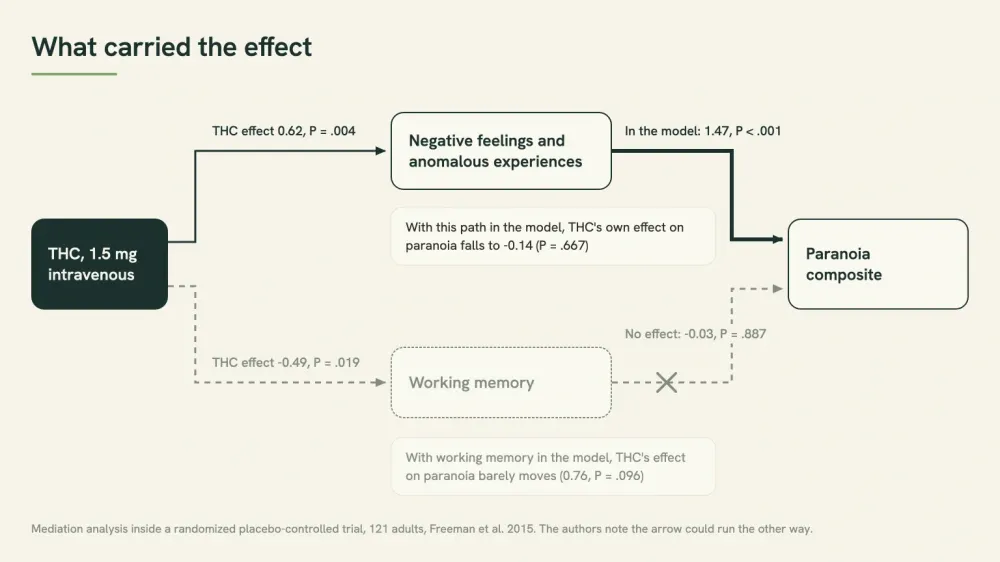
Freeman's team did something most drug trials skip: they measured several candidate mechanisms in the same session and then tested which one carried the effect. THC raised the component covering anomalous experiences and negative affect (coefficient 0.62, SE 0.21, t = 2.95, P = .004) and lowered the working-memory component (-0.49, SE 0.21, t = -2.39, P = .019). Then each candidate was entered into the model alongside THC. With the anomalous-experiences-and-negative-affect component in the model, THC's own effect on paranoia collapsed to -0.14 (P = .667) while that component itself was 1.47 (t = 10.46, P < .001), which is full mediation. With working memory in the model instead, THC's effect barely moved (0.76, P = .096) and working memory itself was null (-0.03, P = .887).
In plain terms: in this trial the paranoia rode on feeling bad and on the world seeming subtly wrong, and not on the memory fog that people mention first when they describe being too high. The authors put the necessary caution in their own discussion: "The data cannot exclude the possibility that the change in paranoia leads to the change in component 1." A mediation analysis is statistics applied after the fact, not a separate experiment on the mediator, and the arrow could run the other way.
So where does the amygdala story come from? The human experiments that gave people THC and imaged the amygdala do not add up to the version you usually read. A 2008 experiment in the Journal of Neuroscience gave 16 healthy volunteers 7.5 mg of oral THC or placebo about two hours before scanning and reported that THC "significantly reduced" amygdala reactivity to social signals of threat, with no effect on primary visual or motor cortex. Reduced, not increased. A 2017 study in Scientific Reports gave 14 healthy men 10 mg of oral THC or placebo at least a month apart and found that THC "induced anxiety and modulated right amygdala activation while processing fear", with both effects positively correlated with how much CB1 receptor availability each man had in the right amygdala, measured by PET. And a 2009 experiment in Archives of General Psychiatry gave 15 healthy men 10 mg of oral THC, 600 mg of oral CBD or placebo before a task of viewing fearful faces: THC raised anxiety there, and the authors conclude that its anxiogenic effects "may be related to effects in other brain regions". It was that trial's CBD condition, not its THC condition, in which the amygdala signal was attenuated, and a brain signal during a face-viewing task in 15 men is not a paranoia outcome; the trials that gave people CBD and actually scored paranoia are further down this page. None of these three studies measured paranoia. The amygdala explanation is therefore an inference from anxiety and threat-processing work in small samples, not a finding about paranoia. Two of the 2017 paper's authors disclose research funding from GW Pharmaceuticals unrelated to that work.
Why weed makes you anxious is a version of the same question
Anxiety and paranoia were not cleanly separable in the trial that produced both. The component that carried the paranoia effect fused negative affect (anxiety, worry, negative thoughts about yourself) with anomalous experiences, which means the trial cannot hand you one without the other. The 2017 imaging study points the same way: what THC induced there was anxiety, and the size of that effect tracked each person's CB1 receptor availability. CB1 is the receptor THC binds to, and our explainer on the endocannabinoid system covers what those receptors are and where they sit. If you are searching for why weed makes you anxious rather than paranoid, the honest answer is that the controlled literature mostly measures them together.
How often it happens, and how much it takes
A 2020 mega-analysis in the International Journal of Neuropsychopharmacology pooled individual participant data from 10 double-blind, randomized, placebo-controlled crossover studies: 400 intravenous THC infusions in healthy volunteers, all scored on the PANSS. Clinically meaningful increases in positive psychotic symptoms were noted after 44.75% of infusions. The items that moved most were conceptual disorganization, hallucinations, blunted affect, somatic concern, motor retardation and poor attention. Read that number carefully. It is a rate per infusion, not per person; the volunteers were healthy and screened; positive symptoms are a broader construct than paranoia; and intravenous is a route almost nobody uses.
Inside that dataset, dose behaved the way you would guess: the rise in PANSS positive symptoms was positively associated with THC dose (beta = 11.13, SE = 4.94, Wald chi-square = 19.88, P < .001). A 2020 systematic review and meta-analysis in The Lancet Psychiatry identified 15 eligible studies of a single acute THC dose in healthy participants, and each of its pooled estimates rests on a different subset of them. Total symptom severity came out at SMC 1.10 (95% CI 0.92 to 1.28), from nine studies and ten samples covering 196 participants. Positive symptoms came out at SMC 0.91 (0.68 to 1.14), from 14 studies and 15 samples covering 324 participants. Negative symptoms came out at SMC 0.78 (0.59 to 0.97), from 12 studies and 13 samples covering 267 participants. All three were p < 0.0001. These are symptom scales in volunteers after one dose, not diagnoses, and the review pooled intravenous, oral and nasal administration.
How fast the drug goes in has been in the literature since 1976. A double-blind study in the American Journal of Psychiatry had six volunteers smoke 20 mg of THC over ten minutes on one occasion and the same amount over 45 minutes on another, with placebo and a matched alcohol dose for comparison. In the fast condition THC produced more persecutory ideation than either alcohol or placebo, and the authors report the same differences as smaller in the slow conditions. Six people, 1976, no modern instrument: treat it as a historical anchor rather than a result.
| Study | Who took part | What they were given | What was measured, and what it showed |
|---|---|---|---|
| Freeman 2015 | 121 adults who had reported a paranoid thought in the past month | 1.5 mg synthetic THC intravenously, in 1 mL pulses once a minute for ten minutes | A four-way paranoia battery. The composite rose against placebo (coefficient 0.91, P = .034) |
| Ganesh 2020 (10 pooled trials) | Healthy screened volunteers, across 400 infusions | Intravenous THC across a research dose range | PANSS. Clinically meaningful positive-symptom increases after 44.75% of infusions |
| Hindley 2020 (15 studies) | Healthy participants | A single acute THC dose, intravenous, oral or nasal | BPRS or PANSS. Positive symptoms SMC 0.91 (95% CI 0.68 to 1.14), pooled from 14 of those studies and 324 participants |
| Englund 2023 | 46 healthy infrequent cannabis users | Vaporized cannabis with 10 mg THC plus 0, 10, 20 or 30 mg CBD | PANSS positive symptoms rose (d = 0.69), and no dose of CBD significantly changed that |
| Phan 2008 | 16 healthy volunteers who had used cannabis at least 10 times | 7.5 mg oral THC (Marinol) about 120 minutes before scanning | Amygdala response to threatening faces on fMRI, which THC reduced. Paranoia was not measured |
| Melges 1976 | 6 volunteers | 20 mg smoked THC over ten minutes, or the same amount over 45 minutes | Persecutory ideation, greater in the faster condition than with alcohol or placebo |
Edibles are the most common version of this question, and the honest answer is about exposure rather than psychology. Eating cannabis changes how much active drug reaches you and how long it stays, which is a pharmacology question rather than a paranoia question: why the route decides what ends up in your blood covers the measured numbers route by route. What the paranoia literature adds is only that dose tracked symptoms across 400 infusions and that, in 1976, the same amount of THC taken faster produced more persecutory ideation than the same amount taken slowly.
Who it happens to: trauma, genes, and how often you use
A 2025 Bayesian meta-analysis in Neuroscience and Biobehavioral Reviews assembled 13 studies covering 13,559 people, with the literature searched to July 2023. In its five experimental studies, people given cannabinoids developed more severe paranoid symptoms than people given placebo, with a standardized mean difference of 0.47 and a 94% posterior probability of inclusion, which is that method's way of saying the data strongly support the effect being there rather than being noise. Studies using THC-prevalent cannabinoids detected higher effects than those using mixed THC and CBD or CBD-prevalent preparations. In four cross-sectional general-population studies, cannabis users had higher odds of paranoid symptoms than non-users: odds ratio 1.75 (95% CI 1.43 to 2.07), with a 99% posterior probability of inclusion, and the effect increased with the percentage of males in the sample. Three prospective studies suggest cannabis use precedes later paranoid symptoms. In studies that recruited patients who already had psychiatric disorders, the pooled effect was not significant.
Three limits travel with those numbers, and printing them is more useful than smoothing them over. First, the paper is paywalled and is not in PubMed Central or Europe PMC, so we could not read its table of included studies: we cannot tell you which trials it pooled, and nothing here should be read as saying it pooled the trials described on this page. Second, its own design counts add up to 12 studies (five experimental, four cross-sectional, three prospective) against a stated total of 13. Third, the interval printed beside its experimental effect size ends barely above that effect size, which reads as a misprint, so we have left the interval out rather than reproduce a number we cannot reconcile. The direction of the finding is clear; the arithmetic around it is not fully auditable from outside the paywall.
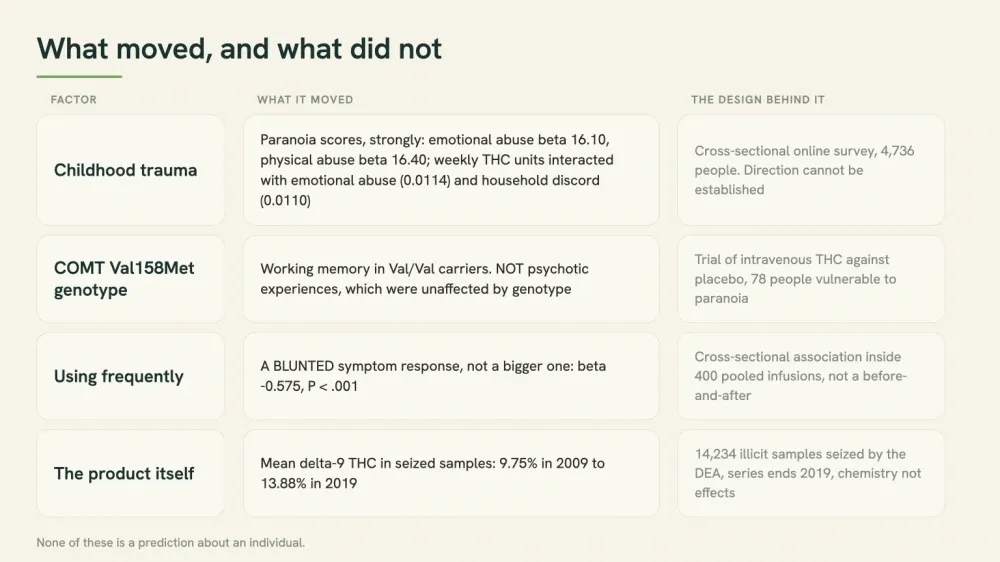
The most repeated susceptibility claim online is trauma, usually with nothing attached to it. There are two large studies. A 2025 study in Psychological Medicine surveyed 4,736 people, measuring childhood trauma with the Childhood Trauma Screen Questionnaire, paranoia with the Green Paranoid Thoughts Scale, and cannabis exposure in weekly standard THC units. Childhood trauma was strongly associated with paranoia, most strongly for physical abuse (beta 16.40, q < 0.001) and emotional abuse (beta 16.10, q < 0.001). Weekly standard THC units also predicted paranoia, at a far smaller magnitude (beta 0.009, q < 0.001), and interacted with emotional abuse (beta 0.0114) and with household discord (beta 0.0110). The indirect path running from trauma to paranoia through cannabis use was significant but small (beta 0.004, p = 0.017). A 2021 survey in Schizophrenia Research of 2,630 cannabis users aged 16 to 25 found the link between cannabis and psychotic-like experiences was stronger in those with more severe childhood trauma, and that the trauma-related associations ran through dysphoria and paranoia felt while using.
Both of those are cross-sectional online surveys of people describing themselves, so neither can establish direction. The authors' own framing is that trauma is the driver and cannabis the amplifier, and the second study's age range is 16 to 25, which is the population it recruited and not a statement about anyone else. Neither result is a prediction about you.
Genetics is the claim that shrinks the most on contact. A 2015 trial in the Journal of Psychopharmacology genotyped 78 people who were vulnerable to paranoia but had no psychiatric diagnosis, then gave them intravenous THC or placebo, looking at COMT Val158Met, the variant everyone cites. THC impaired working memory on Digit Span Backwards in Val/Val carriers but not in Met carriers. The effect of THC on psychotic experiences, measured on the CAPE positive dimension, was unaffected by genotype. So the genotype test that exists found COMT moderating a cognitive effect and not the psychotic one. "Your genes decide whether weed makes you paranoid" is not a thing that study says.
Frequency is the other folk explanation, usually phrased as "it never used to do this to me". In the pooled infusion dataset, frequent cannabis use went with a blunted response rather than a heightened one: the rise in PANSS positive symptoms was negatively associated with frequent use (beta = -0.575, SE = 0.14, Wald chi-square = 18.13, P < .001), and the authors conclude that "healthy individuals who frequently use cannabis have a blunted psychotomimetic response". That is a cross-sectional association inside pooled trial data, not a before-and-after in the same person, and it cannot separate tolerance from the possibility that people who reacted badly simply stopped using. Our page on tolerance breaks covers what changes when regular users stop, and this article recommends neither taking a break nor skipping one. What did change over the years people compare themselves against is the product: an analysis of 14,234 cannabis samples seized by the DEA found mean delta-9 THC rising from 9.75% in 2009 to 14.88% in 2018 and 13.88% in 2019. That is seized illicit material rather than legal-market product, the series stops in 2019, and it measures chemistry rather than effects.
Does CBD block it? What the controlled tests found
This is the question the internet gets wrong in both directions, either promising that CBD cancels a THC high or insisting it does nothing whatsoever. The controlled evidence is small, specific, and worth reading exactly. A 2013 trial in the Journal of Psychopharmacology randomized 48 healthy adults to 600 mg of oral CBD (22 people) or placebo (26 people), then gave everyone 1.5 mg of intravenous THC 210 minutes later. Clinically significant increases in positive psychotic symptoms, defined in advance as a rise of at least 3 points, were less likely in the CBD group (odds ratio 0.22, chi-square 4.74, p < 0.05). Paranoia on the State Social Paranoia Scale was lower with CBD (t = 2.28, p < 0.05). Episodic memory fell 0.4% with CBD against 10.6% with placebo. PANSS positive symptoms were lower with CBD but did not reach significance. Now look at the exposure: that is roughly 400 parts CBD to 1 part THC, swallowed three and a half hours before the THC went into a vein. Nothing on any shelf resembles it.
| Study | Design | What was given | Result for paranoia or psychotic symptoms |
|---|---|---|---|
| Englund 2013 | 48 healthy adults, randomized, double-blind, between-subjects | 600 mg oral CBD (n = 22) or placebo (n = 26), 210 minutes before 1.5 mg intravenous THC | Fewer clinically significant positive-symptom increases with CBD (OR 0.22), and lower paranoia on the State Social Paranoia Scale |
| Englund 2023 | 46 healthy infrequent users, randomized, double-blind, within-subject crossover | Vaporized cannabis with 10 mg THC plus 0, 10, 20 or 30 mg CBD (ratios 0:1, 1:1, 2:1, 3:1) | THC raised PANSS positive symptoms; the effects were "not significantly modulated by any dose of CBD" |
| Hindley 2020 | Systematic review, literature searched to May 2019 | Four studies that evaluated CBD's effect on THC-induced symptoms | Only one of the four identified a significant reduction in symptoms |
| Hundal 2018 | 32 volunteers pre-selected for high paranoid traits, randomized, placebo-controlled | 600 mg oral CBD or placebo, 130 minutes before a 3D virtual reality scenario. No THC given | No effect on persecutory ideation, and a strong trend toward more anxiety (p = 0.09) |
| Spindle 2020 | 18 healthy adults, double-blind, double-dummy, within-subject, four sessions | 100 mg oral CBD, 100 mg vaporized CBD, vaporized CBD-dominant cannabis (100 mg CBD, 3.7 mg THC), or placebo | Pure CBD did not increase self-rated "Paranoid" ratings |
The largest test at the ratios products actually contain, published in Neuropsychopharmacology in 2023, gave 46 healthy infrequent users vaporized cannabis containing 10 mg of THC together with 0, 10, 20 or 30 mg of CBD, each person taking all four in a crossover. THC impaired delayed verbal recall and raised PANSS positive symptoms (t(45) = -4.709, d = 0.69, p = 0.0000241, which the paper prints in scientific notation), and those effects "were not significantly modulated by any dose of CBD". The authors' conclusion is the sentence worth keeping: "At CBD:THC ratios most common in medicinal and recreational cannabis products, we found no evidence that CBD protects against the acute adverse effects of cannabis." The paper's competing-interest statement records speakers' honoraria from GW Pharmaceuticals for its first author, and speakers' honoraria from Lundbeck, Sunovion, Otsuka and Janssen for a co-author.
The Lancet Psychiatry review counted the field in 2019 and reached the same picture: "of the four studies evaluating CBD's effects on THC-induced symptoms, only one identified a significant reduction in symptoms", and "There is no consistent evidence that CBD induces symptoms or moderates the effects of THC". That search closed in May 2019, so it predates the 2023 trial, and four studies is a small set, which is why the review summarized them rather than pooling them into one estimate.
Two more trials close the loop from the other side. A 2018 study in the Journal of Psychopharmacology gave 600 mg of oral CBD or placebo to 32 volunteers pre-selected for high paranoid traits, 130 minutes before a 3D virtual reality scenario, with no THC involved at all. The scenario worked: anxiety rose (p < 0.005), cortisol rose (p = 0.05), and heart rate and systolic blood pressure rose (p < 0.05). CBD changed none of it, "except for a strong trend to increase anxiety (p = 0.09)", and had no effect on persecutory ideation on either scale used. A p of 0.09 is a trend and has to be called one, and the authors say a larger sample would be needed for a definitive study. Separately, a 2020 study in Drug and Alcohol Dependence gave 18 healthy adults 100 mg of oral CBD, 100 mg of vaporized CBD, vaporized CBD-dominant cannabis (100 mg CBD with 3.7 mg THC) or placebo, and reported that pure CBD did not increase ratings for several items typically associated with acute cannabis or THC exposure, "Paranoid" among them. So CBD on its own did not make people paranoid in that study, and in the study before it, it did not reduce anyone's persecutory ideation either.
One more cannabinoid gets floated as a blocker, and it is worth explaining why it cannot be used as evidence here. A 2016 pilot trial gave 10 male volunteers 10 mg of oral THCV daily for five days and then 1 mg of intravenous THC. Nine of the ten rated the THC as subjectively weaker under THCV, and THCV blocked the heart-rate rise. It still tells you nothing about paranoia, for a reason the authors state themselves: at that dose the THC "did not significantly increase psychotic symptoms, paranoia or impair short-term memory", "probably owing to the choice of dose". The trial never produced the effect it was designed to block, so there was nothing to block.
The neighboring question, whether CBD cancels the high rather than the paranoia, is a different experiment with its own answer: CBD does not reliably cancel a THC high walks through the controlled trial that tested exactly that, and keeps the intoxication question separate from the one on this page.
Set, setting, lemon and pepper: what has actually been tested
"Set and setting" is the most confident sentence written about this topic anywhere, and it has been through a meta-analysis. A 2024 systematic review and meta-analysis in Neuroscience and Biobehavioral Reviews pooled 29 studies and reported that contextual conditions, specifically environment, social group, expectancy, time of day and day of week, were not significant predictors of cannabis subjective effects. What did predict the size of the effect was study type: experimental designs produced a larger pooled effect (z = .296, 95% CI .132 to .478, p = .004) than ecological momentary assessment studies (z = .071, .011 to .130, p = .02). The authors then hedge their own result, and the hedge belongs with it: "as current literature is methodologically weak, it may be premature to conclude that subjective effects are not shaped by contextual factors." This is an absence of evidence, not a refutation of set and setting.
One piece of that idea did get a clean randomized test, in the trial at the top of this page. Telling people in advance what THC does was a whole arm, and it did not help. That is one manipulation in one study, and it does not mean a calm room and a familiar person are worthless. It means nobody has yet shown that they move the measurement.
The remedies are a shorter story. A 2024 randomized trial found that vaporized d-limonene, a citrus terpene, reduced self-rated anxious and paranoid ratings compared with THC alone in a subset of participants, and the trial itself, plus whether CBD, black pepper or lemon help, is covered on our greening-out page. Black pepper is the one of those with a dated search behind it: a PubMed query run on September 20, 2026, pairing caryophyllene, black pepper or Piper nigrum with THC or cannabis and with intoxication, anxiety or subjective effects, returns 12 records, and none of them administers black pepper or its terpene to people alongside THC. For lemon juice and cold showers there is no trial to point you to at all.

When it is not just a bad high
Almost everything above concerns the 90 minutes after a dose. The separate question is what it means when the paranoia does not stop there. The CDC's page on cannabis and mental health, last reviewed February 15, 2024, states the population-level association plainly: cannabis use "can cause disorientation and sometimes unpleasant thoughts or feelings of anxiety and paranoia", and people who use cannabis "are more likely to develop psychosis (not knowing what is real, hallucinations, and paranoia) and long-lasting mental disorders, including schizophrenia". The agency adds that the association with schizophrenia is stronger in people who start younger and use more often. That is a statement about populations. It is not a prediction about you, and nothing on this page can diagnose anyone.
What a clinician watches for is more specific. The National Institute of Mental Health's patient publication on psychosis lists these early warning signs, reproduced here as NIMH's list:
- Suspiciousness, paranoid ideas, or uneasiness with others
- Trouble thinking clearly and logically
- Withdrawing socially and spending a lot more time alone
- Unusual or overly intense ideas, strange feelings, or a lack of feelings
- Decline in self-care or personal hygiene
- Disruption of sleep, including difficulty falling asleep and reduced sleep time
- Difficulty telling reality from fantasy
- Confused speech or trouble communicating
- Sudden drop in grades or job performance
NIMH also notes that psychosis can result from sleep deprivation, certain prescription medications, and the misuse of alcohol or drugs. If paranoia is still there long after the drug has clearly worn off, or if the people around you are noticing items on that list, that is a reason to talk to a clinician rather than to read another article. Paranoia outlasting the drug is documented: a 2026 case report in PCN Reports describes one patient whose cannabis-induced paranoia persisted for 28 days and who attempted suicide, after daily use of THC gummies alongside THC-A in dried plant form. The authors' conclusion centers on how such products are labeled: THC-A is, in their words, "often labeled as non-psychoactive" and "becomes psychoactive when heated". One case report shows that something can happen. It says nothing about how often it happens.
The 988 Suicide and Crisis Lifeline takes calls, texts and chats around the clock in the US. If what you are dealing with is physical rather than psychiatric, our companion page covers when to call Poison Help and when to call 911, along with the symptoms that make the difference.
One more routing note. If you take a prescribed psychiatric medicine, a change in mood or thinking after cannabis is harder to attribute than it looks, because the medicine and the cannabis can produce overlapping effects. Our page on sertraline and cannabis covers that overlap and the signs that mean stop and get help now. Do not stop or change a prescribed medicine on your own.
What is still unknown
The honest list is longer than the answer list. None of the trials on this page measured how long cannabis-induced paranoia lasts as an outcome in its own right: the 90 minutes in the 2015 trial is a drug-active window for an infusion, not a duration finding. Set and setting is unresolved rather than refuted, and the 2024 review says so itself: it found no significant contextual predictors across 29 studies and then called that literature too weak to conclude that context does not matter. The 2025 meta-analysis cannot be checked against the trials on this page, because its list of included studies sits behind a paywall. And the mediation result at the centre of this article, though it comes from inside a randomized trial, is a statistical inference that its own authors say could run in the opposite direction.
There is also a shape to this evidence worth naming out loud. Almost every trial here recruited people carefully: vulnerable to paranoia in one case, healthy and screened in another, infrequent users in a third, 14 men in one of the imaging studies. The exclusion criteria that keep such trials safe, such as no history of mental illness and no first-degree relative with a major mental illness, also remove the people most often asked about. Intravenous THC, which produced the cleanest measurements in the whole literature, is a route essentially nobody uses. Those constraints are why this page can tell you what THC does under controlled conditions, and cannot tell you what will happen to you on a Friday night.
A disclosure, since this is a hemp company's website: Planntz sells CBD products, including full-spectrum oils whose certificates of analysis report trace THC below the 0.3% federal limit. Every THC exposure described on this page was delivered by cannula, capsule or laboratory vaporizer under medical supervision, and none of it transfers to a tincture. Nothing here says that CBD, or any product we sell, prevents or reduces paranoia.
Questions people ask about weed and paranoia
No trial on this page measured this as a duration outcome. What has been measured is narrower: in the 2015 intravenous trial, the full post-dose battery finished in an average of 83 minutes (SD 18), inside what the authors describe as the 90-minute period for which the drug was active. That is an infusion in a hospital. Smoked and eaten cannabis follow different curves, which is a question about route rather than about paranoia. Separately, a 2026 case report describes paranoia persisting 28 days in one patient, which shows it is possible and says nothing about how likely it is.
Not dependably, and not at any ratio you can buy. The one trial that found a reduction gave 600 mg of oral CBD three and a half hours before 1.5 mg of intravenous THC, roughly 400 parts CBD to 1 part THC. The largest test at product-realistic ratios, 46 adults given 10 mg of vaporized THC with 0, 10, 20 or 30 mg of CBD, reported that the effects were not significantly modulated by any dose of CBD. A 2020 Lancet Psychiatry review counted four CBD-plus-THC studies and found only one showing a significant reduction. And 600 mg of CBD given on its own to 32 people pre-selected for high paranoid traits did nothing to persecutory ideation, with a trend toward more anxiety (p = 0.09). Nothing in that literature shows CBD prevents paranoia.
The measurable difference is exposure rather than psychology: eating cannabis changes how much active drug reaches you and how long it stays there. What the paranoia literature adds is that dose tracked symptoms across 400 intravenous infusions (beta = 11.13, P < .001), and that in a 1976 study the same 20 mg of THC produced more persecutory ideation when smoked over ten minutes than over 45 minutes. Amount and rate of exposure both show up in the data. Neither figure is a dose recommendation, and neither was measured with an edible.
Two measured things bear on it, and one folk explanation does not survive. Across 400 intravenous infusions, frequent cannabis use was associated with a blunted psychotomimetic response (beta = -0.575, P < .001), so in that dataset heavier use did not make the reaction bigger. Separately, the product changed: mean delta-9 THC in 14,234 samples seized by the DEA rose from 9.75% in 2009 to 13.88% in 2019, though that is illicit seized material and the series stops in 2019. Nothing in this literature identifies why it changed for you in particular.
Feeling paranoid while high is not a diagnosis, and this article cannot give you one. The CDC states that people who use cannabis are more likely to develop psychosis and long-lasting mental disorders including schizophrenia, and that the association is stronger with earlier and more frequent use. That is a population-level association, not a prediction about an individual. NIMH's early warning signs for psychosis include suspiciousness and paranoid ideas, difficulty telling reality from fantasy, and confused speech. Paranoia that continues after the drug has worn off is a reason to talk to a clinician. If you or someone else is in crisis, call or text 988, and call 911 in a life-threatening situation.
No, and the trials are unusually clear about who they studied. The 2015 trial deliberately recruited people who had reported a paranoid thought in the previous month, screening 1,792 respondents to find 121. Pooled across 10 infusion studies in healthy screened volunteers, clinically meaningful positive-symptom increases appeared after 44.75% of 400 infusions, which is a rate per infusion rather than per person, by a route almost nobody uses. A 2025 meta-analysis of 13 studies found higher odds of paranoid symptoms among users than non-users in four cross-sectional samples (odds ratio 1.75, 95% CI 1.43 to 2.07).
This is the mechanism page. If you want the chemistry underneath it, how THC and CBD differ at the CB1 receptor is the place to go next, and it explains why the two molecules are not interchangeable in any of the studies described here.
Writing about hemp, wellness and the small rituals that keep us balanced.