Cannabis Flavonoids and the 1985 Number Most Pages Misquote
Cannabis flavonoids are the plant's third family of compounds, and the best known, cannflavin, carries a famous number from a 1985 cell-culture test. Here is what that test measured, how little cannflavin the plant makes, and why a potency COA cannot confirm a flavonoid claim.
Cannabis makes three families of compounds that people talk about. The cannabinoids, like CBD and THC, get most of the attention, and the terpenes get most of the rest. The third family, the flavonoids, gets very little plain-language coverage, and what it does get usually repeats one famous number about a compound called cannflavin. That number is real, but it came from cells in a dish in 1985, and it was never about people. This guide covers what cannabis flavonoids are, where that number came from, how little of them the plant makes, and how to check a flavonoid claim yourself.
The short answer, up front: cannabis flavonoids are mostly the same common flavonoids found in food plants, plus a few the plant is known for, the cannflavins, and a standard cannabinoid potency certificate does not measure any of them. This page makes no health claim for flavonoids, cannflavins, CBD or any product, and it is current as of September 18, 2026.
What cannabis flavonoids are, and why the plant is not special for having them
Flavonoids are a large class of polyphenolic plant compounds, and the family is enormous. A 2016 overview in the Journal of Nutritional Science describes them as "abundantly found in foods and beverages of plant origin, such as fruits, vegetables, tea, cocoa and wine", sorted into subgroups that include flavones, flavonols, chalcones and isoflavones. Onions and tea, the same review notes, are major dietary sources of flavonols and flavones. So flavonoids are not a cannabis thing. You almost certainly ate some today.
Cannabis makes them too, and mostly the ordinary kinds. You will also see them called hemp flavonoids; the chemistry is the same. A 2023 review of cannabis flavonoids counts more than 30 isolated from the plant. Most belong to the same apigenin, luteolin, quercetin and kaempferol family found in ordinary food plants. Four of them are the cannflavins, the ones cannabis is known for: cannflavin A, cannflavin B, cannflavin C and isocannflavin B.
How much of the plant are they? A 2020 analysis in Scientific Reports measured three cannabis varieties from a Canadian licensed producer and found flower was 15.77-20.37% cannabinoids, 1.28-2.14% terpenoids and 0.07-0.14% flavonoids by weight. Even at the widest spread, the cannabinoids outweighed the measured flavonoids more than a hundredfold. The leaves held more flavonoid than the flowers, 0.34-0.44%, and none was detected in the roots or stem bark. Most of the flavonoids were bound to sugars (chemists call these glycosides), and the most abundant one in flower was vitexin. Note the limits. It was three varieties. And it measured seven flavonoids and left out the cannflavins, because there were no reference standards for them. The study was funded by a third-party testing lab. You may also see a claim that flavonoids reach 2.5% of cannabis dry weight; the learn page we found it on gives no reference for it.
The flavonoids you can see are the anthocyanins, the pigments behind purple, red and blue plant tissue. They are a color story, not a potency story. In a 2025 growth-chamber study in the Journal of Cannabis Research, anthocyanin in a purple-pigmented cannabis population peaked when plants were held at 8 °C and 15 °C, while CBD content tracked plant maturity instead.
| Family | Share of flower by weight | What they are | On a standard potency COA? |
|---|---|---|---|
| Cannabinoids | 15.77-20.37% | The compounds the plant is known for, including CBD, CBG and THC | Yes, the panel is built to measure them |
| Terpenes (terpenoids) | 1.28-2.14% | Aroma compounds; the ones you smell | No, only if a separate terpene panel is added |
| Flavonoids | 0.07-0.14% in flower, 0.34-0.44% in leaf | Polyphenols shared with food plants, including pigments; cannflavins are the cannabis-characteristic ones | No, only if a separate flavonoid panel is added |
Where flavonoids sit next to cannabinoids and terpenes
This blog already covers the first two families in depth: the cannabinoid family tree, and how cannabinoids and terpenes differ. Flavonoids complete the set. The quick way to place them: cannabinoids are what the plant is known for, terpenes are what you smell, and flavonoids are the family, found across the plant kingdom, that includes many plant pigments and is present in cannabis at trace levels.
Here is the detail that ties the three families together, and the reason they belong on one page. Terpenes like myrcene are built from a ten-carbon unit called geranyl diphosphate, or GPP; the 2020 analysis above describes the plant's pathway supplying GPP for the ten-carbon monoterpenes. So is CBGA, the first cannabinoid the plant makes: a 1998 paper in FEBS Letters identified the enzyme that joins GPP to olivetolic acid as the first enzyme in cannabinoid biosynthesis. And so is cannflavin A, which gets the same ten-carbon chain attached to a flavonoid. That is a fact about the plant's plumbing, nothing more. This page makes no claim that the three pathways compete for GPP, and the shared building block does not explain anything a product does.
Cannflavins A and B: the flavonoids cannabis is known for
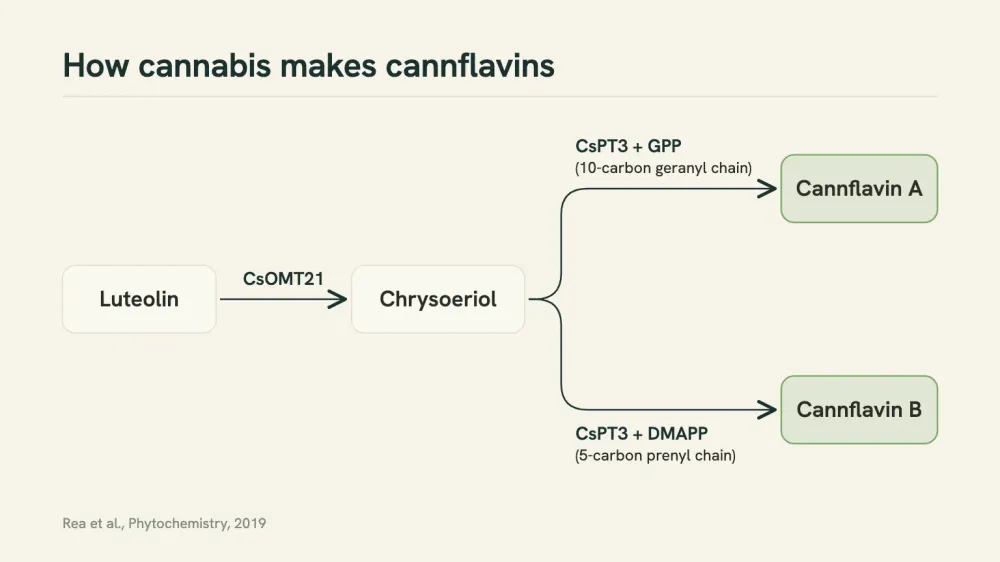
Most cannabis flavonoids are the ordinary kinds. The cannflavins stand out because of one structural detail: each carries a carbon chain that common food flavones do not. A 2021 mini-review in ACS Omega describes them as "prenylated (C5) and geranylated (C10) flavones that are relatively unique to C. sativa". In plain terms, cannflavin B carries a five-carbon prenyl group and cannflavin A a ten-carbon geranyl group. That is why cannflavin A's formula, C26H28O6, has five more carbons than cannflavin B's, C21H20O6. The 1986 paper that named them called both "prenylated flavones", and the rest of this page does the same.
How the plant makes them was worked out in 2019. A University of Guelph team, publishing in Phytochemistry, identified the two enzymes. The first, CsOMT21, turns luteolin, which the paper calls "the widespread plant flavone", into a closely related flavone called chrysoeriol. The second, CsPT3, attaches a carbon chain to chrysoeriol: a ten-carbon chain gives cannflavin A, a five-carbon chain gives cannflavin B. The authors describe the route as "a branch point from the general flavonoid pathway". The enzymes were characterized in the lab, which is the right tool for a pathway question, and it tells you nothing about what the finished compounds do.
One correction to what you will read elsewhere. At least one testing-lab page on the first page of search results says cannflavins are made only by cannabis. They are characteristic of cannabis, not exclusive to it: a 2011 paper in Phytotherapy Research isolated cannflavin A from a desert monkeyflower, Mimulus bigelovii.
The 1985 experiment behind the famous comparison
Almost every popular page about cannflavins repeats the same comparison with a common over-the-counter drug, and almost none says what was measured. Here it is. The number starts in 1985, in a London pharmacy school lab. Barrett, Gordon and Evans, writing in Biochemical Pharmacology, described isolating from cannabis "an inhibitor of prostaglandin (PG) E2 production by cultured rheumatoid synovial cells". In plain terms, the researchers took cells from the joint lining of people with rheumatoid arthritis, grew them in dishes, provoked them to make a signaling molecule called prostaglandin E2, and tested which substances cut that output. They named their substance cannflavin, on what the abstract calls a preliminary structural analysis, and compared it with several established drugs and with the major cannabinoids.
A year later, the same group reported in Experientia that the activity came from two compounds, which they named cannflavin A and cannflavin B and described as "novel prenylated flavones", isolated from a cannabinoid-free ethanol extract. Both cut prostaglandin E2 output in the same kind of cells. The 1986 abstract names no comparison drug. That is why you will see the famous figure dated to both years. The comparison belongs to 1985; the names A and B belong to 1986.
Now the figures, with an honest caveat first: we could not open the 1985 paper itself, which is behind a paywall, so the numbers that follow are the ones a 2025 review in Plants reports for it. According to that review, the cells were stimulated with a phorbol ester (phorbol 12-myristate 13-acetate, at 10 ng/mL), and it took about 31 nanograms per milliliter of cannflavin to cut their prostaglandin E2 output in half, against about 840 nanograms per milliliter of aspirin. Divide 840 by 31 and you get about 27. That ratio, a by-weight comparison of prostaglandin E2 suppression in cultured human rheumatoid synovial cells, matches the line that cannflavin is "nearly 30 times more effective gram-for-gram" than aspirin, in the wording of the University of Guelph's 2019 announcement. "Effective" is the announcement's word. What was measured was how much of each substance it took to halve one molecule's output in a dish. The review also calls the 1985 substance cannflavin A, although the 1985 paper named only "Cannflavin".
Here is the half of the result that rarely gets quoted. The lineup had other drugs in it. According to the 2023 review of cannabis flavonoids mentioned earlier, the cannflavins' ability to cut prostaglandin E release from these cells was "intermediate between aspirin on one side and both indomethacin and dexamethasone on the other side". In other words, two of the drugs in the same comparison, indomethacin and dexamethasone, were more potent than cannflavin. The headline kept the comparator cannflavin beat and dropped the two that beat it.
Later work narrowed down how the effect happens in a dish, still only in enzyme and cell tests: the 2021 mini-review summarizes cannflavins A and B as inhibiting two enzymes, microsomal PGE2 synthase-1 and 5-lipoxygenase. And the reviews do not agree on the exact 1985 figures. A 2020 scoping review in Fitoterapia, two of whose authors were affiliated with a cannabis company, reports figures for cannflavins A and B that do not match the 2025 review's. Neither review is the original paper. That is one more reason not to repeat any of these numbers as a fact about people.
How much cannflavin is actually in the plant
The unit change is the whole story, so start there. Cannabinoids in flower are counted in whole percentage points. Cannflavins are counted in parts per million (ppm), which is the same as milligrams per kilogram or micrograms per gram. One percentage point is 10,000 ppm. With that in hand, four independent sets of measurements land in the same range, tens to hundreds of parts per million. A 2020 analysis of flower from four commercial hemp varieties found cannflavin A and B averaging 61.8 and 84.5 mg/kg. A 2018 study of six hemp flower samples found cannflavin A from about 60 to 320 µg/g. A 2025 University of Mississippi study found cannflavin A anywhere from about 15 to 480 ppm across the cannabis chemovars it tested and called the content "highly chemovar-dependent". And a 2022 team that purified cannflavin A in bulk started with 300 kilograms of hemp aerial parts and finished with 38.73 grams, a yield of 0.013%. One of that paper's authors works for a hemp pharmaceutical company.
- 1Add the 2020 averages: 61.8 + 84.5 = about 146 mg of cannflavins A and B per kilogram of flower.
- 2Per gram of flower, that is about 0.15 mg. As a percentage, 146 ppm divided by 10,000 is about 0.015%.
- 3The bulk purification: 300,000 g of hemp in, 38.73 g of cannflavin A out, or roughly 7.7 kg of plant for every gram of compound.
- 4That 0.013% is a yield after many purification steps, from leaves and stems as well as flower, so it is a floor on what the plant held, not a measurement of it.
- 5One analytical route and one preparative route land on the same order of magnitude: a little over one hundredth of a percent.
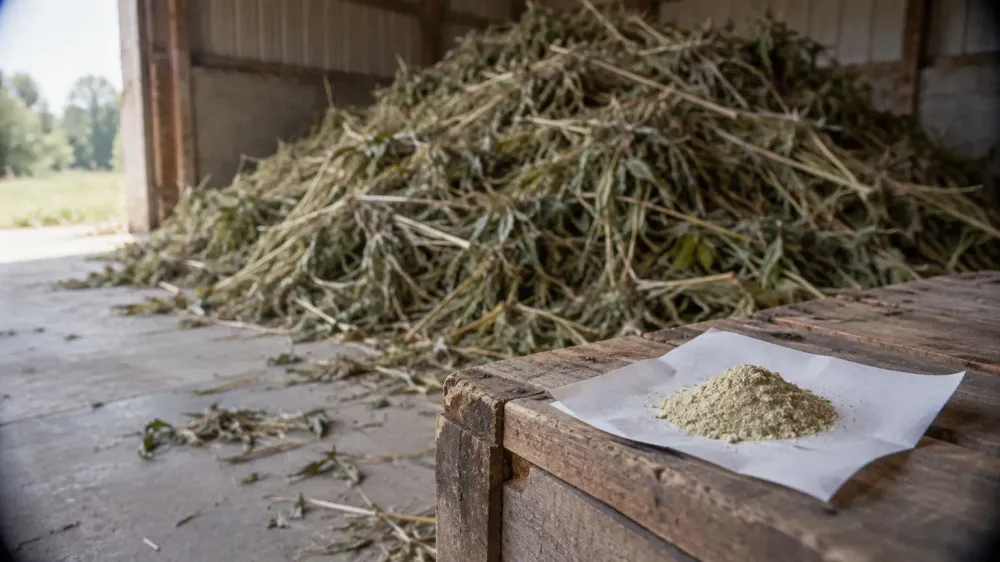
Two things follow. First, the arithmetic on this page stays inside the plant on purpose. Turning a concentration from a dish into an amount of hemp a person would "need" would quietly assume the effect happens in a person, and no one has shown that. Second, the people closest to the chemistry agree the plant is not a practical source. In the university's 2019 announcement, a Guelph researcher said the molecules are "present in cannabis at such low levels" that engineering the plant to make more was "not feasible", and the university licensed its route to a company to make cannflavins outside the plant altogether. A figure of about 0.014% circulated in 2019 press coverage; the published measurements above agree with it.
What extraction does to flavonoids (it depends which one)
You will read that flavonoids are water-loving and get stripped out when hemp is extracted. For most cannabis flavonoids that is a fair description. For the famous ones it is too simple. The processes themselves are covered in how CO2 and ethanol extraction differ, and what a still takes out is covered in what distillation removes. This section is only about where flavonoids go.
| Compound | What it is | Computed XLogP |
|---|---|---|
| Vitexin | Sugar-bound flavone, the most abundant flavonoid in the 2020 flower analysis | 0.2 |
| Luteolin | Common plant flavone, the starting point of the cannflavin branch | 1.4 |
| Chrysoeriol | The intermediate the carbon chain is attached to | 1.7 |
| Cannflavin B | Chrysoeriol plus a five-carbon prenyl chain | 4.6 |
| Cannflavin A | Chrysoeriol plus a ten-carbon geranyl chain | 6.4 |
| CBD (for comparison) | A cannabinoid, not a flavonoid | 6.5 |
Read the table from the top. On paper, cannflavin A is about as fat-loving as CBD itself, 6.4 against 6.5, while vitexin, the sugar-bound flavonoid that led the 2020 flower analysis, sits at 0.2. The added carbon chain is what moves the number: luteolin, where the branch starts, scores 1.4. A sugar-bound flavonoid like vitexin tends to stay behind when a nonpolar solvent is used. The cannflavins are the fat-loving exception. Again, that is a calculation, not a measurement of what survives a real extraction.
The measurements that do exist point the same way. A 2018 lab study in Food Chemistry found that supercritical CO2 took more than 93% of the cannabinoids out of hemp threshing residue, and the flavonoid-containing fractions only came out afterwards, in later pressurized-liquid steps using more polar solvents. A 2015 analysis in Talanta found that cannflavin A and B "are extracted and detected together with cannabinoids but always subordinated": they travel with the cannabinoids into an ethanol extract, but always as a minor passenger. And the original 1986 isolation was an extraction lesson in itself. According to the 2023 review, a light petroleum solvent took the cannabinoids out of the leaves first, and the cannflavins were found in the ethanol extract that came after.
The part a buyer would want is missing. We could not find a single published measurement of what happens to cannflavins in winterization or in a distillation still (PubMed search, September 2026). Anyone who tells you a distillate keeps them, or loses them, is guessing. And none of this tells you what any particular bottle contains, ours included. Only a test of that bottle can.
Why your COA will not show flavonoids
Here is the observation, made on our own paperwork. Open any of our 13 current certificates of analysis (COAs), for the tinctures and the tablets, and count the rows in the potency panel. You will find 13 cannabinoids (CBC, CBD, CBDA, CBDV, CBG, CBGA, CBL, CBN, CBT, delta-8-THC, delta-9-THC, THCA and THCV) plus totals, measured by Infinite Chemical Analysis Labs using UHPLC-DAD, a liquid chromatography method. The tincture certificates also cover heavy metals and microbes; the tablet certificate reports potency only. There is no flavonoid row, and no terpene row either. That is not a gap in ours specifically: a cannabinoid potency test is built to measure cannabinoids, and flavonoids are not what it looks for. For the sections a certificate does carry, see how to read a lab report.
Flavonoid testing does exist. At least one US cannabis testing lab advertises a separate flavonoid panel covering up to 16 analytes by LC-MS, sold as an add-on rather than as part of a potency test. Researchers have validated methods too: a 2023 method paper in the Journal of Pharmaceutical and Biomedical Analysis describes an LC-MS method for cannflavins A, B and C in hemp extract specimens, and the 2025 Mississippi study above validated a liquid chromatography method for cannflavins in plant material. So it can be done. It just is not done on a routine certificate, and nothing requires it. The federal hemp rule defines testing around total THC in the crop, calculated as 0.877 times THCA plus delta-9-THC. Nothing in it asks anyone to measure flavonoids.
Put together, that gives the most useful sentence on this page. A cannabinoid potency panel does not measure flavonoids. Some labs sell a separate flavonoid panel. So a flavonoid claim on a hemp product is checkable only if the brand publishes that panel; otherwise you have nothing to check it against.
Reading a flavonoid claim in sixty seconds
When a label or product page mentions flavonoids or cannflavins, run it through these questions. Each takes a few seconds, and together they separate a checkable claim from decoration.
- 1Does it name a specific flavonoid, such as cannflavin A or quercetin, or just say "flavonoids"? A named compound can be tested. A general word cannot.
- 2Is there a flavonoid panel on the certificate, with the method (LC-MS or HPLC) and a detection limit? If not, the claim cannot be checked against anything.
- 3Is an amount given, per serving or in ppm? Convert it: 1% is 10,000 ppm. Cannflavins in hemp flower run at tens to hundreds of ppm.
- 4Is a health effect attached? Ask which study, and whether it was in cells, worms, rodents or people. For cannflavins, no published study has been in people.
- 5Does it quote a potency comparison with a drug? Ask which assay, which year, and which drugs in the same test did better.
- 6Is the product a distillate or an isolate? We found no published measurement of cannflavins after distillation, so a claim about them needs a test of that product.
- 7Is the claim about purple color? Purple is anthocyanin pigment, a flavonoid, and in a 2025 study it tracked temperature, not CBD content.
Two last checks point to pages that already own them. If the claim is that flavonoids boost what cannabinoids do, it is an entourage claim, it is unmeasured in people for flavonoids, and it runs into the dose problem behind entourage claims. If the claim is about what CBD itself does for you, the honest summary is what human research on CBD does and does not support.
What is still unknown
Quite a lot, and it is worth saying plainly. As of September 2026, ClinicalTrials.gov lists no trial of cannflavins in people, and a PubMed search found no published study of how much cannflavin a person absorbs from anything. There is no human safety data. That cuts both ways: it is not evidence of harm, and it is not evidence of safety.
What is being studied now is still in dishes and small animals: a 2025 study in human immune cells, mouse nerve cells in a 2023 Guelph study (Phytomedicine Plus, doi:10.1016/j.phyplu.2023.100410), a 2024 study in a microscopic worm and a 2026 study in rats. None of it tells you what a cannflavin does in a person. The 2020 scoping review named the bottleneck in one line: "Low yields of extraction however have previously limited research to small pre-clinical investigations." You will also find patents on cannabis flavonoid derivatives near the top of search results. A patent is a legal claim to an invention, not evidence that it works in people.
Flavonoids are not the reason cannabis can make you high; the intoxicating compound in cannabis is THC, a cannabinoid. Flavonoids are the same family of compounds found in tea, onions and cocoa, and cannabis flower carries them at a fraction of a percent. Cannflavins, the ones characteristic of cannabis, have not been tested in people at all, so there is no human data on them either way.
From a 1985 laboratory test, not a study in people. Researchers grew cells from the joint lining of people with rheumatoid arthritis, provoked them to make a signaling molecule called prostaglandin E2, and compared substances by weight for how much it took to halve that output. The drug in the headline is the least potent of the three comparators a 2023 review names; according to that review, indomethacin and dexamethasone were both more potent than cannflavin. No published study has tested cannflavins in people since. The section on the 1985 experiment above has the figures and who reports them.
For any given bottle, you cannot know unless it was tested for them. Most cannabis flavonoids are sugar-bound and water-loving, and tend to stay behind when a nonpolar solvent is used. Cannflavins are the exception on paper, about as fat-loving as CBD, and a 2015 analysis found they travel with cannabinoids into an ethanol extract as a minor passenger. We found no published measurement of what happens to them in winterization or distillation, and a standard potency certificate does not report them. Only a flavonoid panel on that product can answer the question.
Because a potency test measures cannabinoids. Ours lists 13 of them and no flavonoids, and that is how cannabinoid potency panels work generally. Flavonoid testing exists as a separate, paid panel, and the only federally required hemp test is for THC in the crop. If a brand makes a flavonoid claim, ask to see the flavonoid panel.
Anthocyanins, the purple, red and blue pigments, are flavonoids. In a 2025 growth-chamber study, anthocyanin peaked when plants were held at 8 °C and 15 °C, while CBD content tracked plant maturity instead. Purple color is a pigment story, not a potency story.
There is no human safety data in either direction. No published study has tested cannflavins in people, no trial is registered, and no one has published how much a person absorbs. That is not evidence of harm and not evidence of safety. It is an absence of data, and the honest answer is that nobody can tell you yet.
For flavonoids, that idea is unmeasured in people. It also runs into the same problem as terpene entourage claims, which is the amount: cannflavins sit at parts per million in flower, and no published study has tested cannflavins in people at all, let alone alongside cannabinoids. Our entourage effect guide covers how these claims are built and where they break.
To see exactly what a potency panel does and does not cover on a real certificate, open our published certificates and count the rows yourself.
Writing about hemp, wellness and the small rituals that keep us balanced.