What Is CBD Distillate? A Material State, Not a Grade
CBD distillate is a material state, not a purity grade. Here is what a distillation step actually removes, what it carries through with the cannabinoids, what happens after the still, and why the batch certificate is the only document that settles any of it.
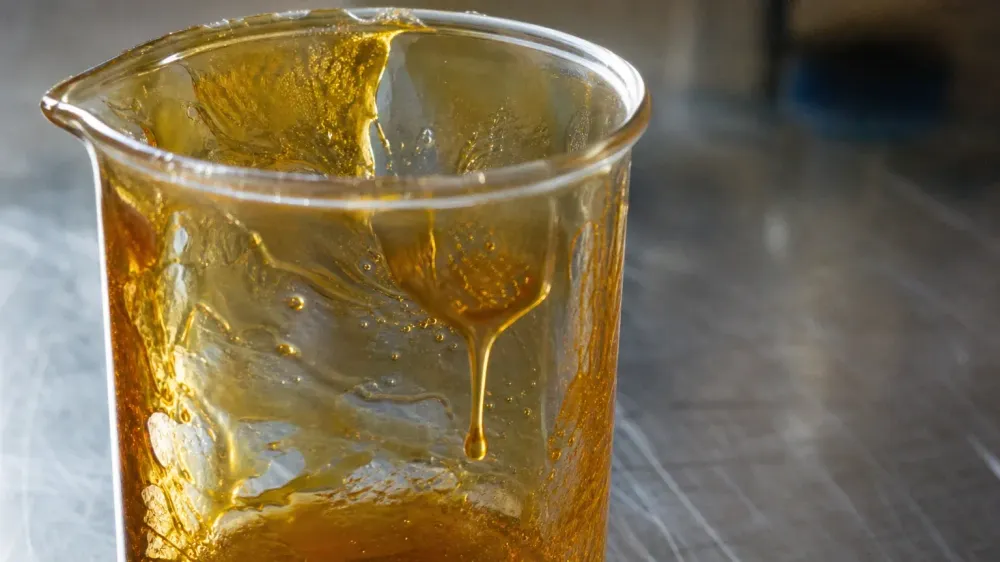
CBD distillate is a refined hemp extract, and the word describes how the material was processed, not how clean it is, how strong it is, or what is still in it. Distillation sorts molecules by how easily they evaporate, which means it has no way to tell a cannabinoid from a pesticide that boils in the same neighborhood.
The short version, up front. Distillate is a material state: a crude extract that has been put through a vacuum distillation step, which strips off the lighter fraction, converts the acid forms of the cannabinoids into their neutral forms, and leaves a thick, high-cannabinoid oil behind. It is the ingredient that most high-concentration tinctures are built from, not something you buy in a dropper bottle. It is not a purity grade, it is not a spectrum, and it is not a substitute for a test result. If you want to know what is actually in a bottle made from distillate, the batch certificate of analysis is the only document that answers the question.
What CBD distillate actually is
Start with what the word describes. Distillation is the oldest separation trick in chemistry: heat a mixture, let the parts that evaporate most easily leave first, and collect them somewhere else. Applied to a hemp extract, it means taking the thick, dark, everything-included material that comes out of an extractor and pulling it apart by boiling behavior. What you collect in the cannabinoid window is the distillate. What stays behind is the residue, and it gets discarded.
The industrial version is not a flask on a hot plate. A 2025 process-development paper in Pharmaceutics describes it as wiped-film distillation under a vacuum below 0.2 millibar, run as the final purification step, and notes two things worth holding onto: decarboxylation happens inside the process, and terpenes can be separated out beforehand and reintroduced afterwards. Read that paper with its disclosure attached. The authors developed and commercialized the process, several are employees of or funded by the company behind it, and what they describe is a pharmaceutical-grade medicinal oil, not a description of how any particular consumer tincture is made.
Why the deep vacuum? Because cannabidiol barely evaporates at all. In 2026, metrologists at the US National Institute of Standards and Technology measured the saturation vapor pressure of pure CBD, THC and CBN across 91 to 151 degrees Celsius, and CBD topped out at 13.44 pascals at the hot end of that range. Atmospheric pressure is about 101,325 pascals. That gap is what a vacuum has to close before a cannabinoid will move at a temperature that does not wreck it. The measurement was made to support breath testing rather than distillation engineering, and it used pure compounds instead of a real extract, but the number is the reason the equipment looks the way it does. The steps that come before the still, the extraction itself and the winterization that pulls out waxes and lipids, are covered in our walkthrough of how CBD is extracted, method by method. This page picks up at the output.
Distillation sorts by volatility, not by safety
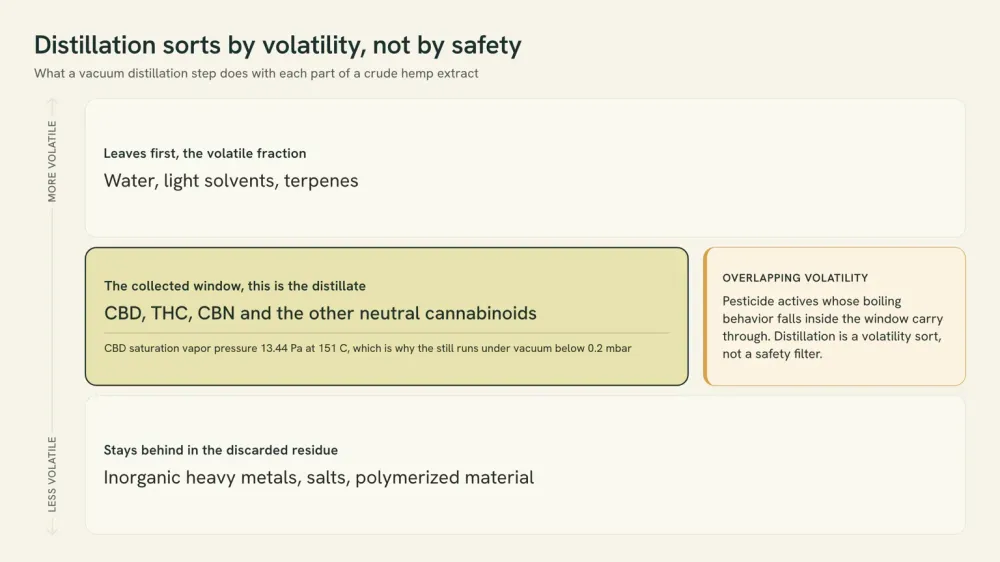
This is where most of what you will read about distillate goes wrong. A still does not know what anything is. It only knows what evaporates under the conditions you set. Everything whose boiling behavior falls inside the collected window comes over with the cannabinoids, and everything outside it does not. At no point in that process does anything ask whether a molecule is desirable.
| Component | What the distillation step does with it | Why |
|---|---|---|
| Water and light solvents | Removed or greatly reduced | They boil far below the cannabinoids and come off ahead of them |
| Waxes and lipids | Mostly gone before the still | Winterization removes them at an earlier step, which is a different operation |
| Terpenes | Removed or greatly reduced | They are the volatile fraction and leave ahead of the cannabinoids |
| CBD, THC and other neutral cannabinoids | Kept, this is the collected fraction | They vaporize under deep vacuum at the operating temperature |
| Acid forms such as CBDA, THCA and CBGA | Converted, not removed | Heat decarboxylates them into their neutral counterparts |
| Pesticide actives with overlapping volatility | Can carry through | The sorting criterion is boiling behavior, and a pesticide is not exempt from it |
| Inorganic heavy metals | Not addressed by this step at all | They do not vaporize, so they stay in the discarded residue, but nothing here measures them |
| Solvents introduced after distillation | Not addressed by this step at all | Remediation and polishing steps run in their own solvents, downstream of the still |
The terpene row is measured, not assumed. When researchers at Oregon State University and the University of Camerino steam-distilled four CBD-hemp varieties in 2021, the terpenes came off into an essential oil while the cannabinoids stayed in the plant material, which ended up carrying 3.4 to 9 times more CBD than it started with. What came off was terpenes, not cannabinoids: in the Cherry Wine variety the essential oil carried 23.2% myrcene and 16.7% caryophyllene, caryophyllene reached 30.5% in another of the four, and across all four the oil held only 0.06% to 5.3% CBD. That was steam distillation of biomass, which is a different operation from vacuum distillation of a crude extract, so treat it as a demonstration of the volatility ordering rather than a description of how distillate is manufactured. The ordering is the part that transfers: terpenes are the light fraction, and they go first.
The same experiment caught two other things heat does. The acid forms converted to their neutral forms, CBDA to CBD and THCA to THC. And CBN appeared in the distilled material where there had been none before it. Heat is not a neutral operation performed on a fixed set of molecules. It rewrites the profile while it works, which is why a distillate's cannabinoid list is not simply the plant's list with the water taken out.
Now the part the marketing copy gets backwards. Heavy metals are not volatile, so they do not follow the cannabinoids into the collected fraction; they stay behind in the residue that gets thrown away. That does not turn distillation into a metals filter, for two reasons. First, metals arrive with the crop rather than at the still: a 2026 greenhouse study in the Journal of Cannabis Research dosed four cannabis cultivars with cadmium, lead, nickel and cobalt and found that even at moderate to low exposure, cadmium and nickel in the flowers exceeded the World Health Organization's threshold for medicinal plant use. That was a controlled greenhouse experiment with deliberate dosing, not a survey of anything on a shelf. Second, the step that concentrates whatever came in with the plant is the extraction step, where a large mass of biomass becomes a small mass of extract, which sits upstream of the still and belongs to that article. Either way, nothing the still does measures a metal. An ICP-MS run on the finished product does, and that is a line item on a certificate.
The page-one claim the chemistry does not support
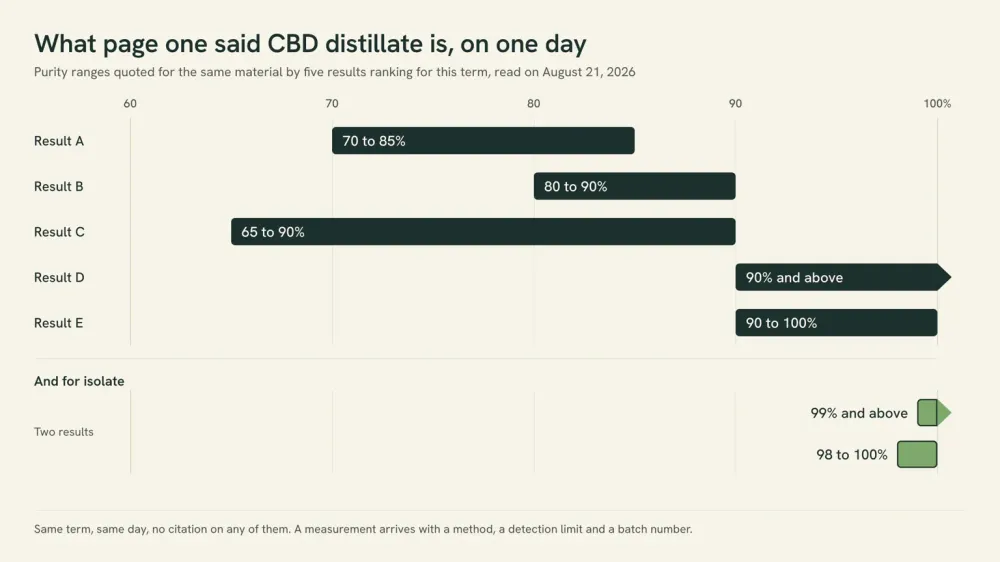
Search this term and you will meet a sentence that circulates almost word for word across the results. We read page one on August 21, 2026. Here is the version we found, quoted exactly. We are not naming the page, because the problem is the claim and not the company:
“A CBD distillate will not contain any lipids, impurities, fertilisers, pesticides, or solvent residues.”
A few lines further down, the same page added that distillate will not have any unnecessary or harmful components such as solvents, heavy metals, or mildew. That is not a description of distillation. It is a description of a hope. If the sentence were true, the entire contaminant half of a certificate of analysis would be pointless for any product made from distillate, which is a strong enough consequence that it is worth checking rather than repeating.
The numbers on that page one did not agree with each other either. On a single day, results ranking for this term offered five incompatible purity figures for the same material: 70 to 85% CBD by weight, 80 to 90% pure CBD, 65 to 90%, a minimum of 90% pure, and 90 to 100% pure cannabinoid. For isolate the same page one offered 99% or higher, and separately 98 to 100%. Not one of them carried a citation. There is no need to argue that any particular figure is wrong. The useful observation is that one afternoon's search produced five answers to one question, which tells you what a purity number on a marketing page is: a description, not a measurement. A measurement arrives with a method, a detection limit and a batch number attached to it.
Separating a pesticide from CBD is a purpose-built engineering problem, and a stubborn one. A 2020 study in Industrial Crops and Products screened the 59 pesticides Oregon regulates in cannabis products and ranked each of them by how cleanly it separates from CBD in liquid-liquid chromatography, a technique chosen specifically to do that job. Depending on the solvent system, 50 to 70% of the listed actives separated easily, while 13 to 22% came out rated medium or highly critical, meaning hard to pull away from CBD. That study is chromatography and not distillation, so it does not tell you what happens inside a wiped-film still. It tells you something more useful: if a method designed for this task struggles with up to a fifth of a regulator's list, a step whose only sorting criterion is boiling behavior is not quietly solving the problem on the side.
Somebody has measured what concentrates actually carry. A 2015 survey in the Journal of Toxicological Sciences screened 57 cannabis concentrates submitted by California medical users in late 2012 and early 2013. Pesticides were absent in 66.7% of them, with paclobutrazol the most frequent detection at 22.8%. Residual solvents were absent in 28.1%, isopentane was the most frequent at 29.8%, and all nine hash samples came back free of solvent. Read the caveats before you read those numbers, because here they matter more than usual. These were inhaled dabbing concentrates, not oral tinctures, not hemp, not CBD and not distillate. The samples were self-submitted rather than randomly drawn. The market they came from predates every state testing program now in place. And the authors state plainly that their pesticide and solvent analysis was 'qualitative and not quantitative', so a detection is not an exceedance and is not a safety finding. It is cited here for exactly one principle: refining a plant extract does not automatically leave contaminants behind.
The reason a contaminant panel exists at all is that four hazard categories are real and independent of each other: heavy metals, pesticides, mycotoxins and residual solvents. A 2026 critical review of how US states regulate and measure cannabis contaminants, published in Cannabis and Cannabinoid Research, described the situation as 'wide variability in allowable limits, analyte lists, and method validation requirements'. Different instruments answer different questions: ICP-MS for metals, LC-MS/MS and GC-MS/MS for pesticides and mycotoxins, headspace GC for residual solvents. The lists are long, too. A 2021 method paper in Talanta built its workflow around an initial target list of 74 pesticides in cannabis oil, and it reports analytical performance rather than how often anything is found. Note that the review covers state-licensed cannabis rather than hemp CBD, which widens the gap between claim and measurement rather than measuring it. A purity claim nobody can check is one of the signals worth treating as red flags, and the separate question of who ran the test has its own answer in what third-party tested actually means.
Steps after the still can put solvents back in
Here is the point that follows directly from the chemistry and that almost nobody makes. Distillation does not remove THC. THC is a cannabinoid whose vapor pressure stays within a factor of two of CBD's across the whole range NIST measured, so it travels with it. A distillate made from an extract that had trace THC in it is a distillate with trace THC in it. If a material is being sold as THC-free, some other step produced that, and that step is published.
A 2025 paper in the Journal of Chromatography A took the process from lab to industrial scale using centrifugal partition chromatography with a heptane, ethanol and water system. From 800 grams of full-spectrum extract, one run recovered 613 grams of broad-spectrum material at 85% CBD and 0.02% THC in 9.5 hours. The part worth reading twice is what else moved: 97.06% of the cannabichromene ended up in the residual fraction, discarded along with the THC. Two limits on that figure. The target there was a Colombian threshold below 0.05%, not the US 0.3% figure, and the 85% is one measured output from one process run, not a market range for anything.
Two consequences follow, and they are the practical payoff of this whole section. First, remediation is a solvent process, which means a broad-spectrum distillate has been through solvents after the still. That is precisely the point at which a residual-solvent panel stops being redundant and starts being the relevant test, and what that panel can and cannot see is set out where the solvents first enter the story. The pesticide separation work above ran in heptane with methanol, acetone or acetonitrile; the THC work ran in heptane, ethanol and water. Second, a refined intermediate is a starting material, and starting materials can be converted into other molecules deliberately, which is the basis of the conversion chemistry behind delta-8. Refinement makes a material more useful. It does not make it finished, and it does not make it tested.
Distillate versus full spectrum is a category error
This comparison shows up in search boxes constantly, and it does not have an answer, because the two words are not on the same axis. Distillate is a material state: it describes what was done to the material. Full spectrum is a composition claim: it describes what is still in it. Any real product has one answer on each axis, which is why full-spectrum distillate and broad-spectrum distillate are both ordinary things and neither one is a contradiction. Asking whether a distillate is full spectrum is like asking whether a bread is baked or whole grain.
| Term | Which axis it describes | What it tells you | What it leaves open |
|---|---|---|---|
| Crude extract | Material state | Everything the solvent pulled out of the plant is still in there, waxes and pigments included | How much THC is present, and what the cannabinoid total is |
| Distillate | Material state | The extract went through a vacuum distillation step, so it is decarboxylated and largely terpene-stripped | Whether THC was removed, and what any contaminant panel says |
| Isolate | Material state | The material is a crystallized single compound rather than a mixture | Its actual purity, which only its own certificate reports |
| Full spectrum | Composition claim | Trace THC and the minor cannabinoids are still present | How refined the material is, or how it was made |
| Broad spectrum | Composition claim | A remediation step targeted the THC after the refining | What else that step carried away, and which solvents it used |
The honest follow-on is about terpenes. If terpenes leave with the light fraction and are added back afterwards, which the 2025 process paper names as an explicit option, then whole plant is a phrase that needs qualifying. Nothing on a label distinguishes aroma compounds that traveled with the plant from aroma compounds poured in from a separate bottle. The only thing that could is a certificate with a terpene panel on it. Which spectrum to actually buy is a different decision and it has its own page: full spectrum, broad spectrum and isolate as a buying decision. Whether the minor compounds do anything together is a research argument that belongs to our look at the entourage effect, and this page does not re-run it.
The arithmetic that makes a 250 mg/mL tincture possible
Here is why any of this reaches somebody holding a bottle. A high-concentration tincture cannot be crude extract stirred into oil, and you can prove that to yourself with a multiplication. Take one of our own products, because our certificates are the only ones we can print numbers from: Broad Spectrum Mango & Peach. The label says 250 mg/mL of CBD and 15,000 mg in the bottle. Check the label against itself first: 250 mg/mL times 60 mL is 15,000 mg, so it is internally consistent. Now open the certificate for batch 260320, produced April 1, 2026.
The certificate reports 16,300 mg of total CBD in the package and 269 mg/mL by volume, against a 15,000 mg label and 250 mg/mL. It reports more than the label promises, not less. That is worth stating flatly rather than selling: the exercise is a reconciliation, and the number that exists is the one on the certificate. Then comes the line that holds this whole article together. The package weighs 56.7 grams at a density of 0.934 g/mL, and the certificate puts CBD at 28.8% of that mass, with total cannabinoids at 29.3%. Close to three parts in ten of a finished tincture, by weight, is cannabinoid. You cannot reach that by diluting a crude extract in coconut MCT oil, because a crude extract is not concentrated enough to get there. A refined, high-cannabinoid input is what makes that arithmetic physically possible. That is a statement about what the numbers allow, not a description of our supply chain, which we do not publish. Turning mg/mL into a per-drop figure is the dropper math, and turning it into a fair comparison between two brands is cost per milligram.
What our own certificates report, and what they do not
We should hold our own paperwork to the same standard. Every Planntz certificate of analysis published on our lab results page reports cannabinoid potency by UHPLC-DAD across thirteen individual cannabinoids plus three calculated totals, four heavy metals by ICP-MS, and six microbial tests, batch by batch, with the lab's license number and a public verification link on the page. What they do not include is a pesticide panel, a residual-solvent panel, a mycotoxin panel or a terpene panel. We are telling you that here because an article whose whole argument is that the document beats the adjective would be worthless if it hid its own document's limits.
- Potency by UHPLC-DAD, method POT-INST-005: 13 individual cannabinoids plus three calculated totals, with a detection limit and a quantitation limit printed beside every cannabinoid row.
- Heavy metals by ICP-MS, four analytes: arsenic against a 1.5 microgram per gram limit, cadmium against 0.5, lead against 0.5 and mercury against 3.
- Microbial, six tests: coliforms, yeast and mold, aerobic bacteria, E. coli, S. aureus and Salmonella species, five of the six against a printed action limit.
- Not on them: no pesticide panel, no residual-solvent panel, no mycotoxin panel, no terpene panel. Those are four separate tests and we do not currently publish any of them.
One more thing our certificates print belongs in this article. Every acid form reads ND, which means not detected: CBDA, THCA and CBGA all come back below the detection limit on every live batch we checked on August 21, 2026. On batch 260320 the CBDA row reads ND against a detection limit of 0.0831 mg/mL and a quantitation limit of 0.249 mg/mL. That is a statement about the document, not about our process. We are telling you what the report says, not how the material was made. Why an acid form disappears in the first place is the decarboxylation story told from CBDA's side, and how to read any of these rows, including what a detection limit actually means for a not-detected result, is our walkthrough of a certificate of analysis.
Five questions to ask about any distillate claim
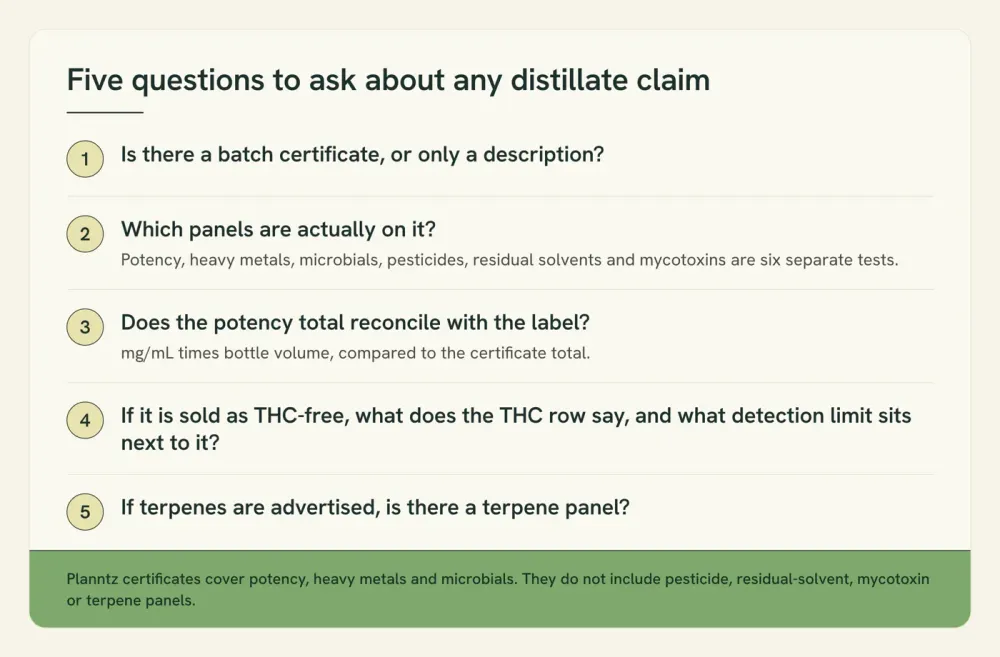
- 1Is there a batch certificate, or only a description? A processing word is not a measurement, and a certificate for a different batch is not a measurement of the one in your hand.
- 2Which panels are actually on it? Potency, heavy metals, microbials, pesticides, residual solvents and mycotoxins are six separate tests. A certificate that shows one of them is silent about the other five, and that includes ours.
- 3Does the potency total reconcile with the label? Multiply the mg/mL by the bottle volume and compare it against the certificate's total. A gap in either direction is a question worth asking out loud.
- 4If it is sold as THC-free, what does the THC row say and what detection limit sits next to it? Non-detected at a stated limit is a real answer. THC-free with no number attached is not an answer at all.
- 5If terpenes are advertised, is there a terpene panel? Without one, nothing in the paperwork separates plant terpenes from terpenes reintroduced after processing.
Those five are the distillate-specific slice of a larger decision. The full version, which puts strength, spectrum, carrier oil and price in the same frame, is how to choose a CBD oil. And if the front label says hemp extract without naming a material state at all, that phrase has its own definition problem: see what hemp extract means on an ingredient list.
What this page cannot tell you
Some honest limits, because this is an argument about evidence and it should hold itself to the same rule. None of the studies cited here measured a retail CBD tincture. The vapor-pressure work measured pure compounds in an instrument. The volatility-ordering study steam-distilled biomass, which is not how distillate is produced. The contaminant survey looked at inhaled concentrates from a pre-regulation market more than a decade ago. The two process papers describe specific industrial processes built by their own authors, one of them with a declared commercial interest in the result. What we did not find, in our reading on August 21, 2026, is a study measuring what fraction of the distillate on the market carries anything at all. That absence is the real state of the evidence, and it is also why the argument lands where it does. Since the category-level number does not exist, the batch-level document is what you have.
Frequently asked questions
It depends entirely on whether a remediation step was run after distillation, and the only thing that answers it for a specific product is that product's certificate. Distillation on its own does not remove THC, because THC evaporates in roughly the same range as CBD does. On page one for this term on August 21, 2026 we found three incompatible answers stated as fact: no THC at all, sometimes 2 to 3% by weight, and under 0.03% by weight. For our own products, the Broad Spectrum Mango & Peach batch 260320 certificate reports total THC of 0.000 mg per package, and our full-spectrum batches report a trace below the 0.3% federal limit. We report what a batch measured rather than promising THC-free, because no product can guarantee a drug test outcome.
No. Distillate is a raw material, an ingredient traded between businesses by the kilo. CBD oil is a finished product: distillate, or some other input, diluted into a carrier oil, which for our tinctures is coconut MCT. You do not buy distillate in a dropper bottle. You buy something that was made from it, and the dilution is most of what determines the strength printed on the label.
Either, both or neither, because those words answer a different question. Distillate describes the material state, meaning what was done to the extract. Spectrum describes the composition, meaning what is still in it. A full-spectrum distillate has kept its trace THC and its minor cannabinoids. A broad-spectrum distillate has been through a THC remediation step afterwards. Neither phrase is a contradiction, and neither one tells you the other half of the answer.
Usually far fewer than the plant had. Terpenes are the volatile fraction, so they leave ahead of the cannabinoids in any distillation, which is exactly what the 2021 steam-distillation study measured. Many finished products add terpenes back afterwards, a step the 2025 process literature names as an explicit option. The only way a buyer can tell the difference is a certificate with a terpene panel on it, and ours do not have one: our published certificates cover potency, heavy metals and microbials only.
Distillate is not a safety category, so the question does not have an answer at the level of the word. Distillation sorts by volatility rather than by hazard, which means it is not a contaminant filter, and the four hazard categories that contaminant panels exist for, heavy metals, pesticides, mycotoxins and residual solvents, are each measured by their own instrument on the finished product. Safety is a statement about a specific batch's results, not about a material's name. If a claim about a product cannot be traced to a printed result with a method and a detection limit beside it, treat it as marketing rather than as information.
As a material, yes by definition: refining raises the cannabinoid fraction, which is what makes a high-concentration tincture possible at all. As a product on a shelf, the comparison stops meaning anything, because what reaches you is the diluted version. The number that matters is milligrams per milliliter on the label, reconciled against the total on the batch certificate, and then divided into per-drop terms using whatever dropper you actually own, since drop size varies by dropper and technique.
If you take one habit from this page, take this one: when a claim about a CBD product is a word, go find the number behind it. Ours are published batch by batch, and you can open every batch report we publish without an account or an email address. If the columns and the abbreviations are unfamiliar, start with reading a certificate line by line and come back to the label arithmetic afterwards.
Read the certificate before the copy
Every Planntz tincture ships with a public, per-batch certificate of analysis covering cannabinoid potency, four heavy metals and six microbial tests, with the lab's license number and a verification link on the page.
See the tincturesWriting about hemp, wellness and the small rituals that keep us balanced.