What Is RSO? Rick Simpson Oil in Milligrams and Evidence
RSO (Rick Simpson Oil) is a dark, whole-plant cannabis extract sold in oral syringes. Here is what is in it, how it differs from distillate, what a 'grain of rice' holds in milligrams of THC, and what the cancer evidence behind the name actually shows.
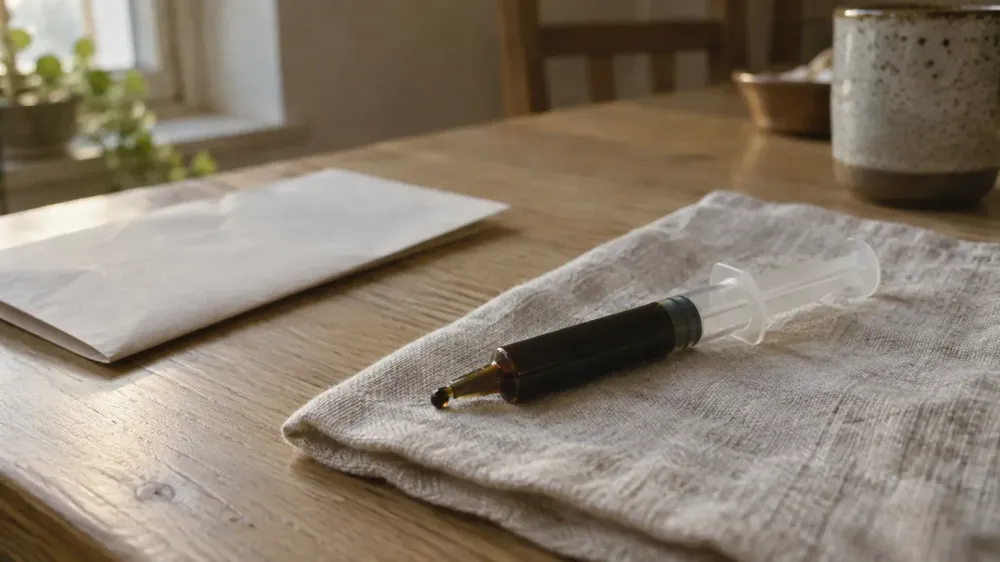
What is RSO? RSO stands for Rick Simpson Oil: a thick, dark, whole-plant cannabis extract, usually sold in a small oral syringe. Sellers label it 60 to 90 percent THC, which puts several hundred milligrams of THC in a single 1-gram syringe. It is named after a Canadian man who said the oil healed his skin cancer. No published trial has tested RSO, and the FDA has approved no cannabis product to treat cancer.
Most pages that rank for this question are dispensary posts and sponsored explainers. They say "not a proven cure" in one line and then list benefits. None of them turns the famous "grain of rice" serving into milligrams, and none of them reads the studies the cancer story actually rests on. This page does both. You will get what RSO is made of, how it differs from the refined extract covered in our guide to THC distillate, the milligram math with every input shown, what each human study did and did not show, the safety issues specific to a syringe this concentrated, the legal picture, and five lines to check on any RSO label. We do not give a recipe, a dose or a treatment schedule, and we explain why.
What is RSO, exactly?
RSO is a full-plant extract: cannabis flower soaked in a solvent, with the solvent then removed, leaving a sticky, near-black paste. Unlike a refined oil, nothing much is taken out after extraction, so the cannabinoids come with the plant's waxes, fats and pigments. Ethanol, the solvent most often used for this kind of extract today, is good at pulling cannabinoids from the plant but not selective about what else comes along; a 2024 comparison of hemp extraction methods noted that plant pigments ride along in ethanol extracts. That is why RSO is dark and thick rather than clear and golden.
Two more facts define the product. First, RSO is heated during production, which converts the plant's THCA into active delta-9 THC (decarboxylation), so the oil is intoxicating when swallowed. Second, "RSO" is a trade term, not a standard. We searched for a state rule defining "Rick Simpson Oil" or its near-synonym FECO (full-extract cannabis oil) and found none, so two syringes with the same name can hold very different oils. It is usually sold in a 1-gram oral syringe, and sellers describe people swallowing it, holding it under the tongue, or mixing it into food or capsules. The US cannabis potency monitoring program gives the closest measured number for the product class: seized cannabis concentrates averaged 55.7 percent THC in 2017, up from 6.7 percent in 2008. That figure covers all concentrates, not RSO specifically, which is why the "60 to 90 percent" you see on menus should be read as a label claim.
Where the name comes from
By his own account, retold widely since, Rick Simpson was a Canadian engineer who says he put cannabis oil on basal cell skin cancer spots in 2003 and that they healed. He went on to promote the oil through an organization called Phoenix Tears, and the oil took his name. That account is a personal claim. It was never documented in a medical journal, and nobody outside his story can confirm the diagnosis, what was in the oil, or what else happened.
The story spread mostly through video and forums. When University of Colorado dermatologists rated the 10 most-watched YouTube videos on THC oil and skin cancer in 2021, all 10 received the lowest quality score and all 10 were judged misleading. Of the top comments they read, 48 percent were favorable to the idea and 4 percent pushed back. That is the information environment most people meet RSO in, and it is the reason the evidence section below goes study by study.
The kitchen recipe vs. what a dispensary sells
Simpson described making his oil by soaking cannabis in a petroleum solvent such as naphtha, or in 99 percent isopropyl alcohol, then boiling the solvent off. We are not going to describe the method, because it is a fire and explosion hazard and the solvent left behind is never measured at home. Products sold as RSO or FECO in licensed dispensaries are made in commercial facilities, and consumer-health overviews describe most of them as ethanol- or CO2-extracted. "Full extract" covers a wide range: at the pharmaceutical end, a 2025 process paper on medical cannabis oil, funded by the manufacturer and written largely by authors affiliated with it, describes ethanol chilled to minus 40 degrees Celsius followed by distillation under a deep vacuum. A dispensary syringe usually sits much closer to crude. Our explainer on how CBD extraction methods and solvents compare covers the chemistry in general.
The difference between the two worlds is regulation. California's cannabis regulations (revised January 1, 2026) treat hexane and butane as "volatile" solvents that can form explosive or ignitable mixtures in air, allow them only in professional closed-loop equipment, and ban that kind of extraction anywhere zoned residential. A licensed California lab then tests the finished product for residual solvents, reports each in micrograms per gram and marks it pass or fail. Hexane, a component of naphtha, fails above 290 micrograms per gram; benzene fails above 1; ethanol, isopropyl alcohol and butane fail above 5,000. A kitchen batch gets none of that.
Burn units have seen what home solvent extraction does when it goes wrong. A Colorado burn center series counted 29 people injured making butane hash oil between 2008 and August 2014, and 19 of them needed skin grafts. That was butane, not the solvents in Simpson's recipe, but the hazard is the same kind: flammable vapor in an enclosed room with a heat source. Our page on dab burns and the hazard of making concentrates covers the injury data in more detail.
RSO vs. distillate (and FECO)
RSO and distillate start in the same place and part ways after extraction. RSO keeps nearly everything the solvent pulled out. Distillate is the next step: the crude extract is distilled under vacuum to isolate the cannabinoids, which is why it runs clear to amber and often has terpenes added back for flavor. FECO is mostly a second trade name for the same unrefined whole extract that RSO describes. Here is how the four oils you are most likely to see compare.
| RSO (as sold) | FECO | THC distillate | CBD oil (hemp tincture) | |
|---|---|---|---|---|
| What the name means | Trade term after Rick Simpson; no legal definition found | Trade term for a whole, unrefined extract; often used interchangeably with RSO | A distilled fraction of an extract | A hemp extract diluted in a carrier oil |
| Typical solvent | Original: naphtha or 99% isopropyl alcohol. Licensed: usually ethanol or CO2 | Ethanol or CO2 | Any, then distilled under vacuum | CO2 or ethanol |
| How refined | Crude: solvent removed, little else | Crude to pharmaceutical-grade | Highly refined | Refined, then diluted |
| What stays in | Cannabinoids, plant waxes, pigments | Same as RSO | Mostly cannabinoids; terpenes often stripped and added back | Cannabinoids in MCT or another oil |
| THC | Sold as very high (seller claim 60-90%; measured concentrate class mean about 56%) | Varies | Varies widely, often very high | Hemp: at most 0.3% delta-9 THC by dry weight today |
| Form | Thick paste in an oral syringe | Same as RSO | Clear-to-amber oil in carts and edibles | Liquid in a dropper bottle |
| Lines to read | Total THC mg per syringe, CBD mg, residual-solvent pass/fail, batch and lab | Same as RSO | Total THC, ingredients and additives | mg per mL, total THC, COA |
Neither "whole" nor "refined" is a quality grade. Whole extracts keep minor compounds but also keep waxes and anything the solvent dragged along; distillates are cleaner in composition but can be cut with additives. What tells you about a specific syringe is its lab report, not its category. If you are sorting the rest of the extract family, our explainers on hash and the solvent-made concentrates named after it and on CBD distillate, the hemp-side refined fraction fill in the neighbors.
How strong is RSO? The milligram math
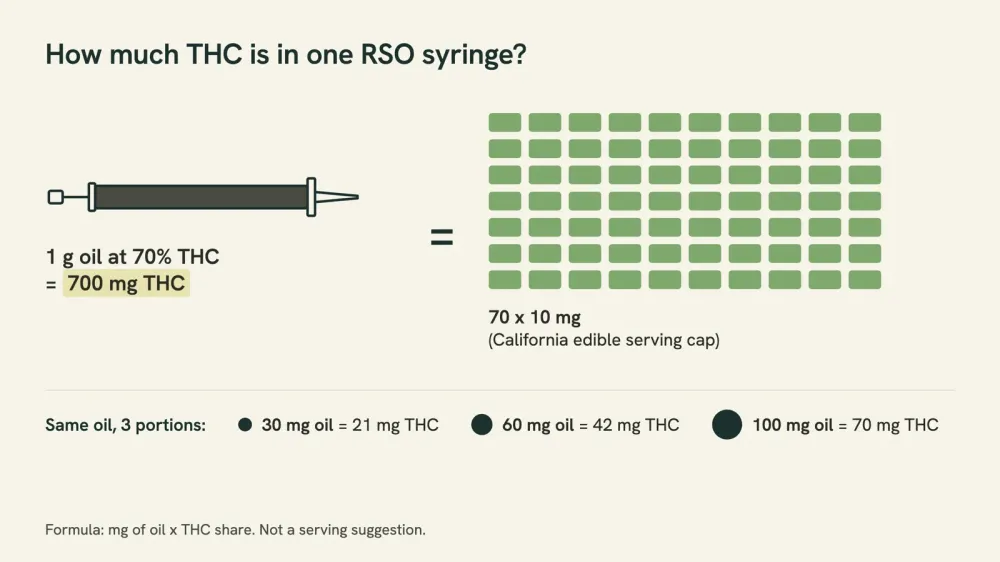
RSO is described in grains of rice, but a grain of rice is not a unit, and no source we could find defines it in milligrams. So the table below uses stated inputs instead. The syringe is 1 gram of oil, the common retail size (check yours). The THC share is 50, 70 or 90 percent, the spread sellers quote. The portions are 30, 60 and 100 milligrams of oil, a range wide enough to cover what different people might call a small or large grain. The formula is one line: milligrams of THC = milligrams of oil x THC share (60 mg x 0.70 = 42 mg). For scale, "units" are the 5 mg standard THC unit researchers proposed in 2020 so that studies could compare products. It is a unit of measurement, not a recommended amount.
| THC in the oil | THC per 1 g syringe | In a 30 mg portion of oil | In a 60 mg portion of oil | In a 100 mg portion of oil |
|---|---|---|---|---|
| 50% | 500 mg | 15 mg (3 units) | 30 mg (6 units) | 50 mg (10 units) |
| 70% | 700 mg | 21 mg (4.2 units) | 42 mg (8.4 units) | 70 mg (14 units) |
| 90% | 900 mg | 27 mg (5.4 units) | 54 mg (10.8 units) | 90 mg (18 units) |
Put that beside a regulated edible. California caps an edible at 10 mg of THC per serving and 100 mg per package. A concentrate package can hold up to 1,000 mg, or 2,000 mg if it is labeled for medical use and sold only to medical patients. A 1-gram RSO syringe sits at the concentrate limit, not the edible one: a 90 percent syringe holds 900 mg, just under the 1,000 mg cap. And because a "grain" is eyeballed, the gap between a small and a large one of the same oil is more than a threefold change in THC. If you want the reasoning behind percent vs. milligrams, see why THC percentage alone tells you little, and for the scale of a single serving, what a 10 mg edible actually is.
Swallowing it is the second trap. The National Cancer Institute's evidence summary on cannabis notes that oral cannabis has a low and variable bioavailability (6 to 20 percent), that blood THC peaks 1 to 6 hours after swallowing, and that the liver converts THC into 11-OH-THC, a potent psychoactive metabolite. A late, strong onset is how people end up taking more before the first amount has landed; our piece on why edibles take so long to kick in explains the clock. In a Colorado hospital review of cannabis-related emergency visits, visits attributed to edibles more often involved acute intoxication (48 vs. 28 percent), psychiatric symptoms (18 vs. 11 percent) and cardiovascular symptoms (8 vs. 3 percent) than visits attributed to inhaled cannabis. That was one hospital with little dose data, but the pattern fits a high-milligram oral product. What overconsumption looks like and when to get help is covered in our guide to greening out.
Does RSO cure cancer? What the evidence actually is
Start with the two authorities. NCI's evidence summary for clinicians, last updated in May 2025, opens with it: "The U.S. Food and Drug Administration has not approved Cannabis as a treatment for cancer or any other medical condition." The cannabinoid drugs that are approved, dronabinol and nabilone, are for side effects of cancer treatment, which is a different claim. The FDA's own page on cannabis regulation says the agency "has not approved a marketing application for cannabis for the treatment of any disease or condition and thus has not determined that cannabis is safe and effective for any particular disease or condition." For how that position applies to CBD, see what the FDA has and has not said about CBD. Then look at what the cancer claim is actually built on.
The studies the RSO story rests on
The study most often cited as human proof is a 2006 Spanish pilot in patients with recurrent glioblastoma, an aggressive brain tumor. Nine people had pure THC infused directly into the tumor through a catheter, after surgery and radiotherapy had failed. Its main question was whether that was safe. There was no comparison group, median survival was 24 weeks, and the authors wrote that the effect on survival was "unclear" and would need "a larger trial with a different design." NCI's summary describes it as a small pilot that "demonstrated no significant clinical benefit." It also has little to do with RSO: a brain catheter of pure THC is not a swallowed whole-plant oil.
NCI notes that clinical data on cannabis as an anticancer agent in children "are limited to a few case reports." The one RSO sellers cite most is a 2013 case report of a 14-year-old with terminal leukemia, whose family gave her home-made cannabis resin prepared with Rick Simpson's help. Her blast counts (the immature cells that define leukemia) fell and rose as batches changed. The authors wrote that the resin "was not analyzed," so nobody knows what was in it, and she died on day 78 from a bowel perforation. The authors listed no institutional affiliation and called for research "to reproduce these results." One case cannot show that the oil caused the changes, and it cannot show what the oil contained.
Sellers also point to a 2025 Dutch report (van den Berg and colleagues, Journal of Cannabis Research, doi:10.1186/s42238-025-00353-0) describing two men, aged 82 and 77, whose advanced liver cancer regressed while they used cannabis oils bought online. Those oils were not RSO. Their labels said 10 percent THC with 5 percent CBD and 15 percent THC with 2 percent CBD, a fraction of RSO's strength, and neither was tested. The doctors who wrote it up noted that liver cancer regresses on its own in about 0.4 percent of cases, said plainly that "causality cannot be inferred," and called the cases "hypothesis-generating rather than conclusive." The corresponding author also disclosed a grant from a medical cannabis company.
The stronger evidence, and why it is not about RSO
The best-controlled human signal is not about RSO at all. In a small 2021 randomized trial in recurrent glioblastoma, 21 people took the chemotherapy drug temozolomide plus either a prescription THC:CBD mouth spray (nabiximols) or placebo. More of the spray group were alive at one year (83 vs. 44 percent), but the share without progression at six months was identical (33 percent in both arms), NCI notes the study was not powered to test survival, and three co-authors worked for the spray's maker. A larger follow-up, the ARISTOCRAT trial, has enrolled 122 patients; its main results are not expected before late 2027 (estimated primary completion October 7, 2027). That is a fixed-dose pharmaceutical given with chemotherapy, which is a different thing from a syringe of whole extract taken alone.
The evidence also points the other way. When Australian researchers re-analyzed a placebo-controlled trial of CBD oil in 128 people with advanced cancer, it made no difference to disease progression or survival over 56 days (CBD only, and a short window). As for RSO itself: searched by name on October 21, 2026, PubMed holds one paper that mentions Rick Simpson Oil, a 2025 survey of what 1,060 medical cannabis patients use. It holds no trial of it. The table below places every source on a ladder of what each kind of study can show.
| Rung (weakest to strongest) | What it can show | What it cannot show | Where the RSO-cancer record sits |
|---|---|---|---|
| Personal story or testimonial | That someone believes it worked | The diagnosis, what was in the oil, what else happened | Rick Simpson's own account; YouTube videos (10 of 10 rated misleading) |
| Lab dish or animal study (preclinical) | A mechanism worth testing | Anything about a person | Much of NCI's laboratory and animal section |
| Case report (1-2 people) | That an unexpected outcome happened, so it can be studied | Cause, dose, or what was in the product | 2013 leukemia case (1 patient, untested resin); 2025 liver cases (2 patients, 10-15% THC oils, not RSO) |
| Uncontrolled pilot | Whether a procedure is feasible and safe enough to test | Whether it works (no comparison group) | 2006 glioblastoma pilot (9 patients, pure THC into the tumor) |
| Small randomized trial | A signal worth a bigger trial | A reliable effect size | 2021 nabiximols plus chemotherapy (21 randomized); 2024 CBD oil (128 patients, no effect) |
| Adequately powered randomized trial | Whether it works, and by how much | Long-term effects beyond follow-up | None for RSO. ARISTOCRAT (pharmaceutical cannabinoid plus chemotherapy, 122 enrolled) is running |
Regulators treat the cancer claim as a marketing problem, not just an unproven idea. In a November 1, 2017 announcement, the FDA said it had sent warning letters to four companies selling cannabis-derived products online with claims to prevent, treat or cure cancer, covering more than 25 products; the four letters, dated October 31, 2017, still head the 2017 section of the agency's list of warning letters to cannabis-derived product sellers. The claims the announcement cited included "killing/inhibiting cancer cells or tumors."
“Substances that contain components of marijuana will be treated like any other products that make unproven claims to shrink cancer tumors.”
The risk is not only what is in the syringe. In a Yale analysis of US cancer records, 280 people with curable breast, prostate, lung or colorectal cancer who chose alternative medicine instead of standard treatment were matched with 560 patients who had standard care, and the alternative-medicine group had 2.5 times the risk of dying. That study was not about cannabis, and it was observational, but it is about the choice the RSO story invites.
Safety: what a syringe of RSO can do
Beyond the milligram problem, RSO raises two issues of its own. The first is drug interactions. NCI's summary notes that cannabinoids interact with the liver's cytochrome P450 enzymes and that, because CBD can inhibit some of them, highly concentrated CBD oils taken alongside cancer drugs those enzymes process could raise the drugs' toxicity or blunt their effect. It also describes an Israeli observational study of 140 patients in which those using cannabis during the immunotherapy drug nivolumab responded less often (15.9 vs. 37.5 percent), although progression-free and overall survival did not differ. That was not a randomized comparison, but it is a reason to tell your care team. Our page on how cannabinoids can interact with your medications explains the enzyme pathway. The second issue is advice that came with the oil: Simpson's own website said that many people cut their medications by half on the first day and stop them within two weeks. Do not change or stop a prescribed medicine without the clinician who prescribed it.
Children are the other concern. Between January 2021 and May 2022, US poison centers logged 10,448 cases involving only THC edibles, and 77 percent of the patients were 19 or younger, the FDA reported in a consumer warning. That data is about edibles, not RSO, but a syringe of dark paste looks like nothing a child would recognize as a drug, and it holds far more THC than a package of gummies.
- Do not drive or operate machinery after taking RSO. Swallowed THC can take 1 to 6 hours to peak, so impairment can arrive after you feel ready to go.
- Remember that a second portion taken while waiting for the first stacks on top of it; the late peak is how most oral overconsumption happens.
- Tell your doctor and pharmacist if you use any concentrated cannabis oil, especially during cancer treatment or with medicines processed by the liver.
- Store syringes locked, labeled and out of reach of children and pets, away from food.
- If a child or pet swallows any, call Poison Help at 1-800-222-1222 right away, even before symptoms (for a pet, call your vet or an animal poison line).
- Call 911 for chest pain, fainting, trouble breathing, a seizure, or someone who cannot be woken.
CBD RSO and hemp-derived RSO
"CBD RSO" is the same kind of whole extract made from hemp, the low-THC type of cannabis, so it is dominated by CBD rather than THC. Under federal law today, hemp is cannabis with no more than 0.3 percent delta-9 THC by dry weight. That definition is set to change. The 2025 appropriations law that rewrote the hemp definition excludes final products holding more than 0.4 mg of total THC per container. On November 12, 2026, only the part excluding cannabinoids that the plant cannot naturally produce is set to take effect; the total-THC standard and the 0.4 mg per-container cap are set for December 11, 2026 (timing set by P.L. 119-103). The arithmetic matters for a whole extract: a 1-gram syringe at 0.3 percent THC holds 3 mg of THC, which is 7.5 times the 0.4 mg per-container limit set to take effect that day. Further congressional action is possible, so check the current calendar in our explainer on hemp-derived THC and the new federal definition.
Is RSO legal?
Under federal law, RSO made from marijuana is marijuana: the Controlled Substances Act definition covers "the resin extracted from any part of such plant" and "every compound, manufacture, salt, derivative, mixture, or preparation" of it. Since the April 28, 2026 rescheduling rule, marijuana under a state medical license sits in Schedule III; everything else, including adult-use RSO, remains Schedule I (checked October 21, 2026; a court challenge to the rule is pending). Whether you can buy RSO therefore depends on your state's medical or adult-use program. Hemp-derived versions follow the hemp rules above. Planntz does not sell RSO or any THC concentrate.
Five checks on an RSO label and lab report
Because the name guarantees nothing, the label and the certificate of analysis (COA) are the product. These are the five lines that matter most for a syringe of whole extract. The same habit of reading milligrams and batch-matched lab reports applies to any oil, which is the core of our guide to choosing a CBD oil you can trust.
- 1Total THC in milligrams per syringe, not just a percentage. On a COA, total THC is calculated as THCA x 0.877 + delta-9 THC; because RSO is decarboxylated, most of it should already show as delta-9.
- 2CBD in milligrams per syringe. It tells you whether you are holding a THC-dominant oil, a CBD-dominant one, or a mix.
- 3A residual-solvent panel with a result for each solvent in micrograms per gram and a pass or fail mark. No panel means nobody checked.
- 4A batch or lot number on the syringe that matches the batch on a lab report from an accredited, independent lab.
- 5Serving information printed in milligrams of THC. A label that only says "a grain of rice" is not telling you how much you are taking.
What we still don't know
Honest limits cut both ways. No one has published a lab survey of products sold as RSO, so the real THC range on dispensary shelves is unknown; the 55.7 percent concentrate average is the nearest measurement. No published trial has tested RSO by name, for cancer or anything else, and the only PubMed paper that names it is a survey. Lab and animal studies of cannabinoids and tumor cells exist, but they are preclinical and say nothing about what a syringe does in a person. The 2021 nabiximols signal is real enough to justify ARISTOCRAT, and its results, expected no earlier than late 2027, will say more about one pharmaceutical cannabinoid with one chemotherapy in one cancer. None of that will be evidence about RSO.
Frequently asked questions
RSO is not a strain. It is an oil made from cannabis flower: a whole-plant extract, heated so its THC is active, usually sold as a dark paste in a 1-gram oral syringe. The name comes from Rick Simpson, a Canadian who promoted it in the 2000s. It is a trade term with no legal definition.
Per gram of product, by far. A 1-gram syringe at 70 percent THC holds about 700 mg of THC; California caps an edible serving at 10 mg. Per portion, it depends entirely on how much oil you take, which is the problem: 60 mg of oil at 70 percent is 42 mg of THC, and a grain of rice is not a measured amount.
RSO is a crude whole extract that keeps plant waxes, pigments and minor compounds. Distillate is a refined fraction, distilled under vacuum to isolate the cannabinoids, often with terpenes added back. Neither is a quality grade by itself; the lab report for the specific product tells you more than the category.
Mostly, yes. Both are trade names for an unrefined full extract of cannabis, and sellers often use them interchangeably. We found no state rule defining either term, so the label and COA (total THC in mg, CBD in mg, residual-solvent results) tell you more than which name is on the syringe.
RSO is made and sold as an oral oil, and sellers describe it being swallowed, held under the tongue, or mixed into food or capsules. Heating any concentrated extract produces breakdown products that have been measured only in lab machines, so no route has been shown to be safer. Swallowed THC also peaks 1 to 6 hours later, which is easy to misjudge.
No published trial has tested RSO for cancer. The human record behind the claim is a personal account, a nine-patient safety pilot of pure THC injected into brain tumors, and a few case reports, while small trials of other cannabinoid products are mixed. The FDA has approved no cannabis product to treat cancer. Talk to your oncology team before using any cannabis product.
Marijuana-derived RSO is legal only where your state allows it. Federally, marijuana under a state medical license has been in Schedule III since April 28, 2026, and everything else remains Schedule I (checked October 21, 2026). Hemp-derived RSO falls under the hemp definition, whose 0.4 mg total-THC per-container cap is set to apply from December 11, 2026 (timing set by P.L. 119-103).
If one habit carries over from this page, make it reading the milligrams and the lab report instead of the name on the syringe. Our step-by-step guide on how to read a certificate of analysis shows where total THC, CBD and the residual-solvent panel sit on a real COA and what a pass or fail means. This article is educational and is not medical advice.
Writing about hemp, wellness and the small rituals that keep us balanced.