CBD Gum: What Chewing Delivers and What One Trial Found
CBD gum has one placebo-controlled trial, no published blood study and a speed claim borrowed from caffeine gum. Here is what chewing delivers, what the trial found, how to read the label and two safety points most pages skip.
CBD gum is a real product with a thin evidence file. One placebo-controlled trial has tested it, and it found no difference between a 50 mg CBD gum and an identical placebo gum on the pain score it was built to measure. No published study has measured how much CBD reaches your blood from a gum, and the popular "five times faster" line traces back to a press release about caffeine gum.
That does not make the format useless. It makes it unmeasured. This guide walks through what happens to a dose when you chew, what the one trial actually found (including two results most pages leave out), four claims you will see on packets and where each one comes from, a five-point label check, and two safety points that rarely get printed: gum that looks like candy, and mouth-swab drug tests. If you are still choosing between the broad formats, our comparison of CBD oil and gummies is the better place to start. Nothing here is a claim that CBD gum treats any condition.
What CBD gum is, and how much CBD a piece carries
CBD gum is ordinary chewing gum base with CBD worked into it, usually dissolved first in an oil. The gum used in the one placebo-controlled trial of the format shows the anatomy well: a 1.25 g piece, 15 mm across, carrying 50 mg of CBD in hemp seed oil, flavored with spearmint and peppermint, and made by AXIM Biotechnologies. You chew it, and at the end you spit out the gum base. Retail products usually carry far less. Examples printed in launch coverage include Blockhead in the UK at 3 mg a piece (Hello! magazine, 2019) and Pin at 10 mg a piece (PureWow, 2019). From 3 mg to 50 mg is a 17-fold spread, so the per-piece figure is the first number to find on any pack.
Gum is not a gummy, even though search results often mix them up. A gummy is a piece of candy you swallow, so all of its CBD takes the digestive route; our guide to how pectin and gelatin gummies are made covers that format. A gum is held in your mouth for many minutes and then thrown away. That creates a problem gummies do not have: any CBD still locked in the gum base when you spit it out was never part of your dose, and nothing on the label tells you how much that is.
How chewing delivers a drug (what nicotine and caffeine gum show)
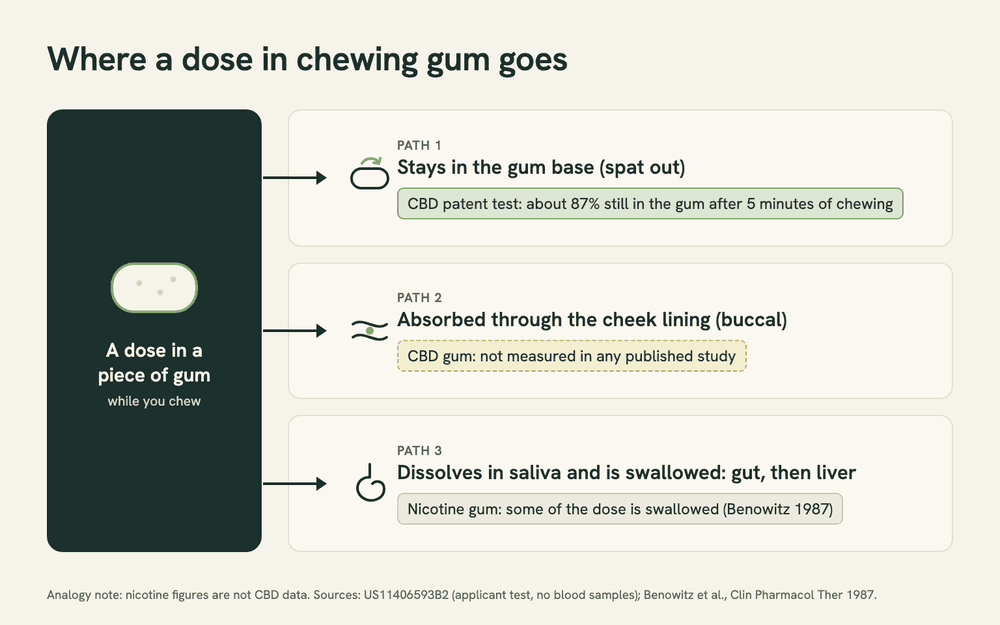
A dose in a medicated gum can end up in three places. Some is absorbed through the lining of your cheeks and under your tongue (buccal absorption), which leads straight into the bloodstream. Some dissolves into saliva and is swallowed, which sends it through the gut and liver like any edible. And some never leaves the gum at all. The split between those three decides how fast and how much, and nobody has measured it for a CBD gum. The best guide is other medicated gums, used here as an analogy, not as CBD data. A 1987 study of nicotine gum in smokers found that chewers extracted on average only 53% of the nicotine from 2 mg gum and 72% from 4 mg gum, that extraction varied more than twofold between people, and that some nicotine "was swallowed and underwent first-pass metabolism" in the liver. Nicotine gum is the best-studied medicated gum there is, and even there, on average 28 to 47% of the dose stayed in the gum.
Caffeine gum shows the upside, for a molecule suited to it. In a Walter Reed Army Institute of Research trial in 84 healthy men, caffeine gum reached peak blood levels at 44 to 80 minutes on average, against 84 to 120 minutes for capsules. Caffeine dissolves easily in saliva. CBD does not: the FDA-approved label for prescription CBD (Epidiolex) describes it as "insoluble in water", and saliva is mostly water. That is the problem a CBD gum has to solve, and it is why some brands turn to the emulsions covered in our guide to water-soluble CBD. The only figure we found for how quickly CBD leaves a gum comes from the applicant's own test in a cannabinoid chewing gum patent first filed in 2019: after five minutes of chewing by 8 test persons, about 12 to 13% of the CBD had come out of the gum. For CBD, the "stuck in the gum" and "swallowed" paths are not small details.
Does CBD gum work? The one trial that tested it
The trial, run at Wageningen University in the Netherlands and published in 2022, is the only published placebo-controlled test of a CBD gum we found. It was a randomized, double-blind crossover: 40 people were enrolled and 32 were analyzed, all women with irritable bowel syndrome (IBS), median age 31. Each used the 50 mg CBD gum for three weeks and an identical placebo gum (hemp seed oil, no CBD) for three weeks, with a one-week washout between. They chewed a piece when pain reached 4 out of 10 or higher, for at least 30 minutes, up to six pieces a day. Those were study conditions, not a dose recommendation; for how people approach amounts in general, see our CBD dosage guide.
The headline result, in the authors' words: "There was no statistically significant difference in pain scores between CBD and placebo at a group level." The average within-person difference in pain reduction 30 minutes after chewing was 0.1 points on the 10-point scale (95% CI -0.3 to 0.5, p = 0.61), and quality of life did not differ either (p = 0.74). Two other findings matter more for anyone buying gum. First, both gums lowered pain a little; the authors note that chewing itself stimulates a reflex that affects the gut. A gum study without a placebo gum would have credited CBD for the chewing. Second, people barely used it: an average of 5.9 gums a week, under one a day. Several said 30-minute chewing sessions were hard to fit into the day, and 2 of 40 dropped out over "unpleasant air ingestion due to chewing the gums". The authors concluded that the benefits "generally did not outweigh practical disadvantages such as prolonged chewing throughout the day". AXIM supplied the gums and paid for logistics.
Is CBD gum faster? Four packet claims, checked
Speed is the main selling point for gum, so it is worth tracing each claim to its origin. "Five times faster" appears in a 2017 press release from gum maker Mastix, in which its CEO said gum delivered through the oral mucosa "is up to five times faster than swallowing pills or capsules", resting on studies the US military ran on the company's caffeine gum. No data were given. The 2019 PureWow piece repeated the number for CBD with no source at all. Even a 2025 commentary arguing for CBD gum, written by paid consultants and employees of Aspeya Switzerland, a company that develops cannabinoid gum, concedes that "current human data are absent" and that AXIM's earlier absorption study "does not appear to have been published in the peer-reviewed literature".
| Claim on the packet | Where it comes from | What has actually been measured |
|---|---|---|
| "Five times faster" | 2017 Mastix press release, based on military studies of its caffeine gum | Caffeine gum: peak at 44-80 min vs 84-120 min for capsules. CBD gum: no published data |
| "Over 99% absorbed in 5 minutes" | 2019 Nordiccan patent (the applicant's own test) | About 12-13% of the CBD left the gum in 5 minutes. The 99% is the share of that small amount not found in saliva, worked out by subtraction. No blood samples |
| "Bypasses the liver" | Launch coverage and brand copy | True only for the share absorbed through the cheek, which is unmeasured for CBD gum. Swallowed CBD takes the usual route through the liver |
| "More bioavailable" or "works in minutes" | Brand copy | No published gum blood study. Unpublished 4-person pilot: peaks at 1-2 h. CBD mouth spray: first seen in blood at about 2 h, peak at about 4 h |
The patent row deserves a plain reading. Its own test measured CBD left in the chewed gum and in saliva after five minutes; about 12 to 13% had come out, and less than 1% of that was in the saliva, so the applicant calculated that more than 99% of the released CBD "was delivered to the oral mucosa". In other words, about 87% of the CBD was still in the gum, and nobody took a blood sample. The liver row follows from the prescription label, which says CBD is broken down mainly in the liver by the enzymes CYP2C19 and CYP3A4: whatever you swallow takes that route, gum or not.
Two measured data sets anchor the last row. When nine people used a cannabis-extract mouth spray designed to absorb through the lining of the mouth, CBD did not show up in their blood for about 2 to 2.5 hours on average and peaked at about 3.7 to 4 hours; the researchers noted that "a portion of the drug was inevitably swallowed". And a 2024 meta-regression of 112 trial arms in healthy adults found that, compared with swallowing, delivery through the mouth lining was associated with lower peak and total CBD exposure, although the mouth-route arms used low doses, which the authors say limits the comparison. None of those arms was a gum. Even oil held under the tongue behaved like a swallowed dose in a crossover study of 8 healthy men, with a 4-hour peak for both drops and capsules; technique is covered in how to take CBD oil under the tongue. "More bioavailable" also has no solid baseline to multiply: a 2020 review of oral CBD bioavailability notes that detailed studies have not been published and estimates oral bioavailability at about 6% from the available data. So the honest answer to "how long does CBD gum take?" is that nobody has published it, and the only figures in print are in hours. Our guides to how long CBD takes to work and how long CBD's effects last cover what is known for other formats.
CBD gum vs oil, gummies and capsules
| Format | Where the CBD goes | Measured in people | How the dose is printed | Still unknown |
|---|---|---|---|---|
| Gum | Part absorbed in the mouth, part swallowed, part left in the gum | One placebo trial; no published blood data | mg per piece | How much leaves the gum, the cheek vs swallow split, onset |
| Oil under the tongue | Mostly swallowed in the one crossover that checked | Many blood studies across oral and mouth routes | mg per mL and per dropper | How much hold time and technique change it |
| Gummy | Swallowed | Covered by general oral CBD data | mg per piece | Whether the gummy itself changes absorption |
| Capsule | Swallowed | Oral blood data, including a large food effect on the prescription label | mg per capsule | How consumer capsules compare with the prescription product |
For reference, the prescription label puts swallowed CBD's peak at 2.5 to 5 hours at steady state, at doses far above any consumer product, and food changes exposure a lot, as our guide on taking CBD with food explains. Gum's real advantages are practical: no measuring, nothing to swallow, easy to carry. Its real costs are practical too: 30 minutes of chewing, and a release from the gum that almost no brand prints. For the other formats, our walkthrough of how to read a CBD product label shows where mg per mL and mg per serving sit on the panel.
How to read a CBD gum label: a 5-point check
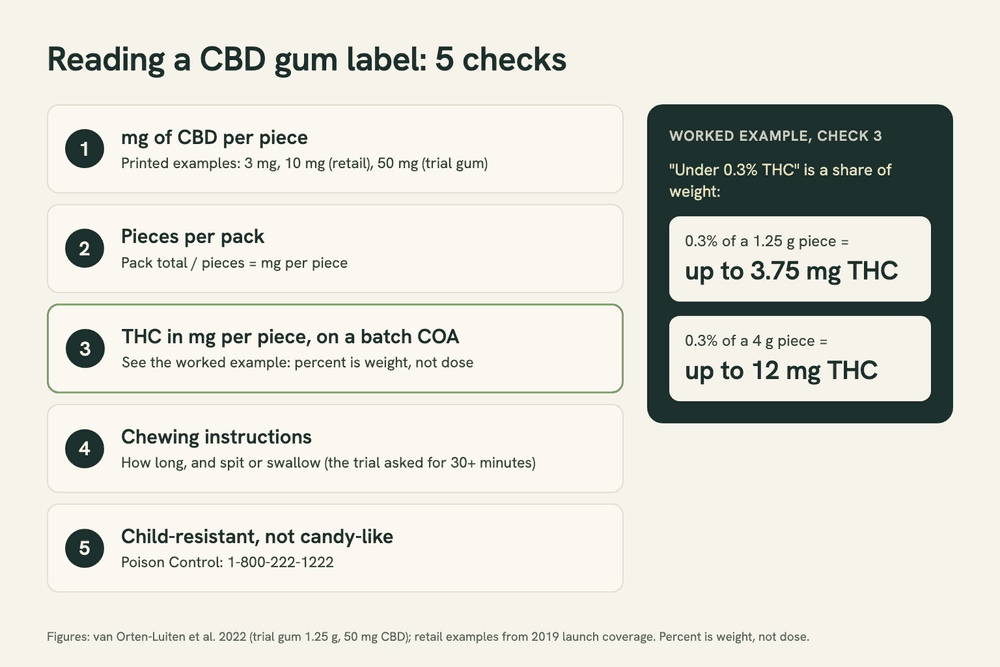
- 1Milligrams of CBD per piece. If the pack only gives a total, divide it by the number of pieces yourself, and check that the math matches any per-piece claim.
- 2Pieces per pack. It sets the total, and it lets you compare price per milligram across brands instead of price per pack.
- 3THC in milligrams per piece on a batch COA, plus the spectrum. "Under 0.3% THC" is a share of weight, not a dose: at 0.3%, a 1.25 g piece could carry up to 3.75 mg of THC, and a 4 g piece up to 12 mg.
- 4Chewing instructions. How long to chew, and whether to spit or swallow. The trial asked for at least 30 minutes; a label that says nothing leaves you guessing how much stays in the gum.
- 5Child-resistant packaging that does not look like candy. Gum in a bright, candy-style wrapper is the format most easily mistaken for a treat.
For point 3, match the batch number on the pack to its certificate with our guide to reading a COA, and see the CBD spectrum guide for what full spectrum, broad spectrum and isolate mean. The milligram figure matters more than usual right now: federal rules on THC in hemp products are set to tighten on December 11, 2026, as our explainer on the December 11 hemp deadline sets out. One number you will almost never find is how much CBD actually leaves the gum while you chew. If a brand prints a release or absorption figure, ask for the study behind it. As the patent shows, a large percentage can describe a small amount.
Safety: candy look-alikes, children and medications
FDA's warning about children eating THC edibles is about THC products, not CBD gum specifically, but the mechanism is the same: a sweet piece in a candy-like wrapper. FDA notes copycat products packaged to look like "Starbursts, Sour Patch Kids, and Trix", among others. CBD has its own record. In an analysis of US poison center data by FDA staff, 6,496 CBD exposures were reported between July 2014 and June 2021; 36.2% involved children aged 2 to 12, and in that age group 94.1% were unintentional. That measures how often it happens, not how serious it is: the 44 major-effect cases the authors reviewed in detail had a median age of 27. Our guide to whether you can take too much CBD covers what is known about large amounts.
For adults, the side effect the trial recorded was swallowed air from long chewing. Medications are the bigger question. CBD is broken down mainly by CYP2C19 and CYP3A4, liver enzymes that also process many common drugs, and the trial excluded people taking drugs handled by those enzymes. If you take any prescription medicine, read our guide to CBD and medications and talk to your doctor or pharmacist before adding CBD in any form, gum included.
CBD gum and mouth-swab drug tests
Mouth-swab tests look for THC itself, and they mostly read what is left in the mouth. In a NIDA study of smoked, vaped and eaten cannabis, THC in oral fluid peaked during or right after use, which the researchers put down to "oral mucosa contamination". A gum is designed to sit in your mouth for half an hour. No study has tested a CBD or THC gum on a swab, so there is no number to give you, but the direction is not reassuring for any gum that contains THC.
Trace THC is enough to matter. In a 2026 controlled dosing trial, 100 mg of CBD in oil carrying 2.8 or 3.7 mg of THC left 8 of 10 people with a positive oral-fluid test, and even with 0.5 mg of THC, 1 of 10 tested positive at 2 ng/mL of THC or above. That was an oil, not a gum. Full-spectrum gum carries trace THC by definition; broad-spectrum or isolate gum lowers the risk but cannot remove it. No product, gum included, can guarantee a test result. Our mouth-swab drug test guide explains cutoffs and detection windows, and CBD gummies and drug tests covers what label surveys have found in a swallowed format.
What nobody knows yet about CBD gum
As of October 23, 2026, a PubMed search for cannabidiol and chewing gum returns four records: one placebo-controlled trial, one commentary, and two papers that are not about a CBD gum. A wider search pairing cannabinoids, gum or chewing with blood levels or release found no human blood study of a CBD gum either. Two registered CBD studies linked to British American Tobacco included "chew" products, but neither is clearly a gum and neither has published results. The open questions:
- How much CBD leaves a commercial gum during normal chewing.
- How that released CBD splits between absorption through the cheek and swallowing.
- Onset and peak blood levels, in published human data rather than press releases or unpublished pilots.
- Whether any effect differs from a placebo gum outside one small trial in women with IBS.
- Long-term safety of daily, prolonged chewing, which even the 2025 commentary lists as a research gap.
Frequently asked questions
On the published evidence, it has not been shown to. The only placebo-controlled trial, in 32 women with IBS using a 50 mg gum, found no difference from an identical placebo gum on its pain score (p = 0.61), and both gums lowered pain a little. No other controlled trial of a CBD gum has been published.
Nobody has published it. The only figures in print, from an unpublished four-person pilot reported inside the trial paper, put peak blood levels at 1 to 2 hours, not minutes. A CBD mouth spray designed for absorption through the cheek took about 2 hours to show up in blood. Our guide to how long CBD takes to work covers other formats.
It varies widely. Printed examples run from 3 mg and 10 mg a piece in retail gums to 50 mg in the trial gum. Read milligrams per piece, not per pack, and remember that the label states what is in the gum, not how much comes out of it, which brands rarely publish.
Different, not better on the evidence. A gummy is swallowed whole. A gum is partly absorbed in the mouth, partly swallowed and partly left in the gum, in proportions nobody has measured. Gum spares you swallowing a piece, but it asks for about 30 minutes of chewing. Our CBD oil vs gummies comparison covers how to choose between the swallowed formats.
It can if it contains THC. Full-spectrum gum carries trace THC, and a gum is held in the mouth, where swabs mostly collect residue. Broad-spectrum and isolate gums lower the risk but cannot remove it, and no product can guarantee a test result. If you are tested, ask for the batch COA and check THC in milligrams per piece.
THC gum is sold in some state cannabis markets and as hemp-derived products. It is intoxicating, and it can show up on mouth-swab and urine tests. The federal rules are also set to change. Under the new hemp definition in section 781 of P.L. 119-37, with timing set by P.L. 119-103, a hemp-derived product carrying more than 0.4 mg of combined total THC (and similar cannabinoids) per container will fall outside the federal definition of hemp starting December 11, 2026. Our explainer on the December 11 hemp deadline covers the details. This reflects the law as of October 23, 2026 and is not legal advice.
Whatever format you choose, the one document worth asking for is the batch certificate of analysis. Planntz does not make CBD gum, but for an example of what a per-batch document looks like, browse the certificates on our lab results page. And for the checklist we use for any CBD purchase, whatever the format, see our guide on how to choose a CBD oil you can verify.
Writing about hemp, wellness and the small rituals that keep us balanced.