Congress Moved the Hemp Deadline to December 11, and Left One Piece on November 12
On September 2, 2026 a single-sentence section inside H.R. 6500 split the 2026 hemp deadline in two. Most of the new definition now arrives on December 11, 2026. One exclusion still arrives on November 12, and it is the one whose official list does not exist.

On September 2, 2026 the President signed a government funding bill, and the coverage since has called what it did a hemp ban delay. Inside its extensions division sits a single sentence that never uses the words hemp, cannabis, cannabinoid or THC, and it changed the date the entire industry has been counting toward for nearly ten months. As of September 3, 2026 there is no longer one date. There are two. November 12, 2026 still arrives, and it now carries exactly one narrow exclusion. Everything else in the new hemp definition, including the total THC standard and the 0.4 milligram per container ceiling, arrives on December 11, 2026.
The statute Congress just rescheduled is Section 781 of Public Law 119-37, and we already have a long explainer on what Section 781 actually does to the definition of hemp, including the per-container arithmetic and what we found when we ran it against our own batch certificates. This article is deliberately narrower. It is about the calendar: what was enacted on September 2, how one short section split a single deadline into two, how it passed, and why the piece that survives on November 12 is the harder of the two to apply.
The hemp ban delay, and what Congress actually enacted on September 2
The bill is H.R. 6500, the Continuing Appropriations and Extensions Act, 2027. The White House record of the signing reads: "On Wednesday, September 2, 2026, the President signed into law: H.R. 6500, the 'Continuing Appropriations and Extensions Act, 2027,' which includes a short-term continuing resolution that provides fiscal year 2027 appropriations to Federal agencies through December 11, 2026 ... and extends authorities for a broad range of programs including surface transportation and veteran programs." Read it again and notice what is not in it. Hemp is not mentioned. Neither is cannabis, nor any cannabinoid. The provision that moved the hemp date is one of those extended authorities, and it is not called out.
The December 11 date is in the law itself, not only in the announcement. Division A, section 106 of the enrolled text presented to the President makes the appropriations available until the first of three events, the last of which is "December 11, 2026." That is the funding cliff, and the hemp section simply borrowed the same date. One administrative note, so you are not confused when you go looking: as of September 3, 2026 there was no public law number. The govinfo slip-law collection stopped at Public Law 119-102, and the official bill status record for H.R. 6500, which we read on September 3, 2026, carried no public law number at all. The bill is law. The citation number is a records lag. Until it posts, the correct way to cite this is H.R. 6500.
Section 2019, printed in full
Division B of the act is titled Authorizing Extensions. It is where Congress parks the short renewals that ride along with a funding bill: surface transportation programs, health programs, veterans authorities. Section 2019 sits among them under a caption that gives away nothing at all, SECTION 781 EXTENSION. Not one page on the first page of search results we read on September 3, 2026 printed it, named it or quoted it. Under that caption the section is one sentence long. Here is that sentence, with the caption itself in the attribution line beneath it.
“Until December 11, 2026, the amendments made by section 781 of division B of Public Law 119-37 (7 U.S.C. 1639o note) shall only apply with respect to products described in paragraphs (1)(C)(ii)(I) and (1)(C)(iv)(I) of section 297A of the Agricultural Marketing Act of 1946 (7 U.S.C. 1639o) (as amended by such section 781).”
Three things about that sentence are worth slowing down for, because they are the difference between understanding this news and repeating a headline. First, it is not an amendment. It does not change one word of Section 781, and it does not move Section 781's own effective date, which is fixed by the section's opening clause at 365 days after the November 12, 2025 enactment of Public Law 119-37. It is a scope limiter: for a defined window it says which products the amendments reach. Second, the window closes. The sentence begins "Until December 11, 2026," so on December 12 the limitation is simply gone and the whole of Section 781 applies on its own terms. Third, the operative words are not there. Hemp, cannabis, cannabinoid and THC appear nowhere in the section; it works entirely by cross-reference to paragraph numbers. That is an observation about drafting, not a claim about anyone's intent, and you can check it in the enrolled text in about a minute.
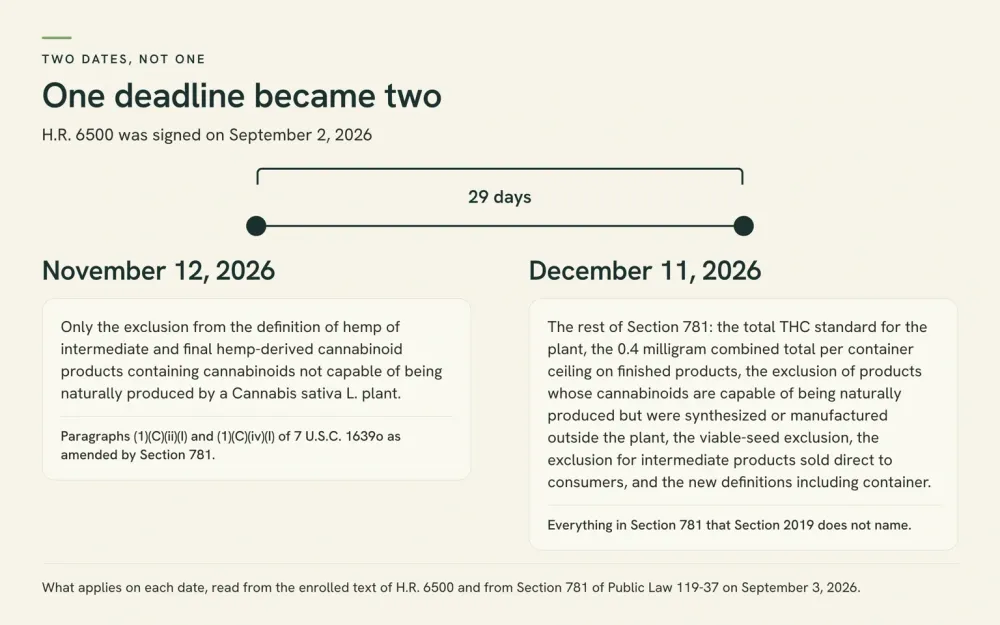
The two dates, side by side
| Date | What is in force on that date | Where it comes from |
|---|---|---|
| November 12, 2026 | Only the exclusion from the definition of hemp of intermediate and final hemp-derived cannabinoid products containing cannabinoids not capable of being naturally produced by a Cannabis sativa L. plant. | Paragraphs (1)(C)(ii)(I) and (1)(C)(iv)(I) of 7 U.S.C. 1639o as amended by Section 781. These are the only two subclauses Section 2019 names. |
| December 11, 2026 | The rest of Section 781: the total THC standard for the plant, the 0.4 milligram combined total per container ceiling on finished products, the exclusion of products whose cannabinoids are capable of being naturally produced but were synthesized or manufactured outside the plant, the viable-seed exclusion, the exclusion for intermediate products sold direct to consumers, and the new definitions including container. | Everything in Section 781 that Section 2019 does not name. The limiting sentence runs only until December 11, 2026, so from December 12 the whole section applies. |
| Neither date moved | Section 781's own effective date, which is 365 days after the November 12, 2025 enactment of Public Law 119-37. | Section 781 itself, which Section 2019 does not amend. What changed is scope, not the date. |
The distinction that keeps getting flattened in coverage is the one between a date and a scope. November 12, 2026 did not move. What moved is how much of the new definition is switched on when it gets here. The two surviving subclauses do the same thing in two places, one for intermediate products and one for final products: they pull out of "hemp" any hemp-derived cannabinoid product containing cannabinoids not capable of being naturally produced by a Cannabis sativa L. plant. Everything else waits 29 more days, including the change from measuring delta-9 THC alone to a total THC figure that adds THCA at a conversion factor, which we walk through in our comparison of hemp and marijuana as the law defines them, and the 0.4 milligram combined total per container ceiling, whose arithmetic and container definition sit on our 2026 hemp ban page.
It is worth being precise about what follows from falling outside a definition, because "excluded from hemp" and "banned" are not the same sentence. Hemp is carved out of the Controlled Substances Act's definition of marijuana, so narrowing hemp narrows the carve-out automatically. The Congressional Research Service, the nonpartisan research arm of Congress, put it this way in a legal sidebar on the changed federal definition of hemp updated December 22, 2025: the amendment "will operate as an exception to the exceptions, meaning that covered hemp-derived cannabinoid products will be subject to CSA regulation as marijuana or THC." The same document says "it is unclear how it will affect future CSA enforcement." Both halves of that belong together. It is CRS reading the statute, not us, and it is not a statement about any particular product on any particular shelf.
What did not change on September 2
News about a deadline moving tends to get rounded up into news about a rule disappearing, so here is the other column of the ledger. If you go looking for the amended language in the United States Code today you will not find it there either: the current edition of 7 U.S.C. 1639o still carries the 2018 Farm Bill's delta-9 standard, because the amendment has not taken effect yet. That, and everything below, is unchanged by the law signed on September 2, 2026.
- CBD is not banned by either date. Neither tranche names CBD, and both work by excluding products from the federal definition of hemp rather than by prohibiting a compound.
- The text of Section 781 is untouched. Section 2019 did not amend a single word of it. It limits which products the amendments apply to, and only until December 11, 2026.
- November 12, 2026 is still an effective date. Section 781 takes effect 365 days after the November 12, 2025 enactment of Public Law 119-37, and nothing in the new law moved that clock.
- The 0.4 milligram figure is still per container rather than per serving, and it is still a combined total rather than delta-9 alone. Only its start date moved.
- State law is a separate layer and is untouched. Several states already restrict hemp-derived cannabinoid products more tightly than the federal definition does, and a few are more permissive.
- The FDA's position on CBD in food and dietary supplements is untouched by this bill, and the three cannabinoid lists Section 781 required from the agency are still not published.
The piece that still lands on November 12 is the one nobody has defined
Here is the part that no page-one result carried when we read the search results on September 3, 2026, and it is the most useful thing on this page. The tranche that survives on November 12 turns entirely on one phrase: cannabinoids "not capable of being naturally produced by a Cannabis sativa L. plant." The statute does not list those cannabinoids. It ordered the FDA to.
At one end of the range the phrase is easy. THC-O acetate is an acetate ester the plant does not make, and we have written separately about why THC-O sits outside the plant's own chemistry. At the other end sit the cases that started this argument in the first place. Delta-8 THC does occur in the plant in trace amounts, but almost all of the delta-8 on the market is converted from CBD in a reactor, and the subclause asks whether the cannabinoid is capable of being naturally produced rather than where the particular molecule in a particular bottle came from. Our piece on delta-8 and where it actually comes from covers that chemistry. That, though, is only the November 12 half of the question, and this is the point almost every write-up drops. Section 781 carries a second exclusion, which Section 2019 defers to December 11, for products whose cannabinoids are "capable of being naturally produced" by the plant but were "synthesized or manufactured outside the plant." The Congressional Research Service prints the two exclusions one after the other in its legal sidebar, in those words. So the identity question arrives on November 12 and the origin question arrives 29 days later, and a cannabinoid can sit on different sides of the two. HHC already has separate federal treatment: the DEA gave it its own Schedule I drug code in a final rule whose DATES line reads "Effective May 4, 2026", which we cover in our page on where HHC stands. Competent lawyers read the phrase differently in the middle of that range, and we are not going to resolve it here.
The Congressional Research Service described the same split before it became law, in the fourth version of its In Focus brief Changes to the Statutory Definition of Hemp and Implications for Agricultural Policy, updated August 17, 2026. It glosses the surviving tranche as "certain synthetic cannabinoids" and notes that those products "would be classified as marijuana under the CSA." Two cautions travel with that. CRS is congressional staff, not a regulator. And version 4 was written on August 17, before enactment, which is why it describes the provision in the conditional; as of September 3, 2026 no newer version had been published. The same brief is where the missing lists are recorded, and it is blunt about it.
You can run the last of those checks yourself in a browser. The FDA's page on cannabis and cannabis-derived products returned nothing on September 3, 2026 for "119-37", for "section 781", for "total tetrahydrocannabinol", for "0.4 milligram", for "November 12", for "December 11" or for "capable of being naturally produced." So the position on September 3, 2026 is this: the one provision that still lands on November 12 is the one whose defining list does not exist, and the provisions that were pushed to December 11 are the ones you can at least measure with a number. That is the opposite of the order most people would have guessed. For how these products came to be sold under a delta-9 arithmetic in the first place, see the math that put hemp-derived THC on the shelf.
How it passed: two minutes on the floor and two roll calls
There was a fight over this exact section, and it lasted two minutes. The Congressional Record of the Senate floor records that Senator Budd of North Carolina proposed amendment No. 6747 to the continuing resolution, with the purpose printed in the record as "To strike section 2019" and an operative text of three words: "Strike section 2019." The presiding officer allowed two minutes of debate, equally divided. Senator Klobuchar then moved to table it, and the motion to table was agreed to, 61 to 32, Rollcall Vote No. 227. A motion to table kills an amendment on procedure without a vote on its merits, which is why the number should not be read as 61 senators endorsing the hemp provision on the substance.
- 1December 9, 2025. H.R. 6500 is introduced in the House and referred to Ways and Means. It is a trade bill.
- 2January 12, 2026. The House passes it 340 to 54, Roll no. 14, as the AGOA Extension Act, to extend duty-free treatment for imports from certain African countries. It contains nothing about hemp.
- 3August 7 and 8, 2026. The Senate replaces the entire text with the continuing resolution by Collins amendment No. 6732, and then tables the Budd amendment described above, 61 to 32, Rollcall Vote No. 227.
- 4In the early hours of August 8, 2026. The Senate passes H.R. 6500 as amended, 90 to 6, with one senator answering present and three not voting, Rollcall Vote No. 228, under a 60-vote threshold set by unanimous consent.
- 5September 1, 2026 at 2:03 p.m. The House concurs in the Senate amendments under suspension, 370 to 48, Roll No. 286: Republicans 193 to 19, Democrats 176 to 29, independents 1 to 0, with 14 not voting.
- 6September 2, 2026. The President signs it. As of September 3, 2026, no public law number had posted.
That session is filed in the record under Friday, August 7 because the Senate convened at 10 a.m. on the Friday and adjourned at 4:56 a.m. on the Saturday, and the one-page version of it is the Senate Daily Digest for August 7, 2026, which records the same vote and the same adjournment time. The House side is in the Daily Digest for September 1, 2026, which records the 370 to 48 concurrence. Before the tabling vote, Senator Klobuchar characterized the provision on the floor in one sentence. We are printing it because it is the clearest statement of what the drafters believed they were doing, and because it is a characterization rather than the statutory text, which is why it sits next to the statute above and not in place of it.
“As is, the bipartisan continuing resolution that is before us delays a ban on naturally produced hemp products for 4 weeks while taking synthetic hemp derivatives off the market. That is important to note. That is included in this continuing resolution.”
One more thing from the record, because it is the cleanest illustration of how a deadline moves in Washington. H.R. 6500 was never introduced as a hemp bill or as a funding bill. It passed the House on January 12, 2026 as the AGOA Extension Act, a measure about duty-free treatment for imports from certain African countries, and you can read the House-engrossed trade bill and find no hemp in it, because there is none. The Senate then replaced the whole text. Swapping new text into a moving legislative vehicle is ordinary Senate practice and there is nothing improper about it. What is striking is what survived: the Clerk of the House and the Daily Digest both still title the September 1 action "AGOA Extension Act." And when we extracted the text of the Congressional Record granule carrying the printed Senate amendment and the House debate, all 96,211 characters of it as we pulled it on September 3, 2026, the words hemp, cannabis and cannabinoid appeared zero times. That is one document, in one chamber, on one day, and it is not a claim that Congress never discussed hemp. The Senate did, at length, four weeks earlier.
What you can actually do before December 11
Every page we read on this story was written for a licensee: inventory, reformulation, distributor contracts. If you are a person holding one bottle, none of that helps. Here is what is actually available to you. It will not produce a legal conclusion, because as of September 3, 2026 nobody can produce one for the November 12 tranche, and anyone who offers you one is filling in a federal document that does not exist. What it will give you is the real numbers and the right office to ask. One thing worth knowing before you start: a certificate that reports only two cannabinoids is telling you less than one that reports the full panel.
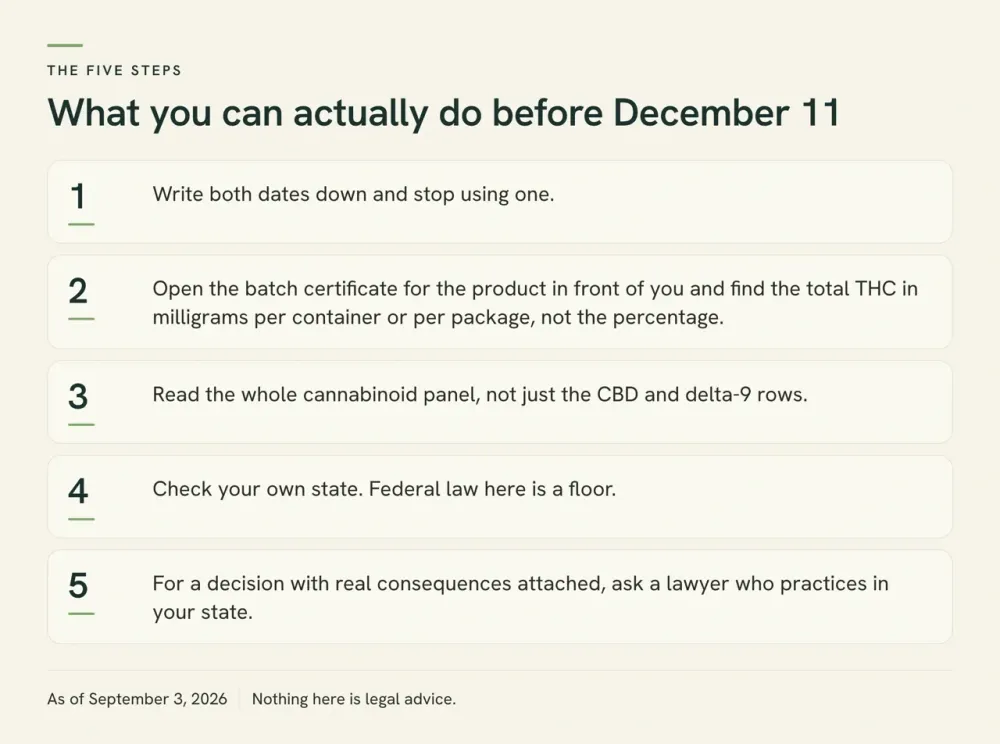
- 1Write both dates down and stop using one. Until December 11, 2026 only two subclauses of Section 781 are in operation, and from December 11 all of it is. Any page still printing a single date has not been updated since September 2, 2026.
- 2Open the batch certificate for the product in front of you and find the total THC in milligrams per container or per package, not the percentage. That is the figure the December 11 tranche measures. A brand that publishes none cannot be checked.
- 3Read the whole cannabinoid panel, not just the CBD and delta-9 rows. The November 12 tranche is about identity rather than quantity: it asks whether a cannabinoid in the product is capable of being naturally produced by the plant.
- 4Check your own state. Federal law here is a floor. Your state department of agriculture or your state department of health is the office that can tell you what applies where you live, and nothing in H.R. 6500 touched that layer in either direction.
- 5For a decision with real consequences attached, ask a lawyer who practices in your state. We can tell you what the statute says and when. Nobody can responsibly tell you in a blog post which side of an undefined line a specific product sits on.
What is still genuinely unknown
A useful page on a moving story has to be as clear about its holes as about its facts. None of the following is a reason to panic and none of it is a reason to relax. They are the parts of the picture that no published federal document filled in as of September 3, 2026, and anyone who fills them in for you is doing it themselves.
- Which cannabinoids the November 12 exclusion actually reaches. The list that would answer this was due from the FDA on February 10, 2026 and had not been published as of September 3, 2026.
- How the new defined terms in Section 781, including intermediate, final and container, operate during the 29-day window. Section 2019 names two subclauses, but identifying the products in them uses definitions elsewhere in the section.
- How any of it is enforced. The Congressional Research Service says it is unclear how the change will affect future Controlled Substances Act enforcement, and an unresolved question is not a safe harbor.
- What Congress does next. The funding this law provides also runs out on December 11, 2026, so another must-pass bill arrives at the same moment. That is a fact about the calendar and not a prediction, and we are not going to turn it into one.
Questions people are asking
Partly, and the word delayed hides the mechanism. The law signed on September 2, 2026 did not move the November 12, 2026 effective date of Section 781. It says that until December 11, 2026 that section applies only to two of its subclauses. So one exclusion still starts on November 12 and the rest starts on December 11. This describes federal law as of September 3, 2026 and is not legal advice.
Both, for different reasons. On November 12, 2026 the only piece in force is the exclusion of intermediate and final hemp-derived cannabinoid products that contain cannabinoids not capable of being naturally produced by a Cannabis sativa L. plant. On December 11, 2026 the rest of Section 781 arrives, including the total THC standard, the 0.4 milligram combined total per container ceiling on finished products, and a second exclusion for cannabinoids that are capable of being naturally produced but were synthesized or manufactured outside the plant. Which side of any of that a specific product falls on is a question for a lawyer or your state regulator, not for a blog post.
No. Neither tranche bans CBD, and CBD is not named in Section 781 at all. Both operate by excluding certain products from the federal definition of hemp, which is a different legal move from prohibiting a compound. The tranche that arrives on November 12 turns on whether a cannabinoid in the product is capable of being naturally produced by the plant. The Congressional Research Service reads the exclusion as pulling covered products back under the Controlled Substances Act, and in the same document says it is unclear how that will affect future enforcement.
It is a single sentence in Division B of H.R. 6500, captioned Section 781 extension. It says that until December 11, 2026 the amendments made by Section 781 apply only to products described in paragraphs (1)(C)(ii)(I) and (1)(C)(iv)(I) of 7 U.S.C. 1639o as amended. It does not amend Section 781, it does not move Section 781's effective date, and it never uses the words hemp, cannabis, cannabinoid or THC.
Not as of September 3, 2026. Section 781 required them within 90 days of the November 12, 2025 enactment, which was February 10, 2026, so the deadline is 205 days past. On September 3, 2026 we ran three Federal Register API queries and read the FDA's own cannabis page, whose footer still reads content current as of 07/16/2024 and which still quotes the 2018 Farm Bill definition. The Congressional Research Service said the same in its August 17, 2026 update. We can show non-publication. We are not offering a reason for it.
It changes when the cap starts to apply, from November 12 to December 11, 2026. It does not change the number, it does not change that the number is per container rather than per serving, and it does not change that it is a combined total rather than delta-9 alone. The container arithmetic, including the figures we published against our own batch certificates, is on our 2026 hemp ban explainer.
The funding this law provides also runs out on December 11, 2026, so another must-pass bill arrives at the same moment. That is a fact about the calendar and not a prediction. Bills to delay Section 781 by three years or to repeal it outright were introduced in this Congress and, as of the most recent Congressional Research Service update on August 17, 2026, had not received floor action. We are not going to guess at the rest, and you should be careful with anyone who does.
No. State hemp rules are a separate layer. Several states restrict hemp-derived cannabinoid products more tightly than the federal definition does and a few are more permissive, and nothing in H.R. 6500 touches that layer. Your state department of agriculture or your state department of health is the office that can answer for where you live. This is information as of September 3, 2026, not legal advice.
A note on our own archive, because we would rather say it than have you find it. Our explainer on the 2026 hemp ban carries a section headed "Where Congress actually is, as of August 19, 2026," and the law signed on September 2 supersedes it; its section on what changes on November 12 is now true for one tranche and not the other. What that page keeps, and what this one deliberately does not repeat, is Section 781 itself, the per-container arithmetic and the batch figures we published against it. Our comparison of THCA and CBD carries a section headed with the November 12 date and needs the same correction. Both are queued for it. And if what you actually want is the layer this article leaves out, how the federal, FDA and state rules stack on top of each other is the evergreen page for that, and it will outlast both of the dates above.
Writing about hemp, wellness and the small rituals that keep us balanced.