Is HHC Legal? What the DEA's May 2026 Schedule I Listing Actually Says
At the federal level the answer is no, and it has a date on it. A DEA final rule effective May 4, 2026 gave hexahydrocannabinol its own Schedule I listing and drug code 7220, and DEA says in that same rule that HHC was already controlled before it.

Is HHC legal? At the federal level, the answer is no, and the answer has a date on it. Hexahydrocannabinol, the cannabinoid sold as HHC, has had its own Schedule I listing and its own DEA drug code, 7220, since a final rule that published and took effect on May 4, 2026. That rule is three pages long, it is public, and almost nothing ranking for this question quotes a single sentence of it. This page does. It also explains why the state permission lists you are being shown answer a different question from the one you asked.
Is HHC legal? The short answer, and the document it comes from
On May 4, 2026 the Drug Enforcement Administration published a final rule under Docket No. DEA-1632, titled Specific Listing for Hexahydrocannabinol, A Currently Controlled Schedule I Substance. It runs three pages, at 91 FR 23913 to 23915, and you can read the rule exactly as it was printed in the Federal Register on govinfo. The rule adds hexahydrocannabinol to the Schedule I hallucinogen list in 21 CFR 1308.11(d) as paragraph (115), with the DEA drug code 7220. Under the heading DATES, the rule says, in full: "Effective May 4, 2026." It was signed on April 22, 2026 by DEA Administrator Terrance C. Cole and filed on May 1, 2026 at 8:45 am. Those are the identifiers you would give a lawyer, and they are the identifiers that were missing from every consumer page we read on the first page of Google for this question.
| Field | What the document says |
|---|---|
| Title | Specific Listing for Hexahydrocannabinol, A Currently Controlled Schedule I Substance |
| Agency and action | Drug Enforcement Administration, Department of Justice. Final rule. |
| Docket | Docket No. DEA-1632 |
| Federal Register citation | 91 FR 23913 (Vol. 91, No. 85, pages 23913 to 23915) |
| FR document number | 2026-08595 |
| Published | Monday, May 4, 2026 |
| Effective | May 4, 2026, the day of publication |
| Filed | 5-1-26, 8:45 am |
| Signed | April 22, 2026, by DEA Administrator Terrance C. Cole |
| Regulation amended | 21 CFR 1308.11(d)(115) |
| Substance listed | 6,6,9-trimethyl-3-pentyl-6a,7,8,9,10,10a-hexahydro-6H-benzo[c]chromen-1-ol (other names: hexahydrocannabinol, HHC) |
| Drug codes | New code 7220. Prior code, per DEA, 7370 (tetrahydrocannabinols) |
What the May 2026 rule changed: a code, not a status
Read the title of the rule again, because one word in it is doing all the work: A Currently Controlled Schedule I Substance. DEA is not announcing that hexahydrocannabinol became a controlled substance in May 2026. It is saying the substance was already controlled and was simply missing its own line in the list. The summary paragraph on the first page, at 91 FR 23913, states that position in one sentence. It is worth reading exactly as printed, including the grammatical slip in the middle of it, which we have reproduced rather than tidied.
“Although hexahydrocannabinol is not specifically listed in schedule I of the CSA with its own unique drug code, it is a schedule I controlled substances in the United States under drug code 7370 because it meets the definition of tetrahydrocannabinols, a schedule I hallucinogen. Therefore, DEA is simply amending the schedule I hallucinogenic substances list to separately include hexahydrocannabinol.”
That is DEA's position, stated in a published rule. It is an agency reading of a statute, not a court's holding, and it should be attributed to DEA every time it is repeated. The rule makes the same point again under its own heading, Effect of Action, at 91 FR 23914: "As previously stated, this rule does not affect the continuing status of hexahydrocannabinol as a schedule I controlled substance in any way." What the new listing does change is administrative. In DEA's words, the action "will allow DEA to establish an aggregate production quota and grant individual manufacturing and procurement quotas to DEA-registered manufacturers of hexahydrocannabinol, who had previously been granted individual quotas for such purposes under the drug code for tetrahydrocannabinols." A drug code is a filing label used for registration, quotas and recordkeeping. Getting your own one is a bookkeeping event, not a status event, and DEA says so in plain language twice. If you arrived here without being sure what the molecule even is, our explainer on hexahydrocannabinol and how it is made from CBD covers the chemistry and the manufacturing route.
Why there was no comment period
Most federal rules go out for public comment before they take effect. This one did not, and the rule explains why on page 23914. DEA invoked 5 U.S.C. 553(b)(B) and wrote: "DEA finds that notice-and-comment rulemaking is unnecessary as hexahydrocannabinol is currently controlled in schedule I as it meets the definition of tetrahydrocannabinols." It then described the change as one that "makes no substantive difference in the status of this drug as a schedule I controlled substance, but instead is 'a minor or merely technical amendment in which the public is not particularly interested.'" A second sentence in the same section calls it a "technical amendment" that is "insignificant in nature and impact, and inconsequential to the industry and public." Those quoted phrases are not a court describing this rule. They are DEA quoting two older appellate decisions about technical amendments in general, National Nutritional Foods Ass'n v. Kennedy, 572 F.2d 377, 385 (2d Cir. 1978) and Utility Solid Waste Activities Group v. EPA, 236 F.3d 749, 755 (D.C. Cir. 2001). Neither case is about hexahydrocannabinol. On the effective date, DEA invoked 5 U.S.C. 553(d)(3) and said that delaying the rule "potentially could cause confusion regarding the regulatory status of hexahydrocannabinol."
The rule also states the consequence DEA draws from its own reading, in the Legal Authority section at 91 FR 23914: "Therefore, all regulations and criminal sanctions applicable to schedule I substances have been and remain applicable to hexahydrocannabinol." That is DEA's sentence. It is quoted here because it is part of the document and leaving it out would be editing the rule to suit us. We are not going to gloss it, extend it, or speculate about how anything is enforced or against whom. Anything about your own circumstances is a question for a lawyer licensed where you live.
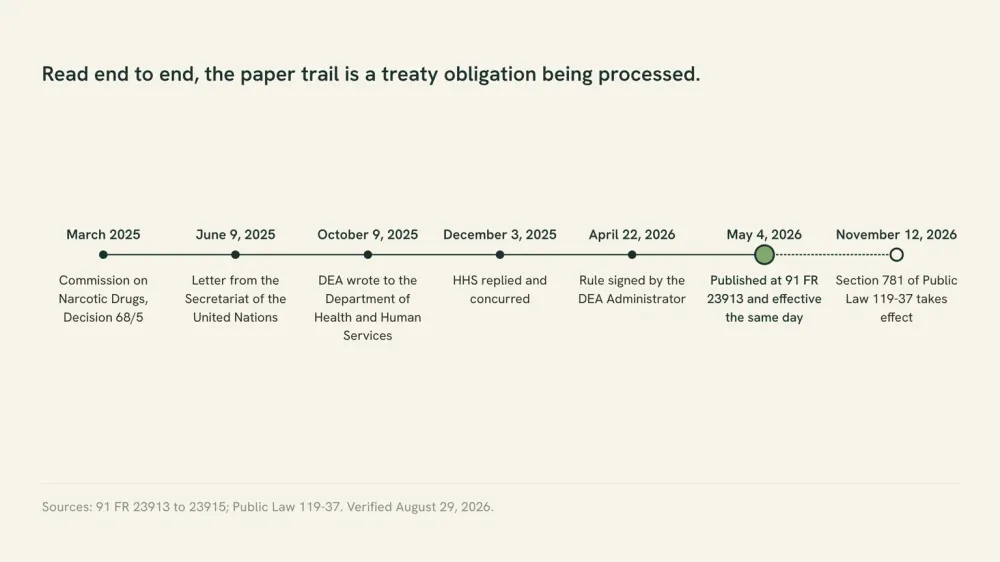
There is also an answer to the question of why this happened in 2026 rather than in 2021, and it is sitting in the same section of the rule. DEA says the action was prompted by a letter dated June 9, 2025, in which the Secretariat of the United Nations informed the United States government that hexahydrocannabinol had been added to Schedule II of the United Nations Convention on Psychotropic Substances of 1971, following Decision 68/5 taken at the 68th session of the Commission on Narcotic Drugs in March 2025. DEA then wrote to the Department of Health and Human Services on October 9, 2025. HHS replied on December 3, 2025 that there are no approved new drug applications or investigational new drug applications for hexahydrocannabinol, and concurred with the direct listing and the drug code assignment. Read end to end, the paper trail is a treaty obligation being processed. The rule describes itself as a listing action and names quota administration as the thing it enables.
Why this page does not have a state-by-state list
On August 29, 2026 we read the first page of Google for this exact question. It is dominated by state permission tables. One of them lists 23 states as legal and mentions the DEA rule nowhere: not the docket, not the drug code, not Schedule I, and it carries no date stamp at all. Another covers all 51 jurisdictions, is dated February 2, 2026, and answers the question by saying HHC "is federally legal when derived from hemp under the 2018 Farm Bill." A third result gets the federal facts right in its headline and then pivots into what to buy instead. We are not publishing another table like those, and we would rather tell you why than leave you wondering.
First, the format answers a question you did not ask. A state that has not banned a federally controlled substance has not thereby made it lawful under federal law. Federal scheduling and state law are separate systems, and both can apply to the same thing at the same time. A row of green cells in a permission table looks exactly like an answer to the question in your search bar, and it is an answer to a narrower one.
Second, being wrong in a table like that has consequences for a person. Fifty-one jurisdictions, each with statutes, scheduling actions and effective dates of their own, is work that has to be kept current and that carries professional responsibility when it is not. That is a lawyer's job, not a blog's. So there is no state named anywhere on this page, no state table, and no per-state verdict, and that is a deliberate editorial decision rather than an oversight.
The second federal date: November 12, 2026
The DEA rule is not the only dated federal document in this story. Section 781 of Public Law 119-37, enacted November 12, 2025, is written to take effect "365 days after the enactment of this Act," which is November 12, 2026, and it amends the federal hemp definition at 7 U.S.C. 1639o. The clause that matters for a cannabinoid made by chemically modifying another cannabinoid excludes from hemp any final product containing cannabinoids that "(aa) are capable of being naturally produced by a Cannabis sativa L. plant; and (bb) were synthesized or manufactured outside the plant." That single clause is the only part of Section 781 this page quotes. The rest of it, including the 0.4 milligram per container ceiling, how a container is defined and where the bills to delay it stand, is treated in full in our article on what changes with the 2026 hemp ban. For the 0.3% dry weight line and what 1639o has said since 2018, read the federal difference between hemp and marijuana, and for how that percentage is measured on a real certificate, the definitional math behind hemp-derived THC. We are not going to characterize how the new definition will be applied to any particular product, because the documents that would settle that do not exist yet.
The disagreement worth naming, and not settling
Here is the part that honest coverage should not skip. The Schedule I listing DEA reads HHC into is titled tetrahydrocannabinols, and on the chemistry HHC is not a tetrahydro compound. Delta-9-THC is the 6a,7,8,10a-tetrahydro molecule, formula C21H30O2, molecular weight 314.5, on the PubChem record titled Tetrahydrocannabinol. Hexahydrocannabinol is the 6a,7,8,9,10,10a-hexahydro molecule, formula C21H32O2, molecular weight 316.5, according to its record in the NIH PubChem database. The difference is two hydrogen atoms, added across the double bond in the terpene ring. The aromatic resorcinol ring is untouched, so this is not a molecule with no double bonds left; it is a molecule whose terpene-ring double bond has been hydrogenated away. That is a real tension between a name and a chemical structure, and it is worth stating plainly rather than pretending it does not exist.
The whole argument, in both directions, runs through one line of statute. Schedule I(c)(17) of 21 U.S.C. 812 reads: "Tetrahydrocannabinols, except for tetrahydrocannabinols in hemp (as defined under section 1639o of title 7)." The notes to the section record that the exception was inserted by Public Law 115-334, the 2018 Farm Bill. DEA reads hexahydrocannabinol into the word tetrahydrocannabinols; much of the hemp industry reads converted hemp cannabinoids into the words in hemp. DEA addresses that second reading directly, and rejects it, at 91 FR 23914.
“To clarify further, tetrahydrocannabinols produced through chemical conversion, even when hemp derived are considered synthetically produced for purposes of the CSA, do not qualify as 'tetrahydrocannabinols in hemp' under the AIA.”
The counterweight on the record is a 2022 decision. In AK Futures LLC v. Boyd Street Distro, LLC, No. 21-56133, filed May 19, 2022, the Ninth Circuit panel held that "the plain and unambiguous text of the Farm Act compels the conclusion that AK Futures' delta-8 THC products are lawful." Four limits belong in the same breath as that sentence: the case is about delta-8 and not about HHC, it arose in a trademark dispute, it was decided on a preliminary injunction record, and it binds one circuit. Our delta-8 article carries the case and the federal positions around it in more detail. It is also worth noticing what kind of document each side of this is made of. DEA's position here is a published final rule with a docket number, a citation and an effective date, which is a different object from the agency correspondence that has driven much of this debate elsewhere: what a DEA letter is worth, and what it is not is its own question. Both readings are on the record, and which one governs a given product is decided by courts, not by us. We are not going to predict that, and you should be suspicious of any page that does.
How to check any cannabinoid's federal status yourself, in about five minutes
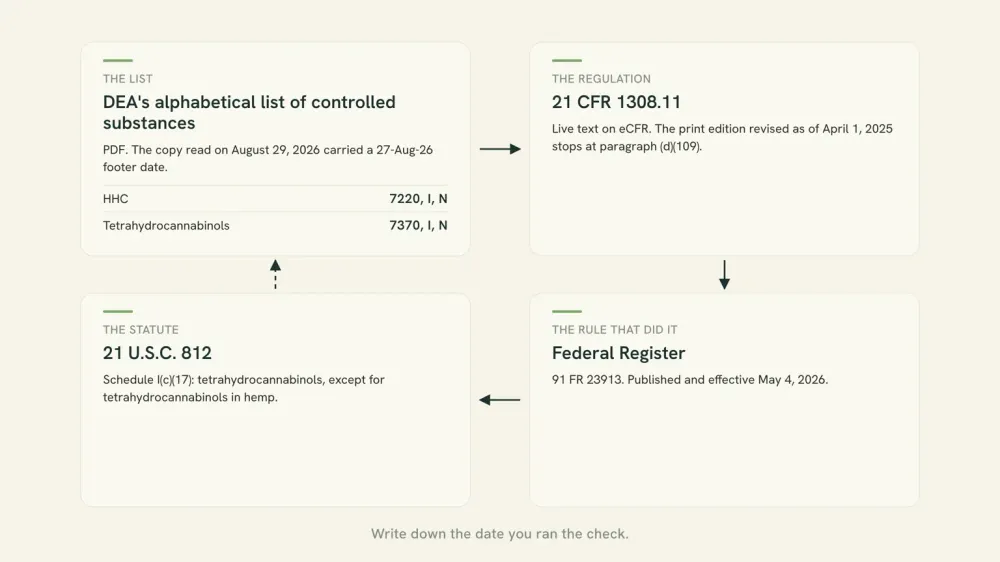
This page has a date on it and it will go stale. Federal scheduling is one of the few areas where you can date the answer yourself, for free, in a few minutes, using documents that carry their own revision dates instead of a publisher's word. Here is the exact loop we ran on August 29, 2026, and it works for any substance, not just this one. It starts with DEA's alphabetical list of controlled substances, a PDF published by the Diversion Control Division.
- 1Open DEA's alphabetical list of controlled substances and search it for the chemical name or the common name. Check the footer date before you read anything else: the copy we opened on August 29, 2026 carried a 27-Aug-26 date on page 24 of 24.
- 2Read the row. The columns are the chemical name, the Controlled Substance Code Number, the CSA schedule and a narcotic flag. The HHC row reads 7220, I, N. The tetrahydrocannabinols row reads 7370, I, N. I means Schedule I; N means not a narcotic.
- 3Confirm against the schedule itself. That list is a reference; the regulation is 21 CFR 1308.11. The live text sits on eCFR, and any printed edition is a yearly snapshot, so always note the date the version you are reading was revised as of.
- 4Find the rule that put it there. Search the Federal Register collection on govinfo for the substance name, open the final rule and read its DATES line. That line, not a headline and not a blog, is the effective date you want.
- 5Check the statute the schedule runs on, 21 U.S.C. 812, and for anything hemp-related, 7 U.S.C. 1639o. Then write down the date you ran the check, because each of these documents can change independently of the others.
Two of those steps hide a trap, and both are worth showing you. The first is in step 3, and it is about editions. The printed annual edition of the Code of Federal Regulations is revised once a year, so it lags: 21 CFR 1308.11 as printed in the 2025 annual edition, revised as of April 1, 2025, stops at Schedule I paragraph (d)(109) and contains no hexahydrocannabinol at all, because it predates the rule by more than a year. That is not a contradiction, it is an edition, and reading it as current law is how a wrong answer gets published with a real citation attached. The live text lives on eCFR, which as of August 29, 2026 sits behind a bot check we cannot link through reliably, so we are naming it rather than linking it. The second trap is in step 4: a DATES line gives you the effective date of the rule you are reading, which is not always the date the substance became controlled. This page is the worked example, because DEA's position is that hexahydrocannabinol was already controlled under drug code 7370 well before the May 4, 2026 listing that its DATES line records. The Federal Register itself is browsable at the govinfo Federal Register collection, where searching a substance name will surface the rule that scheduled it, and the statutes are readable on govinfo and at Cornell's copy of 7 U.S.C. 1639o.
What this article is not
This is a report of what named federal documents say as of August 29, 2026, and nothing more. It does not tell you what you may do. It names no state and issues no per-state verdict. It makes no claim about what HHC does in a person, how strong it is or how safe it is, because none of that is a legal question and this is not the page for it. It does not predict how any court would rule on DEA's reading, and it treats DEA's position as DEA's position rather than as settled law.
One disclosure, because it matters more than usual on a page like this. Planntz sells CBD tinctures in coconut MCT oil. We do not sell HHC, delta-8, or any intoxicating cannabinoid. A federal listing on a cannabinoid we do not sell is not a reason to buy anything from us, and we are not going to pretend otherwise. If you find a page that answers this question and then tells you what to buy instead, that page has told you what it is for. For the wider federal and state picture on CBD specifically, start with where CBD stands legally in the United States. And keep the agencies straight while you read: scheduling is DEA's job, while marketing, supplements and food are the FDA's, which is a different agency answering a different question.
No, according to the federal documents as they stood on August 29, 2026. A DEA final rule under Docket No. DEA-1632, published at 91 FR 23913 and effective May 4, 2026, lists hexahydrocannabinol in Schedule I of the Controlled Substances Act under drug code 7220. DEA's stated position in that same rule is that even before the listing, HHC "is a schedule I controlled substances in the United States under drug code 7370 because it meets the definition of tetrahydrocannabinols, a schedule I hallucinogen" (quoted as printed, including the agency's own grammatical slip). That describes what the documents say. It is not advice about your situation, and state law is a separate question that this page does not answer.
The precise answer is the interesting one. The specific listing took effect on May 4, 2026, the day the rule published. But DEA's position in that same rule is that hexahydrocannabinol was already controlled before it, under drug code 7370, "because it meets the definition of tetrahydrocannabinols, a schedule I hallucinogen," and the rule says outright that it "does not affect the continuing status of hexahydrocannabinol as a schedule I controlled substance in any way." So the rule dates the listing, not the control. That is DEA's reading of the statute, stated in a published rule; it is not a judicial holding, and this page does not treat it as one.
7220. It was added to the Schedule I hallucinogen list at 21 CFR 1308.11(d) as paragraph (115), for 6,6,9-trimethyl-3-pentyl-6a,7,8,9,10,10a-hexahydro-6H-benzo[c]chromen-1-ol (other names: hexahydrocannabinol, HHC). Before that listing, DEA says HHC fell under code 7370, tetrahydrocannabinols. Both codes appear on DEA's published alphabetical list of controlled substances: the version we read on August 29, 2026 carried a 27-Aug-26 footer date and printed HHC as 7220, schedule I, narcotic flag N, and tetrahydrocannabinols as 7370, schedule I, narcotic flag N.
We do not answer per-state questions and this page publishes no state table, for the two reasons given in the section above: a state that has not banned a federally controlled substance has not made it lawful under federal law, and keeping 51 jurisdictions correct is a lawyer's responsibility rather than a blog's. The general point, stated once and without naming a single jurisdiction: federal scheduling and state law are separate systems, and both can apply to the same thing at the same time, so a permission list is never a complete answer on its own. For your own situation, ask a lawyer licensed where you live.
That is the argument on the record, and DEA rejects it in this rule. The statutory hook is Schedule I(c)(17) of 21 U.S.C. 812: "Tetrahydrocannabinols, except for tetrahydrocannabinols in hemp (as defined under section 1639o of title 7)," with the exception inserted by Public Law 115-334 in 2018. DEA's answer, at 91 FR 23914, is that "tetrahydrocannabinols produced through chemical conversion, even when hemp derived are considered synthetically produced for purposes of the CSA, do not qualify as 'tetrahydrocannabinols in hemp' under the AIA." On the other side, in AK Futures LLC v. Boyd Street Distro, LLC, No. 21-56133, filed May 19, 2022, the Ninth Circuit held that "the plain and unambiguous text of the Farm Act compels the conclusion that AK Futures' delta-8 THC products are lawful." That decision is about delta-8 rather than HHC, it arose in a trademark dispute, it was decided on a preliminary injunction record, and it binds one circuit. Both readings are on the record. Which one governs a given product is decided by courts, and we are not going to guess.
Section 781 of Public Law 119-37, enacted November 12, 2025, takes effect "365 days after the enactment of this Act," which is November 12, 2026, and it amends the federal hemp definition at 7 U.S.C. 1639o. The clause that matters for a cannabinoid manufactured from another cannabinoid excludes from hemp any final product containing cannabinoids that "(aa) are capable of being naturally produced by a Cannabis sativa L. plant; and (bb) were synthesized or manufactured outside the plant." That is a definitional change in agricultural law and it is separate from the DEA scheduling action described above; the two are different documents doing different things on different dates. Our article on the 2026 hemp ban covers the statute in full, including the 0.4 milligram per container ceiling.
If you want the other federal date in this story treated properly, with the statutory text, the arithmetic and where the bills to delay it stand, that is what changes on November 12, 2026. And if you are reading this months from now, do not trust the date at the top of the page: run the five steps above and date the answer yourself. That is the only version of this article that never goes out of date.
Writing about hemp, wellness and the small rituals that keep us balanced.