Hemp vs Marijuana: Same Plant, One Legal Line in 2026
Hemp and marijuana are the same species, Cannabis sativa L. What separates them is a number written into federal law, measured in a laboratory, on a sample, on a date. Here is that number, how it is actually calculated, and the two federal changes that moved the line in 2026.
Hemp vs marijuana looks like a question about two plants. It is not. Under the classification most botanists still work from, hemp and marijuana are one species: Cannabis sativa L. What separates them is not biology. It is a number written into federal law, measured in a laboratory, on a sample, on a date. This article explains that number, who measures it and how, and the two federal changes that moved the line in 2026. Everything here reflects federal law as it stood on July 28, 2026.
Three different questions hide inside the phrase hemp vs marijuana. Is it the same plant? Yes, and the genetics turn out to be more interesting than the answer suggests. What makes one legal and the other not? A single statutory threshold, plus a definition that works by subtraction. Is any of that changing? Yes, twice in 2026: a partial rescheduling of marijuana already took effect on April 28, and a new federal definition of hemp is scheduled for November 12. What follows is general information about how those definitions work, not legal advice, and state law can differ from federal law in both directions. If what you actually need is a decision rather than a definition, start with our overview of when CBD is legal.
Botanically, there is only one plant
Neither "hemp" nor "marijuana" is a botanical rank. They are not genus, species, subspecies or variety, and neither word appears in a botanical key. The classification most botanists still work from was published by Ernest Small and Arthur Cronquist in the journal Taxon in 1976, and it treats the whole genus as monospecific: one species, Cannabis sativa L., with subspecies and varieties beneath it. Taxonomic debate has continued ever since, and the 1976 treatment is a classification rather than a law of nature. But it is the framework the field inherited, and it is why no laboratory can tell you which of the two words applies by identifying the plant. It can only measure what the plant made. If the chemistry is new to you, the cannabinoid family is the place to start.
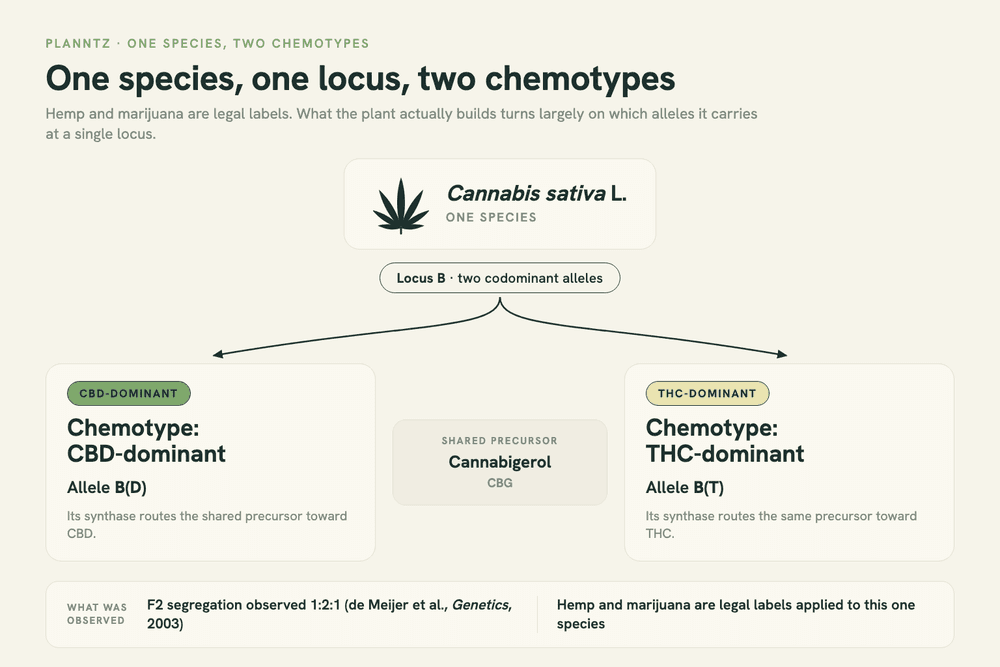
What the plant makes is, to a striking degree, one gene's decision. In a 2003 paper in Genetics, a team led by Etienne de Meijer crossed pure-CBD and pure-THC Cannabis lines and followed the next two generations. The first generation came out uniformly mixed. The second segregated into pure-CBD, mixed and pure-THC plants in a clean 1:2:1 ratio, which is the classic signature of a single locus carrying two codominant alleles. The authors named it locus B, with alleles B(D) and B(T) coding slightly different synthase enzymes that compete for the same precursor, cannabigerol. One version routes the precursor toward CBD, the other toward THC. This was a controlled glasshouse study on inbred lines across four crosses, and later work has added more loci and gene-copy effects to the picture. It still makes the point cleanly: a plant's entire legal identity can turn on which version of one gene it carries.
That does not make the two interchangeable, and this is where a lot of explainers overreach. In a 2015 PLOS ONE study, researchers genotyped 81 marijuana and 43 hemp samples at 14,031 genetic markers and found the two populations "significantly differentiated at a genome-wide level", noting explicitly that the distinction "is not limited to genes underlying THC production". Several of the authors were employed by or funded through a commercial cannabis genomics laboratory, which is worth knowing, and the sample is modest and predates the high-CBD hemp breeding boom. A 2021 paper in Science Advances that resequenced 110 accessions from around the world points the same way: long selection for fiber or for psychoactivity left loss-of-function damage in the pathway for the competing cannabinoid in each lineage. Same species, genuinely different breeding populations.
The legal line: 0.3% THC by dry weight
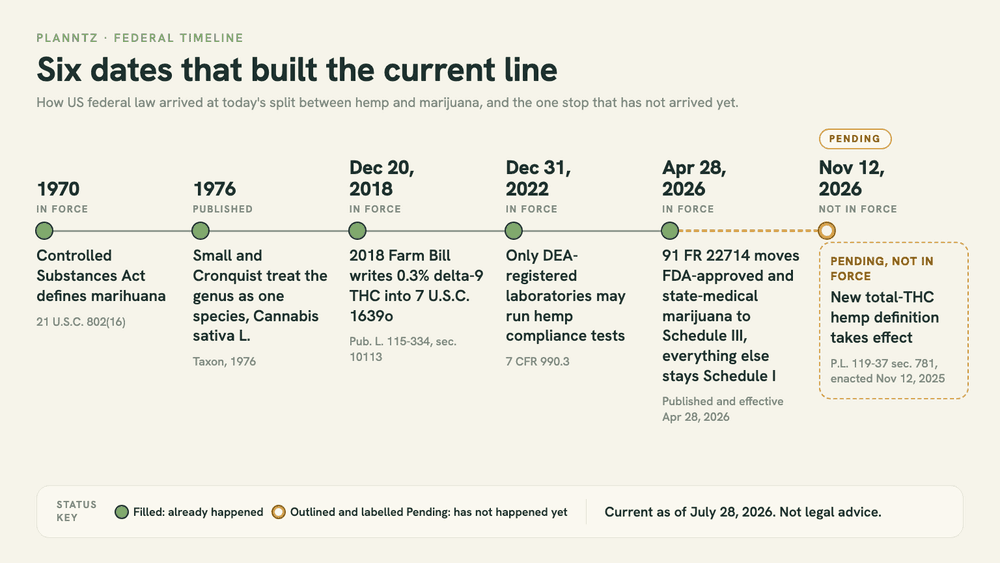
Here is the current federal definition in full. 7 U.S.C. 1639o(1) defines hemp as "the plant Cannabis sativa L. and any part of that plant, including the seeds thereof and all derivatives, extracts, cannabinoids, isomers, acids, salts, and salts of isomers, whether growing or not, with a delta-9 tetrahydrocannabinol concentration of not more than 0.3 percent on a dry weight basis." That text was added by the 2018 Farm Bill (Pub. L. 115-334, section 10113), signed on December 20, 2018. It is the definition in force as you read this, and it stays in force through November 11, 2026.
Now the part that resolves most of the confusion. There is no separate federal definition of marijuana as a plant type. The Controlled Substances Act, at 21 U.S.C. 802(16), defines "marihuana" as all parts of Cannabis sativa L., and then subsection (B) says the term does not include "hemp, as defined in section 1639o of title 7", nor the mature stalks, the fiber, the oil or cake made from the seeds, nor sterilized seed incapable of germination. Marijuana is the leftover. It is whatever cannabis is not hemp. That single piece of drafting is the reason moving the hemp definition automatically moves what counts as marijuana, without Congress touching the word "marijuana" at all.
| What it is | Federal definition through Nov 11, 2026 | Federal definition from Nov 12, 2026 | Where it is written |
|---|---|---|---|
| Hemp (the plant and its parts) | Cannabis sativa L. and its parts, derivatives, extracts and cannabinoids with delta-9 THC of not more than 0.3% on a dry weight basis | Same, but measured as total tetrahydrocannabinols including THCA, not more than 0.3% on a dry weight basis; industrial hemp named explicitly | 7 U.S.C. 1639o(1), as amended by P.L. 119-37 sec. 781 |
| Marijuana | All parts of Cannabis sativa L., minus hemp and minus mature stalks, fiber, seed oil and sterilized seed | Same structure. The carve-out narrows automatically as the hemp definition narrows | 21 U.S.C. 802(16)(A) and (B) |
| A finished consumer product | Not separately defined in the federal hemp definition | Excluded from hemp if it carries cannabinoids synthesized or manufactured outside the plant, or more than 0.4 mg per container of total tetrahydrocannabinols plus any other cannabinoids with similar effects | New 7 U.S.C. 1639o(1)(C) and (3)(C) |
| What actually gets measured | Total delta-9 THC after decarboxylation: (0.877 x THCA) + THC | Total tetrahydrocannabinols including THCA. FDA has not yet published the lists that fix the scope | 7 CFR 990.1; P.L. 119-37 sec. 781 |
| Who measures it | A sampling agent takes the sample, a DEA-registered laboratory runs the test, within 30 days before harvest | Unchanged by the statute. USDA's crop rules still govern the field | 7 CFR 990.3(a)(2) and (a)(3) |
So where does 0.3% come from? The number is older than the law. It comes out of botanical taxonomy, where 0.3% was used to sort fiber-type plants from drug-type plants, and Congress later wrote it into statute. No federal document presents 0.3% as a dose at which anything happens to a person. One more piece of the 2018 law gets misread constantly. Section 10114(b) says that no state may prohibit the transportation or shipment of hemp or hemp products produced in accordance with the Act through that state. That is a rule about trucks passing through. It is not a license to sell, buy or possess anywhere, and several states regulate hemp products more tightly than the federal floor does. The state-by-state picture is its own article.
Why "0.3% THC" does not mean what most articles say
Two things about that percentage get lost. The first is the phrase "on a dry weight basis". It means the weight of the dried plant material, so 0.3% is a property of a crop standing in a field, not of a bottle on a shelf and not of a dose anybody takes. An extract is a different physical thing, suspended in a carrier oil, and its THC content gets reported in milligrams and as a percentage of something else entirely. If the finished-product version of this question is what brought you here, where trace THC actually lives in a product covers it separately.
The second is bigger, and nearly every page ranking for this topic gets it wrong. Federal testing does not read delta-9 THC off the instrument and stop there. 7 CFR 990.1 defines the measurement as post-decarboxylation and prints the formula outright: Total THC = (0.877 x THCA) + THC. THCA is tetrahydrocannabinolic acid, the form the living plant actually builds. It converts to delta-9 THC when heated, shedding a carboxyl group and about 12.3% of its mass along the way, which is where the 0.877 factor comes from. USDA calls the result "the potential total THC in a given sample". The operative federal number has therefore never been raw delta-9 alone. Here is what that does to a report. The numbers below are illustrative, chosen to show the mechanism rather than to describe any real batch.
- 1Read the delta-9 THC line on the report. In this illustrative example, 0.25%.
- 2Read the THCA line on the same report. In this example, 0.90%.
- 3Multiply THCA by 0.877, the share of its mass that survives conversion to THC: 0.90 x 0.877 = 0.79%.
- 4Add the two figures together: 0.79% + 0.25% = 1.04% total THC.
- 5Compare that to the line. 1.04% is roughly three and a half times the 0.3% limit, on a sample whose raw delta-9 reading looked comfortably compliant.
Hemp is a test result, not a permanent property
No plant is born hemp. A lot of plants earns the status from one measurement, taken inside one narrow window, by someone who is not the grower, and it can fail to earn it. That is the practical content of 7 CFR 990.3, the rule governing State, Tribal and USDA hemp production plans, and it is the part of the answer almost no consumer explainer contains. Read it as a procedure rather than as a definition and the whole hemp versus marijuana question stops being philosophical and starts being administrative.
- Samples are collected within 30 days before the anticipated harvest, so the status attaches to a specific lot at a specific moment.
- Samples must be collected by a sampling agent. Producers may not collect samples from their own growing facilities.
- The cutting is taken from the flowering tops, approximately five to eight inches in length from the main stem, terminal bud or central cola.
- The method must give 95% confidence that no more than 1% of the plants in the lot would exceed the acceptable hemp THC level.
- Since December 31, 2022, only laboratories registered with the DEA may perform this testing.
- The measurement of uncertainty must be estimated and reported alongside the test result.
If the lot comes back over the line, it does not so much become marijuana as become a disposal problem. The rule requires plans to include a procedure for the disposal or remediation of the plants: destruction through a DEA-registered reverse distributor or law enforcement, or on site. Remediation, defined at 7 CFR 990.1, means removing and destroying the flower material while retaining stalk, stems, leaf material and seeds, or shredding the entire plant into biomass and testing it again. Notice what none of this touches: the bottle on a shelf. Federal testing rules stop at the field. That is why the certificate of analysis for the batch you actually bought carries the weight it does, and why it is worth knowing whether the laboratory that produced it is genuinely independent.
What American hemp actually is in 2026
Those last two figures dismantle the most common mental model of hemp. American growers planted 49,267 acres in the open in 2025 and harvested 43,707 of them. If you picture hemp as rope, canvas and hurd, the acreage half-supports you: fiber took more harvested acres in the open than flower did, 21,693 against 16,880. The money does not. Fiber returned $13.5 million while floral returned $574 million, out of $646 million of open-field value in total. Floral hemp is 38.6% of harvested open acres (16,880 of 43,707) and 88.9% of the value ($574 million of $646 million). Fiber is 49.6% of the acres and 2.1% of the value. Per harvested acre that works out to roughly $34,000 against roughly $622, and floral value is more than 40 times fiber value. American hemp in 2026 is overwhelmingly a cannabinoid crop, and cannabinoid products are what the 2025 change to the federal definition was aimed at, as the next section covers. Two honest limits: these are NASS survey estimates, and "in the open" excludes greenhouse production, a further $93.3 million. The 64% growth figure is NASS's own, computed on unrounded data.
Hemp vs marijuana: how far apart are they, really?
One species, one locus, one threshold, and the practical gap between the two ends is still enormous. The best long-run measurement comes from a 2021 analysis in Biological Psychiatry: Cognitive Neuroscience and Neuroimaging by Mahmoud ElSohly and colleagues, who analyzed 14,234 herbal cannabis samples seized by the DEA between January 2009 and December 2019 using validated gas chromatography. Mean delta-9 THC rose from 9.75% in 2009 to 14.88% in 2018 and 13.88% in 2019. The mean THC to CBD ratio climbed from 24.81 in 2009 to 103.48 in 2017, then fell back to 24.58 by 2019, which the authors read as higher-CBD varieties entering the illicit supply. Set 13.88% against the 0.3% line and the everyday distance is roughly 46-fold. Three limits belong in the same breath: this is seized illicit material rather than licensed dispensary product, the sample counts fall sharply across the decade as states legalized, and the data stops in 2019. If your real question is about effects rather than categories, whether CBD is intoxicating is the article for it.
What changes on November 12, 2026
On November 12, 2025, Public Law 119-37 was enacted. Inside Division B, section 781, sits a rewrite of the federal hemp definition, and the section opens with its own timer: it takes effect "365 days" after the date of enactment. That date is November 12, 2026. As of this article's cutoff the rewrite is not in force, and nothing in this section describes current law. When it does take effect, hemp will mean the plant and its parts and derivatives "with a total tetrahydrocannabinols concentration (including tetrahydrocannabinolic acid) of not more than 0.3 percent on a dry weight basis", and the term will include industrial hemp explicitly.
- Total tetrahydrocannabinols, including THCA, replaces delta-9 THC alone as the quantity the statutory definition measures.
- Industrial hemp is written into the definition explicitly, closing a persistent ambiguity about which crops the term covers.
- Cannabinoids not capable of being naturally produced by the plant, and cannabinoids synthesized or manufactured outside the plant, are excluded from hemp.
- Final hemp-derived cannabinoid products are excluded from hemp above 0.4 milligrams per container of total tetrahydrocannabinols plus any other cannabinoids with similar effects.
Scale that last figure so it means something. The threshold the new definition sets is 0.4 milligrams for a whole container, and a 5 milligram THC edible, a size commonly sold as one serving in state-legal markets, carries 12.5 times that. The statute defines "container" at new 7 U.S.C. 1639o(3)(C) as "the innermost wrapping, packaging, or vessel in direct contact with a final hemp-derived cannabinoid product" and enclosing it for retail sale to consumers, listing jar, bottle, bag, box, packet, can, carton and cartridge as examples, so it is a per-package figure rather than a per-serving one. As for why Congress did it, the Congressional Research Service records that the Senate Appropriations Committee described the changes as aimed at preventing "the unregulated sale of intoxicating" hemp products. The cannabinoid class that drove that debate was delta-8 THC and its relatives, sold under the hemp label precisely because the old definition measured only delta-9.
What remains unresolved is larger than what is settled, and this is the part most coverage skips. The same law gave FDA 90 days from enactment to publish the lists that decide which cannabinoids count: cannabinoids known to be capable of being naturally produced by the plant, naturally occurring THC-class cannabinoids, and other known cannabinoids with effects similar to that class. It also asked FDA for additional information and specificity about the term "container". As of this article's cutoff those lists had not been published, which means the exact edge of the new definition is not yet knowable. Check FDA's cannabis page for the current status. On what happens next, the most careful available reading is the Congressional Research Service's own: in its Insight of December 3, 2025, CRS wrote that "it remains unclear if and how federal law enforcement will enforce the new prohibitions when the new definition goes into effect", and noted that both FDA and DEA "may lack the resources to broadly enforce". Anyone telling you confidently what all of this will mean for a specific product in November is ahead of the record.
Congress has been asked to move the date, and so far has not. H.R. 6209, the American Hemp Protection Act of 2025, introduced on November 20, 2025, would repeal section 781 outright; its latest action was a referral to subcommittee on January 13, 2026. H.R. 7010 (January 12, 2026), H.R. 7024, the Hemp Planting Predictability Act (January 13, 2026), and S. 3686 (January 15, 2026) each take the simpler route of striking "365 days" and inserting "3 years", which would push the effective date out to November 12, 2028. As of July 28, 2026, the two House bills sit in the Subcommittee on Forestry and Horticulture, referred there on May 20, 2026, and the Senate bill sits in the Committee on Agriculture, Nutrition, and Forestry. None of the four has had floor action. A bill that has been introduced is not a law, and the current schedule is the one on the books.
The other side of the line moved too
While the hemp definition was being rewritten, the marijuana side moved first. A Department of Justice and DEA final rule at 91 FR 22714 was published on April 28, 2026 and took effect the same day. Its scope is narrow and worth stating precisely: it places drug products containing marijuana that have been approved by the Food and Drug Administration into Schedule III, and it reaches marijuana, marijuana extracts, delta-9 THC and other marijuana-derived compounds falling outside the definition of hemp only to the extent they sit inside an FDA-approved drug product or are subject to a state medical marijuana license. The same rule creates an expedited DEA registration path for state medical marijuana licensees. It does not reschedule marijuana generally, and it does not make anything legal that was not legal the day before. Challenges to that rule are pending in the D.C. Circuit, and on September 9, 2026 the court declined to pause it.
Everything outside those two buckets remains in Schedule I, and the broader question is live rather than answered. A companion notice at 91 FR 22777, published the same day, announced that DEA would hold a hearing on the proposed rescheduling of marijuana into Schedule III beginning June 29, 2026, continuing a process that started with a proposed rule published on May 21, 2024. As of July 28, 2026 that hearing had been held and no final rule on general rescheduling had issued. Meanwhile the hemp definition is still the boundary deciding which side something falls on: DEA's own Schedule I listing for tetrahydrocannabinols, at 21 CFR 1308.11(d)(31)(ii), states that "Tetrahydrocannabinols does not include any material, compound, mixture, or preparation that falls within the definition of hemp set forth in 7 U.S.C. 1639o." It is a live cross-reference to a definition that is about to change. CRS puts the consequence carefully: if intoxicating hemp products persist after the definition changes, "it is possible they could be subject to the same criminal and collateral issues as marijuana".
How to tell which one you are actually holding
- 1Find the certificate of analysis for your specific batch, not a generic sample report linked from a product page.
- 2Read delta-9 THC and THCA as two separate lines, then run the 0.877 math yourself instead of trusting one headline number.
- 3Match the batch or lot number and the test date on the report against what is printed on the package in your hand.
- 4Note the milligrams of THC per container, not only the percentage. Milligrams per container is the unit the pending 2026 definition uses.
- 5Check that the laboratory is named and that its accreditation is verifiable in an accrediting body's own public directory.
- 6Check your own state's rules, which can be stricter than the federal floor and can define hemp differently.
- 7Treat any report as a snapshot of one batch on one date, because that is precisely how the federal system treats it.
Each of those steps has a longer version elsewhere. How to read a certificate of analysis, section by section covers the document itself. What trace THC means for a drug test covers the practical consequence of the 0.3% allowance, which is what most people are really asking when they ask whether hemp is "the same thing". The honest short version of that question fits in two sentences: delta-9 THC from a hemp plant and delta-9 THC from a drug-type plant are the same molecule, atom for atom. The difference federal law draws is concentration, not chemistry.
What this article does not settle
This is a description of federal definitions as they stood on July 28, 2026. It is not legal advice and it is not a statement about any particular product. Three limits deserve to be named plainly. First, everything about November 12, 2026 is pending: the statutory text exists and the effective date exists, but the agency lists that would fix the new definition's exact scope do not, so the edge of the rule is genuinely unknown today. Second, federal law is a floor and not a ceiling, so a product satisfying the federal definition can still be restricted, taxed or prohibited by a state, and several states already diverge. Third, the botany here explains why these categories are legal rather than natural; it says nothing about what any cannabinoid does in a person. On that question, NIH's National Center for Complementary and Integrative Health is direct: for most consumer uses, human evidence is limited or preliminary.
Questions people actually ask
Same species, Cannabis sativa L., under the classification most botanists still work from (Small and Cronquist, 1976). Hemp and marijuana are legal labels rather than botanical ranks, and neither word appears in a botanical key. They are, however, genuinely different breeding populations. A 2015 PLOS ONE study that genotyped 81 marijuana and 43 hemp samples at 14,031 genetic markers found the two differed across the whole genome, not only at the genes that build THC.
Through November 11, 2026, a delta-9 THC concentration of not more than 0.3 percent on a dry weight basis, under 7 U.S.C. 1639o. In practice USDA measures total delta-9 after decarboxylation, using Total THC = (0.877 x THCA) + THC, on a sample taken within 30 days before the anticipated harvest by a sampling agent rather than by the grower, and analyzed by a DEA-registered laboratory. From November 12, 2026, the statutory measure becomes total tetrahydrocannabinols including THCA.
CBD itself is not intoxicating, and a compliant hemp crop is defined by a very low THC ceiling. That is not the same as saying everything sold under the hemp label is non-intoxicating. The reason Congress rewrote the definition in November 2025 was intoxicating cannabinoid products sold as hemp, and the Senate Appropriations Committee said so in those terms. The two statements answer different questions. For the effects question specifically, see our article on whether CBD is intoxicating.
Yes, in trace amounts, unless it has been removed during processing. Delta-9 THC from a hemp plant and delta-9 THC from a drug-type plant are the same molecule with the same structure. The legal difference is concentration, not chemistry. That is also why a full-spectrum extract can carry a small, reportable amount of THC and still come from a plant that met the federal hemp definition at harvest.
Because of how the Controlled Substances Act is drafted. 21 U.S.C. 802(16) defines marijuana as all parts of Cannabis sativa L., then carves hemp back out by reference to 7 U.S.C. 1639o. Marijuana is the leftover category. That is why moving the hemp definition automatically moves what counts as marijuana. Whether a given product is lawful at the point of sale is a separate question, and state law varies.
Not reliably. Field hemp grown for fiber and planted densely does look different from a bushy drug-type plant grown a meter apart, but that is agronomy: what the grower selected and how closely they planted it. It is not a species trait. Federal law does not attempt a visual test either. It requires a laboratory measurement on a sampled lot, reported with a measurement of uncertainty.
THCA is the acid form the living plant makes, and it converts to delta-9 THC when heated. USDA's formula for the crop is Total THC = (0.877 x THCA) + THC. A sample reporting 0.25% delta-9 and 0.90% THCA computes to about 1.04% total THC, roughly three and a half times the 0.3% line, even though the raw delta-9 figure looks compliant. It matters because the federal number has always been the calculated one, not the raw reading.
Public Law 119-37, enacted November 12, 2025, redefines hemp by total tetrahydrocannabinols including THCA rather than delta-9 alone, excludes cannabinoids synthesized or manufactured outside the plant, and excludes final hemp-derived cannabinoid products carrying more than 0.4 milligrams per container of total tetrahydrocannabinols plus any other cannabinoids with similar effects. It is pending, not in force. FDA has not yet published the lists that would fix the new definition's exact scope, and bills to delay or repeal the change were introduced and referred to subcommittee with no floor action as of July 2026.
The taxonomy question has a clean answer: one species, one threshold, one dated laboratory result. The question underneath it, whether a given product is lawful where you happen to be standing, does not, because it depends on your state at least as much as on the federal definition. Is CBD legal where you live is where that layer gets covered, and it is the better starting point if what you need is a decision rather than a definition.
Writing about hemp, wellness and the small rituals that keep us balanced.