Does CBN Show Up on a Drug Test? Screening, Confirmation, and the Part Sellers Skip
The two numbers everyone quotes, five times and twenty times, are one 2020 study measuring two machines. Cannabinol can register on an antibody screen; the analyte a federal confirmation names is a different molecule, 34 daltons away. Here is what has actually been measured.
Does CBN show up on a drug test? You are asking because you take something with cannabinol in it and you have a test coming, and every page you open tells you something slightly different. The honest answer has two halves, because a drug test has two halves. The first is an antibody screen, and cannabinol can register on one: that has been measured, on named devices, and the amount it takes is not the same on both of them. The second is a mass spectrometry confirmation, which identifies and quantifies a molecule by name, and cannabinol is not the molecule the federal panel names. This page walks both stages out of the published measurements and the government's own tables. It contains nothing about affecting a result, and it cannot tell you what yours will say.
Does CBN show up as THC? The answer changes between the two tests
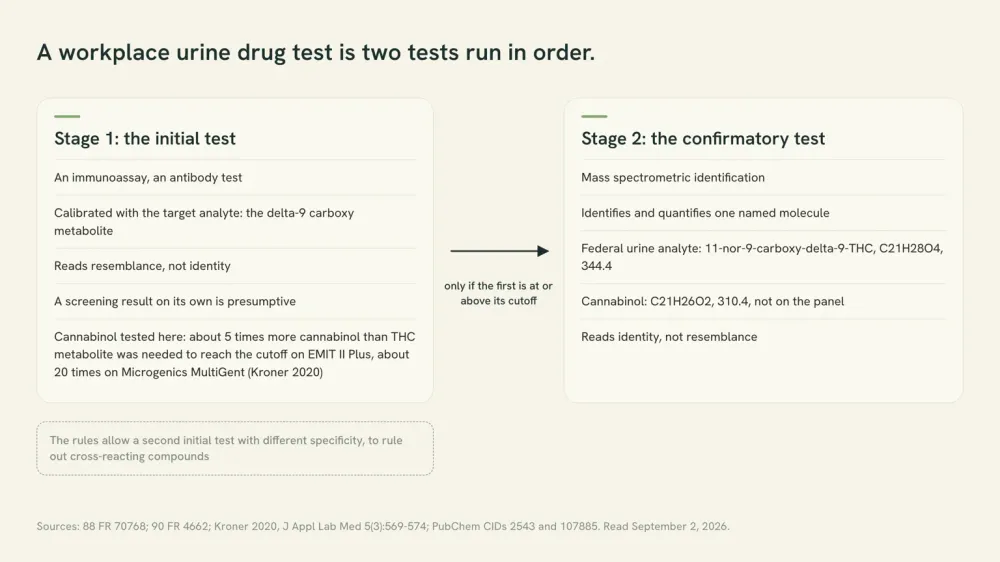
A workplace urine drug test is two tests run in order, and most of the confusion about cannabinol comes from treating them as one. The first is called the initial test. In federal workplace testing it is governed by the Mandatory Guidelines for Federal Workplace Drug Testing Programs using Urine, published at 88 FR 70768 on October 12, 2023. The rule that governs urine testing for federal agencies says an initial drug test may be an immunoassay, and the footnote on its own drug testing panel requires that immunoassay to be calibrated with the target analyte, which for the marijuana row is the delta-9 carboxy metabolite. An immunoassay is an antibody test. It does not identify molecules. It reports how strongly whatever is in the sample binds to an antibody raised against one particular shape, and compares that response to a threshold.
The second test is the confirmation, and the same guidelines describe it in completely different language. A confirmatory method must use mass spectrometric identification, and it must be accurate when identifying and quantifying drugs or their metabolites. Read those two verbs against the first paragraph. A screen produces a response above or below a line. A confirmation produces a name and a number. That is why does CBN show up as THC has two answers rather than one: on the antibody stage, resemblance is enough to produce a signal, and on the confirmation stage, the molecule has to actually be the molecule written on the panel.
One consequence is worth carrying through the rest of this page. A screening result on its own is presumptive. It is a reason to run the second test, not a finding about what was in the specimen, and the federal system treats it that way on purpose. The wider workplace procedure, including where trace THC in a full-spectrum product comes from and what happens between a laboratory and an employer, is covered in our guide to CBD and workplace drug testing, which owns that ground. This page stays on the molecule.
Cannabinol is not an isomer of THC, and that is most of the story
Delta-8 and delta-9 are isomers: identical formula, identical mass, which is why separating their metabolites is genuinely hard and why the delta-8 version of this question is a different article with a different answer. Cannabinol is not an isomer of anything on the panel. PubChem's record for cannabinol gives C21H26O2 and a molecular weight of 310.4. Delta-9 THC is C21H30O2 at 314.5: four hydrogens more, because cannabinol is roughly what is left once that part of the molecule has oxidized away. And the compound a federal urine confirmation actually quantifies, 11-nor-9-carboxy-delta-9-THC, is C21H28O4 at 344.4.
| Compound | Molecular formula | Molecular weight | Named on the federal urine panel? |
|---|---|---|---|
| Cannabinol (CBN) | C21H26O2 | 310.4 | No. Not the initial test analyte and not the confirmatory analyte. |
| Delta-9-THC | C21H30O2 | 314.5 | Not for urine. It is the named analyte on the oral fluid panel. |
| 11-nor-9-carboxy-delta-9-THC | C21H28O4 | 344.4 | Yes. It is the named analyte for both the initial and the confirmatory urine test. |
Thirty-four daltons and two extra oxygens are not a hard problem for a mass spectrometer. They are a hard problem for an antibody, because an antibody does not weigh anything. It binds a shape, and cannabinol's flat, fully aromatic ring system is close enough to the shape the antibody was raised against that it can produce a signal. That is the entire mechanical reason the two stages of a drug test can behave differently about the same molecule: the first instrument is reading resemblance, and the second is reading identity. Hold on to it, because everything below is an application of it.
The 5-fold and the 20-fold number are one study and two machines
Search cbn drug test and within a paragraph you will meet two numbers: that 20 times as much CBN as THC was required to cause a failure in one test, and that just 5 times was enough in another study. Read as written, that is two studies contradicting each other, and versions of that sentence appear across the pages that rank for this search. It is also not what happened. Both numbers come out of one four-page report, from one laboratory, on one set of samples. In 2020, Grace Kroner, Kamisha Johnson-Davis, Kelly Doyle and Gwendolyn McMillin of the University of Utah Health Sciences Center and ARUP Laboratories published a report in the Journal of Applied Laboratory Medicine on cannabinol cross-reacting with two urine immunoassays designed to detect the THC metabolite. They took de-identified residual patient urine that had already tested negative for the THC metabolite, pooled it, and fortified it with cannabidiol, cannabinol, cannabichromene and cannabigerol. Only cannabinol produced significant cross-reactivity. Then they measured how much of it each assay needed.
On the EMIT II Plus assay, about five times more CBN than THC metabolite was required to produce an assay signal equivalent to that assay's cutoff concentration. On the Microgenics MultiGent assay, about twenty times more was required to cross the cutoff. Same cannabinol, same laboratory, same experiment, two answers, because cross-reactivity is a property of an antibody on a device at a threshold and not a property of a molecule. The team also added cannabinol to 21 samples that were weakly positive for THC metabolite by mass spectrometry but negative on the EMIT II Plus, and reported an additive effect. The first author was careful about that part on the record: the results were inconsistent across samples, with the qualification that "we always saw an increase". The paper's own conclusion is a laboratory-workflow one, that the data may help guide the need for confirmatory testing when an immunoassay result is inconsistent with expectations. Full citation, since the publisher's copy sits behind a subscription and was not read here: J Appl Lab Med 2020;5(3):569-574, DOI 10.1093/jalm/jfaa020.
A year before the paper, the same work was presented as a conference abstract, and the learned society that ran the meeting summarized it in an August 2019 release: across three batches of clean urine spiked with 1,000 ng/mL of each compound, "neither test produced a false-positive result in reaction to CBD, CBC, or CBG", while the EMIT II Plus responded to cannabinol at as little as 100 ng/mL. Three cautions travel with that sentence. It is a press release about a conference abstract rather than the peer-reviewed report. It is a year older, and it describes the MultiGent as not responding at that screening concentration, while the 2020 paper reports both assays cross-reacting at higher cannabinol. And its headline says CBN "will" cause a failed drug test, which is not what the peer-reviewed report says and not a word this page will borrow. The study measured cross-reactivity. Cross-reactivity is a property of an assay, not an outcome for a person.
“We screened four different cannabinoid compounds, so CBD, CBN which is cannabinol, CBC, and CBG. And we only observed significant cross-reactivity with CBN... we did a couple of other investigations to see how much CBN was required to cause a false positive and it varied with the assay.”
She put the limits on her own work in the same conversation, and they are the limits this page has to carry. The testing was done "with pure compounds", which is not what is in a consumer product; as she noted, the purity of cannabinoid products on the market is "probably not only containing CBD". The team was "not able to test metabolites of CBD". And the conclusion she drew was about procedure rather than about people: if a screening result is inconsistent with expectations, "it is always important to move to a more specific confirmatory test". Nothing in that study says what happens when a person swallows a cannabinoid product, because that is not the experiment that was run.
What the federal panel actually names
The panel is a short public table, and almost nobody quoting it on this topic has read it. In the authorized testing panels HHS published on January 16, 2025, at 90 FR 4662 and effective July 7, 2025, the urine row names one marijuana analyte for the initial test and the same molecule for the confirmatory test, written Δ9THCC, which the document's own nomenclature table defines as delta-9-tetrahydrocannabinol-9-carboxylic acid. The oral fluid row names Δ9THC, delta-9 THC itself. Those abbreviations are recent, and the notice explains why it built them that way: including the delta-9 prefix distinguishes the panel's analytes from delta-8-tetrahydrocannabinol and its carboxylic acid, and the revised abbreviation also distinguishes this marijuana metabolite from delta-9-tetrahydrocannabinolic acid, the plant compound commonly abbreviated THCA. Cannabinol appears on neither list, in neither column, under any name. HHS then republished both panels on March 13, 2026, at 91 FR 12308, stating that it had made "no revisions" and that the current panels "remain in effect".
The federal rulebook is also not naive about cross-reactants, which is the part of this story that never makes it onto a seller's page. The 2023 guidelines require the screening step to be calibrated with the target analyte, and then, having anticipated exactly the problem the 2020 study measured, they give a testing facility explicit permission to run a second screen with different chemistry.
“An HHS-certified IITF may conduct a second initial drug test using a method with different specificity, to rule out cross-reacting compounds.”
An IITF is an instrumented initial testing facility, the kind of laboratory that runs only the screening step. The same permission is written twice in that rule: Section 11.10(d) gives it to a full HHS-certified laboratory and Section 12.9(d), quoted above, gives it to an IITF. It is not a provision for one niche kind of facility. And read the verb: may, not must. The federal system knows the initial test responds to things that are not the target analyte, and it permits a second look without requiring one. Two limits of scope belong in the same breath. These panels bind federal workplace testing programs, and a private, non-regulated employer writes its own panel and its own thresholds and is bound by none of it, which is why "which panel, and which analyte" is the question worth asking. And HHS publishes panels for urine and for oral fluid only, so a hair test is a different animal governed by whoever ordered it.
Saliva gets one sentence here too, because a laboratory that goes looking for cannabinol in it can find it: in a 2025 study that tested the saliva of 1,024 adults entering New York City nightclubs, cannabinol turned up in 8.9% of samples, alongside THC in 30.8% and THCA-A in 11.7%. That is a surveillance laboratory looking for a compound on purpose in a nightclub sample, which is neither a workplace nor a federal panel, and the federal oral fluid analyte remains delta-9 THC. If your concern is roadside rather than workplace testing, our article on CBD, THC and driving laws covers how per se rules work.
How much cannabinol is actually in a CBN product, and what comes with it
This is the part a seller's page leaves out, so it goes here, before anything on this page reassures anyone about anything. Planntz sells a Full Spectrum CBD+CBN tincture, and it is the clearest available example of the exposure this question is about. The certificate for batch 260311, Mango and Peach, produced on March 26, 2026 by Infinite Chemical Analysis Labs in San Diego under California licence C8-0000047-LIC, reports 4,110 mg of cannabinol in the 60 mL bottle, which is 7.25% by weight and 68.0 mg/mL. The same certificate, on the same 13-analyte potency panel, reports 79.4 mg of delta-9 THC, which is 0.140%: below the 0.3% federal limit, and not zero. Anyone taking a CBN tincture is in exactly the regime this article is about, and the same bottle carries the trace-THC pathway that the drug testing panel is actually built around.
| Product and batch | CBN per 60 mL bottle | Delta-9 THC per bottle | Delta-9 THC, percent by weight |
|---|---|---|---|
| Full Spectrum CBD+CBN, Mango & Peach, 260311 | 4,110 mg (68.0 mg/mL) | 79.4 mg | 0.140% |
| Full Spectrum CBD+CBN, Lemon & Raspberry, 260312 | 4,480 mg (73.6 mg/mL) | 81.1 mg | 0.143% |
| Full Spectrum CBD+CBN, Natural, 260304 | 4,150 mg (73.2 mg/mL) | 73.1 mg | 0.129% |
| Broad Spectrum, Mango & Peach, 260320 | 31.0 mg (0.511 mg/mL) | ND | ND |
| Broad Spectrum, Lemon & Raspberry, 260321 | 28.2 mg (0.470 mg/mL) | 10.7 mg | 0.0189% |
| Full Spectrum CBD, Mango & Peach, 260310 | ND | 136 mg | 0.239% |
| Full Spectrum CBD+CBG, Mango & Peach, 260314 | Below the limit of quantitation | 88.5 mg | 0.156% |
Read that table as several different answers coming out of one potency panel. Broad Spectrum Mango reports cannabinol present and delta-9 THC not detected, and the same certificate's Total THC line reads 0.000 mg per package. Its Lemon and Raspberry sibling, from the next day, reports cannabinol at a similar level and delta-9 THC at 10.7 mg, so even inside one product line the answer moves by batch. Plain Full Spectrum CBD reports the reverse pattern: on batch 260310, cannabinol not detected and delta-9 THC at 136 mg. And the CBD+CBN tincture reports both, in quantity. "Contains CBN" and "contains THC" are separate questions, and only the certificate for the batch in your hand answers either of them. There is a second reason a large cannabinol number is informative: cannabinol is not something the plant sets out to make. It is what delta-9 THC turns into as it oxidizes, which our comparison of CBN and CBD as molecules explains properly, which our CBG and CBN comparison connects to the parent molecule the law counts, and which our explainer on what cannabinol actually is covers as an identity question. The consequence for this page is one sentence: a certificate with a big CBN number is telling you something about what that material used to contain.
Now the arithmetic nobody on this search does. A standard dropper delivers roughly 0.05 mL. On batch 260311 that works out to about 3.4 mg of cannabinol and about 65 micrograms of delta-9 THC per drop. For scale, the largest oral arm of the controlled trial described in the next section delivered 2.1 mg of cannabinol in total, as a constituent of a cannabis brownie. A single drop of a CBN tincture contains more cannabinol than that entire study dose. The limits matter more than the comparison does. Drop size varies with the dropper and with technique, so treat this as an order of magnitude and not a measurement. And this is a comparison of milligrams in a bottle against milligrams administered in a study, not a prediction of anything in urine, because nobody has run the experiment that would connect the two. Those study milligrams are study parameters and not a recommendation: this page publishes no dose, and amounts belong to our dosage guide.
If you want to check this for any product, ours included, the skill is reading the certificate rather than the label: which cannabinoids were quantified, which were reported not detected, what the limit of quantitation was, and whether the batch number on the paper matches the batch in your hand. Our walkthrough on how to read a certificate of analysis goes through it line by line, and our spectrum guide explains why full spectrum, broad spectrum and isolate carry different trace-THC exposure in the first place. What none of that buys you is a guarantee. No product can guarantee a drug-test outcome, ours included, and that sentence is not a hedge: it is the accurate description of a system where the panel, the device, the cutoff and the laboratory are all decided by somebody who has never seen your bottle.

What has actually been measured in people, and what has not
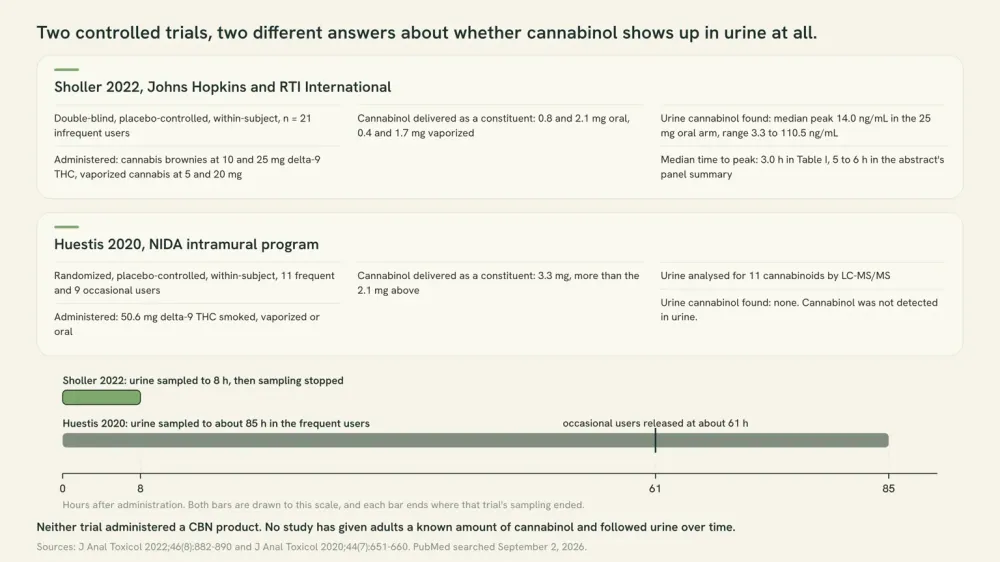
The searches printed at the end of this section turn up two controlled human trials that went looking for cannabinol in urine, and the two do not agree with each other. Start with the one that found it. In 2022, a Johns Hopkins and RTI International team published a urinary excretion profile of cannabinoid analytes after acute oral and vaporized cannabis in infrequent users in the Journal of Analytical Toxicology. It was double-blind, placebo-controlled and within-subject: 21 infrequent cannabis users, 11 men and 10 women, none of whom had used cannabis in the prior month, across six outpatient sessions of brownies containing 0, 10 or 25 mg of delta-9 THC and vaporized cannabis at 0, 5 or 20 mg. Urine was collected at baseline and for 8 hours afterward. The study cannabis was 0.85% cannabinol, which delivered 0.8 and 2.1 mg of CBN in the two oral arms and 0.4 and 1.7 mg in the vaporized arms. In the 25 mg oral arm, urine cannabinol reached a median peak of 14.0 ng/mL, with a range across participants of 3.3 to 110.5 ng/mL. The 10 mg oral arm ran a median of 7.5 ng/mL. The vaporized arms were far lower, at medians of 0.3 and 1.1 ng/mL, against a limit of quantitation of 0.25 ng/mL. Two different peak times sit in that one paper, and it is worth naming which is which rather than picking one: Table I gives cannabinol a median time to peak of 3.0 hours in the 25 mg oral arm, while the abstract summarises the whole analyte panel, cannabinol included, as peaking at 5 to 6 hours after an oral dose and 4 hours after vaporized cannabis.
Three limits before anyone does anything with those numbers. Participants received THC as well as cannabinol, so nothing in that study says cannabinol caused any result. Sampling stopped at eight hours, so it cannot support a statement about days no matter how it is quoted. And 21 infrequent users in one laboratory with one analytical method is a small, specific picture. Now the other trial. A National Institute on Drug Abuse intramural team published a study of free and glucuronide urine cannabinoids after controlled smoked, vaporized and oral cannabis in the same journal in 2020: 11 frequent and 9 occasional users, 50.6 mg of delta-9 THC per dose, smoked, vaporized or eaten. The cannabis it used carried 3.3 mg of cannabinol alongside that THC, which is more cannabinol than the largest oral dose in the 2022 trial, and again as a study parameter rather than anything anyone was told to take. Every urine specimen was analysed for eleven cannabinoids by LC-MS/MS, for about 85 hours in the frequent users and about 61 in the occasional ones. Its conclusion is blunt. The new target analytes, cannabidiol, cannabinol, cannabigerol, THCV and the phase II metabolites, "were not found in urine".
Two controlled trials, both peer-reviewed, both administering cannabis rather than a CBN product, and two different answers about whether cannabinol shows up in urine at all. This page is not going to pick a winner, and it will not explain the gap away either. The trial that found nothing gave people more cannabinol than the trial that found something, so the difference is not simply a matter of how much went in. Different analytical methods, different population mix, and neither one administered cannabinol on its own, which means the honest description of this evidence is that it is thin and it disagrees with itself. Which brings up the negative finding that most of this search result is built on ignoring. On September 2, 2026 we searched PubMed for cannabinol together with immunoassay and got 30 records; every one was screened by title, and exactly one is a study of cannabinol's behaviour in a THC screening assay, the 2020 report above. Cannabinol in the title together with urine returns 12 records, and the only screening study among them is that same paper. Across eleven queries run that day, not one study had given adults a known amount of cannabinol and then followed cannabinol, or a screening result, in urine over time. Absence of a study is not evidence that a window is short or that it is long. It is a reason not to publish one.
What to check before a CBN drug test, and what nobody can tell you
None of this is about changing an outcome. It is about understanding the one you are in, which is the part that is genuinely knowable in advance. Most of these questions have answers, most programs will give them to you if you ask, and several of them are already printed in the policy document you were handed when you were hired.
- 1Which specimen the program collects. Urine and oral fluid have different federal analytes, and hair is not on an HHS panel at all. Every measurement in this article was made in urine unless the sentence says otherwise.
- 2Whether the panel is the federal one or the employer's own. A private, non-regulated employer sets its own analytes and its own thresholds and is bound by none of the federal panels quoted here.
- 3Which analyte the confirmation names, and whether there is a confirmation at all. THC is not an analyte. On the federal urine panel the answer is the delta-9 carboxy metabolite, and cannabinol is not on that list.
- 4Whether the result you were given is a screening result or a confirmed one. A screen is presumptive by design, and the federal rules provide for a second screen with different specificity to rule out cross-reacting compounds.
- 5What the certificate for your own product reports, for cannabinol and for delta-9 THC, by batch number. Label text is not that document, and the batch on the certificate has to match the batch in your hand.
- 6Who to ask. The program administrator or the collection site for the panel and the method, and a clinician or a lawyer for anything medical or employment-related. Not a blog, including this one.
One step this page deliberately hands off. In federal and DOT-regulated testing, a Medical Review Officer reviews a laboratory positive before an employer is told anything, and what that officer may and may not accept as an explanation is set out in the regulations; our delta-8 and drug testing article published that section in full and there is no reason to rebuild it here. The legal half of the topic, including where hemp cannabinoids sit under federal law, belongs to our hemp and CBD legality hub. And the elimination question for CBD itself, across blood, urine, saliva and hair, is answered on how long CBD stays in your system. What none of those pages can do, and what this one cannot do either, is tell you what your test will report. That is not modesty. It is a description of what the evidence supports, which is a mechanism and a set of measurements, and not a prediction about a person.
No page can answer that for an individual, and any page that does is guessing about a specimen, a panel, a device and a laboratory method it has never seen. Here is what has been measured instead. Cannabinol is not an analyte on the federal urine or oral fluid panel. In the one published study of cannabinol in THC screening immunoassays, it did register on both assays tested: about five times the target analyte's decision point on the EMIT II Plus, and about twenty times on the Microgenics MultiGent, in fortified urine using pure compound. And a screening result is presumptive by design, while a confirmation identifies and quantifies one named molecule that is not cannabinol. Those three facts are about devices and rules, not about you. The workplace procedure that follows a laboratory result is covered on our CBD and workplace drug testing guide.
On an antibody screen it can, because an antibody reads shape rather than identity, and cannabinol's shape is close enough to the THC metabolite's that two commercial assays responded to it. On a mass spectrometry confirmation it is a different molecule and is treated as one: PubChem lists cannabinol as C21H26O2 with a molecular weight of 310.4, while the analyte a federal urine confirmation quantifies is 11-nor-9-carboxy-delta-9-THC, C21H28O4 at 344.4. That is 34 daltons and two extra oxygens apart, which is not a difficult separation for a mass spectrometer. So the accurate answer is that cannabinol can look like THC to the first test and does not look like it to the second, which is exactly why the two-stage structure exists.
Nobody has published the study that would answer this. A PubMed search on September 2, 2026 for cannabinol together with immunoassay returned 30 records, and across eleven queries run that day not one had given adults a known amount of cannabinol and then followed cannabinol, or a screening result, in urine over time. What has been measured is much narrower. In a controlled 2022 cannabis trial, urine cannabinol reached a median peak of 14.0 ng/mL within the first few hours after the largest oral dose, and that study stopped collecting at eight hours, so it cannot speak to days. In a separate controlled trial that followed urine by mass spectrometry for about 85 hours in its frequent users and about 61 in its occasional ones, cannabinol was not found at all. That is the whole measured basis, and it does not contain a number of days. This page publishes no clearance timeline and no advice about stopping anything before a test.
In the same 2020 experiment that tested cannabinol, cannabigerol was one of three other cannabinoids spiked into clean urine at 1,000 ng/mL, alongside cannabidiol and cannabichromene. Per the learned society's own August 2019 summary of that work, "neither test produced a false-positive result in reaction to CBD, CBC, or CBG". Only cannabinol cross-reacted. Two limits travel with that answer. It was pure compound in drug-free urine on two named assays, which is not a consumer product on whatever device your program happens to use. And cannabigerol is not an analyte on the federal panel either, so the confirmation stage is not looking for it in the first place. Our CBG and CBN comparison covers the chemistry that separates the two molecules.
The federal oral fluid panel names delta-9 THC as both its initial and its confirmatory analyte. Cannabinol is not on it. That is a separate question from whether a laboratory can find cannabinol in saliva, which it plainly can: a 2025 study tested the saliva of 1,024 adults entering New York City nightclubs and detected cannabinol in 8.9% of samples, with THC in 30.8%. A surveillance study going looking for a compound on purpose and a workplace panel naming an analyte are different activities with different targets, and the second one is what a mouth swab at work is. Roadside testing is different again, and our article on CBD and driving covers how per se laws work.
Read the certificate, not the label, and read it for the batch you actually have. On our own certificates the answers are not the same from product to product. Full Spectrum CBD+CBN, batch 260311, reports 4,110 mg of cannabinol and 79.4 mg of delta-9 THC, at 0.140%. Broad Spectrum Mango, batch 260320, reports 31.0 mg of cannabinol and delta-9 THC as not detected. Same 13-analyte potency panel, opposite answers, and even two batches of the same broad spectrum flavor line can differ. A product being sold for night-time use tells you nothing at all about its cannabinoid content; only the certificate does. Our walkthrough on reading a certificate of analysis explains which lines matter and what a limit of quantitation is.
If you came here for a number of days, the most useful thing this page can do is tell you the number does not exist and show you the search it does not come out of. What does exist is a chemistry that explains why the two stages of a drug test can disagree about the same molecule, a federal panel that names one analyte per specimen and not this one, one 2020 study that measured two machines and got a different answer from each, two controlled trials that contradict each other about urine, and a certificate for whatever is in your cabinet. For the CBD version of the same question, including where the trace THC in a full-spectrum product comes from, start with our workplace testing guide for CBD. None of this is medical or legal advice, and none of it is a claim about what your test will say.
Writing about hemp, wellness and the small rituals that keep us balanced.