Does CBG Show Up on a Drug Test? The Cannabinoid Is Not the Risk
Almost nobody takes cannabigerol on its own, so the real question is what your CBG bottle carries. The federal urine panel names one cannabis analyte and it is not CBG. The exposure that decides the answer is the trace THC printed, in milligrams, on the batch certificate.

Does CBG show up on a drug test? Almost nobody swallows cannabigerol on its own, so a CBG drug test question is really a question about the bottle it came out of, and those are two different questions with two different answers. The molecule question has a short answer: the federal urine panel names one cannabis analyte, and cannabigerol is not it. The bottle question takes longer, because a full spectrum CBG tincture is a full spectrum hemp extract, and the exposure that a drug test is built around is the trace delta-9 THC that came out of the plant with everything else. That number is printed on a certificate, in milligrams. This page shows you ours, walks through what has actually been measured, and does not tell you what your test will say.
Here is the short version with the reasons attached. On the panel the Department of Health and Human Services publishes for federal workplace testing, urine has exactly one cannabis analyte, and it is the carboxy metabolite your body makes from delta-9 THC. Cannabigerol is not that molecule, is not a second analyte, and does not appear anywhere in the notice that sets the panel. In the only published bench experiment that ever spiked cannabigerol into drug-free urine and ran it on commercial THC screens, neither of the two assays tested produced a positive. What no study has done is give a person a known amount of cannabigerol and follow a screening result over time, which is why every page printing a number of days for CBG is printing a number that was measured for a different molecule. And the thing most likely to matter is the one nobody on this search prints: a full spectrum CBG product carries trace delta-9 THC, and its milligrams are on the batch report.
A CBG bottle is a swap, not an addition
Start with what actually changed, because the whole article hangs on it. Planntz's Full Spectrum CBD tincture is 15,000 mg of CBD in 60 mL, which is 250 mg/mL. The Full Spectrum CBD + CBG tincture is 9,000 mg of CBD and 6,000 mg of CBG in the same 60 mL bottle, which is 150 mg/mL of one and 100 mg/mL of the other. Total actives land in the same neighborhood. What moved is the split. Our article on taking CBD and CBG in one bottle works through the subtraction that two certificates print, and there is no reason to redo that arithmetic here.
The part that matters for a drug test is what did not change. Both bottles are whole-plant, full spectrum hemp extract, and every full spectrum extract carries trace THC under the 0.3% federal limit. Swapping some of the cannabidiol for cannabigerol moves the cannabinoid that dominates the label. It does not move the variable a drug test is built around, which is spectrum. That is the entire answer to cbg vs cbd drug test, and everything below is the evidence for it. If you want the molecular story behind the swap, the single closed ring that separates cannabigerol from cannabidiol and what cannabigerol actually is are the two pages for that. If the word on the front of your bottle is the thing you are trying to interpret, our spectrum guide explains why full spectrum, broad spectrum and isolate carry different trace-THC exposure in the first place.
What a CBG drug test is actually looking for, and cannabigerol is not on the list
The panel is a short public table and almost nobody quoting it on this topic has opened it. In the authorized testing panels HHS published on January 16, 2025, at 90 FR 4662 and effective July 7, 2025, the urine row names one marijuana analyte for the initial test and the same molecule for the confirmatory test, written Δ9THCC, which the notice's own nomenclature table defines as delta-9-tetrahydrocannabinol-9-carboxylic acid: the carboxy metabolite a body makes from delta-9 THC. The oral fluid row names Δ9THC, delta-9 THC itself. That same notice sets the urine screening cutoff at 50 ng/mL and the confirmation cutoff at 15 ng/mL, and this is the only time this page states them, because our guide to CBD and workplace drug testing covers what they mean in practice and there is no point re-deriving it.
So we counted. Searched on September 10, 2026, the strings cannabigerol and CBG appear zero times in that notification, and zero times in the republication HHS issued on March 13, 2026 at 91 FR 12308, which states that it made "no revisions" and that the current panels remain in effect. Nothing on the federal panel is calibrated to cannabigerol, screens for cannabigerol or confirms cannabigerol. That is a fact about a document, and it is worth having, because it is the fact almost every page on this search is gesturing at without ever opening the document.
It is not, however, a promise about a device, and the rulebook itself is not naive about the difference. The mandatory guidelines for federal urine testing, at 88 FR 70768 and dated October 12, 2023, require an HHS-certified laboratory to demonstrate and document, for each initial drug test, the potential for interfering substances (Section 11.11), and then, having anticipated exactly this problem, say at Section 11.10(d) that a laboratory may conduct a second initial drug test using a method with different specificity, to rule out cross-reacting compounds. Read the verb: may, not must. Two limits of scope travel with all of it. These panels bind federal workplace programs, and a private employer writes its own panel and its own thresholds and is bound by none of it. And HHS publishes panels for urine and oral fluid only, so any other specimen is governed by whoever ordered the test. One nomenclature note belongs here too, because it causes real confusion on this exact topic: the 2023 rule still wrote the carboxy metabolite as THCA, and the January 2025 notice renamed it to stop that string colliding with tetrahydrocannabinolic acid, the plant compound that has its own separate row on a certificate of analysis. Two different molecules, one old abbreviation between them, and the second of them is the reason section five of this article exists.
The one bench experiment that put cannabigerol in front of a THC screen
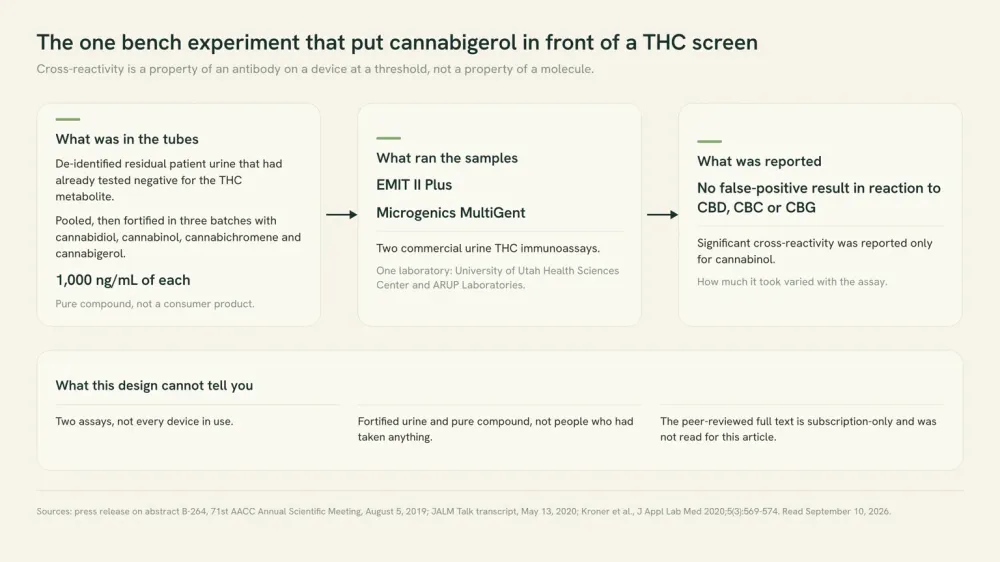
It has been run once, and it is worth knowing exactly what was in the tubes. At the University of Utah Health Sciences Center and ARUP Laboratories, a group took de-identified residual patient urine that had already tested negative for the THC metabolite, pooled it, and fortified three batches with cannabidiol, cannabinol, cannabichromene and cannabigerol at 1,000 ng/mL each. They ran those batches on two commercial urine THC screens, the EMIT II Plus and the Microgenics MultiGent. The learned society that hosted the 2019 meeting summarized the result in a press release dated August 5, 2019, about abstract B-264, and its sentence is the load-bearing one on this entire search.
“neither test produced a false-positive result in reaction to CBD, CBC, or CBG.”
The work was later published as Kroner GM, Johnson-Davis KL, Doyle K and McMillin GA in the Journal of Applied Laboratory Medicine, 2020;5(3):569-574, PMID 32445358. That full text sits behind a subscription and was not read for this article, which matters and is why we are telling you: the peer-reviewed paper reports a cross-reactivity figure for cannabinol, and the cannabigerol result reaches us through the society's summary of the conference abstract rather than through the paper. The first author was precise about the boundaries of her own work on the journal's podcast in May 2020: the team screened four cannabinoids and, in her words, only observed significant cross-reactivity with CBN; how much it took varied with the assay; and the testing that they did was with pure compounds. The cannabinol half of the same experiment, and the cross-reactivity method literature around it, live on our page about CBN and drug testing, so this page will not retell it. One last note on that 2019 release: its headline predicts a drug-test outcome using the word will. That is not a word this page borrows from anybody, including a learned society.
What has actually been measured in people, and what has not
Start with the newest and the closest thing to the question. In a ten-week supplementation study published in Medicine and Science in Sports and Exercise in 2026, researchers at Liverpool John Moores University gave 36 healthy adults either a broad spectrum CBD product at 150 mg per day (n = 31) or a visually identical placebo (n = 5), then put them through a fasted 90-minute exercise bout at 55% of peak oxygen uptake. Nobody had cannabinoids in their urine at baseline. After ten weeks, cannabigerol was detected in 42% of pre-exercise urine samples and 74% of post-exercise samples, and the rise from before to after exercise was statistically significant (P = 0.0023). Cannabidivarin behaved the same way, at 68% and 84%. And the authors report that concentrations of delta-9 THC or its metabolites were not present at any timepoint.
Four limits belong in the same breath as those percentages. The product was a different manufacturer's broad spectrum formula containing trace cannabigerol, not a bottle with 6,000 mg of it. Detected is not positive: those samples were read by a research mass spectrometry method built to find small quantities on purpose, which is a different instrument doing a different job from the antibody screen a workplace uses. The placebo arm was five people. And the study's own frame was anti-doping, a different rulebook with different lists and different thresholds, which our page on CBD and sport covers. Read correctly, the finding is that a hemp supplement can put measurable cannabigerol into urine, and that the THC null in that trial belongs to a broad spectrum product from another manufacturer rather than to full spectrum products generally. It is not a statement about what any Planntz product does to a drug test, and we are not going to turn it into one.
Cannabigerol has been found in real human urine before, in a different context. A 2010 forensic study at the National Institute of Forensic Toxicology in Budapest (Hidvégi E, Somogyi GP, Pharmazie 2010;65(6):408-11, PMID 20614687) hydrolysed authority urine samples from proved cannabis consumers, derivatised the extracts and ran them by GC/MS. The characteristic fragment ions of cannabigerol's bis-trimethylsilyl derivative appeared at 12.48 minutes in both the real samples and in CBG-spiked urine, which the authors read as cannabigerol entering the body during cannabis smoking and leaving it in a conjugated form. A second peak at 14.19 minutes was presumed to be a hydroxy metabolite and could not be completely identified; keep the word presumed, because the authors did. Now set that beside a NIDA controlled-administration study published in 2020, which gave 11 frequent and 9 occasional cannabis users 50.6 mg of delta-9 THC by smoking, by vaporizer and by mouth, measured 11 cannabinoids in urine for roughly 85 hours, and reported that no cannabidiol, cannabinol, cannabigerol, THCV, THC, 11-OH-THC or delta-9-tetrahydrocannabinolic acid were detected in urine. Two careful laboratories, two opposite answers, and this page is not going to pick a winner. Note what neither of them did: administer a CBG product to anybody.
So we went looking for the study that would settle it. These are the searches, run against PubMed through the NCBI E-utilities interface on September 10, 2026, and the counts they returned.
- cannabigerol[Title/Abstract]: 574 records.
- cannabigerol AND urine: 14 records. All 14 titles were resolved and read: analytical method papers, a breast-milk assay, a beef-tissue assay, rodent metabolic work, and four studies this page names, Kroner, Huestis, Gillham and Hidvégi.
- cannabigerol AND urine AND humans[mh]: 12 records.
- cannabigerol AND immunoassay: 6 records, all read.
- cannabigerol AND cross-reactivity: 3 records.
- cannabigerol AND urine AND (administration OR dosing OR controlled) AND humans[mh]: 4 records. Not one of them gave adults a known amount of cannabigerol and then followed cannabigerol, or a screening result, in urine over time.
A record count measures how much literature exists. It does not measure safety and it does not measure risk, so read it for exactly what it is: a negative with a date and a query string attached, which you can reproduce. As of September 10, 2026, there is no published controlled study of cannabigerol excretion in people. That has one blunt consequence for a consumer. Every "CBG stays in your system for 1 to 2 days" figure in circulation on this search is a THC number with a different molecule's name written over it. If you want the elimination question answered where it actually has been studied, how long CBD stays in your system is the page for it, and it is careful about the same gap.
One more study deserves a paragraph, because it is the top scientific result on this exact search and it is not about CBG products at all. In a 2023 paper in Clinical Toxicology, researchers measured whole blood by LC/MS/MS in 24 occasional and 32 daily cannabis smokers, at baseline and 30 minutes after a supervised 15-minute interval of smoking as much as they wanted. At baseline, none of the 24 occasional users had detectable cannabigerol; afterwards, 7 of 24 did. Among daily users the figures moved from 2 of 32 to 21 of 32. The odds ratio for recent smoking given detectable CBG was 27 (95% CI 6.6 to 110.3), and a whole-blood threshold of 0.2 ng/mL was 96% specific, 50% sensitive and 73% accurate. Now read what that actually is: whole blood, not urine; smoked cannabis, not a CBG product; a research assay no employer runs; and a cohort that was not taking cannabigerol supplements. It is a finding about cannabigerol as a marker of recent smoking. It says nothing about what a tincture does to a workplace panel, and the fact that it ranks first on a consumer search is a measure of how little else there is.
Why a CBG certificate still has a THCA line
Cannabigerolic acid, CBGA, is the shared starting material the plant builds its other cannabinoid acids from, and competing enzymes take it down different branches. A CBG-dominant chemotype is one where one of those branches fails. In a 2021 plant genetics paper in Genes, researchers working with two purpose-made crossing populations reported that CBGA dominance is inherited as a single recessive gene, potentially governed by a non-functioning allelic variant of the THCA synthase, and that the null synthase carries a single nucleotide polymorphism that may render it unable to convert CBGA to THCA. Both hedges are the authors' own and they stay. Two things to hold while you read it: this is living plants, with no human, animal or effect data anywhere in it, and all three authors were employed by a hemp seed company, which you should know before you weigh it. It is a fact about inheritance. It is not a fact about potency, quality or how any bottle performs.
The consequence for a certificate is direct. Because the branch point sits upstream of everything, a CBG-rich plant is still a cannabis plant whose report has to carry a THCA row, and the laboratory prints that row whether the number is large or nothing at all. On the three Planntz CBD + CBG batches, the THCA row is reported as non-detected at the quantitation limit each batch's certificate prints: 0.121 mg/mL on batch 260314, 0.193 mg/mL on 260315 and 0.185 mg/mL on 260313. Non-detected at a stated limit means the run could not quantify the compound above that limit. It does not mean zero, it is not a claim about the next batch, and it is not a claim about anybody else's product. The CBGA row reads non-detected on the same three reports, which our page on cannabigerolic acid puts in context across twelve certificates, while the CBG and CBN comparison walks through what each number on a certificate of analysis means.
The arithmetic nobody on this search does
Every page on the first screen of this search answers with the molecule and stops there. Here is the part that gets left out, from our own reports, read on September 10, 2026. All three Full Spectrum CBD + CBG certificates were issued by Infinite Chemical Analysis Labs in San Diego, California, under licence C8-0000047-LIC, by UHPLC-DAD, on a 56.7 g package. Every value in the table below is printed on the certificate. Nothing in it is calculated. The Mango and Peach certificate is the one to open if you want to see the layout for yourself.
| Batch and flavor | CBG (mg per package) | Delta-9 THC (mg per package) | Delta-9 THC (% by weight) | Delta-9 THC (mg/mL) | THCA row | Total THC (mg per package) |
|---|---|---|---|---|---|---|
| 260314, Mango & Peach | 6,290 | 88.5 | 0.156% | 1.45 | ND, quantitation limit 0.121 mg/mL | 88.5 |
| 260315, Lemon & Raspberry | 6,520 | 90.2 | 0.159% | 1.51 | ND, quantitation limit 0.193 mg/mL | 90.2 |
| 260313, Natural | 6,520 | 80.5 | 0.142% | 1.30 | ND, quantitation limit 0.185 mg/mL | 80.5 |
Two things to read out of that table. First, Total THC equals the delta-9 figure on all three, and that is not a coincidence. Every report prints its own formula, Total THC = Delta-10-THC + Delta-8-THC + (Delta-8-THCA x 0.877) + Delta-9-THC + THC-O-acetate + (THCA x 0.877), and because the THCA term is non-detected it contributes nothing to the sum. Second, the column almost nobody publishes is the mg/mL one. A percentage is a weight fraction; milligrams per millilitre describe the liquid you are actually measuring out of the bottle. Total CBD on those same three reports is 9,640, 9,580 and 9,410 mg per package, so this is a bottle in which cannabidiol and cannabigerol are both present at gram scale and delta-9 THC is present in the tens of milligrams.
One figure here is ours rather than the laboratory's, and it is labelled as such. At a nominal 0.05 mL per drop, 1.30 to 1.51 mg/mL works out to roughly 0.065 to 0.076 mg of delta-9 THC per drop, alongside roughly 7.5 mg of CBD and 5 mg of CBG. Drop size varies with the dropper and with technique, so treat that as an order of magnitude and not a measurement. It is also not a serving suggestion: this page publishes no dose, and amounts belong on our dosage pages, not on a testing page.
Now the only scale reference that exists, and the reason it cannot be turned into a promise. In 2001, Leson, Pless, Grotenhermen, Kalant and ElSohly published the only controlled human study that has ever fed measured milligram amounts of THC to volunteers and then screened their urine (J Anal Toxicol 2001;25(8):691-8, PMID 11765026). Fifteen THC-naive adults ate hemp and canola blends across four successive 10-day periods at single daily THC doses running from 0.09 to 0.6 mg, screened on an Immunalysis direct radioimmunoassay and confirmed by GC-MS. The authors report that none of the subjects who ingested daily doses of 0.45 mg of THC screened positive at that screening cutoff; that at a daily dose of 0.6 mg, one specimen did screen positive; and that the highest THC-COOH level found by GC-MS in any specimen anywhere in the study was 5.2 ng/mL. That one positive travels with the null result, always, and it travels with it here.
What nobody can tell you: the residual risk, stated plainly
Every page on this search ends with a reassurance. This one ends with the reasons a reassurance is not available, and one of them is a published measurement rather than an opinion. In an analytical survey of 202 US CBD products bought online between October and December 2021, only 68% of broad spectrum products met the definition claimed on the package, against 67% of full spectrum and 57% of isolate, and three broad spectrum products contained THC, two of them above 0.3%. State the caveats plainly: that study was sponsored by Jazz Pharmaceuticals, which makes a prescription CBD medicine, and several authors were compensated by the company; it tested one sample per product, so it cannot see batch variation; and its basket was bought in 2021 and was not randomly drawn. Say all of that and the finding still stands. The spectrum word on a package is not reliably the spectrum in the bottle, in any of the three categories.
- Every full spectrum batch carries trace THC, and the certificate prints how much. The honest input to this question is a milligram figure for a named batch, not a word on the front of a box.
- Non-detected is a statement about one batch measured against one printed limit. It is not THC-free and it is not zero.
- Batches are not interchangeable. Our own Broad Spectrum Lemon & Raspberry batch 260321 reports 10.7 mg of delta-9 THC, 0.0189%, on a line where two sibling batches report non-detected.
- The spectrum word on a package is not always the spectrum in the bottle. That has been measured across 202 products, and it failed often enough to matter in all three spectrum categories, including isolate.
- No controlled study has ever given a person a CBG product and screened their urine. There is no cannabigerol detection window to publish, and inventing one would be worse than saying so.
- Cross-reactivity belongs to the device, not to the molecule. The one experiment that put cannabigerol in front of a THC screen tested two assays, and the device your program uses may not be either of them.
So here is the sentence that has to sit in the body of the article and not in a footnote: no product can guarantee a drug-test outcome, ours included, and that is true for full spectrum, for broad spectrum and for isolate alike. This page publishes no clearance timeline, no wait time and no advice about stopping anything before a test, because the study that would justify one has not been done and we are not going to improvise it. If a test is going to decide something that matters to you, the useful moves are reading the certificate for the batch in your hand and asking the program what it screens for. Reading a certificate of analysis line by line is the skill that does the first half of that, and the next section is the short version.
A pre-purchase check if you are tested
- 1Match the batch number printed on your bottle to the batch number on the certificate. A single product-line PDF that covers everything a brand sells is not a batch report, and a batch report for a different lot is not yours.
- 2Find the delta-9 THC row and read the mg/mL column, not only the percentage. A percentage is a weight fraction, and it hides the milligrams you are actually measuring out of the bottle.
- 3Find the Total THC line and read the formula the laboratory printed underneath it. Different laboratories sum different terms, and the formula tells you which ones were included in the number you are looking at.
- 4Find the THCA and CBGA rows, then read the limit of detection or quantitation printed beside any ND. An ND with no limit beside it is not a result, because it does not say what the run was capable of seeing.
- 5Read the spectrum word against the certificate rather than against the front panel. Full spectrum, broad spectrum and isolate are claims until the potency table on the batch report agrees with them.
- 6If a test decides your employment, your licence or a legal condition, the conversation is with your employer, the program that ordered it or a medical review officer. Not with a blog, including this one.
Three other specimen types get one sentence each here, because they are different systems and other pages own them. Hair testing uses a different specimen and a different laboratory process and sits outside the panels HHS publishes at all. Oral fluid programs name delta-9 THC itself rather than its carboxy metabolite, which is a different target that behaves differently. And blood is a forensic and clinical matrix, which is exactly the matrix the cannabigerol biomarker study used and a large part of why its numbers do not transfer to a workplace cup. If you arrived here without a clear picture of where cannabigerol sits among the other molecules in the plant, our overview of the cannabinoids is the place to start.
The federal urine panel names one cannabis analyte, the carboxy metabolite of delta-9 THC, and cannabigerol does not appear in the January 2025 notification that sets that panel or in the March 2026 republication that left it unchanged. Separately, in the only published experiment that spiked cannabigerol into drug-free urine at 1,000 ng/mL, neither of the two commercial assays tested produced a positive. Both of those are real findings and both are narrow. The first is a fact about a document, not a promise about a device. The second is two assays in one laboratory using pure compound in fortified urine, not every device your program might use. What the panel does look for is delta-9 THC's metabolite, and a full spectrum CBG product carries trace delta-9 THC that its certificate prints in milligrams.
No page can answer that about a person, and any page that does is guessing about a specimen, a device, a cutoff and a laboratory it has never seen. What can be answered is what is in the bottle. Our three Full Spectrum CBD + CBG certificates report 80.5 to 90.2 mg of delta-9 THC per 60 mL bottle, which is 1.30 to 1.51 mg/mL and 0.142% to 0.159% by weight, with the THCA row reported as non-detected at the quantitation limit each batch's certificate prints. Those are measurements of three specific batches, not a prediction. No product can guarantee a drug-test outcome, ours included, and that holds for full spectrum, broad spectrum and isolate alike.
The conversion people are thinking of runs the other way, and it happens in a living plant rather than in a person. Cannabigerolic acid, CBGA, is the acid form of cannabigerol and the shared starting material the plant builds from, and a synthase enzyme converts CBGA into THCA, which is where the plant's THC comes from. That is plant biochemistry catalysed by a plant enzyme in a growing plant. We found no evidence that swallowing cannabigerol turns it into THC in a person, and we went looking. Our CBG and CBD comparison covers the biosynthesis in full, and our page on cannabigerolic acid covers the acid form and where it shows up on a certificate.
Nobody has measured it. On September 10, 2026, a PubMed search returned 574 records with cannabigerol in the title or abstract, 14 of which also mention urine and 6 of which mention immunoassay. Every one of those titles was resolved and read, and not one had given adults a known amount of cannabigerol and then followed cannabigerol, or a screening result, in urine over time. The 24 to 48 hour figures you will find on this search are not traceable to a study of cannabigerol; they are THC numbers with a different molecule's name on them. This page publishes no clearance timeline and no advice about stopping anything before a test.
Panel size describes how many drug classes are screened, not how many cannabinoids. Adding panels adds other drug classes, and the cannabis line on a wider panel is still calibrated to the same single analyte. The more useful distinction is who wrote the panel. The HHS panels bind federal workplace programs, and the Department of Transportation adopts them by reference. A probation office, a private employer or another program may use different devices, different analytes and different thresholds, and none of them has to tell a blog what they are. Ask the program that ordered the test, in writing if you can.
An isolate certificate that reports non-detected THC is reporting a limit-of-detection result for one batch against one printed limit. That is not an absence, and it is not a guarantee, and this page makes no guarantee for any spectrum, including isolate. There is also a measured reason to check rather than assume: in a 2024 analytical survey of 202 US CBD products, 57% of the products labelled isolate met the definition claimed on the package, and three broad spectrum products in the same basket contained THC, two of them above 0.3%. That survey was sponsored by a pharmaceutical company that makes a prescription CBD medicine, which you should weigh, and it tested one sample per product, so it cannot speak to batch variation.
Which cannabinoid dominates changed. Whether the extract carries trace THC did not. Our Full Spectrum CBD + CBG batches report 1.30 to 1.51 mg/mL of delta-9 THC, and our plain Full Spectrum CBD batches report 2.27 to 2.43 mg/mL, figures already published alongside those certificates. That difference is not a safety ranking and not a recommendation: it is what two sets of batch reports print for two different formulations. Both are full spectrum hemp extract, both are below the 0.3% federal limit, and both are decided by the batch rather than by the front label. Spectrum, not the featured minor cannabinoid, is the variable that moves this question.
If you came here for a number of days, the most useful thing this page can do is tell you the number does not exist and show you the search it does not come out of. What does exist is a federal panel that names one cannabis analyte and not this one, one bench experiment on two assays that produced no positive for cannabigerol, one ten-week trial in which a hemp supplement put measurable cannabigerol into urine while delta-9 THC stayed absent, two careful laboratories that disagree about whether cannabis smoking leaves cannabigerol in urine at all, and a certificate for whatever is in your cabinet. Ours are published in full, including the delta-9 THC row and the quantitation limit beside every non-detect: every batch report we hold is on the lab results page, and the Full Spectrum CBD + CBG product page carries its own. None of this is medical or legal advice, and none of it is a claim about what your test will say.
Read the certificate, not the promise
Every Planntz batch report is published in full, including the delta-9 THC row in milligrams and the quantitation limit printed beside every non-detected result. Look up the batch number on your bottle and read the row yourself.
See the lab resultsWriting about hemp, wellness and the small rituals that keep us balanced.