Ibuprofen and Weed: What Studies in People Actually Found
The warning that cannabis blocks the enzymes that clear ibuprofen comes from lab dishes. Here is what happened when people actually took THC, why 'ibuprofen kills your high' rests on four people and some mice, and the Advil label lines that still apply.
You have a headache or a sore back, you smoked earlier or ate an edible, and the Advil is right there. Can you take ibuprofen while high? Here is what is known about ibuprofen and weed as of October 23, 2026. The scary warning online, that cannabis strongly blocks the enzymes that clear ibuprofen, comes from experiments on enzymes in lab dishes. In the one controlled test in people, a 20 mg THC brownie with no CBD did not slow a test drug that relies on ibuprofen's main liver enzyme. Nobody has measured ibuprofen levels in people who are high, and smoked or heavier use has not been tested. The risks you can act on are already printed on the ibuprofen label. This is general information for adults 21 and over where cannabis is legal, not medical advice.
This page is about THC, the compound in cannabis that gets you high. If the product in your hand also contains CBD, the answer shifts, and our guide to CBD and ibuprofen covers that side in full. If headaches after smoking are the reason you reached for the Advil, can weed cause headaches? looks at that question on its own. Here we sort the evidence into three piles, because that is where most pages on this topic go wrong: what happened in lab dishes, what a computer model predicted, and what was actually measured in people.
Where the "cannabis blocks ibuprofen" warning comes from
Your body clears ibuprofen in two main ways. Liver enzymes from the cytochrome P450 family oxidize it, and lab work assigns most of that job to one enzyme called CYP2C9: in a 2008 study of the enzymes that metabolize ibuprofen, only CYP2C9 formed appreciable amounts of its hydroxy metabolites, while CYP2C8 played a minor role. A second family, the UGT enzymes, attaches glucuronic acid to ibuprofen so the kidneys can flush it out, and a 2005 study of ibuprofen glucuronidation named UGT1A9 and UGT2B7 among the enzymes that do it. One detail most pages miss: the current prescription ibuprofen label names no CYP enzyme at all. These assignments come from lab enzymology, not from the label.
In 2021 a research group at Washington State University published two companion papers on cannabinoids and these enzyme families. In the first, THC competitively inhibited CYP2C9 in cell preparations, along with CYP1A2, CYP2B6 and CYP2D6, and two THC breakdown products inhibited CYP2C9 as well. In the second, THC strongly inhibited UGT1A9 and UGT2B7 in engineered cells and in human liver and kidney tissue preparations, with a binding-corrected IC50 of 0.45 µM for UGT1A9. IC50 is the concentration that blocks half of an enzyme's activity, so a low number means a strong effect in the dish. Put those results next to ibuprofen's enzyme list and you get the warning that circulates online: cannabis strongly inhibits the enzymes ibuprofen needs.
Both papers are in vitro: enzymes in a dish, with no person, no dose anyone actually took, and no ibuprofen in the experiment. The authors' own modelling said their results suggest the possibility of interactions, which is a reason to run a human study, not a result. Work like this tells researchers where to look. It cannot tell you what happens in your body after a joint or an edible. For that, someone has to give people THC and measure.
What happened when people took THC and a CYP2C9 test drug
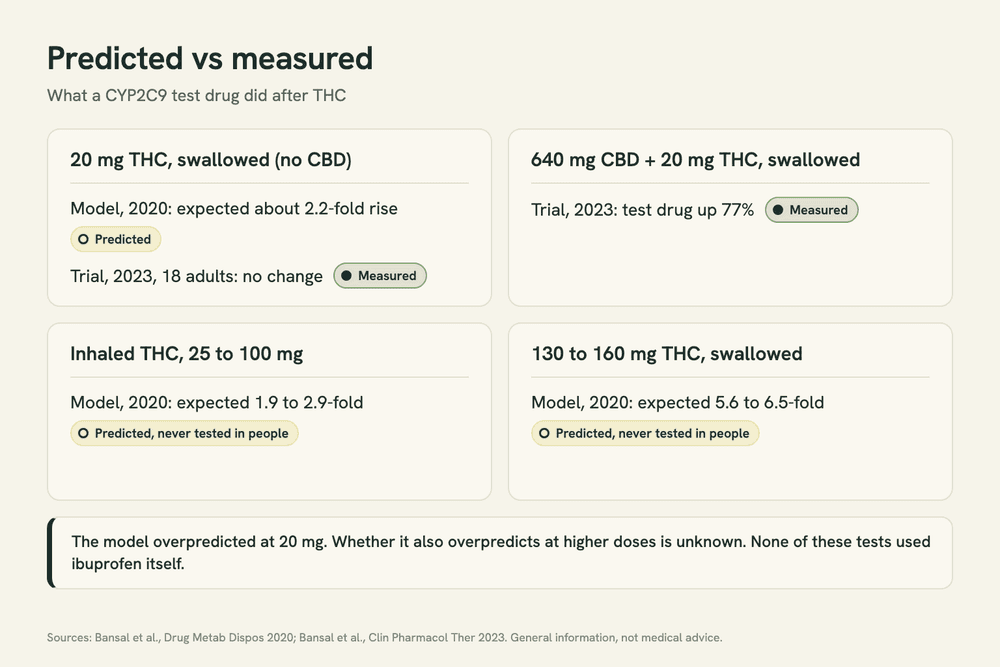
Someone did. In a 2023 double-blind, randomized crossover trial, 18 healthy adults each went through three sessions: a placebo brownie, a brownie with 20 mg of THC and no CBD, and a brownie with 640 mg of CBD plus the same 20 mg of THC. Thirty minutes later they took a cocktail of low-dose test drugs, each cleared by a different liver enzyme. The CYP2C9 test drug was losartan, a blood pressure medicine, at 25 mg. If THC were slowing CYP2C9 in a meaningful way, losartan levels should have gone up.
They did not. In the authors' words, "the Δ9-THC brownie did not inhibit any of the CYPs." The brownie that moved the needle was the CBD-dominant one. It raised losartan exposure by 77%, and it raised the volunteers' own THC exposure by 161%, which the authors attribute to CBD slowing the CYP2C9 clearance of swallowed THC. In the one human test we have, CBD is the variable, not THC.
Keep the limits next to the result. It was one dose, swallowed, not smoked. The test drug was losartan, not ibuprofen. The volunteers were not regular users: the companion paper from the same trial reports they averaged 86 days since their last cannabis use, so this was not a daily user's liver. And the trial could not separate out the UGT enzymes; its authors wrote that their data "cannot deduce the magnitude of inhibition of each UGT isoform." So the honest headline is narrow. At a typical edible dose, in occasional users, THC alone did not slow ibuprofen's main oxidizing enzyme. That is not the same as "THC does not affect ibuprofen."
The model said one thing, people said another
The same research group had made a prediction three years earlier. Their 2020 model, built from human liver tissue, estimated that 20 mg of swallowed THC would raise the levels of a CYP2C9 test drug (diclofenac, another NSAID) about 2.2-fold. The 2023 trial tested that exact dose, with losartan instead of diclofenac as the CYP2C9 test drug, and found no change. In their discussion, the trial authors wrote that these enzyme interactions "were overpredicted by the mechanistic static model" and that such models "predict worse-case scenarios." That is the best single lesson on this topic: a prediction from lab tissue is a hypothesis, and at 20 mg the hypothesis failed.
Now the part most pages skip. The same 2020 model made predictions nobody has checked in people: a 5.6 to 6.5-fold rise for 130 to 160 mg of swallowed THC, and 1.9 to 2.9-fold for inhaled THC at 25 to 100 mg. The authors wrote that after inhalation, THC was predicted to interact only with drugs extensively metabolized by CYP2C9, and that their predictions "need to be verified by a well designed clinical drug interaction study." Smoking or vaping, high-dose edibles and daily heavy use have never been tested against a CYP2C9 test drug in people. The model overshot at 20 mg. Whether it also overshoots at higher doses is unknown.
For scale, here is what a measured CYP2C9 interaction with ibuprofen looks like. In a 2006 crossover study of 12 healthy men given 400 mg of ibuprofen, the antifungal voriconazole, a known CYP2C9 blocker, roughly doubled exposure to S-ibuprofen (the active half of the drug), fluconazole raised it about 83%, and its half-life stretched from 2.4 hours to about 3.1 to 3.2 hours. That is the experiment that would answer the question for cannabis. No cannabis product has been put through it.
Two more pieces belong here. First, THC is itself broken down by CYP2C9. The FDA label for dronabinol, a prescription capsule of synthetic THC, says it is "primarily metabolized by CYP2C9 and CYP3A4 enzymes based on published in vitro studies," and names amiodarone and fluconazole as examples of CYP2C9 blockers. Ibuprofen is not on that list, and no study has checked whether ibuprofen changes THC levels. Second, case reports keep the heavy-use question open, such as a 2009 report of a man on the blood thinner warfarin whose INR, a blood-clotting measure, rose above 10 while he was smoking cannabis heavily. Warfarin's more active half is cleared by CYP2C9. One case proves little, because many things move INR. If you take a blood thinner, our guide to CBD and blood thinners covers that ground.
Which product are you holding?
The answer depends on what you used, how much and how often. This table lines up each common situation against the three kinds of evidence. The label column is the same in every row, which is the point: the ibuprofen warnings never switch off.
| What you used | Measured in people | Lab dish or model only | Label lines that still apply |
|---|---|---|---|
| THC-only edible, around 20 mg | One trial, 18 occasional users: a CYP2C9 test drug did not change | Model predicted about 2.2-fold; the trial did not confirm it | Every Advil warning: alcohol, other NSAIDs, age 60+, stomach, kidney and heart history |
| THC-only flower or vape | Nothing measured | Model predicted 1.9 to 2.9-fold for 25 to 100 mg inhaled; untested | Same |
| High-dose edible (130 to 160 mg THC) | Nothing measured | Model predicted 5.6 to 6.5-fold; untested | Same |
| Daily heavy use, any form | Nothing measured; warfarin case reports only | Lab dish: THC inhibits CYP2C9, UGT1A9 and UGT2B7 | Same, plus the label's caution on long-term use |
| CBD-dominant or CBD plus THC product | 640 mg CBD + 20 mg THC raised a CYP2C9 test drug 77%; smaller CBD amounts not tested in that trial | See our CBD and ibuprofen guide | Same |
Does ibuprofen kill your high?
This piece of folklore has two parents, and neither one is ibuprofen in people. The first is a small 1991 experiment, the only controlled human study we found that gave an NSAID with cannabis and measured how one changed the other. Four people took indomethacin, a prescription anti-inflammatory in the same drug class as ibuprofen, or a placebo, before smoking marijuana. The design was exploratory and single-blind. The authors reported that indomethacin:
“significantly attenuated the subjective 'high' and the heart rate accelerating effects of THC, although the magnitude of this effect was modest.”
Indomethacin also abolished THC's effect on time estimation. But it did not touch the memory problem: the authors write that indomethacin pretreatment "did not affect the decremental effects of THC on word recall." So in four people, a different NSAID made the high a little smaller and left the memory impairment where it was. That is not a way to sober up, and it says nothing about a normal dose of Advil.
The second parent is a 2013 news cycle. Headlines that year called painkillers a marijuana buzzkill, and pages still repeat it. The source was a 2013 study in mice that injected the animals with THC once a day for seven days and looked mainly at memory and the connections between brain cells. The drugs that blocked those effects were celecoxib (Celebrex) and an experimental compound called NS398, both selective COX-2 inhibitors. Blocking COX-2 also blunted two movement effects of THC in the mice, freezing in place and moving around less, which are mouse stand-ins, not a measure of how high a person feels. The paper does not mention ibuprofen. Mice, injections, a week of dosing, memory tests and two drugs that are not ibuprofen: that is a long way from "take an Advil to come down."
If you are too high right now, ibuprofen is not the answer. Our guide to greening out covers what usually happens, what you can do while it passes and the signs that mean you should get help.
The risks that are real are printed on the Advil box
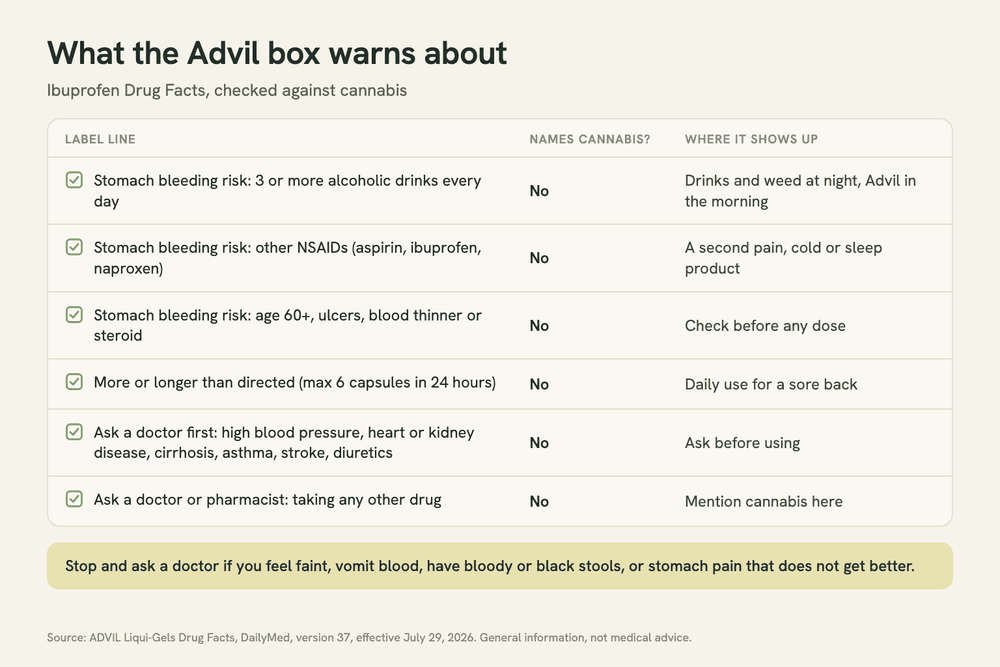
No ibuprofen label mentions cannabis. We read the current Advil Liqui-Gels Drug Facts, version 37, effective July 29, 2026, and found no mention of cannabis, marijuana or THC. That silence is not a clearance either: over-the-counter Drug Facts panels have no pharmacology section, so leaving cannabis out is partly how these labels are written. What the label does carry are warnings that apply whether or not you are high, and a few of them describe exactly what people stack on a night out. Here is the checklist, line by line.
- Stomach bleeding is more likely if you "have 3 or more alcoholic drinks every day while using this product." Names cannabis: no. Where it bites: drinks plus weed at night, Advil for the headache in the morning.
- More likely if you "take other drugs containing prescription or nonprescription NSAIDs [aspirin, ibuprofen, naproxen, or others]." Names cannabis: no. Where it bites: a second pain, cold or sleep product that already contains an NSAID.
- More likely if you are age 60 or older, have had stomach ulcers or bleeding problems, or take a blood thinning (anticoagulant) or steroid drug. Names cannabis: no.
- More likely if you "take more or for a longer time than directed." The label allows no more than 6 capsules (200 mg each) in 24 hours unless a doctor says otherwise. Names cannabis: no. Where it bites: a sore back, daily use, weeks going by.
- Ask a doctor before use if you have high blood pressure, heart disease, liver cirrhosis, kidney disease, asthma or a history of stroke, or take a diuretic. The label also carries a heart attack and stroke warning. Names cannabis: no.
- Ask a doctor or pharmacist before use if you are "taking any other drug." Names cannabis: no. This is the line where cannabis belongs in the conversation.
The prescription ibuprofen label adds two points worth knowing. Its boxed warning says serious stomach and intestinal bleeding "can occur at any time during use and without warning symptoms," and that elderly patients are at greater risk. Its kidney section says the risk is greatest in people with impaired kidney function, heart failure or liver problems, people taking diuretics or ACE inhibitors, and older adults. None of this involves cannabis. All of it still applies when you are high. If you were drinking too, our crossfaded guide covers what alcohol and weed do together before any painkiller enters the picture.
Naproxen, sold as Aleve, is a different NSAID that carries the same stomach-bleeding warning on its Drug Facts label, with no mention of cannabis. It has not been studied with THC either.
If your product has CBD in it
Then the THC-only result above does not cover you. The CBD-dominant brownie in the 2023 trial is the only cannabis product shown in people to raise a CYP2C9 test drug, so if your edible, tincture, vape or 1:1 product lists CBD on the label, read what the evidence says about CBD with ibuprofen before assuming anything. Keep one number in proportion: 640 mg of CBD is far above a typical consumer serving, and smaller amounts were not tested in that trial.
What about Tylenol (acetaminophen)?
Acetaminophen, the drug in Tylenol, is not an NSAID and does not carry the stomach-bleeding warning. Its documented hazards have nothing to do with cannabis. The FDA's acetaminophen page points out that acetaminophen is in hundreds of products and says: "Do not use more than one acetaminophen-containing product at a time." It also warns that "severe liver damage may occur if you have three or more alcoholic drinks per day while using acetaminophen." Doubling up across products and heavy drinking are the two hazards on record. The Tylenol Extra Strength label does not mention cannabis.
There is one odd chemical link. In the body, part of an acetaminophen dose is converted into a compound called AM404, which acts on the TRPV1 receptor and blocks the reuptake of anandamide, one of the body's own cannabinoid-like messengers. In a 2017 study of men given 1 g of acetaminophen by IV during surgery, AM404 was detected in 17 of 26 spinal fluid samples, at concentrations the authors described as "far below the previously documented IC50" for the compound. That is chemistry, not evidence of an interaction with THC.
The combination itself has not been tested. We searched PubMed on October 23, 2026 for controlled trials pairing acetaminophen or paracetamol with THC, cannabis or marijuana. The closest, a 2018 crossover study in 24 volunteers, gave people 1,000 mg of paracetamol and 10 mg of THC on separate occasions, never together. For the CBD side, see CBD and Tylenol. For cold medicines that already contain acetaminophen, see NyQuil and weed. For what research says about cannabis and the liver on its own, read is weed bad for your liver?
What has and has not been studied
We searched PubMed on October 23, 2026, across ibuprofen, naproxen, aspirin, indomethacin, diclofenac and the NSAID class as a whole, paired with THC, cannabis or marijuana. One controlled study gave people an NSAID together with cannabis and measured how one changed the other: the four-person indomethacin experiment from 1991. One later trial, a 2020 study during a medical procedure, gave every participant ibuprofen along with either a THC capsule or a placebo, but it measured how the procedure felt, not an interaction. Nobody has measured ibuprofen levels in people who are high. That gap is the honest bottom line, and it is why this page does not call the combination safe or dangerous.
What to tell a pharmacist, and when to get help
The Advil label tells you to ask a doctor or pharmacist before use if you take any other drug, and cannabis belongs in that conversation. You are not asking permission; you are giving them what they need to check your situation. Bring this list:
- 1The exact product and its active ingredients: Advil, Motrin, store-brand ibuprofen, Aleve, or a combination pain, cold or sleep product.
- 2That you use cannabis: smoked, vaped or eaten, roughly how much and how often.
- 3Whether your cannabis product contains CBD, and how much per serving.
- 4How much you drink, especially if it is 3 or more drinks a day.
- 5Your other medicines, especially blood thinners, steroids, diuretics, blood pressure medicines and any other NSAID, including low-dose aspirin.
- 6Your history: stomach ulcers or bleeding, kidney or liver disease, heart disease, high blood pressure, asthma or stroke, and whether you are 60 or older.
- 7Whether you are pregnant or breastfeeding: the label says to ask a health professional first, and not to use ibuprofen at 20 weeks or later in pregnancy unless a doctor directs it.
- 8How long you have been taking ibuprofen, if it has been more than a few days.

Ibuprofen and weed: questions people ask
No study has measured ibuprofen in people who are high. The one human enzyme test with THC alone (a 20 mg brownie, swallowed, in 18 occasional users) found no slowdown of a test drug that uses ibuprofen's main enzyme. The label warnings about alcohol, other NSAIDs, and stomach, kidney and heart history apply either way. If you take other medicines or use cannabis daily, ask a pharmacist.
Advil is ibuprofen, so the answer is the same. THC blocks ibuprofen's enzymes in lab dishes; in people, a typical edible dose of THC alone did not slow ibuprofen's main enzyme; smoked THC and heavier use were predicted to matter more but have never been tested. Products that contain CBD are the ones that moved a CYP2C9 test drug in people, and our CBD and ibuprofen guide covers them.
That has not been shown. In a 1991 study, four people who took indomethacin, a different NSAID, before smoking had a modestly smaller high and heart-rate jump, but their memory impairment was unchanged. The 2013 'buzzkill' headlines came from mice given Celebrex, and that paper never mentions ibuprofen. It is not a way to sober up; our greening out guide covers what to do if you are too high.
Edibles are the one route that was tested: a 20 mg THC brownie with no CBD did not slow a CYP2C9 test drug in 18 adults. A model predicted larger effects at 130 to 160 mg of THC, and that has never been tested. Edibles that also contain CBD are a different case, covered in our CBD and ibuprofen guide. The label warnings apply whatever form your THC comes in.
No controlled study has given acetaminophen and THC together; the nearest gave them on separate days. The hazards the FDA documents for Tylenol are taking more than one acetaminophen product at a time and drinking 3 or more alcoholic drinks a day while using it. Our CBD and Tylenol and NyQuil and weed guides go further.
No study gives a waiting interval, and we will not invent one. What decides it: ibuprofen reaches its peak blood level one to two hours after a dose and has a half-life of 1.8 to 2.0 hours (prescription label); THC's effects last hours depending on route and dose; and there is no measured interaction to space the two around. Half-life describes blood levels, not a safe gap. Ask a pharmacist about your own situation.
Aleve is naproxen, a different NSAID with the same stomach-bleeding warning, and it has not been studied with THC either. Aspirin is also an NSAID, and the Advil label lists it among the other NSAIDs that raise bleeding risk when combined with ibuprofen. The label also tells people taking aspirin for heart attack or stroke to ask first, because ibuprofen may decrease that benefit of aspirin. If you take low-dose aspirin, ask a pharmacist about ibuprofen; our CBD and blood thinners guide covers aspirin.
Ibuprofen is one of many medicines people take alongside cannabis. For the wider picture, including which drugs share liver enzymes with cannabinoids and which meet them in other ways, read our guide to CBD and medications. For a prescription example with a different kind of overlap, see gabapentin and weed.
Writing about hemp, wellness and the small rituals that keep us balanced.