CBD and Tylenol: Page One Has the Wrong Enzyme Family
The pages ranking for this search say CBD and Tylenol compete for cytochrome P450. Acetaminophen's own prescribing information puts glucuronide and sulfate conjugation first. Here is the enzyme the two actually share, and why no wait window has ever been measured.

Type CBD and Tylenol into a search box and page one answers with an enzyme family. Several of the pages that rank say the two substances compete for the same one, in almost identical words. They name the wrong family, and you can check that yourself in about a minute against a public document none of them opens. That correction is most of this page. The other part is shorter and matters more: acetaminophen is the ingredient people take twice without meaning to, and that, not the enzyme, is where the documented harm on this topic comes from.
This page reports documents: the current prescribing information for acetaminophen, the Drug Facts panel on a box of Tylenol Extra Strength, the FDA-approved label for pharmaceutical cannabidiol, and the small pile of studies people cite when they answer this question. It publishes no amount of either substance, no ratio and no waiting interval, because none of those exist in a source we could check. The two instructions here are the ones the labels themselves give: tell a pharmacist or prescriber everything you take, and add up the acetaminophen printed on every product in your house. If cannabidiol is new to you, start with what CBD is and how it is made and come back.
What page one says, and why it is checkable
Read the results that rank for this search and the mechanism arrives pre-assembled. A cannabis telehealth blog writes that both substances rely on the cytochrome P450 system, and that the enzymes involved, CYP3A4 and CYP2E1, are the same workers responsible for breaking down Tylenol into its non-toxic components. A cannabis-card service writes that CBD inhibits enzymes that help metabolize Tylenol and, a paragraph later, that cannabis can inhibit the amount of enzymes in your liver. A third publishes a waiting interval. We read all of them on August 19, 2026 and we are not linking them, because the point is not who wrote it. There is a real paper underneath. A 2021 narrative review in the Journal of General Internal Medicine did name this drug: it advised that caution should be taken when CBD is used with medications with the potential to cause hepatic injury, such as acetaminophen, presented the possible mechanisms in a table, and said it will be important to investigate the impact of CBD on concomitant medication use in future randomized controlled trials. The caution survived the trip to retail. The hedge did not, and the mechanism those pages attached to it along the way is not the one the underlying literature describes.
Three things are wrong in that mechanism and none of them needs a laboratory to see. First, the direction is inverted: CYP2E1 is the route that forms acetaminophen's reactive metabolite, not the route that clears it, so calling it the path to non-toxic components is the opposite of what the label says. Second, a category error: inhibition is a change in how fast an enzyme works, not in how much of it you have. Changing the amount is induction, a different phenomenon that generally runs the other way. Third, the interval: nobody measured one, and the sites that publish it do not agree with each other. The overlap between these two substances is real and better documented than what page one prints. It just lives in an enzyme family none of those pages mention.
What acetaminophen actually uses to leave your body
Acetaminophen's disposal is described in a single paragraph of its prescribing information, in section 12.3 under Elimination. We pulled the current label on August 19, 2026 from the DailyMed record for acetaminophen injection, version 2, effective June 24, 2026. Here is that paragraph, unedited.
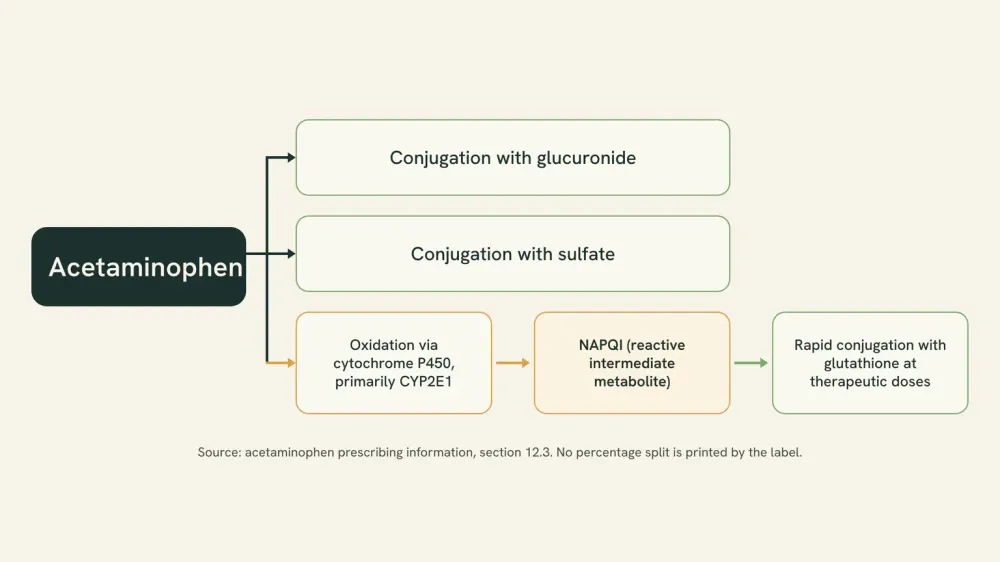
“Acetaminophen is primarily metabolized in the liver by first-order kinetics and involves three principal separate pathways: Conjugation with glucuronide, conjugation with sulfate, and oxidation via the cytochrome P450 enzyme pathway, primarily CYP2E1, to form a reactive intermediate metabolite (N-acetyl-p-benzoquinone imine or NAPQI). With therapeutic doses, NAPQI undergoes rapid conjugation with glutathione and is then further metabolized to form cysteine and mercapturic acid conjugates.”
Read the order. Two conjugation routes come first. Each attaches a chemical handle to the acetaminophen molecule, glucuronide or sulfate, which makes it water-soluble enough for your kidneys to send out. The cytochrome P450 route is named third, and the label qualifies it twice: primarily CYP2E1, and what it produces is a reactive intermediate metabolite called NAPQI. At therapeutic doses that NAPQI is mopped up almost immediately by glutathione, a small sulfur-containing molecule your liver keeps in stock. Overdose toxicity is what happens when the oxidative route outruns the glutathione supply, which is also why the antidote is a glutathione precursor. The label prints no percentage split across the three routes, so neither do we. What it does print is that less than 5% of a dose leaves in the urine as unchanged acetaminophen, and more than 90% of the dose is out within 24 hours.
Two details from the same document earn their place. Acetaminophen is described there as a non-salicylate antipyretic and non-opioid analgesic agent, which is the label's plain way of saying it is not an NSAID: ibuprofen, naproxen and aspirin work through a different mechanism and carry different stomach and kidney cautions, which is why those live on our page about CBD alongside ibuprofen. And at therapeutic levels the label says binding of acetaminophen to plasma proteins is low, ranging from 10% to 25%, which matters because protein binding is one of the things people reach for when they say two substances compete. So page one described the minority pathway, reversed its direction, and presented it as the whole story.
The enzyme family CBD and Tylenol actually share
If acetaminophen is mostly glucuronidated, the next question is which enzyme does the glucuronidating. UDP-glucuronosyltransferases, or UGTs, are a family, and they divide the work between them. The best answer available is a 2001 in vitro study by Court and colleagues in the Journal of Pharmacology and Experimental Therapeutics, which used human liver microsomes from 56 donors and nine recombinant human UGTs to sort it out. Most UGTs could glucuronidate acetaminophen in vitro, but three were most active: UGT1A1, UGT1A6 and UGT1A9. A kinetic model built on those in vitro data identified UGT1A9 as the predominant acetaminophen-glucuronidating enzyme over the clinically relevant concentration range, at more than 55% of total activity in those microsomes. That is a share of enzyme activity in a laboratory preparation, not a share of your dose, and it is a model rather than a measurement in a person. The same work found more than 15-fold variation in that activity between individual livers.
Now the other side. In 2021 a Washington State University group published IC50 values for major cannabinoids against a panel of UGT enzymes in vitro, and the lowest binding-corrected IC50 in that in vitro panel, 0.12 micromolar, was cannabidiol against UGT1A9. What makes the paper unusually relevant here is that one of its UGT1A9 probe substrates was acetaminophen itself. In vitro, against acetaminophen glucuronidation, cannabidiol's IC50 was 1.9 micromolar in the isolated recombinant enzyme, 3.8 micromolar in pooled human kidney microsomes from 8 donors, and 12 micromolar in pooled human liver microsomes from 50 donors. Read that order carefully, because it is the opposite of what a liver headline would need: in vitro, the inhibition was strongest in the isolated enzyme, next strongest in kidney microsomes, and weakest, by about sixfold, in the liver preparation. The authors' own conclusion is that in vivo studies of cannabinoid drug interactions are warranted.
| Enzyme | Acetaminophen (Court 2001, in vitro plus kinetic model) | Cannabidiol (what the sources report) | System behind the cannabidiol column |
|---|---|---|---|
| UGT1A9 | Predominant glucuronidating enzyme, more than 55% of total activity in those microsomes; low affinity (Km 21 mM), high capacity | Inhibited. Lowest binding-corrected IC50 in the 2021 in vitro panel (0.12 micromolar, propofol probe). The FDA-approved cannabidiol label calls cannabidiol a UGT1A9 inhibitor | In vitro, plus one human probe study on a different drug |
| UGT1A1 | Intermediate affinity (Km 9.4 mM); modelled at more than 28% of activity only at toxic concentrations above 1 mM | The FDA-approved cannabidiol label states cannabidiol does not inhibit UGT1A1 | In vitro assessment section of the label |
| UGT1A6 | High affinity (Km 2.2 mM), low capacity; modelled at more than 29% of activity below 50 micromolar | Disputed. The label reports no inhibition; the 2021 in vitro paper reports strong inhibition (binding-corrected IC50 0.40 micromolar, serotonin probe) | In vitro on both sides, and they disagree |
| CYP2E1 | The label's third route, described as primarily CYP2E1, forming the reactive metabolite NAPQI | The string 2E1 appears zero times in the FDA-approved cannabidiol label, searched by us on August 19, 2026 | Whole-document search of a 270,456-byte regulatory file |
The regulator agrees on the isoform that matters. The FDA-approved label for pharmaceutical cannabidiol, version 35, effective May 29, 2026, calls cannabidiol an inhibitor of UGT1A9 and tells prescribers to consider a reduction in dosage of UGT1A9 substrates where minimal concentration changes may lead to serious adverse reactions. The one human measurement attached to that instruction is a probe study in which cannabidiol raised exposure to mycophenolic acid, an immunosuppressant, by 16% for peak concentration and 35% for AUC. Mycophenolic acid is not acetaminophen, the cannabidiol in that study is a prescription oral solution dosed by body weight rather than anything sold as a consumer product, and neither number transfers to this question. Then the boundary, which page one would never print: the same label states that cannabidiol does not inhibit UGT1A1, UGT1A3, UGT1A4, UGT1A6 or UGT2B17. So the overlap with acetaminophen's three most active isoforms is partial, not total, and partial is the finding. The two in vitro sources also disagree about UGT1A6, where the label reports no inhibition and the 2021 paper reports strong inhibition. We are not picking a winner. They agree about UGT1A9, which is the one this question runs through.
Two more pieces close the loop, and both point toward humility rather than alarm. Cannabidiol is not only an inhibitor of this family, it is handled by it: the same FDA label says cannabidiol is metabolized by UGT1A7, UGT1A9 and UGT2B7, and a 2009 in vitro study of twelve human recombinant UGTs found activity toward cannabidiol at UGT1A9 among others. The two substances meet at the same enzyme from both directions, which is interesting and is not the same thing as competition, because nobody has measured competition. The nearest thing to a worked example on a real drug involves oxazepam, a benzodiazepine, where in vitro inhibition constants plus static mechanistic modelling predicted AUC ratios of 1.25 to 3.45. That is a model output on a different drug and it does not transfer either. And the 2019 review that put acetaminophen next to cannabidiol in a UGT1A9 list said the quiet part in the same paper: the clinical relevance of this activity has not been assessed.
CYP2E1, the one cytochrome that really is in this story
So is cytochrome P450 in this story at all? Yes, once, and the acetaminophen label says exactly how. Section 7.1, titled Effects of Other Substances on Acetaminophen, is three sentences long in full. Substances that induce or regulate hepatic cytochrome enzyme CYP2E1 may alter the metabolism of acetaminophen and increase its hepatotoxic potential. The clinical consequences of these effects have not been established. Effects of ethanol are complex, because excessive alcohol usage can induce hepatic cytochromes, but ethanol also acts as a competitive inhibitor of the metabolism of acetaminophen. That is the entire list of metabolic interactions this label names, and the middle sentence is the one that never survives the trip to a retail blog. The ethanol half belongs to our page on CBD and alcohol; the general framework for cytochrome enzymes and cannabidiol lives on our guide to CBD and prescription medications. Neither is re-argued here.
Here is the count that settles the page-one claim. We downloaded the full FDA-approved cannabidiol label as XML on August 19, 2026, all 270,456 bytes of it, and searched the whole document. The string 2E1 appears zero times, in any section, in any direction. So do acetaminophen, paracetamol and Tylenol. The enzyme those retail pages built their answer on is not connected to cannabidiol anywhere in cannabidiol's own regulatory file. Be precise about what that does and does not prove. A label records what has been assessed and submitted, not all of biology, so an absence there is not proof that nothing happens in a body. What it does prove is that the confident mechanism on page one has no regulatory document standing behind it.
The one time people took both under observation
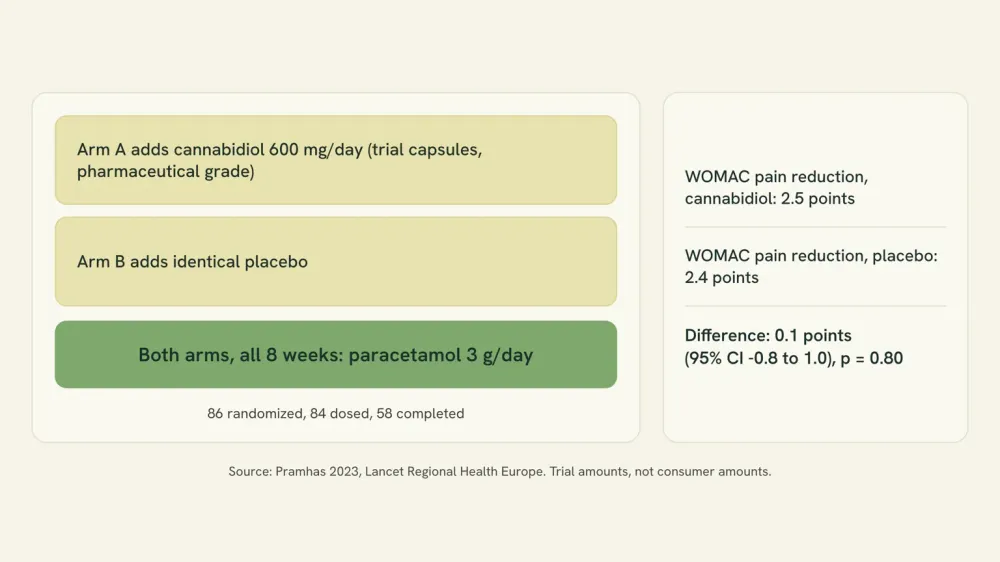
There is exactly one randomized, double-blind, placebo-controlled trial in which people took cannabidiol on top of paracetamol, which is what acetaminophen is called outside the United States. It ran at the Medical University of Vienna and was published in 2023 in The Lancet Regional Health Europe as oral cannabidiol as an add-on to paracetamol for painful chronic osteoarthritis of the knee, registered as NCT04607603. Everyone in it, both arms, was started on paracetamol 3 g/day during a two-week run-in and asked to hold that dose for the whole study. They were then randomized 1:1 to hemp-derived cannabidiol titrated to 600 mg/day in three divided doses with meals, or to identical placebo capsules, for eight weeks. 86 people were randomized, 84 were dosed, 58 completed. Mean age was 62.8 and about 70% were women. The capsules were formulated and the study funded by Trigal Pharma GmbH, which the authors state had no role in study design, data collection, analysis, interpretation or writing, and they declare no competing interests.
The result was negative and it is reported here as negative. Pain fell 2.5 points on the WOMAC subscale with cannabidiol and 2.4 points with placebo, a difference of 0.1 (95% CI -0.8 to 1.0, p = 0.80). Every secondary endpoint was non-significant too, including function, stiffness, a visual analogue scale, patient global assessment and a six-minute walk. The authors' own conclusion is that their results do not support the use of cannabidiol as an analgesic supplement in knee osteoarthritis. The trial is on this page for a different reason: it is the only setting in which a human being took both substances under observation, so it is the only place where anything about the combination was recorded at all, and what it recorded was tolerability, not benefit. Nothing on this page suggests CBD is something to take for pain.
Adverse events were near-universal in both arms: 93% of the cannabidiol group and 88% of the placebo group had at least one, which is not a significant difference, though the total number of events was 135 with cannabidiol against 105 with placebo (p = 0.008). The commonest complaints in both arms were diarrhea and loose stools, abdominal pain and fatigue, the familiar profile described on our page about CBD side effects. On liver monitoring, all three layers travel together or not at all. Any rise above baseline in ASAT, ALAT or gamma-GT was more common with cannabidiol, 15 patients versus 5 (p = 0.02), and the authors write that many of those elevations were mild and clinically irrelevant. Against the trial's own pre-defined criteria for a relevant rise, ASAT was 2 versus 0 and ALAT 3 versus 0, neither significant, while gamma-GT was 11 versus 0 and was significant. Four weeks after stopping the study medication, all of those elevations had fully resolved. The authors recommend that close monitoring of liver parameters should be mandatory when starting CBD therapy.
Two limits travel with all of that. Both arms were on paracetamol, so this is cannabidiol against placebo on a paracetamol background, not the combination measured against paracetamol alone, and nothing in the trial tells you what the pair does that either does by itself. And plasma cannabidiol was never measured, which the authors state plainly, so it cannot tell you anything about blood levels of anything. The wider question of what cannabidiol does to liver enzymes belongs to our page on whether CBD is bad for your liver, which carries the ALT signal and its dose context in full.
How long after taking CBD can I take Tylenol?
That exact sentence is the title of a page currently ranking for this search, so it deserves a direct answer. There is no measured wait window for this pair, because there is no human pharmacokinetic study of this pair. On August 19, 2026 a PubMed search for cannabidiol AND acetaminophen returned 26 records, and cannabidiol AND paracetamol returned the same 26, because the database maps the two terms. We resolved every one of them. The set contains the Vienna trial, three in vitro liver-toxicity papers, a rodent study, several narrative reviews and case reports, a survey, and a handful of unrelated records. Not one gave a person cannabidiol and acetaminophen and then measured the blood concentration of either. The Vienna trial came closest, and its own text says plasma cannabidiol levels were not determined. Say the limiter out loud with the finding: absence of a study is not evidence of no effect.
An interval is also the wrong shape of answer for this kind of question, which is exactly why the numbers published for it disagree with one another. Enzyme inhibition tracks how much inhibitor is present and for how long, not the gap between two swallows. The FDA-approved label for pharmaceutical cannabidiol reports that the half-life of cannabidiol in plasma was 56 to 61 hours after twice-daily dosing for seven days in healthy subjects, and that product is a prescription oral solution rather than anything sold as a consumer tincture, so do not read it as a number for your bottle. Read it for its shape: if inhibition were the mechanism at work, a gap measured in hours is not the thing that resolves it, and a precise-sounding number would be decoration on a guess. So this page publishes none. Amounts of CBD live on our CBD dosage guide, which publishes no interval for this either. What to take alongside a medicine, and when, is a question for a pharmacist who can see your whole list at once.

The acetaminophen you are already taking without meaning to
Here is the part of this topic that actually sends people to hospital, and it has nothing to do with cannabidiol. FDA's own consumer page on acetaminophen, which we reread on August 19, 2026, says it plainly. Acetaminophen is found in hundreds of over-the-counter and prescription drugs. Prescription labels may shorten the name, and FDA lists the abbreviations you may see, among them APAP, Acetaminoph, Acetaminop, Acetamin and Acetam. Outside the United States it is commonly known as paracetamol. FDA's instruction is not to use more than one acetaminophen-containing product at a time, because you could accidentally take too much if you do. FDA also tells you to inform your health care professional of all drugs, prescription and over-the-counter, plus vitamins and supplements you take. Your CBD belongs on that list.
The consumer label says the same thing in its own words. The Drug Facts panel for Tylenol Extra Strength, version 16, effective July 22, 2026, prints Acetaminophen 500 mg as the active ingredient in each caplet. Its liver warning states that severe liver damage may occur if you take more than 4,000 mg of acetaminophen in 24 hours, or with other drugs containing acetaminophen, or with three or more alcoholic drinks every day while using the product. Its Do not use section says: with any other drug containing acetaminophen, prescription or nonprescription, and adds that if you are not sure whether a drug contains acetaminophen, ask a doctor or pharmacist. That 4,000 mg is the label's figure quoted as the label's; we are not restating it as advice and not converting it into caplets. We also searched that whole document on August 19, 2026: the words CBD, cannabidiol, hemp, cannabis, cytochrome and CYP appear zero times in it. Read that carefully, because a Drug Facts panel carries no pharmacology section at all, so its silence about cannabidiol is a labeling convention and not a safety verdict. The only two co-ingestions it names are alcohol and the blood thinner warfarin, and that second one is handled on our page about CBD and blood thinners.
So where does the accidental doubling up happen? Multi-symptom cold and flu products are one place: acetaminophen is one of the active ingredients in several NyQuil formulas, alongside the sedating antihistamine covered on our page about CBD and Benadryl. Prescription opioid combination products are the other: Percocet is oxycodone plus acetaminophen, and the opioid half of that question lives on our page about CBD and oxycodone. Neither of those pages is where you count milligrams. The box in your hand is. This is exactly the skill we teach for our own certificates of analysis in how to read a CBD label, turned around and pointed at somebody else's panel.
- 1Read the active ingredient line on the Drug Facts panel of every over-the-counter product you use, not the brand name on the front of the box.
- 2On prescription labels, look for acetaminophen spelled out or shortened. FDA says abbreviations such as APAP, Acetaminoph, Acetaminop, Acetamin and Acetam may be used.
- 3Add up the milligrams of acetaminophen across every product on that list. FDA's instruction is not to use more than one acetaminophen-containing product at a time.
- 4Write the total down together with everything else you take, including your CBD: the form, and what its label says is in it.
- 5Take the list to a pharmacist. Counting acetaminophen across several boxes is routine work for them, needs no appointment and costs you nothing.
- 6Change nothing on your own. Do not stop, start, delay or adjust the amount of anything because of a web page, this one included.
- 7If you think too much acetaminophen has already been taken, do not wait for symptoms. Call Poison Control at 1-800-222-1222 or get medical help.
What this page cannot tell you
Set out plainly, so you can see the size of the gap. Nobody has measured what happens to acetaminophen concentrations in a person taking cannabidiol. The UGT evidence is enzyme-level: recombinant enzymes, microsome preparations and plates, and in the preparation closest to a working liver the inhibition was the weakest of the three tested. The single human trial of the pair did not measure drug levels and was built to answer a pain question, which it answered in the negative. The regulator's UGT1A9 instruction is real, and the one human number behind it is about a different drug at a prescription dose. Two substances that each carry a hepatic caution of their own are being taken together by a lot of people, and nobody has measured the combination in a person. That is a statement about missing data, not a claim that the combination adds harm, and the distance between those two sentences is most of the reason this page exists. If your worry is cannabidiol on its own, that is how much CBD is too much.
That is a question for a pharmacist, and here is what they would be working with. No human study has measured either substance's blood concentration when the two are taken together. The one randomized trial in which people took cannabidiol on top of paracetamol for eight weeks reported no serious adverse events. The FDA-approved cannabidiol label does flag UGT1A9, which in vitro work identifies as acetaminophen's main glucuronidating enzyme, and that is a reason to disclose rather than a verdict. This page gives no permission, no prohibition and no interval.
There is no measured answer, because there is no human pharmacokinetic study of this pair: a PubMed search on August 19, 2026 for cannabidiol AND acetaminophen returned 26 records, and none measured the blood concentration of either substance in a person taking both. An interval is also the wrong model for an enzyme-inhibition question, since inhibition follows how much inhibitor is present and for how long rather than the gap between two swallows. Ask a pharmacist, who can look at everything you take at once.
Not the ones page one names. Acetaminophen's prescribing information lists conjugation with glucuronide and conjugation with sulfate first, and describes oxidation primarily by CYP2E1 as the route that forms the reactive metabolite NAPQI. The FDA-approved cannabidiol label never mentions CYP2E1 at all. The family the two genuinely share is UGT, and the isoform is UGT1A9. Competition as such has never been measured; what has been measured, in vitro, is inhibition, and it was weakest in the liver preparation.
No. It found no difference from placebo on its primary endpoint or on any secondary endpoint, and the authors wrote that their results do not support the use of cannabidiol as an analgesic supplement in that condition. It is on this page because it is the only setting in which people took cannabidiol and paracetamol together under observation, so it is the only place the combination's tolerability was recorded at all.
That is where the documented risk on this topic actually lives. FDA says acetaminophen is found in hundreds of over-the-counter and prescription drugs, and that prescription labels may abbreviate it, including as APAP. Multi-symptom cold and flu formulas often contain it, and so do opioid combination products such as Percocet. Read the active ingredient line on every panel, add the acetaminophen up, and if you are not sure whether something contains it, ask a pharmacist.
The label's overdose section names nausea, vomiting, sweating and general malaise, and then says the thing that matters most: clinical and laboratory evidence of hepatic toxicity may not be apparent until 48 to 72 hours after ingestion, so the absence of symptoms early on tells you very little. There is an antidote, N-acetylcysteine, and the label instructs that it be given as early as possible. If you think too much has been taken, call Poison Control at 1-800-222-1222 or get medical help right away.
Writing about hemp, wellness and the small rituals that keep us balanced.