CBD and Benadryl: What the Labels Actually Warn About
Benadryl is diphenhydramine, and its own Drug Facts panel already warns about marked drowsiness, alcohol and driving. No study we could find gave CBD and diphenhydramine to the same person, which is why no page can honestly tell you how long to wait between them.

You have a box of Benadryl in one hand and a bottle of CBD oil in the other, and the first page of search results is telling you two opposite things. One set of pages calls CBD and Benadryl a moderate to severe drug interaction that is not safe without a physician's say-so. Another says the risk of any serious side effect appears low. Neither side cites a document you can open. The drug in that box is diphenhydramine, one of the few things you can buy without a prescription whose effect on driving has been measured in randomized trials, and the most authoritative document on this question is already printed on the box in your hand.
Here is what this page is and what it is not. It reports documents: the Drug Facts panel on a diphenhydramine box, the FDA's own consumer list of medicines that make driving dangerous, the FDA-approved label for prescription cannabidiol, and the handful of human trials that have measured what an antihistamine does to a person's driving. It publishes no amounts and no waiting windows for either substance, because none exist in any source we could check and inventing one would be worse than saying so. The one action item on this page is to disclose both products to a pharmacist, which is exactly the professional the Drug Facts panel itself names. If cannabidiol is new to you, start with what cannabidiol actually is. If your question is really about reacting badly to a hemp product, that is a different question and we cover whether you can be allergic to CBD itself on its own page.
Benadryl is diphenhydramine, and the same drug is also sold as a sleep aid
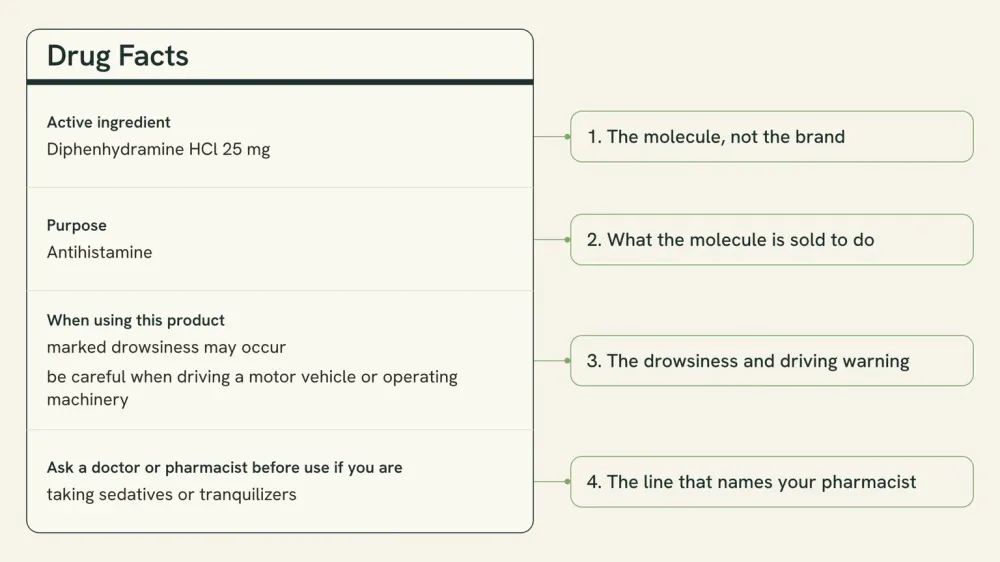
Benadryl is a brand name, not a molecule. The drug inside the allergy tablets is diphenhydramine hydrochloride, and the current Drug Facts label for Benadryl allergy tablets prints it plainly: Active ingredient (in each tablet), Diphenhydramine HCl 25 mg. Purpose, Antihistamine. We read that label on DailyMed on August 15, 2026, in SPL version 32, effective July 28, 2026, and everything quoted below comes from that version. Knowing the generic name matters more here than it usually does, because the same molecule is sold under several brands and hidden inside several combination products, and the panel is the only place it is guaranteed to be spelled out.
Diphenhydramine's second job is why so many people arrive at this question at eleven at night rather than during allergy season. The label for Vicks ZzzQuil Nighttime Sleep-Aid shows the same molecule with a different Purpose line: Diphenhydramine HCl 50 mg per 30 mL dose cup, Purpose, Nighttime sleep-aid (SPL version 7, effective April 23, 2026, read the same day). Its inactive ingredients include alcohol. Those milligram figures are label composition, not a recommendation and not a dose we are suggesting to anyone. We print them so you can see the thing the shelf hides: the allergy tablet and the sleep aid are the same drug, and the sleep aid prints twice as much of it per dose.
| What the panel prints | Benadryl allergy tablets | Vicks ZzzQuil Nighttime Sleep-Aid liquid |
|---|---|---|
| Active ingredient | Diphenhydramine HCl 25 mg in each tablet | Diphenhydramine HCl 50 mg per 30 mL dose cup |
| Purpose | Antihistamine | Nighttime sleep-aid |
| Ask a doctor or pharmacist before use if you are | taking sedatives or tranquilizers | taking sedatives or tranquilizers |
| When using this product | marked drowsiness may occur; avoid alcoholic drinks; be careful when driving a motor vehicle or operating machinery | avoid alcoholic beverages |
| Do not use | with any other product containing diphenhydramine, even one used on skin | with any other product containing diphenhydramine, even one used on skin |
| Label version read on August 15, 2026 | SPL version 32, effective July 28, 2026 | SPL version 7, effective April 23, 2026 |
What the Benadryl box already warns about
The thing page one argues about is already answered, in one direction, by a document that is legally required to exist and that you own. Drug Facts panels are not marketing copy: the format, the headings and much of the wording are set by regulation, which is why this text outranks every unattributed assertion in a search result. Nobody had to be persuaded to publish it. Here is the warnings block of the Benadryl tablet panel, quoted exactly as it prints in SPL version 32.
- When using this product: marked drowsiness may occur
- When using this product: avoid alcoholic drinks
- When using this product: alcohol, sedatives, and tranquilizers may increase drowsiness
- When using this product: be careful when driving a motor vehicle or operating machinery
- When using this product: excitability may occur, especially in children
- Ask a doctor or pharmacist before use if you are taking sedatives or tranquilizers
- Do not use to make a child sleepy
- Do not use with any other product containing diphenhydramine, even one used on skin
- Ask a doctor before use if you have a breathing problem such as emphysema or chronic bronchitis, glaucoma, or trouble urinating due to an enlarged prostate gland
Now the part the pages that quote this label leave out. CBD is not named anywhere on it. The panel warns about alcohol, sedatives and tranquilizers, which is a drug-class phrase written into over-the-counter labeling long before hemp extracts were sold in grocery stores, and we are not going to quietly substitute cannabidiol into somebody else's required text. What the label does establish is narrower and still useful: the manufacturer of this drug expects it to make people markedly drowsy, expects other sedating things to make that worse, tells you to be careful driving, and points you at a doctor or pharmacist if you are already taking something in that category. That last line is where the action item on this page comes from. It is also the same method we used on the supplement facts panel on a melatonin bottle: the other product's own label is almost always a better source than anything written about the pair. The alcohol warning is worth taking literally too, and what human research has measured about CBD and alcohol together is its own page.
The part that changes what you do tonight: driving and machinery
The most useful document on this whole question is a short consumer update from the FDA, and it appears on none of the results we read. Some Medicines and Driving Don't Mix, marked content current as of March 12, 2024, lists what can make driving dangerous. On that list, in the agency's own words: some prescription and OTC cold remedies and allergy medicines that contain an antihistamine, nighttime sleep aids or cough medicines. Then, in the same passage: Also, taking products containing cannabis or cannabis-derived compounds, including CBD, could make driving dangerous. CBD can cause sleepiness and changes in alertness. One federal page, both halves of your question, in the same list. Read the limit with it: this is consumer guidance rather than a measurement, and it does not say the two taken together are worse than either one alone. What it says is that each of them, by itself, belongs on that list.
How much does a sedating antihistamine actually change driving? That has been measured in people, with alcohol as the comparison. In a randomized, double-blind, four-period crossover trial run in the Iowa Driving Simulator, published in Annals of Internal Medicine in 2000, 40 licensed drivers aged 25 to 44 with seasonal allergic rhinitis took one treatment a week and then drove for an hour: fexofenadine 60 mg, diphenhydramine 50 mg, alcohol to a blood alcohol concentration of about 0.1%, or placebo. Lane keeping was worse after alcohol and after diphenhydramine than after fexofenadine. Response time to a vehicle blocking the road was slowest after alcohol, at 2.21 seconds against 1.95 seconds after fexofenadine. The authors' own conclusion is the sentence nobody on page one prints.
“After participants took diphenhydramine, driving performance was poorest, indicating that diphenhydramine had a greater impact on driving than alcohol did.”
Carry the limits with that sentence, because they are real. It is a simulator and not a road. It is 40 people, single doses, one age band, all of them allergic rhinitis patients. And there was no CBD arm, so the trial says nothing whatsoever about cannabidiol and must never be quoted as though it did. The alcohol comparison is a specific one too: a blood alcohol concentration of about 0.1% is above the legal driving limit in every US state, so worse than alcohol here means worse than that. The second finding is the one that should change what you do, and it is quoted just as directly: drowsiness ratings were not a good predictor of impairment, suggesting that drivers cannot use drowsiness to indicate when they should not drive. The plan most people are running, which is to see how they feel and decide then, is the exact plan this trial contradicts.
It does not reliably clear by morning either. A phase 3, randomized, double-blind, placebo-controlled crossover trial published in Human Psychopharmacology in 2016 dosed 59 healthy participants at about 11:30 at night, woke them 6.5 hours later, and put them through a 100 km simulated drive. Diphenhydramine citrate at 76 mg demonstrated significant impairment relative to gabapentin and placebo on speed deviation. Two honest qualifiers: that trial was built to test gabapentin, with diphenhydramine as the active comparator rather than the subject, and it used diphenhydramine citrate, a different salt from the hydrochloride on the Benadryl panel, so read it as evidence about a nighttime dose of this drug rather than as a milligram-for-milligram equivalent. If gabapentin is the drug you were actually asking about, our page on CBD and gabapentin covers that trial's other arm and the conclusion that belongs to it.

What the cannabidiol paperwork says about sedation
There is a document on the CBD side of this question too, and it is the strictest one available: the FDA-approved label for prescription cannabidiol, which we read on August 15, 2026 in SPL version 35, effective May 29, 2026. Its section 5.2 says this: other CNS depressants, including alcohol, could potentiate the somnolence and sedation effect of EPIDIOLEX. Prescribers should monitor patients for somnolence and sedation and should advise patients not to drive or operate machinery until they have gained sufficient experience on EPIDIOLEX to gauge whether it adversely affects their ability to drive or operate machinery. In its trials, somnolence or sedation was reported in 32% of patients on the drug against 11% on placebo in the Lennox-Gastaut and Dravet syndrome programs, and 19% against 17% in the tuberous sclerosis complex trial. Every one of those figures describes a prescription cannabidiol solution given at 10 to 25 mg per kilogram of body weight per day to patients with severe epilepsy, not a hemp tincture bought off a shelf, and none of those percentages may be transferred to a consumer product.
Section 7.4 of the same label is one sentence long: concomitant use of EPIDIOLEX with other CNS depressants (including alcohol) may increase the risk of sedation and somnolence. Again, that is a prescription drug at mg per kilogram doses, and again, diphenhydramine is not named in it. On the consumer side, the federal complementary-health agency's cannabinoid fact sheet, whose footer reads last updated November 2019, puts it in plainer language: CBD may have side effects, including decreases in alertness, changes in mood, decreased appetite, and gastrointestinal symptoms such as diarrhea. Neither document is a study of CBD taken with an antihistamine. Together they establish something narrower and still worth knowing: reduced alertness sits on the cannabidiol side of the ledger too, as a reported effect and not as a feature. That is how it appears on this page and nowhere else. If you want the full picture, our full page on CBD's reported side effects lists them with their frequencies, and if you arrived here because you were using an antihistamine as a sleep aid, what the human research on CBD and sleep does and does not show is a separate question on a separate page.
Do CBD and Benadryl use the same liver enzymes? Where page one gets it wrong
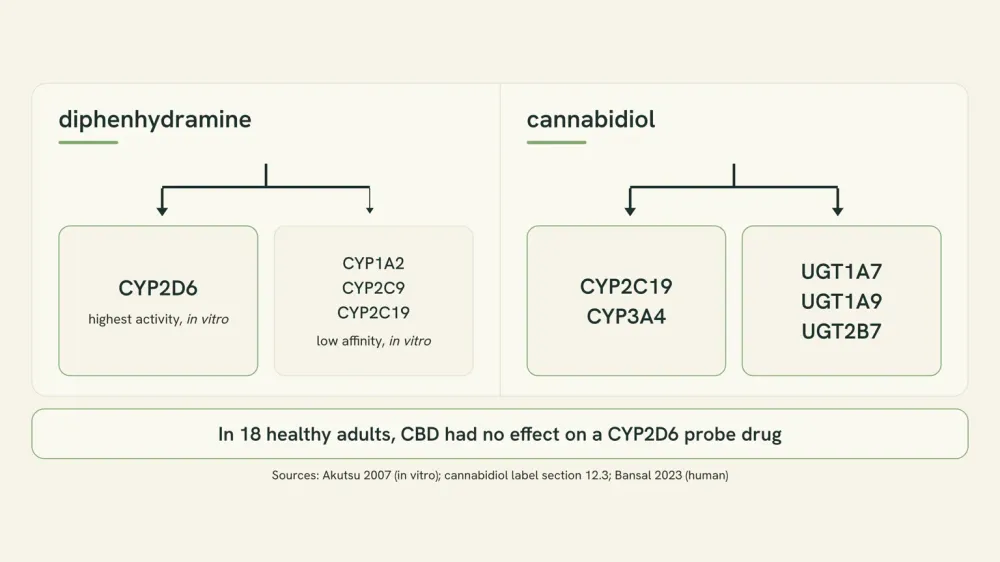
Almost every page on this topic says some version of the same sentence: both are processed by the same liver enzymes, so one builds up. It is worth checking rather than repeating. Diphenhydramine's metabolism was mapped in vitro in 2007, in work published in Drug Metabolism and Disposition that identified which human enzymes do that job using 14 recombinant P450 isozymes and human liver microsomes rather than people: CYP2D6 showed the highest activity of diphenhydramine N-demethylation, with a Km of 1.12 micromolar, and CYP1A2, CYP2C9 and CYP2C19 were identified as low-affinity components. Note what that is. Enzymes in a tube, at concentrations chosen to be clinically relevant, with no person, no swallowed dose and no blood level attached. The same paper also describes diphenhydramine as not only a potent inhibitor but a high-affinity substrate of CYP2D6, which is where the next part comes from.
That inhibition is real, it has been measured in people, and it runs in the opposite direction from the one the blogs describe. In a randomized human crossover study published in Clinical Pharmacology and Therapeutics in 2000, 16 men genotyped as extensive or poor CYP2D6 metabolizers took metoprolol 100 mg alongside steady-state diphenhydramine or placebo. In the extensive metabolizers, diphenhydramine halved metoprolol's oral and non-renal clearance and cut its partial metabolic clearance 2.5-fold, and metoprolol's effects on heart rate and blood pressure were larger and lasted longer. In the poor metabolizers, who have little CYP2D6 to block in the first place, nothing changed. The authors concluded that clinically relevant drug interactions may occur between diphenhydramine and many CYP2D6 substrates, particularly those with a narrow therapeutic index. Read the roles carefully: diphenhydramine is the perpetrator in that study and metoprolol is the victim. Cannabidiol is not in it at all.
So is cannabidiol a CYP2D6 substrate? Its FDA-approved label answers that in section 12.3: cannabidiol is metabolized in the liver and the gut (primarily in the liver) by CYP2C19 and CYP3A4 enzymes, and UGT1A7, UGT1A9, and UGT2B7 isoforms. CYP2D6 is not on that list, and CYP2D6 substrates do not appear on the label's section 7.2 list of drugs whose dosing may need consideration. The paper the CBD blogs actually cite points the other way and deserves to be quoted correctly: in vitro work published in 2011 found cannabidiol to be a competitive inhibitor of CYP2D6 in recombinant enzymes and pooled human liver microsomes, with an apparent Ki of 1.16 to 2.69 micromolar and an IC50 of 6.52 micromolar. That is a mechanism, not an effect size, and unusually for this cluster it has been tested in people. In a double-blind randomized crossover study in 18 healthy adults, published in Clinical Pharmacology and Therapeutics in 2023, a single cannabis-extract brownie containing 640 mg of CBD and 20 mg of THC significantly inhibited the activity of all CYPs tested except CYP2D6, and had no effect on dextromethorphan's AUC, peak concentration or half-life. Dextromethorphan is the classic CYP2D6 probe drug. One single dose of a THC-containing extract against one probe in 18 people is not proof that cannabidiol never touches CYP2D6, and it is not the whole human record. A PubMed search for cannabidiol AND CYP2D6, run on August 15, 2026, returns 16 records, and two of them are single-patient case reports pointing the other way: a 2022 report in the Journal of Pharmacy Practice describes a 58-year-old woman taking tamoxifen whose endoxifen level was 18.75% higher after 60 days without cannabidiol 40 mg a day than while she was taking it, and a second reports, by its title, a potential interaction between cannabidiol, a CYP2D6 gene variant and fluoxetine. One patient with no control condition is the weakest human evidence there is. So the honest reading is narrow: the only randomized human test of cannabidiol against a CYP2D6 probe drug found nothing, two uncontrolled case reports suggest something, and nothing in those 16 records measured diphenhydramine with cannabidiol at all.
One more number sets the ceiling on this entire style of argument. The cannabidiol label's own interaction program ran strong enzyme blockers against it and reported that itraconazole, a strong CYP3A4 inhibitor, increased exposure by less than 10% for cannabidiol, and that although the effects of a strong CYP2C19 inhibitor, fluconazole, were slightly more marked, they are still considered not to be clinically meaningful, with cannabidiol increased by 22% and 24% for AUC and peak concentration. Those are antifungals, chosen because they block hard. If a deliberate, strong block moves cannabidiol exposure by roughly a quarter and a regulator calls that not clinically meaningful, an inhibition constant measured in a tube is nowhere near enough to predict a problem on your kitchen counter. The same 2023 human trial that found nothing on the CYP2D6 probe did move other probes in the same 18 people: omeprazole exposure rose 207%, losartan 77%, midazolam 56% and caffeine 39%, which is why our caffeine page works through what a probe-drug trial can and cannot tell you. For the wider picture of which enzymes matter and when, the general framework for CBD and other medicines is the place to start, and the page where CYP2D6 is explained as a mechanism goes deeper on that specific enzyme.
What has actually been studied: three papers, and none of them is this question
Here is a check you can rerun yourself in about a minute, which is the point of printing it. On August 15, 2026 we queried PubMed through the E-utilities search endpoint for cannabidiol AND diphenhydramine. The count came back 3. Restricting the same terms to title and abstract also returned 3. Adding the humans filter returned 2. The query cannabidiol AND doxylamine, which is the antihistamine in most NyQuil formulas, returned 0. The class-level query cannabidiol AND antihistamine returned 14.
We opened all three rather than counting them and guessing what was inside, because a count you have not opened is not a finding. PMID 37651752 is a 2023 paper in Biomedical Chromatography describing an analytical method for measuring where cannabidiol ends up in skin after a topical gel. PMID 17395417 is a 2007 forensic assay for detecting psychoactive drugs in oral fluid by gas chromatography and mass spectrometry. PMID 10689567 is a 2000 forensic method paper about hair analysis. All three are laboratory chemistry: both compounds appear in an analyte panel, and not one of them gave the two substances to a person. We read the 14 class-level titles individually too, and they are arthritis papers, pediatric neurology, anxiety-drug reviews, a survey of singers, a brain endothelial cell study and two more forensic assays. The absence holds at the substance level and at the class level.
That absence is not reassurance and it is not alarm. It is the reason the two Drug Facts panels and the FDA driving list are the only documents on the table, and it is the reason this page will not tell you how long to leave between them. Not one record those searches returned measured an interval, in either direction, in anyone. A page that publishes a number of hours is not reading a source, because there is no source to read. Those counts are also one database on one date rather than proof that nothing exists anywhere, which is exactly why we printed the query strings: you can rerun them and get a different answer next year.
NyQuil is not one product, and that changes the answer per box
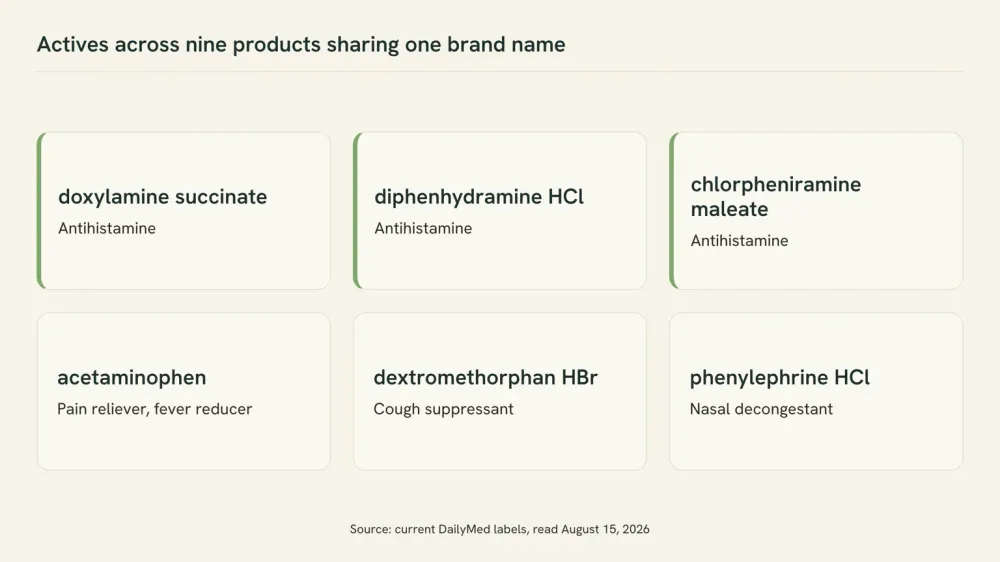
A large share of the people searching this question are not holding a Benadryl box at all. They are holding a cold and flu product, and NyQuil is where the question gets genuinely complicated, because NyQuil is a family of formulas rather than a drug. A search of DailyMed for nyquil on August 15, 2026 returned 64 label records. We opened eleven and parsed their ingredient lists. The actives differ per box, and so does the answer.
| Product, as titled on its current label | Active ingredients printed on the panel | Label version read August 15, 2026 |
|---|---|---|
| NyQuil Severe Cold and Flu LiquiCaps | Acetaminophen 325 mg, dextromethorphan HBr 10 mg, doxylamine succinate 6.25 mg, phenylephrine HCl 5 mg | v19, effective July 2, 2026 |
| NyQuil Intense Flu Multi-Symptom Liquid | Acetaminophen 1000 mg, dextromethorphan HBr 30 mg, doxylamine succinate 12.5 mg per 30 mL; carton prints Alcohol 10% | v3, effective June 23, 2026 |
| NyQuil VapoCOOL Cold and Flu Coated Caplets | Acetaminophen 325 mg, dextromethorphan HBr 10 mg, doxylamine succinate 6.25 mg; no decongestant | v6, effective January 22, 2026 |
| NyQuil Sinus Pain and Headache Liquid | Acetaminophen 325 mg, doxylamine succinate 6.25 mg per 15 mL | v2, effective June 22, 2026 |
| NyQuil Allergy Liquid | Doxylamine succinate 6.25 mg per 15 mL, and nothing else | v4, effective June 22, 2026 |
| NyQuil Cold and Flu Liquid | Acetaminophen 650 mg, dextromethorphan HBr 30 mg, doxylamine succinate 12.5 mg per 30 mL; carton prints Alcohol 10% | v1, effective April 18, 2025 |
| NyQuil Hot Remedy Cold and Flu | Acetaminophen 650 mg, diphenhydramine HCl 25 mg | v1, effective December 5, 2025 |
| NyQuil Alcohol Free Cold and Flu | Acetaminophen 650 mg, chlorpheniramine maleate 4 mg, dextromethorphan HBr 30 mg per 30 mL | v7, effective December 1, 2025 |
| NyQuil High Blood Pressure Cold and Flu | Acetaminophen 650 mg, dextromethorphan HBr 30 mg, doxylamine succinate 12.5 mg per 30 mL; no decongestant | v11, effective December 1, 2025 |
Three facts from that table are worth saying out loud. First, one product with NyQuil on the front lists diphenhydramine HCl 25 mg, the same drug and the same amount as the Benadryl tablet, and its own panel carries the same instruction not to use it with any other product containing diphenhydramine, even one used on skin. Second, NyQuil Allergy is doxylamine succinate and nothing else: it is a sedating antihistamine on its own, sold under a cold and flu brand. Third, the Alcohol Free formula uses chlorpheniramine maleate, which is not even the same antihistamine as the rest of the line. Every NyQuil label we read carries the same warnings block as the Benadryl panel, word for word: marked drowsiness may occur, avoid alcoholic drinks, be careful when driving a motor vehicle or operating machinery, alcohol, sedatives, and tranquilizers may increase drowsiness, and ask a doctor or pharmacist before use if you are taking sedatives or tranquilizers.
The rest of the ingredient list turns one question into four, which is why the honest instruction is to read the panel on the specific box rather than to look up the brand. Eight of these nine formulas contain acetaminophen, and those labels add a Liver warning plus the line do not use with any other drug containing acetaminophen, prescription or nonprescription, so that box raises what is actually known about CBD and the liver and sits alongside the other over-the-counter painkiller question. One formula contains phenylephrine, a decongestant, and one whole SKU exists because it removes the decongestant, which is a different conversation covered on our page on CBD and blood pressure medicines. Most contain dextromethorphan, the same CYP2D6 probe drug from the section above. And two of the cartons we read print Alcohol 10%, which folds straight back into the alcohol warning already on the panel. The risk profile of the box in your hand is set by which of those actives are in it, not by the word NyQuil.
CBD and antihistamines: the non-sedating class, as a contrast and not as advice
Not every antihistamine behaves like diphenhydramine, and the difference has been measured in the same kind of test. In a four-way crossover study of simulated car driving published in Human Psychopharmacology in 2016, healthy volunteers took single doses of levocetirizine 5 mg, fexofenadine 60 mg, diphenhydramine 50 mg or placebo, each at least six days apart. The authors reported that levocetirizine and fexofenadine did not impair psychomotor performance in subjects performing simulated car-driving tasks, while diphenhydramine did impair psychomotor performance in the subjects. The Iowa simulator trial found the same shape: fexofenadine looked like placebo on lane keeping while diphenhydramine did not.
Read that as a description of a drug class, not as an instruction. Both studies are small, single dose, in one population, on simulator tasks rather than roads. Non-sedating is a class description rather than a promise about any individual person, and people do report drowsiness on second-generation antihistamines. Nothing on this page tells you to change which antihistamine you take, or when, or how much: that choice belongs to you and the pharmacist or prescriber who knows the rest of your list. What the contrast is good for is understanding why the answer changes with the generic name on the panel rather than with the aisle the box came from.
If the person taking it is 65 or older
There is one group for whom diphenhydramine carries published guidance of its own, and it has nothing to do with CBD. The 2023 American Geriatrics Society Beers Criteria, published in the Journal of the American Geriatrics Society and current as of our read on August 15, 2026, lists potentially inappropriate medication use in adults aged 65 and older. First-generation antihistamines are a named row, and the drugs listed include diphenhydramine (oral), doxylamine, chlorpheniramine, hydroxyzine, meclizine and promethazine, which covers the antihistamine in every product discussed on this page. The panel's rationale is quoted here in full: highly anticholinergic; clearance reduced with advanced age, and tolerance develops when used as hypnotic; risk of confusion, dry mouth, constipation, and other anticholinergic effects or toxicity. Cumulative exposure to anticholinergic drugs is associated with an increased risk of falls, delirium, and dementia, even in younger adults. The recommendation is Avoid, the quality of evidence is rated Moderate and the strength of recommendation Strong.
Two things must travel with that, and most summaries drop both. The panel writes its own carve-out into the same document: use of diphenhydramine in situations such as acute treatment of severe allergic reactions may be appropriate. And the criteria state that they should be applied thoughtfully and in a manner that supports, rather than replaces, shared clinical decision-making. In other words, this is a prompt for a conversation with a clinician or pharmacist, not a rule to apply to yourself at the bathroom cabinet. Note also what is not in the Beers Criteria: cannabidiol. The document says nothing about CBD, and reading it as though it did would be exactly the error the rest of this page has been correcting. If age is the reason you are here, what older adults should know about CBD covers the rest.
What to bring to a pharmacist, and the red flags that skip that step
The Drug Facts panel names your professional for you: ask a doctor or pharmacist. For an over-the-counter question this is the right one, because a pharmacist can see your whole list, knows which brand contains what, and does not need an appointment. The useful thing you can do before that conversation is stop describing the products by brand and start describing them by what is printed on them. Here is what to write down or photograph.
- 1The generic name off both panels, not the brand on the front: diphenhydramine, doxylamine or chlorpheniramine on one, cannabidiol on the other. Brands move between molecules; the molecule is what your pharmacist needs.
- 2The milligram figure printed beside the active ingredient, and how many tablets, caplets or mL the panel counts as one dose.
- 3The Purpose line. Antihistamine and nighttime sleep-aid are two different purposes printed beside the same molecule, and the amount per dose is often different.
- 4Whether the box contains anything else at all: acetaminophen, a decongestant such as phenylephrine, or dextromethorphan. Each one is a separate question.
- 5Whether the carton prints an alcohol percentage, which two of the liquid cold and flu formulas we read do.
- 6How much of your CBD product you take, how often, and whether it is broad spectrum or full spectrum, plus the batch certificate of analysis if you have it.
- 7Your age, everything else you take including supplements, and whether you drive, ride or operate machinery in the hours afterwards. That last one is the question the evidence on this page is actually about.
What this page cannot tell you
The honest boundary of everything above is easy to state. No study we could find has given cannabidiol and diphenhydramine to the same person and measured what happened, so nobody knows whether either one changes the other's blood levels, whether the drowsiness adds up in a straight line or less than that, or whether any of it depends on how much CBD is involved. The driving trials characterize diphenhydramine, full stop: none of them had a CBD arm. The label warnings characterize each product on its own. The enzyme work says the popular explanation is built on the wrong enzyme, which is a correction rather than an all-clear. And the interaction data on prescription cannabidiol comes from a drug given at mg per kilogram doses to patients with severe epilepsy, which is not the product in your cabinet.
What that adds up to is not a shrug. Two labels, both required by regulation, both independently warn about drowsiness and about driving. A federal consumer page names antihistamine medicines, nighttime sleep aids and CBD in the same list of things that make driving dangerous. A randomized trial found that diphenhydramine impaired driving more than a blood alcohol concentration above the legal limit did, and that people could not tell from how they felt. That is enough to make one practical decision without any new research at all, and the decision is about the car keys rather than the cabinet.
That decision belongs to you and a pharmacist, who is the professional the Drug Facts panel itself names. What we can tell you is what the documents say. The diphenhydramine panel warns that marked drowsiness may occur, that alcohol, sedatives and tranquilizers may increase drowsiness, and to be careful when driving a motor vehicle or operating machinery, and it tells you to ask a doctor or pharmacist before use if you are taking sedatives or tranquilizers. CBD is not named on that label. The FDA-approved label for prescription cannabidiol warns about sedation and about driving on its own side. And no record in a dated PubMed search of both names gave the two to the same person and measured anything. So the useful move is to disclose both, by their generic names and with the milligram figures off the panels, and to treat the drowsiness and driving warnings as applying to you rather than to somebody more sensitive.
No interval has been established in any source we could check, and any page giving you a number of hours is guessing. On August 15, 2026 a PubMed search for cannabidiol AND diphenhydramine returned three records, all of them analytical chemistry method papers in which the two compounds sit in a laboratory panel rather than in a person. The same search for cannabidiol AND doxylamine returned zero. Neither Drug Facts panel states an interval with CBD, and the FDA-approved cannabidiol label does not either. We will not invent a number to fill that gap, because a made-up interval reads like safety advice and is not. If the timing question matters to you, that is a good thing to put to a pharmacist, who can answer it in the context of everything else you take.
The mechanism people cite for this is CYP2D6, and it does not hold up the way it is usually told. Diphenhydramine's main clearance enzyme is CYP2D6, which was mapped in vitro rather than in people. Cannabidiol was reported to inhibit CYP2D6 in vitro in 2011, at micromolar concentrations in recombinant enzymes and liver microsomes. But in the only randomized human test of it, 18 healthy adults given a cannabis extract containing 640 mg of CBD showed no change at all in dextromethorphan, the classic CYP2D6 probe drug, while four other probes in the same people moved substantially. Two single-patient case reports do point the other way, one of them in a woman taking tamoxifen, and a case report is the weakest human evidence there is. What nobody has published is a measurement of diphenhydramine blood levels with CBD on board, so stronger has not been tested in either direction. The documented and practical concern is not blood levels; it is additive drowsiness and reduced alertness, which both labels already warn about.
The first question is which NyQuil, because the name covers several different formulas. Reading their current labels on DailyMed on August 15, 2026: most contain doxylamine succinate, a sedating antihistamine; one contains diphenhydramine, the same drug as Benadryl; one uses chlorpheniramine instead; eight of the nine we tabled contain acetaminophen; one contains the decongestant phenylephrine and one exists specifically to leave it out; most contain dextromethorphan; and two of the cartons print Alcohol 10%. The sedation warnings are identical across all of them, but the rest of the risk profile changes per box. So the answer is to read the Drug Facts panel on the specific box you own, write down every active ingredient with its milligram figure, and take that list to a pharmacist along with what you take of your CBD product.
No. CBD is not an antihistamine, it does not work the way one does, and it is not approved to treat allergies, hives, itching or a reaction of any kind. Nothing on this page should be read as a reason to use one in place of the other, and we do not give advice on treating an allergic reaction. If a reaction involves trouble breathing or swelling of the face, lips, tongue or throat, that is an emergency: call 911. If your question is the other one, whether you can react badly to a hemp product itself, we cover hypersensitivity to CBD on its own page.
Take this one plainly. The Benadryl panel says to be careful when driving a motor vehicle or operating machinery. The FDA lists both antihistamine allergy and cold medicines and CBD among the things that can make driving dangerous, and says CBD can cause sleepiness and changes in alertness. In the Iowa Driving Simulator trial, diphenhydramine impaired driving more than an alcohol dose above the legal limit did, and the same trial found drowsiness ratings were not a good predictor of impairment. A separate 2016 trial found measurable impairment 6.5 hours after a nighttime dose. Feeling fine is not evidence that you are fine, which is the single most useful thing on this page. Plan not to drive, and plan it before you take anything rather than afterwards.
If you want to go further from here, three pages pick up where this one stops. How enzyme interactions with CBD are assessed explains the framework the whole cluster runs on. Melatonin, taken alongside CBD applies the same label-reading method to a different nighttime product. And alcohol, the one substance both Drug Facts panels here name outright, has its own page with the human research on it.
Writing about hemp, wellness and the small rituals that keep us balanced.