CBD for Seniors: What the Research Skipped and What to Check
Page one for this query is six companies selling CBD. Here is the other version: the FDA-approved cannabidiol label's own paragraph about people over 55, how many adults aged 65 and over were in the pooled cannabinoid trials (68), and the medication arithmetic for your list.
CBD for seniors is one of the few searches where every result on the first page is a company selling CBD. We are one too, which is exactly why this page is worth your time: it makes none of the claims those pages make. It answers what an older adult actually has to work out, starting with what the only cannabidiol dossier a regulator has reviewed says about people over 55.
The short answer, before the detail. Nobody can tell you with confidence whether CBD is safe for a 74-year-old, and the reason is arithmetic rather than opinion. The FDA-approved cannabidiol prescription medicine's own label says its trials "did not include a sufficient number of patients aged above 55 years" to know. The largest pooled analysis of cannabinoid trials in adults over 50 found four trials that recruited anyone aged 65 or over, 68 people in total. That is an absence of evidence, not evidence of harm, and the two are not the same thing. What you can do instead is concrete and takes an evening: work out which routes the medicines already in your organizer use to leave the body, write any new bottle onto your medication list, and take that list to the pharmacist who is already required to review it.
We read the first page of Google for this query on August 4, 2026. All six results were companies selling CBD, and two of them were not articles at all: one was a shop listing and one was a page hosted on a university's course software. There was no federal page, no pharmacy organization, no medical publisher. On the single page-one article we could load in full, nine health claims were supported by five references, and not one of those references studied anyone over 65. Change the search to ask whether CBD is safe for older adults on medications and the same engine returns a pharmacy journal, a consumer-testing organization and a meta-analysis in PLoS Medicine. The safety question has good sources. The population question has none. This page is written for the population question and answers the safety one.
CBD for seniors is not a fringe habit, and the federal government has noticed
Start with how common this is, because it changes what the question is for. Executive Order 14370, Increasing Medical Marijuana and Cannabidiol Research, signed December 18, 2025 and published at 90 FR 60541-60543, states that "One in 5 United States adults and nearly 15 percent of seniors reported using CBD in the past year". Read that document for what it is. An executive order directs federal agencies to do things. It approves nothing, it changes no law, and its own text says it creates no enforceable rights. Whatever it produces will arrive later as agency action, in the future tense.
An independent check lands in the same neighborhood. A 2025 analysis in Clinical Gerontologist of the 2022 National Survey on Drug Use and Health, covering 10,516 respondents aged 50 and over, reported past-year CBD use of 18.3% in the 50-64 group and 14.3% in the 65 and over group, against cannabis use of 8.0% in that older group. In other words, after 65, CBD use is the more common of the two. Those are two separate sources arriving in the same range, not one source quoted twice, and we are not claiming the executive order drew its figure from that paper. The authors' own closing line is a call for work that has not been done: "Research is needed to examine therapeutic benefits and negative effects of CBD use in late life."
The same executive order records something that matters more than the prevalence figure. Verbatim: "One patient survey showed that just 56 percent of older Americans using marijuana have discussed the usage with their healthcare provider." That sentence is about marijuana, not CBD, and we are quoting it exactly as the document words it. The gap it describes survives the distinction. Roughly half of the people most likely to be managing several prescriptions at once are not telling the person who manages them what else they are taking.
The FDA-approved CBD label has a paragraph about people over 55. Here it is whole.
There is exactly one cannabidiol dossier a drug regulator has reviewed end to end, and it belongs to a prescription medicine, not to anything sold on a shelf. Its labeling has a section 8.5 headed Geriatric Use. On August 4, 2026 we read it from the prescribing information for the FDA-approved cannabidiol oral solution on DailyMed, label revision 5/2026. Here is the whole paragraph, both sentences, because the second one cuts against the first and almost nobody prints them together.
“Clinical trials of EPIDIOLEX in the treatment of LGS, DS, and TSC did not include a sufficient number of patients aged above 55 years to determine whether or not they respond differently from younger patients. In general, dose selection for an elderly patient should be cautious, usually starting at the low end of the dosing range, reflecting the greater frequency of decreased hepatic, renal, or cardiac function, and of concomitant disease or other drug therapy.”
Four constraints travel with that paragraph and none of them is optional. This is pharmaceutical cannabidiol oral solution, dosed by body weight at 5 to 25 mg/kg per day, in patients with Lennox-Gastaut syndrome, Dravet syndrome or tuberous sclerosis complex, nearly all of whom were taking other antiseizure medicines at the same time. None of that describes a tincture and none of those numbers converts into one. The threshold in the sentence is 55, not 65, which is an unusually low bar to have failed to clear. And "did not include a sufficient number" means the trials could not answer the question, which is an absence of evidence rather than a finding of harm.
How far from answering it were they? The same label, section 6.1, describes who was actually enrolled. Across the placebo-controlled Lennox-Gastaut and Dravet studies, 323 patients received the drug, and "the mean age was 14 years (range 2 to 48 years)". In the tuberous sclerosis trial, 148 patients received it, and again "the mean age was 14 years (range 1 to 57 years)". The oldest person in any of those trials was 57. That is the population from which the entire regulated cannabidiol evidence base comes, and it is a straightforward consequence of the fact that this medicine was developed for rare seizure disorders that begin in childhood.
Section 8.6 adds the one physiological variable the label singles out, and it is worth quoting in the label's own word order: "Because of an increase in exposure to EPIDIOLEX, dosage adjustments are necessary in patients with moderate or severe hepatic impairment. EPIDIOLEX does not require dosage adjustments in patients with mild hepatic impairment." Section 12.3 gives the size of the effect for that same pharmaceutical oral solution: after a single dose, patients with moderate (Child-Pugh B) or severe (Child-Pugh C) hepatic impairment had an approximately 2.5 to 5.2-fold higher AUC, meaning total drug exposure over time, compared with healthy subjects. Read that carefully, because it is routinely misread. Child-Pugh B and C describe established liver disease. Getting older is not liver impairment, and the label never says it is. What section 8.5 says is that decreased liver, kidney or heart function is more frequent with age. A frequency is not a diagnosis, and age is not a condition.
Which half of that paragraph is really about CBD
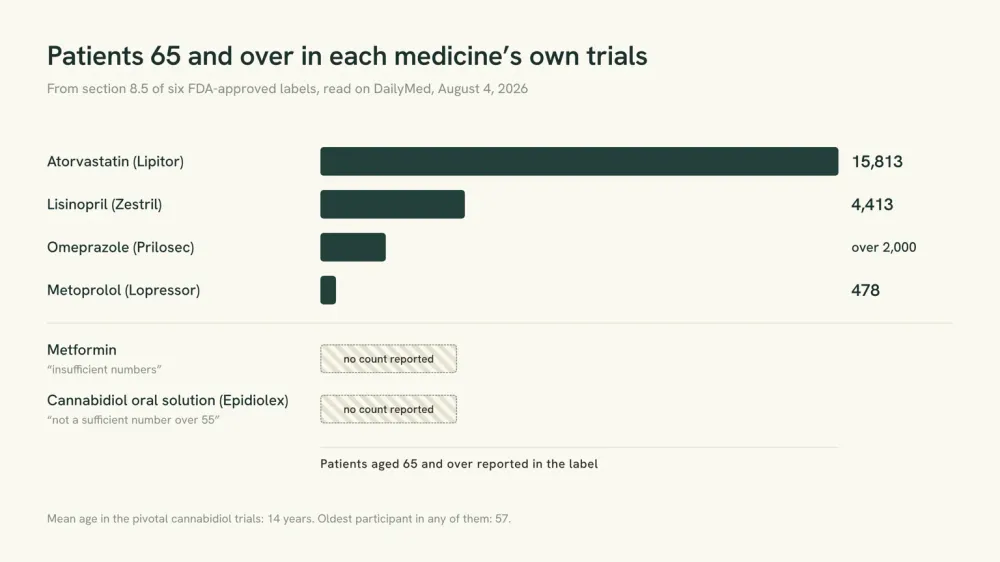
Here is the part a seller would leave out. The second sentence of section 8.5, the one telling clinicians to start at the low end of the dosing range, is close to standard FDA geriatric-use labeling language. It is not a cannabidiol-specific warning. We pulled section 8.5 from five unrelated labels on DailyMed on August 4, 2026 to check, and metformin, one of the most-dispensed medicines in America, carries near-identical wording down to the phrase about decreased hepatic, renal, or cardiac function. What is genuinely unusual is the first sentence, and the way to see it is to compare who each drug's own trials managed to enroll.
| Medicine (class) | What its own section 8.5 reports about older participants |
|---|---|
| Atorvastatin, Lipitor (lipid-lowering) | 15,813 treated patients (40%) in the clinical trials were 65 or older, and 2,800 (7%) were 75 or older. "No overall differences in safety or effectiveness were observed between these patients and younger patients." The same section also names advanced age as a risk factor for that drug's own muscle-related side effects. |
| Lisinopril, Zestril (ACE inhibitor) | 4,413 (47%) were 65 and over, and 1,656 (18%) were 75 and over. |
| Omeprazole, Prilosec (proton pump inhibitor) | Omeprazole was administered to over 2,000 elderly individuals, 65 or older, in clinical trials. |
| Metoprolol, Lopressor (beta blocker) | Approximately 478 patients were over 65 years of age, and none at all were over 75. |
| Metformin (antidiabetic) | Controlled clinical studies did not include sufficient numbers of elderly patients to determine whether they respond differently from younger patients. |
| Cannabidiol oral solution, Epidiolex (antiseizure) | Trials did not include a sufficient number of patients aged above 55 years to determine whether or not they respond differently from younger patients. Mean age in the pivotal trials: 14 years. |
Two things fall out of that table. First, "insufficient numbers of elderly patients" is a real and ordinary category, and cannabidiol is not alone in it. Metformin is there too, and nobody thinks metformin is exotic. Saying so is more useful than presenting a piece of boilerplate as a red flag unique to CBD. Second, the contrast with the statin row is the actual story. One label can tell you how 15,813 people aged 65 and over responded, and 2,800 people aged 75 and over. The other cannot get past 55, and the average participant it does have was fourteen years old. That is not a scandal, but it is the single most important thing to know before reading anything else written about CBD and age. If you want the ground-level chemistry first, our hub on what cannabidiol actually is covers it without the marketing.
How much of the older adults evidence is actually about older adults
The other body of evidence people point to is the trial literature on cannabinoids in older populations. It exists. It is much smaller than the phrase suggests. The reference point is a 2021 systematic review and meta-analysis in PLoS Medicine by Velayudhan and colleagues on the safety and tolerability of cannabinoids in adults aged over 50, which searched the literature from January 1990 to October 2020, followed PRISMA and GRADE, and pooled 46 randomized controlled trials, 60 comparisons and 6,216 participants with a mean age of 58.6 years.
Read the fourth number again. In the whole pooled dataset, and quoting the Results section, "4 RCTs recruited participants over age ≥65 years (n = 68; mean age, 72.4 (SD ± 4.5)), of which one was ≥75 years". Sixty-eight people. Most of that literature is also not about CBD at all: the majority of the pooled trials used medicines containing THC. The CBD-only slice is four comparisons drawn from three trials in unrelated clinical populations, none of them recruited for age, with mean ages between 47.8 and 56.8 years, daily research amounts ranging from 20 mg to 700 mg, durations from a single session to 13 weeks, and GRADE certainty rated low to moderate. Not one CBD-only trial in that review had a mean age of 60. Those amounts are trial parameters in specific patient groups, not servings, and nothing on this page turns them into one.
The headline result gets quoted as reassurance, so here it is with its own qualifiers attached: "CBD alone did not increase the incidence of all-cause AEs (IRR: 1.02 [95% CI, 0.90 to 1.16])". The authors themselves describe the underlying evidence as "generally low-quality evidence (about 67% of studies)". An incidence rate ratio of 1.02 across four small, low-certainty comparisons is a difference nobody detected, which is not the same claim as a difference nobody would find with a larger study. Their conclusion is usually quoted at the comma. Whole, it reads: "This pooled analysis, using data from RCTs with mean participant age ≥50 years, suggests that although THC-containing CBMs are associated with side effects, CBMs in general are safe and acceptable in older adults. However, THC:CBD combinations may be less acceptable in the dose ranges used and their tolerability may be different in adults over 65 or 75 years of age." The reassuring clause and the cautioning clause are the same sentence.
Then there is the pharmacokinetic question: does an older body handle cannabidiol differently? A 2024 review in Pharmaceutics on CBD and THC in special populations searched a drug-interaction database, PubMed and Google Scholar from inception to March 2024, and tabulated cannabidiol pharmacokinetics across seven patient populations, from children with seizure disorders to people with liver and kidney impairment. There is no row for older adults. Its authors write that the pharmacokinetics of CBD and THC in special populations "remain poorly characterized", and that to the best of their knowledge only one research group has published pharmacokinetic work in older adults, on THC rather than CBD. The same review summarizes the general reasons age could matter: it reports that the liver may lose 20 to 40 percent of its volume and around 40 to 60 percent of its blood flow in older adults compared with younger adults, and that serum albumin falls by about 20% by age 70. Those are statements about aging physiology drawn from the geriatric pharmacology literature, not measurements of what cannabidiol does.
Polypharmacy is arithmetic, not a warning label
Now the question that actually matters at 72, and it is not "is CBD safe". It is "what is already in the organizer". Here is the federal number. NCHS prescription drug use data published in Health, United States, drawn from NHANES, reports that the share of adults age 65 and older taking five or more prescription drugs in the past 30 days rose from 33.3% in 2001-2004 to 43.0% in 2017-March 2020. Three or more went from 59.8% to 67.7%. Two caveats travel with those figures and both matter. NHANES surveys the civilian noninstitutionalized population, so nursing-home residents, where this is highest, are not counted in it, and the 2017-March 2020 file covers 3.2 years because field operations stopped in March 2020. That page was last reviewed on August 6, 2024, and we read it on August 4, 2026.
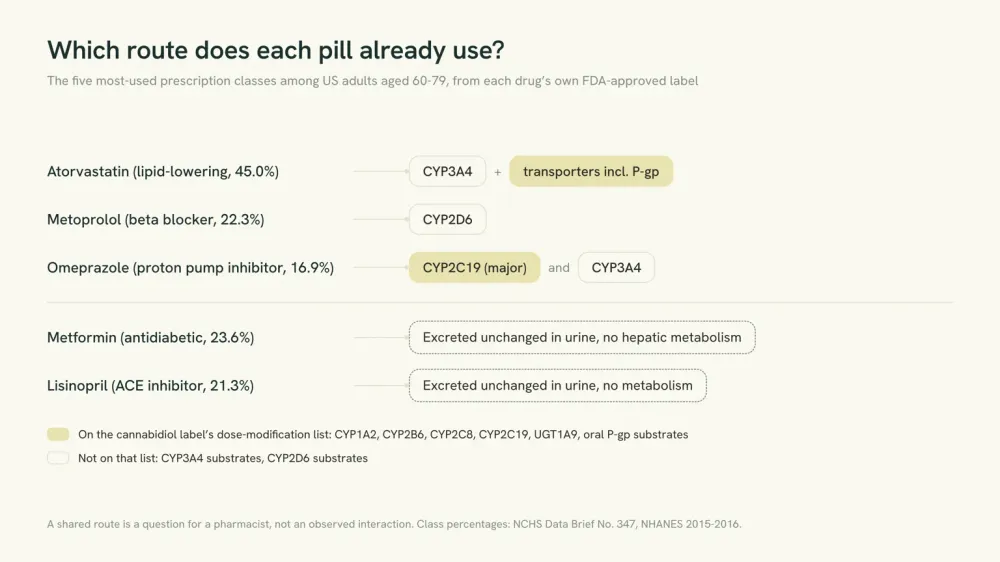
Which medicines are those, in practice? NCHS Data Brief No. 347, using NHANES 2015-2016, reports that among US adults aged 60-79 the most commonly used classes were lipid-lowering drugs (45.0%), antidiabetic agents (23.6%), beta blockers (22.3%), ACE inhibitors (21.3%) and proton pump inhibitors (16.9%). That age band is 60-79, not 65 and over, so it should not be relabeled as if it were. It is still the best public description of what is actually in the organizer, and it is what makes the next table possible.
Here is the move nobody on page one makes. Stop asking whether CBD interacts with a drug by name, and start asking which route that drug uses to leave the body. Every prescription medicine has an FDA-approved label that states this plainly in section 12.3: the label for omeprazole, for instance, says that "the major part of its metabolism is dependent on the polymorphically expressed CYP2C19". Set those routes against the ones the cannabidiol label flags for prescribers, which are CYP1A2, CYP2B6, CYP2C8, CYP2C19, UGT1A9 and orally administered P-glycoprotein substrates. Note what is not on that list: CYP3A4 substrates and CYP2D6 substrates. P-glycoprotein, usually shortened to P-gp, is not an enzyme at all. It is a pump in the wall of the gut that ejects drug molecules before absorption finishes.
| Medicine (class, % of adults 60-79 using the class) | How its own label says the body clears it | What has and has not been tested with cannabidiol |
|---|---|---|
| Atorvastatin (lipid-lowering, 45.0%) | "A substrate of CYP3A4 and transporters (e.g., OATP1B1/1B3, P-gp, or BCRP)", and plasma levels "can be significantly increased with concomitant administration of inhibitors of CYP3A4 and transporters" | Not tested. CYP3A4 substrates are not on the cannabidiol label's dose-modification list and a CYP3A4 probe study showed no change; orally administered P-gp substrates are on that list. Open question for a pharmacist. |
| Metformin (antidiabetic, 23.6%) | "Metformin is excreted unchanged in the urine and does not undergo hepatic metabolism (no metabolites have been identified in humans) nor biliary excretion" | Not on the cytochrome map at all. Not tested with cannabidiol. |
| Metoprolol (beta blocker, 22.3%) | "Primarily metabolized by CYP2D6", and "Metoprolol is not a significant P-glycoprotein substrate" | CYP2D6 substrates are not on the cannabidiol label's dose-modification list. Absence from a list is not a safety statement. |
| Lisinopril (ACE inhibitor, 21.3%) | "Lisinopril does not undergo metabolism and is excreted unchanged entirely in the urine" | Not on the cytochrome map at all. Not tested with cannabidiol. |
| Omeprazole (proton pump inhibitor, 16.9%) | Extensively metabolized by cytochrome P450; "the major part of its metabolism is dependent on the polymorphically expressed CYP2C19", the remainder on CYP3A4 | The cannabidiol label states "Cannabidiol is a moderate inhibitor of CYP2C19", and CYP2C19 substrates are on its dose-modification list. That is an adjacency on paper, not an observed interaction. |
One row deserves its own paragraph, because it is the most interesting thing on this page and the easiest thing to get wrong in either direction. The FDA-approved label for atorvastatin describes it as a substrate of both CYP3A4 and transporters including P-gp. The cannabidiol label reports one clinical study in which a drug that is also both a P-gp and a CYP3A4 substrate, everolimus, showed an approximately 2.5-fold increase in mean Cmax and AUC when given with pharmaceutical cannabidiol at 12.5 mg/kg twice daily in healthy subjects. The same label reports that a pure CYP3A4 probe, midazolam, showed no change in plasma concentrations when given with that same pharmaceutical cannabidiol at 750 mg twice daily in healthy subjects. These two have not been studied together. So the correct sentence is not "CBD raises your statin levels", and it is equally not "statins are fine with CBD". It is this: these two share a transporter route, that route is on the cannabidiol label's list, the pairing has not been studied, and a pharmacist with your full list in front of them is the person equipped to weigh it. The general framework for all of this lives on our page about how CBD interacts with medications, and CBD and blood thinners covers anticoagulants specifically, which this page deliberately does not re-derive.
- 1Write down everything you take, not just the prescriptions: over-the-counter medicines, supplements, herbal preparations, and anything you take only on some days.
- 2For each one, find section 12.3 of its FDA-approved label on DailyMed and read the sentence describing how the body clears it. It is usually one sentence, and it either names the enzyme or says there is not one.
- 3Sort the list into three piles: cleared by a cytochrome enzyme, moved by P-glycoprotein, and neither. Most organizers contain items in all three.
- 4Mark anything with a narrow margin between a working level and too much, where a small change in blood level would matter.
- 5Take the sorted list, not the question, to your prescriber and your pharmacist. A sorted list gets a specific answer in five minutes. "Is CBD safe with my meds?" gets a shrug.
What researchers found when they followed 12,599 seniors
There is one large study of what happens when older people combine cannabis with the rest of their medicines, and it repays being read precisely. A 2025 longitudinal cohort study in Age and Ageing used Ontario administrative and clinical claims data to follow 12,599 seniors holding an authorized medical cannabis prescription between 2014 and 2019, against 48,651 controls. Among those also dispensed a drug with a narrow therapeutic index, meaning a small gap between a working level and a level that causes harm, drug-related intoxication was recorded in 0.88% of the cannabis-exposed group (34 of 3,926) and 0.34% of the controls (41 of 12,223). The adjusted risk ratio was 2.61 (95% CI 1.42 to 4.79); unadjusted it was 1.98 (1.21 to 3.22).
Now the limits, which are load-bearing rather than decorative. This is medical cannabis, not CBD, so in most cases THC is in the picture. It is administrative claims data, not a trial. The absolute counts are 34 events and 41 events, which is exactly why the rates belong beside the ratio: a risk that more than doubles here is still a risk that landed below one in a hundred. And the authors disclose cannabis-industry ties, quoted with both halves as any disclosure should be. They list a board membership at a licensed producer, past paid advisory work for cannabis clinics and a Mitacs grant with a cannabis company as partner, alongside the statement that "the above-mentioned entities, research funders and companies listed were not involved in any aspect of the design or write-up of the study". Funding came from a Canadian Institutes of Health Research project grant.
The finding that actually transfers is not the ratio at all. It is this: the trends in dispensing of those interacting drugs "were similar in the year before and after cannabis prescription". Nothing about the rest of the medication list changed when cannabis was added to it. The authors conclude that "prescribing practices for cannabis may not adequately consider the implications" of drugs at risk of interaction and of narrow-therapeutic-index drugs, and that better prescriber awareness "could mitigate the risk of adverse effects such as drug-related intoxication". That is a statement about a health system in one province, not about you. The practical translation is small and useful: adding one thing is a change to the whole list, and somebody qualified has to look at the whole list.
The side effects are the same list. For an elderly reader, the consequences are not.
Every documented adverse effect of cannabidiol in the regulated setting sits on one page: the FDA-approved label's adverse-reaction tables. Our page on the side effects that are actually documented owns the list itself. What this page adds is what changes when the same event happens to an 80-year-old rather than a 40-year-old. Read the table with its conditions attached, because they are not decoration: these are rates from placebo-controlled trials of pharmaceutical cannabidiol oral solution dosed at 20 or 25 mg/kg per day in patients with rare seizure disorders, most of them children, nearly all of them taking other antiseizure medicines. A tincture does not produce these rates, and this table cannot be converted into one.
| Adverse reaction | Cannabidiol oral solution | Placebo | Trial and dose |
|---|---|---|---|
| Somnolence | 25% | 8% | Lennox-Gastaut and Dravet, 20 mg/kg/day, 238 vs 227 patients |
| Decreased appetite | 22% | 5% | same trial and dose |
| Diarrhea | 20% | 9% | same trial and dose |
| Transaminases elevated | 16% | 3% | same trial and dose |
| Fatigue, malaise, asthenia | 12% | 4% | same trial and dose |
| Lethargy | 8% | 2% | same trial and dose |
| Sedation | 6% | 1% | same trial and dose |
| Gait disturbance | 2% | under 1% | same trial and dose |
| Gait disturbance | 9% | 5% | Tuberous sclerosis complex, 25 mg/kg/day, 75 vs 76 patients |
| Transaminases elevated | 25% | 0% | Tuberous sclerosis complex, 25 mg/kg/day, 75 vs 76 patients |
Three rows in that table change meaning with age, and the label puts its own conditions inside the sentence rather than in a footnote. Section 5.2: "In controlled studies for LGS and DS (10 and 20 mg/kg/day dosages), the incidence of somnolence and sedation (including lethargy) was 32% in EPIDIOLEX-treated patients ... compared with 11% in patients on placebo and was generally dose-related", and that the rate reached 46% among patients also taking clobazam, another antiseizure medicine. It adds that "other CNS depressants, including alcohol, could potentiate the somnolence and sedation effect", and instructs prescribers to "advise patients not to drive or operate machinery until they have gained sufficient experience". The second row is gait disturbance, which the label's own tables record at both body-weight dose levels. The third is the liver row: section 5.1 reports that at the 10 and 20 mg/kg/day dosages, ALT above three times the upper limit of normal occurred in 13% of treated patients versus 1% on placebo (and in 12% at 25 mg/kg/day), concentrated in those also taking valproate (21 to 30%) against 3% in patients on neither valproate nor clobazam. If you drink at all, what happens when CBD and alcohol are taken together is the page that covers the depressant point directly.
Here is why an identical percentage reads differently at 80. CDC's older adult falls data, on a page dated February 26, 2026, reports that falls are the leading cause of injury for adults ages 65 years and older; that over 14 million, or one in four, adults 65 and older report falling each year; that about 37% of those who fall reported an injury that required medical treatment or restricted their activity for at least one day; and that the age-adjusted fall death rate increased by 21%, from 64.7 per 100,000 in 2018 to 78.4 per 100,000 in 2024. CDC says nothing about CBD anywhere on that page, and neither do we. The connection this page draws is one step long and it is a process step, not a causal one: CDC names "use of medicines that may increase fall risk" as a factor clinicians should screen for and address. So anything new that could make you drowsy is a thing to put in front of the person doing that screening, before you start, not after.

The bottle is a fine-motor task, and the number on the box is per milliliter
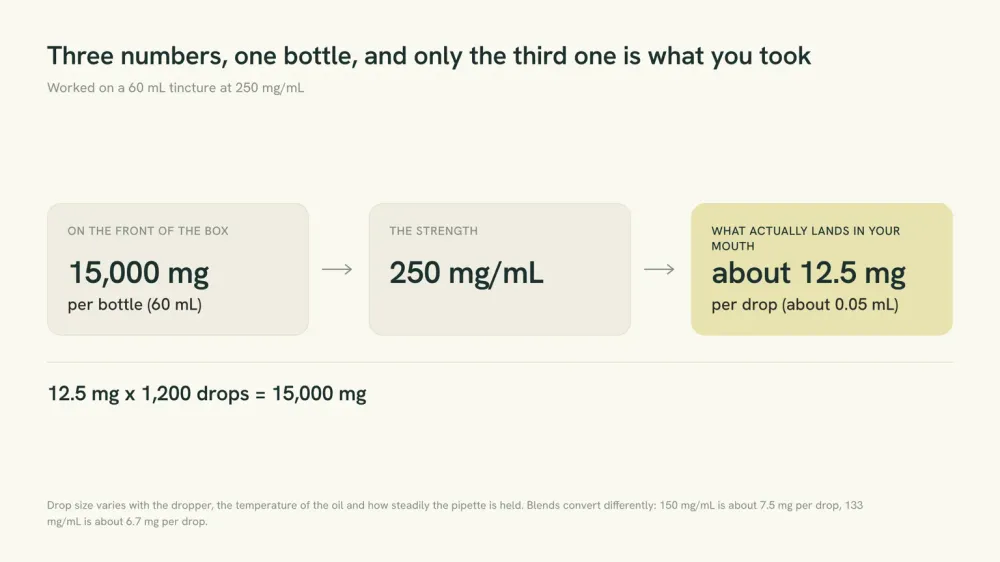
Nobody writes this part, and it is the part people actually struggle with. A tincture is delivered by a glass pipette, in drops, held above the tongue, by hands that may not be steady, guided by eyes that may not read small type on a curved bottle in a dim bathroom. Before any of that, the number printed on the box has to be understood, and it is the single most misread number in this category. The large figure on the front is usually the total in the bottle. The strength is per milliliter. What actually lands in your mouth is per drop. Those are three different numbers, and only the third one is what you took.
Worked in real numbers, using our own line as the example, because the arithmetic is the point rather than the brand. Our standard tinctures are 60 mL bottles containing 15,000 mg of CBD, which is 250 mg/mL. A standard glass dropper delivers roughly 0.05 mL per drop, so one drop carries about 12.5 mg and a full bottle holds about 1,200 drops. Check it: 12.5 mg multiplied by 1,200 drops is 15,000 mg, which reconciles with the bottle total. The blends work out differently, which is exactly why the front-of-box figure is unreliable as a guide: the CBD and CBG tincture is 150 mg/mL CBD plus 100 mg/mL CBG, about 7.5 mg and 5 mg per drop, and the CBD and CBN tincture is 133 mg/mL CBD plus 67 mg/mL CBN, about 6.7 mg and 3.3 mg per drop. Drop size varies with the dropper, the temperature of the oil and how steadily the pipette is held, so treat all of this as label arithmetic rather than a measurement. It is how the number works, not a recommendation of an amount: how CBD amounts are worked out is the page that owns amounts, and this one publishes none. If you would rather not do the multiplication, our per-drop calculator does it, and reading a CBD label explains the rest of what is printed on the box.
- Read the strength in mg/mL, not the headline figure on the front. Two bottles with the same big number can differ by a factor of two per drop.
- Count the drops out loud, or into a spoon in good light, rather than squeezing straight into your mouth and estimating.
- Do it seated, at a fixed point in your routine, in good light. Standing in a dark hallway is how people lose count.
- A graduated pipette, one with volume markings on the glass, is easier to read than counting drops if your hands are not steady. Ask before you buy whether the dropper has markings.
- Write down what you took and when, on the same sheet as everything else you take.
- Store it somewhere it cannot be confused with anything else, and never decant it into a pill organizer or an unlabeled container.
- If the print on the box is too small to read, photograph it with a phone and enlarge it. Guessing at a strength is worse than asking.
One more reason the number matters: it is frequently wrong. A 2024 analysis in Frontiers in Pharmacology of 202 CBD samples bought in the United States between October and December 2021 found that 149 of them, 74%, measured more than 10% away from the CBD amount stated on the label. That study was sponsored by Jazz Pharmaceuticals, which makes the prescription cannabidiol medicine discussed above, and several authors were compensated by the company. Say so, and read it anyway, because an independent 2022 analysis of 80 items in the Journal of Cannabis Research points the same way: label claims spanned 7.5 to 60 mg/mL against measured values of 2.9 to 61.3 mg/mL, with 37 of the 80 at least 10% off. Neither study tested one of our batches, and neither is a verdict on any brand. The only way anyone knows what is in a specific bottle is a batch-specific certificate of analysis, and checking a batch certificate is a five-minute skill worth having before the first purchase.
A checklist to run before the bottle, not after
- 1Write the full list: prescriptions, over-the-counter medicines, supplements, and anything taken only occasionally. Include the ones you consider too minor to mention.
- 2For each item, find how the body clears it in section 12.3 of its label on DailyMed, and sort into cytochrome, P-glycoprotein, and neither.
- 3Flag anything where a small change in blood level would matter, and anything already causing drowsiness or unsteadiness.
- 4Add the CBD bottle to the list as a written line: what it is, its strength in mg/mL, and what you actually take, in drops.
- 5Book the review. If you have Medicare drug coverage and take medicines for more than one long-term condition, ask your plan whether you qualify for Medication Therapy Management.
- 6Bring the list to that review and to every other appointment, including the emergency room.
- 7Ask three specific questions: which of my medicines share a clearance route with cannabidiol, which of them have a narrow margin, and what should I watch for in the first two weeks.
- 8Agree in advance what would count as a reason to stop, and who you would call if it happened.
- 9Do not change, reduce, delay or stop any prescription on your own. Nothing on this page is a reason to, and that decision belongs to the person who wrote the prescription.
Step five is a real, federally required service that almost nobody mentions in this context. Medicare's own page on Medication Therapy Management states that plans with Medicare drug coverage "must offer Medication Therapy Management services to help people who meet certain requirements or are in a drug management program", and that "If you qualify, you can get these services at no cost to you". What you get includes "a comprehensive review of your medications and the reasons why you take them", a written summary of that review with your doctor or pharmacist, and a recommended to-do list and medication list. Eligibility is conditional rather than universal, which is why the page's own instruction is to contact your drug plan for details if you take drugs for more than one long-term condition. Its other instruction applies to everyone: "Bring your medication list with you any time you talk with your doctors, pharmacists, and other health care providers, or if you go to the hospital or emergency room." A new bottle is a new line on that list.
What page one will not tell you, and how to check it in 60 seconds
We described the SERP read at the top of this page, and it is worth returning to, because it is the best argument for reading every page on this topic skeptically, including this one. Three of the six first-page results blocked our automated read, so we make no claim at all about their citation counts. On the one we could load in full, we counted nine health claims supported by five references: an endocannabinoid-system review, a publisher's review article, two consumer-health sites and a general regulatory page. None of the five studied anyone over 65, and none of the five was a trial. That is not a claim about anyone's honesty. It is a claim about what the citations underneath these pages actually contain, and you can run the same check yourself on any page you land on next.
- If a page names a study, search its PMID or title at pubmed.ncbi.nlm.nih.gov. If a page names no study at all, you already have your answer.
- Read the abstract for two numbers: how many people took part, and how old they were. A trial with a mean age of 22 tells you very little about a 78-year-old.
- Check what kind of paper it is. A trial, a review of trials and a mechanism study in cells or animals are three different weights of evidence, and only the first two are about people.
- Check that the page's claim is what the study measured. A study of blood levels is not a study of whether something works.
- Check who paid, and read the whole funding statement. It usually has two halves: the relationship, and the stated limits on that relationship. Quoting either half alone is misleading.
None of that makes a buying decision for you, and this page will not make one either. If you have already had the conversation with your clinician and you are at the point of comparing bottles, our buying checklist sets out the criteria that survive scrutiny, and what people report feeling sets expectations honestly. Neither will rank anything "for seniors", because age is not a formulation variable, and nothing in the evidence described on this page compares one formulation against another in older adults.
What is still unknown, stated as counts
Honest limits, phrased as counts rather than superlatives, because a count can be checked and a superlative usually cannot. There is no row for older adults in the cannabidiol pharmacokinetics table of the 2024 review that searched three sources looking for one. There are 68 people aged 65 and over across the 46 pooled cannabinoid trials in the 2021 meta-analysis, which closed its search in October 2020. None of the searches described on this page turned up a trial of cannabidiol at consumer amounts, in older adults, alongside a typical prescription list. And the FDA-approved cannabidiol label reports no interaction study with any of the five most-used prescription classes in this age group. What we are not saying is that nothing has ever been studied in older adults: small randomized trials do exist, more are being run, and the picture in five years may look different from the picture today.
On the regulatory side, expect movement without resolution. Executive Order 14370 directs federal agencies to take steps on medical marijuana and cannabidiol research. It approves nothing, changes no law, and by its own terms creates no enforceable rights, so anything it produces will arrive later as agency action rather than as a status any bottle already holds. Until then, the position this page takes is the one the evidence supports and no more: the question of cannabidiol in an older body carrying a full medication list is open, it belongs to your prescriber and your pharmacist, and anyone who settles it for you while selling you something has not read the label.
Nobody can answer that from the research as it stands, and the honest version is more useful than a yes or a no. The FDA-approved cannabidiol label says its trials "did not include a sufficient number of patients aged above 55 years to determine whether or not they respond differently from younger patients". The largest pooled analysis of cannabinoid trials in adults over 50 found four trials that recruited anyone aged 65 or over, 68 people in total, and its authors close by saying tolerability "may be different in adults over 65 or 75 years of age". That is an open question, not a warning, and it is also not a reassurance. The way to close it for your own case is a medication review with a pharmacist and a conversation with the person who writes your prescriptions.
The list is the same list. In the trials of the FDA-approved cannabidiol oral solution, dosed by body weight in patients with rare seizure disorders, the most common were somnolence (25% against 8% on placebo), decreased appetite (22% against 5%), diarrhea (20% against 9%), raised liver transaminases (16% against 3%) and fatigue (12% against 4%), with gait disturbance appearing in the label's own tables. What changes with age is not the event, it is what follows from it. CDC reports that falls are the leading cause of injury for adults 65 and older and names medicines that may increase fall risk as something clinicians should screen for. Those are two separate facts, not a finding about CBD, and together they are the reason a new potentially sedating item belongs on a medication list rather than in a drawer.
This page publishes no amount, because there is none to publish. No established serving for an older adult exists, and nothing in the evidence described above comes close to setting one: the pooled cannabinoid literature contains 68 people aged 65 and over, and the CBD-only trials inside it had mean ages under 60. The only dosing language on the FDA-approved label is a general instruction to clinicians that dose selection for an elderly patient "should be cautious, usually starting at the low end of the dosing range", and that sentence is close to standard FDA geriatric labeling language that also appears, near-identically, on the metformin label. It is advice to prescribers about prescription medicines, not a serving suggestion for a tincture. For how amounts work in general, and how milligrams per bottle, milligrams per milliliter and milligrams per drop relate to each other, see our page on CBD dosage, linked above.
The answer is different for each, which is why the route matters more than the name. Atorvastatin's own label calls it a substrate of CYP3A4 and transporters including P-glycoprotein. Omeprazole's label says the major part of its metabolism depends on CYP2C19, and the cannabidiol label describes cannabidiol as a moderate inhibitor of CYP2C19. Lisinopril's label says it "does not undergo metabolism and is excreted unchanged entirely in the urine", and metformin's says the same thing in different words, so two of the five most-used classes in this age group are not on the cytochrome map at all. None of those adjacencies is an observed interaction, and the cannabidiol label reports no interaction study with any of them. They are reasons to ask a pharmacist a specific question, not answers to it.
Yes, and there is a specific place to do it. Medicare drug plans must offer Medication Therapy Management, which includes "a comprehensive review of your medications and the reasons why you take them" and which costs nothing if you qualify. Medicare's own instruction is to bring your medication list to every appointment, including the hospital and the emergency room. A new bottle is a new line on that list, with its strength in mg/mL and what you actually take written beside it. The gap this closes is documented: the December 2025 executive order on cannabis research records a patient survey finding that just 56 percent of older Americans using marijuana had discussed the usage with their health care provider.
In principle it could, and a 2024 review that went looking did not find the measurement. It searched a drug-interaction database, PubMed and Google Scholar through March 2024, tabulated cannabidiol pharmacokinetics for seven patient populations, from children with seizure disorders to people with liver and kidney impairment, and had no row for older adults; the only older-adult pharmacokinetic work it found was on THC. The same review summarizes the general reasons age could matter, reporting that the liver may lose 20 to 40 percent of its volume and around 40 to 60 percent of its blood flow compared with younger adults, and that serum albumin falls by about 20% by age 70. That is a description of aging physiology from the geriatric pharmacology literature, not a measurement of what cannabidiol does in an older body.
Writing about hemp, wellness and the small rituals that keep us balanced.