CBD vs Kratom: Nobody Can Rank Them, and Here Is Why
Ask PubMed for a trial that studied cannabidiol together with kratom and, on September 6, 2026, it returns zero. Here is the comparison that can be documented instead: two statutes, one import alert, and two harm records that cannot be subtracted.
Search cbd vs kratom and you will have a confident answer within one scroll, usually a table that splits pain between the two and calls one of them safer. On September 6, 2026 we asked PubMed for a randomized controlled trial or a clinical trial that studied cannabidiol together with kratom. It returned zero. Not a small number. Zero. Every ranking on the first page of that search was written without one. This page is about the comparison that can actually be documented, which turns out to be sharper than the invented one.
Here is the boundary, stated before anything else. This page does not rank these two substances, in either direction. It does not present one as a replacement for the other, or for anything anyone uses either of them for. It publishes no amount, no starting point and no interval for either substance, because there is nothing honest to build one out of. And it publishes nothing about which of the two is more or less likely to show up on a workplace drug test, a refusal the last section explains rather than repeats. What you get instead is a stack of federal and international documents, each read on September 6, 2026, with its own date and its own limitation attached.
Kratom vs CBD: two different categories of thing
Start with what the documents call each of them, because the comparison people are trying to make assumes the two are the same kind of object, and they are not. Cannabidiol is a compound from the cannabis plant. Kratom is leaf material from Mitragyna speciosa, sold in the words of FDA's own enforcement paperwork as dietary supplements and bulk dietary ingredients. Different plants, different molecules, and, more importantly for anyone trying to rank them, different vocabularies in the agencies that describe them.
The WHO expert committee's pre-review of kratom describes mitragynine and 7-hydroxymitragynine, the two alkaloids that dominate the literature, as partial agonists at the mu-opioid receptor, and reports that the minor alkaloid binds that receptor considerably more tightly than the abundant one, with morphine binding it more tightly still. Two things about that document. It is an unedited advance copy of a pre-review, which is a working paper prepared for a committee rather than a conclusion the committee published, and we label it that way every time we use it. And every comparison in it is among kratom's own alkaloids and a classical opioid: it says nothing whatsoever about cannabidiol, and this page does not convert it into a statement about it.
On the other side of the comparison, FDA's kratom page, stamped December 2, 2025 and reread by us on September 6, 2026, states that there are no prescription or over-the-counter drug products containing kratom or its known alkaloids that are legally on the market in the U.S. Cannabidiol has one. It is the active ingredient in an approved prescription medicine for three rare seizure syndromes, which is a fact about a specific drug product made and tested to a specific standard, and not a fact about anything sold in a store. That gap is the entire subject of our page on the difference between Epidiolex and CBD oil, and we are not re-deriving it here. None of this is a ranking. It is a statement that the two substances are documented in different languages, and a comparison written across two languages compares nothing.
| The question asked of both | Cannabidiol (CBD) | Kratom |
|---|---|---|
| What is it, in the document? | A compound of the cannabis plant, and the active ingredient of one approved US prescription drug | Leaf material from Mitragyna speciosa, described in FDA enforcement paperwork as a dietary supplement and bulk dietary ingredient |
| Which molecules do the documents name? | Cannabidiol | Mitragynine and 7-hydroxymitragynine |
| What did the WHO expert committee report? | The WHO committee's 2018 critical review reports no effects indicative of any abuse or dependence potential in humans | The WHO committee's 2021 pre-review, an unedited advance copy, describes both alkaloids as partial agonists at the mu-opioid receptor |
| Is there an approved US drug product? | Yes: one purified prescription medicine, for three rare seizure syndromes | No: FDA states there are no prescription or over-the-counter drug products containing kratom or its known alkaloids legally on the US market |
| Can it be sold as a dietary supplement? | No: excluded from the definition under FD&C 201(ff)(3)(B) | No: adulterated under FD&C 402(f)(1)(B) as a new dietary ingredient with inadequate safety information |
What has actually been measured about the two together
A comparison needs a measurement, so here is the search, printed and dated so that you can re-run it yourself. On September 6, 2026 we asked PubMed for cannabidiol AND (kratom OR mitragynine). It returned 15 records, the same 15 it returned when our page on taking CBD and kratom at the same time ran the identical search on August 13, so there is no news in that number and we are reporting it as unchanged. Eight of those 15 are indexed as human studies, which makes them records that mention both substances rather than studies of both; the sibling page read that wider human set in August and reported that none of them gives a person both substances and measures either one. Then we added the filter that decides whether a ranking is even possible: publication type randomized controlled trial, or publication type clinical trial. That returns zero.
Be precise about what that filter proves, because this is exactly where a page like this one usually overreaches: a publication type is an indexing decision, so the defensible sentence is that no such trial is indexed, not that no such trial could ever have happened anywhere on earth. Either way, there is nothing indexed for the author of a which-is-better table to have read. The two literatures are also not the same size. On September 6, 2026 PubMed returned 1,171 records for kratom against 9,051 for cannabidiol, and four records tagged as randomized controlled trials against 378. Our page on the DEA's kratom scheduling action printed 1,171 and 9,049 two days earlier, and that two-record gap is simply what a live database does over 48 hours. Those counts describe how much has been published and nothing else. Publishing volume is not evidence quality, and it is not safety.
Now read what the pages that answer the question anyway are actually made of. On the first page of this search result on September 6, 2026, a health publisher tells readers there is some evidence suggesting that kratom is effective for acute pain, while CBD is useful for managing chronic pain. An addiction-treatment provider's page says kratom is considered more effective for acute pain, while CBD is often a better option for addressing chronic pain, especially pain caused by inflammation. Neither sentence carries a citation. The most heavily referenced page on that result carries 13 numbered sources, and every one of them sits on a descriptive claim; the comparative sentences carry none, on any page we opened. We are reproducing those two lines to show what is missing behind them, not because either half is established, and we are naming no site, brand or seller, because the defect is the uncited sentence rather than the person selling something. Notice also that the split appears in near-identical wording on more than one domain, which is what a copied claim looks like.
Neither one can legally be a dietary supplement, for opposite reasons
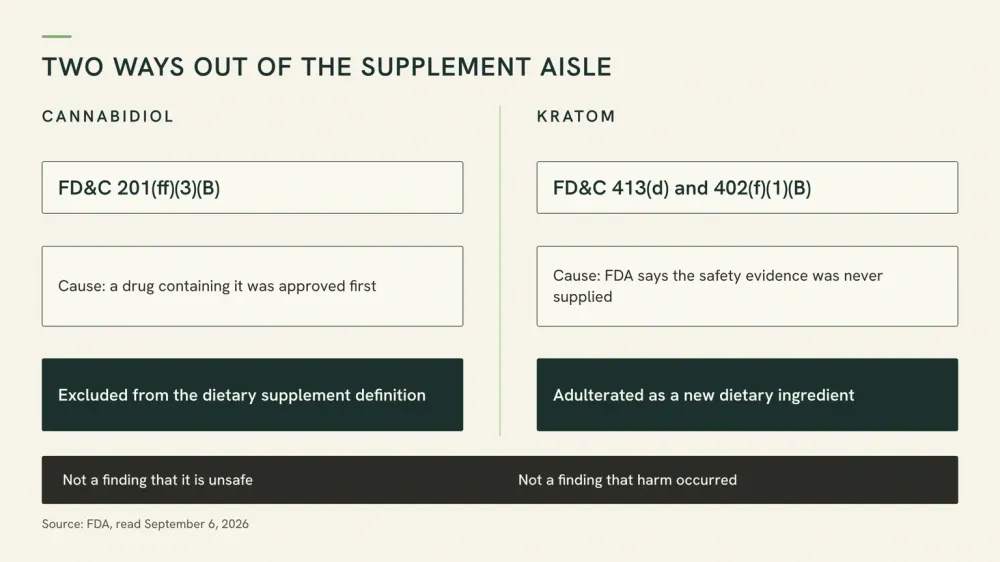
Both substances are shut out of the dietary supplement aisle in the United States, by two different sections of the same law, for reasons that are close to opposites. That asymmetry is the sharpest thing in these documents, and no page we opened on this search result makes it.
Cannabidiol is excluded from the definition of a dietary supplement because a drug containing it was approved first. FDA's cannabis and cannabidiol question-and-answer page, stamped July 16, 2024 and reread on September 6, 2026, applies section 201(ff)(3)(B) of the Federal Food, Drug, and Cosmetic Act: a substance that is an active ingredient in an approved drug, or that has been authorized for investigation as a new drug, is excluded from the supplement definition. There is a statutory exception for substances marketed as a food or a supplement before the drug work began, and FDA has concluded that it does not apply here. The agency can also create an exception by regulation, and on that it says: To date, no such regulation has been issued for any substance. The fuller posture, including the warning-letter record and the agency's own product testing, is on our page about what the FDA says about CBD.
Kratom is shut out of the same aisle by the opposite mechanism. It qualifies as a dietary ingredient. It fails at the next step, which is evidence. FDA treats kratom as a new dietary ingredient under section 413(d), because nothing shows it was marketed as a dietary ingredient in the United States before October 15, 1994. NIH's National Center for Complementary and Integrative Health states the same rule in plainer words and adds that evidence of safety is required; that page carries a Last Updated stamp of April 2022, which makes it the oldest document in this section and worth treating as such. The finding FDA reaches is that there is inadequate information to provide reasonable assurance that such ingredient does not present a significant or unreasonable risk of illness or injury, which makes products containing it adulterated under section 402(f)(1)(B). Added to conventional food, kratom is separately an unsafe food additive under section 409.
Read those two paragraphs next to each other. One substance is out of the aisle because a drug was approved. The other is out because a safety dossier was never filed. Inadequate information is a statement about a missing document, not a finding that something happened to somebody, and if you take one sentence from this article, take that one. Neither statute tells you which substance works. Neither was written to.
| The question | Cannabidiol | Kratom |
|---|---|---|
| Which section does FDA apply? | FD&C 201(ff)(3)(B) | FD&C 413(d) and 402(f)(1)(B); section 409 when added to conventional food |
| What triggers it? | A drug containing the substance was approved, and it had been authorized for investigation as a new drug | It counts as a new dietary ingredient, because nothing shows it was marketed as a dietary ingredient in the US before October 15, 1994 |
| Which test does it fail? | The prior-marketing exception. FDA concluded it does not apply, and says no regulation creating an exception has ever been issued for any substance | The safety-evidence test. FDA finds inadequate information to provide reasonable assurance that the ingredient does not present a significant or unreasonable risk of illness or injury |
| What is the result called? | Excluded from the dietary supplement definition | Adulterated |
| What does it NOT mean? | Not a finding that cannabidiol is unsafe. The exclusion was caused by an approval | Not a finding that kratom caused harm to anyone. Inadequate information describes a dossier that was never filed |
Import Alert 54-15, and the index with no CBD entry
There is one more federal document on the kratom side, and it appeared on none of the pages we opened on this search result. Import Alert 54-15 is titled Detention Without Physical Examination of Dietary Supplements and Bulk Dietary Ingredients That Are or Contain Mitragyna Speciosa or Kratom. Its type is DWPE. The version we read on September 6, 2026 carried a publication date of August 17, 2026, and the charge it cites is refusal of admission under section 801(a)(3): a new dietary ingredient with inadequate safety information, adulterated under 402(f)(1)(B), which is the same statutory sentence as the section above. What the alert does is let FDA districts detain the specified products, without physically examining them, from the firms identified on the alert's Red List.
It is not a ban on the plant. An import alert is a standing instruction about shipments from named companies, which is easy to read as a prohibition on a substance and is not one. Counting the dated firm entries on the Red List in the version we read, there are 91 of them, grouped under six country headings. The oldest is dated February 28, 2014. The newest is dated August 17, 2026, three weeks before we read it, and its product description is a flavored 7-hydroxymitragynine tablet. There is no Green List on this alert, so it carries no roster of firms cleared from detention. And a firm entry is not a firm, because one company can hold several product lines, so 91 entries measures the length of an enforcement list rather than the size of a market.
That last pair is the closing asymmetry of this section, and it needs its exact wording. FDA's index of every import alert it maintains lists alert titles. Search it for these two substances, as we did on September 6, 2026, and kratom appears in one title while cannabidiol appears in none. The honest sentence is that no import alert on that index is titled for cannabidiol. It is not that no CBD shipment has ever been detained, which the index cannot tell you, and we are not upgrading it into that.
Recent federal enforcement on this side has been about a concentrate rather than the leaf, and the two are not the same product. On July 15, 2025 FDA sent warning letters to seven firms marketing products containing concentrated 7-hydroxymitragynine, letters the agency describes as focused on concentrated 7-OH products such as tablets, gummies, drink mixes and shots. On December 2, 2025 the U.S. Marshals Service seized roughly 73,000 units of such products, valued at roughly $1 million, from three firms in Missouri. Both actions are about concentrated 7-OH products, not about kratom leaf, and a headline that drops that distinction turns an action against a concentrate into an action against a plant. What the DEA did and did not do about scheduling afterwards is an entirely separate document set, and it is all on our kratom scheduling page linked above. This one prints none of it.
The same WHO committee looked at both
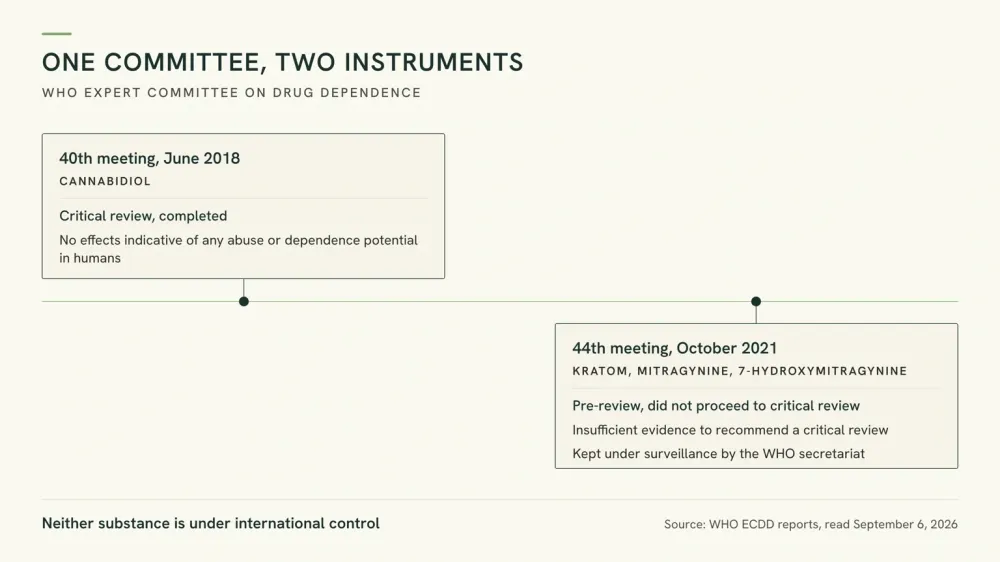
Two substances, one committee, two different instruments. In June 2018, at its 40th meeting, the WHO Expert Committee on Drug Dependence completed a critical review of cannabidiol and concluded that in humans, CBD exhibits no effects indicative of any abuse or dependence potential. That review is the backbone of our page on whether CBD is addictive, and it is not re-derived here. In October 2021, at its 44th meeting, the same committee ran a pre-review of kratom, mitragynine and 7-hydroxymitragynine. A pre-review is the earlier and lighter instrument: its job is to decide whether a full critical review is warranted. This one decided it was not, and the committee's own published report of that meeting gives the reason in a single clause.
“there is insufficient evidence to recommend a critical review of kratom”
Both halves of that finding have to travel together, or the sentence turns into something the committee did not say. It did not find kratom safe. It found the evidence in front of it in 2021 insufficient to justify going further, and in the same recommendation it asked that kratom, mitragynine and 7-hydroxymitragynine be kept under surveillance by the WHO secretariat. The committee made no such surveillance recommendation for cannabidiol. Two differently shaped conclusions, from two different instruments, and neither is a verdict on whether either substance does anything for anybody. Neither substance is under international control by the drug conventions, a status NIDA's kratom page records on the kratom side and which we reread on September 6, 2026. What is federally scheduled inside the United States is a different question, it moved in August 2026, and it belongs to the scheduling page rather than to this one.
Who paid for the human evidence, on both sides
PubMed tagged four kratom records as randomized controlled trials on September 6, 2026, and one of them is a double-blind, placebo-controlled study of dried kratom leaf powder, published in July 2026 in Drug Testing and Analysis. It gave that powder to 116 healthy adults who had never used it: 49 received kratom across four groups and 67 received placebo, either on a single occasion or on 15 consecutive days. It reported subjective effects on the Drug Effects Questionnaire that tracked with the amount given and decreased with repeated dosing, no participant crossing the threshold for clinically meaningful opioid withdrawal on either of the two standard scales used for it, abuse-related adverse events that were more frequent in the higher groups but that the authors describe as generally mild, and no serious adverse events and no deaths. Healthy adults who had never used it, for at most fifteen days, tell you nothing about long-term or dependent use, and this page prints none of the amounts, for either substance, anywhere.
Now read the funding line in the same breath, because it is on the public record and it is the whole point of this section. The study was paid for by NP Pharma, doing business as Della Terra Pharmaceuticals, a kratom pharmaceutical company, and the disclosure states that the sponsor reviewed a draft of the manuscript. Three authors consult to that sponsor through Pinney Associates, a consultancy which the same disclosure says has consulted to the American Kratom Association, the Holistic Alternative Recovery Trust and Botanic Tonics LLC on kratom science and regulatory issues. Two of the authors are paid expert witnesses in legal cases related to kratom. None of that makes the result wrong. Disclosures exist to be read, and this one is detailed enough to read properly. It is why one trial is not a verdict, whoever paid for it.
Follow the names upstream and several of them recur. The WHO committee's published report for that 44th meeting lists, among those who addressed its open session or submitted written statements, the American Kratom Association with two representatives, Pinney Associates, and two of the scientists who would later author the placebo-controlled trial. That is disclosed in the committee's own report; open sessions exist to receive submissions, and industry participation in them is normal and expected. It is also exactly the kind of thing worth knowing before a comparison table impresses you. We hold our own side of this to the same standard: the approved cannabidiol medicine is a Jazz Pharmaceuticals product, and a study funded by the company that sells the approved CBD medicine gets the same footnote on this site that an industry-funded kratom study gets in this paragraph.
- 1Open the study's own record on PubMed rather than the article a website wrote about it, and read the design line first: who was randomized, how many people, and for how long.
- 2Scroll to the conflict-of-interest statement. It is usually the least-read paragraph in the paper and the one that changes how you read the rest of it.
- 3Read the funding line next, and note whether the sponsor is disclosed as having reviewed or approved the manuscript before publication.
- 4Check the author affiliations against the sponsor and against any trade association in the same field. Recurring names are a fact you can see, not an accusation you are making.
- 5Then run those same four steps on the study that supports what you already believe. That is the only version of this exercise that does any work.
The harm record, counted rather than described
The sentence this section exists to replace is a familiar one: that one of these substances is much safer than the other. The direction of that claim is arguable. Its form is not. It is a comparative clinical statement with no comparative measurement behind it, and no page we opened attached one. So here are two harm records instead, each with its own document, its own period, and its own refusal to become a rate.
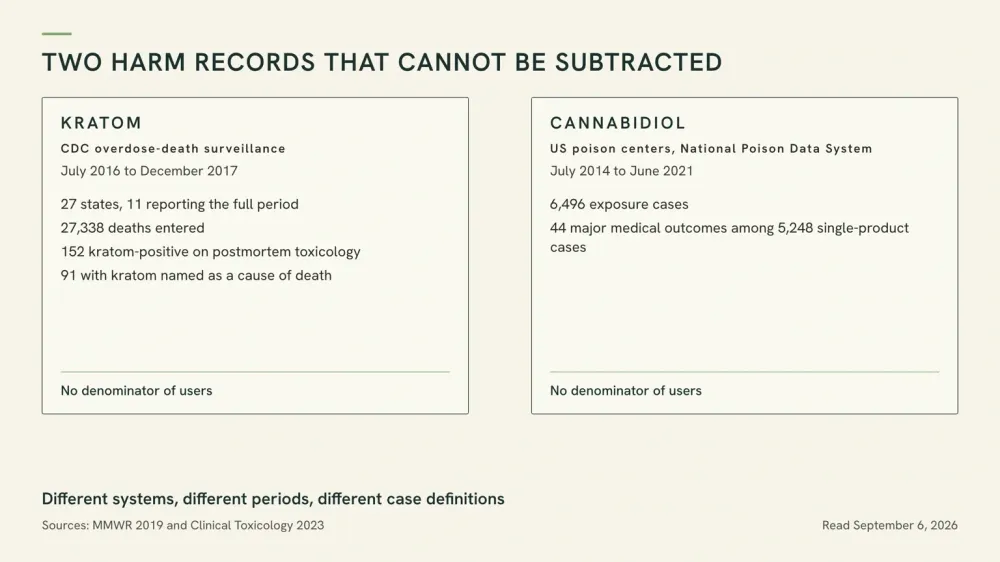
Between July 2016 and December 2017, CDC's overdose-death surveillance system logged 27,338 unintentional and undetermined-intent overdose deaths across 27 states, of which 11 reported the entire period. Kratom was detected on postmortem toxicology in 152 of those deaths, which is 0.56%, and a medical examiner or coroner determined kratom to be a cause of death in 91 of the 152. Seven of those 91 had no other substance detected, and the authors add that for those cases the presence of additional substances cannot be ruled out. About 80% of the kratom-positive decedents had a documented history of substance misuse, and any fentanyl was listed as a cause of death for 65.1% of them. The report states its own largest limitation plainly: postmortem toxicology testing protocols were not documented and varied among and within states. That is a record of what was found, over eighteen months that ended more than eight years ago, in a specific class of deaths. It is not a rate, and it is not anybody's personal risk.
Cannabidiol has its own line in the same kind of database. Between July 2014 and June 2021, US poison centers logged 6,496 CBD exposure cases. Of those, 85.2% involved CBD that was not the FDA-approved medicine, children aged 2 to 12 made up 36.2% of cases, and among the 5,248 single-product cases there were 44 major medical outcomes, every one of them involving a product that was not the approved medicine. A poison-center case is a telephone call rather than a poisoning, most of these were unintentional swallowing by a child, the reporting is passive and voluntary, and the database has no denominator of users at all. What happens at the individual level, as opposed to in the national paperwork, is the subject of the side effects CBD itself reports. And the two counts in these two paragraphs cannot be compared with each other, for reasons the next paragraph gives in full.
| The question | Kratom: CDC overdose-death surveillance | Cannabidiol: US poison centers |
|---|---|---|
| What does the system record? | Unintentional and undetermined-intent overdose deaths investigated by medical examiners and coroners, with postmortem toxicology | Telephone calls to poison centers reporting an exposure, reported passively and voluntarily |
| Which period? | July 2016 to December 2017 | July 2014 to June 2021 |
| What coverage? | 27 states, of which 11 reported the entire period | US poison centers nationally |
| What is the denominator in the document? | 27,338 deaths entered into the system. There is no denominator of users | None. An exposure call is not a rate of anything, and no denominator of users exists |
| What is the count? | 152 kratom-positive on toxicology (0.56%); kratom named a cause of death in 91; 7 with no other substance detected | 6,496 exposure cases; 36.2% children aged 2 to 12; 44 major medical outcomes among 5,248 single-product cases |
| What does the document say about its own limits? | Postmortem toxicology testing protocols were not documented and varied among and within states | Reporting is passive and voluntary, and an exposure call is not a confirmed poisoning |
Put those two records side by side and the temptation is to divide one into the other. Do not. One counts deaths investigated by medical examiners in 27 states over eighteen months; the other counts telephone calls to poison centers over seven years. The case definitions are different, the periods are different, the systems are different, and neither has a denominator of users. They are two records of what got written down, not two measurements of risk, and nothing in either of them supports a sentence beginning X is safer than Y. That refusal is not a dodge and it is not a hedge: it is the reason this page has a harm section at all, because the alternative on offer is an adjective with nothing behind it. If you want the bigger and much more recent poison-center picture on the kratom side, and the rat pharmacokinetic experiment that gave both substances at once, both are on our co-ingestion page linked above, and this page deliberately does not reprint their figures.
How to read either bottle
Underneath the ranking question is a practical one. Someone is standing in front of two containers and wants to know what is in either of them. Here the documents give you something usable, and they give two different answers, which is itself the finding.
On the kratom side, the most useful sentence in the WHO expert report is a labeling sentence, and it is blunt: in the absence of accurate labeling of kratom products, it is impossible to know the actual doses of kratom alkaloids ingested by kratom users. That is the unedited advance copy of the pre-review talking, so treat it as a working paper rather than a published conclusion. Even so, it is a statement about documentation rather than about danger, and it is the practical reason an amount-for-amount comparison between these two substances cannot be written by anybody.
On the cannabidiol side, a per-batch certificate of analysis answers a narrower question than most people expect, and knowing exactly which question is the whole skill. Here is what one discloses, using ours as the worked example and for no other purpose: the certificates for a Planntz broad-spectrum tincture report THC as non-detected on the mango and natural batches and a 0.019% trace on the lemon batch. Those are three separate findings about three separate laboratory runs of the same product. They are printed here to show what a certificate line looks like, and this page publishes no amount of anything. A certificate names a batch, an analyte, a limit of quantitation and a measured amount, and it cannot describe a second product from a different supply chain, because it was not written for one. The mechanics are covered on how to read a certificate of analysis line by line and on what an independent test report actually certifies.
- Is there a document for this exact batch, and does its batch or lot number match the one printed on the container in your hand?
- Does it name the laboratory that ran the test, and is that laboratory independent of the company selling the product?
- Does the analyte list match what the label claims? A report that measured one compound has not measured the others, whatever the front of the package says.
- Is there a date on it, and does that date belong to this batch rather than to an earlier run of the same product?
- For an import alert, read what it actually covers: named firms and named products, not a whole plant, and it certifies nothing at all about anything that is not on it.
- And the limit that applies to every document on this page: not one of them has measured these two substances against each other, because no such measurement turns up in the search we ran.
What this page will not tell you, and where those questions live
A comparison page is judged as much by what it declines to say as by what it says, so here is the list, and the paragraph below it gives the address for each one. First, though, one refusal deserves naming rather than routing. Comparison pages on this search result have advised readers which of the two substances is less likely to show up on a workplace test. We are not restating that advice in any form, including as a correction with the detail still attached. No product can guarantee a drug-test result; choosing a substance in order to beat a test is not a comparison we will help anyone make; and the question of what a given test detects belongs to a clinician and to whoever is administering the test.
- We do not rank them. Nothing indexed has given the same people both substances and measured anything, so a ranking would be an opinion wearing a table's clothes.
- We publish no amount, no starting point and no interval for either substance. Every amount question about cannabidiol lives on our dosage page, and there is no kratom amount anywhere on this site.
- We do not present cannabidiol as a replacement for kratom, for an opioid, or for anything anyone uses kratom for. That would be a treatment claim, and nothing supports it.
- We publish nothing about what a drug test does or does not detect for either substance, in the body of this page or in the questions below.
- We do not do state-by-state legality, and we do not retell the federal scheduling action, which has its own dated page on this site.
- We do not settle organ, dependence or side-effect questions inside a comparison. Each has a page that treats it properly, which is a better answer than a paragraph here.
In order, then. Every amount lives on our guide to CBD dosage. The liver and the organ questions live on whether CBD is bad for your liver. The nearest comparison we have written to this one, including how it handles a liver warning, is CBD alongside kava. And if cannabidiol itself is new to you, the place to start is what CBD actually is, because a comparison is a poor first introduction to either substance. If any of this is urgent rather than editorial, Poison Help runs the national poison-center line and an online triage tool, and FindTreatment.gov is the federal locator for substance use treatment.
Nobody can answer that from evidence, and the pages that answer it are not citing anything. On September 6, 2026, PubMed returned zero randomized controlled trials and zero clinical trials that studied cannabidiol together with kratom, and no head-to-head comparison of the two is indexed there. What can be compared is documentation: one is the active ingredient in an approved prescription medicine for three rare seizure syndromes, the other is named in an FDA import alert, and neither can be sold as a dietary supplement, for opposite statutory reasons. None of that is a ranking, and this page will not supply one.
Different plants, different molecules, and two different regulatory positions. Cannabidiol is a compound of the cannabis plant and the active ingredient of one approved prescription drug in the United States. Kratom is leaf material from Mitragyna speciosa, and its two most-studied alkaloids, mitragynine and 7-hydroxymitragynine, are described by the WHO expert committee's pre-review as partial agonists at the mu-opioid receptor. FDA states there are no prescription or over-the-counter drug products containing kratom or its known alkaloids that are legally on the market in the U.S. Those are facts about documents and molecules, and none of them tells you what either substance would do for you.
That question cannot be answered, and it is worth being exact about why rather than hedging. Stronger requires a shared measurement: the same outcome, in the same people, under the same conditions. Nothing in the indexed literature has given the same people both substances and measured anything at all, so there is no shared scale for either one to be stronger on. Receptor-binding numbers do not fill the gap: a binding affinity describes how tightly a molecule attaches to a target in a laboratory preparation, and it is not a dose, not an effect in a person, and not transferable across two substances described at different targets. We refuse the question rather than answer it badly.
Report the documents rather than the label. The WHO Expert Committee on Drug Dependence's pre-review, an unedited advance copy, describes mitragynine and 7-hydroxymitragynine as partial agonists at the mu-opioid receptor, and reports that 7-hydroxymitragynine binds that receptor considerably more tightly than mitragynine does. That is receptor pharmacology, and it is why kratom is routinely described as opioid-receptor-active. It is also why the comparison this page refuses cannot be made: a substance described in mu-opioid terms and a substance the same committee found showed no effects indicative of abuse or dependence potential are not two points on one scale. What is federally scheduled in the United States, and what changed in August 2026, has its own dated page on this site.
That question belongs to a different page on this site, and the experiment behind it was run in rats, not in people. Our co-ingestion article covers what it measured, in which species, and the five things it does not establish. The answer here is the one the evidence supports: nothing indexed measures what happens when a person takes both, so no page can honestly give you an amount, an order or a waiting interval. If you are already taking either substance and are considering the other, that is a conversation with a clinician and a pharmacist who can see the actual containers.
Cannabidiol is the active ingredient in one approved prescription medicine, for three rare seizure syndromes. That approval covers a specific drug product made and tested to a specific standard, and it is not an approval of anything sold in a store. FDA's own page, stamped December 2, 2025 and reread on September 6, 2026, states that there are no prescription or over-the-counter drug products containing kratom or its known alkaloids that are legally on the market in the U.S. Neither substance can lawfully be sold as a dietary supplement, and they are shut out by two different statutes for opposite reasons: one because a drug was approved, the other because a safety dossier was never filed.
Writing about hemp, wellness and the small rituals that keep us balanced.