
Epidiolex vs CBD Oil: One Molecule, Two Different Products
Same molecule, two completely different products. Epidiolex is a 100 mg/mL prescription oral solution for three rare seizure syndromes, dosed by body weight with liver bloodwork attached. A retail CBD oil is none of those things. Here is every difference, on the documents.
Two products contain the same active molecule. One is a prescription medicine that a neurologist titrates by body weight against blood tests. The other is something you can order tonight. The short answer to Epidiolex vs CBD oil is that they share an ingredient and almost nothing else: not the dose, not the indication, not the manufacturing, not the monitoring, and not the way anybody pays for them. This page walks each of those differences back to the document it comes from.
The question matters because of what people do with the answer. Epidiolex is the fact vendors reach for when they want to say that the FDA approved CBD, and it is genuinely the strongest card in the deck: a real approval, real randomized trials, real federal review. The approval is not in dispute. What it covers is far narrower than most pages that cite it admit, and the parts they leave out (the weight-based dosing, the liver bloodwork, the named drug interaction, the pharmacy) are exactly the parts that decide whether the finding travels. If you want the plain definition of cannabidiol first, start there and come back.
What Epidiolex actually is, on its own label
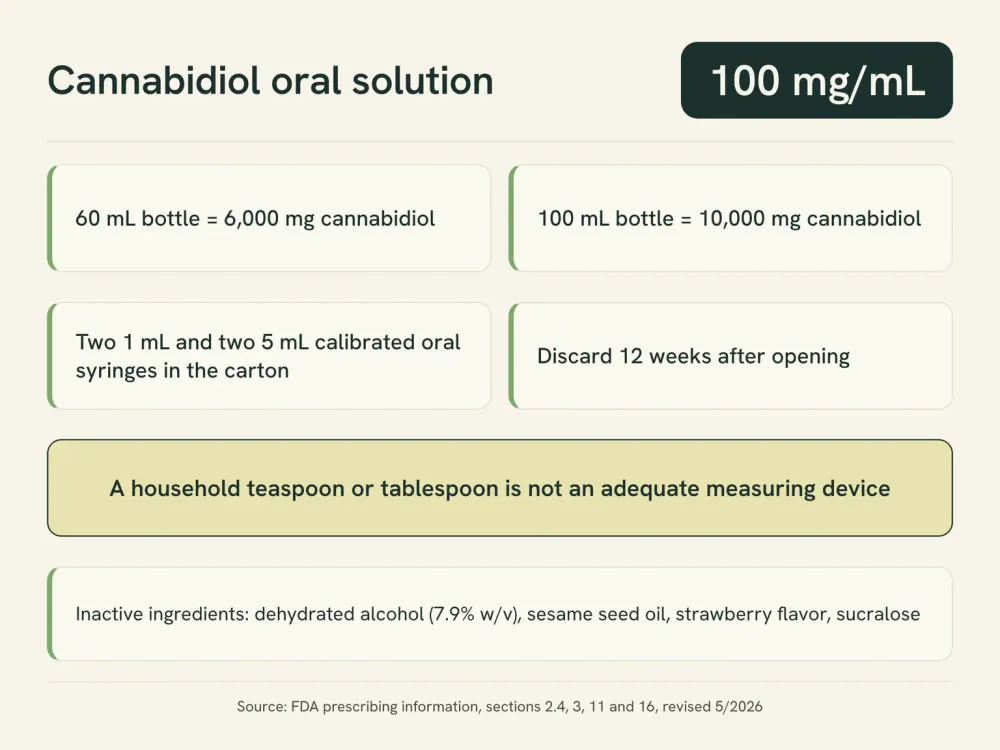
Start with the object rather than the reputation. The prescribing information, revised May 2026 and posted in full on DailyMed, the National Library of Medicine's label archive, describes it in section 3 as a cannabidiol oral solution: 100 mg/mL of a strawberry-flavored, clear, colorless to yellow solution. Its FDA dosage form is SOLUTION. It is not an oil and it is not a tincture. Section 11 lists what else is in the bottle, in the label's own words: dehydrated alcohol (7.9% w/v), sesame seed oil, strawberry flavor, and sucralose.
The packaging is part of the product, which is unusual and worth noticing. Section 16.1 supplies it in amber glass bottles of 60 mL or 100 mL. Multiply the concentration by the volume, which is our one-step arithmetic and not the label's, and a 60 mL bottle holds 6,000 mg of cannabidiol while a 100 mL bottle holds 10,000 mg. Two 1 mL and two 5 mL calibrated oral syringes come in the carton, and section 2.4 explains why in a sentence that tells you a great deal about how tightly the dose is specified: a household teaspoon or tablespoon is not an adequate measuring device. The bottle is discarded 12 weeks after it is first opened.
- Dosage form: cannabidiol oral solution, 100 mg/mL, strawberry-flavored, clear and colorless to yellow (section 3).
- Inactive ingredients: dehydrated alcohol at 7.9% w/v, sesame seed oil, strawberry flavor and sucralose (section 11).
- Containers: amber glass bottles of 60 mL or 100 mL, which works out to 6,000 mg or 10,000 mg of cannabidiol per bottle (section 16.1, plus one multiplication of ours).
- Measuring: two 1 mL and two 5 mL calibrated oral syringes in the carton, because the label states that a household teaspoon or tablespoon is not an adequate measuring device (sections 16.2 and 2.4).
- After opening: discard 12 weeks after the bottle is first opened (section 16.2).
- Indication: seizures associated with Lennox-Gastaut syndrome, Dravet syndrome or tuberous sclerosis complex, in patients 1 year of age and older (section 1).
Now the fact-check that no comparison page runs. At least four of the pages currently ranking for this question print a purity figure: more than 98% pure CBD isolate. We extracted the full prescribing information on August 20, 2026, about 101,000 characters of text, and searched it. The strings purif, 98, highly, isolate and grade return zero hits each. That is a claim about one document on one date, and it is worth stating precisely: the 98% figure is not on the label, and we found no primary document publishing a numeric purity specification for this product. FDA's own web material does describe the drug substance as a purified form of the drug substance CBD, so the concept exists in the agency's prose. The number does not, and neither does the word isolate, which carries a specific and quite different meaning in the retail market. If that word is what brought you here, our guide to full spectrum, broad spectrum and isolate is the right page.
The approval, read literally
The approval document is short and it rewards reading rather than paraphrasing. The FDA approval letter for NDA 210365 went to GW Research Ltd., and it carries the electronic signature of Robert Temple, Deputy Director of the Office of Drug Evaluation I at CDER, dated June 25, 2018. FDA's own Drugs@FDA database gives the same date for the original approval, which is the cross-check we ran rather than trusting one read of a scanned letter. What was approved that day was narrower than what the label says now: seizures associated with Lennox-Gastaut syndrome or Dravet syndrome, in patients two years of age and older. Tuberous sclerosis complex and the extension down to age one came later. Any page that tells you the 2018 approval covered three syndromes has fused two moments together.
Approval did not make the product sellable, and the letter says so. It records that the drug substance, cannabidiol, is currently controlled in Schedule I, and that the drug product remains a Schedule I controlled substance and may not be marketed until the DEA has made a final scheduling decision. DEA acted three months later: a final order published on September 28, 2018 placed FDA-approved drugs containing CBD derived from cannabis, with no more than 0.1 percent tetrahydrocannabinols, into Schedule V. Those are two documented endpoints. The third is simply what the label says today, in section 9.1, as a complete section: EPIDIOLEX is not a controlled substance. We are not going to narrate the step between the second endpoint and the third, because a Federal Register search of DEA rules mentioning cannabidiol on August 20, 2026 returned eight records and none of them is a removal order. Where we cannot cite the document, we do not tell the story.
The approval also arrived with a stack of homework. Seventeen numbered postmarketing requirements, PMR 3429-1 through 3429-17, were imposed under section 505(o) of the Federal Food, Drug, and Cosmetic Act, and the letter gives FDA's reason on its face: an analysis of spontaneous postmarketing adverse events reported under subsection 505(k)(1) of the FDCA will not be sufficient to assess a known serious risk of liver injury, to assess a signal of a serious risk of increased serum creatinine, or to identify a list of unexpected serious risks that the letter then spells out, among them adverse maternal, fetal or infant outcomes and the carcinogenic potential of cannabidiol and its 7-COOH metabolite. The list of studies includes a two-year mouse carcinogenicity study, a chronic liver injury assessment with five-year patient follow-up, a pregnancy outcomes study, and a thorough QT trial. It also includes eight separate drug-interaction trials, numbered 3429-9 through 3429-16, and the split between them is worth seeing: five ask what the drug does to something else (caffeine, a sensitive CYP2B6 substrate, a sensitive CYP2C9 substrate, a sensitive UGT1A9 substrate and a sensitive UGT2B7 substrate) and three ask what something else does to it (a strong CYP2C19 inhibitor, a strong CYP3A inhibitor, and rifampin). One of the eight, PMR 3429-9, became the caffeine study we took apart in what a CBD and caffeine interaction trial actually measured. We did not check which of the seventeen have been completed, so we make no claim about that. The point is what a serious approval looks like: a finding plus a list of things the agency still wanted measured.
Epidiolex vs CBD oil: six axes of difference, each with a document
Comparison pages tend to give you a two-column table of vibes: regulated versus unregulated, medical versus wellness. Here is the same table with a citation behind every cell. The sixth row is the one that surprises people, and it gets its own section further down, because it is the difference a reader can verify in about a minute.
| What differs | Epidiolex, the FDA-approved drug | A retail CBD oil |
|---|---|---|
| Identity | Cannabidiol oral solution, 100 mg/mL, in dehydrated alcohol at 7.9% w/v, sesame seed oil, strawberry flavor and sucralose (sections 3 and 11) | A consumer product, usually cannabidiol in a carrier oil, whose contents are documented by a per-batch certificate of analysis rather than by an approved application |
| Indication | Seizures associated with Lennox-Gastaut syndrome, Dravet syndrome or tuberous sclerosis complex, in patients 1 year of age and older (section 1) | No FDA-approved indication of any kind, for any condition, including the three named on the left |
| Dose | By body weight and titrated: 2.5 mg/kg twice daily up to a maximum recommended maintenance of 10 mg/kg twice daily for LGS and Dravet (section 2.2) | Chosen by the buyer from a milligram figure printed on the front of a bottle. This page publishes no consumer amount |
| Safety monitoring | Serum transaminases and total bilirubin before the first dose, at 1, 3 and 6 months, periodically thereafter, and within 1 month of any dose change (sections 2.1 and 5.1) | None built in. Nobody is measuring, so nobody has thresholds to act on |
| Interaction management | A documented clobazam interaction, characterized in dedicated studies, handled by a prescriber moving two doses at once (section 12.3) | The buyer's problem unless they raise it with a prescriber or a pharmacist |
| Access and payment | Dispensed by a pharmacy on a prescription and payable by a drug plan: Medicare Part D reported 43,893 claims in calendar 2024 | Bought at retail. Outside the definition of a covered Part D drug at 42 CFR 423.100, which requires a drug dispensed only upon a prescription |
The dose, in a volume you can actually picture
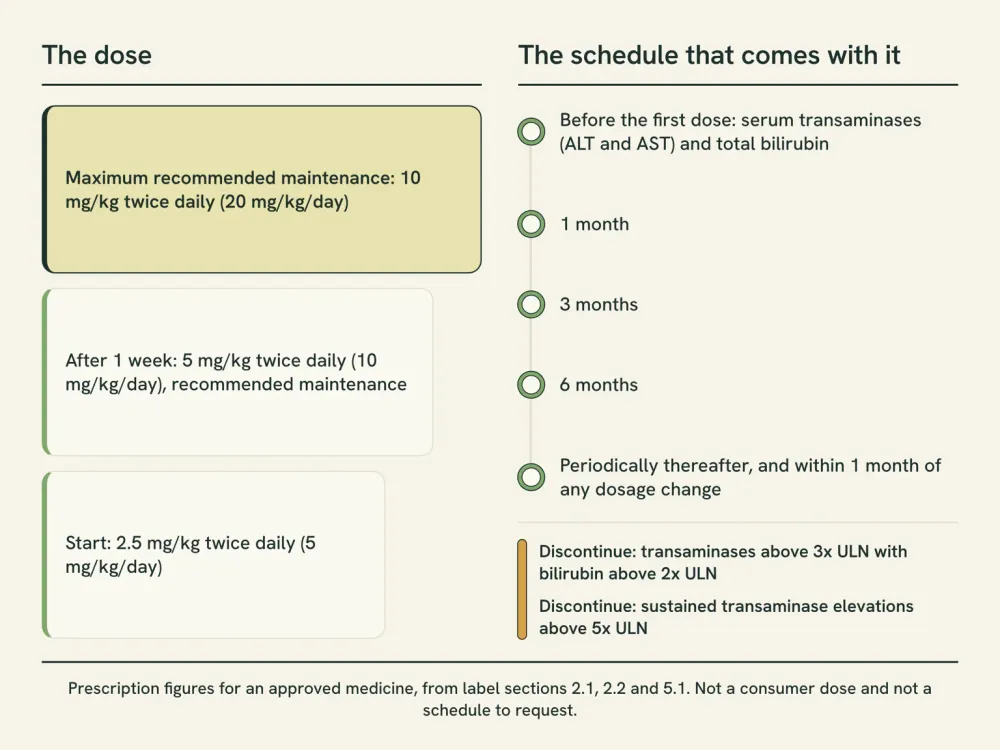
Section 2.2 sets the ladder for Lennox-Gastaut syndrome and Dravet syndrome. Start at 2.5 mg/kg twice daily, which is 5 mg/kg/day. After one week, increase to 5 mg/kg twice daily, 10 mg/kg/day, which is the recommended maintenance dosage. If further reduction in seizures is needed and the patient tolerates it, go up in weekly increments to a maximum recommended maintenance of 10 mg/kg twice daily, 20 mg/kg/day. The label is unusually blunt about the trade at the top of that ladder: 20 mg/kg/day gave somewhat greater reductions in seizure rates than the recommended maintenance dosage of 10 mg/kg/day, but with an increase in adverse reactions. For tuberous sclerosis complex, section 2.3 escalates in weekly 2.5 mg/kg twice-daily increments to 12.5 mg/kg twice daily, which is 25 mg/kg/day.
Every page we read on this SERP in August 2026 stops at mg/kg, which is not much use unless you happen to be holding a calculator and a body weight. The label does the conversion itself. In section 9.2, the abuse-potential section, it describes 750, 1500 and 4500 mg as equivalent respectively to 10, 20, and 60 mg/kg in a 75 kg adult. So the maximum recommended maintenance dosage for LGS and Dravet, 20 mg/kg/day, is 1,500 mg of cannabidiol per day in a 75 kg adult, and that figure is the label's own, not something we derived. Everything below it is one division.
| Step | Number | Where it comes from |
|---|---|---|
| Maximum recommended maintenance dosage, LGS and Dravet | 10 mg/kg twice daily, so 20 mg/kg/day | Prescribing information, section 2.2 |
| That dosage for a 75 kg adult | 1,500 mg per day | Prescribing information, section 9.2, the label's own arithmetic |
| As a volume of the approved 100 mg/mL solution | 15 mL per day | 1,500 divided by 100. Our division |
| How long a 100 mL bottle of the approved solution lasts at that rate | Under 7 days | 10,000 mg per bottle, divided by 1,500 |
| How long a 60 mL bottle of the approved solution lasts | 4 days | 6,000 mg per bottle, divided by 1,500 |
| Against a bottle at the 2017 median labeled retail strength of 15 mg/mL | 100 mL of liquid per day | 1,500 divided by 15 |
| Against the bottle on your own shelf | Days it would last = the milligram figure printed on the front, divided by 1,500. A bottle labeled 1,000 mg: about two thirds of one day | Your own arithmetic, one division |
The 15 mg/mL anchor in that table deserves its source, because it is what makes the scale legible. In a 2017 cross-sectional laboratory analysis of 84 CBD products from 31 companies sold online, published in JAMA, the median labeled concentration was 15.00 mg/mL, with a range from 1.33 to 800.00. Two honest limits on that: the sample is from 2017 and predates much of today's market, and the paper is better known for a different finding, that only 30.95% of those products were labeled within 10% of their measured content. Use the labeled median as a rough sense of what the middle of the market says about itself, then run the division on the bottle you actually own, which is the version that means something. Consumer amounts are not this page's territory at all; they live on our dosage page.
The dose never traveled alone: the monitoring came with it
This is the part every comparison page leaves out, and it is the reason the mg/kg figure does not transfer to anything you can buy. The dose is one half of the prescription. The other half is a laboratory schedule written into the same label. Section 2.1 instructs the prescriber to obtain serum transaminases (ALT and AST) and total bilirubin levels in all patients prior to starting treatment, and section 5.1 sets the repeats: at 1 month, 3 months, and 6 months after initiation of treatment, and periodically thereafter, and within 1 month following changes in EPIDIOLEX dosage. The dose and the schedule are not two facts about the drug. They are one object, and only one of them can be bought.
- 1Before the first dose: serum transaminases (ALT and AST) and total bilirubin, in all patients.
- 2One month after starting treatment.
- 3Three months after starting treatment.
- 4Six months after starting treatment.
- 5Periodically after that, and again within one month of any change in the dosage.
- 6Stop rule one: discontinue if transaminases exceed 3 times the upper limit of normal together with bilirubin above 2 times the upper limit of normal.
- 7Stop rule two: discontinue on sustained transaminase elevations above 5 times the upper limit of normal.
Nobody supervising a retail tincture has those two stop rules, because nobody is measuring the values they apply to. That is the difference between a monitored exposure and an unmonitored one, and it is not a small one. The numbers behind the rules are on the label: in the controlled LGS and Dravet studies, at 10 and 20 mg/kg/day, ALT above 3 times the upper limit of normal occurred in 13% of patients on the drug against 1% on placebo, and in the TSC study at 25 mg/kg/day it was 12%. Fewer than 1% had ALT or AST above 20 times the upper limit of normal.
The signal tracks the companion drugs, and the four subgroups in section 5.1 have to be read together or not at all. ALT above 3 times the upper limit of normal appeared in 30% of LGS and Dravet patients taking both valproate and clobazam, 21% of those on valproate without clobazam, 4% of those on clobazam without valproate, and 3% of those on neither. The last figure is what stops this becoming a scare story; the first is what stops it becoming a reassurance. Almost every patient in those trials was taking other antiepileptic drugs, which is the population caveat that matters most here. We are keeping this to three sentences on purpose, because the mechanism, the mouse study everybody quotes and the 2025 randomized data in healthy adults are all covered on what those transaminase numbers actually mean.
The two interactions the trials were built around
Clobazam is the big one, and the label characterizes it precisely enough that it is worth quoting rather than summarizing. Section 12.3 reports that coadministration increased the clobazam active metabolite, N-desmethylclobazam, C max and AUC by approximately 3-fold, with no effect on clobazam levels. Read that twice, because it is routinely mis-stated on the way out the door: what roughly triples is exposure to the metabolite, not to clobazam itself. The measurements came from dedicated interaction studies, in healthy subjects at 750 mg twice daily and in patients at 20 mg/kg/day.
The consequence shows up in the adverse-reaction tables, and it shows up as a split. Somnolence and sedation were reported in 32% of patients on the drug against 11% on placebo in the LGS and Dravet studies. Within that, the rate was 46% among patients also taking clobazam and 16% among those who were not, so the 46% figure belongs to clobazam co-administration and should never be quoted on its own. Pneumonia followed the same pattern, and the label prints counts rather than bare rates: with concomitant clobazam, 7 of 41 patients (17%) at 10 mg/kg/day and 13 of 125 (10%) at 20 mg/kg/day, against 0% and 4 of 113 (4%) without it, with the placebo arms at 1 of 123 (1%) and 1 of 104 (1%). A managed interaction means a prescriber who knows both drugs is watching one patient while both doses move. That is a different object from two things sitting in the same medicine cabinet, which is the interaction question in general.
Is CBD covered by insurance?
Almost always no, and the reason is a definition rather than a policy preference. 42 CFR 423.100 is the regulation that defines what a Medicare drug plan is allowed to pay for, and one clause settles the whole question in about fifteen seconds of reading: a Part D drug is, among other things, a drug that may be dispensed only upon a prescription and that is described in the cross-referenced provisions of the Social Security Act. A retail CBD product is not dispensed only upon a prescription, so it never reaches the rest of the test. Every page we read on the insurance SERP in August 2026 asserts the conclusion; not one of them names the regulation. Note the scope: that is a statement about a category, not about your plan. Whether a particular plan covers a particular drug for a particular person is always a question for the plan.
The other half is measurable, and the government publishes it. Filtering the CMS Medicare Part D Spending by Drug dataset for the brand returns, for calendar 2024, $207,443,287.44 of total spending across 43,893 claims for 4,517 beneficiaries, which is $4,726.11 of average spending per claim and $45,925.01 per beneficiary. The companion CMS Medicaid Spending by Drug dataset reports $519,204,482.78 across 150,530 claims in the same year, $3,449.18 per claim. Two caveats travel with those figures. They are two different programs with different populations and different pricing, so do not average them; adding the two totals to roughly $727 million is our arithmetic and not a published number. And 4,517 Part D beneficiaries is a small and atypical population for a drug whose named syndromes usually begin in childhood.
The tax code lands in the same place. IRS Publication 502, the guidance on the itemized medical expense deduction, says you cannot include in medical expenses the cost of nutritional supplements, vitamins, herbal supplements, natural medicines and similar items unless they are recommended by a medical practitioner as treatment for a specific medical condition diagnosed by a physician. Separately it says that except for insulin, you cannot include amounts you pay for a drug that is not prescribed. Health savings and flexible spending accounts follow related but not identical rules, and the CARES Act added a distinct over-the-counter medicine allowance to those accounts, so the deduction answer and the account answer are not automatically the same and the account question belongs to your plan administrator. None of this is tax advice. One comparison we are deliberately not running here: dollars per milligram. Payer spending per claim and a retail price per bottle are not the same kind of number, and setting them beside each other manufactures a shopping comparison out of two unrelated systems. What a milligram actually costs at retail is a separate page with a separate method.
Pharmaceutical grade CBD is not a term the FDA defines
It is a phrase that appears on packaging and on comparison pages, and it borrows its authority from a rulebook, so check it against the rulebook. On August 20, 2026 we ran a full-text search of the Electronic Code of Federal Regulations for the exact phrase pharmaceutical grade. In Title 21, the title that holds FDA's food and drug regulations, it returns zero results. Across the entire CFR it returns 14, and all 14 sit in Title 40, the EPA's title, where the phrase describes the purity of water and refrigerants inside test methods. As a control, the same search for cannabidiol restricted to Title 21 returns 6, so the endpoint is working and the zero is a real zero. Keep the claim scoped to what was tested: the phrase has no definition in FDA's drug regulations as of that date. Compendial quality standards do exist under the Federal Food, Drug, and Cosmetic Act. Pharmaceutical grade is not one of them. It is marketing vocabulary, and that is true no matter who prints it.
What exists in place of the phrase is an approved application with a reviewed manufacturing process attached to it. FDA puts the difference in its own words on the agency's page about cannabis and cannabidiol regulation: because of the adequate and well-controlled clinical studies that supported this approval, and the assurance of manufacturing quality standards, prescribers can have confidence in the drug's uniform strength and consistent delivery that support appropriate dosing. That sentence is about one approved drug and it does not extend one inch past it. On the consumer side the nearest available instrument is a per-batch certificate of analysis from an independent laboratory, which tells you what one batch measured and nothing at all about the next batch unless the next batch is also tested. How to read one is a genuinely useful skill, and it is a different object from an approved application, not a smaller version of it.
Why approving one drug is not evidence about the shelf
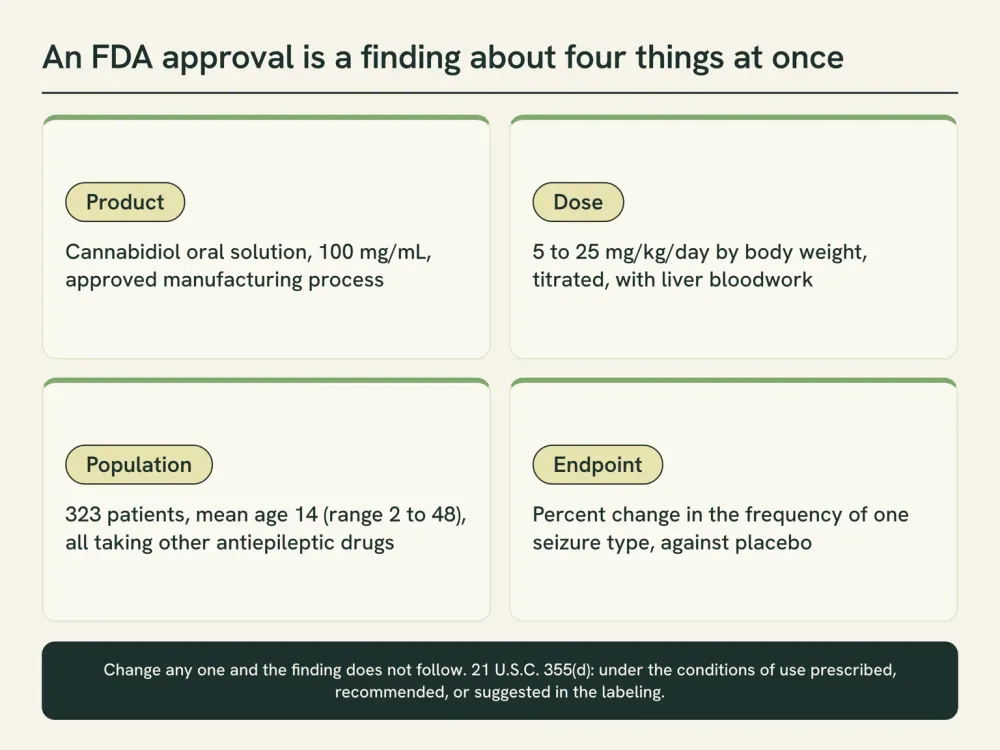
This is the paragraph the rest of our library is going to point at, so it is worth being exact. An FDA approval is not a verdict on a molecule. It is a finding about a labeled condition of use, and the statute says so in as many words. Section 505(d) of the Federal Food, Drug, and Cosmetic Act, codified at 21 U.S.C. 355(d), defines substantial evidence as evidence on the basis of which it could fairly and responsibly be concluded by qualified experts that the drug will have the effect it purports or is represented to have, and then it adds the clause that does all the work.
“...under the conditions of use prescribed, recommended, or suggested in the labeling or proposed labeling thereof.”
Four variables live inside conditions of use, and changing any one of them breaks the inference. This is why an approval is a narrow instrument, and why a vendor sentence of the form the FDA approved CBD is not false so much as it is missing everything that matters.
- The product. A cannabidiol oral solution at 100 mg/mL made to an approved manufacturing process, not a category of things that happen to contain cannabidiol.
- The dose. 5 to 25 mg/kg/day depending on the syndrome, set by body weight, reached by titration, and carrying a liver-bloodwork schedule with it.
- The population. In the LGS and Dravet controlled studies, 323 patients received the drug: about 46% female, 83% Caucasian, mean age 14 years with a range of 2 to 48, and all of them were taking other antiepileptic drugs.
- The endpoint. Percent change in the frequency of one specific seizure type over a defined treatment period, measured against placebo, and not a general sense of feeling better.
It is also worth knowing how large the measured effects were, because they get described as if they were dramatic. In the pivotal Dravet trial, 120 children and young adults randomized to cannabidiol oral solution at 20 mg/kg/day or placebo on top of standard treatment, published in the New England Journal of Medicine in 2017, median monthly convulsive seizures fell from 12.4 to 5.9 on cannabidiol and from 14.9 to 14.1 on placebo, an adjusted median difference of -22.8 percentage points (95% CI -41.1 to -5.4), P=0.01. In the same trial, the proportion of patients whose seizure frequency was at least halved was 43% against 27%, and that difference was not statistically significant (odds ratio 2.00, 95% CI 0.93 to 4.30, P=0.08). Five percent of the cannabidiol group became seizure-free against none on placebo, a difference that also did not reach significance (P=0.08). The trial was funded by GW Pharmaceuticals, and it tested add-on therapy on top of existing antiepileptics, never monotherapy.
The Lennox-Gastaut trial published in 2018 randomized 225 patients across 30 centers to two doses: median reduction in drop-seizure frequency was 41.9% at 20 mg/kg/day, 37.2% at 10 mg/kg/day and 17.2% on placebo, and fourteen cannabidiol patients (9%) had elevated liver aminotransferases. The tuberous sclerosis complex trial published in JAMA Neurology in 2021 randomized 224 patients at 46 sites, median age 11.4 years, and reported seizure reductions of 48.6% at 25 mg/kg/day, 47.5% at 50 mg/kg/day and 26.5% on placebo, with a reduction versus placebo of 30.1% (95% CI 13.9 to 43.3), P<.001, for the 25 mg/kg arm; 28 cannabidiol patients (18.9%) had elevated liver transaminases. Both were funded by the manufacturer. Two of these three trials randomized more than one dose, and they answered the more-is-better question differently. In the Lennox-Gastaut trial the higher dose was slightly ahead (41.9% at 20 mg/kg/day against 37.2% at 10 mg/kg/day). In the TSC trial, doubling the daily dose to 50 mg/kg/day did not beat 25 mg/kg/day, on either measure: 47.5% against 48.6% from baseline, and 28.5% against 30.1% versus placebo. The label draws the same trade in section 2.2 for LGS and Dravet, where 20 mg/kg/day gave somewhat greater reductions in seizure rates than 10 mg/kg/day but with an increase in adverse reactions.
Look at the placebo arms too. The label's own summary tables in section 14 put them at 22% and 17% in the two LGS studies, 13% in Dravet and 20% in TSC. Seizure counts fall on their own, by 13% to 22% depending on the trial, in people taking nothing new. That is precisely why these trials had to exist, and it is why people say it helps is not the same category of statement as a trial result. The label's medians and the published papers' medians are computed slightly differently, so we have kept every number attached to the document it came from rather than fusing them. One more piece of candor from the same label: section 12.1 says the precise mechanisms by which EPIDIOLEX exerts its anticonvulsant effect in humans are unknown, and that cannabidiol does not appear to exert its anticonvulsant effects through interaction with cannabinoid receptors. An approval is a finding about effect, not about mechanism. The wider question of what human evidence supports for CBD generally is the subject of our evidence hub.
What the two genuinely share, and the irony inside it
Honesty runs in both directions, so here is the other side. Three things really are shared, and not one of them is therapeutic. First, the molecule: cannabidiol is cannabidiol whether it is in an approved oral solution or in a carrier oil, and this does not mean the two products behave alike, because dose, formulation and supervision are not properties of a molecule. Second, an overlapping adverse-reaction profile at high exposure: somnolence, diarrhea, decreased appetite and transaminase elevations are cannabidiol effects rather than brand effects, and this does not mean a retail product produces them at the amounts people actually take, because the trial figures come from milligram loads most buyers never approach. Third, the same cytochrome-mediated interaction concerns, and this does not mean those interactions have been characterized at consumer exposures, because for the most part they have not been. Sharing a hazard is not the same as sharing a benefit, and only one of those two transfers automatically.
Then the part almost nobody notices. Vendors cite the approval as proof that CBD works. That same approval, together with the public clinical investigations that preceded it, is what FDA points to when it excludes CBD from the dietary supplement category entirely. On the same agency page quoted earlier, FDA states that based on available evidence, it has concluded that THC and CBD products are excluded from the dietary supplement definition under section 201(ff)(3)(B) of the FD&C Act. That exclusion clause is codified at 21 U.S.C. 321(ff)(3)(B), and it turns on an article having been approved as a new drug or having been the subject of substantial clinical investigations that were made public. So the single legal event used as a credibility transfer is the event that keeps the retail category out of the supplement definition. For completeness, and dated to our read on August 20, 2026: FDA states on its page about cannabis research and the drug approval process that it has approved one cannabis-derived drug product and three synthetic cannabis-related drug products, and has not approved any other cannabis, cannabis-derived, or cannabidiol (CBD) products currently available on the market. That page is stale on the indication itself, which is why every indication statement above comes from the label. The agency's broader position on the category, including warning letters and the supplement question, is covered here.
If you or someone you care for already takes the prescription
There is exactly one thing to do with everything above, and it is short. Do not substitute, do not adjust, and do not stop a prescribed medicine on the strength of a comparison article, this one included. Those decisions belong to the prescriber, who has the body weight, the bloodwork, the other prescriptions and the seizure diary in front of them. If you take the approved medicine, or you care for someone who does, and you are curious about a consumer product, the useful move is to say so to the prescribing neurologist and to the pharmacist before anything changes. There is no version of this page that ends with a different instruction, because there is no version of the evidence that supports one.
They share an active molecule and very little else. Epidiolex is an FDA-approved cannabidiol oral solution at 100 mg/mL whose inactive ingredients are dehydrated alcohol at 7.9% w/v, sesame seed oil, strawberry flavor and sucralose. It is dispensed on prescription, in amber glass, with two 1 mL and two 5 mL calibrated oral syringes in the carton, and its approved indication is seizures associated with Lennox-Gastaut syndrome, Dravet syndrome or tuberous sclerosis complex in patients 1 year of age and older. A retail CBD oil is a consumer product, typically cannabidiol in a carrier oil, documented by a per-batch certificate of analysis rather than by an approved application, and it has no approved indication for anything.
A prescriber can write for Epidiolex, the approved cannabidiol medicine, for the three named seizure syndromes in patients one year of age and older. There is no approved prescription version of a consumer CBD tincture, and no approved consumer indication for CBD at all. FDA states that it has approved one cannabis-derived drug product and three synthetic cannabis-related drug products, and that it has not approved any other cannabis, cannabis-derived, or cannabidiol products currently available on the market. Nothing on this page is guidance about seeking a prescription. That is a conversation between a patient and a clinician about a diagnosed condition, and it is not something an article should shape.
The approved drug can be. In calendar 2024, Medicare Part D reported $207,443,287.44 of spending on it across 43,893 claims for 4,517 beneficiaries, and Medicaid reported $519,204,482.78 across 150,530 claims. A retail CBD product is a different matter, and the obstacle is definitional rather than discretionary: 42 CFR 423.100 defines a Part D drug as including one that may be dispensed only upon a prescription, and a product you can buy without one never meets that test. So the general answer is no. Whether a specific plan covers a specific drug for a specific person is always a question for the plan, not for a web page.
Treat this as a question for your plan administrator, and note that none of it is tax advice. IRS Publication 502, which governs the itemized medical expense deduction, says you cannot include in medical expenses the cost of nutritional supplements, vitamins, herbal supplements, natural medicines and similar items unless they are recommended by a medical practitioner as treatment for a specific medical condition diagnosed by a physician, and says separately that except for insulin you cannot include amounts you pay for a drug that is not prescribed. Health savings and flexible spending accounts follow related rules with their own over-the-counter medicine allowance added by the CARES Act, so the deduction answer and the account answer are not automatically the same.
Section 9.1 of its current prescribing information consists of one sentence: EPIDIOLEX is not a controlled substance. That was not always true. The 2018 FDA approval letter records that the drug substance was controlled in Schedule I and that the product could not be marketed until DEA made a final scheduling decision, and DEA then placed FDA-approved drugs containing cannabis-derived CBD with no more than 0.1 percent tetrahydrocannabinols into Schedule V in a final order published on September 28, 2018. Those are the two endpoints we can document. We did not find the record that produced today's status, so we do not describe it.
Nothing that FDA defines. A full-text search of the Electronic Code of Federal Regulations on August 20, 2026 returned zero results for the exact phrase pharmaceutical grade in Title 21, the title containing FDA's drug regulations, and 14 results across the whole CFR, all of them in the EPA's Title 40 describing water and refrigerant purity inside test methods. A control search for cannabidiol in Title 21 returned 6, so the zero is a real zero rather than a broken query. What exists in place of the phrase is an approved application with a reviewed manufacturing process behind it, which FDA describes as giving prescribers confidence in the drug's uniform strength and consistent delivery that support appropriate dosing. That description belongs to the approved drug it was written about and to nothing else.
It means one product, at a labeled dose, in a defined population, produced a measured effect on a defined endpoint. The statute is explicit that substantial evidence is evidence that a drug will have the effect it is represented to have under the conditions of use prescribed, recommended, or suggested in its labeling. Change the product, the dose, the population or the endpoint and the finding does not carry across. The trials behind this approval enrolled patients with three rare seizure syndromes who were all already taking other antiepileptic drugs, at 5 to 25 mg/kg/day set by body weight, with liver bloodwork before and during treatment. None of that describes anyone buying a bottle online, and the label itself says the mechanism is unknown.
Writing about hemp, wellness and the small rituals that keep us balanced.