Smoking Weed for the First Time: What a Controlled Study Says to Expect
Every first-time guide says go slow, and none says what slow means. Here is what the closest controlled study measured, why vaping hit harder than smoking, why some people feel nothing, and who should not start at all.
Smoking weed for the first time usually goes one of three ways: a clear but manageable high that starts within minutes and fades over a few hours, almost nothing at all, or far more than you wanted. What decides which one you get is mostly how much THC actually reaches you. Every first-time guide tells you to respect that variable. Almost none says what it means in numbers. Here is what a controlled study measured, and what it cannot tell you.
This guide is for adults 21 and older in states where cannabis is legal, and it is not encouragement to start. It reports what controlled studies measured in their own participants. It does not give you a starting amount, because no source we found gives one, and product labels list THC per serving.
First time smoking weed: what it usually feels like
The first effects people notice are physical. In the study described in the next section, adults rated their symptoms on 0 to 100 scales for hours after inhaling THC, and the researchers reported how far each rating rose above where it started. Throat irritation and coughing peaked in the first 10 minutes, while blood THC and heart rate peaked within 30 minutes. Dry mouth was the side effect that rose most, by 61.8 to 67.1 points after the vaporized doses. Hunger peaked around three hours in for every active dose, and sleepiness peaked somewhere between one and four hours. The reasons behind that cotton-mouth feeling are covered in our explainer on why weed makes your mouth dry.
The mental side varies far more from person to person. Some people get giggly, some get quiet or emotional, and some get uneasy. Our guides to why weed can make you laugh and whether weed makes you more emotional go deeper into those reactions. Part of that variation appears to be inherited. In a study of more than 8,000 male twins from the Vietnam Era Twin Registry, about a quarter of the variation in whether cannabis felt pleasant or unpleasant traced to genes, and the family environment the twins grew up in had no detectable influence. Those men had used cannabis more than five times and were recalling their reactions, so it is not a study of first use specifically. It does fit what people report: two people can take the same amount and have very different experiences.
The controlled study that comes closest to a first time
We found no controlled study that gave THC to people who had never used cannabis. The nearest data come from people who had used it before, but not for a long time. In a 2018 Johns Hopkins trial published in JAMA Network Open, 17 healthy adults (9 men and 8 women, average age 27) inhaled set amounts of THC under double-blind conditions: 0, 10 and 25 mg, each smoked in a pipe and each vaporized, in separate sessions. None had used cannabis in the previous month, and on average their last use had been 398 days earlier. They were not first-timers, and every number below should be read with that in mind. The study was funded by the Substance Abuse and Mental Health Services Administration (SAMHSA), with co-authors from SAMHSA's Division of Workplace Programs and RTI International.
| Rating (0-100) | 10 mg smoked | 10 mg vaporized | 25 mg smoked | 25 mg vaporized |
|---|---|---|---|---|
| Drug effect | 45.7 | 69.5 | 66.4 | 77.5 |
| Anxious or nervous | 3.1 | -3.6 (below baseline) | 21.4 | 25.5 |
| Heart racing | 4.2 | 16.4 | 17.9 | 24.2 |
Read across the rows and the pattern is the point. At 10 mg, people clearly felt something, and the authors describe "modest impairment of cognitive functioning". At 25 mg, they report an "increased incidence of adverse effects, and pronounced impairment of cognitive and psychomotor ability", meaning thinking and coordination tests got noticeably worse. Feeling anxious barely moved at the lower dose and jumped at the higher one. Paranoia rose most at the higher vaporized dose, by 17.4 points against 10.0 when the same dose was smoked. Three of the 17 had a rough session at the higher dose: two vomited (one after smoking, one after vaping) and one hallucinated after vaping. None of those events were reported at the lower dose.
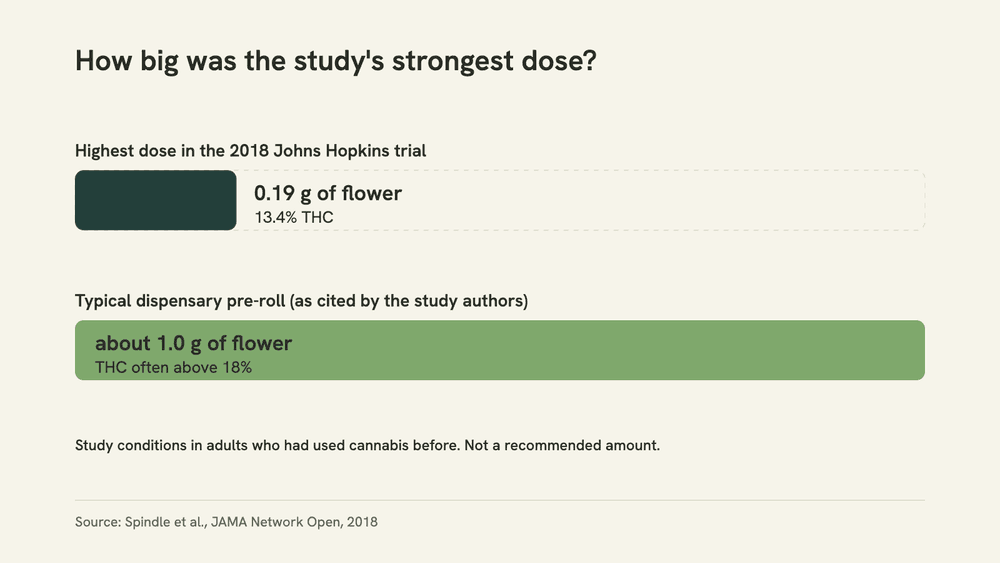
Two details about those doses matter more than the milligrams. First, each dose was a whole, weighed bowl, finished within about 10 minutes from a pipe or across three vaporizer balloons, not a single puff. Second, the strongest dose was small by retail standards: 0.19 grams of flower at 13.4% THC. Citing a 2018 survey of retail products, the authors point out that dispensary pre-rolls "commonly contain roughly 1.0 g of cannabis with THC concentrations often exceeding 18%", which is about five times the plant material, at a higher strength. In their words, people who start using cannabis "can readily access products that contain far greater amounts of cannabis, with higher THC concentrations, than administered in this study". These are study conditions, not a recommended amount. Product labels list THC per serving, and this page does not tell you how much to use.
Joint, pipe, vape or edible: why the format changes a first time
Many people assume a vaporizer is the gentle option because there is less smoke. In the Johns Hopkins trial it was the opposite. At the same dose, vaporized cannabis "resulted in qualitatively stronger drug effects for most pharmacodynamic outcomes and higher peak concentrations of THC in blood". At 25 mg, peak blood THC averaged 14.4 ng/mL vaporized against 10.2 ng/mL smoked, about 40% higher by our arithmetic. Less smoke is not less THC, which is also the point of our comparison of dry herb vaporizers and smoking. One limit: the study used a single dried-flower vaporizer at a fixed temperature, not a cartridge or a disposable vape pen, so those were not tested. The smoked arm used a pipe, not a joint or a blunt; how those two differ is covered in our breakdown of blunts versus joints.
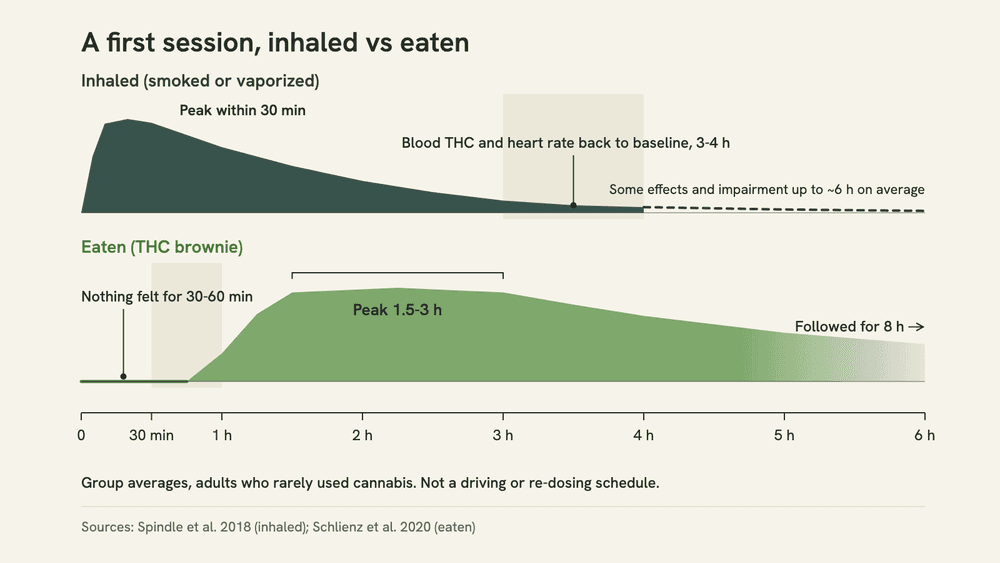
Edibles run on a different clock. In a placebo-controlled study of 17 adults who rarely used cannabis, run by the same Johns Hopkins group, nothing was felt for 30 to 60 minutes after eating a THC brownie, and effects peaked at 1.5 to 3 hours. That delay is the trap. The Lower-Risk Cannabis Use Guidelines, written by addiction researchers and published in the American Journal of Public Health in 2017, note that edibles spare the lungs, but "the delayed onset of psychoactive effect may result in the use of larger than intended doses".
Hospital data point the same way. In a chart review at one Colorado hospital covering 2012 to 2016, visits blamed on edible cannabis were more often for intoxication (48% vs 28%), acute psychiatric symptoms (18% vs 11%) and heart symptoms (8% vs 3%) than visits blamed on smoked or vaped cannabis. From 2014 to 2016, edibles accounted for 10.7% of cannabis-attributable visits, against an estimated 0.32% of THC sold. People who came in after edibles were also far more likely to live outside Colorado (40.8% vs 6.6%), and the authors suggest that naive users or tourists are at greater risk. It is one hospital, looking back at charts, with little dose data. If you are weighing an edible instead, our guides to what a 10 mg edible does and why edibles take so long to kick in cover the milligrams and the delay. THC drinks and syrups are swallowed too, and our THC syrup explainer covers how quickly they act.
| Format | When effects start | Peak | What the evidence adds |
|---|---|---|---|
| Joint or pipe (smoked flower) | Within minutes | Blood THC and heart rate within 30 min | Effects rose sharply from 10 mg to 25 mg (Spindle 2018) |
| Dried-flower vaporizer | Within minutes | Within 30 min | Stronger than smoking at the same dose; peak blood THC 14.4 vs 10.2 ng/mL at 25 mg |
| Edible (eaten) | 30-60 min | 1.5-3 h | Over-represented in one hospital's cannabis emergency visits (Monte 2019) |
| Cartridge or disposable vape pen | Not tested in these studies | Not tested in these studies | The trial used dried flower, so its results may not carry over |
A first-session timeline, inhaled vs eaten
Put the two Johns Hopkins studies side by side and the shape of a session looks like this. Every cell comes from those controlled studies, both in people who rarely used cannabis, and every figure is a group average.
| Time after use | Inhaled (smoked or vaporized) | Eaten (THC brownie) |
|---|---|---|
| First 10 min | Coughing and throat irritation at their peak; effects starting | Nothing felt yet |
| 10-30 min | Drug effect, blood THC and heart rate reach their peak | Nothing felt yet |
| 30-60 min | Past the peak | Effects begin to appear |
| 1.5-3 h | Hunger peaks around 3 h; sleepiness peaks between 1 and 4 h | Peak effects |
| 3-4 h | Blood THC and heart rate back to baseline | Past the peak; participants were followed for 8 h |
| Up to about 6 h | Some effects and measured impairment still present on average | Participants were followed for 8 h |
Two notes on reading it. The 6-hour tail is a study average, not a promise that you are clear after 6 hours, and it is not a point after which driving is safe. And if you feel nothing 20 minutes after an edible, the timeline says that is expected, not a sign it failed. The full duration curves, by route, are in our guide to how long a weed high lasts.
Why didn't I get high the first time?
Feeling nothing is a common first-time story, and the explanations that hold up are less mysterious than the folklore. The first is simply how much THC got in. In a 1992 lab study of seven men who smoked set numbers of puffs, blood THC tracked how many puffs people took as closely as it tracked the strength of the cigarette, and combinations that produced similar blood levels produced similar effects. Someone who coughs most of it out, or takes in very little, may get very little. The study was small, in regular users, with low-potency 1990s cannabis, so treat it as a mechanism, not a measurement of you.
- Delivered dose: the THC in the product is not the THC that reaches your blood. How much is actually inhaled changes the dose.
- Expectation: what you expect shapes what you feel, in both directions, and some effect is reported even on placebo.
- Recognition: low-dose effects can be subtle enough to miss, and people differ in how strongly they react.
Expectation is measurable. In a 2009 pilot study of 20 young cannabis smokers, being told the joint contained THC changed how strong people rated it, whatever was actually in it. The Johns Hopkins trial shows the flip side: the placebo session, with no THC at all, still raised the "drug effect" rating by 11.2 points when smoked (2.1 when vaporized). So a first session can feel like nothing because you did not know what to look for, or feel like something that was not the THC. A 1953 sociology paper by Howard Becker, "Becoming a Marihuana User" (American Journal of Sociology), argued from interviews, not lab data, that new users often have to learn to recognize the effects.
What we did not find is evidence for the popular claim that your body, or your endocannabinoid system, has to be "primed" before THC works, sometimes called reverse tolerance. We found no human study showing that. If a first session felt like nothing, the likely explanations are the ordinary ones above.
One folk fix adds more harm than high. In three small controlled studies, including a 1995 study that varied puff volume and breath-holding, holding the smoke longer did not make people feel more high. One found more THC in the blood; another found more carbon monoxide absorbed. What moved the high was how much smoke went in. The lower-risk guidelines advise against "deep inhalation", breath-holding and the Valsalva maneuver (straining against a closed throat), because these practices "disproportionately increase the intake of toxic material into the pulmonary system". They grade that evidence as limited, but what those habits add is mostly smoke.
Smoking weed for the first time: normal effects vs warning signs
In the Johns Hopkins trial, most of what people reported at the lower dose was uncomfortable rather than dangerous, and blood THC and heart rate were back to baseline within 3 to 4 hours. Coughing comes first and is covered in why weed makes you cough. Red eyes are common, as our explainer on why weed turns your eyes red describes. A faster heartbeat is expected: heart rate peaked within 30 minutes in the Johns Hopkins trial, and our guide to whether weed raises blood pressure covers the cardiovascular side. Some uneasiness is common, more so at higher doses, and why weed can make you paranoid explains what is known about it. The common, expected effects:
- Dry mouth, the side effect that rose most in the trial
- Coughing or throat irritation in the first minutes
- Red eyes
- A faster heartbeat that settles as the high fades
- Hunger, peaking around three hours in
- Sleepiness over the first few hours
- Mild unease that eases as the effects wear off
These signs mean a session has gone past ordinary. Each showed up in the controlled trial at the higher dose or in the Colorado emergency data, and our guide to greening out covers what to do when it is too much:
- A racing heart that does not settle
- Panic or fear that does not ease
- Vomiting that keeps happening
- Hallucinations, confusion or unusual behavior
The last two are where a bad session can become an emergency. The NIH's MedlinePlus list of warning signs of a medical emergency includes severe or persistent vomiting, a change in mental status such as confusion or difficulty waking, breathing problems, fainting or loss of consciousness, and chest pain or discomfort lasting two minutes or more. Those go to 911, not to a hotline.
This is not a reason for panic, and it is also not a promise that nothing can go wrong. In the Colorado chart review, the authors reported that severe adverse cardiovascular events, "including myocardial infarction and ventricular dysrhythmia, occurred in both groups", meaning heart attacks and dangerous heart rhythms were seen after edibles and after smoked or vaped cannabis. The review counts visits, not users, so it cannot tell you how likely that is for any one person. It does rule out the line that weed is harmless.
Who should not start
You should not start if any of these apply to you. The sources follow the list.
- You are under 21, or under the legal age where you live
- You are pregnant or breastfeeding
- You have a predisposition to psychosis, or a parent, sibling or child has had psychosis or a substance use disorder
- You have heart disease, such as angina
- You take prescription medicines and have not checked with a pharmacist or doctor
- You plan to drive afterward
On age, the lower-risk guidelines advise avoiding use "definitively before the age of 16 years", and their 2022 update recommends delaying use until after adolescence; adult-use states set the legal age at 21. On family history, the guidelines say that people with a "predisposition for, or a first-degree family history of, psychosis and substance use disorders, as well as pregnant women" should refrain from using cannabis, and they state that this rests in part on precautionary principles. A first-degree relative is a parent, sibling or child. The wider link between cannabis and psychosis is an association, strongest for heavy use: across 11 sites in Europe and Brazil, a case-control study of 901 people with a first episode of psychosis found they were more likely than 1,237 controls to have used daily, especially high-potency cannabis. That is about heavy use, not a prediction for any one person.
On pregnancy, the FDA is direct: "FDA strongly advises against the use of cannabidiol (CBD), tetrahydrocannabinol (THC), and marijuana in any form during pregnancy or while breastfeeding." The FDA's consumer update on cannabis in pregnancy lays out its reasons, and our page on CBD, pregnancy and breastfeeding covers the details. On the heart, the American Heart Association's 2020 scientific statement on cannabis says "many of the concerning health implications of cannabis include cardiovascular diseases, although they may be mediated by mechanisms of delivery". The direct evidence is old and small but pointed: in a 1975 study of patients with angina, ten people who already had the condition reached chest pain on an exercise test in half the usual time after smoking one cannabis cigarette. Add heart rate peaking within 30 minutes of inhaling, and a heart condition is a reason to talk to your cardiologist, not to experiment.
On medicines, THC can matter for some prescriptions. Our guides to Zoloft and weed and gabapentin and weed show what those questions look like, and a pharmacist can check yours.
One last, honest note. A first time that goes well is not evidence of low risk. In a New Zealand birth cohort study, teenagers who tried cannabis before 16 and liked it most the first few times had much higher odds of dependence by age 21, while negative early reactions were unrelated to later dependence. It is about teenagers, the uncertainty around the estimate is wide, and it shows an association, not a cause. Still, it is a reminder that how the first time feels does not tell you how later use will go.
Driving, alcohol and the next morning
Do not drive after using cannabis. The lower-risk guidelines say to "abstain from cannabis-impaired driving", and the Johns Hopkins trial measured thinking and coordination problems that outlasted the rise in blood THC. How long impairment lasts, and why a breath or blood number does not settle it, are covered in CBD, THC and the rules for driving and whether a weed breathalyzer can work. Keep alcohol out of a first session too: the guidelines say using both multiplies impairment and driving risk and "categorically should be avoided". Our explainer on being crossfaded covers what is known about that combination. For the night itself, see whether it is bad to sleep high.
What this evidence cannot tell you
Be clear about the limits. The central trial had 17 people, all of whom had used cannabis before, in a lab, with one type of flower at 13.4% THC and one vaporizer at a fixed temperature. Retail products are often stronger, as the authors themselves note. The edible timing comes from 17 people eating lab brownies. The hospital data come from one Colorado emergency department, counting visits rather than risk per user, with little dose information. The twin study was men recalling their reactions, and the puff and breath-holding studies used small groups of regular users decades ago. We found no controlled study of people who had never used cannabis at all. And no source we found gives a personal first amount, which is why this page does not either.
Frequently asked questions
Yes, it is a common experience, and it usually has ordinary explanations. Less THC may have reached you than you think: in lab studies, blood THC tracked how much smoke went in as closely as it tracked the strength of the product. Expectation matters too, and low-dose effects can be subtle enough to miss. We found no human study showing the body has to be primed first. Feeling nothing is not a reason to take a lot more at once, because the gap between too little and too much can be narrow.
Not in the controlled data. In a 2018 Johns Hopkins trial of 17 adults who had not used cannabis for about a year on average, the same dose produced stronger effects and higher peak blood THC when vaporized than when smoked in a pipe: 14.4 against 10.2 ng/mL at 25 mg. Paranoia ratings were highest at the higher vaporized dose. The study used a dried-flower vaporizer, not a cartridge, so vape pens were not tested.
It spares your lungs, but its slow start makes it easier to overshoot. In a controlled study, nothing was felt for 30 to 60 minutes after eating a THC brownie, and effects peaked at 1.5 to 3 hours. At one Colorado hospital, edibles made up 10.7% of cannabis-attributable emergency visits from 2014 to 2016, against an estimated 0.32% of THC sold, and those visits were more often for intoxication and psychiatric or heart symptoms. Our 10 mg edible guide covers the milligrams.
After inhaling, in the Johns Hopkins trial, blood THC and heart rate peaked within 30 minutes and were back to baseline in 3 to 4 hours, yet some effects and measurable impairment lasted up to about 6 hours on average. Edibles start later, with effects peaking at 1.5 to 3 hours. These are group averages from a lab, not a schedule for driving or for taking more. Our guide to how long a weed high lasts has the full curves.
Stop using any more, and do not drive. In the controlled trial, heart rate and blood THC were back to baseline within 3 to 4 hours of inhaling, although some effects lasted longer; after an edible, the peak may not arrive until 1.5 to 3 hours in. Our greening-out guide covers what helps and what does not. Call 911 for chest pain lasting two minutes or more, trouble breathing, fainting, a seizure, confusion, someone who cannot be woken, or vomiting that will not stop. For a racing heart or panic that will not settle, Poison Help at 1-800-222-1222 is free and answered around the clock.
No. Do not drive after using cannabis. In the Johns Hopkins trial, some impairment in thinking and coordination lasted up to about 6 hours on average, after blood THC was already back to baseline, and that is an average from a lab, not a safe point for you. Our guides to CBD and driving and to weed breathalyzers explain why no simple number settles it.
Serious emergencies do happen. In a chart review at one Colorado hospital, heart attacks and dangerous heart rhythms were recorded after both edible and inhaled cannabis, and three of 17 participants in a controlled trial vomited or hallucinated at the higher dose. The review counted visits, not users, so it cannot say how likely this is for any one person. Our greening-out guide covers the warning signs. Call 911 for chest pain lasting two minutes or more, trouble breathing, fainting, a seizure, confusion, someone who cannot be woken, or vomiting that will not stop.
No. CBD is a different compound and is not intoxicating the way THC is. Full-spectrum CBD products contain trace THC below 0.3%, so effects and drug-test results can vary. If what you wanted was a non-intoxicating option, our guide to taking CBD for the first time covers what to expect, and our explainer on whether CBD gets you high goes deeper.
If you came here looking for something that will not make you high, CBD is a different compound with a different set of questions. Start with taking CBD for the first time, see whether CBD can get you high, or read what CBD is if it is new to you. And if a session ever goes further than you wanted, our guide to what to do if you green out covers the next steps.
Writing about hemp, wellness and the small rituals that keep us balanced.