Is It Bad to Sleep High? What THC Does to Your Sleep Stages
Whether sleeping high is bad depends on which night you mean. One night after THC, nightly use and the week you stop each have different evidence. Here is what the sleep-lab studies measured, who was in them and what they cannot tell you.
Is it bad to sleep high? The honest answer depends on which night you mean. Sleep researchers have studied three different situations: a single night after THC, using cannabis most nights, and the nights after regular use stops. Each has its own kind of evidence and its own answer. Falling asleep faster and sleeping well also turn out to be two separate results, and the studies show why people can report one while a sleep lab records something else.
The evidence below is sorted by those three situations, because the kind of study changes between them. This page is an evidence review, not advice, and it gives no dose, strain, timing or cutting-down plan. One disclosure before the evidence: Planntz sells a tablet that contains delta-9 THC, and nothing on this page is a recommendation to use it, or any THC item, for sleep.
Is it bad to sleep high? Tonight, every night and the week you stop
People who ask whether it is bad to sleep high are usually asking one of three things, and the research splits the same way. The first is about a single night: what THC does to sleep on the night you take it. That is the question researchers can test most directly, by giving THC or a placebo and recording the night in a sleep lab. The second is about using most nights. No study we found randomly assigned people to years of nightly use, so that evidence comes from comparing people who already use cannabis with people who do not, and comparisons like that cannot show cause. The third is about stopping after regular use, where there are sleep-lab recordings made during abstinence. Keep the three apart and most of the contradictions you read online stop looking like contradictions. The table below is the map for the rest of the page.
| Which night | The real question | Main kind of evidence | What it has shown so far | Biggest limit |
|---|---|---|---|---|
| Tonight: a single night | What does THC do to one night of sleep? | Controlled trials: THC or placebo given, the night recorded in a sleep lab | Mixed. In a 2025 insomnia-disorder trial, less REM and less total sleep, with no faster sleep onset. Across 18 lab studies, no consistent change | Small groups, one night, very different formulations and doses |
| Every night: regular use | What does sleep look like in people who use most days? | Observational: people who already use compared with people who do not | More waking during the night and lower sleep efficiency. REM findings disagree | Cannot show cause; people who sleep badly may use more |
| The week you stop | What happens to sleep when regular use stops? | Sleep-lab recordings during abstinence in heavy or daily users | Shorter, more broken sleep in the first nights; REM rebound in some studies, not in others | Small groups; timelines differ between studies |
Sleep stages in two minutes
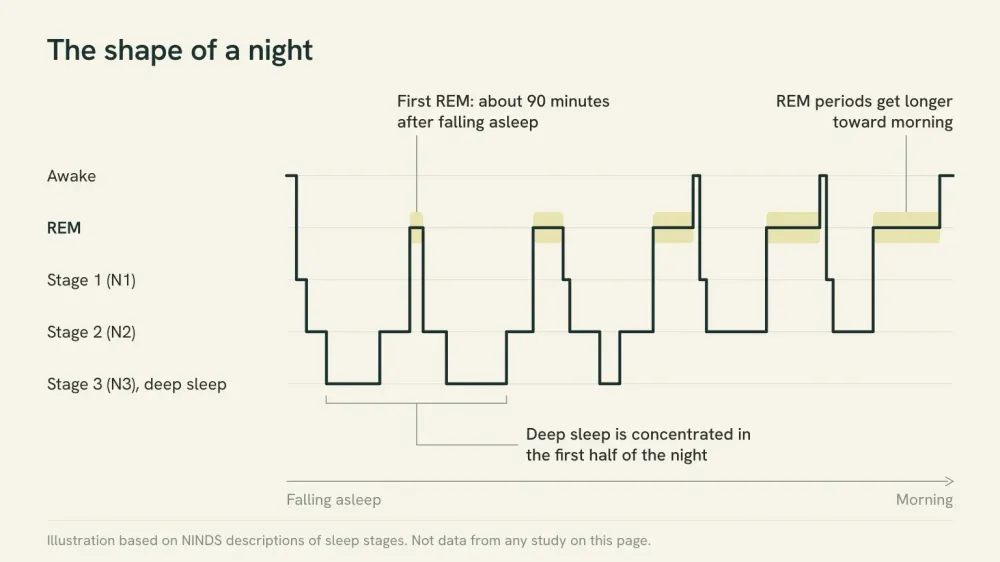
Sleep is not one uniform state. Through the night you cycle several times between non-REM sleep and REM (rapid eye movement) sleep, and the National Institute of Neurological Disorders and Stroke's guide to understanding sleep describes how those stages are spread across the night. The pattern matters for everything below, because something that changes one part of the night can leave another part untouched.
- Stage 1 (N1): the light transition into sleep, which usually lasts several minutes.
- Stage 2 (N2): settled but still light sleep. Across your repeated sleep cycles, you spend more time here than in any other stage.
- Stage 3 (N3): deep sleep, the stage you need to feel refreshed in the morning. It comes in longer stretches during the first half of the night.
- REM sleep: first arrives about 90 minutes after you fall asleep, gets longer toward morning, and is when most dreaming happens.
Sleep studies report a handful of measures, and knowing them makes the rest of this page easier to read. Total sleep time is how long you were actually asleep. Sleep onset latency is how long it took to fall asleep. Wake after sleep onset is the time spent awake once you had fallen asleep, and sleep efficiency is the share of your time in bed spent asleep. REM latency is how long you slept before the first REM period arrived. Most of the studies below recorded these with polysomnography, an overnight recording of brain waves, eye movements, muscle activity and breathing; a few used simpler home devices. NINDS also notes that memory consolidation most likely requires both non-REM and REM sleep, which is one reason researchers pay attention to what happens to REM.
A single night: does THC affect REM sleep?
The controlled single-night studies are small, and they do not agree with each other, which is useful to know in itself. In a 2004 crossover study of eight healthy young adults, four men and four women aged 21 to 34 slept in the lab on four separate nights after a placebo spray, a THC spray, or one of two sprays combining THC and CBD, all given in the late evening. The authors reported no effects of THC alone on nocturnal sleep. The two combinations reduced stage 3 deep sleep, and the higher combination increased time awake. The next morning, after THC alone, memory was impaired, participants fell asleep faster on a morning sleep-latency test, and they reported feeling sleepier. Eight people, one spray formulation and one night per condition are real limits, and the study is more than 20 years old.
The larger of the two trials asked the question in a clinical group. In a 2025 pilot trial of 20 adults diagnosed with insomnia disorder, none of whom had used cannabis in the previous three months, one oral dose of a THC-and-CBD oil cut REM sleep by about 34 minutes and total sleep time by about 25 minutes against placebo, and it did not shorten the time taken to fall asleep. The first REM period also arrived about 66 minutes later than on the placebo night, while deep stage 3 sleep did not change significantly. Sixteen of the 20 participants were women, and their average age was 46. The trial was double-blind and crossover, so each person slept once with the oil and once with a placebo, and its protocol was published in 2020 with total sleep time and night waking as its primary outcomes. The limits belong right next to the result: one night, one formulation, a population with a sleep disorder, no THC-only comparison so the effects of THC and CBD cannot be separated, and 70% of participants correctly guessed which night was the active one. Two authors are named on issued patents relating to cannabinoid therapeutics, and several reported consulting fees, including from a medical cannabis industry body. It tells you what THC combined with CBD did to the shape of a night in people with insomnia disorder, not what it will do to yours.
Why falling asleep faster and sleeping well are not the same result
Many people who use cannabis at night say they sleep better, and that deserves a straight answer rather than a dismissal. A 2022 systematic review of 31 cannabis sleep studies found sleep improvements in 7 of 19 randomized studies and in 7 of 12 uncontrolled ones. Those studies mixed people with pain-related, neurological, psychiatric and sleep disorders with healthy participants, and used many different preparations. The review found no significant effect on healthy participants' sleep, and no significant difference between THC and CBD. The authors also said the studies were too varied to support any specific dosing recommendation. And they described a gap between what participants felt and what the recordings showed:
“While subjective improvements in sleep quality were often observed, diagnostic testing showed no improvements in sleep architecture.”
The studies here do not explain that gap, and it would be a guess to pretend they do. What they show is that a self-rating and a recording measure different things, so both can be reported honestly and still disagree. A 2025 systematic review and meta-analysis of cannabis and sleep architecture points the same way. It identified 18 sleep-lab studies and found nine suitable for combining. Its authors concluded that giving cannabis does not consistently alter sleep duration, time taken to fall asleep, time awake, sleep efficiency or sleep staging. They wrote that early findings of reduced REM sleep came mainly from small trials with high THC doses and significant methodological limitations, and that more recent studies with larger samples and lower doses report mixed, and often no, evidence of REM suppression. They also called for further research to address the gap between subjective sleep improvements and objective sleep measures. We could not access the review's full table of included studies, so this page reports its written conclusions and no pooled numbers.
Those early studies are worth seeing plainly, because the idea that THC wipes out REM sleep is partly built on them. In a 1975 sleep-lab study, seven experienced cannabis users were given tens and then hundreds of milligrams of oral THC a day, the higher amount for two weeks. REM eye-movement activity fell while they were taking it, and REM duration fell to a lesser extent. When the THC stopped, both rose above their normal levels. Amounts like that are far beyond ordinary use, and a group of seven cannot stand in for everyone. One more source of confusion is worth clearing up: if you have heard that older cannabis is sleepier because its THC has turned into CBN, our explainer on how CBN forms as THC ages covers that chemistry, though not the sleepiness claim. The sleep studies on this page gave THC, sometimes with CBD, and none of them tested CBN.
Every night: what sleep looks like in people who use most days
Evidence about nightly use comes from a different kind of study. Nobody in the studies below was given THC by the researchers: they compared people who already use cannabis with people who do not. A sleep difference in that setup could come from cannabis, or from whatever makes someone who sleeps poorly more likely to use it, and the studies cannot tell which. In a 2024 study of 177 healthy Colorado adults, using cannabis close to sleep, a window the researchers defined separately for inhaled and edible cannabis, went with more time awake during the night and more light stage 1 sleep, and not with longer or more efficient sleep. A 2025 study at a Canadian sleep clinic compared 151 patients who had used cannabis at least once a day for at least a year with 1,298 who never had, adjusting for 28 other factors. The users had more waking during the night and lower sleep efficiency, but REM sleep and deep sleep did not differ. Only 9.6% of the patients in that sample had no sleep apnea, so it is not a picture of healthy sleepers.
| Study | Who | How sleep was measured | What differed | What did not differ | Main limit |
|---|---|---|---|---|---|
| Colorado adults, 2024 | 177 healthy adults | One night of home sleep testing, plus blood and urine cannabinoid tests the next morning | Use close to sleep: more night waking (median 60.5 vs 45.8 minutes) and more stage 1 sleep (15.2% vs 12.3%). Use on more than 20 days a month: also a longer wait for REM and lower sleep efficiency | Use close to sleep was not linked to longer sleep or better sleep efficiency | One home night; a snapshot in time; participants chose whether and when to use |
| Canadian sleep clinic, 2025 | 151 patients using cannabis at least once a day for at least a year, and 1,298 never-users | Overnight polysomnography in a sleep clinic | About 21% more night waking (roughly 16.6 minutes), lower sleep efficiency, more stage 1 sleep | REM sleep, deep sleep, time to first REM and time to fall asleep | Only 9.6% of the sample had no sleep apnea; cannabis use self-reported; caffeine not accounted for |
| Conference abstract, 2020 | Fewer than two dozen young adults, frequent users and non-users | EEG headband at home, two nights | Lower REM percentage and a longer wait for REM in frequent users, who also rated their dreams as more bizarre | Other sleep measures | Abstract only, not a full journal paper; very small; headband rather than a lab recording |
One source cited online for the idea that regular use erases REM sleep is much smaller than it looks. A 2020 conference abstract (Carr and colleagues, Sleep, doi:10.1093/sleep/zsaa056.157) is the third row of the table above: fewer than two dozen young adults, recorded at home with an EEG headband, and not a full journal paper. The far larger clinic study did not see its REM difference. The clinic study's authors, who also wrote the 2025 review, put the underlying problem plainly: "the effects of acute administration likely differ from those of chronic use." You may also read that the REM effect fades as your body gets used to nightly THC. The direct sleep-lab evidence for that on this page is a 1976 follow-up from the same lead researcher, which reported some tolerance developing to the drop in REM eye movements, at doses of tens to hundreds of milligrams a day. None of the studies here measured it at everyday levels.
The week you stop: sleep during cannabis withdrawal
Of the three situations, stopping is the one the 2025 review's abstract describes as consistent: withdrawal from active cannabis use was consistently associated with sleep disturbance, including less total sleep, taking longer to fall asleep, and REM rebound. When 17 heavy users aged 18 to 30 stopped using, their first two nights in the lab had less total sleep and less deep sleep than drug-free controls, although a comparison with controls cannot show how much of that was already there before they quit. In a study of 20 daily users compared with themselves, three days without cannabis meant less total sleep, lower sleep efficiency, taking longer to fall asleep, and more time in REM than on the days they used. And in an inpatient study of 18 heavy users, chosen because they had reported sleep problems during earlier abstinence, total sleep, sleep efficiency and REM sleep all declined across 13 nights without cannabis, while night waking rose.
The REM rebound shows up in some studies and not in others. In the 1975 lab study, REM activity climbed above normal after THC stopped, and the daily-user study above recorded more REM time on the days off. But in a two-person lab study that gave THC for 14 nights, the mild insomnia of the withdrawal nights came without any increase in REM, and slow-wave deep sleep, reduced from about a week into the drug period, stayed reduced for a week after stopping. In the inpatient study, REM went down rather than up. Dreams are on the official list: NIDA's summary of cannabis research names experiencing strange or unsettling dreams among withdrawal symptoms, alongside insomnia. Whether REM rebound is the reason those dreams happen has not been directly tested in any of the studies on this page, so treat that link as a hypothesis, not an established fact.
How long does it last? The studies give observed ranges, and the ranges do not agree, so none of this is a timetable. In a 2003 study that followed 18 heavy users through 45 days without cannabis, withdrawal symptoms, sleep problems among them, typically began within the first 1 to 3 days, peaked between days 2 and 6, and mostly lasted 4 to 14 days. The inpatient sleep-lab study was still recording worsening sleep on night 13. The FDA-approved label for dronabinol, a prescription form of THC, records that people coming off high doses complained of disturbed sleep for several weeks. And a 2016 systematic review of 36 publications found sleep was frequently interrupted during cannabis withdrawal, while warning that the studies' methods were too uneven for any definitive conclusion about which aspects of sleep are affected. For scale, a 2020 meta-analysis of 47 studies covering 23,518 people put cannabis withdrawal syndrome at 47% among people with regular or dependent use, but at 17% in population-based samples, and our page on CBD, dependence and withdrawal sets those figures in context and explains why the answer differs for THC. Sleep disruption after stopping is a documented feature of withdrawal in regular users. It is not a diagnosis, and this page does not offer a plan for cutting down.
The morning after
The two controlled single-night studies disagree about the next morning, and they differ in almost every variable that could explain why. In the 2004 study of healthy young adults, THC alone left people sleepier and worse on a memory test when they were tested the next morning, starting about ten hours after the spray. In the 2025 insomnia-disorder trial, the next morning's objective alertness tests did not differ from placebo, participants rated themselves slightly sleepier, and performance on a driving simulator did not change. The formulation, the amount of CBD, and whether participants were healthy or had insomnia disorder all differed between the two. Neither study tells you how many hours to leave before driving, and this page does not give a number either.
In the 2025 trial, where the THC was swallowed in an oil, no THC was detected in blood samples the next morning, but its active metabolite 11-hydroxy-THC still was, in 10 of the 20 participants. Detection is not the same thing as impairment. Our explainer on how the route changes the mix of THC and 11-hydroxy-THC shows why swallowed THC reaches the blood with far more of that metabolite, relative to THC itself, than inhaled THC does. For the road, the dronabinol label tells patients not to operate motor vehicles or other dangerous machinery until they are reasonably certain the drug does not affect them adversely, and our guide to cannabinoids, impairment and driving explains why feeling fine says nothing reliable about the THC number a per se law measures.
Stacking sedation: alcohol, sleep medicines and antihistamines
Bedtime is when THC is most likely to meet something else that makes you drowsy. The FDA-approved dronabinol label lists somnolence, meaning sleepiness, among its most common side effects. It warns that other drugs causing dizziness, confusion, sedation or sleepiness may increase that effect, and its examples include alcohol, benzodiazepines, opioids, muscle relaxants and antihistamines. That warning is written for a prescription form of THC rather than for cannabis in general, and it describes added effects, not a measured amount. Two common bedtime medicines carry warnings of their own: zolpidem, sold as Ambien, and diphenhydramine, the antihistamine in Benadryl that is also sold as a sleep aid. Our page on what the Ambien label warns about and our page on the Benadryl box warnings read those labels closely. Both are written about CBD rather than THC, so use them for what the labels say, not as a review of THC interactions.
When it is not a lifestyle question
Some sleep problems have nothing to do with cannabis, and some have everything to do with it in a way an article cannot sort out. These are signs that call for a conversation with a clinician, rather than another change to your evening routine.
- Trouble falling asleep or staying asleep on most nights for weeks or months, whether or not you use cannabis.
- Frequent loud snoring, breathing that starts and stops, or waking up gasping for air.
- Heavy daytime sleepiness, or feeling that you cannot sleep without cannabis, alcohol or a sleep medicine.
- Trying to cut down and not managing to, or sleep problems alongside low mood, anxiety or irritability after stopping. A clinician can assess whether this is cannabis use disorder.
- Feeling slow, foggy or unsteady the morning after, especially if you drive, operate machinery or care for someone else.
Sleep apnea deserves its own mention, because it was so common among the sleep-clinic patients above. The National Heart, Lung, and Blood Institute lists breathing that starts and stops, frequent loud snoring and gasping for air among its signs, and advises talking to a healthcare provider about symptoms, since you may need a sleep study. For sleep trouble that persists, the CBD and sleep guide linked at the end of this page covers where cognitive behavioral therapy for insomnia (CBT-I) and a short sleep diary fit.

What the evidence cannot tell you yet
Here is the honest edge of the research on this page, as of our reading on September 13, 2026.
- Which studies the 2025 review combined, or its pooled numbers. We could not access its full table, so we report only its written conclusions.
- Anything precise about ordinary use. The controlled studies here are small: 8 people, 20 people, and very small lab groups in the 1970s and 1980s.
- What THC alone did in the 2025 insomnia trial. It had no THC-only arm, so its effects cannot be split between THC and CBD.
- Whether cannabis caused the sleep differences in people who use most days. Observational studies cannot separate cause from effect.
- Whether REM rebound is what makes dreams vivid after stopping. None of the studies on this page tested that link directly.
- How any of this applies to you if you are older, pregnant or take other medicines. None of the studies here was designed around those groups.
None of that makes the question unanswerable, but the fair summary is a narrow one. THC changed the shape of a night in some controlled studies, most clearly REM sleep in one insomnia-disorder trial and in high-dose lab work from the 1970s, without making the night longer. People who use most nights show more waking, not more sleep, in studies that cannot show cause. And stopping after regular use is linked to disrupted sleep for a while, on a timeline that varies between studies. Anyone who answers "is it bad to sleep high" in a single word is going further than the evidence does.
Questions people ask about sleeping high
No study on this page randomly assigned people to months of ordinary nightly use, so the best evidence is observational. In 177 healthy Colorado adults, using cannabis close to sleep went with more waking during the night and more light sleep, and not with longer or more efficient sleep. In 151 long-term daily users at a sleep clinic, sleep had more waking and lower efficiency than in never-users, while REM and deep sleep did not differ. Neither study can show that cannabis caused the difference. If you feel you cannot sleep without cannabis, or you sleep poorly most nights, that is worth raising with a clinician.
In some studies, yes. In a 2025 pilot trial of 20 adults with insomnia disorder, one oral THC-and-CBD dose cut REM sleep by about 34 minutes against placebo, and 1970s lab studies using very high daily doses reduced REM activity. But a 2025 review of 18 sleep-lab studies concluded that more recent studies with lower THC doses show mixed, and often no, REM suppression, and a sleep-clinic study of 151 daily users found no REM difference from never-users.
The studies on this page did not measure how many dreams people remember, so they cannot answer this exactly. What they recorded is that some controlled studies saw less REM sleep, the stage when most dreaming happens, and a small 2020 conference abstract found a lower REM percentage in frequent young users. That same abstract found frequent users rated their dreams as more bizarre, not absent, and a much larger sleep-clinic study found no REM difference at all. Less REM would fit what people describe, but that link was not tested directly.
NIDA lists experiencing strange or unsettling dreams among cannabis withdrawal symptoms, so you are describing a documented feature of withdrawal in regular users. Some sleep-lab studies recorded REM sleep rising above normal after regular users stopped, which is called REM rebound. Others did not: in one small study the withdrawal nights brought insomnia without extra REM, and in an inpatient study REM went down. Whether REM rebound is what makes the dreams vivid has not been directly tested in these studies.
The controlled studies do not show a consistent change. In the 2025 insomnia-disorder trial, a THC-and-CBD dose did not significantly shorten the time taken to fall asleep, and a 2025 review of 18 sleep-lab studies found cannabis did not consistently alter how fast people fell asleep. Feeling drowsy and falling asleep sooner on a recording are different measures. A 2022 review found people often reported better sleep quality while sleep-lab testing showed no improvement in sleep architecture.
The two controlled studies disagree. In a 2004 study of eight healthy young adults, THC alone left people sleepier and worse on a memory test the next morning. In a 2025 trial of 20 adults with insomnia disorder, objective alertness the next morning did not differ from placebo, though people rated themselves slightly sleepier, and the metabolite 11-hydroxy-THC was still detectable in half of them. Neither study gives a number of hours after which anyone is unimpaired, and feeling fine is not a test. Do not drive until you are sure you are not affected.
The studies give ranges that do not agree, so treat these as observations, not a schedule. In a 2003 study of 18 heavy users, withdrawal symptoms including sleep problems typically began within 1 to 3 days and mostly lasted 4 to 14 days. An inpatient sleep-lab study of 18 heavy users was still recording worsening sleep on night 13, and the dronabinol label records disturbed sleep for several weeks after people stopped high doses. If sleep stays poor, or you have tried to cut down and could not, talk to a clinician.
The FDA-approved label for dronabinol, a prescription form of THC, warns that alcohol, benzodiazepines, opioids, muscle relaxants and antihistamines can add to its sedating effects. Sleep medicines such as zolpidem, and sedating antihistamines such as diphenhydramine, carry their own drowsiness warnings. If you take any prescription sleep medicine or sedating drug, talk to your prescriber or pharmacist before adding THC, and do not change a prescribed medicine on your own.
If the question underneath all this is sleep trouble that persists, rather than what THC does, the next page to read is our review of what the evidence on CBD and sleep does and does not show. It separates the CBD-only trials from combination studies, explains why research does not give a universal dose or bedtime, and has a section on what to do when sleep trouble persists.
Writing about hemp, wellness and the small rituals that keep us balanced.