CBN vs Melatonin: What the Sleep Evidence Actually Supports
Every page we read ranking for this comparison declares CBN the winner, leaning on one trial without mentioning who paid for it. Here is what that trial actually reports, what melatonin's own meta-analysis measured, and how the two evidence bases compare.

Search CBN vs melatonin and the first page of results is made almost entirely of companies that sell CBN, and almost all of them declare CBN the winner. They lean on one randomized trial. That trial is real, it is the only one that has ever put the two side by side, and its title names the branded CBN ingredient belonging to the company that paid for it. Read past its abstract and it reports something none of those pages mention: on the measure the researchers themselves had defined as clinically meaningful, no arm beat placebo. Not the CBN arms, and not the melatonin arm either. This page compares the two the only way that helps you, which is by the quality and the quantity of the evidence behind each.
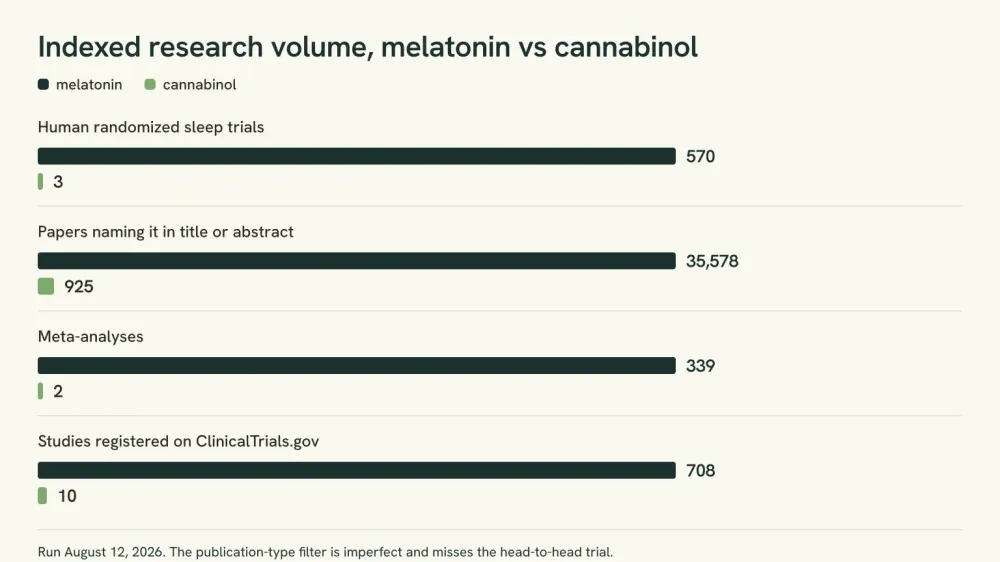
The short answer. Melatonin is a hormone your brain releases in darkness, it has decades of human trials behind it, and its largest general meta-analysis measured a modest effect: about 7 minutes faster to sleep onset. CBN is not a hormone and not something the plant makes on purpose, and the same PubMed query that returns 570 human randomized trials for melatonin and sleep returns 3 for cannabinol (that filter is imperfect, and we show you its limits further down). So neither one is the winner the search results describe. One has a small measured effect and a long record; the other has a reputation and very little data. If you want the molecule itself, our profile of cannabinol as a molecule covers the chemistry, and the cannabinoid-to-cannabinoid version of this comparison goes trial by trial through the CBN sleep research.
CBN and melatonin are not the same kind of thing
Melatonin is not a compound your body has never met. It is a hormone your brain produces in response to darkness, and the federal summary adds the part people forget: being exposed to light at night can block that production. A pharmacology reference chapter on melatonin describes the mechanism in one line: it regulates the body's sleep-wake cycles through interactions with the suprachiasmatic nucleus of the hypothalamus and the retina, acting at its MT1 and MT2 receptors. The rest of that chapter is worth knowing too. Melatonin's elimination half-life is roughly 1 to 2 hours. About 90% of it is metabolized in the liver, primarily by an enzyme called CYP1A2. And its oral bioavailability has been reported anywhere from 1% to 74%, which is an enormous spread for something sold by the milligram. Hold onto CYP1A2, because it comes back at the end of this article.
Cannabinol is a different category of object. The hemp plant does not biosynthesize it at all: CBN is what THC becomes as it oxidizes over time, which is why aged material carries more of it. The rest of its chemistry, and where it sits among the wider cannabinoid family, belongs to the two pages linked in the paragraph above. What CBN does not have is an established sleep mechanism. Its reputation came from somewhere else, and the somewhere is traceable. A 2021 review in Cannabis and Cannabinoid Research traces the sedation story to "cannabis lore. Namely, that 'old' cannabis makes users sleepy". The human study most often invoked for it, a 1975 crossover in five male volunteers, reported that the volunteers "felt drugged, drunk, dizzy, and drowsy under the delta9-THC condition, but not under the CBN condition". Five men, in 1975, and the drowsiness was under THC. Worth noting about the review as well: its single author discloses that he is medical director of a for-profit cannabis clinical and consulting entity.
So the axis nearly every comparison page runs on, which of the two hits harder, is the wrong axis. Melatonin's documented role is timing. It is the signal that says night, not a switch that says sleep, and you will see that confirmed later by which of the two sleep-medicine guidelines endorses it. Sedation is the thing CBN is sold on, and sedation is precisely what the trials have not managed to show.
The one trial that put CBN and melatonin head to head
The 2024 trial everyone cites randomized 1,020 US adults aged 21 and over, all of whom had said they wanted to sleep better, into five arms: 25 mg, 50 mg or 100 mg of CBN, 4 mg of melatonin, or placebo, taken for four weeks. It was double-blind, placebo-controlled and fully decentralized, meaning every piece of data was collected through online surveys. The primary outcome was PROMIS Sleep Disturbance 8A, an eight-item self-report questionnaire scored from 8 to 40, on which participants started around 29 to 30. Three things follow from that design and none of them are hidden: nobody in the trial had a diagnosis of insomnia, nobody's sleep was measured by an instrument, and roughly a quarter of participants completed no follow-up survey at all.
Three more facts belong in the same breath as its result, and the comparison pages we read print none of them. The paper's title names "Three Formulations of Floraworks Proprietary TruCBN", which is a branded ingredient. Its funding statement reads: "Radicle Science is conducting the evaluation of the effectiveness of the product under contract with the funder (Floraworks)." And its conflict statement lists six of its eight authors as employed by Radicle Science, the company that conducted the study. Now the other half of that disclosure, which matters just as much, quoted in full because half a funding statement is worse than none: the paper states that the funding source "had no role in the design and conduct of the study; in the collection, management, analysis, and interpretation of the data; preparation, or approval of the manuscript", and adds that the funders were able to review the manuscript but that their approval was not required. The trial's registry record was also first posted on August 23, 2022, with enrollment beginning on September 12, 2022. Registering a trial before you enroll anyone is a point in its favor and we will say so plainly. That registry record is also bigger than the paper: it lists 2,679 participants across 13 arms and four product forms, of which this publication reports five arms and 1,020 people, and no results have been posted to the registry itself. None of this is an accusation of anything. It is the context a reader needs in order to weigh the result, and it is the context that goes missing when the trial is quoted by people selling one of the arms.
| Arm | Participants | Change on the sleep questionnaire vs placebo | Reached the clinically meaningful threshold more often than placebo |
|---|---|---|---|
| Melatonin 4 mg | 202 | beta = -0.564, p = 0.029 | No (estimate 1.43, 95% CI 0.70 to 2.16, p = 0.434) |
| CBN 25 mg | 206 | beta = -0.544, p = 0.030 | No (estimate 1.33, 95% CI 0.65 to 2.01, p = 0.729) |
| CBN 50 mg | 205 | beta = -0.603, p = 0.018 | No (estimate 1.46, 95% CI 0.72 to 2.20, p = 0.348) |
| CBN 100 mg | 203 | beta = -0.566, p = 0.023 | No (estimate 1.39, 95% CI 0.70 to 2.08, p = 0.498) |
| Placebo | 204 | reference arm | Placebo itself reached the threshold 42.2% of the time |
The third column is what the comparison pages report, and as far as it goes they report it correctly: each CBN dose and the melatonin dose improved on the questionnaire faster than placebo did, and there was no statistically significant difference between any CBN dose and melatonin. The paper's own conclusion draws the inference directly, in one sentence: "There was no significant difference in improvements in sleep quality between any of the treatment groups and the 4 mg melatonin group, indicating that TruCBN offers an alternative for effective sleep support." Hold that sentence for a moment, because the next section is about why its first half does not produce its second. One neutral observation, since it is the paper's own reading of its own table: the article's key-findings summary describes the 25 mg and 100 mg results as marginally significant, even though the table prints both under 0.05. And a hard limit on what those numbers are. They are rate-of-change coefficients on a questionnaire. They are not minutes, they are not hours, and no honest sentence converts them into either.
One more thing about that table before we go on. Every amount named on this page (4 mg of melatonin, 25, 50 and 100 mg of CBN, and the 30 mg and 300 mg you will meet further down) is a study arm, reported here as a fact about a trial. None of them is a recommendation, and this article does not give amounts for either substance, because that is a conversation with a clinician who knows what else you take. How we talk about CBD amounts is a separate page, and it deliberately covers neither CBN nor melatonin.
The two sentences in that trial nobody quotes
Alongside the questionnaire score, the researchers had defined a minimum clinically important difference: the size of change big enough to actually matter to a person, set here at half the standard deviation of the baseline score. Then they asked how often each arm reached it. The paper's answer runs to one sentence and it is not ambiguous: "This means there was no difference in the MCID achieved in the placebo group and that of any of the active groups." The placebo group reached that threshold 42.2% of the time. Melatonin did not beat it. Neither did any dose of CBN. That is the trial's own result, on the trial's own definition of a change worth having. It sits in the same paper as the conclusion quoted a moment ago, in the results rather than in the summary, and it does not appear on any of the pages we read while researching this article.
The same paper contains more that the marketing skips. On anxiety, pain and well-being, it reports no significant differences between any group and placebo. That is directly relevant, because the most repeated selling line for CBN is that unlike melatonin it works on the underlying pain and anxiety keeping you awake. In the one trial that measured those things alongside sleep, it did not. The single exploratory hit was 100 mg CBN against placebo on stress (beta = -0.323, p = 0.011), which is one comparison among many, unpowered, and not something to build a claim on. Side effects did not differ significantly from placebo either (chi-square 8.58, p = 0.073), and the most frequently reported one across the whole trial was grogginess or drowsiness, with 22 reports, ahead of trouble falling or staying asleep (10), headache (10), nausea (5) and nightmares (5). All were mild and none were considered serious. Keep that next to the claim that CBN spares you the morning after.
What melatonin's own evidence actually shows
Melatonin's number exists, and it is small. The largest general meta-analysis of melatonin and sleep pooled 19 randomized placebo-controlled trials and 1,683 people with primary sleep disorders, adults and children together. It found sleep onset 7.06 minutes faster (95% confidence interval 4.37 to 9.75), total sleep time 8.25 minutes longer (1.74 to 14.75), and a small improvement in sleep quality (standardized mean difference 0.22, 95% CI 0.12 to 0.32). The authors' own word for this is "modest", and they add that the absolute benefit of melatonin compared to placebo is smaller than other pharmacological treatments for insomnia. Two limits travel with it: the analysis is from 2013, and its participants had diagnosed primary sleep disorders, so it does not describe a healthy person taking a gummy because they went to bed too late. The authors also disclose partial funding from Eli Lilly research awards. Seven minutes is not much. It is also seven more minutes than anyone has measured for CBN.
“We suggest that clinicians not use melatonin as a treatment for sleep onset or sleep maintenance insomnia (versus no treatment) in adults.”
That is the most quotable sentence on this entire topic, and quoting it alone would be the same trick this article is criticizing. It comes from the American Academy of Sleep Medicine's 2017 clinical practice guideline, and the guideline itself tells you how to read it. A WEAK recommendation, it states, "should not be construed as an indication of ineffectiveness", and the GRADE strengths it uses refer to the strength of evidence in the published data rather than to the size of the effect in any one person. The guideline also notes that its evidence was downgraded partly because of funding sources and the small number of trials. It reaches the same conclusion about trazodone, tiagabine, diphenhydramine, tryptophan and valerian. And note the population: chronic insomnia, which is a clinical diagnosis and is not what this page is about.
The same organization is positive about melatonin somewhere else, and where it is positive tells you what melatonin is actually for. Its 2015 guideline on circadian rhythm sleep-wake disorders gives a positive endorsement, at what it calls a second-tier degree of confidence, to strategically timed melatonin for delayed sleep-wake phase disorder, for blind adults with non-24-hour sleep-wake rhythm disorder, and for children and adolescents with irregular rhythms and comorbid neurological disorders. The same guideline recommends against melatonin in elderly patients with dementia. Second tier means weak, and every one of those groups has a diagnosis, so none of this transfers to a person who simply wants to fall asleep earlier on a Tuesday. But the pattern is the point. Where melatonin has an endorsement, that endorsement is about timing, not about sedation. Which means the axis every CBN comparison page is fighting on, which of the two knocks you out harder, was never melatonin's axis in the first place.
CBN vs melatonin: the evidence, counted
Those figures come from queries you can rerun yourself, which is the point of printing them. On August 12, 2026, searching PubMed's indexed literature for melatonin[Title/Abstract] AND sleep[Title/Abstract] AND randomized controlled trial[Publication Type] AND humans[Filter] returned 570 records, and the identical query with cannabinol in place of melatonin returned 3. The bare terms in title or abstract returned 35,578 against 925, and adding meta-analysis[Publication Type] to each returned 339 against 2. The ClinicalTrials.gov API, queried on intervention name, returned 708 registered melatonin studies against 10 for cannabinol. Now the honest caveat, in the same breath rather than in a footnote: that publication-type filter is imperfect in both directions, and it misses the 2024 head-to-head trial described above, which is unambiguously a randomized placebo-controlled trial. So do not read 3 as a census. Read the order of magnitude, which no filter artifact can explain away, and notice what it means practically: with melatonin you are arguing about how big a small effect is, and with CBN you are arguing about whether an effect has been shown at all.
Five claims from the comparison pages, checked against the trials
Here is the part that is actually a tool. These five lines recur across the pages ranking for this comparison. We are not naming sites, because the claims are what matter and anyone can find them in thirty seconds. Each row states what a trial reports about the claim, so you can carry the check with you the next time one of them appears.
| The claim | What the trials report |
|---|---|
| CBN treats the underlying pain and anxiety that keep you awake | The one trial that measured them alongside sleep found no significant differences in anxiety, pain or well-being between any group and placebo (2024 trial, n = 1,020). |
| CBN has no next-day grogginess | Grogginess or drowsiness was the most frequently reported side effect in that trial (22 reports), and side-effect frequency did not differ significantly from placebo in any arm (p = 0.073). No trial has measured a morning-after difference between the two in either direction. |
| CBN is the one for staying asleep, melatonin only helps you fall asleep | The trial whose registered primary outcome was wake after sleep onset, measured by overnight polysomnography, did not meet it: 300 mg changed it by -6.3 minutes (95% CI -18.2 to +5.5, p = 0.29) in 20 adults with diagnosed insomnia. A separate trial in 293 adults also missed its primary endpoint (odds ratio 2.26, 95% CI 0.93 to 5.52, p = 0.082). |
| Long-term melatonin stops your body making its own | No page we read carries a citation for this. The federal summary says something narrower: short-term use appears safe for most people, and information on long-term safety is lacking. An absence of data is not a documented shutdown, and we are not asserting the opposite either. |
| Melatonin is well researched, so it works | Both halves are true and mean less together than they sound. 19 pooled trials measured roughly 7 minutes to sleep onset, and a sleep-medicine guideline still suggests clinicians not use it for chronic insomnia in adults. |
Two of those rows lean on trials this page has not otherwise described. A 2026 crossover study using overnight polysomnography gave 20 adults with physician-diagnosed insomnia 30 mg or 300 mg of CBN, or placebo, on single nights in a sleep laboratory; its pre-registered primary outcome was wake after sleep onset and it was not met, with the authors writing that the improvement they saw "was neither statistically nor clinically significant". Twenty people, one night each, and no formal power calculation, which the authors state openly. A 2024 trial in 293 adults also missed its primary sleep-quality endpoint, and all nine of its authors were employed by cannabinoid companies. Both are worked through properly in the CBN and CBD comparison, which is where the trial-by-trial reading of the CBN literature lives.

The regulatory asymmetry nobody mentions
In the United States, melatonin is a dietary supplement. The federal summary from NCCIH states the consequence directly: that means it is regulated less strictly by the FDA than a prescription or over-the-counter drug would be. It then adds a sentence most American readers have never seen: "In several other countries, melatonin is available only with a prescription and is considered a drug." Europe is the clearest example. Circadin, a 2 mg prolonged-release melatonin tablet, is authorized in the EU as monotherapy for the short-term treatment of primary insomnia characterized by poor quality of sleep in patients aged 55 or over, taken 1 to 2 hours before bedtime for up to 13 weeks, and it can only be obtained with a prescription. That indication belongs to that specific prolonged-release product, under that regulator, for that population. It does not transfer to a gummy on a US shelf, and nothing here is a suggestion to take anything.
CBN sits on neither side of that line. We found no marketing authorization for it of the kind Circadin has. And FDA's page on cannabis and cannabis-derived products, which we read on August 2, 2026 and confirmed still live on August 12, does not contain a single standalone mention of cannabinol: every occurrence of that string on the page sits inside the longer word tetrahydrocannabinol. Read that carefully, because the CBN pages tend to read it backwards. A silence in federal guidance is not a permission, not a safety finding and not an approval. It means the question has not been addressed. Melatonin, whatever you make of its evidence, has been argued about in public by regulators on two continents, and you can read what they concluded. For CBN there is nothing yet to read.
Both bottles have a label problem, and that is the actionable part
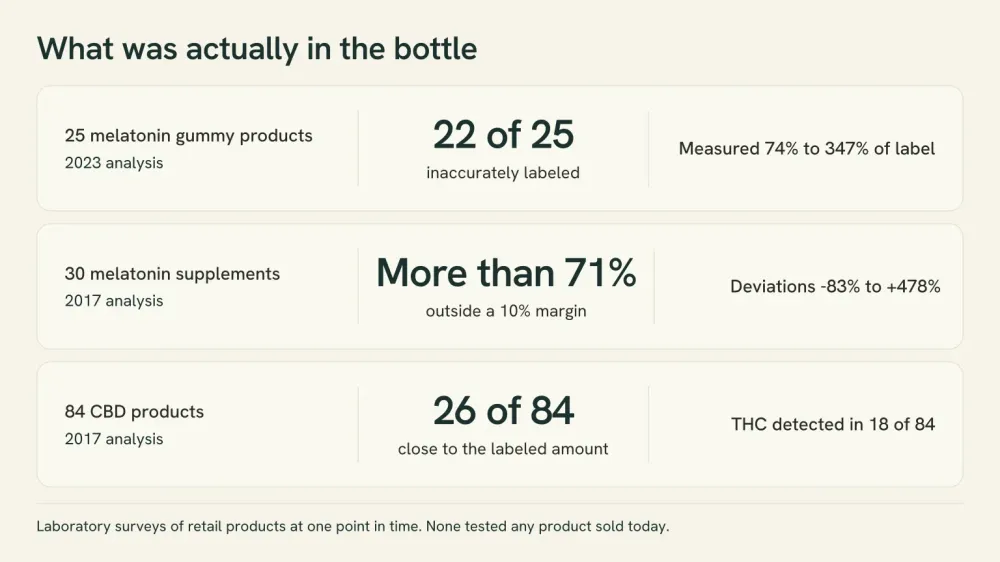
This is the section neither category's marketing writes. A 2023 analysis in JAMA bought 25 melatonin gummy products and measured what was actually in them. Twenty-two of the 25 were inaccurately labeled; only three fell within 10% of the declared amount; measured melatonin ranged from 74% to 347% of the label. One product, labeled as containing 5 mg of melatonin and 30 mg of CBD, contained no detectable melatonin at all. An earlier analysis in the Journal of Clinical Sleep Medicine tested 30 supplements from 16 brands and found content deviating from the label by -83% to +478%, which means one product held 83% less than it claimed and another held nearly six times as much. More than 71% failed a 10% margin. And serotonin, which has no business being in a melatonin supplement, was detected in 8 of the 30. Both studies are snapshots of a shelf at a moment: 25 gummies bought in September 2022, and 30 products from one Canadian city in 2017. Neither describes any specific bottle you own. We run the same check on a melatonin bottle separately, alongside the co-ingestion question.
One more line from that JAMA paper, and it is physiology rather than advice. The authors note that as little as 0.1 mg to 0.3 mg of melatonin raises plasma concentrations into the normal night-time range. That is an observation about how the hormone behaves, not a suggestion about what to take, and we are not turning it into one. It is worth knowing mainly because the amounts printed on most bottles are multiples of it, and because a NHANES analysis of 55,021 US adults found reported melatonin use rising from 0.4% in the 1999-2000 survey cycle to 2.1% in 2017-2018, with that last cycle closing before the gummy category took off.
The cannabinoid side is not better, and saying so on a site that sells cannabinoids is the whole reason to trust the rest of this page. A 2017 JAMA analysis of 84 CBD products bought online from 31 companies found that about 31% (26 of 84) contained close to the labeled amount, roughly 43% contained more CBD than the label claimed, and roughly 26% contained less. THC was detected in 18 of the 84. That study is from 2017, it sampled online products, and it did not test any product sold today, including ours. The conclusion it supports is not that one category is cleaner than the other. It is that a number printed on a carton is a claim, and a batch certificate of analysis is the only thing that turns it into a measurement.
- 1Find the batch or lot code on the bottle itself. Not on the website, not on the marketing page: on the object in your hand.
- 2Find a lab report carrying that same code. A generic certificate for the product line, with no batch code on it, does not describe your bottle.
- 3Check the date on the report. A certificate dated before the batch was made, or carrying no date at all, tells you nothing about what you bought.
- 4Compare the measured amount with the label, in the same unit. Labels claim per bottle or per serving while lab reports often print mg/g or mg/mL, and most label disputes are really unit confusion.
- 5Check who ran the test. The lab should be independent of the company selling the product, and the report should name the lab, its accreditation and the method used.
We wrote both halves of that out in full elsewhere: how to read a certificate of analysis line by line covers what each panel on the report means, and what third-party tested actually means covers the part of that phrase that does the work. Then run the same five steps on the other bottle. Very few supplement categories make it easy, and how hard a company makes it is itself a piece of information about the company.
Safety, and the questions that belong to a clinician
Melatonin's safety record is not a blank, but it has a shape worth knowing. The NCCIH summary quoted earlier says short-term use of melatonin supplements appears to be safe for most people, and that information on the long-term safety of supplementing with melatonin is lacking. It names epilepsy and blood-thinning medication as situations that need medical supervision, and it notes a lack of research in pregnancy and breastfeeding. Note the split: short-term appears safe, long-term is unstudied. That is a narrower statement than either of the two you usually meet online, which are that melatonin is completely harmless and that melatonin shuts down your own production. Neither of those sentences appears in the federal summary.
One more datum belongs here, and how it is framed matters. A 2022 federal surveillance report counted 260,435 pediatric melatonin ingestions reported to US poison centers between 2012 and 2021. The annual number rose 530% over that decade; melatonin went from 0.6% of all pediatric ingestions reported in 2012 to 4.9% in 2021; 83.8% involved children aged 5 or under, and 94.3% were unintentional. Its published erratum reports that most children, 84.4%, were asymptomatic, and two deaths were reported across the ten years. Now the caveat that has to travel with it: poison-center calls have no denominator of users, so this is not a rate of harm per person and it is not a reason to be frightened of a supplement. It is a fact about storage and access, in a category that is sweet, chewable and usually kept somewhere a child can reach.
Then the question most people actually arrive with: whether to take both. Nobody has measured that in people. What exists is a 2025 preclinical study reporting that CBN potently inhibited CYP1A2-mediated metabolism of melatonin and increased melatonin's apparent oral bioavailability, producing a four-fold increase in plasma melatonin exposure in mice. Mice are not people. The finding is mechanistically plausible, since about 90% of melatonin's clearance runs through the liver and mostly through that same enzyme, but plausible is not measured. This is not a warning about a dangerous combination and it is not permission for one either. It is the reason the honest answer to "can I take both" is that nobody has measured it, and the person to ask is the clinician who knows your medication list. What happens when people take CBD and melatonin together goes deeper into the enzyme story, cannabinoids and prescription medications covers interactions properly, and the side effects that actually show up in CBD trials covers tolerability.
Where CBD, and our own bottle, sit in this
CBD is a third thing again, with its own body of sleep research and its own gaps, and it belongs to our review of what the human CBD sleep research shows rather than to this comparison. The federal position on the wider category is short enough to quote exactly: NCCIH states that "the effects of cannabis/cannabinoids on sleep problems in people who don't have other illnesses are uncertain". For disclosure, because it is the reason to trust or discount everything above: Planntz sells a full spectrum tincture containing both cannabinoids, at 133 mg/mL of CBD and 67 mg/mL of CBN, with a third-party certificate of analysis for every batch. We are not going to tell you it will make you sleep. The evidence laid out on this page is exactly why we cannot, and we would rather you heard that from us than worked it out later.
No published study supports that. The only trial that has compared them directly, four weeks in 1,020 adults, found no statistically significant difference between three CBN doses and 4 mg of melatonin on a self-reported sleep questionnaire. It was funded by the manufacturer of the CBN ingredient it tested, and in that same trial no arm, melatonin included, reached the researchers' own threshold for a clinically meaningful change more often than placebo did, which reached it 42.2% of the time. Failing to detect a difference between two arms is not the same as showing they are equal.
Nobody has measured that in people. The only relevant experiment is preclinical: a 2025 study reported that CBN inhibits CYP1A2, the liver enzyme that handles roughly 90% of melatonin's clearance, and produced a four-fold increase in plasma melatonin exposure in mice. Mice are not people, and a plausible mechanism is not a measurement. That is a reason to ask a clinician who knows your medication list, not a reason to combine and not a reason to avoid. We do not give combination advice in either direction.
Not that anyone has shown. In the head-to-head trial, grogginess or drowsiness was the most frequently reported side effect across all arms, with 22 reports, and the overall frequency of side effects did not differ significantly from placebo in any group (p = 0.073). No trial has measured a morning-after difference between the two in either direction, which means claims pointing either way are currently unsupported.
We do not give amounts, and a comparison page is the wrong place to look for them. The doses named in this article are study arms: 25, 50 and 100 mg in the four-week trial, and 30 mg and 300 mg in the laboratory study that measured sleep with polysomnography and missed its primary endpoint at both. Those are facts about trials, not recommendations. If you are considering either substance, and especially if you take any prescription medication, that conversation belongs with a clinician.
This claim appears on several comparison pages with no citation attached to it. What the federal summary actually says is narrower: short-term use of melatonin supplements appears to be safe for most people, and information on long-term safety is lacking. That is an absence of data, not a documented shutdown, and we are not going to assert the opposite either, because that would be just as uncited. It is also a strange argument for switching to the compound that has far less data of any kind behind it.
The American Academy of Sleep Medicine's 2017 clinical practice guideline suggests that clinicians not use melatonin for sleep onset or sleep maintenance insomnia in adults, and grades that recommendation weak. Read the guideline's own footnote in the same document: a weak recommendation should not be construed as an indication of ineffectiveness, and the grade describes the strength of the published evidence rather than the effect in any one person. The same body positively endorses strategically timed melatonin for certain circadian rhythm disorders. Timing, not sedation.
You check the batch, whichever bottle it is. In a 2023 laboratory analysis, 22 of 25 melatonin gummy products were inaccurately labeled and one labeled as containing 5 mg of melatonin had none detectable in it. In a 2017 analysis of 84 CBD products bought online, fewer than a third were close to the labeled amount. A certificate of analysis tied to the batch code printed on your bottle, produced by a laboratory independent of the seller, is the only thing that turns the number on the front into a measurement.
If you take one thing from this page, take the method rather than the verdict. When a comparison names a study, open it: look at who paid for it, what the primary outcome was, whether that outcome was met, and whether the sentence being quoted is a finding or the absence of one. That check took us about ten minutes on the trial at the center of this whole category, and it changed the answer. From here, the sleep evidence hub collects what human research does and does not show about cannabinoids and sleep, and the batch-verification steps above work on any bottle in your house.
Writing about hemp, wellness and the small rituals that keep us balanced.