
Does Weed Raise Blood Pressure? What Each Study Measured
Search results say weed raises blood pressure, lowers it, or triples your risk of dying from it. Each answer measures a different clock. Here is the study behind each one, the retracted paper behind the scariest claim, and when a reading means call someone.

Does weed raise blood pressure? Yes, briefly, and then sometimes the opposite. Search the question and you get three answers that seem to contradict each other: THC raises your blood pressure, a big study found no link, and weed triples your risk of dying from high blood pressure. The first two are both true, at different times. The third comes from a paper its own journal retracted in 2019.
The short answer. In the first hour after THC, your heart rate climbs and your blood pressure measured lying down stays flat or ticks up slightly. When you stand up, it can drop, sometimes enough to make you dizzy or faint. In a 1970s hospital study, days of steady, heavy dosing pushed blood pressure lower. And across whole populations followed for years, the large surveys mostly do not find a consistent link between cannabis use and high blood pressure. None of this makes cannabis a treatment for anything, and a lower number is not automatically a good one. This page covers THC and cannabis; CBD gets its own short section, and the full CBD story lives in our guide to CBD, heart rate and blood pressure.
Does weed raise blood pressure? Why the answers disagree
Most pages answer "does weed raise blood pressure" with a single sentence, and they pick different sentences. The research actually measures four different things on four different clocks: what happens in the minutes after a dose, what happens when you stand up, what happens after days of repeated dosing, and what shows up when researchers survey thousands of people about years of use. Each clock has its own answer and its own quality of evidence. "How strong" in the table below means how well the study design can show cause and effect, not how big the effect was.
| Clock | What happens to blood pressure | Key studies | How strong the evidence is |
|---|---|---|---|
| First hour after a dose (minutes to about 3 hours) | Heart rate rises; lying-down pressure stays flat or rises slightly | Jones 2002 review; CDC; Pabon 2022 | Consistent, but mostly older lab studies of smoked cannabis |
| Standing up (seconds to minutes, possibly the next morning) | Can drop, causing dizziness or fainting | Mathew 2003 (29 people); Gonzalez 2026 (17 people) | Small placebo-controlled lab studies |
| Days of steady heavy dosing | Lower pressure and slower heart rate, with fluid retention | Benowitz and Jones 1975 | One inpatient research program from the 1970s |
| Years, across whole populations | No consistent link to high blood pressure; small differences in both directions | NHANES, CARDIA and UK Biobank analyses | Large but observational; use was self-reported |
Seen this way, the contradictions on page one mostly disappear. "THC raises blood pressure right away" is a first-hour statement. "A big study found no link" is a population statement. They are answers to different questions. The one claim that does not fit anywhere is the "triples your risk" headline, and the section on it below explains why. One caution applies to every row: the lab studies tested healthy, mostly young volunteers, so they say little about older adults or people who already have heart or blood pressure problems.
The first hour: heart rate jumps, blood pressure barely moves
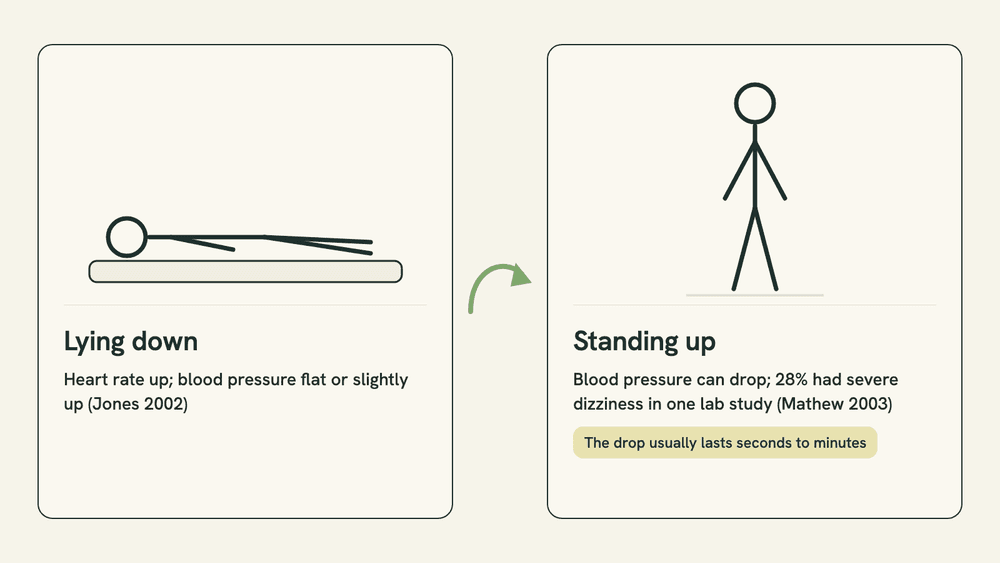
The most reliable thing THC does to your circulation in the first hour is speed up your heart. A 2002 review of the human lab studies by Reese Jones put the whole picture in one line: THC and cannabis "increase heart rate, slightly increase supine blood pressure, and on occasion produce marked orthostatic hypotension." Supine means lying down. Orthostatic hypotension means a drop in blood pressure when you stand up. A companion review in the same journal issue described "a substantial dose-dependent increase in heart rate, generally associated with a mild increase in blood pressure." The CDC's page on cannabis and heart health says the same thing in plain words: cannabis "can make the heart beat faster and can raise blood pressure immediately after use." Note the size words in those sentences: the heart-rate rise is substantial, the blood-pressure rise is slight or mild.
When that first clock starts depends on how you take THC. In a placebo-controlled study that gave the same dose of about 54 mg of THC by smoking, vaping or eating, heart rate was already above baseline half an hour after smoking or vaping, while the oral dose raised it at 1.5 and 3 hours. With an edible, the clock starts late. In a Johns Hopkins study of 17 infrequent users who ate THC brownies (10, 25 or 50 mg), effects did not appear until 30 to 60 minutes after eating and peaked 1.5 to 3 hours later; even the 10 mg dose raised heart rate. That delay is the reason edibles take so long to kick in, and the whole timeline is laid out in how long a weed high lasts.
What about blood pressure itself after an edible? In a University of Chicago study of women who used cannabis occasionally, 7.5 mg and 15 mg of oral THC raised heart rate in step with the dose but did not significantly change blood pressure. We did not find any controlled study that compared blood pressure head to head across smoking, vaping and edibles, so any page quoting a specific "edibles raise your blood pressure by X" figure is going beyond the evidence. If you are watching a cuff in the first hour, heart rate is the number most likely to move. The detailed heart-rate trial numbers, including whether adding CBD changed them, are in our breakdown of the THC and CBD heart-rate trial.
Standing up: the drop that makes you dizzy
Here is the part of the story most pages skip. Orthostatic hypotension, as MedlinePlus defines it, means your blood pressure drops when you shift from lying down to standing, and it "usually lasts only a few seconds or minutes." THC makes that drop more likely. In a randomized, double-blind, placebo-controlled study of 29 volunteers, researchers gave THC by infusion or as smoked marijuana and measured people while they reclined and then stood, 10 minutes each. Both forms caused dizziness on standing, with 28% reporting severe symptoms. Dizziness peaked right after the drug was given. The people with severe dizziness had the sharpest drop in blood pressure and in blood flow to the brain. And the amount of THC in their blood did not predict who got dizzy. An earlier study by the same group found that 6 of 10 people had moderate to severe dizziness on standing after smoking marijuana, and none after placebo.
The effect may also outlast the night. A small, exploratory 2026 study from Oregon gave 17 young adults a 10 mg THC pill about an hour before bedtime and, about an hour after they woke, tilted them upright on a table for 30 minutes, a standard test of how well blood pressure holds up when you go vertical. Among people who did not normally use cannabis, the diastolic (bottom-number) response to tilting was weaker after THC, 6 of 8 felt dizzy (against 3 of 9 after a placebo night), and 2 had to stop the test early because of nausea or lightheadedness. Regular users showed no difference between THC and placebo. With 17 people and a single dose, this is a signal rather than a settled finding, and the authors note that older adults, for whom a fall matters more, were not tested. If you use THC to wind down, our look at sleeping high covers what else that bedtime dose does.
Two related questions get their own pages. If the dizziness comes with nausea, sweating and a racing heart after too much THC, our guide to greening out covers what is happening and what helps. And if you have read that red eyes after smoking are a sign your blood pressure dropped, our red-eye explainer checks that claim step by step.
What to do if you feel lightheaded: a checklist
The studies point to specific moments when the standing drop is most likely: right after inhaling, around the peak of an edible, and, in people who rarely use cannabis, possibly the morning after a bedtime dose. None of the steps below is a treatment. They are simple ways to avoid a fall while a drop passes.
- 1At the first sign of lightheadedness, sit or lie down where you are. Do not try to walk it off.
- 2Stay down until the feeling passes. A standing drop usually lasts seconds to minutes.
- 3Get up in stages: sit up, sit on the edge of the bed or couch for a moment, then stand while holding something steady.
- 4Take extra care right after inhaling, 1.5 to 3 hours after an edible, and the morning after a bedtime dose if you rarely use cannabis.
- 5Do not drive, climb stairs alone or stand in a hot shower while you still feel dizzy.
- 6If you feel faint, ask someone to stay with you until it passes.
After days of steady use: why blood pressure can drift lower
This is where "does weed lower blood pressure" comes from. In the 1970s, Neal Benowitz and Reese Jones gave hospitalized volunteers oral THC around the clock and watched what happened over days. The picture flipped. The racing heart of the first doses faded almost completely, and heart rate slowed. Blood pressure fell. The dizziness on standing faded too, but the lower lying-down pressure did not. The volunteers also gained weight, which the researchers tied to fluid retention and an expanded blood volume. In a follow-up from the same program, volunteers took THC for 14 days, and the researchers wrote that their data fit the picture of "reduced sympathetic and enhanced parasympathetic activity" previously described in animals, meaning a shift in the automatic nervous system that sets heart rate and vessel tone.
“In contrast to the tachycardia and unchanged or increased blood pressure seen after single doses, prolonged delta-9-tetrahydrocannabinol (THC) ingestion produced significant heart rate slowing and blood pressure lowering in hospitalized volunteers.”
The 2002 review describes the same pattern from many lab studies. Tolerance to most of the first cardiovascular effects "appears rapidly", and with repeated exposure "supine blood pressure decreases slightly, orthostatic hypotension disappears" and heart rate slows. That may help explain why the regular users in the 2026 next-morning study showed no change, though that study did not test why. Read this finding for what it is. It describes the body's blood-pressure control being altered by a drug taken in large, repeated doses in a hospital, with fluid gain as a side effect. It is not evidence that cannabis treats or manages high blood pressure, and nobody should use it that way. The studies did not test the kind of use most people have today, and the abstracts do not report how many people took part or exactly how much they took. If you want the nervous-system background, our explainer on whether weed is a depressant covers how cannabis acts on the body's automatic controls.
Years and whole populations: what the big surveys found
The fourth clock is the one most people mean when they ask whether weed causes high blood pressure: does using cannabis over years leave you with hypertension? Several large studies have looked, and they do not all point the same way. Using national NHANES survey data from 2005 to 2012, an analysis of 12,426 US adults found that people who had used cannabis recently had systolic (top-number) readings about 1.6 mmHg higher on average (95% confidence interval 0.6 to 2.7), measured at one visit, with no difference in the bottom number; the authors called it "a modest association." A smaller analysis of 758 people seen three times found that readings bounced around a little more from visit to visit in active users, about 1 mmHg more variation, with no robust link to how much they had used over their lives. And earlier data from the CARDIA study of 3,617 young adults showed a lesson in confounding: heavier users had higher systolic pressure at first glance (116.5 against 112.7 mmHg across use levels), until researchers accounted for the fact that they also drank more alcohol. Then the difference disappeared.
The newer analyses mostly find no link to hypertension. In a 2023 NHANES study of 4,565 people, the odds of a hypertension diagnosis were statistically the same in past regular users and everyone else (odds ratio 1.12, 0.66 to 1.91). In a 2023 analysis of 9,783 Americans aged 35 to 59, more than a year of monthly cannabis use was not linked to higher blood pressure or to hypertension (odds ratio 0.88, 0.62 to 1.24), in a group where about 48% met the definition of hypertension. This is almost certainly the unnamed "2023 NHANES study" some health sites mention. In the UK, an analysis of 91,161 UK Biobank volunteers found that heavy lifetime users actually had systolic readings 1 to 2 mmHg lower, a difference the author called "too small to adopt cannabis-blood pressure public policy in clinical practice." That is an association, not a benefit, and it is not a reason to use cannabis.
One study was built to answer the reader's question directly, by counting who went on to develop hypertension over time. The 2025 CARDIA analysis tracked 4,328 Black and White young adults, free of heart disease at the start, for 35 years: 2,478 developed hypertension over 88,292 person-years. Lifetime cannabis use, counted in "cannabis-years" (365 days of use each), was not linked to developing hypertension (adjusted hazard ratio 0.99, 95% CI 0.97 to 1.00; P=0.18), and the result held across sex, race, alcohol and tobacco groups. A hazard ratio of 1 means no difference. Two limits matter. Most participants used little (a median of 0.2 cannabis-years by year 35), so it says less about very heavy daily use, and use was self-reported with no data on route or dose. One disclosure, too: the lead author of both the 2023 middle-aged analysis and the 2025 CARDIA paper sits on the board of CV Sciences, a hemp CBD manufacturer. We are a CBD company as well, which is why we flag it. The independent analyses above, with no declared conflicts, point the same mostly null way.
| Study | Who | What was found | Caveat |
|---|---|---|---|
| Alshaarawy and Elbaz 2016 | 12,426 US adults, NHANES 2005-2012 | Recent use: systolic about 1.6 mmHg higher; no diastolic difference | One visit, one point in time |
| Alshaarawy and Vanderziel 2021 | 758 people, three visits | Active use: about 1 mmHg more visit-to-visit variation | Small, older survey data |
| Rodondi 2006 (CARDIA) | 3,617 young adults, 15 years | Higher systolic in heavy users, gone after adjusting for alcohol | Older data |
| Shah 2023 | 4,565 US adults, NHANES 2017-2018 | No link to diagnosed hypertension, OR 1.12 (0.66-1.91) | Self-reported diagnosis; limited adjustment |
| Corroon 2023 | 9,783 adults aged 35-59 | No link to blood pressure or hypertension, OR 0.88 (0.62-1.24) | One point in time; author conflict disclosed |
| Vallee 2023 (UK Biobank) | 91,161 UK volunteers | Heavy lifetime use: systolic 1 to 2 mmHg lower | Author: too small to matter clinically |
| Corroon 2025 (CARDIA) | 4,328 young adults, 35 years | No link to developing hypertension, HR 0.99 (0.97-1.00) | Few heavy users; author conflict disclosed |
Put together, the honest summary is not "cannabis has no effect on blood pressure" and not "cannabis is safe for your blood pressure." It is narrower: across large groups, the studies find small differences in both directions and no consistent link to hypertension. Every one of them relied on people reporting their own use, most measured blood pressure at one point in time, and none could separate smoking from edibles or account for today's higher-potency cannabis.
The 'triples your risk of dying' headline was retracted
The scariest claim on this topic, that cannabis makes you more than three times as likely to die from high blood pressure, traces to a 2017 study in the European Journal of Preventive Cardiology. It linked 1,213 adults who answered a 2005 national survey to death records through 2011. It did not measure how long people had actually used cannabis. As the European Society of Cardiology's press release for the paper explained, "participants reported the age when they first tried marijuana and this was subtracted from their current age to calculate the duration of use." Summarizing the lead author's own caveat, the release added that "it cannot be certain that participants used marijuana continuously since they first tried it." Under that definition, someone who tried cannabis once at 18 and never again would have counted as a 22-year user at 40. The figure behind the headline, the number the retracted paper reported, was 3.42 times the risk of death from hypertension.
Other researchers wrote to the journal about the analysis, and letters such as "Analyses and interpretation of cannabis use among NHANES adults" were published. Then, on April 11, 2019, the journal published a retraction notice. The notice says the paper was retracted "at the request of the Journal Editor and SAGE Publishing, with the agreement of the authors," because "a methodological error has led to immortality bias within the findings of this article; therefore, the survival intervals for participants used in this survey were unsound." It adds that "any patients who died prior to 2005 would not have been able to posthumously complete the survey regarding marijuana use." In plain terms, immortal time bias happens when a study counts a stretch of time in which participants could not, by design, have died, which makes its survival comparisons unreliable. The notice describes an error in method, not misconduct. A widely shared 2017 news story built on the paper is still online with no correction as of October 2026, which is why the number keeps resurfacing.
If you already have high blood pressure or take blood pressure medicine
Nothing on this page is a reason to start, stop or change any medicine, and the studies above were mostly done in healthy people, so they cannot tell you how cannabis will affect you if you already have hypertension. The closest thing to a professional-society position is the American Heart Association's 2020 scientific statement on cannabis, which says: "Cannabis may have therapeutic benefits, but few are cardiovascular in nature. Conversely, many of the concerning health implications of cannabis include cardiovascular diseases, although they may be mediated by mechanisms of delivery." In other words, how you take it (smoked, vaped or eaten) may matter. The statement's summary does not take a specific position on blood pressure, so we will not put one in its mouth. The most useful step is a conversation with your clinician or pharmacist. These are good questions to bring.
- Does a faster heart rate for an hour or two after THC matter with my blood pressure and heart history?
- My blood pressure medicine also lowers pressure. Should I watch for dizziness when I stand up after using cannabis?
- Does how I use cannabis (smoking, vaping or edibles) change your advice?
- Do any of my medicines interact with THC or CBD?
- If I check my blood pressure at home, when should I measure, and which readings should make me call you?

Drug interactions are their own subject. If you take blood pressure medicine and are thinking about CBD, our guide to CBD and blood pressure medication walks through what is known about each drug class, and our overview of CBD side effects covers the rest of the safety picture.
What about CBD?
CBD is not THC, and its blood-pressure story is different. In a small crossover trial in 9 healthy young men, none of whom took any medication, a single 600 mg dose of CBD lowered resting systolic blood pressure by about 6 mmHg, while heart rate went up. When the same research group gave 26 healthy men 600 mg a day for seven days, that effect on resting pressure was gone by day seven, a sign of tolerance. These are tiny, short studies in healthy men at a high single dose. They do not show that CBD treats or manages blood pressure, and they do not apply to people on blood pressure medicine. The full CBD picture, including heart rate, is in our guide to whether CBD affects heart rate.
Red flags: when a reading or a symptom means call someone
The thresholds below come from the National Heart, Lung, and Blood Institute's guidance on high blood pressure symptoms, and they apply whether or not cannabis is involved. Questions about heart attack and stroke are a separate topic that this page does not cover, but do not assume chest pain is just being too high: treat it as a red flag.
What the evidence still cannot tell you
- No controlled trial has compared blood pressure head to head across smoking, vaping and edibles.
- Almost all lab studies used healthy, mostly young volunteers; people with hypertension and older adults are largely untested.
- The next-morning effect has been tested in only 17 people after a single 10 mg dose.
- The tolerance findings come from one 1970s inpatient program using large, repeated oral doses.
- The 35-year CARDIA cohort had few heavy daily users, so it says little about that pattern.
- Population studies relied on self-reported use and could not account for today's higher-potency cannabis.
- Nothing here shows that cannabis or CBD prevents, treats or manages high blood pressure.
Frequently asked questions
Briefly and slightly, in most lab studies. A 2002 review of the human research found that THC raises heart rate substantially and lying-down blood pressure slightly, and the CDC says cannabis can raise blood pressure immediately after use. The bigger effect is on standing: in a placebo-controlled study of 29 volunteers, 28% had severe dizziness when they stood up after THC, and those people had the sharpest drop in blood pressure.
It can in two situations: for seconds to minutes when you stand up, and after days of steady heavy dosing, as seen in a 1970s hospital study where blood pressure and heart rate fell and volunteers retained fluid. A large UK study also found heavy users had readings 1 to 2 points lower, which its author called too small to matter. None of this is a treatment, and cannabis should not be used to manage blood pressure.
The effects start later. In a Johns Hopkins study, THC brownie effects began 30 to 60 minutes after eating and peaked at 1.5 to 3 hours, and 10 mg was enough to raise heart rate. In a University of Chicago study of women, 7.5 and 15 mg of oral THC raised heart rate but did not significantly change blood pressure. No trial has compared blood pressure across edibles and smoking head to head.
THC makes it harder for your body to hold blood pressure steady when you go from lying or sitting to standing, so pressure and blood flow to the brain can dip for a moment. In a small 2026 study, people who rarely used cannabis were still more likely to feel dizzy on a tilt test the morning after a 10 mg bedtime dose. Sit or lie down at the first sign, get up in stages, and call 911 if anyone faints.
The largest studies mostly do not find a consistent link. The 35-year CARDIA cohort of 4,328 adults found no association between lifetime use and developing hypertension (hazard ratio 0.99), and two NHANES analyses found no link to hypertension. One NHANES analysis did find systolic readings about 1.6 points higher in recent users. These are observational studies with self-reported use and few heavy daily users, so they cannot rule out an effect in that group.
That claim comes from a 2017 paper that its journal retracted in April 2019, with the authors' agreement, because a methodological error (immortal time bias) made its survival times unsound. The study also counted 'years of use' from the age a person first tried cannabis, whether or not they kept using it. Some news coverage of the original finding is still online without a correction.
That is a question for your clinician, not a website, because the research was mostly done in healthy volunteers. The American Heart Association says cannabis has few cardiovascular benefits and that its cardiovascular concerns may depend on how it is consumed. Bring up the heart-rate rise, dizziness on standing with blood pressure medicine, and how you plan to use it. Do not change or stop any medicine on your own.
The first-hour heart-rate and blood-pressure changes follow the high: within about half an hour of smoking or vaping, and around 1.5 to 3 hours after an edible. The drop on standing usually lasts seconds to minutes each time you get up, but one small 2026 study saw it the morning after a bedtime dose in people who rarely use cannabis. Regular users develop tolerance to much of this.
Where to go next. THC is only half of the cannabis question. If you use CBD, or are thinking about it, read how CBD affects heart rate and blood pressure, and what the trials actually measured. If you have high blood pressure or take medicine for it, bring both pages to your next appointment.
Writing about hemp, wellness and the small rituals that keep us balanced.