Does CBD Affect Your Heart Rate? What Two Trials Found
Page one of Google gives three different answers, all from companies that sell CBD. The trial everyone quotes reported heart rate going up in nine healthy men on a single 600 mg dose. Three years later the same laboratory could not reproduce it.
Search this question and you get three answers on one page of results, and every result is published by a company that sells CBD. One says CBD has no effect on heart rate. One asks whether CBD lowers it. One asks whether it makes your heart race. Here is what the people who actually attached instruments to volunteers reported, and why two trials from the same laboratory disagree with each other.
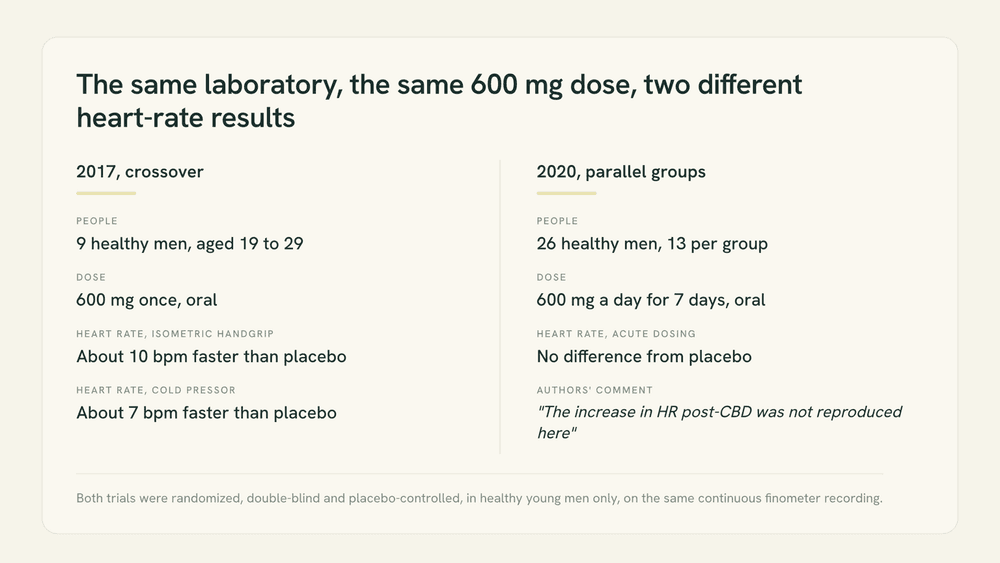
The short answer has a shape rather than a direction. In the randomized crossover trial built to watch a heartbeat continuously under cannabidiol, nine healthy young men on a single 600 mg oral dose ran faster than they did on placebo: about 10 beats per minute faster during a two-minute handgrip test and about 7 during a cold pressor test. Three years later the same laboratory gave 600 mg a day to 26 healthy men for a week, on the same instrument, and the heart-rate difference did not appear. Nobody has measured any of this at the amounts people actually buy and swallow. Everything below is that evidence, arm by arm, with the sample sizes attached. If you are still working out what cannabidiol is, start there; the general adverse-effect list lives on our roundup of CBD side effects, and this page stays on one question: what happens to a pulse.
CBD and heart rate: page one gives you three different answers
We read the first page of results on August 23, 2026, for two queries: does CBD affect heart rate, and does cbd raise heart rate OR can cbd cause heart palpitations. Every informational result on both queries is published by a party that sells CBD or cannabis products, ourselves included. That is worth saying out loud before anything else on this page, including this page. What sits there now, verbatim, is three mutually exclusive answers: "Research suggests CBD has no effect on resting blood pressure or heart rate, nor will it lead to any sort of heart arrhythmia", next to a headline asking "Does CBD lower heart rate?", next to a headline asking "Can CBD make your heart race?" One of those results runs to roughly 4,500 words, with seventeen headings and a twelve-item FAQ, and contains no citations, no PubMed identifiers and no outbound links to primary research at all. It is long, not deep.
The most useful result on that page is the one that gets closest and still lands backwards. It carries a reference list with the correct identifier for the trial we are about to walk through, and then tells the reader "Based on the current research, no, CBD won't make your heart race or cause heart palpitations", and separately that studies "have shown that CBD may lower blood pressure and heart rate". The paper it cites reported heart rate going up in every arm where it moved at all. The same page asserts that CBD's vasorelaxant properties "actually help it reduce the increase in heart rate caused by THC". We are not going to repeat that claim, and section 8 explains exactly why it cannot be supported by anything in the literature we read. The reason page one contradicts itself is not that any one writer is lying. It is that everybody is paraphrasing the same small handful of studies without the design, and the design is where the entire answer lives.
The trial everyone quotes: nine men, one 600 mg dose
The study underneath most of the internet's confident sentences is a randomized, double-blind, placebo-controlled crossover trial published in JCI Insight in 2017 by Jadoon, Tan and O'Sullivan (doi:10.1172/jci.insight.93760). Ten healthy young male volunteers were recruited, mean age 24 and range 19 to 29; one withdrew for personal reasons, so nine men were analyzed. All were non-smokers, none had ever used cannabis, and each had an ECG at screening to rule out a pre-existing cardiac condition. Each man attended twice and received, in random order, a single 600 mg oral dose of CBD (as 100 mg capsules, supplied by GW Pharmaceuticals, which did not fund the study) or a matched placebo, with a washout of at least 48 hours between visits. After an overnight fast and a standardized breakfast, blood pressure and heart rate were recorded beat to beat for two hours on a calibrated finometer, a finger cuff that measures continuously rather than taking a reading now and then. At the two-hour mark, chosen to coincide with peak CBD plasma levels, each man went through three stress tests in order: mental arithmetic, an isometric handgrip held at 30% of maximum for two minutes, and a cold pressor test with one foot in ice slush at 4 to 6 degrees Celsius.
| Condition | What was measured | Difference versus placebo | Statistic as reported |
|---|---|---|---|
| Rest | Systolic blood pressure | About 6 mmHg lower | 95% CI -1 to -12, P < 0.05 |
| Rest | Stroke volume | About 8 mL lower | 95% CI -2 to -14, P < 0.05 |
| Rest | Heart rate | Higher, and significantly so from about 1 hour after the capsule | P < 0.05 |
| Rest | Cardiac output | Unchanged | No difference reported |
| Rest | Forearm skin blood flow | Reduced before the stress tests began | P < 0.01 |
| Mental arithmetic | Overall treatment effect | None; post-hoc pressures were lower | P < 0.05 to < 0.0001 post-hoc |
| Isometric handgrip | Heart rate | About 10 bpm faster | 95% CI 5 to 14, P < 0.01 |
| Isometric handgrip | Systolic blood pressure | About 5 mmHg lower | 95% CI -1 to -10, P < 0.05 |
| Isometric handgrip | Stroke volume | About 13 mL lower | 95% CI -4 to -22, P < 0.01 |
| Isometric handgrip | Cardiac output | No difference | No difference reported |
| Cold pressor | Heart rate | About 7 bpm faster | 95% CI 2 to 13, P < 0.05 |
| Cold pressor | Systolic blood pressure | About 8 mmHg lower | 95% CI -4 to -12, P < 0.01 |
| Cold pressor | Cardiac output | No decline | No difference reported |
Two things in that table are usually left out of the summaries, and both change how you should read it. The first is the cardiac output rows. Cardiac output is how much blood the heart actually moves per minute, and in these nine men on a single 600 mg dose it did not change in any condition. A faster rate paired with a smaller stroke volume and an unchanged output is the signature of a system compensating, at least in those nine men over those two hours, rather than of a system being driven harder. The second is who was in the room. The trial's own methods state that exclusion criteria included "any significant cardiovascular or metabolic disorder or use of any medication", and no participant had taken any prescribed or over-the-counter medicine in the week before randomization. So this trial is silent, by design, about anyone with a heart condition and anyone on a prescription. On safety, the authors write that "CBD was well tolerated, and there were no adverse events on the day of stress tests", and that none of the men reported an adverse event over the following week. That is nine people, one dose and one week of follow-up, and it should be read as exactly that much.
Why the heart rate went up, according to the people who measured it
The authors offered their own reading in the discussion section, and it is a compensatory one. Their words: CBD "may cause sympathoinhibition (through CB1 or some other mechanism), thereby preventing an increase in blood pressure and cardiac output, causing a compensatory rise in heart rate to maintain cardiac output. Indeed, the changes in SBP preceded any changes in HR." That last clause is the evidence for the ordering: in these nine men on a single 600 mg dose, the pressure moved first and the rate followed. It is the same thing your body does when you stand up quickly, or when you give blood, or on a hot day. Nothing in that sentence says the rate rose because cannabidiol is a stimulant, and nothing in it says the rise is good for you either.
Then the same lab ran it again, and the heart-rate result vanished
This is the part no result on page one carries, and it is the single most useful thing we found. In 2020 the same research group published a randomized, double-blind, placebo-controlled trial in the British Journal of Clinical Pharmacology with 26 healthy men, 13 per group, taking 600 mg of CBD a day or placebo for seven days. Same laboratory, same dose, same finometer, two of the same three authors. Eleven of the 26 had used cannabis before and had been abstinent for between two months and a year. On the first dose, mean arterial pressure was about 2 mmHg lower than placebo (95% CI -3.6 to -0.3, P = 0.04), and the paper's own results section then says that this happened "without affecting other cardiovascular parameters compared to placebo". Heart rate is one of those other parameters. Resting systolic pressure on its own did not reach statistical significance in this trial at all (P = 0.08), and neither did diastolic (P = 0.09).
“We previously showed that a single dose of CBD decreases resting BP and increases HR in cannabis naive men. The effect on BP was reproduced in the present study, but this effect was lost after repeated dosing, suggesting that tolerance develops. However, the increase in HR post-CBD was not reproduced here.”
Then they say the part that a seller would have been tempted to leave out: "Explaining the difference in findings on the effect of CBD on HR between our two studies is challenging as the protocols were so similar in terms of dose, population (young males) and methods of measurement." They also retired the obvious explanation before anyone else could offer it. Eleven of their 26 men were former cannabis users while all nine of the 2017 volunteers were cannabis naive, so the natural guess is that prior exposure did it. The paper reports that "post hoc analyses did not show any differences in HR between previous cannabis users and those who were cannabis naive". That is a post-hoc test on small groups and it settles nothing on its own, but it does remove the tidiest available story.
So here is the honest end of this section, and we are not going to resolve it for you, because the laboratory that ran both trials has not resolved it either. Two randomized, placebo-controlled studies from the same group, at the same 600 mg dose, in the same kind of healthy young men, on the same continuous instrument, disagree about whether cannabidiol raises heart rate. One found it and one did not, and the authors say in print that they cannot explain why. Anyone telling you the answer is settled in either direction has not read the second paper.
Pool everything and you are mostly pooling animals
There is one attempt to add all of this up, and reading it explains the whole search result. A 2017 systematic review and meta-analysis in Frontiers in Pharmacology, from the same research group, reviewed 25 studies and pooled 22 of them for blood pressure and heart rate. The critical detail, and the one every summary of it drops, is that the pool runs across six species: humans, mice, dogs, rats, piglets and rabbits. It is not a human meta-analysis, and it should never be quoted as one.
- Acute dosing under ordinary conditions: heart rate mean difference -0.05 beats per minute (95% CI -2.68 to 2.57, p = 0.97). That is a statistical way of writing nothing.
- Chronic dosing: heart rate mean difference 0.3 beats per minute (95% CI -3.97 to 4.57, p = 0.89). Also nothing.
- One within-species signal did appear: acute CBD significantly increased heart rate in rats (p = 0.004). That is a rat result and it stays a rat result.
- The doses pooled ran from 0.003 mg to 22,800 mg across species and models. The authors note that one animal dose would be equivalent to 14,000 mg in a 70 kg human.
- Median study quality was 5 out of 9, and the authors detected publication bias specifically for heart rate after acute dosing.
- It predates both trials in the sections above, so nothing in this pooled picture includes the 2017 or the 2020 result.
The review's authors wrote the sentence that explains the entire disagreement on page one: "It is also worth noting that most of the human data reviewed did not show any significant effects of CBD while significant effects were observed in animal studies." And, plainly: "Our analysis has highlighted the limited amount of human research carried out to date." They also count the human slice of what they pooled, and it is thin: n = 36 for blood pressure and n = 87 for heart rate, against 344 and 395 in the pool as a whole. Their own evidence table then contains a row that makes the point sharper than any pooled estimate. One human trial gave the same 600 mg oral dose to healthy volunteers, took readings by hand before the drug and then hourly for three hours, and recorded "no changes on BP or HR". That row is the 2012 trial we come back to further down this page, so it is one trial appearing twice in this article rather than two independent negative results. Same compound, same amount as the trial at the top of this page, opposite conclusion, and the visible difference is not the dose. It is that one team took a reading once an hour and the other watched a continuous trace. When you read two articles that disagree about whether CBD changes a pulse, the disagreement is usually about instruments and timing, not about cannabidiol.
The size of the evidence: four trials, 120 people
It is fair to ask how large this literature is before deciding what it proves. A systematic review of randomized controlled trials published in the Journal of Cannabis Research in June 2026, by a group at the UCL Institute of Sport, Exercise and Health, searched the databases for oral cannabidiol and blood pressure in adults up to September 2024. We read its structured abstract rather than its full text, because the publisher serves a challenge page to automated requests, so treat everything in this paragraph as coming from the abstract. Its headline number is the size of the field: four randomized controlled trials involving 120 participants met the inclusion criteria, with CBD doses of 225-600 mg a day and durations from two hours to five weeks. And it could not combine them. In the review's own words, "substantial variability in dosing and blood pressure outcome reporting precluded quantitative pooling; therefore, results were synthesised narratively due to clinical heterogeneity". It is a systematic review, not a meta-analysis, and anyone who describes it as a meta-analysis is describing a search snippet. Its own listed limitations are small sample sizes, short trial durations, variability in CBD matrices and dosages, and a lack of pharmacokinetic data. We are citing it here only for the shape and size of the evidence base, not for its conclusion, which you can read for yourself at that link. Note also what its outcome was: blood pressure. Searched on August 23, 2026, PubMed returns zero records that carry cannabidiol and heart rate in a title or abstract and are indexed under a systematic review or meta-analysis publication type. That is a fact about indexing rather than a claim that nothing exists: the six-species review in the section above is a systematic review and meta-analysis by its own title, and PubMed files it as a plain journal article. What is missing is not the search term. It is a synthesis that pools human heart-rate data on its own.
There is one more document worth checking, because it is the only cannabidiol dossier a regulator has actually reviewed. We read the full prescribing information for EPIDIOLEX, the FDA-approved prescription cannabidiol oral solution, on DailyMed on August 23, 2026, in the version revised 5/2026: across the entire label, the terms tachycardia, bradycardia, palpitations, heart rate, blood pressure, hypotension, hypertension, arrhythmia and cardiovascular appear zero times, and the only cardiac pharmacology statement in the document is section 12.2 on QTc, which reports that at monotherapy exposures the drug "did not prolong the QTc interval greater than 10 msec". That is a prescription drug dosed by body weight, and our comparison of Epidiolex and CBD oil covers why its label does not transfer to a tincture. Read the zero-count as what it is: an absence of a reported adverse reaction in one regulated product's trials, not a clearance for any other product.
600 mg is not a serving, and that is the whole problem
Six hundred milligrams is the dose in every trial above. On the strongest Planntz tinctures, which report 250 mg of CBD per milliliter, that is roughly 48 drops swallowed at once, about a twenty-fifth of a 60 mL bottle. That is not a suggestion in either direction; it is the distance between the research and the bottle. Nobody has run this measurement at the amounts people actually take. Drop size varies with the dropper and with technique, so treat 48 as an order-of-magnitude scale comparison rather than a count you could reproduce in your kitchen.
The reason this matters is not that a smaller amount is automatically safer. It is that the honest description of the low-dose picture is unstudied, and unstudied is a different finding from inert. Four trials and 120 people, all at 225 mg a day or more, is what exists. Nothing in that set tells you what a heartbeat does over months at the amounts sold in a dropper bottle, in either direction, and a page that tells you it is fine is making the same unsupported move as a page that tells you it is dangerous. If you want to work out what you personally took, our per-drop calculator does the arithmetic and how to read a CBD label shows you where the milligram figure hides. Amounts, and every question that starts with "how much", belong on our page about CBD dosage, not here.
A racing heart after cannabis is mostly a THC finding
If your actual worry is palpitations, the most relevant trial in this whole dossier is the one that tested both compounds in the same people. A 2012 randomized, double-blind, placebo-controlled crossover study in Current Pharmaceutical Design gave 16 healthy male volunteers three sessions at one-month intervals: oral THC 10 mg, oral CBD 600 mg, or placebo, with measurements before dosing and at 1, 2 and 3 hours. Its result reads: relative to both placebo and CBD, THC was associated with anxiety, dysphoria, positive psychotic symptoms, sedation, subjective intoxication and "an increase in heart rate (p < 0.05)". And then: "There were no differences between CBD and placebo on any symptomatic, physiological variable." Ten milligrams of THC moved a pulse. Six hundred milligrams of CBD, sixty times the milligram amount, did not separate from placebo. Federal drug information says the same thing about the plant: the NIDA page on cannabis as a drug of use states that "cannabis can increase heart rate and blood pressure right after use", a statement about a THC-containing product rather than about cannabidiol.
Now the refusal, because this is where page one goes wrong in our favor and we are not taking it. We cannot tell you that CBD counteracts, blocks or offsets THC's effect on heart rate, and neither can anyone else honestly. In that 2012 trial the two compounds were given in separate sessions a month apart, never together, so it is a comparison and not an interaction test. Nothing else in the evidence we read co-administered them either. A trial that shows THC raises heart rate and CBD does not is exactly that, and turning it into "CBD protects you from THC" is a product-benefit claim wearing a citation's clothes. If you meet that sentence on a shop's blog, it is not coming from a study.
The practical version is a label question rather than a pharmacology question. A full-spectrum product contains trace THC below the 0.3% federal limit, and Planntz full-spectrum COAs run around 0.13% to 0.25%. A broad-spectrum product has had the THC removed and reports non-detected on this batch's COA for the mango and natural flavors, with a 0.019% trace on lemon. Non-detected is a lab result for one batch, not a guarantee. If a gummy or a tincture is followed by a racing pulse, the first thing worth knowing is which of those you took, and the answer is on the certificate of analysis for your batch. How to read a CBD label shows you where to find it, and the difference between CBD and THC covers what each compound does.
What actually moves a pulse, according to the NLM and the FDA
| What it is | What the source says about it | Source |
|---|---|---|
| Anxiety, stress, panic or fear | Listed first among the causes of palpitations | MedlinePlus, Heart palpitations |
| Caffeine | Increased heart rate and heart palpitations are named as signs of consuming too much; 400 mg a day is cited as an amount not generally associated with negative effects, with wide individual variation | FDA consumer update on caffeine |
| Nicotine | "Nicotine intake" is on the causes list | MedlinePlus, Heart palpitations |
| Excessive alcohol | "Excessive alcohol consumption" is on the causes list | MedlinePlus, Heart palpitations |
| Stimulant drugs | "Cocaine, methamphetamine or other stimulant drugs" is on the causes list | MedlinePlus, Heart palpitations |
| Decongestants | Named specifically, as phenylephrine or pseudoephedrine | MedlinePlus, Heart palpitations |
| Diet pills | On the causes list | MedlinePlus, Heart palpitations |
| Exercise or fever | Both on the causes list | MedlinePlus, Heart palpitations |
| Dehydration or infection | "A fast pulse may signal an infection or dehydration" | MedlinePlus, Pulse |
Cannabidiol is not on the National Library of Medicine's list of what causes heart palpitations. Be careful with that: it is a fact about the list, not evidence that CBD is inert, and the NLM was not asked the question. What the list is genuinely good for is triage. Almost everyone who notices a fast pulse after trying a new supplement has also had coffee that day, or is running on five hours of sleep, or is mildly dehydrated, or is a little anxious about swallowing something new, and any one of those is better documented than anything in the trials above. The FDA's own consumer page on caffeine puts increased heart rate and heart palpitations at the top of its list of signs of too much, and that list belongs to caffeine alone: nothing on this page suggests CBD reduces, treats or balances any of it. For the combinations, CBD and caffeine covers the stimulant question, CBD and alcohol covers drinking, and CBD and Adderall covers prescription stimulants. If you take a blood pressure medicine, CBD and blood pressure medication is the page that handles it in full, and this one deliberately does not.
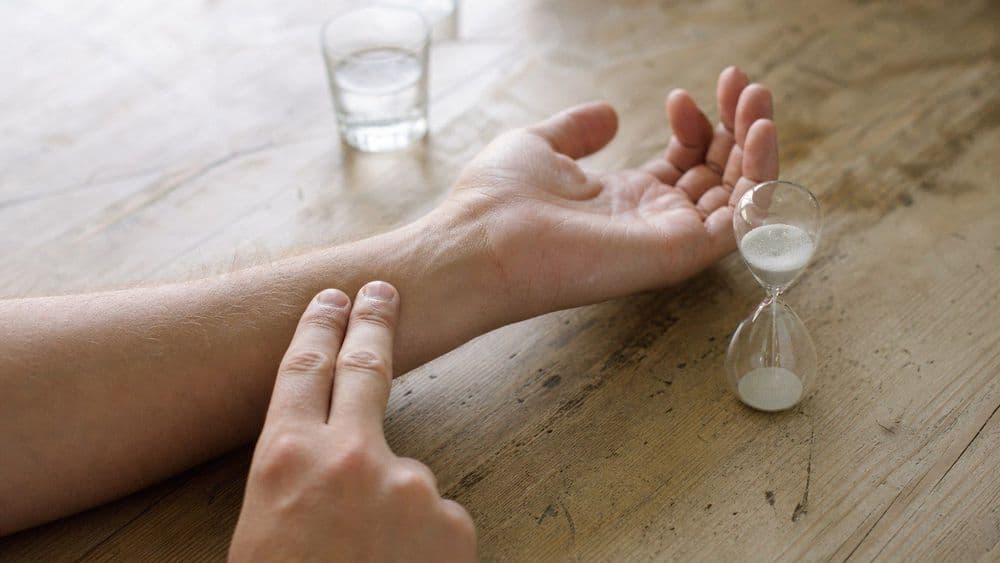
How to check your pulse before you conclude anything
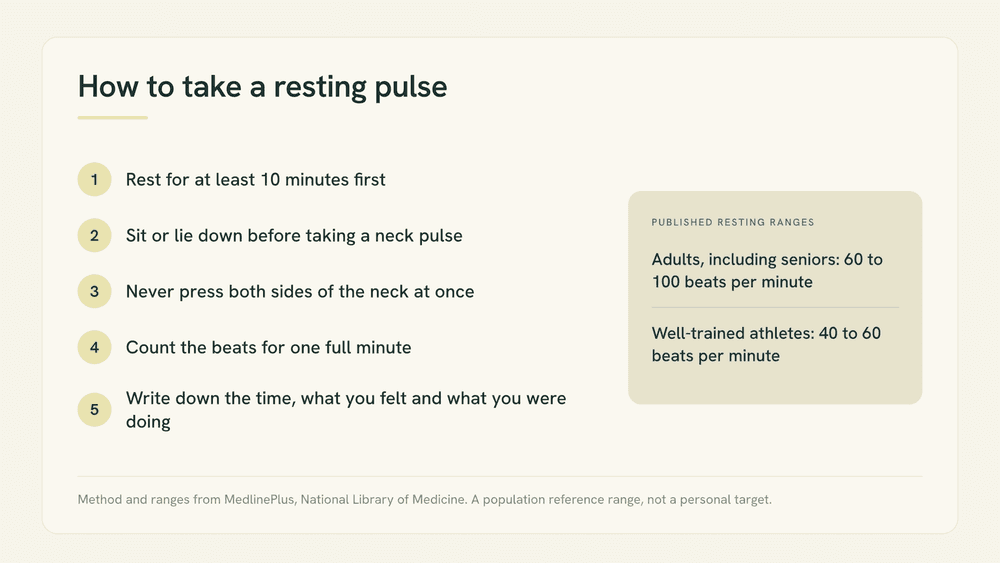
- 1Rest for at least 10 minutes first. The NLM is explicit: a rate taken 30 seconds after you stood up is not a resting rate.
- 2Sit or lie down before taking a neck pulse. The NLM warns that neck arteries are sensitive to pressure in some people, and that fainting or a slowed heartbeat can result.
- 3Never press both sides of the neck at the same time. The NLM says doing so can slow the flow of blood to the head and lead to fainting.
- 4Count the beats for one full minute. Not 15 seconds multiplied by four, which turns one miscounted beat into four.
- 5Compare against the published range rather than a number you saw online: 60 to 100 beats per minute for adults including seniors, and 40 to 60 for well-trained athletes.
- 6Write down the time, what you felt, and what you were doing. The NHLBI asks for exactly that record, and it is the thing a clinician can actually use.
- 7Write down the rest of the hour too: coffee, alcohol, nicotine, a decongestant, a missed meal, how much water, how much sleep.
- 8Repeat it on a few ordinary days, so you are comparing against your own baseline instead of guessing at it.
Those numbers and that method come from the National Library of Medicine's page on taking a pulse, which also notes that a fast pulse may signal an infection or dehydration. The 60 to 100 band is a population reference range and not a personal target: plenty of healthy people sit outside it in both directions, and what matters more is a change from your own normal that sticks around. The record-keeping step is the NHLBI's advice on arrhythmia symptoms, which asks you to keep track of when and how often symptoms happen, what you feel, what you were doing, and whether any of it changes over time. Two weeks of scrappy notes will tell a clinician more than a wearable's summary graph, because the notes contain the coffee.
When this is a clinician question today
The NLM also says that palpitations are "not serious most of the time", and that sentence only means anything when it travels with the list above it, so we have printed them together. Two more boundaries, both firm. First, nothing here is a reason to start, stop, delay, re-time or change the amount of any prescription, cardiac or otherwise. If you take a medicine and you are wondering how CBD fits alongside it, that conversation belongs to the person who prescribed it; our overview of CBD and medications explains why the question exists at all, and CBD and blood pressure medication covers the specific case. Second, if you already have a heart condition, no trial in this article can answer your question, and that is not a hedge: the 2017 trial's exclusion criteria removed anyone with "any significant cardiovascular or metabolic disorder or use of any medication", and the 2020 trial recruited healthy young men. Older readers, who are the most likely to be monitoring a pulse in the first place, will find the population-specific caveats on CBD for seniors.
In the randomized crossover trial designed to measure it continuously, yes: in nine healthy men on a single 600 mg oral dose, heart rate was about 10 beats per minute higher than placebo during a two-minute handgrip test and about 7 higher during a cold pressor test, with cardiac output unchanged in both. When the same laboratory repeated the design in 26 healthy men at the same 600 mg dose, the heart-rate difference did not appear, and the authors said they could not explain the discrepancy. Nobody has measured it at the amounts people actually take.
No study we read reports that. The 2017 pooled analysis across six species found essentially no change under ordinary conditions, a mean difference of -0.05 beats per minute, and the human trial where anything moved moved it upward. "CBD lowers heart rate" is a page-one headline without a trial behind it.
Searched on August 23, 2026, PubMed returns two records where cannabidiol and palpitations appear together in a title or abstract, and neither is a study of CBD causing them. The National Library of Medicine's own list of causes names anxiety, caffeine, stimulant drugs, decongestants, diet pills, exercise, fever, nicotine and excessive alcohol, and does not name CBD. That is not proof CBD cannot; it is a measure of how little has been looked at.
There is no evidence either way, and we are not going to invent a reassurance. No trial in this article included anyone with a diagnosed arrhythmia, because they all recruited healthy volunteers and excluded cardiovascular conditions on purpose. A new irregular rhythm is a same-day clinician question regardless of what you have taken, and if it comes with chest pain, breathlessness or fainting it is an emergency-number question.
A gummy is a package, not a molecule. Check the label and the batch COA for THC first, since THC at 10 mg raised heart rate in a controlled trial where 600 mg of CBD did not. Then check the rest of the hour: caffeine, a decongestant, nicotine, alcohol, a stimulant prescription, a fever, dehydration, or plain anxiety about trying something new. Every one of those is on the National Library of Medicine's causes list. If it keeps happening, it is a clinician question rather than a label question.
In the 2017 crossover trial, nine healthy men on a single 600 mg oral dose had resting systolic pressure about 6 mmHg lower than on placebo. In the 26-man follow-up at the same dose, the resting effect was present after the first dose and gone by day seven, which the authors attributed to tolerance. That is a pharmacology finding in healthy young men on a large single dose, not a property of any product, and none of it is a reason to change anything about a blood pressure prescription. The interaction question is covered in full on our page about CBD and blood pressure medication.
The 2017 trial recorded beat to beat for two hours and ran its stress tests at the two-hour mark, chosen to coincide with peak CBD plasma levels. The 2020 trial recorded for three hours. Neither followed anyone with continuous monitoring beyond that on a given day, so nobody can tell you what happens at hour six, or at week six at a consumer amount.
No trial in this article can answer that, because they all excluded those people. The 2017 trial's methods say it outright: exclusion criteria included any significant cardiovascular or metabolic disorder or use of any medication. That makes it a question for the clinician who knows your history and your prescriptions, and it is not one an article can answer from published averages in healthy 24-year-olds.
If you are building a general picture of what cannabidiol does to a body, the full roundup of CBD side effects holds the list this page is one entry on, and what CBD actually feels like covers the subjective side that a finometer cannot record. What this page can tell you is narrower than page one would like, and we think more useful than a reassurance: the number everybody quotes has nine people behind it, and the amount sitting in a dropper bottle has never been measured against a heartbeat at all.
Writing about hemp, wellness and the small rituals that keep us balanced.