How to Read a CBD Label: Every Number Decoded
One CBD bottle can carry four milligram numbers, and only one of them compares across brands. Here is every element on a US CBD label decoded: the front-panel total, mg/mL, servings, the Supplement Facts panel, and the batch code that links the bottle to its lab report.
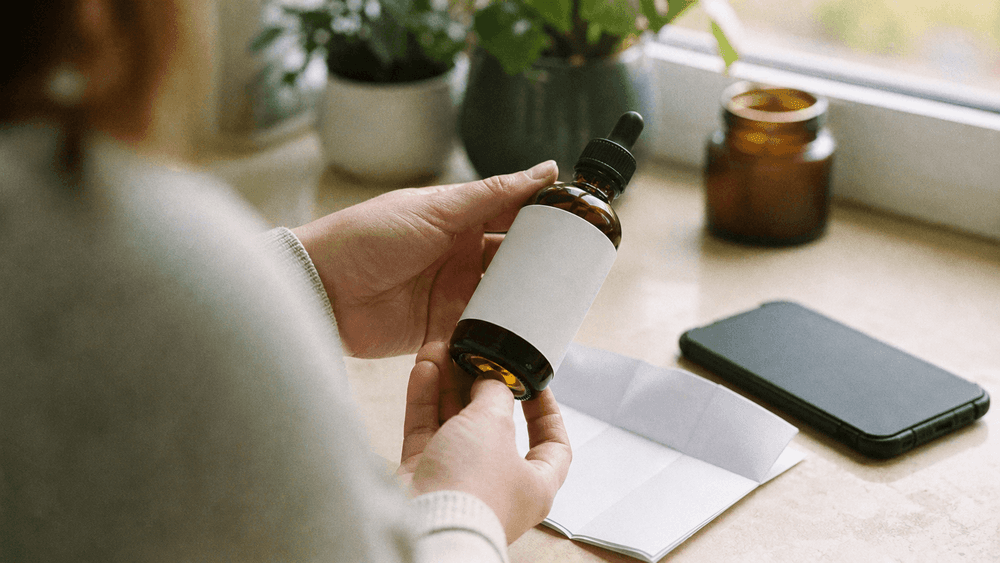
Pick up a CBD bottle and you can be looking at four different milligram numbers at once: the big one on the front, a concentration, an amount per serving, and an estimate per drop. Only one of them lets you compare two brands honestly. Learning how to read a CBD label is mostly a decoding job, element by element: what each part of a US label legally has to say, how to turn any front-of-bottle number into real strength in about 30 seconds, and which line on the bottle is the only one you can actually verify.
The short version, before the detail. The big number on the front is almost always the total in the whole container, not a serving. Divide it by the bottle's volume in milliliters and you get mg/mL, the one figure that compares across brands and bottle sizes. Then find the batch or lot number and the link to that batch's lab report, because everything printed on the bottle is the manufacturer's claim, and the certificate of analysis is the part that was measured. In a 2024 analysis published in Frontiers in Pharmacology, researchers bought 202 US CBD products online in 2021 and tested them: 149 of them (74%) measured more than 10% away from the CBD stated on the label, and one product came in at 565% of its claim. That study was sponsored by Jazz Pharmaceuticals, tested a single unit per product and is not a verdict on any particular brand, but it is the reason label literacy starts with "this is a claim" rather than "this is a measurement".
The four numbers people confuse
Almost every label misunderstanding comes down to treating these four figures as if they were interchangeable. They are not, and only one of them survives a comparison between two different bottles.
- **Total mg per container.** The headline number: 1,000 mg, 3,000 mg, 15,000 mg. It tells you how much active is in the whole bottle and nothing about strength until you know the volume.
- **mg/mL (concentration).** Total CBD divided by total milliliters. This is the only figure that lets you compare a 30 mL bottle with a 60 mL bottle, or a $40 product with an $80 one.
- **mg per serving.** A brand-defined unit. One company calls 0.5 mL a serving, another calls 1 mL a serving, and the same oil then shows two very different "per serving" numbers. Useful only once you know the serving's volume.
- **mg per drop.** An estimate, never a printed fact. Drop size changes with the dropper, the oil's viscosity and how you squeeze. Treat it as an approximation and use the dropper's mL graduations when precision matters.
The front panel: what the big number actually promises
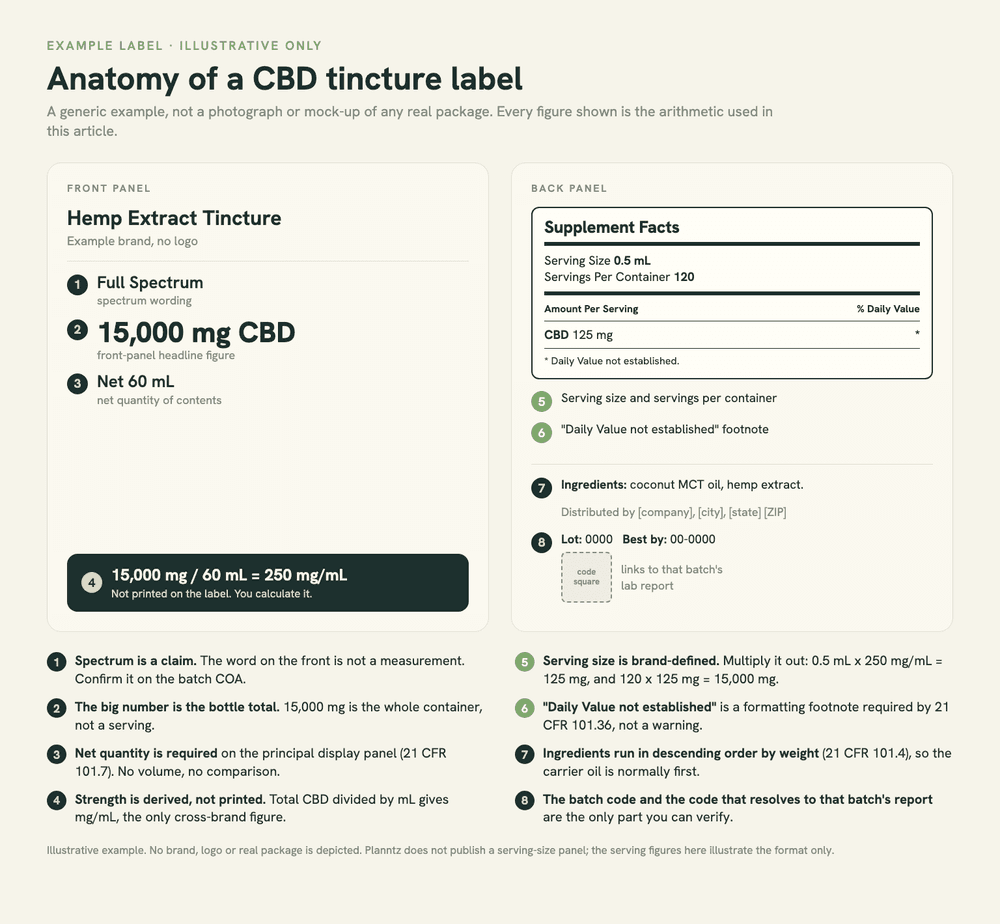
The front of a bottle (the principal display panel) carries the product identity and the net quantity of contents. That volume declaration is not optional: 21 CFR 101.7 requires a net-quantity statement on the principal display panel, expressed in fluid measure for a liquid. If you cannot find a mL or fl oz figure anywhere, you cannot compute strength, and that is a problem with the label rather than with your arithmetic. When the volume is in fluid ounces, convert first: 1 US fluid ounce is about 29.57 mL, so a 1 oz bottle is roughly 30 mL and a 2 oz bottle is roughly 59 mL.
Do the math: turn any label into mg/mL
Three steps, and they work on every tincture on the shelf. Step one: get the volume into milliliters (multiply fluid ounces by 29.57). Step two: divide the total CBD milligrams by that volume. Step three: multiply the result by the mL mark you would actually use on the dropper. On a Planntz 60 mL bottle carrying 15,000 mg of CBD, that runs 15,000 mg divided by 60 mL equals 250 mg/mL, so the 0.25 mL graduation holds about 62.5 mg and a full 1 mL pipette holds 250 mg. At the common assumption of 20 drops per mL (about 0.05 mL per drop), a single drop works out to roughly 12.5 mg, but drop size genuinely varies, so treat per-drop figures as estimates. Our guide to measuring your own dropper instead of assuming shows how to check yours in a couple of minutes.
| Front-of-bottle claim | Net volume | Strength (mg/mL) | mg in a full 1 mL dropper | Est. mg per drop |
|---|---|---|---|---|
| 75 mg | 0.5 fl oz (~14.8 mL) | ~5 | ~5 | ~0.25 |
| 250 mg | 1 fl oz (~30 mL) | ~8 | ~8 | ~0.4 |
| 1,000 mg | 1 fl oz (~30 mL) | ~33 | ~33 | ~1.7 |
| 1,500 mg | 1 fl oz (~30 mL) | 50 | 50 | ~2.5 |
| 3,000 mg | 2 fl oz (~60 mL) | 50 | 50 | ~2.5 |
| 15,000 mg | 60 mL | 250 | 250 | ~12.5 |
Two things fall out of that table. First, 1,500 mg in 30 mL and 3,000 mg in 60 mL are exactly the same strength. The front number alone tells you nothing until you divide. Second, look at the first row, because it is a real label people search for: "75 mg of full spectrum hemp extract per 0.5 oz". Half a fluid ounce is about 14.8 mL, so 75 mg in that bottle is roughly 5 mg/mL, or about 0.25 mg per drop at the 20 drops per mL assumption. The whole 0.5 oz bottle holds about as much active material as six drops of a 250 mg/mL oil. And there are two traps stacked in that one phrase: "per 0.5 oz" is describing the container, not a serving (nobody takes half an ounce of tincture at a time), and 75 mg of hemp extract is not 75 mg of CBD.
Multi-cannabinoid labels: read each cannabinoid separately
As soon as a product carries more than one cannabinoid, a single "15,000 mg of actives" figure stops being informative. Two bottles can advertise the same total and contain completely different things. The fix is to insist on a per-cannabinoid breakdown and to run the division on each line, exactly as you would for a single-cannabinoid oil. Here is what that looks like across the Planntz tinctures, all of them 60 mL, so the concentrations are directly comparable.
| Product | Actives on the label | Strength (mg/mL) | Est. per drop | THC as reported on the COA |
|---|---|---|---|---|
| Broad Spectrum | 15,000 mg CBD | 250 mg/mL CBD | ~12.5 mg CBD | Non-detected on the current mango and natural batch COAs; a 0.019% trace on the lemon batch |
| Full Spectrum CBD | 15,000 mg CBD | 250 mg/mL CBD | ~12.5 mg CBD | Trace, below the 0.3% federal limit |
| Full Spectrum CBD + CBG | 9,000 mg CBD + 6,000 mg CBG | 150 mg/mL CBD + 100 mg/mL CBG | ~7.5 mg CBD + ~5 mg CBG | Trace, below the 0.3% federal limit |
| Full Spectrum CBD + CBN | 8,000 mg CBD + 4,000 mg CBN | 133 mg/mL CBD + 67 mg/mL CBN | ~6.7 mg CBD + ~3.3 mg CBN | Trace, below the 0.3% federal limit |
The back panel, decoded
Turn the bottle around and you are looking at a panel built to the format in 21 CFR 101.36, the federal rule for Supplement Facts. That rule is what makes the layout familiar: a serving size, servings per container, and quantitative amounts under "Amount Per Serving". Ingredients that have no official daily reference amount carry an asterisk and the footnote "Daily Value not established", which is a formatting requirement rather than a warning or an endorsement. Here is what to read, in order, and what each line can hide.
- **Serving size and servings per container.** Multiply them and the result should land close to the net volume. If a 30 mL bottle claims 60 servings, the serving is 0.5 mL, which is half a dropper, not a full one.
- **Amount per serving.** This is the number to compare against the front panel. Amount per serving times servings per container should reconcile with the bottle total. When it does not, one of the two figures is decorative.
- **"Daily Value not established".** The asterisk footnote required by 21 CFR 101.36 when no official daily reference amount exists for that ingredient. It is normal on cannabinoid products and means nothing about quality.
- **Proprietary blend.** Under 21 CFR 101.36(c), a proprietary blend only has to declare the blend's *total* weight, components listed in descending order, no individual amounts. On a cannabinoid product, that hides how much of each cannabinoid you get.
- **Ingredient list.** Ingredients appear by common name in descending order of weight (21 CFR 101.4), so the carrier oil is normally first. If hemp *seed* oil is the only hemp-related ingredient, you are holding a seed oil, not a CBD extract.
- **Manufacturer identity.** 21 CFR 101.5 requires the name and place of business of the manufacturer, packer or distributor: wording like "Distributed by" plus street address, city, state and ZIP. No identifiable company is a missing requirement.
What a Supplement Facts panel on a CBD bottle is and is not
This is the part most label guides skip, and it changes how much weight the panel deserves. Under the FDA's current position, CBD is excluded from the legal definition of a dietary supplement, because it is the active ingredient in an approved drug. The agency's consumer guidance states that "it is currently illegal to market CBD by adding it to a food or labeling it as a dietary supplement", and that regulatory question is still under active reconsideration. The practical consequence for a shopper is straightforward: when a CBD bottle carries a Supplement Facts style box, that layout is an industry convention borrowed from the supplement rules, not a panel an agency has reviewed or signed off on. That is true right across the category.
So how much should you trust the numbers in that box? Enough to do the arithmetic with them, not enough to stop there. The FDA says it has tested the cannabinoid content of some CBD products and that "many were found to not contain the levels of CBD they claimed", and a 2022 analysis in the Journal of Cannabis Research measured 80 hemp-derived products by mass spectrometry and found 37 of them at least 10% away from their labeled concentration, with label claims spanning 7.5 to 60 mg/mL against measurements from 2.9 to 61.3 mg/mL. That was a single snapshot of 80 products and it named no brands, so read it as a reason to verify rather than a verdict. None of this makes the panel useless; it makes it a claim that needs a check behind it, and the check is the batch lab report.
Spectrum and THC words on the front
"Full spectrum", "broad spectrum" and "isolate" describe how much of the plant survived the extraction: everything including trace THC, everything with the THC removed, or CBD alone. They are useful words and they are also just words on a package. In that same 2024 analysis of 202 products, about a quarter did not meet the definition of the product type printed on the label. By category, only 67% of full-spectrum, 68% of broad-spectrum and 57% of isolate products matched their claimed definition, and three products sold as broad spectrum still contained THC (two of them above 0.3%). If you want the trade-offs rather than the definitions, our breakdown of what full, broad and isolate actually mean covers them.
THC is where the wording has to be exact, because a label rarely prints a THC figure at all. Broad-spectrum products have the THC removed, and a clean batch reports non-detected on its COA (Planntz Broad Spectrum reports non-detected on the currently published mango and natural batch COAs, with a 0.019% trace on the lemon batch). Full-spectrum products keep trace THC below the 0.3% federal limit. Neither of those is "THC-free" as an absolute, and no product can guarantee a drug-test outcome, since test sensitivity and personal factors vary. If a test matters to you, read our look at whether CBD shows up on a drug test before you rely on any front-panel wording.
Batch numbers, QR codes and dates
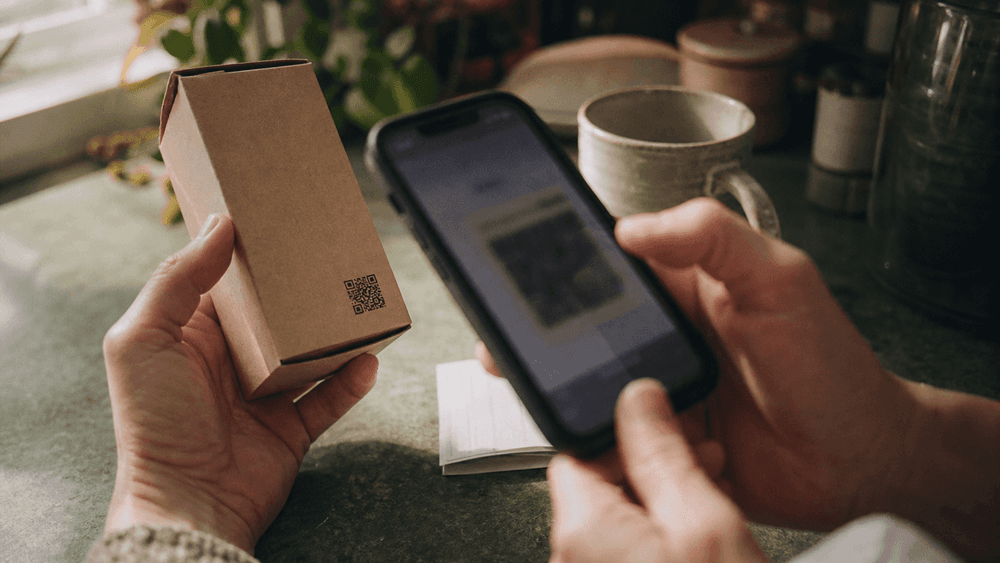
Everything above is a claim you read. This part is the claim you can test. A batch or lot number identifies a specific production run, and a certificate of analysis is written for one run, not for a product line. When the number on the bottle and the number on the report are the same, the potency and contaminant figures in that report describe the liquid you are about to swallow. When they are not, the report is a brochure. Our walkthrough of matching a batch number to the lab report covers how to read each panel once you have the right document open.
- **Batch or lot code.** Usually inkjet-printed on the bottle, the box or the carton flap rather than part of the printed label art. If there is no code anywhere, no report can be tied to your bottle.
- **Where the code leads.** A QR code, short URL or batch lookup field on the brand's site should land on that batch's report in a step or two. A code that dumps you on a homepage, or one undated generic PDF for every product, is not traceability.
- **Dates.** Look for a manufacture date, a best-by date, or both; they show how long the oil has sat, which matters more than most shoppers assume. Our note on best-by dates and what ageing does explains what changes over time.
- **State rules can vary.** Florida's hemp statute (Fla. Stat. 581.217, 2025) requires a batch number, expiration date, per-serving cannabinoid milligrams and a QR/barcode linked to the batch's lab report. One verified example, not a national requirement.
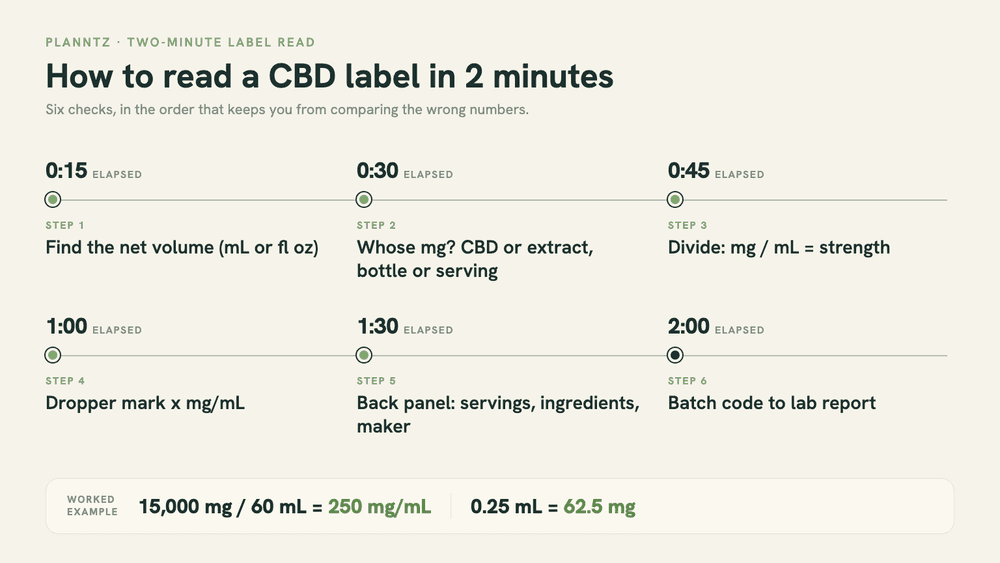
How to read a CBD label in 2 minutes
- 1**0:00 to 0:15, find the volume.** Locate the net quantity on the front panel in mL or fl oz. Convert ounces to milliliters (multiply by 29.57). No volume, no comparison, and a missing net-quantity declaration is itself a problem.
- 2**0:15 to 0:30, interrogate the big number.** Ask whose milligrams those are. CBD or hemp extract? The whole bottle or one serving? All cannabinoids added together or one of them?
- 3**0:30 to 0:45, divide.** Total CBD milligrams divided by milliliters gives mg/mL. Write it down. This is the number you carry to the next bottle.
- 4**0:45 to 1:00, look at the dropper.** Find the graduations (usually 0.25, 0.5, 0.75 and 1 mL) and multiply mg/mL by the mark you'd use. That is a realistic serving in milligrams: a strength calculation, not a dosing recommendation.
- 5**1:00 to 1:30, work the back panel.** Serving size times servings per container should roughly equal the net volume. Each cannabinoid needs its own milligram figure, no proprietary blend hiding the split, and the manufacturer's name and address listed.
- 6**1:30 to 2:00, close the loop.** Find the batch or lot code, scan the QR or use the batch lookup, and confirm four things on the report: same batch number, a recent date, an independent lab, and a CBD figure that matches the label.
Label red flags
- A milligram figure with no bottle volume anywhere, so strength cannot be calculated.
- "Hemp extract" milligrams with no separate CBD figure on the label or the report.
- Hemp seed oil as the only hemp ingredient, which is a culinary oil rather than a CBD extract.
- A proprietary blend that shows only a combined total, so the split between cannabinoids stays hidden.
- No batch or lot code, or a code that appears nowhere in the brand's published reports.
- A QR code that lands on a homepage, a shop page, or one undated generic PDF used for every product.
- "FDA approved" or "FDA registered" on a CBD label. Neither describes a CBD tincture.
- A disease claim on the package. In December 2020 the FTC brought its first enforcement actions against six CBD marketers over unsupported claims that their products treat serious conditions, so a claim like that is a warning sign rather than a strength.
- "THC-free" stated as an absolute with no THC figure on a batch report to back it up.
- No manufacturer or distributor name and address, and no date of any kind on the package.
What a label can never tell you
A label, read well, tells you what a manufacturer says is in the bottle and how strong that would make it. It does not tell you what is actually in the bottle (that is the lab report), and it does not tell you how much to take. Strength is not a dose: 250 mg/mL is a property of the liquid, and what a person uses is a separate decision, which our guide to thinking about serving size treats on its own terms. A label also says nothing about whether CBD will do anything for you. According to the NIH's National Center for Complementary and Integrative Health, human evidence for most consumer CBD uses is limited or preliminary, and a well-printed panel does not change that. Label literacy protects your money and your expectations; it is one part of the decision, and the full buyer's checklist covers the rest.
Frequently asked questions
Half a US fluid ounce is about 14.8 mL, so 75 mg in that bottle works out to roughly 5 mg/mL, or about 0.25 mg per drop at the common 20 drops per mL assumption. Two catches sit inside that phrase. "Per 0.5 oz" is describing the whole bottle, not a serving, because nobody takes half an ounce of tincture at once. And 75 mg of hemp extract is a weight of extracted plant material, not a stated amount of CBD, so unless the label gives a separate CBD figure the CBD content is unknown.
Almost always the total amount in the whole container, not per serving and not per drop. Divide it by the bottle volume to get strength: 1,000 mg in 30 mL is about 33 mg/mL, and 15,000 mg in 60 mL is 250 mg/mL. A bigger front number can simply mean a bigger bottle, which is why 1,500 mg in 30 mL and 3,000 mg in 60 mL are the same strength.
No. Hemp extract is the whole extracted material, which includes other cannabinoids, terpenes, waxes and fats. CBD is one compound inside it. A label can be perfectly truthful about milligrams of extract while saying nothing about milligrams of CBD. Look for a CBD-specific figure on the panel, then confirm it on the batch certificate of analysis.
Divide the total CBD milligrams by the bottle's milliliters. If the volume is printed in fluid ounces, convert first: 1 fl oz is about 29.57 mL, so 1 oz is roughly 30 mL and 2 oz is roughly 59 mL. Worked example: 15,000 mg divided by 60 mL equals 250 mg/mL. That single number is what you compare between brands, and it is also what you multiply by a dropper graduation to get milligrams per serving.
About 5 drops at the common assumption of 20 drops per mL, but a drop is not a fixed unit: size varies with the dropper, the oil's viscosity and your technique, so the mL graduation on the pipette is the more reliable input. What 0.25 mL contains depends entirely on strength: about 62.5 mg at 250 mg/mL, and about 1.25 mg at 5 mg/mL. On the same assumption, a 60 mL bottle holds roughly 1,200 drops.
It is the exact disclaimer text set out in 21 CFR 101.93(c), required whenever a product makes a structure/function statement. It signals the opposite of approval: the FDA has not evaluated the statement. It is also worth knowing that under the FDA's current position CBD is excluded from the legal definition of a dietary supplement, so a Supplement Facts panel on a CBD bottle is an industry formatting convention rather than a reviewed panel.
There is no single federal labeling rule requiring a THC figure on the bottle, which is why most labels do not carry one. Some states go further: Florida's hemp statute requires the milligrams of each marketed cannabinoid per serving plus a scannable code linking to that batch's independent lab report. In practice the delta-9 THC number lives on the certificate of analysis rather than the package, so that is where you should look for it.
Run the last step on us
A label read ends where the lab report begins. Every Planntz batch has a public third-party certificate of analysis with the cannabinoid and contaminant panels in full, so you can match the code on the bottle to the numbers a lab actually measured.
View our lab resultsWriting about hemp, wellness and the small rituals that keep us balanced.