How to Choose CBD Oil: A Buyer's Checklist
Vague advice like 'look for lab testing' won't protect your wallet. This buyer's checklist turns CBD quality into something you can verify at the shelf: how to read a COA, match the spectrum, decode the label, and compare the real price per mg of CBD.
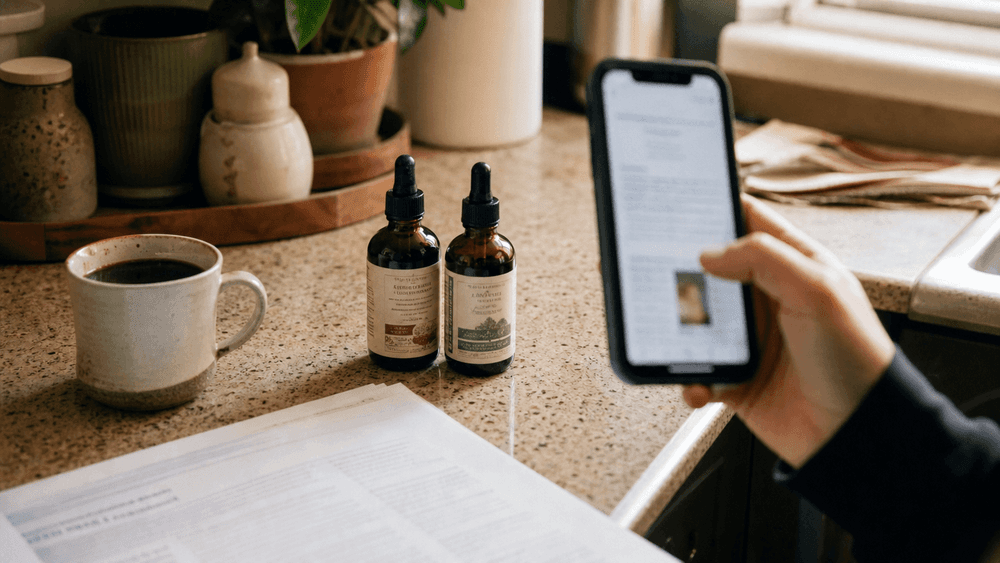
Learning how to choose CBD oil should be simple, but every shelf and search result is full of confident marketing: 'premium', 'lab-tested', 'the gold standard'. None of that is proof. A good buyer's checklist doesn't care about a brand's story. It gives you a handful of things you can actually verify, so you can judge any CBD oil (including this one) on facts instead of adjectives.
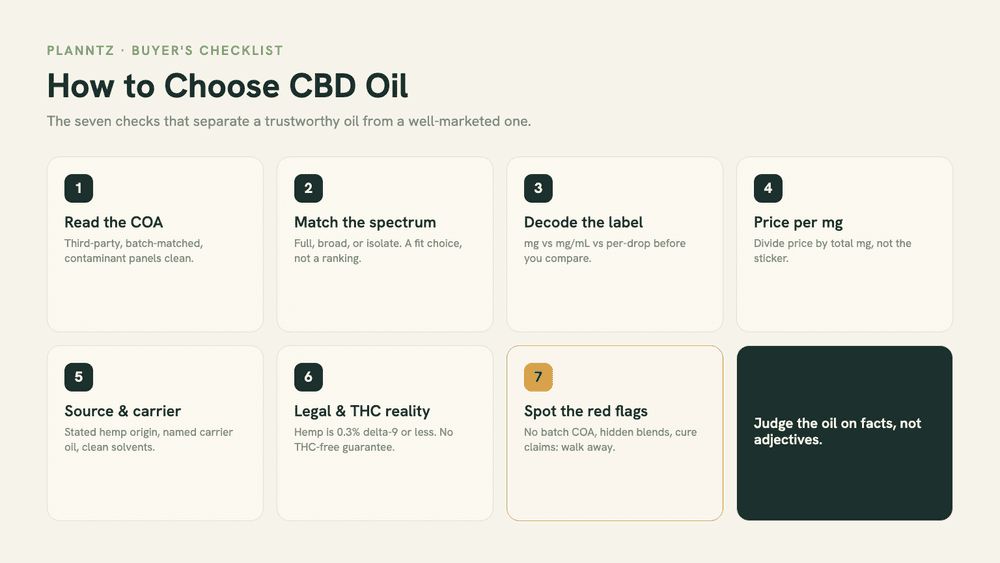
Here is why the checklist matters more than the label. A 2017 JAMA analysis of 84 CBD products sold online found only about 31% were labeled within 10% of their actual CBD content, and THC was detected in about 21% of them, which is exactly why a batch-specific lab report matters. The market has matured since then, but the lesson holds: the claim on the front of the bottle is not evidence. The document behind it is. This guide walks you through the seven checks that separate a trustworthy CBD oil from a well-marketed one.
1. Start with the COA (the third-party lab report)
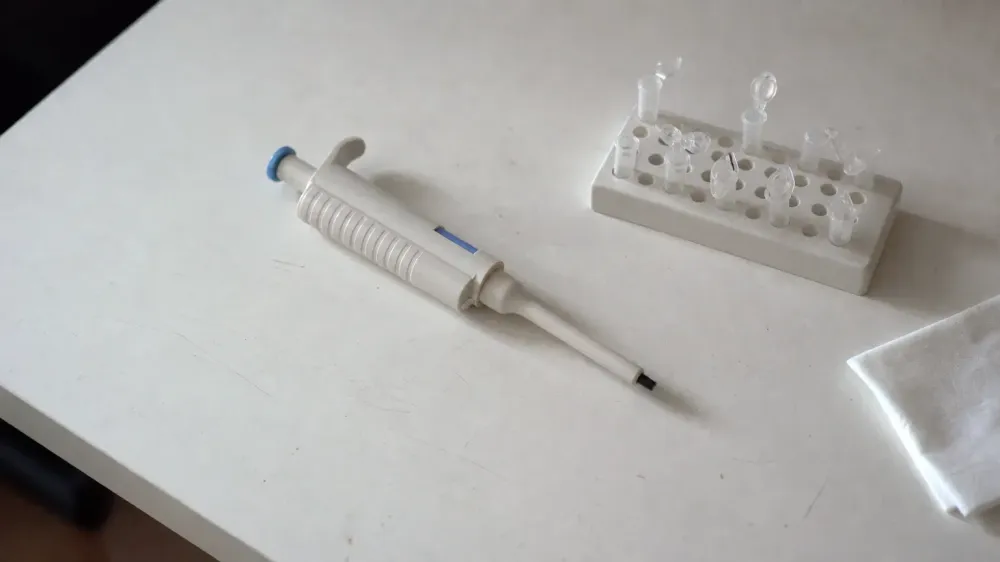
A certificate of analysis (COA) is an independent lab's report on what is actually in a specific batch of product. It is the single most useful thing you can look at, and it is where most guides stop being helpful. They tell you to 'check for a COA' but never show you how to tell a trustworthy one from a decorative PDF. The FDA has reported that some CBD products it examined contained contaminants such as pesticides, heavy metals, or THC that was not on the label, so verifying the report is not paranoia, it is basic due diligence.
A COA is only worth trusting if it passes these five cross-checks. If you want the deep version of this, our guide on how to actually verify a COA breaks down each panel line by line.
- 1Independent lab: the test comes from a third-party lab, ideally accredited to ISO 17025, not the brand's own in-house bench.
- 2Batch and date match: the lot number and date on the report match the bottle in your hand, and the report is recent, not years old.
- 3Potency vs label: the cannabinoid table shows a CBD figure that actually matches what the label promises, within a small margin.
- 4Contaminant panels: pesticides, heavy metals, residual solvents, and microbials are each listed and marked pass or non-detected.
- 5THC figure: the report states the delta-9 THC level so you can confirm it sits within the legal limit.
Where do you find the report? A transparent brand makes it easy: a QR code on the box, a batch lookup on the site, or a public lab-results page listing every current batch. If finding the COA feels like a scavenger hunt, or if the only 'proof' offered is a generic marketing image with no lab name or accreditation, that is information in itself. The willingness to publish a full, matchable report is one of the clearest signals of a brand that has nothing to hide.
2. Match the spectrum to your goal
CBD oils come in three types, and none of them is 'stronger' by default. Full spectrum keeps the whole range of the plant's compounds, including trace THC that stays below the 0.3% federal limit. Broad spectrum keeps the minor cannabinoids but removes THC, so a clean batch reports non-detected THC on its COA. Isolate is CBD only, with everything else stripped out. Some researchers describe an 'entourage effect', where the plant's compounds may work together, but human evidence for it is limited, so treat it as a research idea rather than a promise.
The right choice is a fit decision, not a ranking. Choose based on whether you want the minor cannabinoids and how you feel about any trace THC at all. For example, Planntz Broad Spectrum reports non-detected THC on its mango and natural batches, while the Full Spectrum line carries trace THC that stays below 0.3%. Our full breakdown of full vs broad vs isolate walks through the trade-offs so you can pick the one that matches your situation.
3. Read the label like a chemist
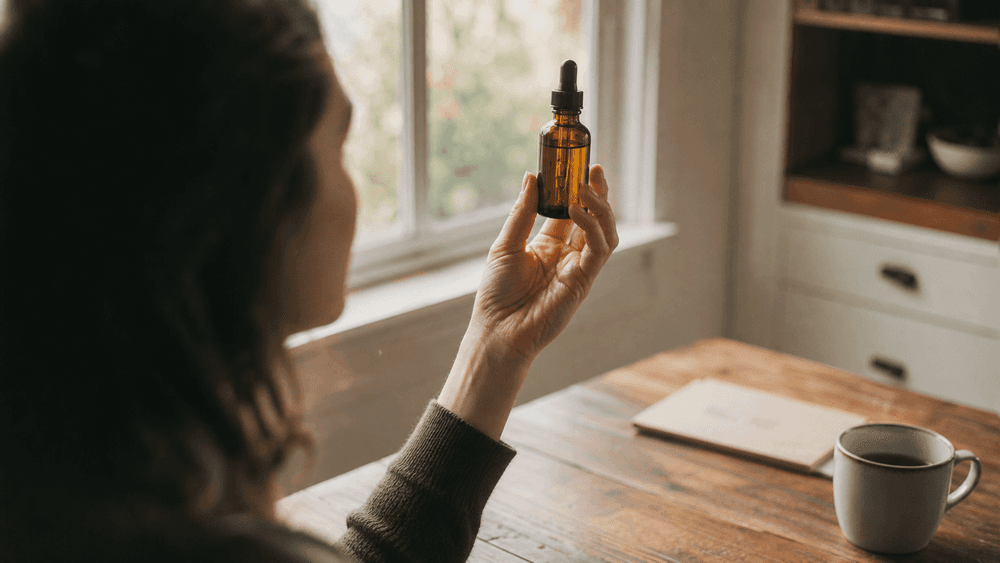
The single most common way shoppers overpay is confusing three numbers: total mg, mg/mL, and mg per serving. Total mg is how much CBD is in the whole bottle. mg/mL is the strength. mg per serving is a marketing unit a brand defines however it likes, which makes a weak product look generous. Convert everything to strength and per-drop dose before you compare. A standard dropper delivers about 0.05 mL per drop, so a 60 mL bottle holds roughly 1,200 drops.
| Term on the label | What it means | Planntz Broad Spectrum |
|---|---|---|
| Total CBD (mg) | How much CBD is in the whole bottle | 15,000 mg |
| Volume (mL) | How much liquid the bottle holds | 60 mL |
| Concentration (mg/mL) | Strength: total CBD divided by volume | 250 mg/mL |
| Per drop (mg) | Dose in one ~0.05 mL drop | ~12.5 mg |
| Per serving (mg) | A brand-defined unit, easy to inflate or shrink | set by the brand, not a fixed rule |
The math is simple once you see it: 15,000 mg divided by 60 mL is 250 mg/mL, and 250 mg/mL times 0.05 mL is about 12.5 mg of CBD per drop. Drop size varies by dropper and technique, so treat per-drop figures as close estimates rather than exact doses. If you want to run these numbers for any bottle, our tool for converting mg/mL into a per-drop dose does the arithmetic for you.
4. Do the price-per-mg math
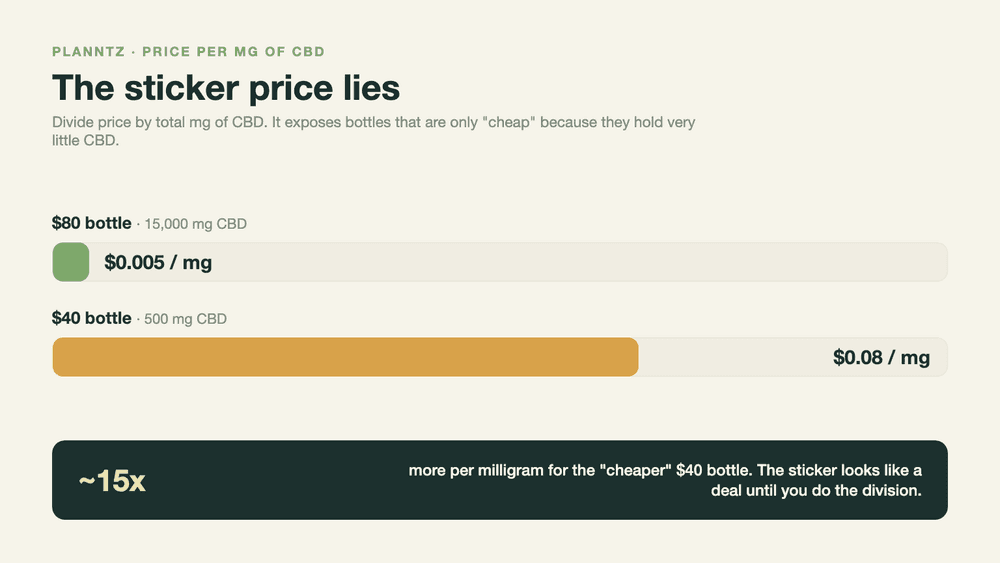
This is the one calculation that ends overpaying, and almost no buying guide actually does it. Ignore the sticker price and compare price per mg of CBD. Divide the price by the total mg of CBD in the bottle. The result tells you what you truly pay for the active ingredient, and it exposes 'cheap' bottles that are only cheap because they contain very little CBD.
Work it through: an $80 Planntz bottle at 15,000 mg of CBD comes to about $0.005 per mg, roughly $5.33 per 1,000 mg. A $40 bottle with only 500 mg works out to about $0.08 per mg, which is close to 15 times more expensive for the same milligram of CBD. The $40 sticker looks like a deal until you do the division. For a multi-cannabinoid oil, add up all the actives: Planntz CBD + CBG at $84 for 15,000 mg total actives is about $0.0056 per mg, and CBD + CBN at $88 for 12,000 mg total actives is about $0.0073 per mg. Sticker price lies; price per mg does not.
5. Check the source, carrier, and extraction
Once the lab report and the label check out, look at what the product is made of and how. A transparent brand tells you all of it without you having to ask.
- Hemp source: look for a stated origin, such as US or EU grown hemp, rather than a vague 'sourced globally'.
- Carrier oil: a clean label names it, so you know what you are actually swallowing. Planntz uses coconut MCT oil.
- Extraction: CO2 and ethanol are both common methods; what matters is that the COA's residual-solvents panel comes back clean.
- Ingredients: you should recognize every line, meaning the hemp extract, the carrier oil, and any flavoring, with nothing you cannot identify.
- Flavor transparency: Planntz lists its three flavors plainly (Mango & Peach, Lemon & Raspberry, and Natural), rather than hiding a sweetener system.
6. Confirm the legal and THC reality
Federal law defines hemp as cannabis with no more than 0.3% delta-9 THC by dry weight (a rule that is changing, so verify the current version). Broad-spectrum oils have the THC removed and can report non-detected on a clean batch; full-spectrum oils keep trace THC that stays below that 0.3% line. CBD itself is not intoxicating, but full spectrum is not zero THC, which matters if you are ever tested. Our guide to the legal and 0.3% THC reality covers where things stand and what could change.
7. Red flags: when to put the bottle back
Some signals are not close calls. If you see any of these, the smartest move is to walk away, no matter how good the marketing sounds. The FDA warns that many CBD products are sold with unproven claims, and the ones below are how those products give themselves away.
- No batch-specific COA at all, or a report you cannot match to the exact bottle in front of you.
- A COA whose batch number or date does not match the bottle, or that is years old.
- A potency shown in 'mg' with no bottle volume, so you cannot work out strength or price per mg.
- Claims like 'FDA approved', 'clinically proven', or that the product 'cures' or 'treats' a condition.
- A proprietary blend listed only as mg-per-serving, hiding how much of each cannabinoid you actually get.
- A price far below the category, which usually means far less CBD than the sticker implies.
- No US business address, phone number, or any way to reach a real human.
The honest limits of any checklist
A checklist tells you whether a CBD oil is well-made, clean, and fairly priced. It does not tell you that CBD will do something for you. Those are different questions. According to the NIH's NCCIH, human evidence for most consumer CBD uses is limited or preliminary, and the FDA has approved only one CBD medication (Epidiolex) for specific seizure conditions and has not approved CBD as a dietary supplement. A higher potency or a cleaner COA does not mean stronger results; it means a more accurately labeled product. If you take other medications, talk with a doctor first, because CBD can interact with some of them. Our overview of CBD and medications explains why that conversation matters.
How to choose CBD oil in five questions
None of this means you need to be a chemist to buy well. It means you should be able to answer five questions before you pay: Can I see the COA and match it to this batch? Do the CBD numbers on the report match the label? Which spectrum is this, and am I comfortable with its THC? What is the price per mg of CBD? And does anything on the label set off a red flag? Run those five, and a confident sales pitch loses its power over your decision.
Frequently asked questions
The single best signal is a current, batch-specific, third-party COA you can match to the exact bottle. A 2017 JAMA analysis of 84 CBD products found only about 31% were labeled within 10% of their actual CBD content, so a lab report you can verify matters far more than any word on the label. Check that the lab is independent, the batch and date match, the potency lines up with the label, and the contaminant panels come back clean.
Compare price per mg of CBD, not the sticker price. Divide the price by the total mg in the bottle: an $80 bottle with 15,000 mg is about $0.005 per mg, while a $40 bottle with 500 mg is about $0.08 per mg, roughly 15 times more per mg. The cheaper sticker is often the more expensive product once you do the math.
Full spectrum keeps the whole plant, including trace THC below the 0.3% limit; broad spectrum removes THC; isolate is CBD only. Match it to whether you want the minor cannabinoids and how you feel about any trace THC. No option is 'stronger' by default. Our spectrum guide walks through the trade-offs in detail.
It is not legally mandated as a supplement, since the FDA has not approved CBD as a dietary supplement, which is exactly why independent testing is the shopper's safeguard. The FDA has reported finding contaminants such as pesticides, heavy metals, and unlabeled THC in some CBD products, so a verifiable COA is your best protection.
Steer clear of cheap fillers, undisclosed flavor or sweetener systems, residual extraction solvents, and any contaminant flagged on a COA, such as heavy metals, pesticides, or microbials. A clean label lists the hemp extract, a carrier oil (for example coconut MCT), and any flavoring, with nothing you cannot identify.
No product can guarantee a drug-test result. Full-spectrum oils contain trace THC, and even a broad-spectrum batch that reports non-detected carries residual risk from test sensitivity. If a test is a real concern for you, read our CBD and drug tests guide and never rely on an absolute 'THC-free' claim.
See the report before you decide
Run the checklist on us. Every Planntz batch has a public, third-party COA you can match to the bottle, with the potency and contaminant panels in full.
View our lab resultsWriting about hemp, wellness and the small rituals that keep us balanced.