Weed Stems: Can You Smoke Them, and What to Do With Them?
Yes, you can smoke weed stems, but you won't get much. Stem bark carries a small fraction of the cannabinoids in flower, the woody fiber burns harsh, and homemade stem tea or butter has no knowable strength. Here's what to do with them instead.
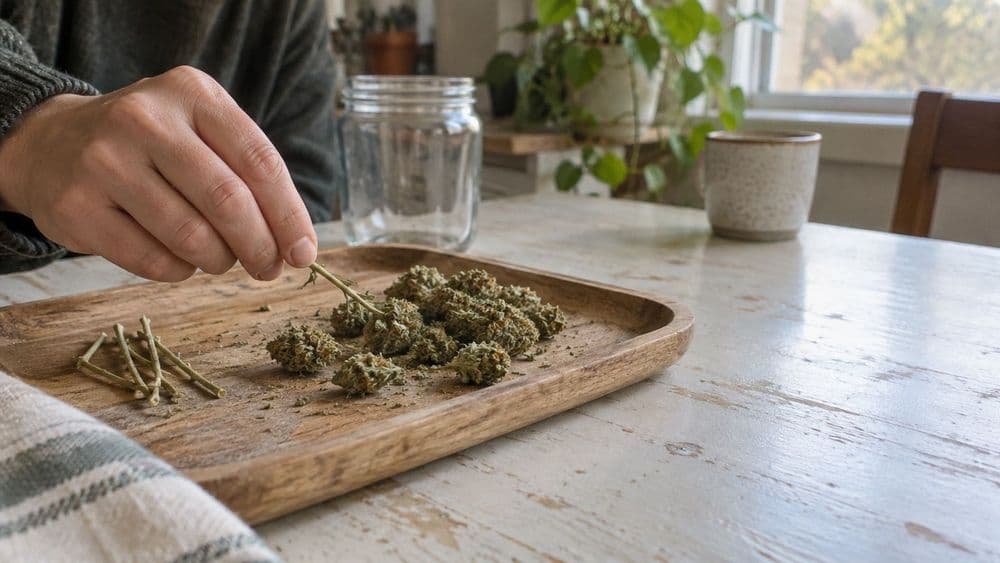
If you are holding a small pile of stems from the bottom of a jar and wondering what to do with weed stems, or whether to save them at all, this guide is for you, written for adults 21 and over where cannabis is legal. Most guides on this question say stems have "very little THC" without ever printing a number, and some say they have none at all. Neither is quite right. Two lab studies have measured stem tissue on its own, so we can put a figure on "very little", explain why stem smoke is rough on your throat, show what stems tell you about the bud you paid for, and sort the uses that make sense from the ones that are a dosing guess. You will not find recipes, temperatures or soak times here, and the section on homemade stem products explains why.
What a weed stem actually is
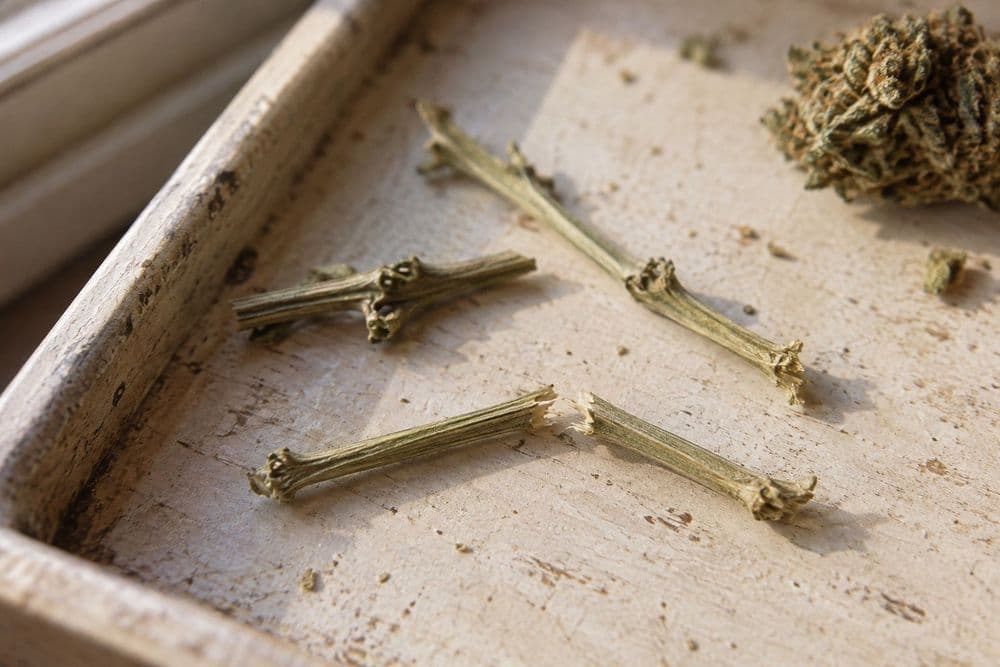
"Stem" covers two different things. The first is the main stalk and its larger branches, the plant's skeleton, which rarely makes it into a retail bag because it is cut away during harvest and trimming. The second is the thin stems that held the buds: short, pale twigs a millimeter or two across that you find at the bottom of the jar or inside a nug when you break it up. If you want the full botany of stalks, nodes and branches, our guide to the parts of the cannabis plant covers it. For this question, the important point is what a stem is for. It is structure. It carries water and holds the flowers up; it is not where the plant makes resin.
That structure is mostly wood. In industrial hemp, a 2022 review of hemp stalk fiber describes the woody core (xylem, pith and cambium) as roughly 75 percent of the stalk's total mass, with a thin skin of fiber outside it. When a 2021 French analysis of hemp shiv, the name for that woody core, broke it down, the organic part measured 50.4 percent cellulose, 22.2 percent hemicellulose and 8.3 percent lignin. Those are the same three building blocks as wood: the paper gives hardwoods 38 to 51 percent cellulose, 17 to 38 percent hemicellulose and 21 to 31 percent lignin, so hemp shiv sits in the hardwood range for cellulose with less lignin. These figures come from industrial hemp stalks, a crop grown partly for that fiber (our guide to what hemp is used for covers the stalk side), not from the thin stems in a jar of drug-type flower. But a stem is a stem: when you burn one, you are mostly burning plant fiber.
Do weed stems have THC? The measured numbers
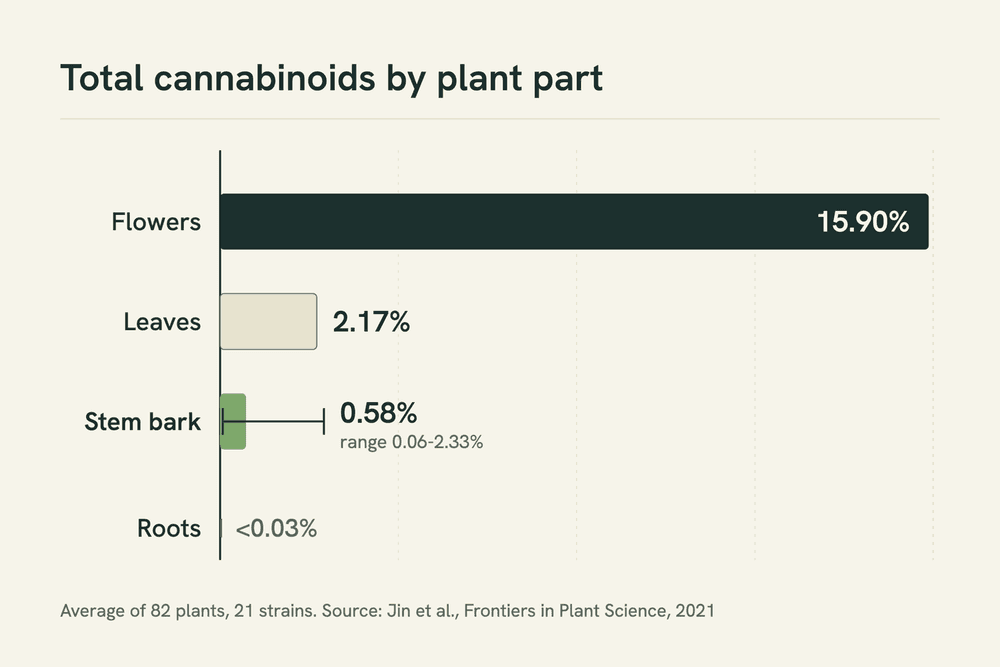
Yes, a little. The best figure comes from a 2021 Canadian analysis of 82 plants from 21 commercial strains, grown in one greenhouse under a Health Canada research license and tested part by part with liquid chromatography and mass spectrometry. Stem bark averaged 0.58 percent total cannabinoids, against 15.90 percent in the flowers and 2.17 percent in the leaves. Roots came in under 0.03 percent. The stem range was wide, from 0.06 to 2.33 percent, so some stems carry far more than others.
Read those numbers with their limits. They are total cannabinoids, 14 compounds added together, mostly in the raw acid forms such as THCA and CBDA, not THC alone. The 21 strains included THC-dominant, CBD-dominant and in-between types. Only the bark was assayed, not the woody core, and the paper does not say how high on the stem the samples were taken. Where you sample matters a great deal. An earlier study from the same group, working with three strains, took bark next to the root and found just 0.005 to 0.008 percent: a few thousandths of a percent. The authors noted that differences in strain and sampling position may explain why their figure came in below earlier reports.
There is one older THC-only figure in circulation. A 2017 review in Cannabis and Cannabinoid Research, quoting a 2009 doctoral thesis, gives THC content of 0.3 percent in stems against 15.2 percent in flowers and 0.8 percent in leaves. It is a secondary citation, and the review does not say what kind of plant was measured. One widely read guide cites this same review as saying stems hold 0.03 percent THC; the review actually prints 0.3, ten times more. Another popular page says stems "contain no THC". Every measurement we found says otherwise: the amount is small, not zero.
Put in grams, the gap is easier to see. At the 2021 average, a gram of stem bark holds about 6 milligrams of total cannabinoids, while a gram of flower holds about 159. At the top of the stem range it is about 23 milligrams; at the base-of-stalk figure from 2020 it is well under a tenth of a milligram. This is arithmetic on study averages, not a measurement of your stems, and it is total cannabinoids, mostly the inactive acid form, not a THC dose. The reason the numbers are so lopsided is that cannabinoids are made in resin glands, which crowd onto the flowers; our explainer on what trichomes are and where cannabinoids are made walks through it. The thin stems that hold the buds spent their life inside sticky flower, so they may sit toward the upper end of that range, but no study we found has measured them on their own. For how stems, leaf and trim mix into the cheaper grades of flower, see what shake weed is and how it compares to whole buds.
Can you smoke stems? Why the smoke is harsh
You can, and almost nothing will happen. With a stem holding something like a twenty-seventh of the cannabinoids that flower does, you would need to burn a lot of stem to match a small pinch of bud. What you would get in exchange is a lot of smoke, and people who try it tend to describe it the same way: harsh on the throat and tasting like burning wood.
We could not find a study that has measured what is in the smoke from cannabis stems. What follows is reasoning, not a measured result. A stem is mostly cellulose, hemicellulose and lignin, the same plant fiber that makes up wood, with only a thin film of resin. EPA's guidance on wood smoke describes what burning that kind of material releases: a mix of gases and fine particles, including irritants such as acrolein and formaldehyde, along with benzene and polycyclic aromatic hydrocarbons, which can irritate the eyes, nose, throat and lungs. So it is reasonable to expect stem smoke to behave more like wood smoke than like the smoke from resin-coated flower, and that is consistent with how harsh people find it. Any smoke can set off the airway's cough reflex; our page on why weed makes you cough explains the mechanism and what the research on regular smokers shows.
A small stem that ends up in your grinder by accident is not a big deal. Most people pick them out for practical reasons: a sharp stem can poke through a joint and tear the paper, which is one reason rolling papers are made thin and porous in the first place. Stems are also one of the things, along with resin and ash, that end up in the leftover end of a joint, which our guide to what a roach is and what to do with it covers.
Stem tea, butter and tincture: why nobody can tell you how strong they are
Most of what ranks for this question is recipes for stem tea, stem butter and stem tincture, complete with oven settings and soak times. We are not going to print any of them, because none of them can tell you the one thing you need to know: how much THC ends up in a serving. There are three reasons that number is unknowable at home.
- 1The starting amount is tiny and swings widely. In the 2021 study, stem bark ran from 0.06 to 2.33 percent total cannabinoids, a spread of nearly 40-fold, and you have no way to tell where your stems fall.
- 2Most of it is not THC yet. Raw plant material holds its THC mostly as THCA, an acid form that has to be heated to become THC, and even in a lab that conversion is incomplete.
- 3What reaches the cup or the butter depends on the preparation. THC dissolves far better in fat than in water, so the amount pulled out changes with every small difference in method.
On the second point, our page on how THCA differs from CBD explains the acid forms, and a 2023 forensic study of how efficiently THCA converts to THC found that even under a standardized lab method the conversion did not reach 100 percent. A kitchen is far less predictable than a lab vial.
The third point has been measured, with flower rather than stems. When a Danish lab brewed prescribed medical cannabis into tea three times over, following the official instructions, a standard 0.2 liter cup held anywhere from 0.46 to 11.3 milligrams of THC depending on the product, and adding creamer before boiling raised the THC 2.3 to 4.4 times. That was lab-tested flower with a known label. A jar of stems has no label at all. Even professionals miss: when researchers tested 75 dispensary edibles from three US cities in 2014, only 17 percent matched their label within 10 percent. Rules have tightened since. California, for example, requires every serving of a commercial edible to carry the same THC concentration, and licensed products are lab-tested before they are sold. Nothing like that happens to a jar of stem butter.
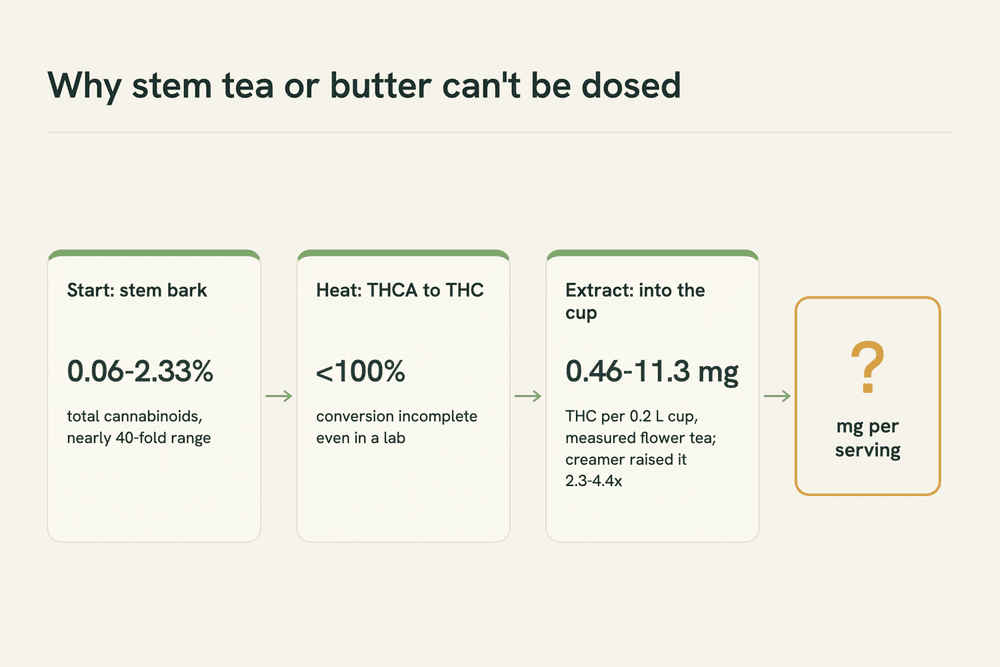
The risk with stem butter is not that it is strong. Most of the time it will be weak. The risk is that you do not know, so you eat some, feel nothing, and eat more. Edibles take far longer to start working than smoke does, as we explain in why edibles take so long to kick in, and an unknown-strength edible plus a slow onset is the classic setup for taking a second dose too early, and for the unpleasant overload people call greening out. If you want to know what a measured serving looks like, our guide to what a 10 mg edible feels like is the reference point a homemade batch cannot give you. Pages that sell stem salves or teas as remedies for skin conditions or sleep cite nothing, and we found nothing to cite.
What stems tell you about the bud you bought
Stems are part of what you paid for. Flower is sold by weight, and in California the label must show the net weight of cannabis in the package in both metric and US units, stems included. If you want the arithmetic of grams, eighths and ounces, our explainer on how many grams are in an eighth has it. How much stem is too much? Washington gives one benchmark: under its lab-testing rules for foreign matter, a lot of flower fails if more than 5 percent of it is stems 3 millimeters or more in diameter. At that ceiling, an eighth (3.5 grams) could carry up to about 0.18 grams of thick stem before the lot failed. That 5 percent is a failure line for thick stems, not an allowance, and it does not count the thin stems that hold the buds. In practice, most of what you see is that thin stem, and it is normal.
- Thin stems holding the buds: normal. Every bud grows on one, and you cannot sell whole flower without them.
- Lots of thick stems or branch pieces: a trimming shortcut. You paid for that weight, and it is fair to mention it to the seller.
- Stems that bend instead of snapping: the flower may still be damp, which matters for mold, not potency.
- Stems with no visible frost and a plain woody smell: ordinary stem. There is nothing worth saving on it.
The "snap test" in that list is grower convention rather than a measured standard; we found no study that has validated it as a quality check. It is not made up, though. The 2021 Canadian study dried its plants for 7 days "until the leaves and stems became brittle", which the authors say usually means moisture below 10 to 15 percent. A stem that snaps cleanly is a sign the flower dried; it tells you nothing about how strong it is. Flower that stays damp is the mold risk, which our guide on whether weed goes bad and how to spot mold covers. For the rest of the visual checks, from color to trichome coverage, see what good weed looks like.
What to do with weed stems
Here is every common option side by side, with what you actually get and the limit that matters. None of them involves a recipe, because the honest answer for most people does not need one.
| Option | What you get | The measured or known limit | Safety note |
|---|---|---|---|
| Smoke them | Harsh, woody smoke and very little effect | Stem bark averaged 0.58% total cannabinoids vs 15.9% in flower; no study has measured stem smoke | Full combustion for almost no return |
| Stem tea | Unknown, usually very weak | Even lab-tested flower brewed as tea ranged 0.46-11.3 mg THC per cup | Slow onset invites a second cup; treat the strength as unknown |
| Butter, oil or tincture | A product of unknowable strength | Tiny, variable starting amount; partial conversion of THCA; extraction depends on fat | Never serve it to others; label it and lock it away from children and pets |
| Mix into flower you cook with | Extra weight, little else | About 6 mg total cannabinoids per gram of stem at the study average | The dose is still set by the flower, and still unmeasured at home |
| Compost | Organic matter for the garden | Allowed only where local rules permit | Use a bin a dog cannot get into |
| Trash | The simplest option | None | Seal it and put it out of reach of children and pets |
For most people, the sensible answer is compost or trash. Rules for disposing of cannabis vary by state and city, so check yours. California's waste rule for licensed cannabis businesses lists on-site composting as an approved route and requires waste to be kept in a secured receptacle until it goes. That rule is written for businesses, not homes, but the logic carries over: whatever you do with stems, do it where a child or a dog cannot get at them. A bare stem holds little, but a compost pile can also collect resin, leftover butter or the odd bud. The ASPCA's guidance on cannabis and pets lists unsteadiness, dilated eyes and dribbling urine among the signs in a dog; its Animal Poison Control Center is at (888) 426-4435, and a consultation fee may apply.
What nobody has measured yet
The numbers on this page are real, but narrower than they might look. The thin stems that hold the buds have never been assayed on their own in any study we found. The two Canadian studies measured stem bark, reported total cannabinoids that are mostly the inactive acid forms, and grew their plants under controlled commercial conditions in Canada; one paper's authors work for a testing lab and the other's for cannabis biotech companies. The composition figures for the woody core come from industrial hemp, not drug-type flower. And when we searched PubMed on October 26, 2026, none of the records that mention cannabis stems alongside smoking, tea or edibles actually measured any of them. So "stems have very little" is well supported. Exactly how little in your stems, what their smoke contains, and how strong a stem tea or butter turns out are all unmeasured.
Frequently asked questions
Physically, yes. You get a lot of woody smoke and very little cannabinoid: in a 2021 study of 82 plants, stem bark averaged 0.58 percent total cannabinoids against 15.9 percent in the flowers. Most people find the smoke harsh, and it adds combustion without adding much effect.
A little, mostly as THCA, the raw acid form. Measured figures run from a few thousandths of a percent in bark next to the root to an average of 0.58 percent total cannabinoids in stem bark across 82 plants. A 2017 review, quoting a 2009 thesis, gives 0.3 percent THC. It is not zero, whatever some guides say.
Smoking them, very unlikely, because the amount is so small. Cooking them into an edible is less predictable: most batches will be weak, but nobody can tell you how weak, and that uncertainty is the problem.
People do, and the result has no knowable strength. The starting amount is tiny and varies nearly 40-fold between stems, heat converts THCA to THC only partly, and how much ends up in the butter depends on the method. Treat any homemade stem product as unknown, start with very little, wait, and never share it.
Usually little or nothing. But even lab-tested flower brewed into tea ranged from 0.46 to 11.3 milligrams of THC per cup in a Danish study, and a stem tea starts from an unknown, much smaller amount. Because edibles and drinks take a while to work, the real risk is drinking a second cup before the first has kicked in.
Some thin stem is normal; it is what held the buds. Lots of thick stems usually means rough trimming. In Washington, a lot of flower fails lab testing if more than 5 percent of it is stems 3 millimeters or thicker. Since flower is sold by weight, you paid for those stems.
Nothing much happens. Raw plant material holds its THC mostly as THCA, which needs heat to become THC, and stems hold very little to start with. They are mostly cellulose and lignin, the stuff of wood. Keep them away from pets anyway.
Same plant part, different crop. Industrial hemp is often grown for its stalks, which become fiber, textiles and building material, while drug-type cannabis is grown for its flowers and the stems are what is left over. Our guide to what hemp is used for, linked in the first section, covers the stalk side.
Stems are one piece of shake, the loose leaf, trim and broken bud at the bottom of the bag, and the shake weed guide linked above compares all of it with whole flower. The same habit that runs through this page, looking for the measured number instead of the claim, is what our guide to choosing a CBD oil by its lab report applies to hemp products.
Writing about hemp, wellness and the small rituals that keep us balanced.