What Are Trichomes? Where Cannabinoids Are Actually Made
Trichomes are the tiny glands where cannabis makes and stores its cannabinoids and terpenes. Here is the cell biology behind them, what clear, cloudy and amber heads actually tell you, why frostier is not the same as stronger, and what kief is.
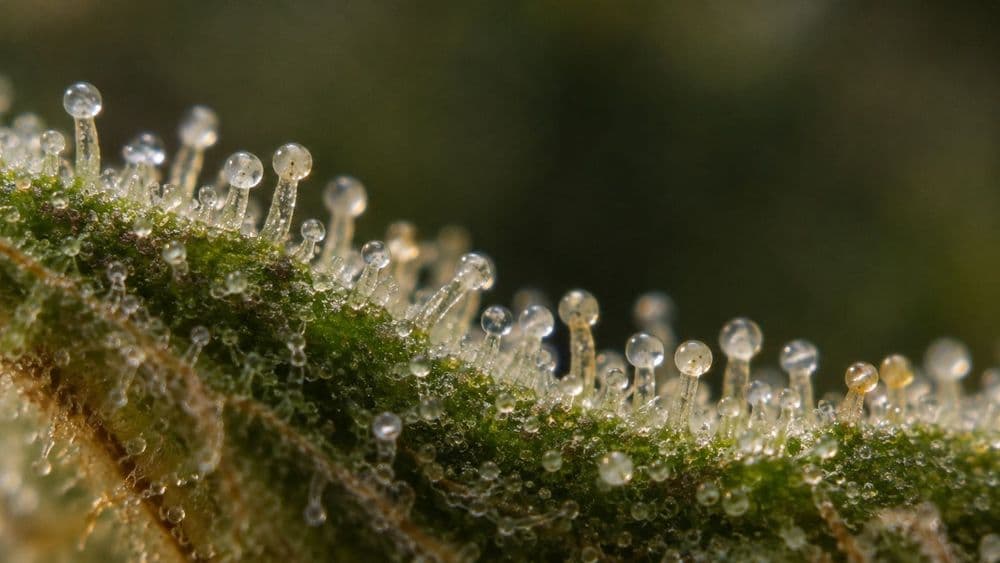
If you have ever looked closely at a cannabis bud, you have seen trichomes: the glittering frost that coats the flower. They matter more than any other part of the plant for what ends up in a cannabis or hemp product, because they are where the plant actually makes and stores its cannabinoids. They are also where a lot of harvest-chart folklore lives.
So what are trichomes? In short, they are microscopic hairs on the surface of the cannabis plant. Some are plain hairs, but the glandular kind, tiny mushroom-shaped glands packed onto the flowers, are both factory and warehouse for the plant's cannabinoids and terpenes. A disc of secretory cells at the top of each gland makes the raw materials, and the finished compounds, mostly acids such as THCA or CBDA, are stored in a sealed cavity above those cells. What trichomes cannot do is tell you much by eye. Their color tracks how old a gland is, and how frosty a bud looks is a weak guide to how strong it is. If you have met the word in our explainers on CBDA and THCA and wondered what it meant, this page defines it.
What are trichomes? Four kinds of plant hair
A trichome is any hair-like outgrowth on a plant's surface. Tomato stems, mint leaves and stinging nettles all have them. What makes cannabis unusual is what its glandular trichomes produce. On the small leafy bracts that wrap each cannabis flower, a 2023 microscopy study that followed trichomes through flowering found four kinds side by side. Non-glandular trichomes are plain pointed hairs with no secretory cells, so they make no resin. The other three are glandular. Bulbous glands are the smallest, with heads 15 to 30 micrometers across (a micrometer is a thousandth of a millimeter) on very short stalks. Capitate glands, named for their round heads, have heads 40 to 110 micrometers across. Sessile capitate glands sit almost flat on the surface, while stalked capitate glands raise their heads on a stalk that ranged from 20 to 1,100 micrometers in that study; the longest, up to about a millimeter, grow at the edge of a bract.
Size is not the only difference. A 2020 University of British Columbia study of cannabis glandular trichomes found the tall, stalked trichomes carry 12 to 16 secretory disc cells, against 8 in the small sessile ones, and grow out of sessile-like precursors as the flower matures. The stalked glands also gave off a blue glow under UV microscopy that went along with high cannabinoid levels, and they were rich in monoterpenes, the lighter aroma compounds. That work used a single hemp variety grown under lab conditions. The frost you see on a bud is mostly these stalked glands: as a 2024 review of cannabis trichome biology puts it, the stalks lift the heads above the surface, "giving cannabis flower their frosty appearance". Terpenes are made in the same glands as cannabinoids, which is why cannabinoids and terpenes so often travel together, and why the compounds behind cannabis's skunky smell are stored in trichome heads too.
| Type | What it looks like | Head size | Secretory disc cells | Makes resin? |
|---|---|---|---|---|
| Non-glandular hair | A plain, pointed hair with no head | No head | None | No |
| Bulbous | A tiny gland on a very short stalk | 15-30 micrometers | Not counted in these studies | Yes |
| Sessile capitate | A round head sitting almost flat on the surface | Within the 40-110 micrometer range for capitate heads | 8 | Yes |
| Stalked capitate | A round head raised on a stalk; this is the visible frost | Within the 40-110 micrometer range for capitate heads | 12-16 | Yes, with an expanded cell factory |
How a trichome makes cannabinoids
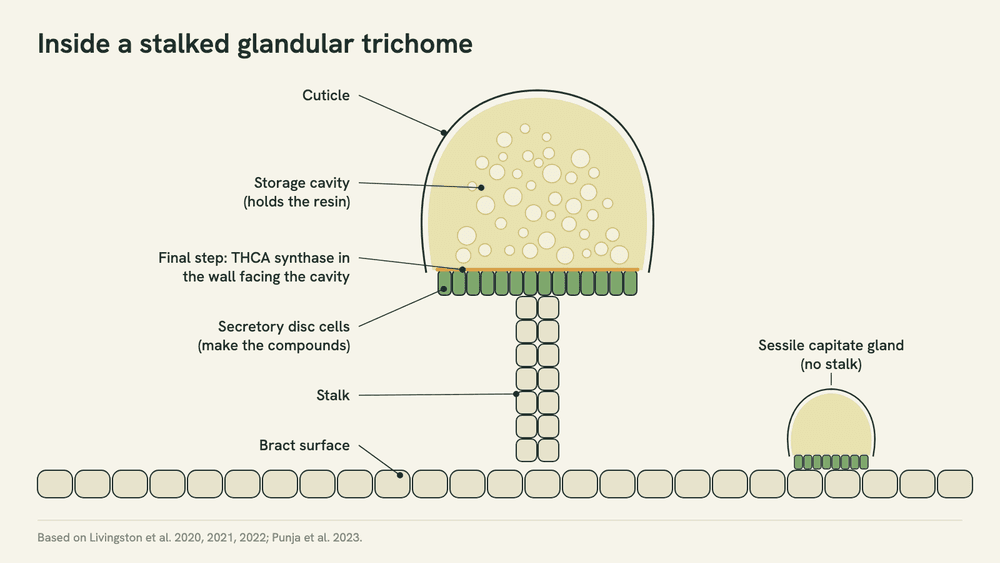
The clearest picture comes from electron microscopy. In a 2022 study that mapped cannabis trichome cells with cryo-electron microscopy, the UBC group found that the disc cells behave like one connected "supercell", linked by bridges of cytoplasm. The cannabinoid pathway begins inside plastids, small compartments within those cells, and the enzyme that finishes THCA, called THCA synthase, sits in the cell wall on the side facing the storage cavity. In other words, the last step happens at the door of the warehouse. The chemistry of that pathway, from CBGA, the shared precursor, to the acid forms, has its own explainer; here the point is where it happens.
Earlier work points the same way. Japanese researchers showed in 2005 that THCA synthase is made only in the secretory cells and is exported into the storage cavity, where its activity turned up in the cavity's contents; part of that work used tobacco plants engineered to make the enzyme. A 2019 analysis of resin from drug-type cannabis found both THCA synthase and CBDA synthase in the resin itself, with levels rising over flowering, and showed they could turn CBGA into the acid cannabinoids in lab conditions. The cavity is built out of the cell wall. A 2021 paper on how the storage space forms describes the wall's outer layer separating from the disc to open a space under the cuticle, the gland's thin waxy skin, which then fills with droplets of resin.
Why build it that way? The 2022 paper's summary puts it bluntly: "Cannabinoids are toxic to cannabis cells." In lab tests on cannabis leaf cells and cultured cannabis cells, THCA and CBCA triggered cell death through a process involving the cells' mitochondria. Keeping the finished acids in a sealed cavity outside the living cells is the best explanation for the design. This is a finding about plant cells in a dish. It is not about people, and it says nothing about human safety.
What sits in the warehouse is mostly acid. When researchers cut single trichomes out with a laser and analyzed them, THCA, CBDA and CBGA dominated; CBN turned up only as a minor compound, and only in stalked glands from plants eight weeks into flowering. That is why raw cannabis contains relatively little THC or CBD as such: the acids convert to the neutral forms mainly with heat, which our guides to CBDA versus CBD and how THCA compares with CBD explain. The warehouse also holds more than the famous names. Analyzing trichomes one gland at a time, Italian chemists found close to 70 different cannabinoids, with amounts varying from one gland to the next while the ratio of CBD to THC held steady, a ratio set by the plant's genetics.
Why does the plant make trichomes?
Why the plant spends so much effort on these glands is still partly open. A 2021 review of glandular trichomes as metabolite factories says it plainly: "The exact benefit of cannabinoids and terpenes for the plant has yet to be discovered but several findings point to defense-related functions." Among those findings, CBGA and THCA are toxic to insects, shown in part on insect cells grown in the lab. You will also read confident claims that trichomes exist to shield the plant from UV light or from drying out. Those ideas may turn out to be right, but the honest status is the one in that review: defense is the leading explanation, and the full answer is not settled.
Clear, cloudy, amber: what trichome color can and cannot tell you
Many of the top search results on trichomes are really harvest charts. They say clear heads mean an immature flower, cloudy or milky heads mean peak THC and an energetic high, and amber heads mean THC has turned into CBN and the high will be sedating. The charts we read cite no study, and the research that does exist says something narrower.
The 2023 microscopy study measured head color with image analysis in one genotype. Over the weeks of flowering, heads lost their translucency and turned redder and browner, but not in step: glands on the same bract were at different stages at the same moment. One annotated image held 83 clear, 96 milky and 52 brown heads side by side. Browning came with the gland aging: after releasing their resin, heads lost their UV glow and collapsed, which in this study happened at weeks 7 to 8, and some broke off their stalks. Handling after harvest changed the glands again: drying left stalks shriveled and twisted, heads came loose especially during drying, and in machine-trimmed samples many heads were detached or collapsed. The authors also mention that heat or drought stress can brown heads as early as week 5, but they label that as their own unpublished observation.
What the study did not do matters just as much. It did not measure THC, CBN or any other cannabinoid against head color. The idea that amber heads mean less THC appears in the paper as a belief: a color transition "considered by cannabis growers" to produce over-mature flowers with reduced THC levels. We found no study that measured cannabinoid levels against trichome color at harvest.
The amber-means-sedating chain breaks at both links. First, CBN is not something the plant sets out to make: a 2021 review of CBN describes it as a degradation product of THC. A 1976 stability study of cannabis found that THC lost to light does not turn into CBN, while air oxidation in the dark does, which is part of why CBN shows up in cannabis that has been stored a long time. In the single-trichome analysis above, CBN was only a minor compound, even in eight-week plants. Second, no human study we found links trichome color to how cannabis feels. Whether some cannabis is simply more sedating is its own question, and our look at what couch-lock is and what the evidence says takes it apart. For CBN itself, see how CBN compares with THC.
| Question | Can head color answer it? | Why |
|---|---|---|
| How old is this gland? | Roughly, yes | Heads go from clear to milky to brown as they age and break down. |
| Are all the glands on a flower the same age? | No, and color shows it | Clear, milky and brown heads sit on the same bract at once (83, 96 and 52 in one image). |
| How much THC is in the flower? | No | No study we found measured THC against head color. |
| How much CBN is there? | No | CBN forms from THC by oxidation, was minor in single-gland analysis, and was not measured against color. |
| Will it feel energetic or sedating? | No | No human study we found links trichome color to effects. |
| Is a dried product good quality? | No | Drying and trimming can shrivel, collapse or dislodge heads, so what you see on dried flower reflects handling as well as age. |
Does more frost mean more potent?
"The frostier the flower, the more potent the cannabis" sounds like folk wisdom, but it has a traceable source. It is the headline of a 2019 University of British Columbia press release about the 2020 trichome study described above. The headline is the release's own wording, not a quote from any of the scientists. The plant was Finola, a fast-flowering hemp variety, and the release notes that its stalked trichomes were "strongly geared towards making cannabidiolic acid (CBDA)". The study compared kinds of gland, stalked against sessile, not frosty buds against plain ones. What the study's first author, Livingston, is quoted as saying in the release was narrower: "We saw that stalked glandular trichomes have expanded 'cellular factories' to make more cannabinoids and fragrant terpenes."
“Despite trichomes' pivotal role, higher density alone does not guarantee greater cannabinoid potency.”
That line comes from a 2025 review of how trichomes are counted and measured. It is a review of methods, not a new experiment, and it goes further: trichome density "does not consistently predict cannabinoid content across genotypes". The authors note that a dense covering "is often perceived by consumers as an indicator of higher potency and quality", and that the hand lenses and macro photos people use to judge clear, cloudy and amber heads are not validated for measuring trichome density. They also list light, temperature, humidity and UV-B exposure among the conditions that change how many trichomes a plant grows, which is one reason indoor and outdoor flower can look so different without the difference telling you what is inside. Frost is sometimes mistaken for something added, too, but the sparkle on a normal bud is the plant's own glands, which is part of why appearance cannot tell you whether weed is laced.
Breeding does seem to have changed the glands themselves. An Australian team comparing two modern cultivars with two traditional landraces found the modern plants' trichomes were larger and held more secretory cells, in step with their higher cannabinoid and terpene levels. That is four plant genotypes and an association, but it suggests productivity lives in the size and machinery of each gland, not only in how many glands there are. Add the single-trichome finding that amounts vary from one gland to the next, and a bud's sparkle stops looking like a reading of anything precise. If you judge flower by the number on the label instead, our guide to whether THC percentage matters explains what that figure does and does not capture.
What is kief?
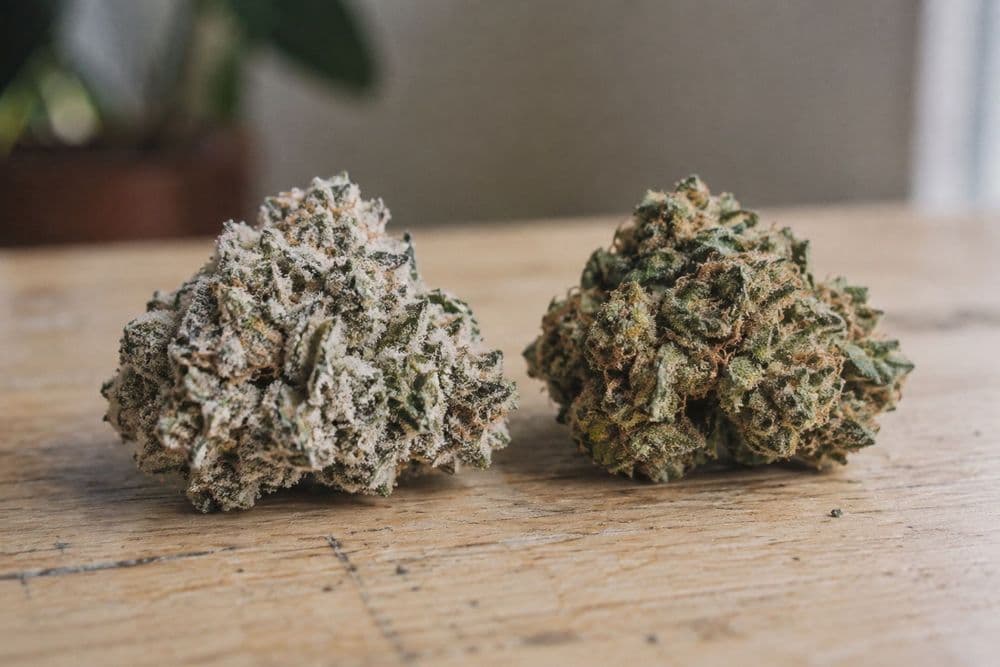
Kief is the loose mass of trichome heads that have come off the flower. Stalked glands develop a narrow, weak zone at the top of the stalk, and in the 2023 microscopy study that weak point left many heads dislodged, especially after harvest and during drying. Gathered together, the loose heads look like a fine, pale, sandy powder. They also collect in the bottom of a bag, alongside the small bits of flower and leaf known as shake.
Because kief is trichome heads without most of the rest of the plant, it is far more concentrated than flower. In a 2021 technical report from one Oregon facility, sifted trichome material from four chemovars ran between 36.7% and 60.7% total cannabinoids, against 11.5% to 29.6% in the flower it came from, a concentration of roughly 1.9 to 5.1 times. In a CBD-rich chemovar, CBDA rose from 7.26% in the flower to 20.4% in the sifted material. The lead author had filed a patent application on the method studied, and the report covers a single facility, so read these as one lab's measurements, not a general rule. You will often see "kief is 40% to 60% THC" repeated without a source; this is the closest thing to a measured range we found. The same report traces the word to the Moroccan hashish tradition, "variously rendered as kif, kief or keef in English."
- What it is: trichome heads detached from the flower, with little leaf or stem.
- Why it is stronger: the heads hold the resin, so leaving the rest of the plant behind concentrates every cannabinoid in them, THC and THCA included.
- Why labels matter: a potency figure measured on flower does not carry over to kief from the same plant.
That last point has a legal edge. Federal law currently defines hemp as cannabis with no more than 0.3% delta-9 THC on a dry-weight basis, and a 2025 law is set to switch the test to total THC, including THCA, in late 2026. Concentrating trichome heads concentrates their THC and THCA along with everything else, so material from a plant that tests under the line as flower need not test under it as kief. Our explainer on hemp-derived THC and the federal definition covers where that line sits and how it is changing.
Trichomes in hemp and CBD products
Hemp has the same trichomes as any other cannabis. The plant behind the UBC study was Finola hemp, and the single-trichome analysis included a high-CBD hemp variety. In hemp bred for CBD, the glands make mostly CBDA instead of THCA, from the same CBGA starting point. So every CBD product starts as trichome resin, and the different ways CBD is extracted are all ways of pulling that resin, with its cannabinoids and terpenes, away from the plant material. None of that is visible on the finished product. Here is what to check instead of how a plant looked.
- 1A batch-specific certificate of analysis (COA) from an independent lab, with a batch number that matches your product.
- 2The cannabinoid panel, including total CBD and total THC, which account for the acid forms (CBDA, THCA) as well as the neutral ones.
- 3The THC result against the federal 0.3% line, and the date the batch was tested.
- 4For tinctures, the concentration in mg per mL, which lets you work out how much is in each serving.
- 5Contaminant panels such as pesticides, heavy metals and residual solvents, if the lab ran them.
A label or COA gives you a number, and looking at a plant does not. Planntz's Broad Spectrum and Full Spectrum CBD tinctures, for example, list 250 mg/mL of CBD, which is 15,000 mg in a 60 mL bottle, and each batch has a public third-party COA. If you have never read one, our five-minute guide to reading a COA shows what to check first, including how THCA is counted in total THC.
What is still unknown
- What trichomes do for the plant. A 2021 review says the exact benefit of cannabinoids and terpenes to the plant has yet to be discovered, though defense is the leading idea.
- How best to count them. A 2025 review of the methods found gaps and biases in how trichome density is measured and called for standardized approaches.
- Whether head color at harvest predicts cannabinoid levels. We found no study that measured THC or CBN against trichome color.
- Whether trichome color relates to how cannabis feels. No human study we found links the two.
- How far the cell biology generalizes. Much of it comes from a handful of cultivars, including one hemp variety, grown in labs or greenhouses.
- How the secretory cells avoid harm while making compounds that killed other cannabis cells in lab tests, beyond storing the final products outside.
Frequently asked questions
They are microscopic hairs on the surface of the plant. The glandular ones, concentrated on the flowers and the small leaves around them, make and store cannabinoids such as THCA and CBDA along with terpenes. The frosty, sparkly coating you see on a bud is mostly stalked glandular trichomes, whose stalks lift their resin heads above the surface.
They mark a gland's age. Heads go from clear to milky to brown as they mature and then break down, and a 2023 microscopy study found all three on the same bract at once. That study did not measure THC or CBN against color, and we found no study that did, so color is not a reliable guide to potency or to how cannabis will feel.
Not reliably. A 2025 review of trichome research concluded that higher density alone does not guarantee greater cannabinoid potency. The slogan 'the frostier the flower, the more potent the cannabis' is a 2019 press release headline about a hemp study that compared types of gland, not buds. The potency figure on a lab report is the actual measurement.
Mostly they contain THCA, the acid form, or CBDA in CBD-type plants, plus CBGA. When researchers analyzed single trichomes, the acids dominated. The acids convert to THC and CBD mainly with heat, which is why raw cannabis contains relatively little THC as such.
Kief is the mass of trichome heads that have come off the flower. Because it is mostly resin, it is more concentrated: one Oregon facility measured sifted trichome material at about 37% to 61% total cannabinoids, roughly two to five times its source flower. The lead author had filed a patent application on the method, so treat those as one lab's numbers.
Yes. Hemp is cannabis, and it has the same glands. The 2020 UBC study of trichome structure used a hemp variety called Finola, whose stalked glands were geared toward making CBDA. CBD products start from this resin, which extraction separates from the plant material.
No. Trichomes are structures: the glands. Terpenes are among the compounds those glands make and store, alongside cannabinoids. That is why aroma and cannabinoid content both trace back to the same resin, even though terpenes and cannabinoids are separate groups of molecules.
Trichomes are where the plant does its chemistry, but the only way to know what came out of them is to measure it. You can see the third-party lab results for Planntz products and check the numbers for yourself.
Writing about hemp, wellness and the small rituals that keep us balanced.