Why Does Weed Make You Cold? What Science Actually Shows
Feeling chilly when you're high? THC reliably cools mice and rats, but in people core temperature barely moves and the chill is mostly your body making heat. Here is what was measured, and when chills mean get help.
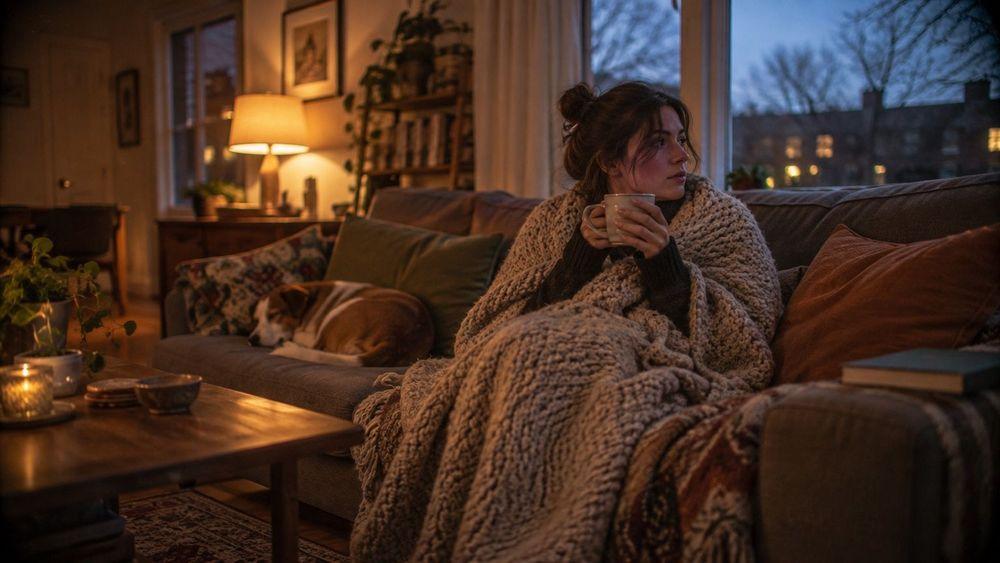
You're on the couch in a warm room, you've had a few hits or an edible, and suddenly you're reaching for a blanket, maybe even shivering. Why does weed make you cold? The short version: in mice and rats, THC reliably lowers body temperature. In people, the few direct measurements found core temperature steady or only slightly lower. What you feel is mostly your body working to make heat, not losing it.
The pages that rank for this question disagree with each other, mostly because they mix rodent data with human experience without saying which is which. Below, we keep the species in every sentence, show what has actually been measured in people, and finish with the few situations where chills are a reason to get help. It is part of our series on why cannabis does what it does, next to why weed dries out your mouth, and it sits under our broader map of what cannabinoids are and how they differ. This is general information for adults 21 and over, not medical advice.
Why does weed make you cold? The answer has three layers
Most of the confusion online disappears once you separate three questions: what happens to a rodent's temperature, what happens to a person's core temperature, and what you actually feel on the couch. They have different answers, and they come from different kinds of studies. Here is the whole picture in one table before we go layer by layer.
| Layer | What was measured | Result | Who |
|---|---|---|---|
| Mice and rats | Core body temperature after injected or vaped THC | A reliable drop; about 3 °C in rats exposed to high-dose THC vapor | Rodents, at doses far above human use |
| People: core | Rectal or body temperature after smoked or swallowed THC | No change in two small studies; a slight downward trend in a third | 5 to 28 men per study, 1975-1976 |
| People: skin | Skin and wrist temperature | Mostly unchanged, lower at very heavy oral doses, slightly higher (not significant) at the wrist | 6 to 17 people per study, 1976-2026 |
| What you feel | Heat production and the muscles used for shivering | Heat production rose and shivering muscles warmed | 10 men in cool water and cool air, 1976 |
What happens in mice and rats
Scientists have a standard way of checking whether a new compound acts like THC in the brain. In mice, a drop in body temperature is one of four signs, the "tetrad", that researchers use to tell whether a compound activates the CB1 receptor. A methods protocol describing the mouse tetrad lists the four as reduced movement, hypothermia, catalepsy (holding still in an unusual posture) and reduced pain response, all induced by CB1 agonists with THC as the prototype. The battery traces back to Billy Martin's lab at Virginia Commonwealth University: a 1988 mouse study of synthetic cannabinoids measured the four effects together and found some compounds lowered activity without lowering temperature. So even in mice, the temperature drop is a separate effect, not an automatic part of being "high".
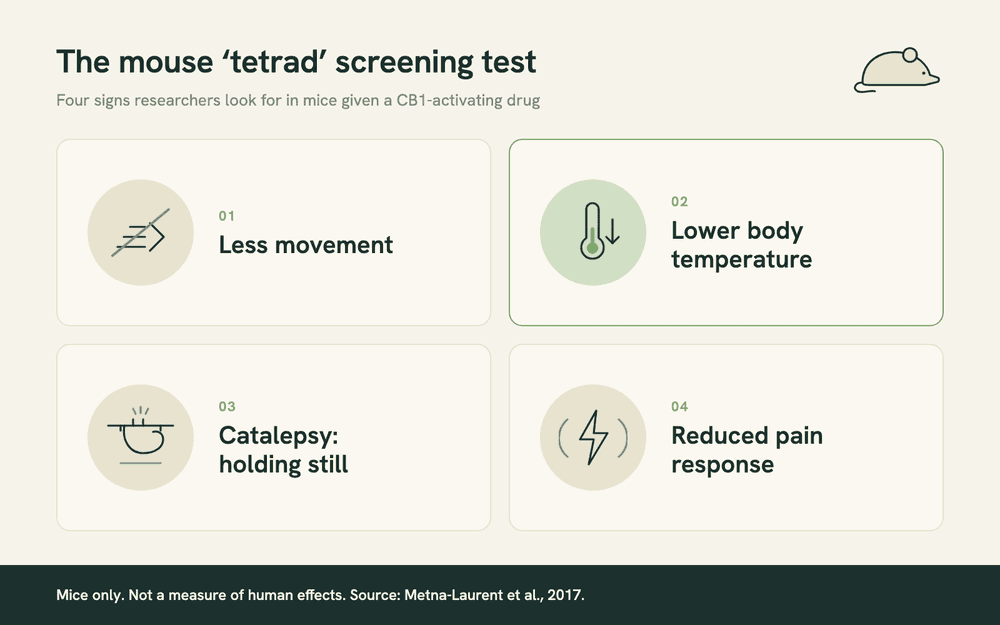
The best-known rodent numbers come from a series of rat vapor studies from Michael Taffe's group. In rats exposed to THC vapor in a sealed chamber, body temperature fell by about 3 °C (about 5.4 °F), bottomed out around 40 minutes and recovered within three hours, according to a 2016 rat study of vaped THC. Female rats were more sensitive than males. Those rats had blood THC levels comparable to a large injected dose, so the number does not translate to a person. In a 2018 follow-up in rats, four days of repeated THC vapor blunted the temperature drop, sooner in females than in males. One disclosure worth knowing: a co-author's company markets the vapor equipment used in these studies.
Two more rodent details that the popular pages leave out. First, dose matters even in rats: in a 2008 rat study comparing three injected doses, "true hypothermia" showed up only at the largest dose, and the authors questioned whether that drop was specific to CB1 at all. That is where the "low doses make you hot, high doses make you cold" line online comes from, and it is a rat finding, not a human rule. Second, the drop in animals is mostly about making less heat. 1970s animal research summarized by Haavik concluded that THC-induced hypothermia "results primarily from decreased heat production and not from increased heat loss", and the rodent tail, which rats and mice use to dump heat, actually got cooler instead of warmer.
Where your brain's thermostat comes in
Your body temperature is managed mainly by a small region at the base of the brain, the preoptic area of the hypothalamus. Think of it as a thermostat: it compares signals from your skin and core against a target, then triggers sweating, shivering or changes in blood flow. Animal research points to CB1, the receptor THC acts on, in this region (our guide to the endocannabinoid system explains CB1 from the ground up). A 2002 Temple University rat study traced cannabinoid hypothermia to CB1 receptors in the preoptic hypothalamus: blocking CB1 stopped the drop, blocking CB2 did not, and injecting the drug straight into that area lowered temperature immediately. It used a synthetic cannabinoid, not THC.
Other findings make the picture less tidy. In a 1982 mouse study, THC injected into the hypothalamus lowered body temperature and oxygen use, but not when the room was kept at 32 °C (about 90 °F) instead of 22 °C (about 72 °F). Surroundings change the result. In a 2020 rat study, blocking those same preoptic CB1 receptors in rats at rest did not change their temperature, which suggests the system matters more when something pushes on it than in everyday life. And cannabinoids are only one input. A review of the brain's temperature-control systems describes cannabinoid, opioid and TRP "temperature sensor" channels all shaping body temperature, and notes that in animals, switching on TRPV1 (the capsaicin receptor) lowers body temperature.
Does weed lower body temperature in people?
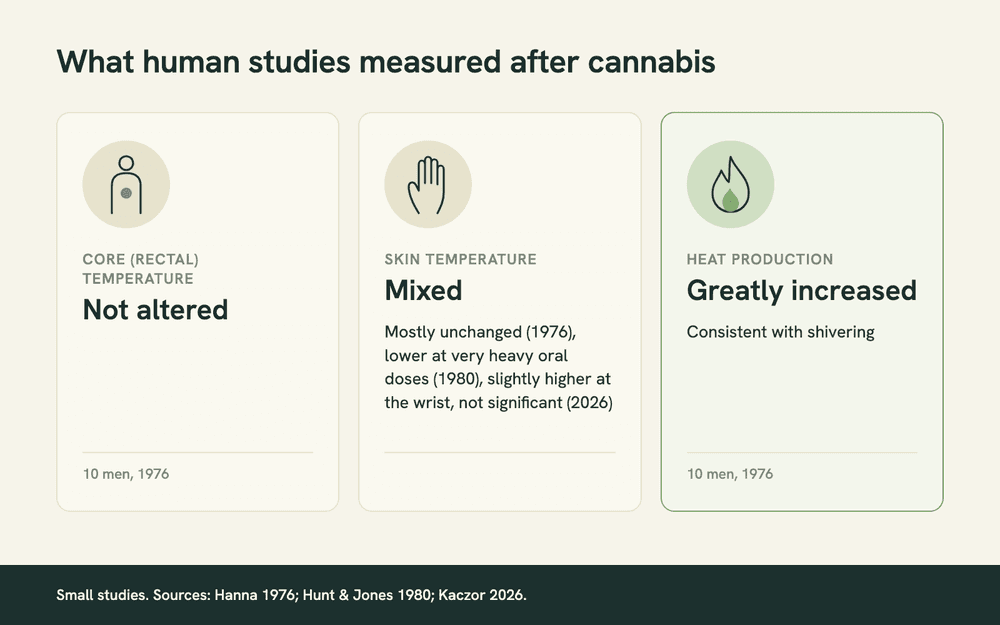
This is the part the top-ranking pages skip. The closest thing to a direct test is a 1976 study of marijuana smoking and cold tolerance. Ten men who used cannabis smoked either marijuana (the smoke of 0.739 g) or a placebo, then sat in cool water (28 °C, about 82 °F) for an hour or cool air (20 °C, 68 °F) for two hours. Their rectal temperature barely moved: the authors wrote that "rectal temperature and most peripheral temperatures were not altered." But their bodies produced much more heat, and the skin over the muscles used for shivering warmed up. The researchers concluded that cannabis had stimulated shivering. Heart rate rose too.
The other measurements point the same way. In a 1975 study of oral THC and cannabinol, 25 mg of swallowed THC raised five volunteers' heart rates but did not change their body temperature. In a 31-day hospital-ward study of 28 men who smoked cannabis daily, body temperature "tended to be slightly reduced", and the authors gave it no more weight than that. A 1980 inpatient study of repeated oral THC gave six people 30 mg of THC every four hours for over a week: THC lowered skin temperature at first, and that effect faded as tolerance built. That dose is many times what a consumer takes. Most recently, a 2026 study using wrist sensors on 17 people who smoked their own cannabis at home found heart rate jumped, while skin temperature at the wrist rose slightly, not significantly. Four of its authors have a patent application pending on the results.
When we searched PubMed on November 15, 2026, we found no modern placebo-controlled study that measured core body temperature after a typical edible or vape dose of THC. The human measurements that exist are small studies from the 1970s and one 2026 wearable pilot. Put together, they suggest that in people the drop is small or absent, and what you feel is mostly your body making heat, not losing it.
Feeling cold vs being cold
So if your core temperature isn't falling much, why do you feel so cold? Nobody has mapped it step by step in people, but the measurements give a few solid clues and rule out one popular story.
- Shivering is heat production. In the 1976 study, heat output rose and the shivering muscles warmed. Shivering feels like being cold, but it is your body warming itself.
- Your heart speeds up. THC reliably raises heart rate, and a racing heart plus shaky muscles can feel a lot like a chill.
- The skin story is mixed. Skin temperature was mostly unchanged in 1976, lower at very heavy oral doses in 1980 and slightly higher at the wrist in 2026. "Your vessels open and you lose heat" is a hypothesis, not a finding.
- Context adds up. Sitting still for a long time, a cool room and being tired all make a chill easier to notice. That is everyday experience, not a study result.
The blood-vessel question has its own story, which we take apart in why weed makes your eyes red, including why "THC lowers your blood pressure" does not fit single doses. Anxiety can also bring on shakiness that feels like cold; if your chills come with a pounding heart and racing thoughts, our piece on why weed can make you paranoid covers that side. And cannabis is not a coolant. A 1996 case report describes a man whose temperature reached 41.7 °C (about 107 °F) after smoking and then jogging on a warm day. It is a single case and an association, but it is a reminder that THC does not reliably cool people down.
Why edibles might feel different
Chills after edibles are a common search, and there are two plausible reasons they might feel stronger, neither of them measured in people for temperature. The first is timing: swallowed THC takes longer to build and lasts longer, which we break down in why edibles take so long to kick in. The second is metabolism. In ICR mice, the metabolite your liver makes from swallowed THC, 11-OH-THC, lowered body temperature at 7 to 31 times lower doses than THC, according to a 2021 mouse study comparing THC and its metabolites. No one has measured that in people, so it is a reason for curiosity, not a prediction. Our explainer on 11-hydroxy-THC covers what is and isn't known about that metabolite.
The bigger practical risk with edibles is stacking. If the first dose feels slow and you take more, the doses can land together hours later. If chills come with nausea, vomiting, confusion or trouble staying awake after a large dose, that is overconsumption rather than a quirk, and our guide to greening out and what to do about it walks through the next steps.
What about CBD?
CBD gets mentioned online as both a cause of chills and a fix for them, so it's worth being precise. CBD is not a CB1 agonist. In cell studies of CBD at the TRPV1 channel, CBD switched on TRPV1, a heat- and capsaicin-sensing channel, at micromolar concentrations, and it bound the CB1 receptor only weakly. Because switching on TRPV1 lowers body temperature in animals, that can sound like a temperature effect. It is pharmacology in a dish: it does not tell you what CBD does to your temperature.
The human data are thin but clear. In the only controlled human trial we found that measured temperature after CBD, a 2025 randomized crossover trial in the heat, 13 men took 298 mg of CBD or a placebo before an hour on a treadmill in 32 °C (90 °F) heat. Their core temperature rose by the same amount either way: 1.69 °C with CBD and 1.79 °C with placebo, which the authors reported as no difference. The idea that CBD cancels THC's chill has no support either. In rats, adding CBD did not soften THC's temperature drop and in some setups deepened it, according to a 2015 rat study of THC and CBD together that used very high injected doses. So "pick a high-CBD strain to avoid the chills" is not backed by evidence.
When chills are a signal, not a quirk
Most chills while high are uncomfortable and pass as the effects wear off. A few situations are different. Run through this checklist before you write it off.
- 1A child may have eaten an edible. Call Poison Control at 1-800-222-1222 right away, even if the child seems fine. In a small child, a cold, very sleepy body is an emergency sign, not a quirk.
- 2Anyone is having difficulty breathing, is unresponsive or is having a seizure. Call 911 immediately.
- 3Chills come with vomiting, confusion, loss of coordination or trouble staying awake after a large dose. Treat it as overconsumption and call Poison Control for guidance.
- 4You use cannabis heavily and have repeated bouts of vomiting with a strong pull toward hot showers. That pattern may be cannabinoid hyperemesis syndrome and is worth raising with a doctor.
- 5The chills start a day or two after you stop daily use. That can be part of withdrawal (see the next section).
- 6You have a real fever, a cough or chills that continue after the high has worn off. Treat it like any other illness and see a clinician; don't assume cannabis explains it.
Those lines come from the FDA's warning on children eating THC edibles, which counted 10,448 poison-center cases involving THC edibles alone between January 2021 and May 2022, and from America's Poison Centers' edible cannabis data, which lists vomiting, confusion, drowsiness and loss of coordination as symptoms and notes that children have more severe reactions. Chills are not the main sign in kids. In a review of published pediatric cannabis cases, 71% of the young children described in detailed case reports arrived very drowsy or hard to wake, and 18% went to intensive care. French pediatricians reviewing child poisonings list a low body temperature among the ways cannabis poisoning can show up in small children, alongside drowsiness, floppiness and slowed breathing.
For heavy users, a clinical chapter on cannabinoid hyperemesis syndrome describes years of use, cycles of vomiting and relief from hot baths or showers as a hallmark pattern that resolves when cannabis use stops. If you use cannabis heavily and find yourself having bouts of vomiting with a strong pull toward hot showers, that pattern has a name, and it is worth raising with a doctor.
Chills after quitting: what withdrawal looks like
Chills can also show up when you stop. A 2022 clinical review of cannabis withdrawal reproduces the DSM-5 criteria: three or more signs within about a week of stopping heavy, prolonged use. One of the options is "physical symptoms causing significant discomfort: abdominal pain, shakiness/tremors, sweating, fever, chills or headache", alongside irritability, anxiety, poor sleep and low appetite. Symptoms usually start 24 to 48 hours after stopping and peak between days two and six.
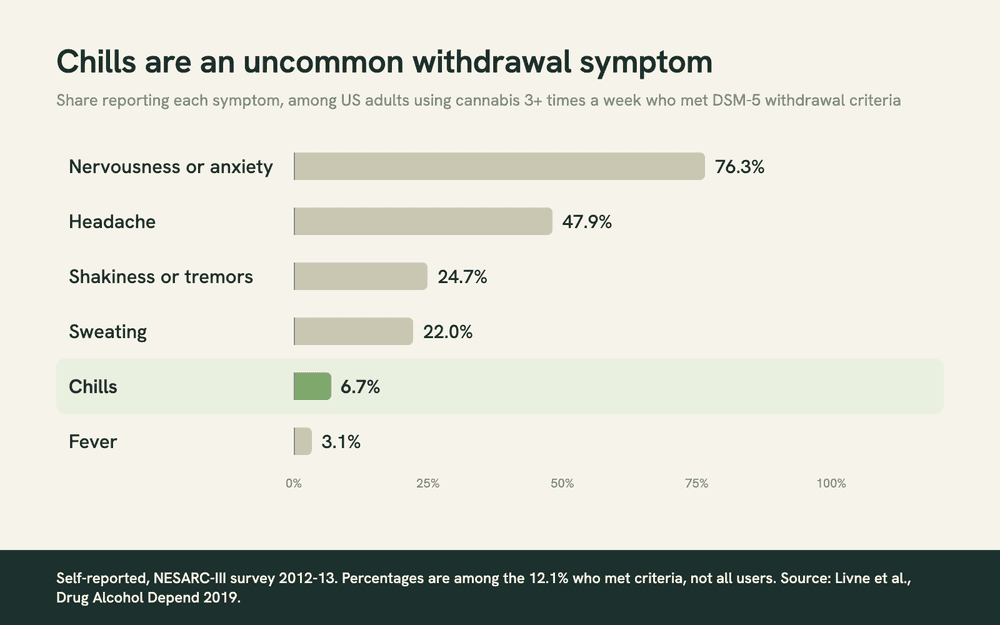
Chills are a real but uncommon part of quitting. In a national US survey of frequent cannabis users, people using at least three times a week, 12.1% met the criteria for withdrawal. Among those who did, the most common symptoms were nervousness or anxiety (76.3%) and headache (47.9%); 24.7% reported shakiness, 22.0% sweating, and only 6.7% chills and 3.1% fever. Older inpatient research points the same way: in 1970s studies of heavy research dosing, people who stopped after a week or more of THC ran slightly warmer, sweated and trembled, and the symptoms were described as mild and short-lived. If you're planning time off, our tolerance break guide covers what to expect. The National Institute on Drug Abuse notes that withdrawal symptoms can follow stopping or significantly decreasing heavy or long-term use, and lists SAMHSA's National Helpline, 1-800-662-HELP (4357), plus call or text 988 in a crisis.
If you feel cold while high: what actually helps
If none of the red flags apply, the chill is uncomfortable but usually passes as the high fades. There is no special trick, just plain common sense.
- Add a layer or a blanket, and move somewhere warmer if the room is cool.
- Sit or lie down if you also feel lightheaded, and stand up slowly.
- Sip water or a warm drink without alcohol.
- Don't take more to "feel normal". More THC is the most likely way to make things worse.
- Give it time, and expect the effects of an edible to last longer than inhaled cannabis.
The advice to sit down is not just caution. Heart rate goes up after THC, and in a 1992 study of standing up after marijuana, six of 10 subjects reported moderate to severe dizziness when they stood after marijuana but not after placebo. If you feel cold, clammy and lightheaded, get low first. And if the chill hits as you're heading to bed, our guide on whether it's bad to sleep high covers the rest of the night.
What we still don't know
The honest summary is that this everyday experience has barely been studied in people. There is no modern controlled trial measuring core temperature at consumer doses of THC. The human studies that exist enrolled mostly men; in rats, females were more sensitive, but nobody has checked whether that holds for women. There are no human temperature data for edibles or 11-OH-THC, and we found no study of whether cold weather changes the high. Until those studies exist, anyone who tells you exactly how many degrees weed lowers your temperature is quoting a rodent.
Frequently asked questions
Mostly because you feel cold rather than lose much core heat. In a 1976 study of 10 men, rectal temperature held steady while heat production rose, which is what shivering looks like. A faster heart rate, sitting still and a cool room can add to the feeling.
Reliably in mice and rats. In people, small studies found no change or only a slight downward trend, and no modern controlled trial has tested typical consumer doses of THC.
It can feel like either. Chills and shivering are common, while one 1996 case report describes dangerous overheating after a man smoked and then jogged on a warm day. Cannabis is not a reliable way to warm up or cool down.
Edibles take longer to peak and last longer, and in mice the edible metabolite 11-OH-THC lowered temperature at much smaller doses than THC, though that has not been measured in people. If chills come with vomiting, confusion or trouble staying awake after a large dose, treat it as overconsumption and call Poison Control at 1-800-222-1222 for guidance.
It can happen. Chills are on the DSM-5 list of physical withdrawal symptoms, but they are uncommon: 6.7% of people who met withdrawal criteria in a national US survey reported them. Symptoms typically start 24 to 48 hours after stopping and peak around days two to six. SAMHSA's National Helpline is 1-800-662-HELP (4357), and you can call or text 988 in a crisis.
We found no human study on it. In mice, a warmer room blocked THC's effect on body temperature, but that study did not measure the high. If you're out in the cold, dress for the weather as you would anyway.
Not in the one controlled human trial we found: 298 mg of CBD did not change core temperature in 13 men exercising in the heat. CBD acts on the TRPV1 channel in cell studies, but that is lab pharmacology, not a measured effect on body temperature.
If a child may have eaten an edible, call Poison Control at 1-800-222-1222 without waiting for symptoms. Call 911 if anyone has difficulty breathing, is unresponsive or is having a seizure. Chills with a real fever or cough that outlast the high deserve a clinician's attention.
Understand the receptor behind the chill
CB1, TRPV1 and the rest of the endocannabinoid system explain why THC and CBD act so differently in the body. Our plain-English guide walks through how it works.
Read the ECS guideWriting about hemp, wellness and the small rituals that keep us balanced.