Microdosing THC: What a Microdose Is, What Studies Measured
There is no agreed definition of a THC microdose, and no trial has tested a repeated microdose routine for a benefit. Here is what the cited pain trial, a 2.5 mg lab study and edible label audits actually measured, plus a checklist.
What counts as a microdose of THC, and what do the studies behind microdosing THC actually show? Most pages that rank for this question answer with a range, usually 1 to 5 mg, and a list of things a microdose is supposed to do. This page reads the research underneath that range instead: the pain trial the press keeps citing, a 2.5 mg study none of the top-ranking pages we read mentions, the 5 mg research unit that sits at the top of the range, and the label data that decides whether a quarter of a gummy is really a quarter.
The short answer, as of November 2026: there is no agreed definition of a THC microdose, and no placebo-controlled trial has tested whether a repeated THC microdosing routine benefits healthy adults. The pain trial that coverage calls the first microdosing study gave a single inhaled dose of 0.5 or 1 mg to 27 patients with chronic pain, and its authors never used the word microdose. In lab studies, low swallowed doses moved mood in both directions, and a dose volunteers could not feel still changed sedation and timed-task scores. This page is for adults 21 and over where cannabis is legal. The doses on this page are what researchers gave volunteers under supervision; none is a recommendation. If you want the wider map first, our guide to cannabinoids shows where THC sits among the other plant compounds.
What microdosing THC means: there is no agreed number
Nobody has fixed the number. On page one of search results in November 2026, the ranges we read included 1 to 5 mg, a split of 1 to 2.5 mg and 2.5 to 5 mg, and one dispensary that put the ceiling at 10 mg. Their ceilings run from 2.5 mg to 10 mg, a fourfold spread, and none of them points to a study that defined the term for THC.
Researchers have not settled it either. In a nationally representative 2023 survey of 1,525 US adults, 9.4% said they had microdosed cannabis at some point, about 24.1 million people, and 41.2% of them gave medical reasons only. The survey's question described a cannabis microdose as usually about 2 mg of THC or less, lower than the ceiling of every range above. The answers rest on memory: no dose was checked.
The word itself is borrowed. In psychedelic research, a microdose is usually described as roughly 10-20% of a full dose, taken one to three times a week, a definition built for a different class of drugs. Our piece on microdosing CBD traces where the term came from and why it does not transfer cleanly from one compound to another.
One fixed point helps with scale. The smallest capsule of dronabinol, the FDA-approved prescription form of THC, is 2.5 mg, according to its FDA prescribing label on DailyMed (revised January 2023). That is the same number many guides call a microdose, and the same label tells patients not to drive or operate dangerous machinery until they are reasonably certain the medicine does not affect them.
The 5 mg problem: where "microdose" meets the research unit
In 2020 two addiction researchers proposed a 5 mg "standard THC unit" in the journal Addiction for every cannabis product and every route, by analogy with alcohol units. The National Institute on Drug Abuse (NIDA) asked the researchers it funds to report THC this way from 2021 (notice NOT-DA-21-049), and its FAQ on the standard THC unit says plainly that the unit does not indicate safety or endorse any amount as advisable. In NIDA's own arithmetic, 10 mg is two units.
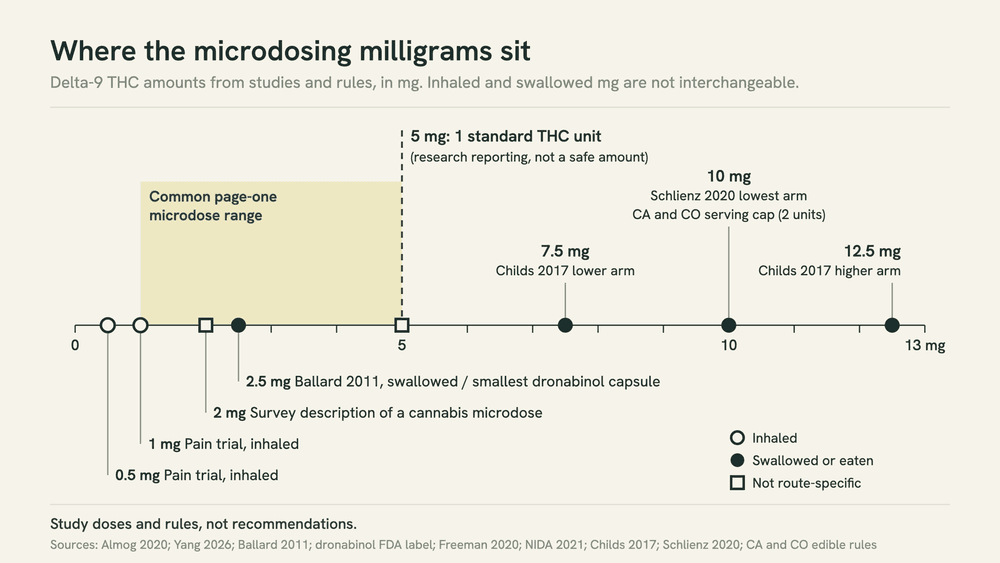
Put those together and the top of most "microdose" ranges is one full research unit. The 10 mg ceiling some sellers use is two units, and it is also the per-serving cap for adult-use edibles in California and Colorado, which our breakdown of what a 10 mg edible actually is covers with the regulations. The table lines up every milligram figure you will meet in this article. It is a map of where studies and rules sit, not a ladder to climb.
| Amount | What it is | Route | Source |
|---|---|---|---|
| 0.5 mg | Lower arm of an inhaler trial in patients with chronic pain | Inhaled, metered device | Almog 2020 |
| 1 mg | Higher arm of the same trial; the only arm that separated from placebo on pain | Inhaled, metered device | Almog 2020 |
| 2 mg | The amount a 2023 national survey used to describe a cannabis microdose ("about 2 mg or less") | Not specified | Yang 2026 |
| 2.5 mg | A dose volunteers could not feel, yet scored more sedated; also the smallest dronabinol capsule | Swallowed capsule | Ballard 2011; FDA label |
| 5 mg | One standard THC unit; top of most page-one microdose ranges | Unit applies to any route | Freeman 2020; NIDA 2021 |
| 7.5 mg | Lower arm of a lab stress study (1.5 units) | Swallowed capsule | Childs 2017 |
| 10 mg | Lowest arm of a placebo-controlled brownie series; California and Colorado per-serving cap (2 units) | Eaten | Schlienz 2020; state rules |
| 12.5 mg | Higher arm of the stress study, which worsened mood | Swallowed capsule | Childs 2017 |
The one "microdosing" trial, read in full
The study that coverage calls the first clinical trial of microdosing cannabis is a 2020 randomized trial in the European Journal of Pain, and here is what it did. Researchers in Israel enrolled 27 adults with chronic pain, most of it neuropathic (nerve) pain, who already held government licenses to use medical cannabis. Each person came in on three separate days, at least two days apart, and inhaled a single dose from a metered inhaler made by Syqe Medical: about 0.5 mg of THC, about 1 mg, or placebo, in random order, with neither patients nor staff told which. Pain and side effects were tracked for 150 minutes.
Both doses lowered pain compared with each person's own starting score. Only the 1 mg dose separated from placebo on the pain scale. Counting people whose pain had fallen by at least 30% at 120 minutes, the share was 60.9% on 1 mg, 36.4% on 0.5 mg and 21.7% on placebo. The authors also reported no consistent impairment on the computerized cognitive tests they ran during the session.
Now the parts the coverage leaves out. The paper never uses the word microdose. It describes itself as a study of a novel selective-dose cannabis inhaler, and it did not appear in the PubMed searches for microdosing we ran in November 2026. The label came from the headlines. The study was supported by Syqe Medical, which makes the inhaler, and four of the eight authors worked for the company. The trial was not registered in advance, which the authors put down to an administrative error, and they wrote that they could not be sure patients were fully blinded to which dose they received.
The "no high" story does not hold either. Patients reported feeling high in 9 placebo sessions, 12 sessions at 0.5 mg and 16 sessions at 1 mg, and the authors wrote that the intensity of the high doubled from the 0.5 mg dose to the 1 mg dose. Dizziness was reported by 1 patient on placebo, 2 on 0.5 mg and 8 on 1 mg. Most side effects were mild, and all resolved within the 150-minute session.
What follows for you: one inhaled dose, through one device, in one group of experienced patients, tells you nothing about a gummy, about repeated use, or about people without chronic pain. The authors called it a feasibility trial and wrote that long-term studies are needed.
What low swallowed doses did in controlled studies
Swallowed THC has been studied at low doses, but not under the microdose label, and not to test a benefit. These five studies are the most useful here. All enrolled healthy adults, and most enrolled people who use cannabis rarely.
At the bottom of the range, an 11-person University of Chicago study gave volunteers a 2.5 mg THC capsule or a placebo. They reported no drug effect they could feel, yet the THC lowered their vigor ratings, raised a sedation score and worsened their score on a timed symbol-coding task at 100 minutes, although the overall effect on that task was only marginal. The authors described the doses they used as threshold doses. The volunteers were very light users, with a mean of 4.6 lifetime uses.
A second Chicago lab study, of 42 healthy adults, shows the dose-response running both ways. Volunteers swallowed a placebo, 7.5 mg or 12.5 mg of THC before a public-speaking stress test. The lower dose blunted how distressing the test felt; the higher one worsened mood overall, starting before the test, and changed speaking performance only marginally. Neither dose changed the cortisol response. It shows a direction in one lab task, not a dose anyone should aim for, and 7.5 mg is already 1.5 standard units.
Above that, a placebo-controlled brownie series started at 10 mg. In that study of 17 adults who had not used cannabis for at least 60 days, a 10 mg brownie was clearly felt and raised heart rate, and some individuals were impaired even though the average test score did not change. When Johns Hopkins researchers pooled four controlled studies of 50 infrequent users, women reported a stronger drug effect than men after the same low vaporized dose (5 or 10 mg); after a 10 mg swallowed dose the difference was not statistically significant. The closest thing to a repeated low-dose trial in healthy adults is a pair of seven-day studies run by a cannabis company, and it measured side effects and subjective ratings, not any benefit.
| Study | Dose and route | Who | What changed vs placebo | Main limit |
|---|---|---|---|---|
| Ballard 2011 | 2.5 mg, swallowed capsule | 11 healthy adults, very light users | No felt effect; lower vigor, higher sedation, worse symbol-coding score at 100 min (marginal overall) | One dose, 11 people |
| Childs 2017 | 7.5 mg and 12.5 mg, swallowed capsule | 42 healthy occasional users | 7.5 mg: less distress after a stress test; 12.5 mg: worse mood, starting before the test | About 14 per group, one lab task |
| Schlienz 2020 | 10 mg, brownie | 17 adults abstinent 60+ days | Clearly felt; peak heart rate about 76 vs 70 bpm; some individuals impaired | Small, infrequent users only |
| Sholler 2021 | 5 or 10 mg vaporized, 10 mg eaten (low arms) | 50 infrequent users, pooled | Stronger drug effect in women at the low vaporized dose; swallowed difference not significant | Secondary analysis of pooled studies |
| MacNair 2024 | About 2.5 or 5 mg twice daily for 7 days (low arms) | 84 healthy adults, two trials | No sex differences in side effects or subjective effects at the low dose | Company-run, 7 days, no benefit measured |
Read together, these studies show the shape of a dose-response in small lab samples: effects rise with the dose, start below the point people notice, and differ between individuals. None tests whether repeated low doses do anything useful for anyone, against a placebo, outside a lab.
"Sub-perceptual" is not the same as unimpaired
Many microdosing guides promise a dose below the point where you feel it, and treat that as a dose that leaves you unaffected. The 2.5 mg data say otherwise: the dose was not felt and still moved a timed-task score. Feeling fine is a poor gauge at higher doses too. In a driving simulator trial of 191 regular cannabis users, 68.6% of those who smoked THC said they felt ready to drive 90 minutes later, while their simulated driving had not improved.
The road data start well above microdose amounts. In an on-road study of 26 occasional users, 13.75 mg of vaporized THC increased lane weaving by 2.33 cm between 40 and 100 minutes after dosing, which the authors compare to driving at a 0.05% blood alcohol level. That is a measured result at one dose, not a line below which driving is safe.
For how long a swallowed dose can last, see how long a weed high lasts. For per se laws, roadside testing and the CBD side of the question, see our guide to CBD and driving.
Is a quarter of a gummy actually 2.5 mg?
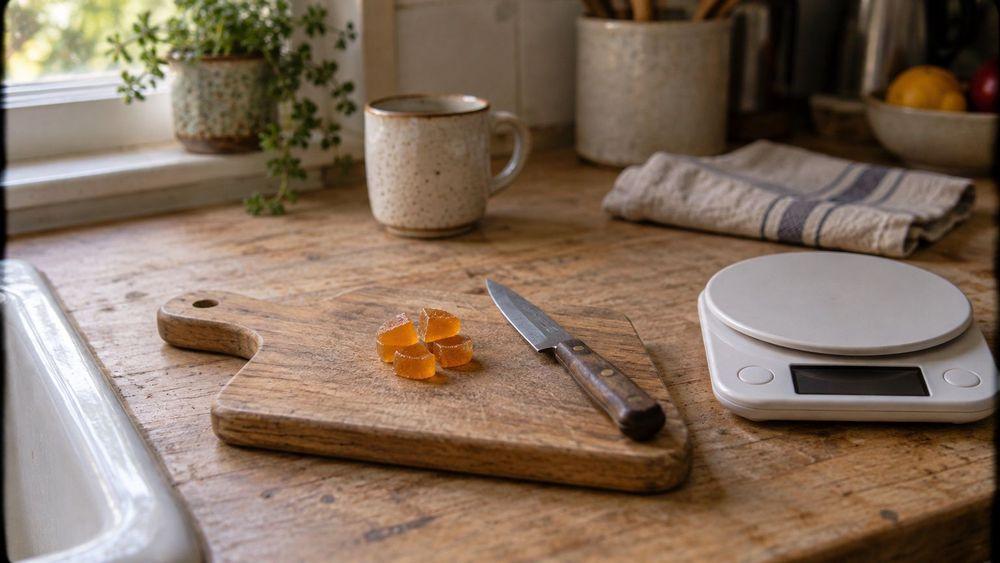
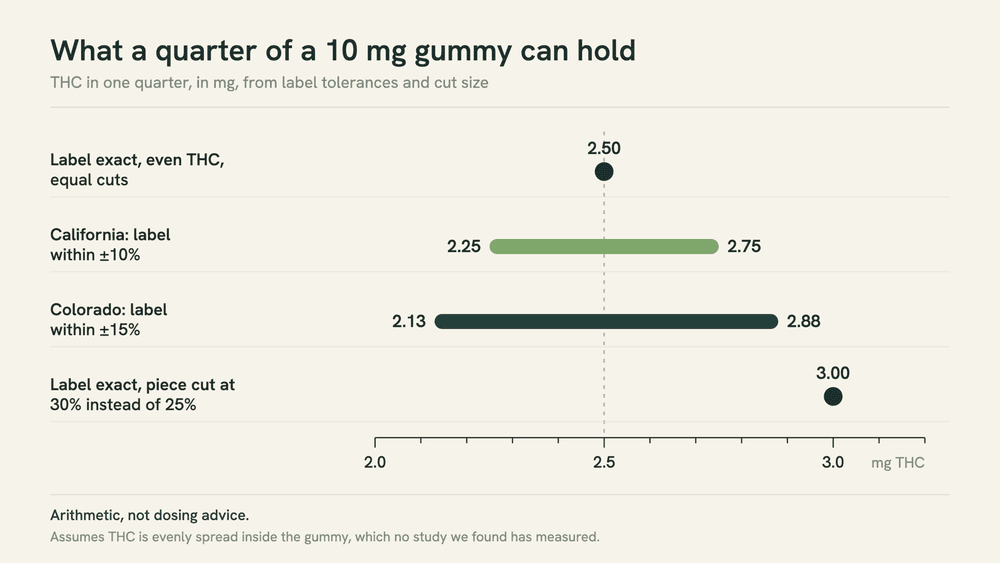
A common suggestion on microdosing pages is to cut a 10 mg gummy into quarters. That arithmetic works only if two things are true: the gummy holds what its label says, and the THC is spread evenly through it. Here is the math with the legal label tolerances built in. It is arithmetic, not dosing advice.
- A gummy labeled 10 mg, cut into four equal pieces, with perfectly even THC: 2.5 mg per piece.
- California treats a label as accurate within plus or minus 10%, so a compliant 10 mg gummy can hold 9 to 11 mg. A quarter: 2.25 to 2.75 mg.
- Colorado's testing rule allows plus or minus 15% for a serving above 2.5 mg, so 8.5 to 11.5 mg per gummy. A quarter: about 2.13 to 2.88 mg.
- Both ranges assume the THC is spread evenly inside the gummy. We did not find a study that measured that.
- Uneven cuts widen every range: a piece that is 30% of a gummy holding exactly 10 mg contains 3 mg, not 2.5 mg.
Those tolerances come from California's cannabinoid testing rule and Colorado's potency and homogeneity rule. California also requires every serving of a multi-serving edible to carry the same THC concentration, and Colorado tests at least four servings for a spread under 10%. Neither rule checks the pieces you cut from a single gummy.
Real products do not always land inside those bands. When researchers tested 75 edibles bought in San Francisco, Los Angeles and Seattle in 2014, 17% matched their label within 10%; 60% held less THC than printed and 23% held more. That was before most state testing rules. In a tested market the gap is smaller: in a 2026 Colorado sample from licensed dispensaries, edibles labeled at a median of 10 mg measured a median of just over 9 mg. In Canada, Ontario's legal oral THC oils missed a 15% band 12 times out of 30. Outside regulated markets it can be far worse: a 12-package test in Jackson, Mississippi, mostly delta-8 products from dispensaries and convenience stores, found THC ranging from 288 mg less to 5,491 mg more than advertised.
On November 12, 2026 we searched PubMed for studies of how evenly THC is distributed within a single edible, with the query (edible OR gummies OR chocolate) AND (THC OR cannabis) AND (homogeneity OR "within-product" OR "dose variability" OR "content uniformity"). It returned 5 records, and none measured THC distribution inside a consumer gummy. The evenness that quartering depends on is assumed, not measured.
Then your body adds its own variance. The dronabinol label reports that swallowed THC is almost completely absorbed, yet only about 10-20% of the dose reaches the bloodstream intact after the liver's first pass, and how much varies from person to person and meal to meal. The liver also turns THC into 11-hydroxy-THC, an active metabolite, which is part of why edibles take so long to kick in. Flower labels have their own accuracy problems, covered in whether THC percentage matters. And if a piece turns out stronger than expected, our page on greening out explains what too much looks like.
Tolerance, repetition, and what a small dose does next month
Microdosing, as page one sells it, is a regular habit. That is exactly where the evidence is thinnest. The longest controlled low-dose data in healthy adults we found is the seven-day company trial above, and the PubMed searches we ran on November 12, 2026 found no long-term placebo-controlled trial of repeated low-dose THC in healthy adults. Most low-dose THC trials those searches returned tested prescription THC in patients with specific diagnoses, which is a different question from this page.
What is known about tolerance comes from higher doses. In a placebo-controlled NIDA study that gave about 54 mg of THC smoked, vaped or eaten, frequent users showed partial tolerance to the subjective effects (after the oral dose, only occasional users' ratings rose above placebo), while heart rate rose with no difference between frequent and occasional users. Whether a small daily dose builds tolerance, and how fast, has not been measured. Our guide to taking a tolerance break covers what is known about resetting it.
Expectation also matters when effects are small. In the self-blinded psychedelic microdosing study cited above, 191 people completed the protocol, and those taking placebo improved about as much as those taking the real microdose. That was a different class of drug, not THC, but it is a reminder that a subtle effect is hard to separate from what you expect to feel when you know what you took.

How to read a microdosing claim
When you meet a microdosing claim on a package, a menu or a web page, run it through these eight questions. The pain trial and the Chicago stress study are scored as worked examples.
- 1Dose and route: is it stated in milligrams of delta-9 THC, and was it inhaled or swallowed? (Pain trial: 0.5 and 1 mg inhaled. Stress study: 7.5 and 12.5 mg swallowed.)
- 2Population: were the people patients, daily users or people who rarely use? (Pain trial: licensed patients with chronic pain. Stress study: healthy occasional users.)
- 3Placebo and blinding: was there a placebo, and could people tell which was which? (Both had a placebo; the pain trial's authors could not confirm blinding.)
- 4Duration: one dose or repeated doses, and for how long? (Both: a single dose.)
- 5Outcome: is the measured outcome the one the claim names? (A pain score over 150 minutes is not "better days"; distress in one speaking test is not a stress treatment.)
- 6Funding: who paid, and did any authors work for the product's maker? (Pain trial: the inhaler company, with four employee authors.)
- 7Source: are you reading the paper, or a press story about the paper?
- 8Product: does the label match a lab test, and within what tolerance?
What the evidence does not show
As of November 2026, the evidence does not show that a repeated THC microdosing routine benefits healthy adults, because no placebo-controlled trial has tested one for a benefit. It does not show that a dose you cannot feel leaves you unimpaired; the 2.5 mg study found measurable changes. It says nothing about gummies specifically, since the sub-milligram trial on this page used a metered inhaler. And most results come from small lab samples of light users, so it may not describe someone who uses cannabis often.
A PubMed search for microdosing and cannabis on November 12, 2026 returns 15 records. Not one is a controlled trial of a THC microdose in people, and the pain trial the press cites does not appear in the results at all, because its authors never used the word. The few records that involve an actual THC microdose are a chemistry paper, a mouse study (preclinical) and a single-patient case report.
“We cannot be sure that patients were fully blinded to treatment arms.”
There is no agreed number. Pages that rank for the term give ranges from 1-5 mg up to 10 mg, and a 2023 national survey described a cannabis microdose to respondents as about 2 mg of THC or less. For scale, 5 mg is one standard THC unit in NIDA-funded research, and the low-dose arms of the studies on this page ran from 0.5 mg inhaled to 10 mg eaten. These are study and research figures, not a recommendation.
It can. In the inhaler trial, 12 patients reported feeling high on the 0.5 mg day and 16 on the 1 mg day (and 9 on the placebo day). In the 2.5 mg Chicago study, the dose was not felt by its 11 light-using volunteers, yet it raised a sedation score and worsened a timed-task score. Sensitivity also differs between people: in pooled Johns Hopkins data, women reported a stronger effect than men at the same low vaporized dose.
The first question is "work for what". No placebo-controlled trial has tested whether a repeated THC microdosing routine benefits healthy adults; the one seven-day low-dose study we found in healthy adults measured side effects, not benefits. The pain trial the press cites gave one inhaled dose to 27 people with chronic pain and was funded by the device maker. Lab studies show low swallowed doses shifting mood in opposite directions at nearby doses. That is a dose-response finding, not evidence that a routine will help you.
No. A 2.5 mg dose volunteers could not feel still worsened a timed-task score, regular users in a driving simulator felt ready to drive before their driving recovered, and the FDA label for prescription THC capsules, the smallest of which is 2.5 mg, tells patients not to drive until they are reasonably certain it does not affect them. Do not drive after any THC dose, however small.
Tolerance is documented at higher doses: in a NIDA study using about 54 mg of THC, only occasional users' ratings rose above placebo after the oral dose, while heart rate rose in frequent and occasional users alike. No long-term trial in healthy adults has measured tolerance from repeated low doses, so nobody can say how fast it builds at that level. Our tolerance-break guide covers what is known about resetting it.
Only approximately. With California's plus or minus 10% label tolerance, a quarter of a compliant 10 mg gummy can hold 2.25 to 2.75 mg, and Colorado's 15% band widens that to about 2.13 to 2.88 mg, before uneven cutting or uneven THC inside the gummy. Audits have found bigger misses: in a 2014 test of 75 edibles, only 17% were within 10% of the label.
THC is intoxicating and CBD is not, so a THC microdose is usually framed as staying under a felt effect, while the CBD version has a different definition problem of its own. Our microdosing CBD guide covers that side, and our CBD vs THC guide explains how the two compounds differ.
One step up the scale. If you want to see what the next landmark looks like, our guide to what a 10 mg edible actually is covers the state serving caps, the placebo-controlled brownie study and how edible labels measure up. And if you came here from the CBD side, CBD vs THC explains how the two compounds differ.
Writing about hemp, wellness and the small rituals that keep us balanced.