How Long Does a Weed High Last? The Three Clocks, Measured
How long a weed high lasts depends on which clock you mean: how long you feel it, how long you are measurably impaired, or how long a test finds THC. Here is what studies measured for joints, vapes, edibles and dabs, and why no hour count makes driving safe.
How long does a weed high last? It sounds like one question, but it is really three: how long you feel it, how long you are measurably impaired, and how long a test can find THC. Those three clocks run on different schedules, and the one people usually check, how they feel, is the least reliable guide to when you can drive. Here is what controlled studies measured, route by route, in hours.
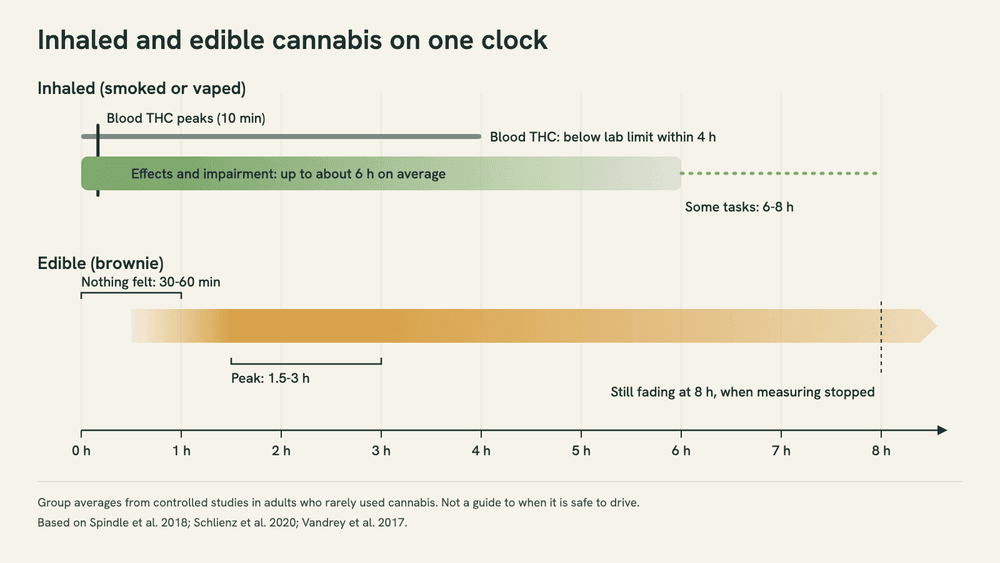
The short answer. If you smoke or vape, you usually feel it within minutes, and the strongest effects come in the first hour. In a controlled lab trial of adults who rarely used cannabis, blood THC was back to baseline within 3 to 4 hours, yet some effects and measurable impairment lasted up to about 6 hours on average. Edibles start later (30 to 60 minutes), peak at 1.5 to 3 hours and were still fading when the measurements stopped at 8 hours. None of those numbers tells you when it is safe to drive.
How long does a high last? Three clocks, not one
Most answers online give a single range, such as 1 to 4 hours or 2 to 10 hours, and cite no study for it. The ranges disagree partly because they blend three separate things. The feeling fades on one schedule. The measurable effects on your attention, memory, balance and driving fade on another. THC and its byproducts linger in blood, saliva and urine on a third. Controlled studies have measured all three, and they do not line up, which is the most useful thing to know before you plan anything around a high.
- Clock 1, how long you feel high: the drug effect you notice, which researchers capture by asking people to rate it on a scale. It fades gradually, and the tail is easy to underestimate.
- Clock 2, how long you are measurably impaired: performance on attention, memory, balance and simulated driving tests. It can run as long as the feeling or longer, and people are poor judges of it.
- Clock 3, how long a test can find THC: blood, saliva or urine. Blood THC can fall quickly while effects continue, and urine tests can stay positive long after both.
This page is about the first two clocks. On the third, a positive urine test, as a NIDA scientist put it in a 2007 review of human cannabinoid pharmacokinetics, "indicates only that drug exposure has occurred". It does not say when you used or how impaired you are. Detection windows have their own guides: how long cannabinoids stay in your system and whether a failed workplace test can cost you your job. And if you meant how long weed itself lasts in a jar, that is a storage question, answered in our guide to whether weed goes bad.
How long does a weed high last from a joint or a vape?
The best data on inhaled cannabis come from a 2018 Johns Hopkins crossover trial of smoked and vaporized cannabis. Seventeen healthy adults who had not used cannabis in the previous month (on average it had been more than a year) smoked and vaped flower at two THC doses and a placebo, in separate double-blind sessions, and were tested for 8 hours each time. Blood THC and heart rate peaked within 30 minutes and were back to baseline within 3 to 4 hours. Several subjective effects and measured impairments lasted up to about 6 hours on average.
At the stronger dose, the tail was longer than that average suggests. People rated the drug effect on a 0 to 100 scale. It peaked at 66 after smoking and 78 after vaping, and 6 hours later it still had not returned to baseline, sitting at about 12 and 11. Cognitive and psychomotor deficits, the attention, memory and coordination tasks, typically peaked 30 to 60 minutes after use and in some cases did not return to baseline for 6 to 8 hours. Eight hours was the last time point, so the study cannot say exactly when every effect ended.
Notice which clock ended first. Blood THC was highest at the 10-minute draw and below the lab's limit of quantification (0.5 ng/mL) within 4 hours, while effects and impairment kept going for hours after that. A 2019 analysis of the blood and saliva samples from the same sessions found THC often stayed detectable in oral fluid well after it had disappeared from blood, and that neither concentration was more than moderately correlated with performance on the cognitive and psychomotor tasks. The trial's authors concluded that blood THC is "not a valid indicator" of a user's intoxication or impairment.
You will often read that a vape high is shorter or milder than smoking. In the only controlled head-to-head we found, the opposite happened. When the same people inhaled the same amount of THC, vaping produced qualitatively stronger effects on most measures and higher peak blood THC (14.4 versus 10.2 ng/mL at the stronger dose), and the 6-hour tail looked about the same. That is one vaporizer at one temperature with one high-THC flower, so it does not settle every device, but it is the data that exist. The device side of the comparison is in our guide to dry-herb vaporizers versus smoking.
Why do so many pages say 1 to 3 hours? Older sources are part of it. A widely cited 2003 review of cannabinoid pharmacokinetics says inhaled effects "taper off within 2-3 hours". That is closer to how long the strongest part of a high lasts than to how long it lasts in total. The 2018 trial, which tested people hour by hour, found a measurable tail at 6 hours. Where the two differ, the trial is the better guide.
The route-by-clock table
Here is what controlled and observational studies measured for each route, on the first two clocks plus blood THC. "Not measured" means exactly that: no study we found has the data. Read every hour as a group average from a specific population, not a prediction for you.
| Route and population | First felt | Peak | Clock 1: feeling | Clock 2: measured impairment | Blood THC | Source |
|---|---|---|---|---|---|---|
| Smoked flower, adults who rarely use | Minutes | Within the first hour | Still above baseline at 6 h after the stronger dose | Peaked at 30-60 min; some tasks not recovered for 6-8 h | Peaked at 10 min; below lab limit within 4 h | Spindle 2018 |
| Vaped flower, same people, same doses | Minutes | Within the first hour, stronger than smoked | Similar 6 h tail | Similar to or larger than smoked | Higher peak than smoked; below lab limit within 4 h | Spindle 2018, 2019 |
| Smoked, regular users, as much as they wanted | Not reported | Not reported | 68.6% of the THC group said they were ready to drive at 90 min | Driving worse at 30 and 90 min; borderline at 3.5 h; no group difference from placebo at 4.5 h | Highest in the heaviest users; did not predict driving | Marcotte 2022 |
| Inhaled, pooled across 80 publications | Not reported | Not reported | Not the focus | Modelled: most driving-related skills recovered by about 5 h, almost all by about 7 h | Not reported | McCartney 2021 |
| Edible (brownie), adults who rarely use | 30-60 min | 1.5-3 h | Still fading at 8 h, when measuring stopped | Marked at the higher doses; oral impairment may take longer to subside than inhaled | Not compared here | Schlienz 2020, Vandrey 2017, McCartney 2021 |
| Concentrate (dab), regular users | Not measured in controlled trials | Not measured | Not measured past 1 h | Memory and balance changes similar to flower at 1 h | About twice that of flower users after use | Bidwell 2020 |
About the study conditions: the 2018 inhaled trial used 10 mg and 25 mg of THC, and the 2020 brownie study used 10, 25 and 50 mg, all in adults who rarely used cannabis. Those were research conditions, not suggested amounts. The 2021 review modelled a 20 mg inhaled reference dose. The 2022 driving trial let regular users smoke as much as they wanted, and the 2020 concentrate study had regular users take dispensary products at home. None of these hours marks a point at which it becomes safe to drive.
How long does an edible high last?
Edibles run on a slower, longer clock. In a 2020 Johns Hopkins study of THC brownies, 17 adults who had not used cannabis for at least 60 days felt nothing for 30 to 60 minutes; effects peaked between 1.5 and 3 hours, and the two higher doses markedly impaired cognitive and psychomotor function. An earlier oral-dosing study from the same group, with six people per dose, found effects gradually decreased in severity until the 8-hour time point, when measurement ended. So the honest summary is "still fading at 8 hours", not a known end point. Part of the reason is chemistry: when you swallow THC, the liver turns some of it into 11-hydroxy-THC, an active metabolite that helps explain why edibles feel different. The slow start is also where trouble begins. At one Colorado hospital, emergency visits blamed on edibles were more often for intoxication (48.3% versus 27.8%) and acute psychiatric symptoms (18.0% versus 10.9%) than visits blamed on inhaled cannabis, in a chart review covering 2012 to 2016. Onset, peak and the risk of taking more too soon are covered in depth in why edibles take so long to kick in.
How long does a dab high last? Nobody has measured it
Pages that sell concentrates often say a dab high lasts 1 to 3 hours, or 3 to 6. We could not find a controlled study behind either figure. The best human data come from a 2020 Colorado study of flower and concentrate users that brought a mobile lab to 121 regular users (55 using flower, 66 using concentrates). They used products bought at a dispensary, at home, as much as they chose, and were assessed before, right after and 1 hour after use. Concentrate users ended up with roughly twice the plasma THC of flower users (0.32 versus 0.14 micrograms per milliliter). Yet most measures did not change, and the ones that did, delayed verbal memory and balance, changed about the same whatever the product type or potency.
Nobody was tested past the first hour, so the honest answer to how long a dab high lasts is "not measured". The study had no placebo group and covered only regular users, but it adds one more reason not to read blood THC as a measure of how impaired someone is. For what concentrates are and how they are made, see our explainer on THC distillate.
Why your high lasts longer or shorter
A few variables change the length or strength of a high in ways studies have actually measured. Others get repeated online without data. Here is which is which.
- Dose: in the brownie study, the two higher doses were the ones that markedly impaired thinking and coordination, and in the inhaled trial the 6-hour tail in drug-effect ratings was reported at the stronger dose.
- Route: swallowed THC starts later and lasts longer than inhaled THC. Between the inhaled routes, vaping was stronger than smoking at the same dose, not shorter.
Tolerance. In a NIDA study comparing frequent and occasional cannabis users, everyone felt smoked and vaped cannabis, but frequent users' ratings after an oral dose were no different from placebo, which the authors read as partial tolerance to subjective effects. Their heart rate rose just as much as occasional users'. The study did not report how many hours the effects lasted in each group. Feeling it less is also not the same as being unimpaired, and impairment can outlast the feeling: in a 2022 driving-simulator trial of regular users, driving was no better in the heaviest users than in lighter ones. What a break does to tolerance is covered in our guide to a tolerance break.
Alcohol. In a controlled study that combined vaped cannabis with alcohol, run in 19 occasional-to-moderate users, subjective effects including feeling high stayed above baseline longer with alcohol than with cannabis alone. Mixing the two is its own topic, covered in what being crossfaded does to you.
What has not been measured. Metabolism, body weight, sex and age come up in almost every answer online. We found no controlled study that measured how any of them change the length of a high, so we are not going to guess.
How long until you can drive after smoking weed?
This is the question where the clocks matter most, and where an hour count does the most harm. The largest review of cannabis and driving-related impairment, covering 80 publications and 1,534 outcomes, modelled that after a 20 mg reference dose of inhaled THC, most driving-related skills "recover" within about 5 hours and almost all within about 7. Impairment after oral THC may take longer to subside, and regular users were less impaired than mostly occasional ones. Two details change how to read that. "Recover" is a statistical cut-off, not zero impairment, and the model is built from lab studies, mostly in occasional users. The authors advise waiting at least 5 hours after inhaled cannabis before safety-sensitive tasks. That is a minimum they set, not the point at which everyone is fine.
The second problem is that you cannot feel clock 2. In the 2022 UC San Diego trial, 191 regular users (on average 16.7 days a month) smoked placebo or THC cigarettes, as much as they wanted, and then drove a simulator. Driving was worse 30 minutes and 90 minutes after smoking. At 90 minutes, 81 of the 118 people who had smoked THC (68.6%, about two in three) said they were ready to drive, though their performance had not improved from right after smoking. Driving scores did not differ by the THC content of the cigarette or by how heavily people usually used, even though the heaviest users had the highest blood THC. By 4.5 hours the THC group no longer differed from placebo on average, and the authors write that impairment "appears to resolve" by then "in most individuals". Most, not all: that is a group average from a simulator, not a waiting time, and it cannot tell you how you will drive on a given night.
“...may indicate a false sense of driving safety.”
Blood and saliva tests do not solve this. In a 14-person simulator study of per se THC limits, people who rarely used cannabis vaped it, and 30 minutes later all were over the blood and saliva limits tested, yet 46% did not meet the criteria for impaired driving. At 3.5 hours, 57% showed impaired driving, with blood and saliva THC down to a median of about 1 ng/mL. The authors concluded that per se limits "cannot reliably discriminate" between impaired and unimpaired drivers. A low number on a test did not mean unimpaired, and a high one did not mean impaired. The legal and practical side is in our guide to cannabis, CBD and driving.
Can you still be high the next morning?
After a single dose, the evidence for a next-day effect is thin. A 2023 systematic review of "next day" effects pooled 20 studies and 345 tests run more than 8 hours after THC, mostly after single doses (median 16 mg) in mostly occasional users. Of those tests, 209 found no next-day effect, 12 found impairment, 3 found better performance and 121 were unclear. The five studies behind the 12 impairing results were all non-randomized and more than 18 years old. The authors call the evidence that cannabis impairs next-day performance limited. Read it with three caveats. First, the authors themselves point out that 88 of the 209 "no effect" tests also failed to show impairment in the first 8 hours, which they say could reflect low doses or tests that are not very sensitive to THC; a test that misses the acute effect cannot say much about the next morning. Second, all three authors disclose consulting fees from the Medical Cannabis Industry Association, among other relationships, and one acts as an expert witness in legal cases about cannabis impairment. Third, the review does not cover heavy daily use, a different question, which is taken up in what heavy use does to the brain. If what you want to know is whether going to bed while still feeling it is a problem, see is it bad to sleep high.
When it will not end: red flags
A high that feels too long or too strong is common and usually passes with time. There is no trick that sobers you up faster, so we are not going to suggest one. What greening out is and how long it lasts explains that too-high state and what helps while you wait. Some signs, though, mean you should get help now. Call 911 for:
- Chest pain.
- Fainting or passing out.
- A seizure.
- Trouble breathing.
- Severe confusion, panic or paranoia that is not easing.
- A child who may have eaten cannabis, even if they seem fine at first.
For anything else you are worried about, call Poison Help at 1-800-222-1222, which connects you to a poison center. Tell them what was used, how much if you know, and when.
What nobody has measured yet
- How long a dab or cartridge high lasts. The only concentrate study stopped at 1 hour, and we found no controlled duration data for distillate vape cartridges.
- Hours to baseline in frequent users. Tolerance studies show frequent users feel some routes less, not how many hours their high lasts.
- The end of the edible curve. Measurements stopped at 8 hours with effects still present.
- Older adults and sex differences. The inhaled trial's participants averaged 27 years old, and we found no study that measured duration by age or sex.
- Real-world use. Lab doses are fixed and given once; at home people take more, mix products and add alcohol.
- Who the data describe. The inhaled and edible time courses come from people who rarely use cannabis; regular users appear mainly in the driving and concentrate studies.
Frequently asked questions
You usually feel it within minutes, and the strongest effects come in the first hour. In a 2018 controlled trial of adults who rarely used cannabis, blood THC was back to baseline within 3 to 4 hours, but some effects and measurable impairment lasted up to about 6 hours on average, and after the stronger dose the drug-effect rating was still above baseline at 6 hours. That is how long the effects lasted, not how long until it is safe to drive.
In the only controlled head-to-head we found, vaping the same dose of THC produced stronger effects and higher blood THC than smoking it, with a similar tail at 6 hours. The common claim that a vape high is shorter or milder has no controlled support. That trial used one dry-herb vaporizer and one flower, so results with other devices may differ.
In controlled brownie studies, nothing was felt for 30 to 60 minutes, effects peaked between 1.5 and 3 hours, and they were still fading when measurements stopped at 8 hours. Because of the slow start, the main risk is taking more before the first dose has peaked. Our guide to why edibles take so long to kick in covers that in depth.
Common reasons are a bigger dose than you thought, an edible (slower and longer than inhaled cannabis), alcohol on top, or low tolerance if you rarely use. The tail of a high is also real: in a controlled trial, effects lingered for hours after blood THC was gone. If it feels unmanageable, or you notice warning signs such as chest pain, fainting or trouble breathing, see the red flags above and get help.
No number of hours guarantees it. The largest review modelled that most driving skills recover within about 5 hours of inhaling a 20 mg reference dose of THC and almost all within about 7, with edibles taking longer, and its authors call 5 hours a minimum before safety-sensitive tasks, not a point where everyone is fine. In a 2022 trial, about two in three regular users felt ready to drive at 90 minutes while their driving had not improved, and a separate study found blood and saliva limits did not sort impaired from unimpaired drivers. If you have used cannabis, plan a ride.
After a single dose, most controlled tests found no lingering effect, but the evidence is thin. A 2023 review of 20 studies found that most tests run the morning after showed no lingering effect, and the few that did were older and not randomized. The authors, who disclose cannabis-industry consulting, call the evidence for next-day impairment limited, and none of it covers heavy daily use.
No. A positive urine test shows that exposure happened, not when or how impaired you were. Even blood THC is a poor guide: in a controlled trial it dropped below what the lab could measure within 4 hours while effects continued, and in a driving study more than half of participants were still impaired with blood THC around 1 ng/mL.
THC and CBD run on very different clocks, and CBD on its own is not intoxicating. If you came here wondering about the CBD side of the question, how long the effects of CBD last walks through that clock separately.
Writing about hemp, wellness and the small rituals that keep us balanced.