THC Distillate: What Gets Added Back and What Labs Found
THC distillate is refined THC oil, but it rarely reaches you on its own. Here is what public labs found added back during the 2019-2020 vaping outbreak, what states banned afterward, where converted THC fits, and how to read the paperwork.
THC distillate is a cannabis extract refined until it is mostly THC: a thick oil with most of the plant's aroma stripped out. It is usually an ingredient rather than the finished product, so it tends to reach you mixed with something else. The question that matters is not how pure the distillate was, but what else went into the cartridge or edible you are holding, and whether the paperwork shows it.
Most people meet distillate inside a vape cartridge, where it is typically blended with added terpenes for flavor and, in some products, with a thinner. In 2019 that blend became a public-health story. A lung-injury outbreak, later named EVALI (e-cigarette, or vaping, product use-associated lung injury), sent thousands of people to the hospital, and federal and state laboratories spent months measuring what was in the liquids. Their numbers are the most detailed public record of what goes into THC distillate products, and they are the spine of this page.
This is general information for adults 21 and over, not medical or legal advice, and it contains no instructions for using any product. Planntz does not sell THC distillate, vape or cartridge products. We cover this because reading a cannabis product's paperwork takes the same skill whatever you buy.
What THC distillate is, in three sentences
THC distillate starts as a cannabis extract, which is then distilled, a process that separates compounds by how easily they turn to vapor and collects them as fractions. The fraction that is mostly THC becomes the distillate, and most of the plant's own terpenes (the aroma compounds) separate out along the way, which is why flavor is so often added back later. Distillation sorts an extract; it does not certify it, and whatever travels with the THC fraction, or is added after it, is what ends up in the product.
The process chemistry is the same whether the target is CBD or THC, so we will not repeat it here. Our guide to CBD distillate explains how distillation sorts an extract by volatility, what happens to solvents after the still, and why "distillate" describes a material state rather than a grade. The rest of this page is about THC distillate as an ingredient: what it measures, what gets mixed into it, and how you can tell from the paperwork.
How pure is "pure"? The measured numbers
Seller pages commonly advertise distillate at 90% THC or more. That is a marketing claim about the raw ingredient, and it tells you little about the product in your hand. Public laboratories have measured the finished liquids, and their numbers spread much wider. New York's public-health laboratory compared vape fluids from outbreak patients with the state's medical-program products: the medical-program fluids held 80-90% cannabinoids by mass and were "excipient-free", meaning no diluent at all, while the illicit cartridges recovered from patients averaged about 30% THC.
FDA's own chemists saw a similar spread. In FDA's analysis of the cannabinoids in about 300 outbreak vaping liquids, delta-9 THC ran up to 80% by weight and was frequently above 50%. A newer paper from the same FDA lab, covering synthetically derived "delta-9 THC" and "delta-8 THC" products analyzed between 2019 and 2024, found total THC isomers in vaping liquids and dabs ranging from 25% to 96% by weight. These were products tied to patients or submitted to the lab for analysis, not a random draw from store shelves, so none of these figures describes the market as a whole.
So when a label or certificate gives a THC number, check three things before you trust the comparison. Which THC: delta-9 only, "total THC", or the sum of every THC isomer the lab looked for. What basis: a percentage of the oil by weight, milligrams per gram, or milligrams per cartridge. And whose number: the ingredient supplier's, or a test of the finished batch. Our walkthrough of a certificate of analysis shows where each of those appears on the page. Whether the label number itself holds up is a separate question; in a blinded Colorado audit, 95 of 99 concentrates matched their THC label within 15%, and our look at what THC percentage does and does not tell you covers that audit in full.
What gets added back: diluents, terpenes and flavors
Anything that is not THC in a distillate product was either carried over from the extract or added on purpose. The added part falls into two groups. Diluents (also called thinners or cutting agents) change how thick the oil is and stretch it further. Terpenes and flavor blends restore the taste and smell that refining removed. The best public record of both comes from the outbreak investigation. FDA's outbreak summary reports on more than 1,300 samples, about 1,090 of them linked to patients, and FDA's detailed analysis of the additives in about 300 cannabis vaping liquids names what the chemists found.
New York's lab went a step further and traced where one additive came from. In its analysis of the state's first 10 cases, the team bought six commercial products sold as diluents or thickeners for cannabis oil: three were more than 95% vitamin E acetate, two were mainly squalane and one was mainly alpha-bisabolol. Separately, an additive sample traced back to a cannabis cartridge manufacturer turned out to be mostly pine rosin (colophony), mixed with MCT oil and a small amount of oleamide; that was a single sample, so it shows the practice exists, not how common it is. FDA's lab also found pine rosin acids in outbreak liquids.
| Additive | Role in the product | What public labs found | State rule status |
|---|---|---|---|
| Vitamin E acetate | Diluent; sold commercially as a cannabis-oil thickener | FDA: in 50% of 511 THC products, at 23% to 88% of the liquid where measured. New York: in 132 of 202 patient cartridges, averaging 37% of the oil | Colorado: barred in licensed marijuana products meant to be inhaled (since 2020). Washington: sale of any vapor product containing it banned |
| MCT oil (medium-chain triglycerides) | Diluent | FDA: 29% of THC products held another diluent such as MCT; about 30% of the liquids FDA's lab analyzed. New York: 42 of 202 cartridges | Colorado: barred in licensed marijuana products meant to be inhaled |
| Polyethylene glycol (PEG) | Diluent | FDA's lab: about 5% of liquids. New York: 8 of 202 cartridges | Colorado: barred in licensed marijuana products meant to be inhaled |
| Squalane, triethyl citrate, DPG dibenzoate, SAIB | Diluents and thickeners | Identified by FDA's lab; two of six commercial thickeners New York bought were mainly squalane | Not named in Colorado's or Washington's rule |
| Pine rosin (colophony) | Cutting agent | Pine rosin acids identified by FDA's lab; one additive sample from a cartridge maker was mostly rosin, plus MCT and oleamide | Not named in Colorado's or Washington's rule |
| Added terpenes and flavor blends | Flavor and aroma | FDA's lab: terpenes in about 85% of liquids. New York: nine commercial flavoring additives were mostly terpenes | Washington: licensees must disclose terpenes and thickening agents to the regulator |
| No identified additive | n/a | FDA's lab: about 1 in 5 liquids | n/a |
Two states wrote the lesson into rule. Since January 1, 2020, Colorado's marijuana rules have barred licensed manufacturers from using polyethylene glycol, vitamin E acetate or MCT oil in marijuana products meant to be inhaled. Since November 15, 2020, Washington has had a rule that no one may sell a vapor product containing vitamin E acetate in the state. Colorado's rule applies to its licensed marijuana market, not to hemp or other states, and its list does not include propylene glycol or vegetable glycerin, which some sellers name as thinning agents. That is a fact about the rule, not evidence that either is safe to inhale.
Terpenes deserve their own paragraph, because "cannabis-derived terpenes" and "botanical terpenes" appear on labels as if they were quality grades. They are sourcing claims. Botanical terpenes come from plants other than cannabis, and a molecule such as limonene or caryophyllene can be chemically identical whichever plant it came from; the source changes the label, not the chemistry. What terpenes are, and what they are not, is covered in our explainer on cannabinoids and terpenes. No study we found compares the inhalation safety of the two sources, so neither is "better" here.
Two facts do apply to added terpenes of any origin. First, "food-grade" does not mean "inhalation-grade". The flavor industry's trade association (FEMA) says, in a statement revised in March 2021, that its expert safety panel "evaluates the safety of flavor ingredients only under their conditions of intended use in food and does not evaluate flavor ingredients for use in vaping products, or any other uses that are intended for inhalation." Second, terpenes are not inert when heated. In a 2021 bench study, heated THC and the terpene myrcene broke down, by way of a common chemical intermediate, into the same four small volatile compounds, which made up 18% to 30% of the gas phase of the aerosol. No people were exposed in that work, and one author is a founder of an Oregon hemp company.
The 2019-2020 lung-injury outbreak: what the labs found
By February 18, 2020, CDC's outbreak page, now archived, counted 2,807 hospitalized EVALI cases or deaths and 68 confirmed deaths. Our explainer on THC-O covers that record and a related acetate chemistry question. Here the focus is narrower: what the investigation found in the products and in patients.
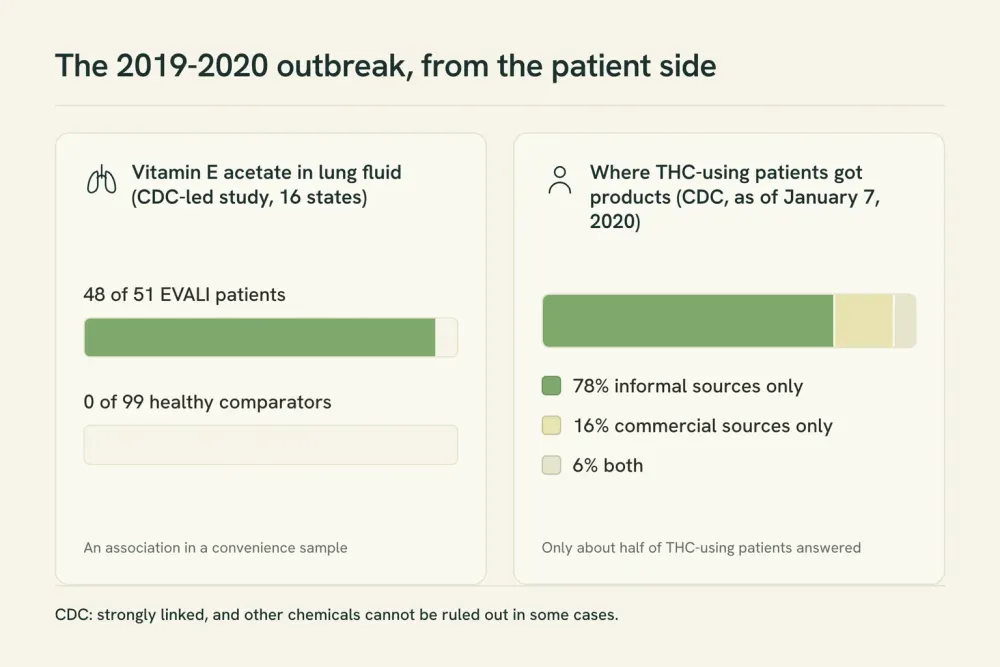
The clearest human evidence came from patients' lungs. In a CDC-led study published in the New England Journal of Medicine, investigators tested fluid washed from the lungs of 51 EVALI patients in 16 states. Vitamin E acetate was present in 48 of them (94%) and in none of 99 healthy comparison participants. No other chemical on the priority list was found, except coconut oil and limonene in one patient each, and 47 of 50 patients with data had evidence of THC exposure. The authors called it an association "in a convenience sample", and the comparison group came from a separate study, which is exactly as far as the data go.
The product side matched. Of the 511 samples FDA found to contain THC, half contained vitamin E acetate as a diluent, and where FDA measured it, it made up 23% to 88% of the liquid. In New York, 132 of 202 cannabis-oil cartridges recovered from patients between August 2019 and June 2021 contained it, at 2.0% to 67.8% of the oil's mass. Where patients got those products matters too. Among patients who reported THC use and said where they got it (about half of them answered, as of January 7, 2020), 78% got products only from what CDC calls informal sources, such as friends, family, dealers or online, 16% only from commercial sources and 6% from both.
On that record, CDC concluded that "Vitamin E acetate is strongly linked to the EVALI outbreak" and that THC-containing vaping products, "particularly from informal sources", were linked to most cases. CDC and FDA recommended that people not use THC-containing vaping products, particularly from informal sources, and stated that vitamin E acetate "should not be added" to vaping products. The concern is the route: CDC notes that vitamin E acetate "usually does not cause harm when ingested as a vitamin supplement or applied to the skin", but that previous research suggests that when it is inhaled, it "may interfere with normal lung functioning." CDC was also careful about what it could not say:
“Evidence is not sufficient to rule out the contribution of other chemicals of concern, including chemicals in either THC or non-THC products, in some of the reported EVALI cases.”
Animal work pointed the same way. In a 2020 mouse study reported in the same journal, two weeks of inhaled vitamin E acetate aerosol raised markers of lung damage and produced numerous lipid-laden immune cells like those seen in patients. Mice given a propylene glycol and glycerin aerosol had lower damage markers and minimal to no fat staining in those cells. That is an animal model, not a human result, and the authors noted that the aerosol may have included breakdown products of heated vitamin E acetate and that other oily solvents might act similarly. It does not show that any other diluent is safe to inhale.
What the outbreak did not prove
An honest reading of the outbreak keeps its limits in view. New York's lab wrote early on that "The cause(s) of EVALI is unknown." Years later, a 2025 review of cannabinoid vaping toxicology concluded that although EVALI has been linked to vitamin E acetate, "a definitive mechanism of injury has not been established, and cases continue to be reported." Mechanism work is still small: a 2024 study of lung fluid from just four ventilated THC-related EVALI patients and five controls found oxidized fats and inflammatory signals, a lead to follow rather than an answer.
- It did not prove vitamin E acetate was the only cause. CDC calls it strongly linked and says the evidence cannot rule out other chemicals in some cases.
- It did not clear licensed products. Among THC-reporting patients who named a source, 16% said they bought only from commercial sources.
- It did not explain every liquid. About 1 in 5 of the cannabis liquids FDA's lab analyzed had no identified additive.
- It did not show that a diluent missing from a ban list is safe to inhale. The mouse data are short-term, in animals, and tested only one alternative.
- It did not describe today's market. These samples were collected in 2019-2021, mostly from illicit products tied to patients.
Where the THC came from: plant-extracted or converted
THC distillate can be made from marijuana extract. In the hemp market, the THC may instead be produced by chemically converting CBD from hemp, and that origin matters because conversion is not clean. In the outbreak liquids, FDA's lab found what it calls unnatural THC isomers (delta-8, delta-10, exo-THC and others) in significant or major amounts in more than 10% of the THC liquids, and in lesser amounts in another 60%. The authors proposed, without proving it, that chemical and heat treatment during manufacturing of source materials "such as marijuana concentrates or converted hemp materials" was the main cause.
The 2026 FDA paper made the point directly. Products submitted as synthetically derived "delta-9 THC" or "delta-8 THC" between 2019 and 2024 contained various combinations of seven THC isomers: delta-9, delta-8, delta-6a,10a, delta-10, delta-4(8)-iso, delta-8-iso and exo-THC, and some also contained THCP or HHC. Only the abstract was available when we wrote this, and the products were samples submitted for analysis rather than a market survey, so it cannot tell you what share of hemp THC is made this way. The chemistry behind it is that acid-treating CBD does not give one product: depending on conditions, the same starting material yields delta-9, delta-8 or iso-THCs, which our comparison of delta-8 and CBD walks through alongside the byproduct audits.
Rules are starting to draw the line. Colorado's rule described above also bars licensed manufacturers from using any ingredient other than regulated marijuana that carries more than 0.3% combined THC isomers. Federal law is in motion and not settled. Public Law 119-37, signed November 12, 2025, rewrites the federal definition of hemp, and Public Law 119-103 staggers when it applies. On November 12, 2026, only one piece is set to take effect: the exclusion of hemp products containing cannabinoids "not capable of being naturally produced" by the plant. On December 11, 2026, the rest is set to follow, including the exclusion of products with cannabinoids the plant can make but that "were synthesized or manufactured outside the plant", and of final products with more than 0.4 mg combined of total THC and similar cannabinoids per container, a definition that includes cartridges. Our note on the move to December 11 explains the split, and our guide to hemp-derived THC covers where hemp THC comes from today. None of this is legal advice about any product.
The hardware is a second ingredient list
For a vape product, the oil is not the only thing that can add contaminants. Canadian government chemists tested six legal cannabis vape products, five cartridges of each, and traced metal particles in the liquid, including cobalt, nickel and zinc, back to the device's own parts. They called it "strong evidence that cannabis vape liquids are contaminated by the metal components of vaping devices." Machine-made vapor from every sample carried metal particles, including lead, though in amounts below the limit the method could quantify, so the study supports no exposure or health estimate. They also found surface cracking on the connector pin of an unused device.
Earlier, California's public-health lab took apart eight vaping devices and found nickel and chromium components in all of them, with copper, lead or tin in some, and charring on the ceramic heating elements of the two THC cartridges used by EVALI patients. The authors stress that their "findings do not imply that harmful exposures would occur under all usage conditions" and that the sample was small. Retail surveys point the same way: a lab survey of 27 delta-8 THC vape products bought in 2021 found none accurately labeled, unlabeled cutting agents in 11, reaction side products in all of them, and metals detected. The practical upshot is simple: for anything inhaled, the lab report should cover the filled, finished product, hardware included.
How to read the paperwork on a distillate product
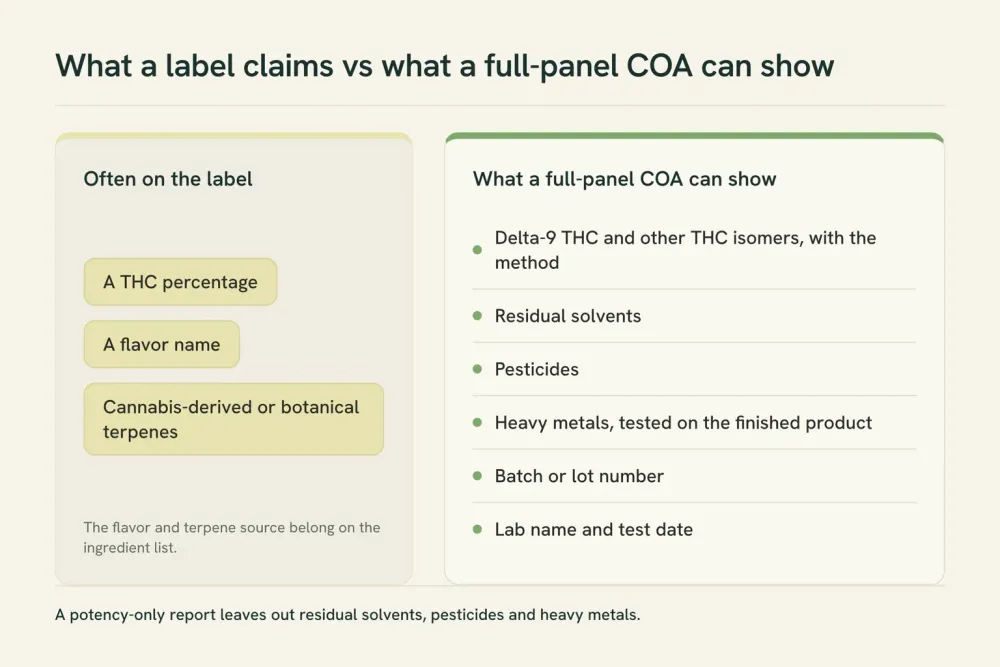
Everything above turns into a short checklist. A certificate of analysis (COA) is the only document that can show what is in a batch, and for distillate products the panels beyond potency carry most of the information. Our guide to what third-party tested actually means lays out the full-panel tests and what each one catches. One caution on potency: in that same delta-8 survey, the liquid-chromatography method named on the products' own certificates could not tell delta-8 THC apart from one of its iso-THC byproducts, so a single THC number can hide a conversion product. And ingredient disclosure is uneven: Washington requires licensed processors to disclose every compound added to cannabis concentrates for inhalation, including thickening agents and terpenes, but that disclosure goes to the regulator and does not have to appear on the package.
- 1Match the batch or lot number on the certificate to the one on the package. A COA with no batch number does not describe any product in particular.
- 2Check the test date against the manufacture date. The certificate should describe this batch, not an older one.
- 3Look for the lab's name and its accreditation or license number, so you can confirm the lab exists and is independent of the seller.
- 4Read the potency panel for delta-9 THC and other THC isomers such as delta-8, delta-10 and exo-THC. One THC value alone cannot show conversion byproducts.
- 5Note the potency method. A method named on some delta-8 certificates could not separate delta-8 THC from an iso-THC byproduct, so a single number may include both.
- 6Confirm a residual-solvent panel. Distillate is made from an extract, and a potency-only report says nothing about leftover solvent.
- 7Confirm a pesticide panel. In 202 illicit cartridges from New York patients, 79% carried pesticide residues, and myclobutanil turned up in half.
- 8For anything inhaled, look for heavy metals tested on the filled, finished product, since the hardware itself can shed metal into the oil.
- 9Read the ingredient list for every non-cannabis ingredient, including any diluent and the terpene source. "Natural flavors" alone does not tell you.
Distillate vs full-spectrum and live resin: a category, not a grade
People often ask whether distillate is better or worse than live resin or other full-spectrum extracts. It is a category difference, not a ranking. Distillate is refined toward one cannabinoid and then has flavor added back; full-spectrum-style extracts, including live resin, are made to keep more of the plant's own mix of compounds rather than rebuilding it. Neither word is a safety or quality verdict. A full-spectrum extract can carry pesticides or leftover solvent, and a distillate product can have a clean, complete certificate. The "category error" section of our CBD distillate guide makes the same point for CBD. Whichever you are looking at, the paperwork questions are the same.
Symptoms that need a clinician
In CDC's interim clinical guidance, published in MMWR in October 2019, 95% of 339 EVALI patients with data had respiratory symptoms such as cough, chest pain or shortness of breath. 77% had stomach symptoms (abdominal pain, nausea, vomiting or diarrhea), and 85% had fever, chills or weight loss. In some, the stomach symptoms came before the breathing ones. Those shares describe people already diagnosed, so they are not a self-check. The guidance told clinicians to instruct patients to seek medical care promptly if respiratory symptoms worsen. Separately, MedlinePlus lists breathing problems and chest pain lasting two minutes or more among the warning signs of a medical emergency.
Questions people ask about THC distillate
Not as sold in finished products. Sellers often advertise the raw ingredient at 90% THC or more, but measured products vary: New York's medical-program vape fluids held 80-90% cannabinoids with no diluent, and FDA's outbreak-era liquids ran up to 80% delta-9 THC by weight, often above 50%. The rest can be other cannabinoids, added terpenes or diluents. Check which THC the certificate reports and whether it tested the finished batch.
No one can answer that for a whole product category, and we do not give a verdict either way. What the record shows: CDC strongly linked the 2019-2020 lung-injury outbreak to vitamin E acetate in THC vaping products, mostly from informal sources, and said other chemicals could not be ruled out. Converted-THC isomers and metals from hardware are separate open questions. A full-panel certificate is how you see what a specific product contains.
Usually added terpenes or flavor blends, and in some products a diluent. In the outbreak investigation, public labs found vitamin E acetate, MCT oil, polyethylene glycol, squalane, pine rosin and several thickening esters, while about 1 in 5 of the liquids FDA's lab analyzed had no identified additive. Colorado now bars vitamin E acetate, PEG and MCT oil in licensed marijuana products meant to be inhaled, and Washington bans selling vapor products with vitamin E acetate.
Distillate is refined toward one cannabinoid, with flavor usually added back afterward. Live resin and other full-spectrum-style extracts are made to keep more of the plant's own compounds. That is a category difference, not a ranking: neither label tells you whether a given product is clean. The certificate does.
Terpenes taken from plants other than cannabis, such as limonene from citrus. The molecule can be chemically identical to the one in cannabis, so "botanical" versus "cannabis-derived" is a sourcing claim, not a quality grade. The flavor industry's trade association says its food safety reviews do not cover inhalation, and heated terpenes break down into their own byproducts.
It can be. Some distillate is extracted from marijuana; in hemp products, THC may be made by chemically converting hemp CBD. FDA's lab found what it calls unnatural THC isomers in many outbreak liquids, and a mix of THC isomers in synthetically derived "delta-9" and "delta-8" products it analyzed from 2019 to 2024. Under federal law as written, hemp products containing cannabinoids the plant can make but that were synthesized or manufactured outside the plant are set to fall outside the hemp definition on December 11, 2026. This is not legal advice about any product.
CDC's wording is that vitamin E acetate is strongly linked to the outbreak and that THC-containing vaping products, particularly from informal sources, were linked to most cases. It did not say distillate itself caused the injuries, and it said evidence was not sufficient to rule out other chemicals in some cases. A 2025 review adds that the mechanism of injury is still not established.
If you take one habit from this page, make it asking for the full certificate before you trust any claim on a cannabis product, THC or CBD. Our breakdown of what a full-panel third-party test should cover shows what to expect on each panel, and our guide to choosing a CBD oil applies the same paperwork checks to hemp products.
Writing about hemp, wellness and the small rituals that keep us balanced.