CBD Cigarettes: What's in Them, and the Quit Claim Checked
A CBD or hemp cigarette is hemp flower in a cigarette paper with a filter. It has no nicotine if the label is honest, but it still burns into smoke and carries a few milligrams of THC. Here's what the blood, urine and quit-smoking studies actually tested.
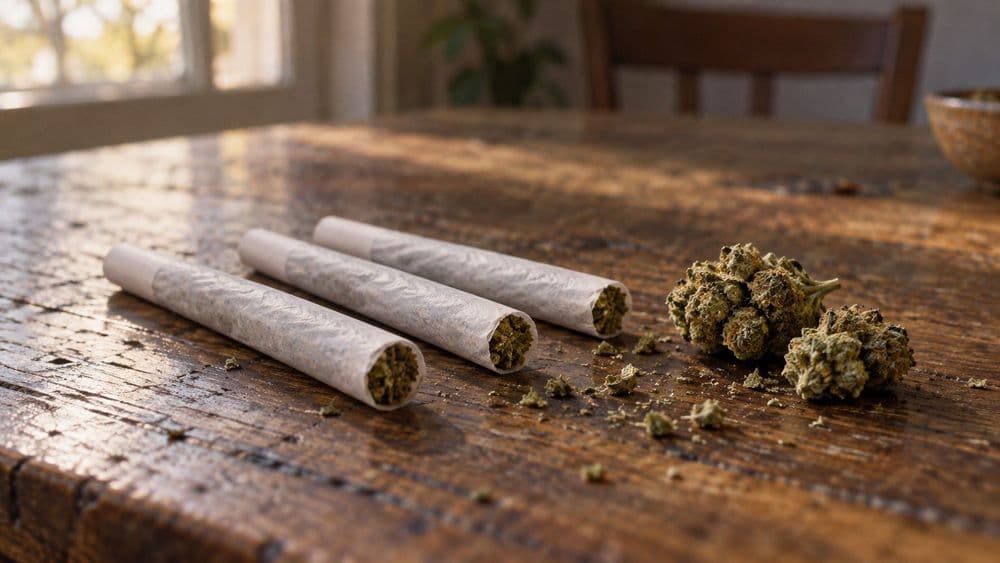
A CBD cigarette, also sold as a hemp cigarette, is dried hemp flower rolled in a cigarette paper with a filter. There is no tobacco in it, so if the label is honest there is no nicotine. What it does not escape is smoke, and it is not THC-free: the CBD-flower cigarettes and joints measured in forensic studies carried roughly 1.6 to 4.5 mg of THC each. And the claim you see most, that CBD cigarettes help people quit smoking, traces back to a one-week trial in which nobody smoked hemp at all. They used a CBD inhaler.
That is the short answer. The rest of this guide takes it apart piece by piece: what is in the stick and how it differs from a joint or a pre-roll, how much THC it carries and what that did to blood and urine in the people who were tested, what the quit-smoking studies actually gave their volunteers, what labs found in hemp cigarette smoke and filler, and the four lines on a pack and its certificate of analysis (COA) that tell you whether it is really hemp. This is not a buying guide. Planntz does not sell hemp flower, pre-rolls or cigarettes, and we are not recommending that you smoke anything. If you roll your own, our blunt vs joint comparison covers wraps, papers and where hemp flower fits on that shelf.
What a CBD (hemp) cigarette actually is
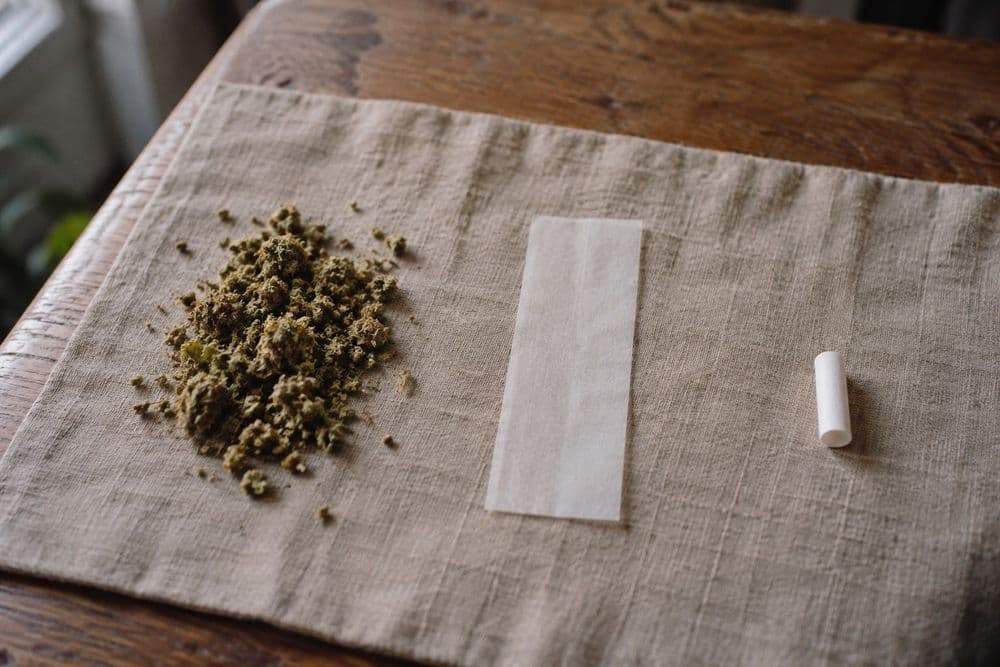
Strip off the branding and a CBD cigarette has three parts: filler, paper and filter. The filler is dried hemp, the same species as marijuana (Cannabis sativa) but grown and sold for a low THC content and, in these products, a high CBD content. Some brands use only the flower, meaning the buds. Others use flower mixed with trim and other above-ground plant parts. The paper wraps it, and a filter sits at the mouth end, so the stick looks and draws like a tobacco cigarette rather than a joint. The paper is not a neutral detail: it burns along with the hemp, and our guide to what rolling papers are made of goes through wood pulp, hemp, rice and the additives some papers carry.
How much CBD is in one? When Mayo Clinic researchers machine-smoked two commercial hemp cigarettes in 2021, one weighed about 1 g and listed about 90 mg of CBD, and the other listed about 50 mg. A brand whose marketing was coded by tobacco-control researchers at UCSF in 2024 printed "approximately 50 MG CBD and less than 0.3 THC" on its pack. And when Swiss forensic scientists analyzed CBD cigarettes sold legally there as tobacco substitutes, they measured an average of 42.7 mg of CBD and 2.2 mg of THC per cigarette. Those are three different products in two countries, but they put the typical stick in the range of roughly 40 to 90 mg of CBD, with a couple of milligrams of THC riding along.
A CBD cigarette is also not quite the same thing as a CBD pre-roll. A pre-roll is a joint: ground flower in a cone of rolling paper, usually with a small rolled card tip called a crutch instead of a cigarette filter (our explainer on what a roach is covers why crutches and filters behave differently). Both burn the same kind of flower, and for THC, smoke and drug tests the difference is mostly shape. The table below puts the CBD cigarette next to the three things it is most often compared with.
| Question | CBD (hemp) cigarette | Tobacco cigarette | Herbal cigarette | Cannabis joint or pre-roll |
|---|---|---|---|---|
| What burns? | Hemp flower, sometimes with trim, in paper with a filter | Cured tobacco leaf in paper with a filter | Non-tobacco, non-cannabis herbs such as mullein, damiana or mint | Cannabis flower in paper, often with a crutch |
| Nicotine? | No, unless blended with tobacco | Yes | No, if truly tobacco-free | No, unless mixed with tobacco |
| Cannabinoids? | CBD-dominant; THC low but present (about 1.6 to 4.5 mg per stick in the studies below) | None | None, unless the blend contains hemp | THC-dominant |
| Makes smoke? | Yes | Yes | Yes | Yes |
| Federal framework | Hemp rules based on THC content; outside the federal tobacco definition if no tobacco or nicotine | FDA tobacco product rules, federal minimum sales age of 21 | Outside the federal tobacco definition if no tobacco or nicotine | Controlled substance under federal law; adult-use sales legal only under state law |
| Anything for a THC drug test to find? | Yes, it can carry THC | No | No, unless the blend contains hemp | Yes |
The row to remember is the fourth one: every column makes smoke. Removing tobacco removes nicotine, and that is all it removes. Non-hemp herbal cigarettes are a different product, and our guide to herbal smoking blends and what's in them covers them, including the tar and carbon monoxide warning the Federal Trade Commission made two cigarette companies print on herbal cigarette packs and ads in 2000.
Do CBD cigarettes get you high?
CBD itself is not intoxicating the way THC is; our guide to whether CBD gets you high explains why the two cannabinoids act so differently. So the honest question about a CBD cigarette is not the CBD. It is the THC that comes along with the hemp, and the forensic studies below measured exactly that.
Start with the most detailed numbers. In a Basel study of blood and urine after smoking CBD joints, a volunteer with no cannabis history smoked one 200 mg joint of CBD flower at 0.94% THC and 23.5% CBD. That is about 1.9 mg of THC, by our arithmetic from the published percentages. Blood THC peaked at 2.7 ng/mL, which the authors note is significantly above the Swiss road-traffic threshold of 1.5 ng/mL. A second volunteer smoked two joints a day for 10 days, at 0.8% THC (about 1.6 mg per joint), to mimic regular use, and peaked at 4.5 ng/mL. The authors found no build-up of any cannabinoid in the blood over those 10 days.
The Swiss cigarette study pointed the same way. Its one male volunteer smoked one cigarette in 15 minutes, and in separate sessions four in an hour and four in 30 minutes, and the authors concluded that the trace THC in CBD cannabis can push blood THC above the Swiss legal limit for driving. A later paper from the same Bern group summarizes that pilot as producing blood THC of up to 6.8 ng/mL. Note the setting: in Switzerland only cannabis above 1% total THC is controlled, so these products may carry more THC than a US product sold as hemp. The common thread is still clear. In every one of these studies, smoking CBD flower put measurable THC into the blood.
Does that mean you will feel high? None of these studies set out to measure that, and how much 2 mg of THC registers varies from person to person. What they show is narrower and more useful: "CBD cigarette" does not mean "no THC in you". The Bern group's larger trial tested driving performance after a CBD-rich joint, and our guide to CBD and driving covers what it found. If you are wondering about burning CBD turning into THC, there are two records. German state food-control labs machine-smoked six retail samples of CBD joints and reported that "no THC formation was provable": the THC in the smoke was THC already in the flower. In a lab pyrolysis study of pure CBD, CBD heated to 250-500 C did partly convert, with THC as the main product, but that was a pure CBD standard in a lab instrument, not a cigarette. Flower sold as THCA flower is a different object altogether, explained in THCA vs CBD.
Can CBD cigarettes help you quit smoking? What the studies used
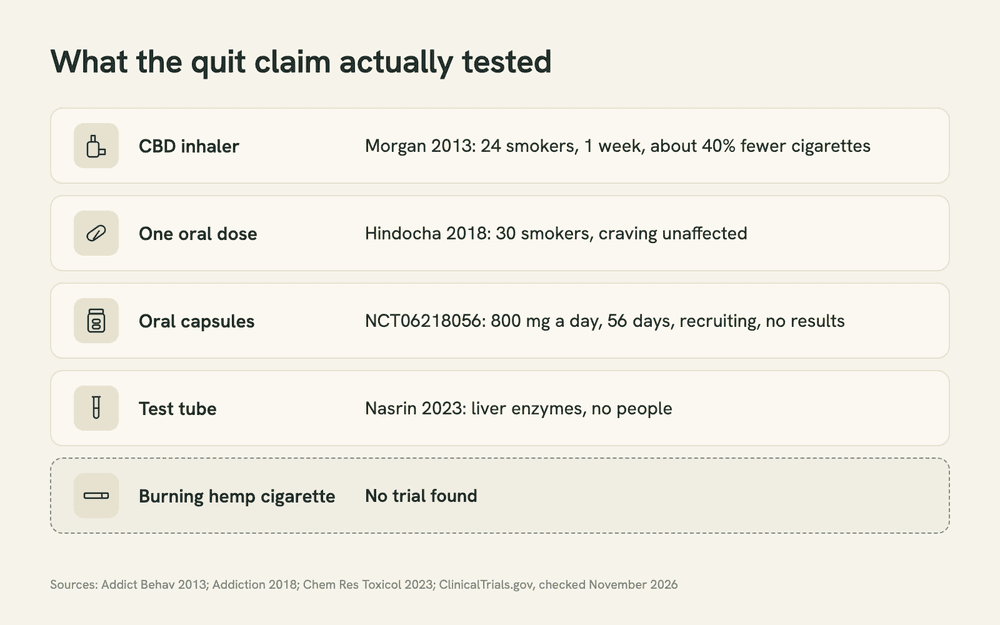
Almost every page on this topic repeats that CBD cut smoking by 40%. That figure comes from a 2013 pilot trial in Addictive Behaviors. Twenty-four smokers who wanted to quit got either a CBD inhaler or a placebo inhaler for one week, 12 people per group, and were told to use it when they felt the urge to smoke. The placebo group's cigarette count did not change. The CBD group smoked about 40% fewer cigarettes during that week. No hemp was burned, nobody was measured quitting, and the trial was 12 people per arm. The abstract says some of the effect seemed to hold at follow-up; we could not access the full paper, so we are not reporting its dose, follow-up length or craving data. The authors called it preliminary, and it is.
The next step is a proper trial, and one is registered. ClinicalTrials.gov record NCT06218056, run at UCLA, is testing 800 mg a day of oral CBD in capsules against placebo for 56 days in about 120 people with tobacco use disorder at a residential treatment center. Its main outcome is cotinine, a nicotine breakdown product, in the blood at 8 weeks. When we checked in November 2026, it was listed as recruiting, with no results posted. It does not involve a cigarette either. Two other studies get cited in the same breath. In a lab study of 30 dependent smokers, a single 800 mg oral dose of CBD reduced how much attention they paid to pictures of cigarettes, but craving and withdrawal were unaffected. And the "CBD shows promise" headline that ranks for this search is a test-tube study of liver enzymes that break down nicotine. It involved no smokers.
| Study | Who | What they got | How long | What was measured | Result as reported |
|---|---|---|---|---|---|
| Morgan 2013, pilot trial | 24 smokers who wanted to quit, 12 per group | CBD inhaler or placebo inhaler, used on urge | 1 week | Cigarettes smoked | CBD group about 40% fewer cigarettes that week; placebo no change |
| Hindocha 2018, lab study | 30 dependent smokers not trying to quit | Single 800 mg oral CBD dose or placebo | One session each | Attention to cigarette pictures, craving, withdrawal | Less attention to cigarette cues; craving and withdrawal unaffected |
| Nasrin 2023, test tube | No people | CBD and a CBD metabolite added to liver enzymes | Not applicable | Activity of two enzymes that break down nicotine | Enzymes inhibited |
| NCT06218056, UCLA | About 120 people with tobacco use disorder (planned) | 800 mg a day of oral CBD capsules or placebo | 56 days | Blood cotinine at 8 weeks | Recruiting; no results posted |
| A burning hemp cigarette | No trial found | Not tested | Not tested | Not tested | Not tested |
That last row is the point. Both human trials behind the headline used a route that involves no smoke at all, an inhaler and a capsule, and no trial we found has tested a hemp cigarette as a way to quit. Marketing fills the gap anyway. When the UCSF researchers coded one hemp-cigarette brand's website, 307 of its 851 sentences (36.1%) made a harm-reduction or health claim, 519 claims in all, and the largest group (35.3%) pitched the product as an alternative to tobacco or an aid to quitting. The authors noted that "the website did not provide independent verification to support claims". A widely shared headline calls all this a medical study; the only controlled result behind the 40% figure is the one-week inhaler pilot.
If quitting tobacco is your goal, the tools with real evidence are already listed. FDA's guide to approved quit-smoking products names nicotine patches, gum and lozenges, a prescription nicotine nasal spray and inhaler, two prescription medicines and one cleared device. No CBD product is on that list. Free coaching is available through Smokefree.gov, run by the National Cancer Institute, and the national quitline.
Nicotine-free is not smoke-free
"No nicotine" and "no tobacco" are true of an honest hemp cigarette, and they are the lines most packs lead with. They say nothing about what happens when you set plant material on fire. Two recent lab studies measured hemp cigarettes themselves, and a third compared cannabis smoke with tobacco smoke. Read them together and you get a picture that does not fit a simple better-or-worse verdict.
The Mayo Clinic team smoked both hemp brands in a machine under an intense standard regimen and measured carbonyls, a family of irritant and toxic compounds that includes formaldehyde, acetaldehyde and acrolein. They compared them with a leading US tobacco cigarette and a standard research reference cigarette. Per puff, the hemp smoke carried less formaldehyde: 3.71 and 4.94 micrograms, against 7.76 and 8.98 for the two tobacco cigarettes. But the hemp cigarettes took more puffs to finish (16.5 and 14.25, against 11.25 for the tobacco brand), so the gap narrows per cigarette. Acetaldehyde per puff from the second hemp brand (117.77 micrograms) sat between the two tobacco cigarettes, and that brand had the highest butyraldehyde of anything tested. The authors' conclusion: "Smoke from hemp cigarettes contains carbonyls at biologically significant concentrations."
The filler itself carries something too. CDC chemists tested the filler of 14 commercial hemp cigarette brands for metals in a study published in late 2025. Cadmium was below the reportable level in all of them, lower than in US tobacco cigarettes. But all 14 had nickel above Michigan's action limit for cannabis products, 13 had chromium above the limit used in Maryland and Missouri, 5 had lead above California's limit and 4 had arsenic above California's. Those limits are state rules for cannabis products and they differ by state, the brands were a convenience sample, and the study measured the filler, not the smoke. Still, it is the first look most buyers will ever get at metals in this product, and only 4 of the 14 companies' own lab reports had tested for them.
Why does burning hemp look so much like burning anything else? A 2020 lab comparison of cannabis and tobacco smoke in Scientific Reports detected 2,575 compounds in mainstream cannabis smoke and tentatively identified 536. Of those, 110 were compounds with known toxic, carcinogenic or mutagenic effects, against 173 in tobacco smoke, with 69 in common. Cannabis smoke particles were also about 29% larger, and fresh cannabis smoke carried about 3.4 times the total particle mass. That study used marijuana, not hemp, but the lesson carries: the cannabinoid content is not what makes smoke. Burning plant material is.
So are hemp cigarettes bad for you, or better than tobacco? Lab data runs in both directions: lower for some compounds, higher for others, and metals that nobody on the pack mentions. What no one has done is follow people who smoke hemp cigarettes over years and compare their health with tobacco smokers or nonsmokers, so we will not hand you a verdict the evidence does not support. For what smoke of any kind does to your airways, see our explainer on why weed makes you cough. For how heating flower without burning it differs, see dry herb vaporizers vs smoking, and if you want to see how a non-inhaled CBD product is used, our guide on how to take CBD oil walks through it.
Will a CBD cigarette make you fail a drug test?
It can. Standard workplace drug tests do not look for CBD; they look for a breakdown product of THC, usually in urine, first with a quick screening test (an immunoassay) and then, if that is positive, a confirmation test. Our guide to CBD and drug tests explains the cutoffs and why full-spectrum products carry risk, and our 10-panel drug test guide covers what standard panels include. The table below collects every study we found that measured blood or urine after people smoked or inhaled CBD-rich flower.
| Study (people) | What was smoked or inhaled | THC and CBD per dose | Blood THC | Urine | Caveat |
|---|---|---|---|---|---|
| Hädener 2019, Bern (1) | Swiss CBD cigarettes: 1 in 15 min; later 4 in 1 hour and 4 in 30 min | 2.2 mg THC, 42.7 mg CBD per cigarette | Above the Swiss driving limit; a later paper cites peaks up to 6.8 ng/mL | Negative on three screening immunoassays, sampled up to 27.3 hours | One person; abstract only |
| Meier 2018, Basel (2) | 200 mg CBD-flower joints: one joint (first-time user); 2 a day for 10 days (second volunteer) | About 1.9 and 1.6 mg THC (our arithmetic); 23.5% and 17% CBD | Peaks of 2.7 and 4.5 ng/mL vs Swiss 1.5 ng/mL | THC metabolite seemed to rise over the 10 days | Two people |
| Gelmi 2021, Bern (33) | Joint of 500 mg CBD-rich flower plus 500 mg tobacco | 4.5 mg THC, 83 mg CBD | 6.7 to 102 ng/mL free THC about 5 min after; 0.9 to 38 at about 45 min | Not used here | Contained tobacco; finger-prick blood spots |
| Spindle 2020, Baltimore (6) | Vaporized CBD-dominant cannabis | 3.7 mg THC, 100 mg CBD | Not used here | 4 samples confirmed positive above 15 ng/mL; pure CBD: 0 of 218 | Vaporized, not smoked; six people |
Read the rows together and you see why no one can promise you a result. The single Swiss volunteer screened negative on three urine tests for 27 hours, even after smoking four cigarettes in half an hour. That is reassuring until you reach the next study. In a Johns Hopkins study with a co-author from SAMHSA, the federal agency behind the federal workplace drug-testing program, six adults inhaled a CBD-dominant cannabis carrying 3.7 mg of THC, less than two Swiss CBD cigarettes' worth. Four of their urine samples confirmed positive for THC's metabolite. Pure CBD with no THC produced none. And in the Basel study, the THC metabolite in urine seemed to climb over 10 days of two joints a day, which the authors flag as important for abstinence testing. One person, six people and two people are tiny samples, and the products differed. What they agree on is that a CBD cigarette is not a THC-free product, and the more you smoke, the more there is to find.
Read the pack and the COA: four checks
Since the THC question decides so much, the most useful thing you can do before smoking anything sold as hemp is read its certificate of analysis, the lab report for the batch. Our step-by-step guide on how to read a COA walks through a full report. For a hemp cigarette, these four checks do most of the work.
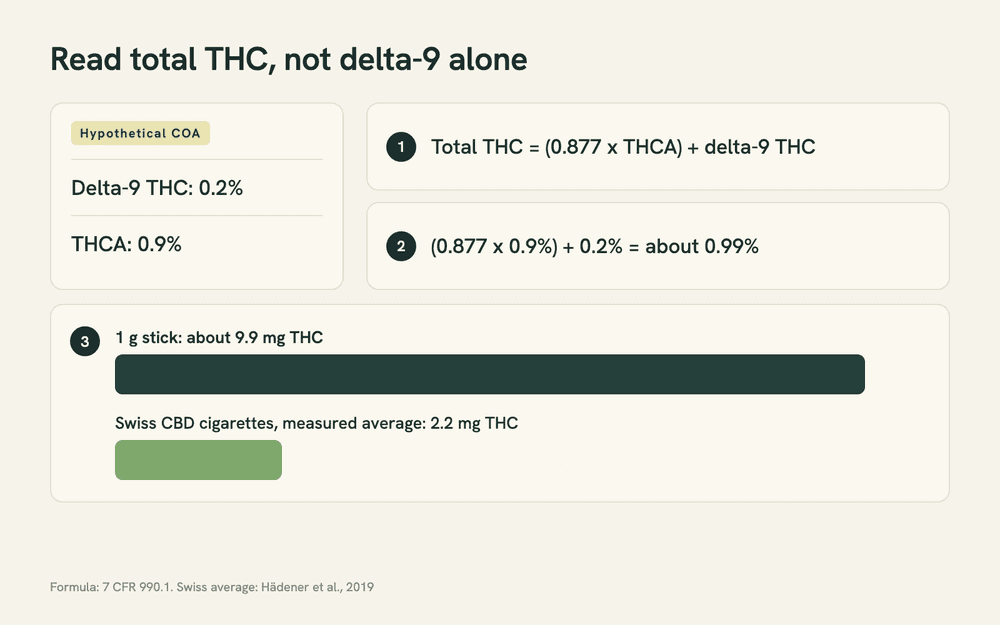
- 1Total THC, not delta-9 alone. A line reading "less than 0.3% THC" may count only delta-9 THC. Find THCA on the COA and do the total THC math below.
- 2Batch match. The lot or batch number on the pack should match the one on the COA. A report for a different batch tells you nothing about the stick in your hand.
- 3Lab independence. Check who ran and signed the report. It should be an outside, accredited lab with no ties to the brand.
- 4Contaminants. Look for a heavy-metals panel (lead, arsenic, cadmium, mercury, ideally nickel and chromium) plus pesticides. No panel means no data, not a clean result.
The total THC math. THCA is the raw, acid form of THC in the plant. It does little on its own, but heat converts it to THC, and lighting a cigarette is heat. The federal hemp-crop rule writes the formula out: total THC equals 0.877 times THCA, plus delta-9 THC. (The 0.877 accounts for the weight THCA loses when it becomes THC.) Here is a hypothetical example. Say a COA shows 0.2% delta-9 THC and 0.9% THCA. A delta-9-only line reads "0.2%", comfortably under 0.3%. Total THC is 0.2 + (0.877 times 0.9) = 0.2 + 0.79 = about 0.99%. In a 1 g cigarette, that is about 9.9 mg of THC, more than four times the 2.2 mg average in the Swiss cigarettes. The USDA rule governs the crop at harvest and retail labeling rules vary, but the arithmetic is the same on any COA, and our guide to THCA vs CBD flower explains why that one line matters so much.
Who signed the report. The UCSF study found that the brand it examined published a COA signed by a person who was also the company's chief science adviser, which the authors called a conflict of interest. A report like that may still be accurate, but you cannot tell. Our explainer on what third-party tested really means shows how to check that a lab is independent and accredited. What wasn't tested. Remember the CDC finding: only 4 of 14 brands' own reports included metals at all. If the COA covers cannabinoids and nothing else, the smoke and filler questions above are simply unanswered for that product.
Are CBD cigarettes legal?
It depends on federal hemp law, on which rulebook the product falls under, and on your state. Federally, hemp is defined by its THC content, and that definition is being rewritten. Our guide to whether CBD flower is legal reads the statutes and the dates, and our history of hemp-derived THC explains how the current definition came about. Tobacco law is a separate question. Federal law defines a tobacco product as one "made or derived from tobacco, or containing nicotine from any source", so a hemp cigarette with neither sits largely outside FDA's tobacco rules, including the federal age-21 tobacco law. Age limits and sales rules for these products come from states and retailers. That is a gap in the rules, not a safety finding. Some states ban the format outright. Iowa Code section 204.14A, as we read it in November 2026, makes it a serious misdemeanor to possess, use, manufacture, market, transport or distribute hemp intended to be inhaled, and it names cigarettes, cigars, cigarillos and pipes. Rules vary by state and change often. This is a factual summary, not legal advice.
What the evidence does not show
- No trial we found has tested a burning hemp cigarette as a quit-smoking aid. The two human trials cited for it used an inhaler and oral capsules.
- We found no long-term study of the health of people who smoke hemp-only cigarettes, compared with tobacco smokers or nonsmokers.
- The blood and urine studies enrolled 1, 2, 6 and 33 people, and the 33-person study mixed tobacco into the joint.
- The Swiss products could legally carry up to 1% total THC, so their THC levels do not describe any particular US product.
- The smoke and metals data come from machine smoking and filler analysis of a limited set of brands, not from measuring what people inhale.
- For the 2013 inhaler pilot and the Swiss cigarette study, we read the abstracts only; their full methods were not accessible to us.
Frequently asked questions
They are not designed to, but they are not THC-free. The CBD-flower cigarettes and joints in forensic studies carried about 1.6 to 4.5 mg of THC each, and every one of those studies found THC in the volunteers' blood, in several cases above Switzerland's driving limit. Whether you notice that amount varies from person to person. The number that decides it is total THC on the batch COA.
Not if they contain no tobacco and the label is accurate, since nicotine comes from tobacco. Some products blend hemp with tobacco (the joints in the largest Swiss study did), so read the ingredient list. And no nicotine does not mean no smoke: lab tests found carbonyl toxicants in hemp cigarette smoke.
No hemp cigarette has been tested as a way to quit. The 40% figure comes from a one-week pilot in which 24 smokers used a CBD or placebo inhaler, and the larger UCLA trial uses oral capsules and had posted no results as of November 2026. No CBD product is FDA-approved for quitting. FDA-approved aids include nicotine patches, gum and lozenges, and free coaching is at 1-800-QUIT-NOW and Smokefree.gov.
It can. One Swiss volunteer who smoked CBD cigarettes screened negative, but in a Johns Hopkins study six people who inhaled CBD-dominant cannabis with 3.7 mg of THC produced four confirmed-positive urine samples. Results depend on the batch's THC, how much you smoke, the test's cutoff and your body. No product can guarantee a result.
Nobody has measured that in people. Lab tests show hemp cigarette smoke contains the same families of toxicants as tobacco smoke, lower for some compounds per puff and higher for at least one, and CDC chemists found metals above some state limits in the filler of every brand they tested. No study has followed hemp cigarette smokers' health over time.
It varies. Federally, hemp is defined by its THC content and that definition is changing; our guide to whether CBD flower is legal covers the details. A hemp cigarette without tobacco or nicotine falls largely outside federal tobacco rules, and some states ban smokable hemp outright: Iowa's code names cigarettes. This is not legal advice.
In a machine-smoking test of six retail samples of CBD joints by German state labs, no new THC formation could be shown: the THC in the smoke was THC already in the flower. A separate lab pyrolysis study found pure CBD heated to 250-500 C partly converted, mostly to THC, but that was a pure CBD standard in a lab instrument, not a cigarette.
Close, but not identical. A CBD cigarette is shaped like a tobacco cigarette with a filter; a pre-roll is a joint in a cone of rolling paper, usually with a card crutch. Both burn the same kind of hemp flower, so for THC, smoke and drug tests the difference is mostly shape.
Everything that matters about a CBD cigarette, the THC that comes along with the hemp, whether metals were tested and who vouched for the numbers, is written on one document. If you take one skill away from this page, make it this one: our guide on reading a certificate of analysis line by line shows you how. And if you are weighing CBD products that are not smoked at all, our guide to choosing a CBD oil applies the same label checks to oils.
Writing about hemp, wellness and the small rituals that keep us balanced.