What Is a Good Terpene Percentage? What the Number on the Jar Measures, and What It Can't Tell You
A terpene percentage is a weight: milligrams of aroma compounds per gram of flower, counted on one lab's list on one day. Here is what measured flower actually tests at, why two labs disagree, why the number shrinks in the jar, and what it cannot tell you.
The jar says 2.8% total terpenes. A budtender calls that great, a website says anything over 2% is top shelf, and the next jar on the shelf says 1.1%. Before you decide whether either number is good, it helps to know what the number actually is: a weight, measured on one lab's list of compounds, on one day.
The short answer: there is no official good terpene percentage, but measured cannabis flower usually lands around 1% to 2% total terpenes by weight. Researchers who tested 19 commercial flowers found 0.4% to 2.3%, and about 47,000 US lab samples with terpene results averaged about 2%. Around 3% is high, and that figure comes from breeders, not shelf surveys. "Good" is a marketing word: the number depends on which compounds the lab counted, when it tested, and whether terpenes were added. It cannot tell you how a strain will feel.
What a terpene percentage measures
Terpenes are the volatile compounds behind most of the smell of cannabis. If you want the chemistry, our guide to cannabinoids vs terpenes covers what they are and where the plant makes them. On a flower certificate of analysis (COA), the total terpenes line is a mass fraction, written as % w/w (weight per weight): the combined weight of every terpene the lab measured, divided by the weight of the dried flower sample. California's rule for licensed labs, 4 CCR 15725, asks for the terpene result as a percentage and in milligrams per gram (or per milliliter for liquids). Those are the same number in two units.
There is a second kind of percentage that looks identical and means something else. Profile wheels and strain cards often say something like "myrcene 40%". That is a share of the terpenes, not an amount in the flower. The 2022 Molecules paper behind the 0.4% to 2.3% range notes that terpene data are reported either as a concentration or as each terpene's fraction of the total terpene content, and the two answer different questions. A flower with 0.5% total terpenes and a flower with 2.5% can both be "40% myrcene". If you are doing the math on an eighth of flower, only the w/w figure gives you milligrams.
What is a good terpene percentage? Measured ranges vs marketing tiers
Search this question and you will find confident tiers: under 1% is mild, 1% to 2% is good, 2% to 4% is top shelf. None of the top results we read on October 30, 2026 cited a source for those cut-offs. Here is what researchers actually measured. The Israeli team behind the Molecules paper (Raz, Eyal and Davidson) tested 19 commercial medical flowers by gas chromatography and found 0.4% to 2.3% total terpenes; the authors work with a medical cannabis producer, which the paper discloses. In the US dataset, Smith and colleagues pooled compliance-lab results from six labs. Across the samples with terpene data, total terpenes averaged about 2% by weight, and a single terpene was rarely present above 0.5%, with most below 0.2%. One author worked for Leafly. A University of British Columbia team measured five cultivars at 9.3 to 13.6 mg/g in mature flowers, roughly 0.9% to 1.4%, and at 4.9 to 7.3 mg/g in younger flowers, so the flower's stage of development alone moves the number. One author there was affiliated with Aurora Cannabis.
The 3% figure has a different pedigree. The Molecules review says flower terpenes were "commonly in the 1% range" and that selective breeding has raised some to about 3%, but it cites that to a 2018 Planta Medica paper describing a commercial breeding program, whose lead author ran the company behind the lab-report format it described. That makes 3% a breeder's ceiling, quoted second-hand, not an average from store shelves.
| Figure | Source | Sample | Method | Measured or asserted |
|---|---|---|---|---|
| 0.4% to 2.3% | Raz, Eyal and Davidson, Molecules, 2022 | 19 commercial medical flowers, Israel | Gas chromatography (GC-FID) | Measured |
| About 2% average | Smith et al., PLOS One, 2022 | About 47,000 US flower samples with terpene results, six labs | Compliance-lab panels, cut back to the compounds every lab shared | Measured |
| 0.93% to 1.36% (9.3 to 13.6 mg/g) | Booth et al., Plant Physiology, 2020 | Five cultivars, mature flowers, research grow | GC-MS, 42 terpenes quantified | Measured |
| 1.49% at the start of storage | Bueno et al., Journal of Cannabis Research, 2020 | Control flower, three samples per time point | Headspace GC-MS | Measured (one sample series) |
| About 3% in some flower | Lewis, Russo and Smith, 2018, as cited in the 2022 Molecules review | A commercial breeding program | Not stated in the review | Asserted, second-hand |
| "1-2% is good, 2-4% is top shelf" | Retail and dispensary blogs | None given | None given | Asserted, no source |
So what is a good terpene percentage? On the measured evidence, about 1% is ordinary, about 2% is the US lab average, and about 3% is high for flower. Past that, "good" is a marketing word. A higher number does mean more aroma compounds by weight in that sample on that day. It does not mean better flower in any way the research has measured, and above about 3% the useful reaction is a question rather than a verdict: which panel, which date, and were terpenes added?
Why two labs print different totals
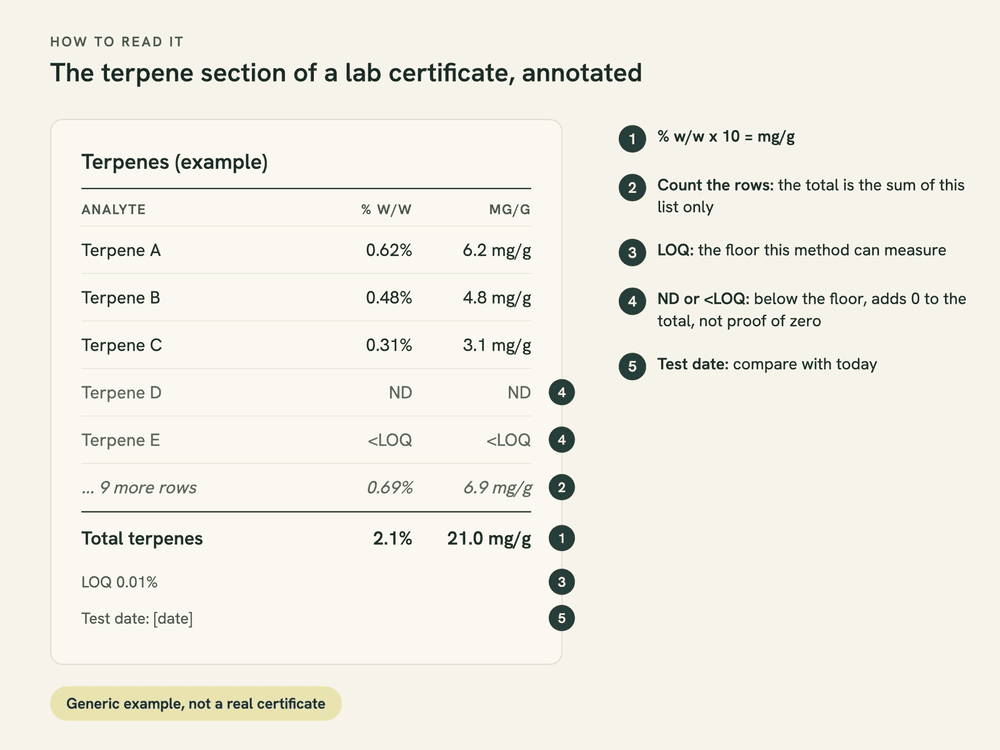
A total terpenes line is a sum. The lab adds up every compound on its panel that came in above its limit of quantitation (LOQ), the smallest amount the method can measure reliably. Anything below that floor is reported as ND (not detected) or below LOQ and adds zero to the total, even if a trace is present. So the total depends on how long the list is, where the floor sits, and the method: gas chromatography with a flame-ionization or a mass-spectrometry detector, run on a solvent extract or on the air above the flower (headspace). The clearest statement of the problem comes from the authors of the large US dataset, explaining why they could not simply add up the labs' own totals:
“Given that cannabis testing is not standardized nationally, each lab had a unique set of cannabinoids and terpenes that they measured. Because of this, we established a list of compounds common across every lab.”
Panel size in the published literature spans an order of magnitude. A validated University of Mississippi method quantifies 10 major terpenes, with recoveries of 89% to 111%. The UBC team quantified 42. A 12-month storage study in Frontiers in Plant Science analyzed 93 terpenoids. Every one of these would print a line called total terpenes:
- 10 terpenes: a validated GC-FID method (Ibrahim et al., 2023)
- About 14 terpenes: the compounds all six labs shared in the US dataset (Smith et al., 2022)
- 42 terpenes: 15 monoterpenes and 27 sesquiterpenes in mature flower (Booth et al., 2020)
- 93 terpenoids: a year-long storage study (Milay et al., 2020)
Rules do not fix the list either. In California, the terpene panel is the test someone has to ask for: the lab analyzes at least 0.5 g "if requested". Minnesota's 2022 medical-program rule lets a manufacturer request the analysis and allows a terpene profile on a dried-flower label only when one was performed. Minnesota's 2026 technical standard, approved July 1, 2026, goes further: a terpene test is required when terpenes are added or claimed on the label, and a quantity claim must land within 15% either way of the test. A December 2021 motion from a Washington task-force workgroup noted that terpene testing was not required in that state at the time, and recommended that a list of required terpenes, with limits of quantitation, be created. We also searched PubMed on October 30, 2026 for an interlaboratory or label-accuracy study of cannabis terpene results and found none; the label-accuracy literature measures THC and CBD. So the case that two labs can print different totals for the same jar rests on the panel spread above, not on a head-to-head lab trial.
Why the number shrinks after the test
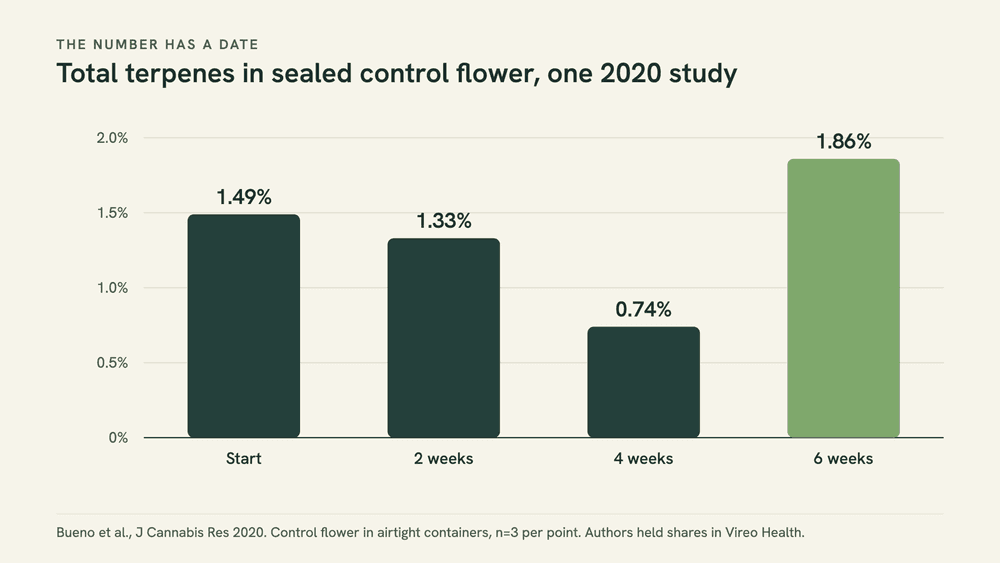
Terpenes evaporate and break down, so a terpene result describes the sample on its test date. The clearest jar-level numbers come from a 2020 packaging study in the Journal of Cannabis Research by Bueno and colleagues. Control flower sealed in airtight containers tested at 1.49% total terpenes, 1.33% at two weeks and 0.74% at four weeks. The six-week sample then came back at 1.86%. Each point was three samples, and the series was not a smooth decline, which is its own lesson: one test is one sample on one day. Read it with the conflict in mind too. The authors held shares in Vireo Health, a cannabis company, and one was named on a provisional patent for the packaging method the study tested.
Older work points the same way. A 1996 University of Mississippi study of fresh and air-dried buds, as the 2020 paper summarizes it, recorded terpene losses of about 31%, 45% and 55% after one week, one month and three months of drying and storage, while the mix of compounds stayed recognizable even as the amount fell. The year-long storage study found terpenoid concentrations fell rapidly under every condition it tested. Our guide to whether weed goes bad covers storage itself. For reading a label, the lesson is narrower: compare the test date with today. If the test is months old, treat the printed figure as what the flower held then, and expect less now, not more.
Flower vs carts and edibles: when terpenes are added
Extraction is hard on terpenes. In the Molecules study, oils made from the flower kept their cannabinoids but lost about 90% of the lighter monoterpenes, and the commercial oils the team tested topped out at 0.93% total terpenes. That is why many vape oils made from THC distillate have terpenes blended back in. One terpene-blend seller's formulation guide suggests 5% to 15% for vape cartridges and oils, 1% to 3% for edibles, and 2% to 8% for what it calls flower enhancement. That is a seller's recipe card, not a measurement of any product, but it tells you added terpenes are an ordinary ingredient.
The last line on that list matters for flower. In the Bueno study, storing flower alongside external terpenes equal to 56% of the flower's weight raised its total from 1.49% to 6.12% in two weeks, and 1.18% w/w of added terpene was the minimum that held the starting level for six weeks. The study was a proof of concept by the method's inventors and says nothing about how common the practice is. Regulators treat it as real, though. Washington's health-department standard for products sold as DOH-compliant says "The addition of any terpene to useable marijuana is prohibited", and Minnesota's 2026 standard requires a terpene test whenever terpenes are added. A high number on flower does not mean your jar was treated. It means the number alone cannot tell you.
A note on botanical terpenes
Packages that list "botanical terpenes" or "plant-derived terpenes" usually mean the blend came from plants other than cannabis. On its own, that is a formulation choice, not a sign of quality or of fraud. Our guide on how to tell if a cart is fake covers what else to check on the package.
Terpene percentage vs THC percentage
Both numbers on a flower label are weights per weight, and both come off the same certificate. Terpenes are the much smaller slice. When the Molecules team set terpenes against cannabinoids in the same flowers, they found 2.1 to 12.2 mg of terpenes per 100 mg of cannabinoids. In the US lab data, flower with more cannabinoids tended to carry slightly more terpenes, but the link was modest (a rank correlation of 0.37 on a scale where 1 is a perfect match), so one number does not tell you the other. Neither number, on its own, tells you how a given flower will feel.
| Question | THC percentage | Terpene percentage |
|---|---|---|
| What it weighs | THC and its acid form, as a share of the flower's weight | Every terpene on that lab's panel, as a share of the flower's weight |
| Scale on flower | Usually many times the terpene line | About 1% to 2% in measured samples; about 3% is high |
| Who decides what is counted | The lab's cannabinoid panel, which also varies by lab | Each lab's own panel; no national standard |
| What it can tell you | How much THC that sample held when tested | How much aroma-compound mass that sample held, on that panel, on that day |
| What it cannot tell you | How a given flower will feel | How a given flower will feel, or whether terpenes were added |
What a terpene percentage cannot tell you
You will read that a high terpene number means a better or different high, or that a profile led by one terpene will relax you or lift you. Those are retail claims, not findings. We did not find a study that tested a total terpene percentage against effects in people. Human trials of terpenes alongside THC are few and small, and they test single compounds at fixed doses; our guide to the entourage effect walks through what they found and what they did not. The names on the jar do not fill the gap. Smith's team found that indica, sativa and hybrid labels did not line up with the measured chemistry, a point we unpack in our piece on mango and weed, and the UBC team found "large variation both within and between" sets of plants sold under the same cultivar name.
- Effects: no study we found links a total terpene percentage to how cannabis feels.
- Overall quality: it says nothing about moisture, cure, contaminants or the rest of the certificate.
- Origin: it cannot show whether the terpenes came from the plant or were added later.
- Freshness: it describes the test date, not the day you open the jar.
- Comparability: a total from a 10-compound panel and a total from a 42-compound panel are not the same measurement.
Read the terpene line in 30 seconds
- 1Ask: percent of what? A % w/w of the product gives you an amount (multiply by 10 for mg/g). A share of the terpene profile ("myrcene 40%") gives you proportions only.
- 2Count the panel. How many terpenes did the lab list, what is its LOQ, and how many rows read ND? A short panel prints a lower total for the same flower.
- 3Check the test date against today. A months-old result describes the flower as it was then. In the storage studies we read, the direction of travel was down.
- 4Flower or formulation? On carts and edibles, the number mostly reflects what the maker added. On flower above about 3%, ask whether terpenes were added.
- 5Treat the top three names as a profile, not a promise. They tell you which compounds led that lab's panel, not how the flower will feel.
Questions people ask about terpene percentage
It is about average. In the largest US dataset, roughly 47,000 flower samples with terpene results, total terpenes averaged about 2% by weight. That is above most research samples: 0.4% to 2.3% in 19 Israeli medical flowers and about 0.9% to 1.4% in five research-grown cultivars. Whether 2% on your jar means much depends on how many compounds the lab counted and how long ago it tested.
Yes. About 3% is the high end researchers describe for bred flower, and that figure comes second-hand from a breeding program, not from a survey of store shelves. Above that, check how many compounds the lab counted and whether terpenes were added. In a 2020 study, flower stored with external terpenes went past 6% in two weeks.
No study we found links a total terpene number to strength or effects. In the US lab data, terpenes and cannabinoids rose together only modestly (a rank correlation of 0.37), so a high terpene number does not even tell you the THC number. Potency is the THC line's job, and that number has its own caveats.
Terpene panels are often optional. California's rule, for example, runs the terpene test only if someone requests it. Extraction also strips most of the light terpenes: in one study, oils lost about 90% of their monoterpenes compared with the source flower. Planntz certificates carry no terpene panel, so they make no terpene claim either way.
Yes, the overall direction in storage studies is down. In one 2020 study, control flower in airtight jars went from 1.49% to 0.74% in four weeks, although a six-week sample came back at 1.86%, which shows how noisy single tests are. Older work recorded losses of about 31%, 45% and 55% after one week, one month and three months.
Because terpenes are usually blended into the oil. Extraction removes most of them, so makers add them back, and one terpene-blend seller's formulation guide suggests 5% to 15% for vape oils. A cart's terpene number describes the recipe, not the plant it came from.
Not detected above that lab's limit of quantitation. It does not prove the compound is absent. It means the amount, if any, was below the smallest level that method reports reliably, and it adds nothing to the total terpenes line.
Planntz makes hemp CBD products, and our certificates carry no terpene panel, so there is no terpene number of ours to read here. The same habits work on any certificate, though: check what was measured, how and when. Our step-by-step guide to reading a certificate of analysis covers the rest of the page, its companion on whether THC percentage matters covers the other big number on a flower label, and if you are shopping for CBD, see how to choose a CBD oil.
Writing about hemp, wellness and the small rituals that keep us balanced.