What Is a Hemp Wick? Hemp Wick vs Lighter, Fact-Checked
A hemp wick is beeswax-coated hemp twine you light once and hold to the bowl instead of a lighter. It changes the first second, not the smoke. What is in the spool, what a tobacco lighting study found, and which claims nobody has measured.
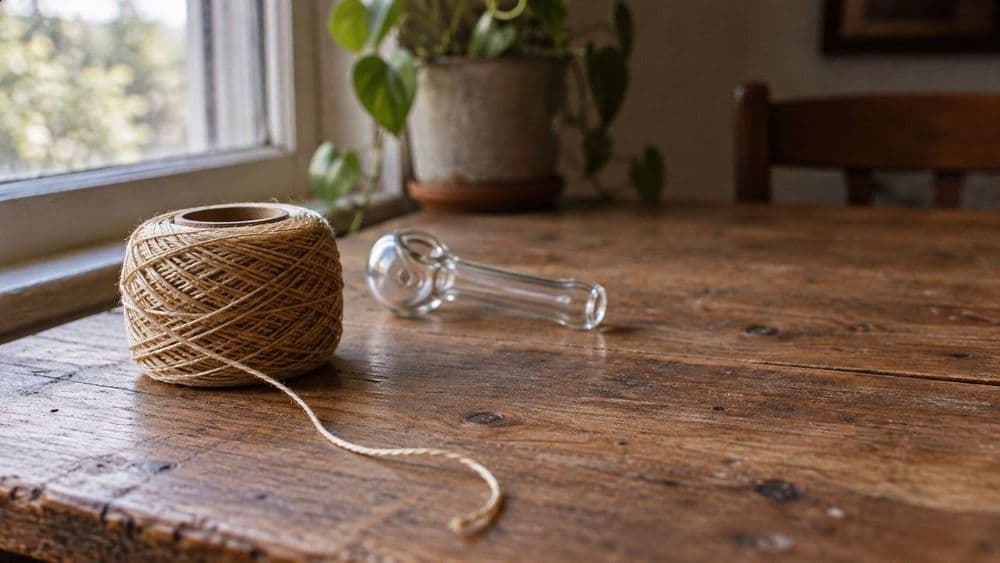
What is a hemp wick? It is hemp twine coated in wax, usually beeswax. You light one end once, then use that small, steady flame to light a bowl or a joint instead of holding a lighter to it. Almost every guide says this gives cleaner, cooler, better-tasting smoke. None of them cites a measurement, and in the only lab study we found that compared ways of lighting a cigarette (tobacco, not cannabis), the wax flame was the one that added benzene to the first puff.
The short answer: a hemp wick changes what touches your flower for the first second, not what the smoke is made of. Once the plant is burning, the plant makes the smoke, whatever lit it. As of November 2026, no one has published a study comparing a hemp wick with a lighter for cannabis, and no one has published a measured hemp-wick flame temperature. Liking the slower, steadier flame is a fair preference. "Cleaner" is a claim, not a finding.
What is a hemp wick?
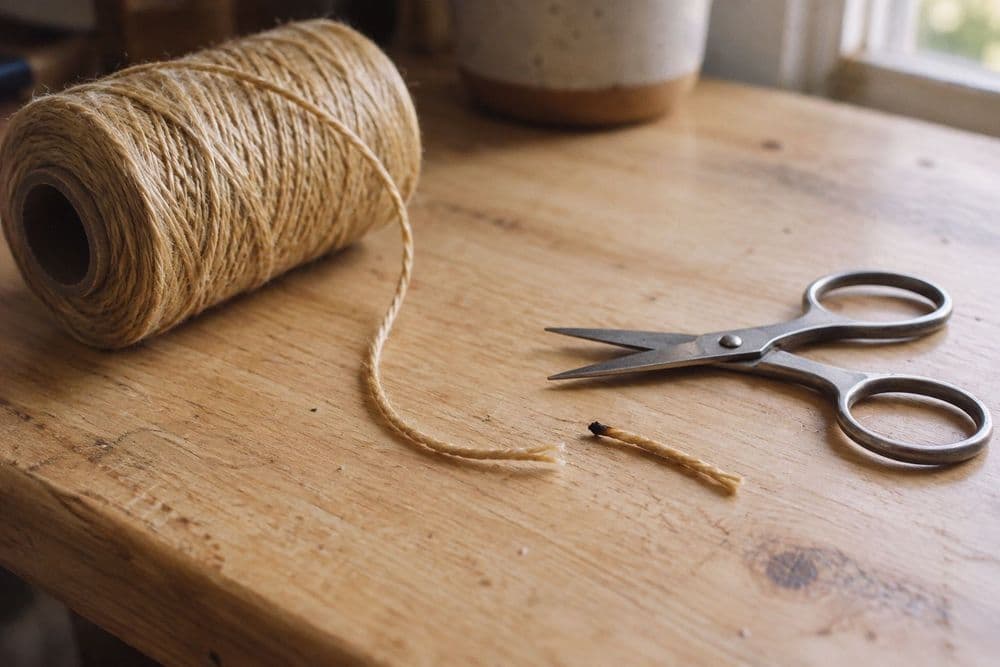
A hemp wick is a length of thin twine spun from hemp fiber, the long, strong fiber in the plant's stalk, and then coated in wax. Hemp fiber is a textile material, the same raw stuff behind hemp rope, canvas and cord, which our guide to what hemp is used for covers in detail. The wax is usually beeswax; some spools use other waxes, and a few are sold unwaxed. Wicks come wound on spools or balls, and you unwind and burn a few inches at a time. It belongs to the same family of smoking materials as the papers and wraps in our breakdown of what rolling papers are made of.
The wax does the work. Without it, the twine would simply burn down. With it, the coating melts and feeds a small flame along the strand, the same way a candle's wax feeds its wick. Keep that in mind, because it matters later on this page: when you light a hemp wick, the flame you hold to the bowl is a wax flame. Here is what is actually in a typical spool:
- Hemp fiber: twine spun from the stalk, the same textile fiber used in rope and canvas. It is not flower.
- Wax coating: usually beeswax. Some spools use other waxes or none at all, and labels do not always say which.
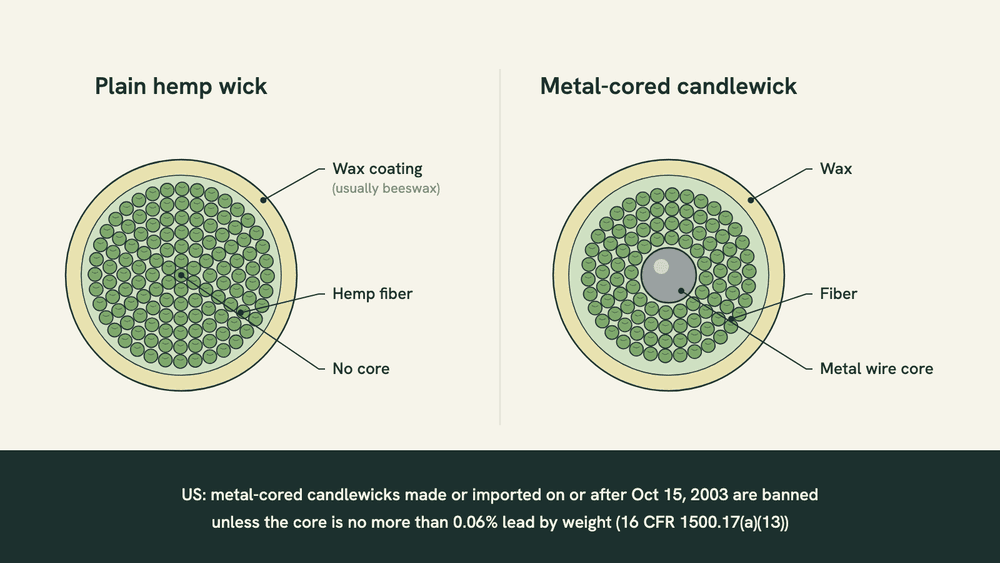
- No core: a plain hemp wick is fiber and wax only. A wire running through the center is a candle-making design, and in the US the lead in such cores has been restricted since 2003.
- Sometimes dyes or scents: a few spools add them. Each is one more material burning near the bowl, and none has been tested in this use.
How people use a hemp wick
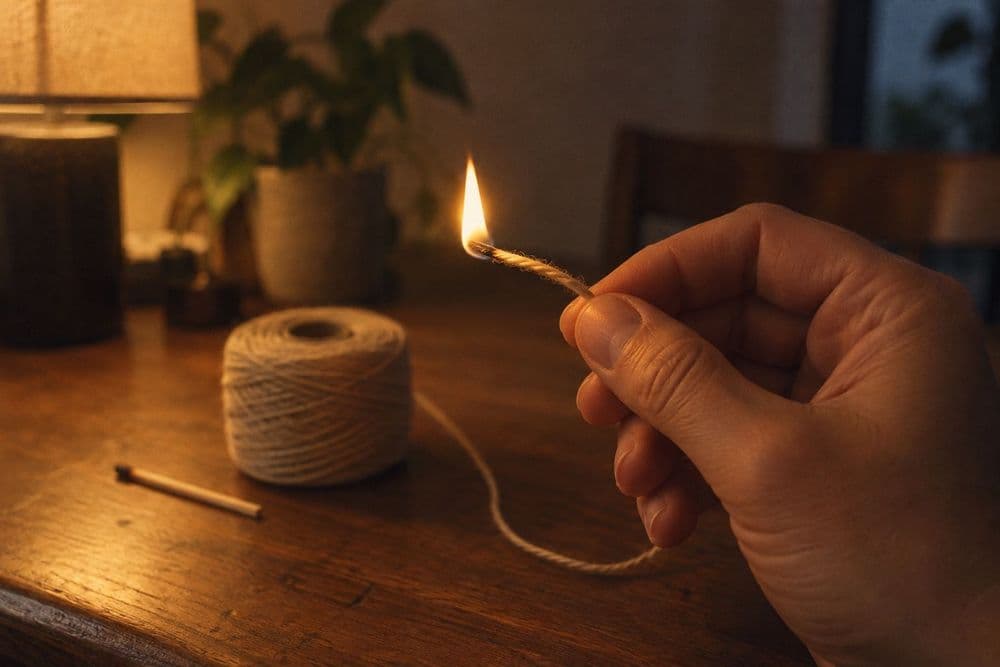
This is a description of the device, not advice on getting more out of a session. The routine most guides describe is simple, and it has one irony built in: a hemp wick still needs a lighter or a match to get started. It works the same way for a bowl, a joint or a blunt; our blunt and joint comparison covers what the wrap itself adds.
- 1Unwind a few inches of wick and hold the free end away from the spool, so the flame cannot climb back into the coil.
- 2Light the free end with a lighter or a match, then set the lighter down.
- 3Let the flame settle into a small, steady burn as the wax melts.
- 4Touch the flame to the edge of the bowl or the tip of the joint until it catches.
- 5Blow the wick out or dip the end in water, let it cool, and trim the charred tip before you rewind the spool.
Hemp wick vs lighter: what actually touches the bowl
The only controlled comparison of lighting methods we could find is a 2007 lab study in Analytical and Bioanalytical Chemistry by Adam, Baker and Zimmermann. The researchers lit tobacco cigarettes five ways (a laboratory electric lighter, a propane/butane gas lighter, a match, a candle and another cigarette) and analyzed the first puff of smoke with a real-time mass spectrometer. The table puts their findings next to the options people actually choose between, and marks what is still unknown for cannabis.
| Option | What makes the flame | What the 2007 tobacco study found (first puff) | What is unknown for cannabis |
|---|---|---|---|
| Gas lighter (butane or propane) | Pressurized gas burned at a hand-held nozzle; open flame | One of the open flames whose first puff was "usually similar" | Not measured with cannabis |
| Match | A wooden or paper stick with a chemical head; short open flame | Also an open flame with a broadly similar first puff | Whether the match head changes anything: not measured |
| Candle | Melted wax drawn up and burned through a wick | Open flame, but added larger amounts of substances such as benzene, most likely from the wax breaking down | Which wax the study used is not in the abstract; no cannabis test |
| Hemp wick (beeswax coated) | Beeswax burned along hemp twine; a small open wax flame, first lit with a lighter or match | Not tested. The closest thing in the study is the candle: also a wax flame | Everything: we found no study of any kind |
| Electric or plasma lighter | A heated element or an electric arc; no fuel flame | A laboratory electric lighter gave a "more unique" first puff, with slightly higher isoprene | Consumer plasma and coil lighters were not tested |
Two cautions about reading the table. First, the electric lighter in the study was a laboratory device, not the plasma or coil lighters sold in stores today, so that row does not transfer to them. Second, lighters have their own federal safety rule: under 16 CFR 1210.3, covered disposable and novelty lighters must resist operation by at least 85% of a child test panel. That standard covers lighters, not wicks, and a lit wick is still an open flame, so do not treat one as safer around children.
Does a hemp wick give cleaner smoke?
Here is what the 2007 study found for the one wax flame it tested, in the authors' own words:
“Lighting the cigarette by use of a candle resulted in larger amounts of substances, e.g. benzene, which most probably originated from thermal decomposition of wax.”
Apart from that, the open flames (the gas lighter, the match and the candle) gave a first puff that was "usually similar". Lighting from another cigarette raised ammonia and other nitrogen compounds, and the electric lighter showed slightly higher isoprene. Four limits apply every time this study comes up: it used tobacco, not cannabis; it measured the first puff only; its wax flame was a candle, not a hemp wick; and it reported relative chemical patterns, not health effects. We could not read the full methods, so we do not know which wax the candle used, and the abstract gives no amounts. That is why this page prints no benzene figure. The direction still matters, though. A beeswax wick is a wax flame too, and in the only study we found that tested a wax flame, it added something to the first puff rather than cleaning it up.
After that first second, the flame you used drops out of the picture. A 1978 model study in the UN Bulletin on Narcotics described what happens inside a burning cannabis cigarette: the very steep temperature profile around the glowing coal flash-evaporates much of the cannabinoid content before it can burn, the authors reported under 0.1% oxygen behind the glowing zone, and they cited earlier work that recovered about half of the cannabinoids unchanged in the smoke and the butt combined. The coal sets the conditions, not the lighter. The smoke's chemistry comes from the plant, too. When Health Canada machine-smoked cannabis and tobacco the same way in 2008, cannabis smoke carried up to 20 times the ammonia of tobacco smoke and 3 to 5 times the hydrogen cyanide and nitrogen oxides. That was a machine, not people, and it did not vary the lighter, because it did not need to. Our hookah explainer goes through that study in depth.
As of November 1, 2026, we found no published study in PubMed that compared a hemp wick with a lighter for cannabis. A title-and-abstract search for hemp wick, or wick plus cannabis, returned 3 records, and all three were about vaping devices, not lighting. A broader search pairing lighters or butane with cannabis smoking returned 16 records, and none compared ignition sources. If the smoke itself is what you care about, the variable that matters is whether the plant burns at all, not what lit it. See why smoke makes you cough and how a dry herb vaporizer compares with smoking.
The claim check: cooler, butane-free, tastier, stronger
Six claims show up on almost every hemp-wick page. The table gives the status of each. One needs a note first. The "butane is toxic" paper that one popular guide links to is a 2015 case report of a single patient who fainted and developed a dangerous heart rhythm after deliberately inhaling butane. That is gas misuse, a different exposure from a flame held over a bowl, and it is not evidence that a wick is safer than a lighter.
| Claim | Evidence status | What you can actually say |
|---|---|---|
| Burns cooler | Not measured | No one has published a measured hemp-wick flame temperature. The figures online cite no measurement, and some pages give two that contradict each other. A wick and a lighter are both open flames. |
| Avoids butane | True only at the moment of lighting | No gas flame touches the bowl, but the wick itself is lit with a lighter or match. We found no study measuring lighter butane in cannabis smoke, either way. |
| Cleaner smoke | Not shown; one tobacco study points the other way for wax | In the tobacco study, open flames gave a broadly similar first puff, and a candle's wax flame added benzene. After ignition, the plant makes the smoke. |
| Better taste, more terpenes | Not measured | Flavor is subjective and we found no study testing it. Preferring the taste is a preference, not a finding. |
| Gets you higher | Not measured | No study found. What reaches you depends on the flower and how it burns, not on the flame that started it. |
| Whiter ash | Not isolated | We found no study that isolated lighter versus hemp wick as a cause of ash color. |
On strength, what the THC number on a label does and does not predict matters far more than the ignition source, and our THC boiling point explainer covers what heat does to THC itself. On ash, our guide to ash color already lists lighter versus hemp wick among the variables no study has isolated.
What the wax and the core mean
Candle researchers have measured how the wax and the wick change a flame. In a 2021 chamber study in Indoor Air, Andersen and colleagues burned five types of pillar candle under drafty conditions and found that wax and wick composition "strongly influenced" emissions of soot, fine particles and particle-bound PAHs (polycyclic aromatic hydrocarbons), though not nitrogen oxides or formaldehyde. Under those drafty conditions, soot made up most of the particle mass. That work used candles, and none of it tested a hemp wick held over a pipe, so it cannot tell you which wick to buy. It does tell you the coating is not a neutral detail.
The habit that helps here is the one that helps with any product: read what is actually in it. It is the same idea behind our guide to choosing a CBD oil, applied to a spool of twine. If you use a wick, this short checklist keeps the unknowns down. It is about fewer variables, not about health:
- Fiber and wax only. Check that nothing runs through the center: a hemp wick should have no wire or metal core.
- Plain over dyed or scented. Every additive is one more material burning near the bowl, and none has been tested in this use.
- A coating you can identify. If the label names the wax, you at least know what you are burning. Many spools do not say.
- Dry storage. Damp twine lights poorly and sputters, so keep the spool in a dry, closed container.
- Trim the charred end. A frayed, blackened tip burns unevenly; cut it off before the next use.
- Pull only what you need. A few inches free of the spool keeps the flame from running back toward the coil.
Hemp wick and candles: the 2003 lead-wick rule
Search for hemp wick and many of the results are candle supplies, because it is the same product family: braided hemp is a common candle wick. That overlap brings in the one firm federal fact in this topic. For years some candlewicks had a metal wire core, and in some of them the metal was lead. When US EPA researchers bought 100 sets of candles that looked metal-wicked and tested them, published in 2002, 8% had lead-cored wicks, those cores were 39% to 74% lead, and the candles released 100 to 1,700 micrograms of lead into the air per hour. Lead was there, the authors explain, as a stiffening agent to keep the wick standing out of the melted wax. Modeling those emission rates, the authors estimated that burning even a single such candle could push the air in a room above 1.5 micrograms of lead per cubic meter, the outdoor air standard EPA had set in 1978 and tightened tenfold, to 0.15, in 2008. An earlier Michigan study of 14 candle brands had found lead emissions of 0.5 to 66 micrograms per hour from metal-core wicks, plus zinc.
The rule followed. Under 16 CFR 1500.17(a)(13), metal-cored candlewicks "manufactured or imported on or after October 15, 2003" are banned hazardous substances unless the lead content is "not more than 0.06 percent of the total weight of the metal core" and the shipping container is labeled as conforming to the rule. Two honest limits. Those lead numbers describe candles bought before the ban, not smoking wicks, and we found no data on lead in hemp wicks sold for smoking. The rule also certifies nothing about a smoking wick. What it gives you is a simple check: a plain hemp wick is fiber and wax with no core at all. If you see a wire, you are holding a candle wick, not the product this page describes.
Is a hemp wick weed?
Not in the legal sense. As of November 2026, the federal Controlled Substances Act excludes from the definition of marijuana "the mature stalks of such plant, fiber produced from such stalks", along with oil or cake made from the seeds. A hemp wick is stalk fiber and wax. The plant concentrates its THC in the resin glands of the flower, which our trichome explainer describes, not in the twine. No study we found measured THC in wick fiber, and no drug-testing study has looked at burning a little twine, so we cannot promise anything about a test result. Our guide to hemp seed oil and drug tests explains how hemp products and tests interact, and hemp vs marijuana covers what separates the two plants in the first place.
Whether a wick counts as drug paraphernalia is a separate question. Federal law at 21 U.S.C. 863 defines paraphernalia largely by what an item is primarily intended or designed for, and states write their own rules; our roach explainer walks through the federal definition. This is general information as of November 2026, not legal advice, and state laws vary.
What we still do not know
- Whether a hemp wick and a lighter differ for cannabis smoke: no published study as of our PubMed search on November 1, 2026.
- How hot a hemp wick burns: no one has published a measured flame temperature.
- How far the one lighting study transfers: it used tobacco, measured one puff and tested a candle, not a hemp wick.
- Which wax that study's candle used, and how much benzene it added: the full methods were not available to us and the abstract gives no amounts.
- Whether one wax coating behaves differently from another when used as a smoking wick: not tested in any study we found.
- Whether a wick changes flavor, potency, ash or THC exposure: not measured in any study we found.
Frequently asked questions
No study shows that. The only lab study of lighting methods we found used tobacco, measured the first puff, and found open flames broadly similar, except that a candle's wax flame added benzene. A beeswax wick is also a wax flame. After the first second, the burning plant makes the smoke either way, and no one has compared a wick with a lighter for cannabis.
Nobody has published a measured hemp-wick flame temperature. The figures you see online cite no measurement, and some pages give numbers that contradict each other. Both are open flames, and once the flower is lit, the burning coal sets the conditions, not the flame you started it with.
Nothing has measured it. What reaches you depends on the flower and on how it burns, and much of the THC in a burning joint evaporates just ahead of the coal. The flame you light it with is not part of that process for long.
Yes. Braided hemp is a common candle-wick material, and much of what is sold as hemp wick is marketed for candles too. Choose plain wick without a metal core. Since October 15, 2003, US law has banned metal-cored candlewicks unless the core contains no more than 0.06% lead by weight.
A hemp wick is twine made from stalk fiber, which federal law, as of November 2026, excludes from the definition of marijuana. THC is concentrated in the flower, not the stalk. No study we found measured THC in wick fiber, and no one can guarantee a drug-test result. This is general information, not legal advice.
It depends on how it is intended and used, and on where you are. Federal law defines paraphernalia largely by an item's primary intended use, and each state has its own rules, so how an item is marketed and used can matter. This is general information as of November 2026, not legal advice.
No. A vaporizer heats plant material without a flame, so there is nothing to light. If avoiding combustion is your goal, the heat source under the herb is what changes the exposure, not the flame above it. Vaporizing is a different exposure, not no exposure.
No study has looked at the shelf life of a hemp wick. In practice, damp twine lights poorly and sputters, so keep the spool dry and closed, and cut off any frayed or soggy end before you use it.
A hemp wick is a small, steady, wax-fed flame, and if you prefer using one, that is a fair choice. It just does not change what burning a plant produces. If the smoke itself is your concern, the comparison worth reading next is how a dry herb vaporizer compares with smoking: the variable that matters is the heat source under the herb, not the flame above it.
Writing about hemp, wellness and the small rituals that keep us balanced.