Dry Herb Vaporizer vs Smoking: Less Smoke, Not Less Dose
A dry-herb vaporizer heats cannabis flower without burning it, and in two controlled studies that kept exhaled carbon monoxide from rising. It does not cut the dose: the same amount can hit harder. Here is what the research measured, and what it has not.
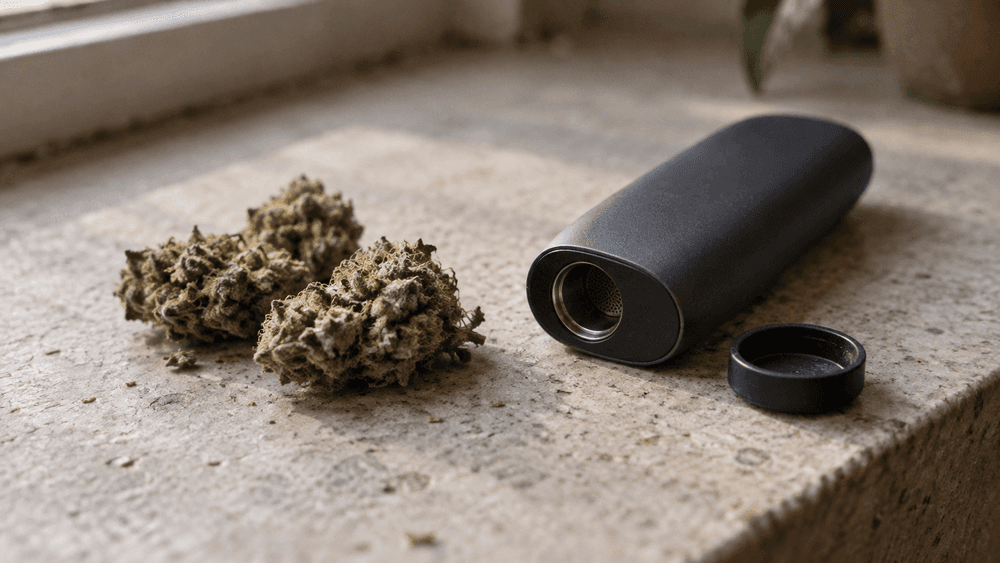
Heating cannabis flower without burning it takes away the fire, the smoke and most of the carbon monoxide. It does not take away the dose. And a dry-herb vaporizer is not the same product as the vape cartridge most people picture when they hear "vaping". This guide covers what each one heats, what controlled studies actually measured, and what nobody has studied yet.
Dry herb vaporizer vs smoking, in short: in a 2007 inpatient study of 18 adults at San Francisco General Hospital, vaporizing and smoking the same cannabis produced similar blood THC levels, while exhaled carbon monoxide was lower with vaporizing. A 2017 study at the National Institute on Drug Abuse repeated the carbon monoxide result. That is less exposure to combustion products in the studies we have. It is not proof of healthier lungs: as of September 2026, no randomized trial has tested switching, and no long-term study has followed people who only vaporize. And because the same amount can feel stronger when vaporized, the dose deserves more attention after a switch, not less.
Most pages ranking for this question are written by companies that sell vaporizers, and few of them name a single study. Planntz sells no smokable or vape product (our line is oil tinctures), so nothing here is a pitch. This page is written for adults who already use cannabis and want to know what actually changes when they stop burning it. The starting point is worth saying plainly: the Lower-Risk Cannabis Use Guidelines, published in the *American Journal of Public Health*, put not using cannabis first, and advise people who do use it to avoid burning it. Everything below is about that second recommendation, and how far the evidence behind it goes.
Dry herb vaporizer vs smoking vs cartridge: at a glance
| Joint or pipe | Dry-herb vaporizer | Oil cartridge (vape pen) | |
|---|---|---|---|
| What is heated | Cannabis flower, set on fire | Cannabis flower, heated without a flame | A liquid THC oil or distillate |
| Is it burned? | Yes, combustion | No, when the device works as intended | No, the liquid is heated into an aerosol |
| Carbon monoxide in controlled studies | Higher after smoking in both inpatient studies | Lower than after smoking in the same two studies | Not measured in these studies |
| What the human data show | The most studied route; linked to cough and phlegm | Two small inpatient studies, one online survey, one 12-person switch study | Linked to the 2019-2020 EVALI outbreak; surveys link oil vaping to wheeze |
| Main open question | Effects of high-potency flower over years | Long-term lung outcomes: not yet studied | What is actually in a given liquid |
The table has three columns because the word "vaping" covers two different products. When a headline says "cannabis vaping" is linked to lung problems, it usually means the third column. When a seller says vaping is gentler, it usually means the second. Keeping them apart is the single most useful thing you can do when reading anything on this topic. If you are comparing smoked formats with each other instead, our blunt vs joint comparison covers what a tobacco wrapper adds to the smoke.
What "vaporizing" actually means
When you light cannabis flower, the plant material burns. Combustion produces smoke: a mix of gases and fine particles made by the fire itself, not by the cannabinoids. A vaporizer heats the flower hot enough that THC, CBD and other compounds turn into vapor, but not hot enough for the plant to catch fire. The heat still does the chemistry you need. Raw flower holds most of its THC as THCA, an acid form that is not intoxicating until heated. When University of Bern researchers tested five commercial vaporizers by machine, with the four electric devices set to 210 degrees Celsius as a test condition, each converted at least 97.3% of the THC acid into THC. That was a lab test with no people, and it measured cannabinoids, not toxic compounds.
Vaporizers come in two broad designs. Conduction devices heat the herb by contact with a hot surface. Convection devices pass heated air through it. Some are drawn by your own breath, others fill a bag or balloon that you then inhale from. Nobody has compared the health effects of these designs in people, so this page does not rank them and names no device. What the lab work does show is that the category is wide.
A vaporizer is not one thing
In the Bern test, the share of THC that reached the vapor ranged from about 55% to 83% across the five devices, and the one gas-powered device burned the cannabis it was meant to vaporize. Earlier, a 2006 lab evaluation of a vaporizer used for research dosing, using pure THC rather than flower, found that only about 54% of the loaded THC reached the inhalation bag, and about 35% of what people inhaled came straight back out on the exhale. Both were device tests, not health studies. Together they show that how much THC you actually absorb depends on the device and on how you breathe, which is one reason the same amount of flower can land differently from one session to the next.
What is in smoke vs what is in vapor
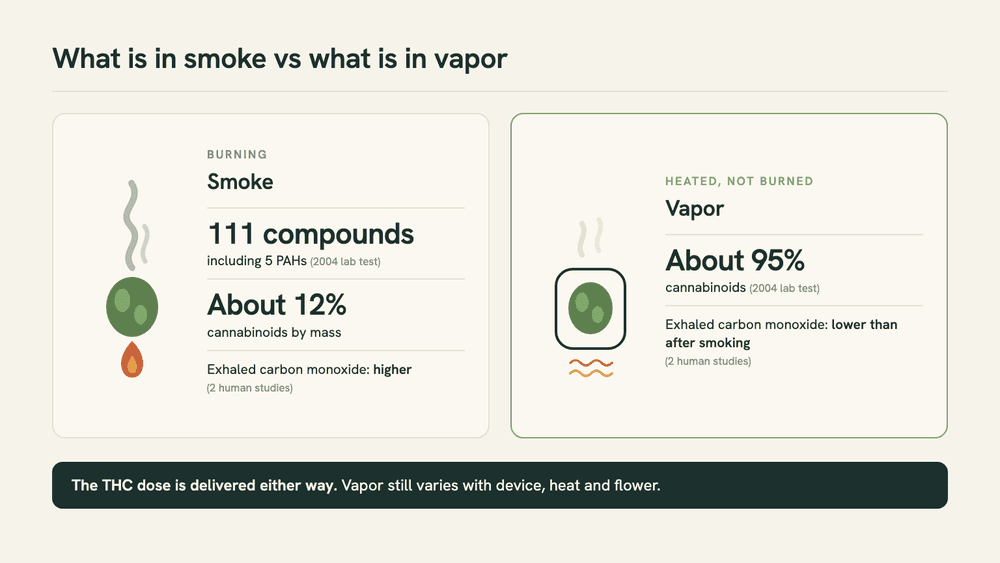
The first lab analysis of vaporizer output was a 2004 test funded by two cannabis-reform groups, California NORML and MAPS, and published in a journal that PubMed does not index. We read it through a 2015 review in the *Canadian Journal of Respiratory Therapy*, whose authors belong to the same research group as the two symptom studies later on this page. As summarized there, the smoke contained 111 detectable compounds, including five polycyclic aromatic hydrocarbons (PAHs, a class of chemicals formed when organic material burns). The vapor was about 95% cannabinoids by gas-phase mass (94.8%, against 12% for the smoke). Treat it as an advocacy-funded machine measurement, not a health finding.
A more independent test points the same way, with a twist. A Leiden University lab compared vapor from one vaporizer with smoke from a cannabis cigarette at three test temperatures: 170, 200 and 230 degrees Celsius. At 200 and 230, the vapor carried a significantly higher ratio of cannabinoids to other by-products than the smoke. At 170, the ratio was the worst the lab recorded. That is one device measured by machine, the by-products were counted as chemical peaks rather than a toxicology panel, and those temperatures are test conditions, not settings to copy. What it shows is that "vapor" is not a fixed substance.
What goes into the device matters too. A 2008 UK lab study heated confiscated "street" cannabis in commercially available devices and measured ammonia at levels approaching 200 parts per million in the air samples, against peaks of about 10 ppm from standardized research cannabis. It also found acetaldehyde, methanol and acetone at lower levels. Nobody inhaled anything in this study, the leaf came from one batch of unknown handling, the devices date from 2008, and the source of the ammonia was not established. It is still a clear reminder that a vaporizer cannot clean up the flower you put in it.
What changes, and what does not
- Drops, in lab tests: combustion products. The 2004 smoke held 111 compounds, including five PAHs; the vapor was mostly cannabinoids.
- Drops, in two human studies: exhaled carbon monoxide, which was lower after vaporizing than after smoking.
- Does not drop: the cannabinoids. Delivering THC or CBD is the point of the device, so the dose is still there.
- Does not drop: whatever is in or on the flower. Street cannabis released far more ammonia than research cannabis in the 2008 test.
- Varies: the vapor itself. It changed with temperature in one lab test and with the device in another.
What controlled studies found: blood THC and carbon monoxide
Carbon monoxide is the marker researchers use here because it comes from burning, not from cannabinoids, so it tracks combustion directly. In the 2007 San Francisco study, 21 healthy adults who already used cannabis were enrolled and 18 completed it (15 men, average age 30). Over six days as hospital inpatients, each inhaled cannabis at 1.7%, 3.4% and 6.8% THC, both as standard cigarettes and from a balloon-style vaporizer. Peak blood THC, and total THC exposure over the following 6 hours, were similar either way. On carbon monoxide, the published abstract says: "CO levels were reduced with vaporization." In the investigators' preliminary abstract, 14 of the 18 said they preferred the vaporizer, 2 preferred smoking and 2 had no preference.
The 2017 NIDA study repeated the carbon monoxide result in a placebo-controlled design with both frequent and occasional users (about 20 adults, according to a companion paper from the same program). In separate sessions, each person received cannabis at 6.9% THC, about 54 mg of THC, smoked, vaporized or eaten. Exhaled carbon monoxide stayed significantly higher from 15 minutes to 6 hours after smoking than after vaporizing, in both groups. Heart rate rose by a similar amount either way: about 12.2 beats per minute 30 minutes after smoking and 10.7 after vaporizing. That last point matters. Removing combustion changed the carbon monoxide, not the fact that THC raises heart rate.
Is vaping weed stronger than smoking?
It can be, and this is the part most seller pages leave out. In a Johns Hopkins crossover of 17 adults who had not used cannabis in the past month (9 men, 8 women), the same dose felt stronger vaporized than smoked, and blood THC peaked higher. At 10 mg of THC, the average drug-effect rating on a 0 to 100 scale was 46 smoked and 69 vaporized, and effects lasted up to about 6 hours. The peak blood levels at the higher dose are printed in our guide to whether THC percentage matters. This was a small lab study in people who rarely use cannabis, but its direction is the opposite of what many people assume.
Regular users seem to respond differently. A 2022 University of Toronto review read the lab studies together: in habitual users, peak effects and blood THC came out about the same whether smoked or vaporized, while infrequent users got a stronger effect from the same amount vaporized. The authors suggest that habitual users can titrate, meaning they adjust how much they inhale as they go, while new users cannot. The Lower-Risk Cannabis Use Guidelines add a note that the delay before effects are felt led to higher dosing with vaporizers. Read that one with care: the two papers the guideline cites for it are evaluations of vaporizer devices, one of them the 2004 lab test described above, not trials that followed people switching from smoking.
If a dose does overshoot, our guide to greening out explains what is happening in the body and when it is time to get help.
Does vaping weed make you cough less?
Coughing after a hit is a reflex, and smoke is a strong trigger for it. For the reflex itself, the breath-hold myth and what long-term smoking does to the airway, see our guide to why weed makes you cough. What this section covers is narrower: what studies of vaporizer users reported. There are two, both from the same research group, and both have real limits.
In a 2007 online survey of 6,883 cannabis users, only 152 people (2.2%) said a vaporizer was their main method. Of those, 34% reported at least one of six respiratory symptoms, such as cough or morning phlegm, against 44% of everyone else. After adjusting for age, sex, cigarette smoking and how much cannabis people used, the odds of a symptom were about 60% lower in the vaporizer group. Now the design. Respondents were recruited through the mailing lists of three drug-law-reform organizations, with a cash-prize draw. They answered about themselves, nobody's lungs were examined, and "main method" does not mean they never smoked. The authors themselves flagged that people who had paid for a device might report more favorably, and the lead author is an advocate of cannabis-law reform.
In a PubMed search we ran in September 2026, we found one study that actually switched people to a vaporizer. In that 2010 study, 20 frequent users with at least two respiratory symptoms used a vaporizer for a month. The 12 who did not catch a respiratory illness during that month reported fewer symptoms and had a small gain in forced vital capacity, a measure of how much air the lungs can push out (about 0.22 L, or 4.8%, per the 2015 review). A second lung measure, FEV1, did not change significantly. There was no comparison group and no blinding, and the eight who got sick were left out of the analysis. The authors concluded that a randomized trial is warranted. As of our search, none has been published.
| Study | Who | Design | What it found | What it cannot tell you |
|---|---|---|---|---|
| Online survey, 2007 | 6,883 respondents; 152 mainly vaporized | One-time self-report, recruited via reform mailing lists | 34% vs 44% reported a respiratory symptom | Whether vaporizing caused the difference |
| Switch study, 2010 | 20 frequent users with symptoms; 12 analyzed | One month, no control group, no blinding | Fewer symptoms and a small lung-volume gain in the 12 | What happened to the 8 who got sick, or after one month |
| Randomized switch trial | None found (September 2026) | Not done | Nothing to report | Whether switching changes lung health |
| Long-term cohort of vaporizer-only users | None found (September 2026) | Not done | Nothing to report | What years of vaporizing do to the lungs |
So the honest answer is: people who mainly vaporize reported fewer respiratory symptoms in one self-selected survey, and a handful of people reported fewer symptoms after a month in one uncontrolled study. That is consistent with removing smoke from the airway. It is not evidence that switching prevents or treats any lung condition, and no study has tested that.
Dry herb vs cartridge: two products called "vaping"
A dry-herb vaporizer heats plant material. A cartridge or vape pen heats a liquid, usually a THC oil or distillate. A 2018 scoping review of cannabis routes of administration drew the line in plain terms: vaporizing natural cannabis appears to reduce respiratory system problems but may come with other risks, while vaporizing cannabis concentrates can carry distinct acute risks, such as excessive impairment and injuries. The same review found a paucity of rigorous, high-quality data on health outcomes for every route it looked at.
This distinction matters because the studies linking "cannabis vaping" to lung symptoms are mostly about liquids. In a 2020 survey of 2,553 young adults in Southern California (average age 19), those who vaped cannabis on three or more of the past 30 days had about twice the odds of bronchitis-type symptoms (adjusted odds ratio 2.14) and wheeze (2.27), even after accounting for smoking it. The survey question asked about vaping THC or hash oil and dabs, not flower. It was a one-time survey, so it cannot show which came first, but it also cannot be used to say anything about dry herb, in either direction.
The same line runs through the 2019-2020 outbreak of lung injury the CDC called EVALI. According to the CDC's archived outbreak page, it involved vaping liquids, mostly THC cartridges from informal sources: by February 18, 2020, 2,807 hospitalized cases or deaths had been reported, including 68 deaths, and the CDC called vitamin E acetate, an oil-thickening additive, "strongly linked" to it. A dry-herb vaporizer heats plant material, not a liquid. The full record of what was found in those cartridges is in our THC distillate guide.
What "less exposure" does not mean
Less carbon monoxide in two inpatient studies is a real, measured difference. It is not the same thing as "safe", and it does not stretch to every situation. Here is where it stops.
- It is not safe. Vapor still carries by-products, and they change with the device, the heat and the flower.
- It is not lower risk than not using. The Lower-Risk Cannabis Use Guidelines rank abstinence first; avoiding combustion is advice for people who already use.
- It is not a treatment. The studies here do not show that switching prevents or treats any lung disease.
- It is not a green light to drive. Vaporized cannabis still impairs.
- It does not apply to pregnancy, breastfeeding or anyone under 21.
On driving, the 2022 Toronto review was direct: "with respect to driving, vaping any form of cannabis does not provide a safer route of administration than smoking." The controlled driving trials that used vaporized cannabis are covered in our guide to cannabinoids and driving. The same review also noted that new users, regardless of how they take cannabis, may experience intense effects and cognitive impairment.
If you are pregnant or breastfeeding, the route is not the question to start with: read what the evidence says about cannabinoids during pregnancy and breastfeeding and talk to your clinician. For teenagers, a national survey of nearly 15,000 US adolescents found higher odds of wheezing among those who had ever used cannabis, its oils or concentrates in an e-cigarette-type device. This page is written for adults 21 and over.
Where hemp and CBD flower fit
The physics does not depend on which cannabinoid dominates. The Bern team tested CBD-rich cannabis alongside THC-rich cannabis, and its electric devices delivered between 51.4% and 70.0% of the CBD into the vapor. Burning hemp flower still makes smoke, and heating it without a flame still makes vapor with its own by-products. No human study has looked at vaporizing CBD flower and the airway. Whether a given hemp flower is legal where you live is a separate question, covered in our guide to whether CBD flower is legal.
Anything you swallow skips the airway entirely. That is a fact about the route, not a claim that any product is good for you, and swallowed cannabinoids also take much longer to act, which brings its own dosing mistakes. How differently the same dose reaches the blood when vaporized versus swallowed, and why no trial has ranked how long each lasts, is covered in our guide to how long the effects of CBD last.
What is still unknown
- Long-term lung outcomes. As of September 2026, no randomized trial has tested switching and no long-term study has followed the lungs of people who only vaporize.
- Today's flower. The 2007 study used cannabis at up to 6.8% THC and the 2017 study at 6.9%.
- Devices. THC delivery ranged from about 55% to 83% across five devices, and vapor composition shifted with temperature in a separate test.
- Everyday use. The controlled studies measured single sessions over hours, not months of regular vaporizing.
- Heart and blood vessels over time. Heart rate rose similarly with both routes, and long-term cardiovascular effects remain an open question.
- Dry herb in the youth surveys. The wheeze studies did not separate flower from oils and concentrates.
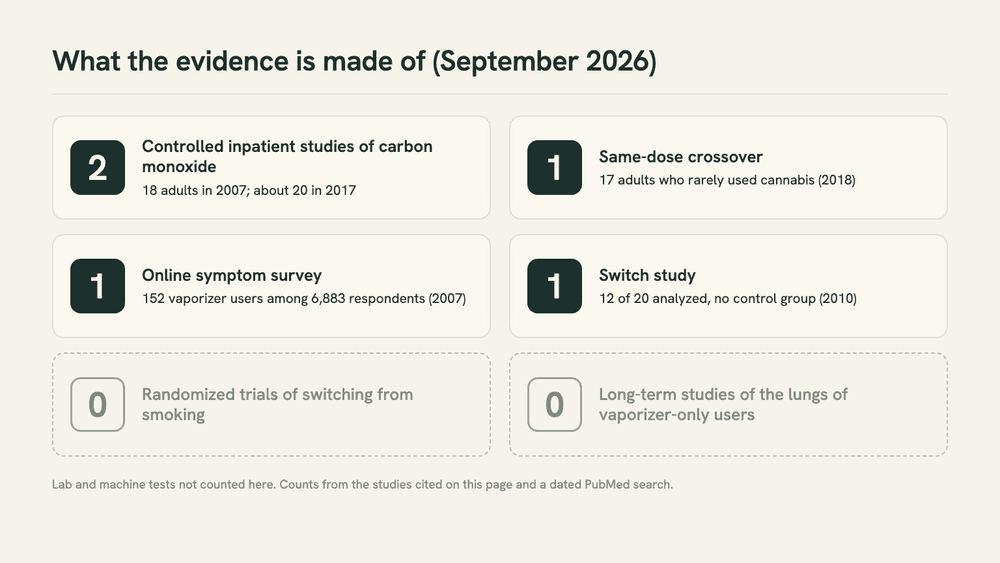
Three reviews from three different research groups reach the same place. The 2015 respiratory review found no published randomized trials of vaporization with long-term follow-up. The 2022 Toronto review found no randomized trials or cohort studies of the respiratory effects of switching. The Lower-Risk Cannabis Use Guidelines state that no rigorous studies exist on the long-term effects of vaporizer use. Our own PubMed search in September 2026, on vaporizers and lung function or respiratory symptoms, returned 20 records: the one uncontrolled switch study described above, and no randomized switching trial or vaporizer-only cohort. Until one exists, the accurate summary is less combustion exposure in short studies, not a demonstrated lung benefit.
Frequently asked questions
Nobody can honestly call it safe. What the studies we have show is less exposure to combustion products: in two controlled inpatient studies, exhaled carbon monoxide was lower after vaporizing than after smoking, and a 2004 lab test found vapor was mostly cannabinoids while smoke held 111 compounds. But no randomized trial has tested switching, no long-term study has followed vaporizer-only users, vapor still carries by-products, and the same amount can hit harder. The Lower-Risk Cannabis Use Guidelines rank not using as the lowest-risk option.
It can. In a Johns Hopkins study of 17 adults who rarely used cannabis, the same dose felt stronger vaporized than smoked and blood THC peaked higher. A 2022 review suggests regular users tend to adjust how much they inhale and reach similar peaks either way, while newer users cannot. If you switch, do not assume your usual amount will feel the same.
Possibly, but the evidence is thin. In a 2007 online survey, 34% of people who mainly vaporized reported a respiratory symptom against 44% of others, and in a 2010 study 12 people reported fewer symptoms after a month on a vaporizer. The survey was self-selected and self-reported, and the switch study had no control group and excluded the 8 participants who got sick.
No. A dry-herb vaporizer heats plant material; a cartridge heats a liquid oil. The 2019-2020 EVALI lung-injury outbreak involved vaping liquids, mostly THC cartridges from informal sources, and the young-adult surveys linking cannabis vaping to wheeze asked about oils and dabs, not flower.
In two controlled inpatient studies, exhaled carbon monoxide was lower after vaporizing than after smoking. Vapor is not empty, though: its by-products changed with temperature in one lab test, heated street cannabis released far more ammonia than research cannabis in another, and one gas-powered device actually burned the sample.
Conduction devices heat the herb by contact with a hot surface. Convection devices pass heated air through it. Some are drawn by your own breath and others fill a bag. No study has compared the health effects of the two designs in people.
Vaporizing changes the smoke, not the plant or the dose. If what brought you here is a cough that will not settle, our guide to why weed makes you cough walks through the reflex, what long-term smoking does to the airway, and the warning signs that mean it is time to see a clinician.
Writing about hemp, wellness and the small rituals that keep us balanced.