Blunt vs Joint: The Difference Is the Wrap, and What It Adds
A blunt and a joint can hold the same cannabis. The wrapper is the real difference: cigar leaf carries nicotine, and in a randomized lab study blunts raised carbon monoxide more. Here is what the research measured and what "tobacco-free" wraps do not guarantee.
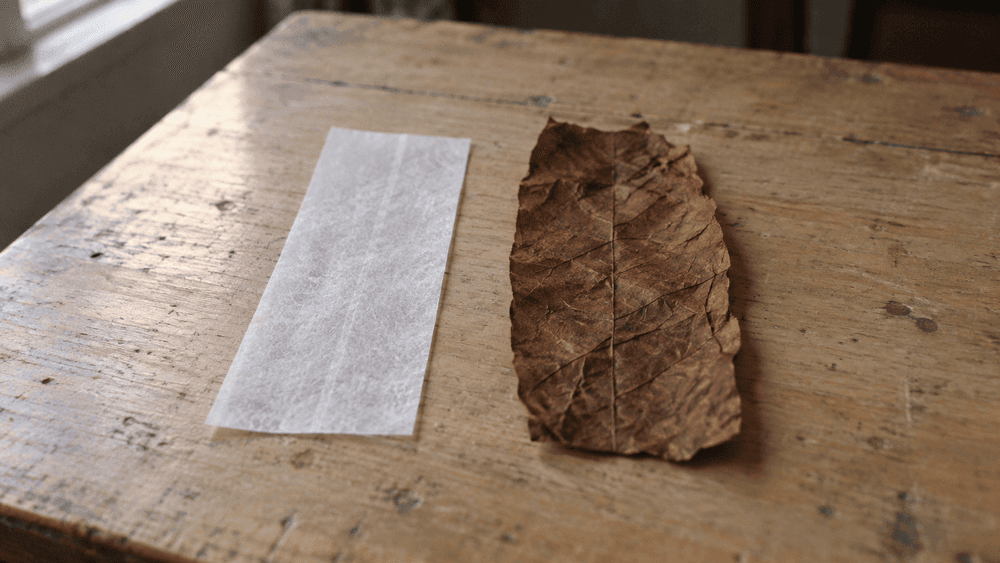
A blunt and a joint can hold exactly the same cannabis. What changes is the wrapper around it, and that wrapper decides whether you are also smoking tobacco. This guide covers what each format actually is, where the nicotine in a blunt comes from, and what happened when researchers put the same cannabis in both and measured the result.
Blunt vs joint, in short: a joint is cannabis rolled in paper. A traditional blunt is cannabis inside a hollowed-out cigar or a tobacco blunt wrap, and the FDA regulates cigars as tobacco products. That leaf carries nicotine even with the tobacco filler gone. In a 2009 randomized, placebo-controlled lab study at Columbia University, the same cannabis smoked as a blunt raised breath carbon monoxide more than as a joint and raised heart rate just as much, while producing lower blood THC. Size and burn time are real differences too, but the wrapper is the one most comparison pages skip.
Blunt vs joint vs spliff at a glance
| Feature | Joint | Blunt (cigar or tobacco wrap) | Blunt (tobacco-free wrap) | Spliff |
|---|---|---|---|---|
| Wrapper | Rolling paper (wood pulp, rice, hemp or flax) | Cigar or cigarillo leaf, or a tobacco wrap | Hemp, palm or other plant leaf | Rolling paper |
| Tobacco in it? | No | Yes, in the wrapper | Not in the wrapper, unless added | Yes, mixed into the fill |
| Nicotine source | None from the paper | The leaf: 1.2 to 6.0 mg per cigar wrapper | None from the wrap | The added tobacco |
| Typical size (retailer ranges) | About 0.5 to 1 g | About 1 to 2 g | Varies | Varies |
| Federal status of the wrapper | Papers meant for tobacco are tobacco components (2016 rule) | Tobacco product; 21+ to buy | Not a tobacco product (2024 and 2025 analyses) | The tobacco is regulated; 21+ to buy |
| 2009 lab study | Higher blood THC and strength ratings | More breath carbon monoxide; same heart-rate rise | Not tested | Not tested |
Read the table by column and one pattern stands out: the word "blunt" now covers two different products. A cigar-leaf blunt is part tobacco product. A blunt in a hemp or palm wrap has no tobacco in the wrapper at all. Most online comparisons treat them as one thing, which is why they end up saying blunts "may" contain nicotine. The honest answer depends on which wrapper you mean, and on what went inside it.
What each one actually is
These three words describe how cannabis is wrapped, not what kind of cannabis it is. None of them tells you the strain, the THC percentage or how much flower is inside. Here are plain definitions, with no rolling steps.
- Joint: ground cannabis rolled in a thin rolling paper. Papers are usually made from wood pulp, rice, hemp or flax. There is no tobacco unless someone adds it.
- Blunt (traditional): cannabis rolled in the leaf of a hollowed-out cigar or cigarillo, or in a pre-made tobacco blunt wrap. The wrapper is tobacco, so the whole thing is part tobacco product.
- Blunt (tobacco-free wrap): cannabis in a wrap made from hemp, palm or another plant leaf, sold to look and burn like a cigar wrap. The wrapper holds no tobacco by design.
- Spliff: cannabis mixed with loose tobacco inside a rolling paper. The tobacco is in the fill, not the wrapper.
- Pre-roll: a joint made in a factory. Check the package to see whether it uses paper or a wrap.
Tobacco-free wraps are not a niche product anymore. In a nationally representative 2022 survey of 1,178 US young adults, 22.7% had ever used a blunt wrap and 14.3% a hemp wrap, and 3.2% and 2.3% had used them in the past 30 days. In a fall 2022 survey of Connecticut high-school students who had ever smoked a blunt, tobacco-free wraps were the most common material among those who knew what they had used (72.6%), ahead of cigarillos (56.5%) and tobacco blunt wraps (49.2%), and 40.3% had used both tobacco and tobacco-free blunts. So when someone says "blunt" today, you cannot assume which wrapper they mean.
The spliff is the least studied of the three. A 2017 systematic review of 45 studies on blunts and spliffs found that most of the research is surveys and descriptions, that only 11 studies looked at spliffs at all, and that just five used designs able to test cause and effect. The nicotine question is simpler for a spliff, because the tobacco is in the mix on purpose, but there is no spliff-specific lab comparison to report.
How much cannabis goes in each
Retailers commonly quote about 0.5 to 1 g of flower for a joint and 1 to 2 g for a blunt. Those are marketing ranges, not measurements, but research points the same way. In a New York study of people enrolled in cannabis treatment trials, participants estimated they put about 50% more cannabis in a blunt than in a joint, and more than twice as much as in a pipe. That was self-reported, using a weighing method, in a treatment-seeking group, so treat it as a direction rather than a precise figure. A related pattern showed up among 377 adults screened for a cannabis treatment trial: more days of blunt smoking went with more cannabis per day of use, while more days of joint smoking did not. That is an association in one clinical sample, not a rule.
This explains most of the folklore that blunts are "heavier". A bigger smoke that lasts longer delivers more cannabis. The wrapper does not make the cannabis stronger; the amount and the potency of the flower do. For the potency half of that equation, our guide on whether THC percentage actually matters explains what the number on a flower label can and cannot tell you.
Where the nicotine in a blunt comes from
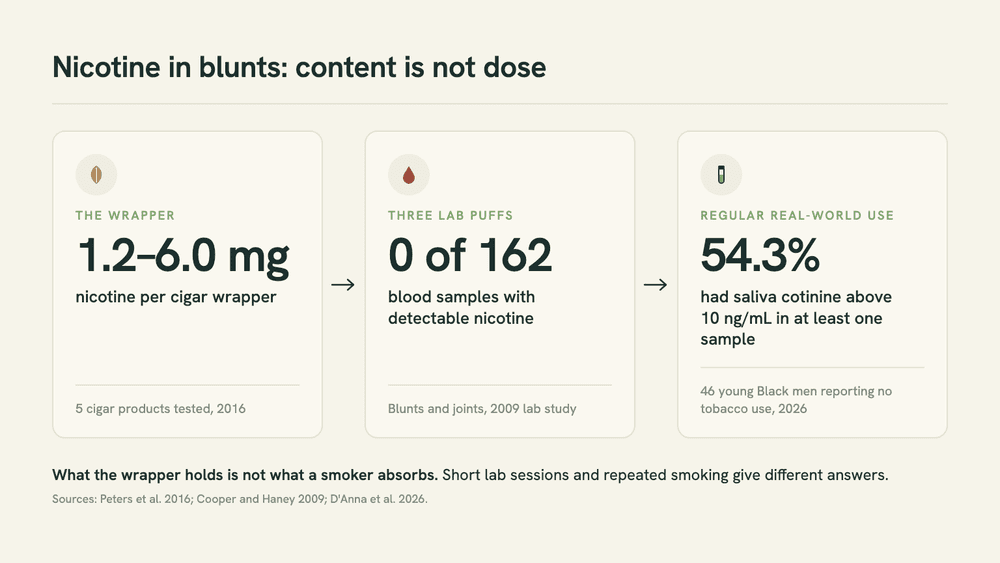
Cannabis does not contain nicotine. In a traditional blunt, the nicotine comes from the leaf. When researchers tested the wrappers of five cigars commonly hollowed out for blunts, three large cigars and two cigarillos, every wrapper contained measurable nicotine: between 1.2 and 6.0 mg per wrapper, with the wrapper making up 8% to 18% of the cigar's weight. That is what the leaf holds, not what a smoker absorbs, and the authors called their results preliminary: five products, one lab, tested in 2016.
So does that nicotine reach you? It depends on how much you smoke, and the two best data points pull in different directions. In the 2009 Columbia lab study, participants took only three controlled puffs, and plasma nicotine was undetectable in all 162 blood samples, whether they smoked a blunt or a joint and at every THC strength (the detection limit was 0.5 ng/mL). The authors wrote that it was unknown whether cigar paper would produce meaningful nicotine levels over longer smoking, which is how people usually smoke blunts. A separate lab study of flavored cigar wrappers for blunts, registered by Battelle and completed in 2019, has not posted results.
A 2026 study looked at real-world smoking instead. Researchers recruited young adult Black men aged 18 to 30 who had smoked blunts in the past 30 days and said they used no tobacco or nicotine products. Of the 111 enrolled, 46 gave two saliva samples about 10 hours apart, between July 2023 and March 2024. More than half of them (54.3%) had at least one sample with cotinine, the main breakdown product of nicotine, above 10 ng/mL, a level the authors describe as exceeding what is typical of secondhand smoke. Cotinine ran higher in men who smoked more blunts and in those who made their own. This is one specific group, fewer than half of the enrolled men were tested, and the design shows association, not cause. It does show that people who did not think of themselves as tobacco users can carry measurable nicotine exposure that tracks with blunt smoking.
Part of the reason is that many people do not know the wrap contains nicotine. A 2026 survey of 466 New Yorkers aged 15 to 24 who smoked blunts found that those unaware that blunt wraps contain nicotine were more likely to smoke blunts often and to also smoke cigars. That is an association in a young, single-state sample, not proof that knowing changes behavior. Put the three studies together and you get the honest answer: the leaf holds nicotine, a few puffs may not register in the blood, and regular blunt smoking can add up to exposure people do not expect.
What a controlled lab comparison found
Most blunt vs joint comparisons online are opinion. In a PubMed search we ran in September 2026, we found one randomized, placebo-controlled lab study that put the same cannabis in a blunt and in a joint: the Columbia University study published in 2009 in Drug and Alcohol Dependence. Twenty-four people who regularly smoked blunts (12 women and 12 men) came in for six outpatient sessions. Each time they smoked about 800 mg of cannabis at 0%, 1.8% or 3.6% THC, rolled either as a joint or inside a hollowed-out cigar, through a holder and without being able to see which one they had. They took three timed puffs, and researchers measured blood THC, breath carbon monoxide, heart rate and how strong the effect felt.
| Outcome | Joint | Blunt | What to keep in mind |
|---|---|---|---|
| Peak blood THC (3.6% THC cannabis) | About 100 ng/mL | About 50 ng/mL | Authors attribute the gap mostly to the thick cigar leaf drawn through a holder |
| Strength and liking ratings | Higher | Lower | Gap was larger in women; too few people to test that properly |
| Breath carbon monoxide | Lower | Higher at every strength, including placebo | In men, the difference was significant only at placebo |
| Heart rate (highest strength) | Increased | Increased by the same amount | Authors suspect extra carbon monoxide offset the lower THC |
| Blood nicotine | Undetectable | Undetectable | Three puffs only; all 162 samples below 0.5 ng/mL |
The THC result surprises people. At the highest strength, joints produced almost twice the peak blood THC of blunts (roughly 100 versus 50 ng/mL), and participants rated joints as stronger and more likable. The authors, though, think the gap is mostly about the setup: both formats were smoked through a cigarette holder to keep people blinded, and the cigar leaf was thicker than the paper, which made the blunts harder to draw through. So the study does not show that blunts deliver less THC in everyday use. What it does undercut is the common claim that blunts hit harder because of the wrapper itself. When the cannabis was held constant, the wrapper did not make it stronger.
The carbon monoxide result is the one that held across the board. Blunts raised expired carbon monoxide more than joints at every strength tested, including the placebo with no THC, which points to the leaf rather than the cannabis. Heart rate rose at the highest strength with both formats, with no statistical difference between them, even though the blunts delivered less THC. The authors suggested the extra carbon monoxide from the blunt was the likely reason. THC raises heart rate on its own too, as seen in a randomized trial where 12.5 mg of oral THC raised heart rate with or without CBD.
What "tobacco-free" on a wrap does and does not mean
Federal regulation follows the tobacco. The FDA defines a cigar as a roll of tobacco wrapped in leaf tobacco or in a substance that contains tobacco, and a 2016 rule brought cigars under its authority. That same 2016 deeming rule notes that rolling papers intended for use with cigarette or roll-your-own tobacco were already covered as tobacco components. Tobacco-free blunt wraps fall outside both. As a 2024 analysis in *Tobacco Control* put it, the FDA regulates components that influence how tobacco is used, such as filters and wrappers, but had no language specifically covering tobacco-free blunt wraps, which are sold in flavors and marketed as "organic", "natural" or "no additives".
The label also cannot tell you what goes inside. Yale researchers note that, unlike cigarette rolling papers and tobacco blunt wraps, tobacco-free blunt wraps are not regulated by the FDA as tobacco products. In their spring 2024 survey of 4,760 Connecticut high-school students, 489 had ever smoked a blunt. Of those, 24.7% had used a tobacco-free wrap, and among that group 12.4% had put tobacco in one and about one in 12 said they usually did. That is a teenage sample from one state, so read it as evidence that "tobacco-free wrap" and "tobacco-free blunt" are not the same thing, not as a national rate. The regulatory status here is what those 2024 and 2025 papers describe; check the FDA's tobacco product pages for anything newer.
Reading a wrap label: five checks
- 1Is it sold as a cigar or cigarillo? Then the leaf is tobacco and carries nicotine, whatever the flavor or packaging suggests.
- 2Is there a tobacco or nicotine warning on the pack? If so, treat the wrap as a tobacco product.
- 3Read "tobacco-free", "organic" and "natural" as marketing words. As of the 2024 analysis, no FDA language specifically covered this category.
- 4Do not read anything into flavor. Both tobacco wraps and tobacco-free wraps are sold flavored.
- 5Ask what went inside, not only around. A tobacco-free wrap with tobacco mixed into the fill brings the nicotine right back.
What a joint does not avoid
None of this makes a joint a clean option. A joint is still combustion: burning plant material and paper produces smoke, whatever is inside. Rolling paper is not a blank either. A 2024 lab analysis of commercial rolling papers measured 26 elements and found that some papers, especially colored ones, contained copper, chromium or vanadium. For copper-based pigments, the authors estimated that exposure could reach 4.5 to 11 times maximum exposure limits for frequent users. That was an estimate from what the paper contains, not a measurement in people who smoked it, and the authors called for studies under realistic smoking conditions.

The lung side of the story, from coughing to long-term airway effects, is a separate topic with its own evidence, and this page does not try to settle it. What this comparison can say is narrower: a tobacco wrapper adds nicotine and, in the one lab study, more carbon monoxide. For the basics of what THC itself does and how it differs from CBD, see our explainer on CBD vs THC.
Age and the law
The tobacco part of a blunt comes with its own age rule. Since December 20, 2019, federal law sets 21 as the minimum age to buy any tobacco product, cigars and cigarillos included, and it is illegal for a retailer to sell one to anyone under 21. That law does not name tobacco-free wraps; for those, state law and store policy decide. The cannabis inside is a separate question with separate rules. Marijuana laws are set state by state, and hemp flower sits under its own framework, explained in our guide to whether CBD flower is legal and in how hemp-derived THC ended up on store shelves.
If you are pregnant or breastfeeding, the wrapper is not the question to start with: read what the evidence says about cannabinoids during pregnancy and breastfeeding first.
Where hemp and CBD flower fit
If you smoke hemp or CBD flower, every point about the wrapper applies unchanged. The nicotine in a blunt comes from the tobacco leaf, not the plant inside it, so hemp flower in a cigar wrap carries the same wrapper nicotine as marijuana in one, and hemp flower in paper carries none from the paper. Hemp and marijuana are the same species separated by a legal THC line, as covered in our hemp vs marijuana explainer. And whatever it is wrapped in, old flower is its own quality issue; see what storage studies found about weed going bad. For transparency: Planntz does not sell any smokable product. Our line is oil tinctures, so nothing on this page is a pitch.
What the evidence does not tell you yet
- How much nicotine a person absorbs from a whole blunt. Wrapper content (1.2 to 6.0 mg) is not dose, and the one lab comparison stopped at three puffs.
- Whether blunts deliver less THC in real life. The 2009 gap is most likely a lab artifact, by the authors' own account.
- How today's higher-THC flower changes any of this. The lab study used cannabis at up to 3.6% THC.
- How spliffs compare. Only 11 of the 45 studies in the 2017 review looked at spliffs, and the lab comparison did not test them.
- How tobacco-free wraps compare with paper when burned. None of the studies here measured their smoke.
- Long-term outcomes by format. The studies here measured short-term markers such as blood THC, breath carbon monoxide and cotinine, not disease.
Frequently asked questions
Traditional blunts made with a cigar leaf or tobacco wrap do: in one lab test, the wrappers of five cigars commonly used for blunts held 1.2 to 6.0 mg of nicotine each, even with the filler removed. How much reaches you depends on how much you smoke. Three lab puffs did not raise blood nicotine above detection, but in a 2026 study of young Black men who smoked blunts and reported no tobacco use, more than half of those tested had cotinine above 10 ng/mL. A tobacco-free wrap adds no nicotine from the wrap itself, unless tobacco is mixed in.
Not because of the wrapper. In the 2009 randomized lab study, the same cannabis produced lower blood THC and lower strength ratings as a blunt, although the authors attribute that gap mostly to their setup. Blunts usually hold more cannabis than joints (about 50% more, by one self-reported estimate). That larger amount, not the leaf, is the likely reason people find blunts heavier.
The measurable difference is exposure. A tobacco wrapper adds nicotine, and in the lab study blunts raised breath carbon monoxide more than joints at every strength and raised heart rate just as much despite lower THC. That does not make a joint harmless: it is still smoke, and some rolling papers contain metals. The research does not rank long-term health outcomes by format.
A joint is cannabis in a rolling paper. A blunt is cannabis in a cigar leaf, a tobacco blunt wrap or a tobacco-free plant wrap. A spliff is cannabis mixed with loose tobacco inside a rolling paper, so the tobacco is in the fill instead of the wrapper. Spliffs are the least studied: only 11 of 45 studies in a 2017 review looked at them.
The wrap material is, by design. But tobacco-free blunt wraps are not regulated by the FDA as tobacco products, a 2024 analysis found no FDA language specifically covering them, and words like "organic" or "natural" on the pack are marketing terms. In a 2024 survey of Connecticut high-school students who used them, 12.4% had put tobacco inside one.
For cigars, cigarillos and other tobacco products, yes: federal law has set the minimum age at 21 since December 20, 2019. That law does not name tobacco-free wraps, so for those, state law and store policy decide. The cannabis itself is governed by state law.
A pre-roll is a joint made in a factory instead of by hand. Most use rolling paper, but some are sold in wraps, so check the package to see which wrapper you are getting.
The wrapper is only half of what decides how a smoke affects you. The other half is the flower itself, and our guide to reading THC percentage on a flower label walks through what that number does and does not predict.
Writing about hemp, wellness and the small rituals that keep us balanced.