How to Rehydrate Weed Without Inviting Mold, and What It Can't Fix
Dry, crumbly weed is harsh, not ruined. You can add water back, but not the THC or aroma that time took. Here is the one number that decides it, how eight popular methods compare, and when rehydrating turns into a mold problem.
Dry, crumbly weed is not ruined. It is harsh. You can rehydrate weed by putting water back into it, but you cannot put back the THC that age took or the aroma that evaporated. The whole job is hitting one number, a water activity between 0.55 and 0.65, without overshooting into the range where mold can grow.
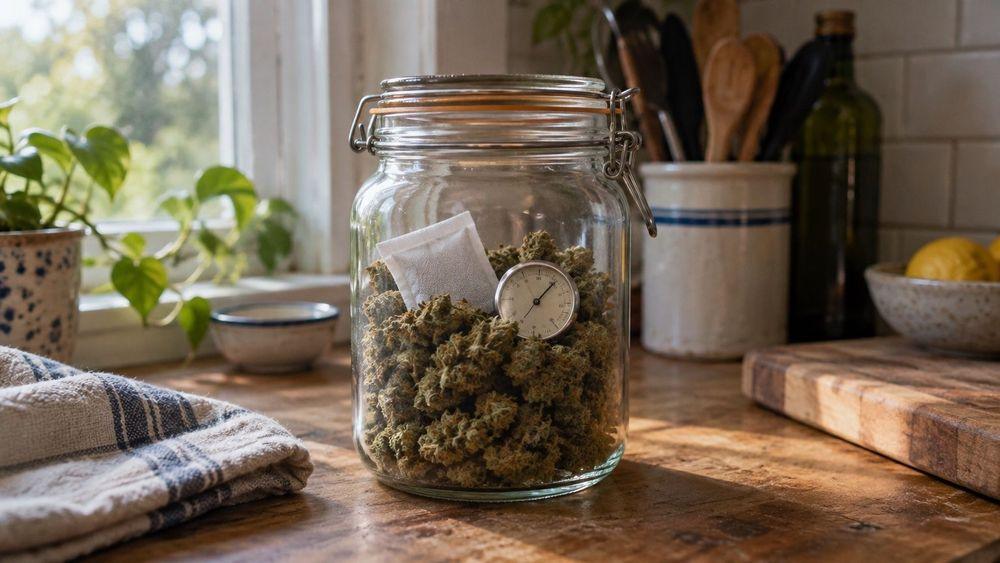
The short version: seal whole buds in an airtight glass jar with a small hygrometer and a moisture source that never touches the flower, ideally a two-way humidity-control packet rated within 55-65%. Check the reading instead of the clock, and stop once the jar settles between 55% and 65% relative humidity. Kitchen tricks such as an orange peel, a slice of bread or a lettuce leaf do work, but they work by adding something that is nearly pure water, so they overshoot easily and bring their own mold risk. This is general information for adults 21 and over. Planntz does not sell cannabis flower; we cover this because moisture and condition are central to how we think about quality.
The number that matters: water activity, not moisture percent
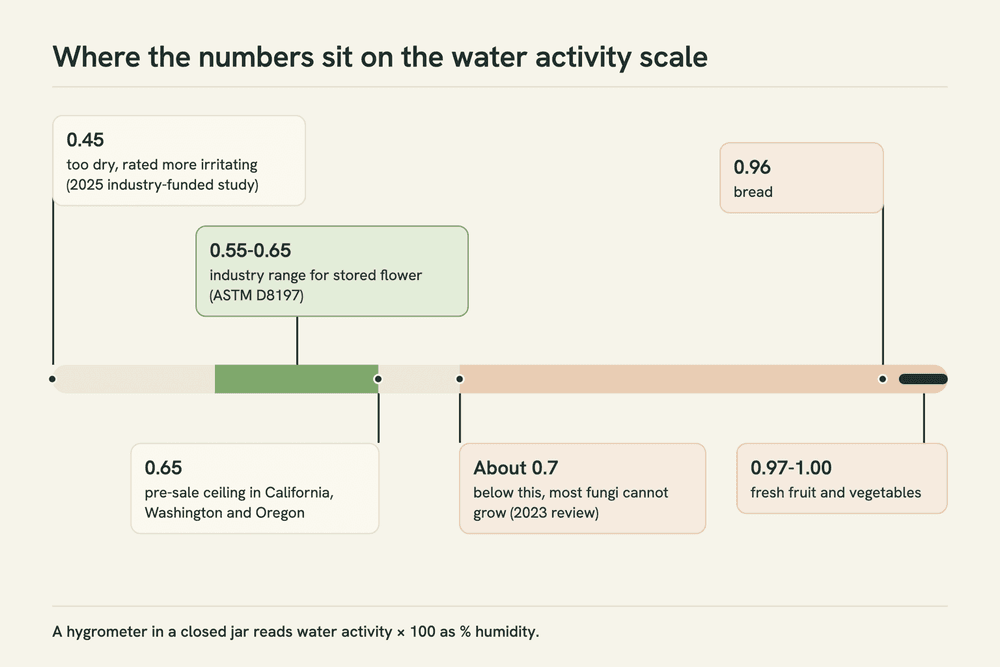
Water activity is a 0-to-1 measure of how much water in a material is free for microbes to use. It is the number testing labs and regulators use for dried flower, because it tracks mold risk more directly than a raw moisture percentage. An industry standard, ASTM D8197, sets the range for stored flower at a water activity of 0.55 to 0.65: under 0.65 to guard against mold, over 0.55 so buds don't crumble in routine handling. The same standard describes rehydration in plain terms, with no brand attached: for flower below 0.68, storing it with a salt-based humidity-control sachet designed to hold 0.55 to 0.65 can bring it into that range. ASTM standards are voluntary industry consensus documents, not law, and the full text is paywalled, so we worked from the publisher's published summary and scope.
State testing rules land on the same ceiling. California's cannabis regulations, revised January 1, 2026, will not let dried flower be sold above a water activity of 0.65. Washington's lab-testing rule fails useable cannabis above 0.65, and Oregon's testing rule does the same and also fails flower above 15% moisture. Other states are reported to use 0.65 too, but these are the three we read at the source in November 2026. All three are pre-sale tests on a licensed batch, not rules about what you do with a jar at home. What they do tell you is where regulators draw the line for mold risk.
Why not just aim for a moisture percentage? Because the numbers online disagree. Popular guides give the ideal as 6-9%, 10-12% or about 10%, none with a source, and a moisture percentage depends on how it was measured and whether it was calculated on a wet or a dry basis. Oregon's 15% cap is a fourth number. Water activity sidesteps that, which is why the standard uses it. For a sense of how the two scales relate, our guide to whether weed goes bad draws on a Canadian team that tested more than 2,000 cannabis samples for fungi from one licensed greenhouse. Drying buds to about 12-14% moisture or lower, which corresponds to a water activity of 0.65-0.7, kept counts down.
How to read water activity at home
You don't need a lab meter to get close. At equilibrium, water activity and relative humidity are the same scale. The FDA's inspection guide on water activity in foods describes the method in plain words: the product is left to come to equilibrium in a tight enclosure with a small headspace, the air's relative humidity is measured with a hygrometer, and water activity equals that equilibrium humidity divided by 100. So seal flower in a jar with a small hygrometer, let the air settle, and a reading of 62% means the buds are at about 0.62. That is the same principle labs use, applied by us to a jar of flower; a home hygrometer is not a calibrated lab meter. The guide also notes that water activity rises with temperature, so read your jar at room temperature, not after it has sat somewhere warm.
Two practical consequences follow. First, give the jar time: a reading taken right after you open and close it is mostly showing the room's air, not the flower's. Second, check the hygrometer itself. A National Bureau of Standards compilation of saturated salt solutions shows that air sealed over saturated table salt (sodium chloride) settles at about 75% relative humidity: 75.47% at 20°C (68°F) and 75.09% at 30°C (86°F). That fixed point gives you a free reference to test your hygrometer against.
Is dry weed weaker? What drying changes and what it doesn't
Not measurably, if dryness is the only thing that changed. In a 2025 industry-funded study of water activity and smokability, researchers made pre-rolls from one CBD-dominant hemp cultivar at a water activity of 0.45 and 0.65 and burned them on a smoking machine. The cannabinoids reaching the smoke were not significantly different between the two. Terpene delivery to the smoke was highest at 0.65, and consumers rated the 0.45 pre-rolls more irritating on two of the response levels. Keep the limits in view: the study ran in a trade journal, not a peer-reviewed one, its sponsors include humidity-control and packaging companies, it tested one cultivar on a machine using a tobacco puff profile, and its own conclusion says consumers could not tell the two apart. Read the irritation finding as modest. If dry hits make you cough, our guide to why weed makes you cough covers the other causes.
A 2025 Cornell study of postharvest drying and curing points the same way from the other end: drying and curing hemp flower did not significantly change its total cannabinoids. What does make old weed weaker is time, light, air and heat. In the 1997 storage data most pages quote, cannabis kept in a dark, cool vault had lost 16.6% of its starting THC after one year. The storage guide linked above walks through those studies. Water does not reverse any of it.
Aroma is a different story, and it does fade with time. A 1996 University of Mississippi study of fresh and air-dried buds, as a 2020 paper summarizes it, recorded terpene losses of about 31%, 45% and 55% after one week, one month and three months of drying and storage, while the mix of compounds stayed recognizable even as the amount fell. More recently, an Italian study that stored hemp flower for six months in the dark at 18°C (64°F) and 60% relative humidity found its scent changed whatever it was kept in. A glass bottle kept it closest to where it started, but nothing held it. For what a terpene figure on a label does and does not tell you, see how to read a terpene percentage.
“The scent of cannabis changes with time independently of the storage condition.”
So set your expectations before you start. Rehydrating fixes texture and harshness. It does not bring back THC lost to age or aroma lost to time, and anything that promises to restore potency or freshness is promising more than water can do.
Every rehydration method, rated by what it adds
We found no published study that tested the orange-peel, bread or humidity-pack methods on cannabis (PubMed searches, November 2026). What follows rates each method by what it adds, how wet its source is, and what can go wrong. The wetness column is the one to watch. A food-safety report prepared for the FDA puts fresh fruit and vegetables at a water activity of 0.97 to 1.00 and bread at about 0.96. Flower is supposed to stay at or under 0.65. Every kitchen trick works by placing something close to pure water next to buds that should be far drier, which is why they work fast and why they overshoot. Freshly harvested hemp flower in the Cornell study was 74.9-80.6% moisture, so adding a fresh bud is the same story.
| Method | What it adds | How wet the source is | What can go wrong | How you would notice | Verdict |
|---|---|---|---|---|---|
| Two-way humidity-control packet rated within 55-65% | Water vapor, with the jar pulled toward the packet's rating by a salt solution | Held near its rating (the maker's figure) | Slowest option; a packet rated above 65% pushes the jar past the ceiling | Hygrometer settles above 65% | Best fit |
| Distilled water on a paper towel, kept off the buds | Water vapor from liquid water | Liquid water, the top of the scale | Keeps adding water until you remove it | Hygrometer climbs past 65%; damp feel | Workable with checks |
| Citrus peel | Water plus a citrus smell the buds absorb | Fresh fruit: 0.97-1.00 | Overshoots; the peel itself can mold; the aroma is no longer the strain's | Citrus smell, soft or spotted peel, high reading | Short use only, with checks |
| Slice of bread | Water | About 0.96 | A food that molds readily, sealed in with your flower; adds nothing useful | Spots on the bread, musty smell | Skip |
| Lettuce leaf | Water | Fresh vegetables: 0.97-1.00 | Wilts and rots; overshoots | Slimy leaf, musty smell | Skip |
| Fresh bud | Water and its own aroma | 74.9-80.6% moisture at harvest (hemp) | Mixes aromas; any mold on it is now in your jar (our reasoning) | Damp spots, musty smell | Skip |
| Steam, kettle or misting | Liquid water straight onto the surface | Liquid water | Untested; wets the resin, and handling wet buds can knock resin heads off (our inference) | Sticky, damp surface | Skip |
| Homemade table-salt slurry | Water vapor held near 75% humidity | About 75% relative humidity | Holds the jar above the 0.65 ceiling | Hygrometer settles near 75% | Use only to check a hygrometer |
Two methods earn their place. A two-way humidity-control packet works by chemistry: a saturated salt solution in a closed space pulls the air toward one fixed humidity set by the salt, which is what the salt-solution compilation above tabulates for 28 salts. That makes a packet slow but self-limiting, as long as its rating sits inside 55-65%. Pack makers sell several ratings, such as 58%, 62% and 69%; those numbers are the makers' own, and a 69% rating sits above the industry range. The second is distilled water on a paper towel kept from touching the buds, which is how the 2025 industry study brought its flower to target inside sealed containers while watching a digital hygrometer. It is not self-limiting: it keeps adding water until you take it out.
The same salt chemistry explains a trap nobody mentions: a homemade slurry of table salt and water holds a jar near 75%, past the 0.65 ceiling. Use it to check a hygrometer, never to store flower. The citrus peel deserves its own note too. A 2020 packaging study showed that flower in a sealed jar soaks up aromatic compounds from the air around it, and used that on purpose to push terpene levels up; its authors hold shares in the company behind the method. That is why a peel makes buds smell of citrus: it adds a new note, it does not bring back the old one.
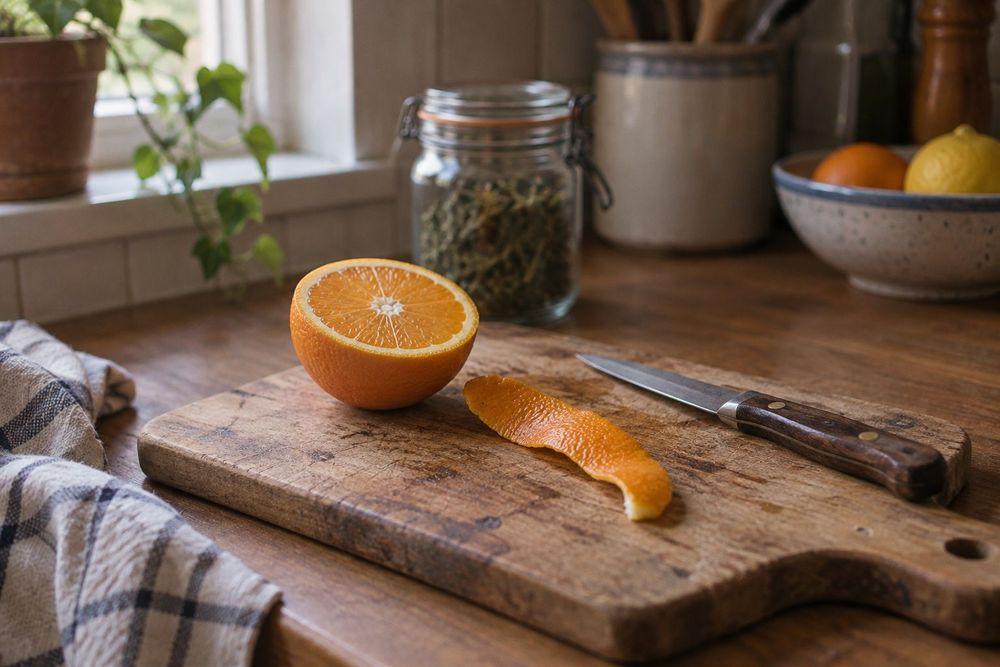
Steaming buds over a kettle or misting them with water is the shortcut we would avoid first. No study has tested either. Both put liquid water straight onto the surface that drying worked to dry. Under a microscope, a 2023 imaging study saw many of the resin heads on cannabis flowers breaking off at a narrow neck during trimming and drying. Handling wet, sticky buds is an easy way to lose more; that last point is our inference, not something the study measured. Our trichome guide explains what those resin heads hold and why they matter.
How to rehydrate weed, step by step
This routine follows the standard's range and checks the number rather than the clock. Guides online give hours for a peel and days for a packet; none of those figures comes with a source, so we don't print one. Expect a wet food to move the reading quickly and a packet to move it slowly.
- 1Put whole buds in an airtight glass jar, about three-quarters full, so there is air space for a hygrometer. Leave buds whole; break them up only when you use them.
- 2Add a small hygrometer, ideally one you have checked against damp table salt (it should read near 75%).
- 3Close the jar, let the reading settle, and note it. Below 55% means the flower is drier than the industry range.
- 4Add one moisture source that never touches the flower: a two-way packet rated within 55-65%, or a paper towel dampened with distilled water in a small open cup.
- 5Close the jar and keep it at room temperature, out of light. Water activity rises with temperature, so a warm spot reads high.
- 6Check the reading and the buds regularly. Buds should bend slightly instead of snapping. Look for any fuzz, spots or musty smell every time.
- 7When the jar settles between 55% and 65%, take out any towel or food. A packet rated within that range can stay in.
- 8If the reading climbs above 65%, open the jar, remove the moisture source, and let the buds air out until it drops back into range.
Expect patience to pay off. In the Cornell study, hemp flower dried to between 2% and 7% moisture slowly took water back from the air inside closed jars over a three-week cure, gaining 3.3 to 13.6 percentage points. The more humid the air in the container, the wetter the flower ended up. That is the physics in one line: flower drifts toward whatever humidity its jar holds. Control the jar and the flower follows.
Where rehydrating turns into a mold problem
Adding water reverses the main thing keeping mold in check. A 2023 review of fungi on cannabis and hemp flowers notes that drying below a water activity of about 0.7 stops most fungi from growing, and that buds kept humid raise concern about mold toxins, called mycotoxins. Some fungi live inside the plant without visible signs, and the heat of smoking "may be insufficient" to kill every spore. The Canadian team behind the 2,000-sample study warned that microbes surviving the drying step can multiply later, during curing and storage. Rehydrating is a storage step.
The 2025 industry study drew the same line in practice. It prepared flower at a water activity of 0.85, found it delivered only about 30% of the cannabinoids of the 0.65 flower, and excluded it from consumer testing because of potential microbial growth. Food tricks add a second problem. A slice of bread or a lettuce leaf is a food that molds on your counter, and you are sealing it in a jar with your flower. We found no study of this exact setup, so treat it as reasoning: you are adding water and whatever lives on the food at the same time.
The companion test standard, ASTM D8196, puts the limit bluntly: controlling water activity is not a kill step. It stops mold from growing. It does not remove mold that is already there. So rehydrating cannot rescue moldy flower, and drying it out again does not make it clean.
Rehydrate or discard? The 30-second check
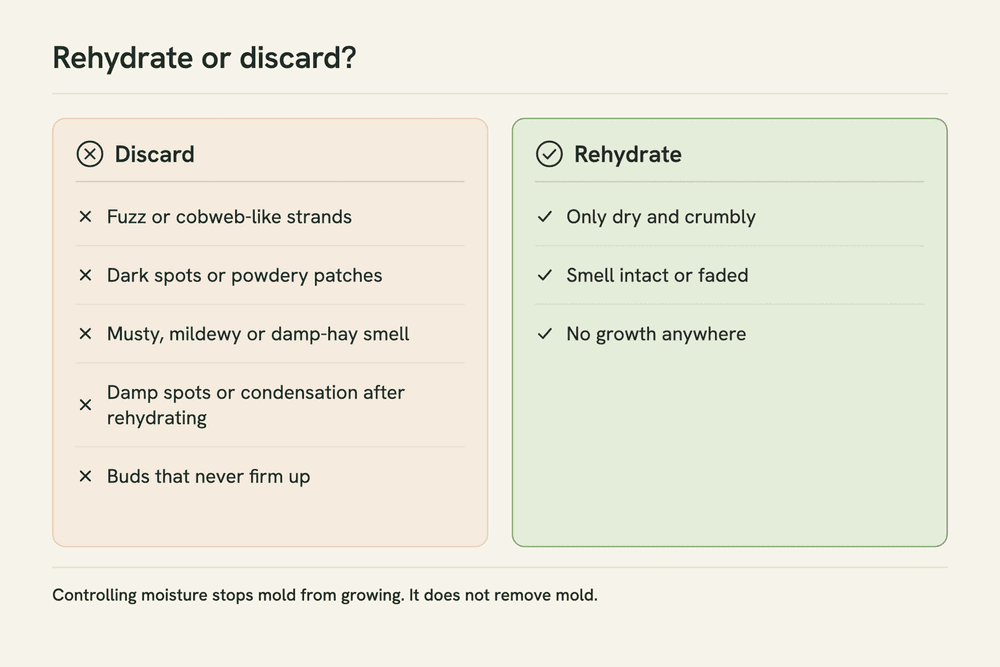
Run through this before you add any water, and again each time you open the jar. For a fuller visual guide, start with the stop signs in our guide to what good weed looks like. These are common warning signs, not a lab test, and not seeing them does not prove flower is clean.
- Discard: white, gray or greenish fuzz, or cobweb-like strands on or between buds.
- Discard: dark or black spots, or powdery patches that do not look like the plant's glittering resin.
- Discard: a musty, mildewy or damp-hay smell.
- Discard: damp or spongy spots, or condensation inside the jar, after rehydrating.
- Discard: buds that never firm up after the jar reads back in range.
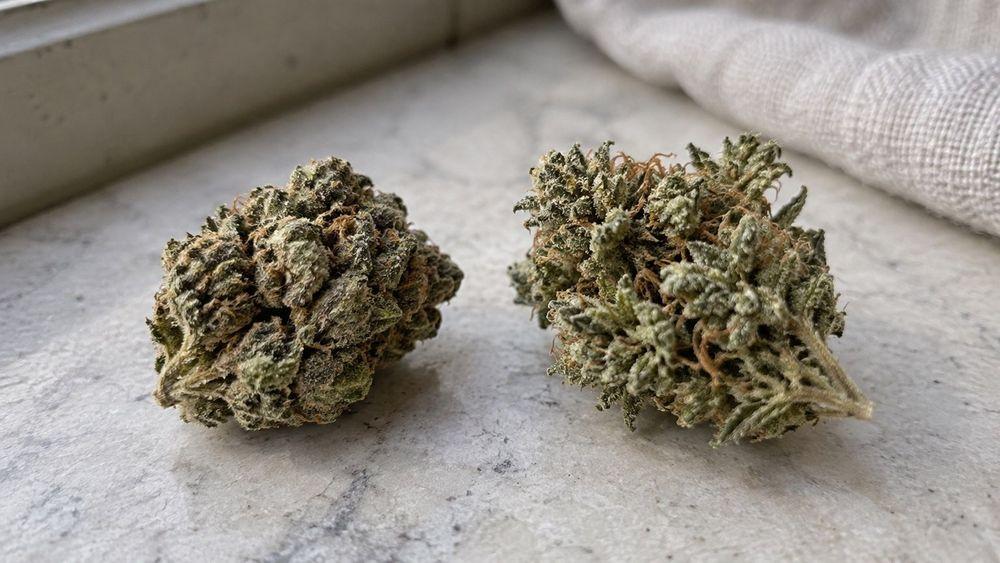
- Rehydrate: buds that are only dry and crumbly, with an intact or merely faded smell and no growth anywhere.
Who should be strictest? According to the CDC, most people breathe in Aspergillus spores every day without getting sick, but people with weakened immune systems or lung diseases are at higher risk. Cough and shortness of breath are common symptoms; see a clinician if they appear. If that describes you, treat any doubt about a jar as a reason to discard it.
Hemp flower and pre-rolls follow the same physics
The two most useful studies on this page were done on hemp: the Cornell work used CBD-type hemp cultivars, and the 2025 industry study used a CBD-dominant hemp pre-roll. The same 0.55-0.65 logic applies to hemp flower. Hemp is defined by its THC content, not by how it holds water, and our guide to whether CBD flower is legal covers that identity question. For pre-rolls, use a humidity-control packet in the closed pack or jar and never a food item, because rolling paper soaks up water wherever it touches something wet. Our guide to hemp pre-rolls sold as CBD cigarettes covers the format itself. Loose, broken material is its own case; see how shake differs from whole bud.
Keep it from drying out again
Once flower is back in range, storage keeps it there. Store whole buds airtight, in the dark and somewhere cool, and keep the air inside below about 65% relative humidity, the same rule the storage guide above sets out. A two-way packet rated within 55-65% can stay in the jar to hold it there. Open the jar only when you need to, since every opening swaps some of its air for the room's. Grind just before use: in a 2020 study of postharvest storage conditions, ground samples tended to hold fewer terpenes than whole ones and built up significantly more breakdown products. And handle dry buds gently: the industry standard's 0.55 floor exists to prevent breakage in routine handling.
What we could not find
- A published study testing consumer rehydration methods on cannabis flower (PubMed, November 2026).
- A peer-reviewed test of humidity packs on stored flower. Pack ratings are the makers' own figures.
- A reliable time to rehydrate. It depends on how dry the flower is, the jar and the moisture source.
- Any test of steaming or misting buds.
- Data on how accurate home hygrometers are, which is why we suggest a salt check instead of trusting the dial.
- Whether the hemp results on dryness and smoke carry over fully to high-THC flower; the key studies used hemp.
Questions people ask about rehydrating weed
The fast methods, a citrus peel, bread, lettuce or a damp towel, are fast because they are close to pure water: fresh produce sits at a water activity of 0.97 to 1.00 and bread at about 0.96. That is also why they overshoot. If you use one, keep a hygrometer in the jar, check often, and take the item out as soon as the reading settles between 55% and 65%. Faster is riskier.
It adds water and a citrus smell, which buds absorb from the jar's air. It does not bring back the strain's own terpenes, and the peel itself can mold. If you try it, keep the peel off the buds, check often and remove it early.
You can, but it is the method we would skip. Bread sits at a water activity of about 0.96, molds readily, and adds nothing that a damp paper towel or a humidity-control packet does not, with more to go wrong.
Not measurably because it is dry, on the limited evidence available. In a 2025 industry-funded study, the cannabinoids reaching the smoke did not differ significantly between flower at a water activity of 0.45 and 0.65, though the drier flower was rated more irritating. Old weed is weaker because of age, light, air and heat, a separate process that water does not reverse.
No. Water fixes texture and harshness. THC lost to age and terpenes that evaporated are gone, and a citrus peel or other additive adds a new smell rather than restoring the old one.
An industry standard, ASTM D8197, sets the range for stored flower at a water activity of 0.55 to 0.65, which a hygrometer in a closed jar reads as 55-65% relative humidity once settled. California, Washington and Oregon fail flower above 0.65 in pre-sale lab tests. Specific pack ratings such as 62% are the makers' own figures.
If it never went above the range and shows no mold, it is the same flower with more water in it. If anything grew, throw it out: rehydrating cannot remove mold, and the heat of smoking may not kill every spore. People with weakened immune systems or lung disease should be the strictest about discarding.
We found no reliable source for a time. Guides online say hours for a wet food and days for a packet. Very dry hemp in a 2025 Cornell study took water back slowly over a three-week cure. Watch the hygrometer rather than the clock.
Yes. The physics is the same, and the two most useful studies on moisture and smoke were done on hemp. For pre-rolls, use a humidity-control packet, never a food item.
To keep the next jar from drying out, read how weed ages in storage and how to store it based on what was measured. Before you rehydrate anything you are unsure about, run it past our visual guide to judging flower quality.
Writing about hemp, wellness and the small rituals that keep us balanced.