What Does Good Weed Look Like? The Checklist, Graded
Every top result on what good weed looks like gives you the same checklist. We added the evidence column: which signs are stop signs, which track chemistry, which are just taste, and the one document that answers what your eyes cannot.
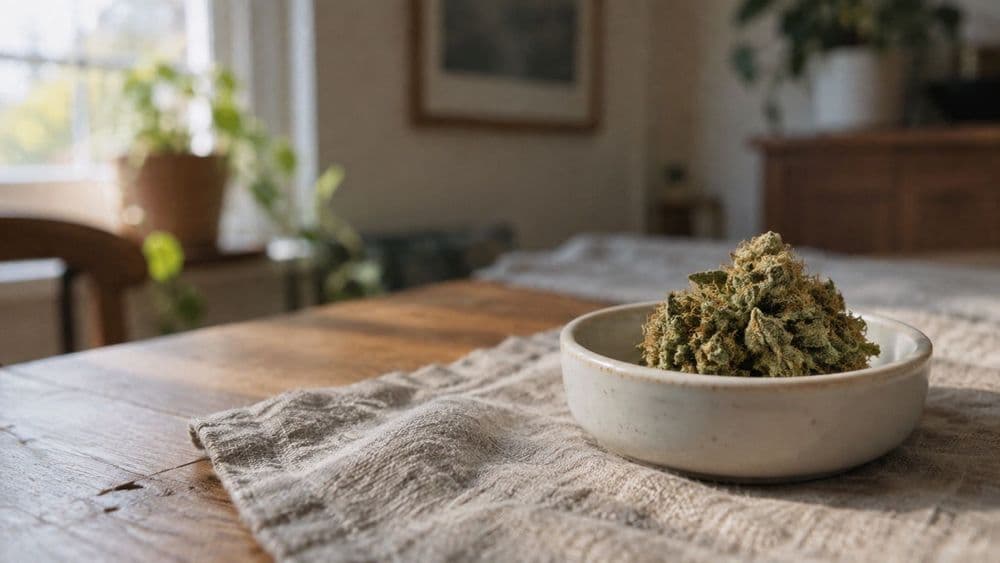
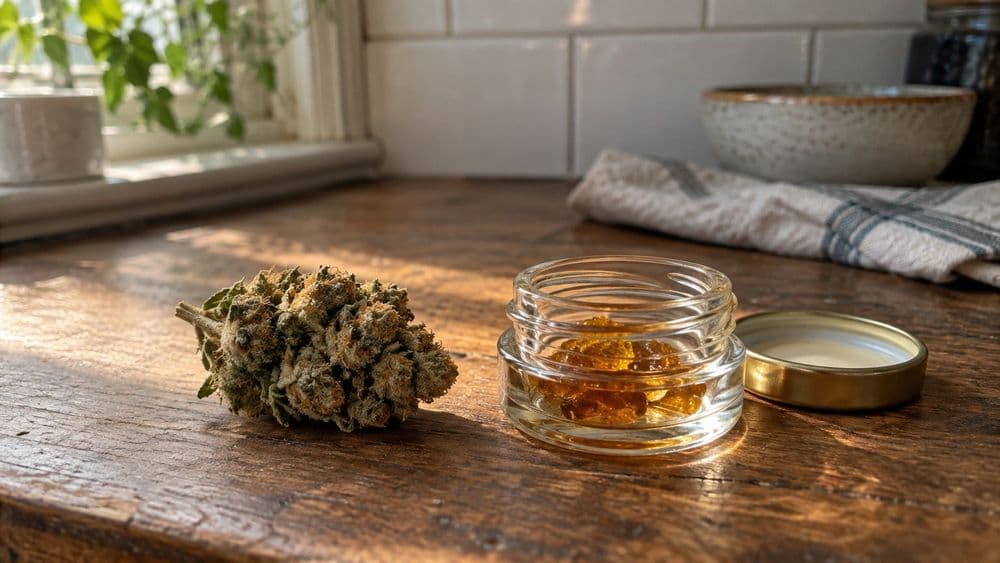
What does good weed look like? Ask the top search results and you get the same checklist every time: green buds, orange hairs, lots of frost, dense structure, a loud smell, no seeds. Each item is presented as a quality signal, and almost none comes with a source. We went through that checklist one cue at a time and asked a simpler question: has anyone actually measured this?
The short answer: a few signs are worth acting on and most are not. Three are stop signs: visible mold, a damp or spongy feel, and a musty smell. Two track chemistry: intact frost and the absence of seeds. Orange hair color is a fair clue that the plant was not harvested early. Bud color, density, how loud it smells, the THC percentage on the label and the strain name are mostly taste or, when they were tested, misleading. What settles quality is the batch lab result, which measures moisture, microbes, contaminants and total THC that no eye can see. This guide is for adults 21 and over where cannabis is legal, and for anyone buying hemp flower. If you are shopping for oils rather than flower, our buyer's checklist for CBD oil covers the same ground for bottles.
What does good weed look like? Every cue, with its evidence
Here is the checklist that shows up across page one of search, with two things added: what each cue can and cannot tell you, and how much evidence stands behind it. We used five grades. Stop sign means discard, whatever else looks good. Tracks chemistry means a study has linked the cue to cannabinoid content. Partly measured means it has been studied, with real limits. Mostly taste means it reflects preference, growing conditions or cultivar rather than quality. Measured and misleads means it was tested and failed as a guide to what is inside or how it will feel.
| Cue | What it can tell you | What it cannot | Evidence grade | Where we go deeper |
|---|---|---|---|---|
| Fuzz, webbing, grey or black patches | Possible mold. Discard it. | Whether fungi are hiding in a clean-looking bud | Stop sign | Does weed go bad? |
| Musty, damp, hay-like or ammonia smell | A moisture problem or mold | Anything about strength | Stop sign | Does weed go bad? |
| Damp, spongy feel or a fogged jar | Too much moisture, the condition mold needs | The exact water activity (only a lab measures that) | Stop sign | Stop signs, below |
| Frost (intact resin glands) | A plant that made plenty of resin and flower handled gently | A potency reading | Tracks chemistry, loosely (1981 gland count; 2025 review) | What are trichomes? |
| Seeds | The flowers were pollinated, which lowered nearly every cannabinoid in a plant study | How much lower your bag is | Tracks chemistry (2021 plant study) | Frost and seeds, below |
| Orange or amber hairs | The plant probably was not harvested early | Potency; dried retail flower was not studied | Partly measured (22 of 25 genotypes, 2025) | Hair color, below |
| Bud color, including purple | Pigment responding to cold and cultivar | Strength or quality | Mostly taste (2025 growth-chamber trial) | Mostly taste, below |
| Density and bud shape | How it was grown, lit and trimmed | Cannabinoid content | Mostly taste (no study found) | Indoor vs outdoor weed |
| How loud it smells | Freshness and aroma family | THC level | Measured and misleads for strength (2018) | Why does weed smell like skunk? |
| THC % on the label | One lab's number for one batch | How strong it will feel | Measured and misleads (2018, 2020, 2025) | Does THC percentage matter? |
| Strain name, indica or sativa | Marketing lineage | The chemistry inside | Measured and misleads (2021, 2022) | THC and names, below |
| Shake and pre-ground flower | More stem and leaf in the mix | What the source flower looked like | Mostly taste, plus a blind spot | What is shake weed? |
The order matters more than any single cue. Run the check like this:
- 1Look and smell for stop signs: fuzz, webbing, grey or black patches, a musty or damp smell, a spongy feel. Any one of them ends the check.
- 2Break a bud open and look inside, then check for seeds and for intact frost under good light.
- 3Treat color, density, hair color and smell strength as preference, not proof.
- 4Read the batch lab result: batch number, water activity, microbial and contaminant panels, total THC and total CBD.
- 5If there is no lab result you can match to the package, weigh that more heavily than anything you can see.
Stop signs first: mold, damp and a musty smell
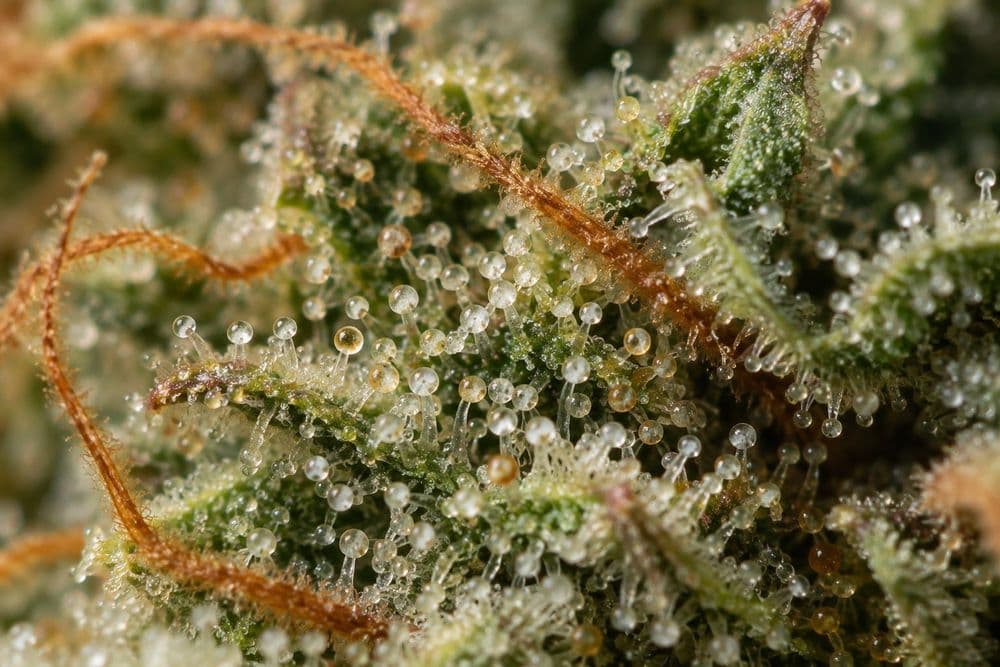
Mold is the part of a bad bag that can actually hurt you, so check for it before anything else. On flower it usually shows up as grey or white fuzz, fine webbing, or grey to black patches lying across the surface of the bud. Resin glands look different: under a magnifier they are glassy round heads on tiny stalks, standing up from the plant rather than spreading over it like a film. A musty or damp smell, a spongy or wet feel when you squeeze gently, and condensation inside the jar all point the same way: too much moisture, which is what mold needs. Our guide to how weed goes bad in storage covers mold, browning and fading aroma in depth.
- Grey or white fuzz, or fine webbing, sitting on top of the bud
- Grey or black spots or patches, including inside a dense bud once you break it open
- A musty, damp, hay-like or ammonia smell in place of a plant smell
- A spongy, wet or squishy feel
- Droplets or fog on the inside of the jar or bag
Moisture is the measurable part of the problem. A 2023 review of fungi on cannabis notes that keeping flower below a water activity of about 0.7 stops most fungi from growing. Water activity is a 0 to 1 scale of how much free water a material holds, and it maps straight onto humidity: a bud in balance with air at 60% relative humidity sits at a water activity of about 0.60. Regulators set their line just under that fungal threshold. California's testing rules will not let dried flower be sold if its water activity is above 0.65, and the lab has to print that result as a pass or fail on the certificate. Drying works in practice, too: in more than 2,000 samples from one licensed Canadian greenhouse, flower dried to about 12 to 14 percent moisture carried less mold.
The honest limit runs the other way. The same 2023 review notes that some fungi live inside the plant with no visible sign at all, and that the heat of smoking may not kill every spore. A clean-looking bud is not proof of a clean one. Adulteration has the same blind spot: the EU drugs agency's 2021 review of synthetic cannabinoids in Europe says hemp sprayed with them would be very difficult to distinguish from ordinary cannabis by look, smell and flavor. Our guide on whether you can tell if weed is laced explains what does and does not work there.
Two cues that track chemistry: frost and seeds
Frost: a resin signal, not a potency meter
Frost is the coating of trichomes, the resin glands where the plant makes and stores its cannabinoids and terpenes. More glands does loosely mean more cannabinoids: botanists counting resin glands in 1981 found that a bract's cannabinoid content rose with its gland count, in a study of three clones. A 2025 review of trichome research puts the limit plainly, though: higher density alone does not guarantee greater cannabinoid potency, and density does not consistently predict cannabinoid content across genotypes. Handling changes the picture as well. A 2023 microscopy study of cannabis trichomes found clear, milky and brown resin heads on the same bract at the same time, and machine trimming knocked many heads off.
So read frost as two facts: a plant that made plenty of resin, and flower handled gently enough to keep it. It is not a potency reading, and the clear, cloudy and amber color charts you see online describe a grower belief: we found no study that measured cannabinoids against trichome head color. Our explainer on what trichomes are and what their color can tell you goes deeper.
Seeds: the most underrated cue on the list
Seeds tell you something about chemistry. A seed means a flower was pollinated, either by a male plant or by a female that formed pollen sacs of its own. In a 2021 Israeli plant study on pollination and cannabinoid content, pollinating two cannabis varieties, one THC-rich and one CBD-rich, so that they set seed substantially lowered the concentration of nearly every cannabinoid, whichever plant supplied the pollen. The ratio between cannabinoids held, and monoterpenes, the lighter aroma compounds, generally followed the cannabinoids down. That was a growth-chamber study with three plants per treatment, not a test of seeded flower sold in stores, but it is why seeds are a real quality cue rather than a cosmetic one. It also explains an old word: sinsemilla is Spanish for "without seed", and the authors note that fertilized flowers are considerably less potent.
Regulators treat seeds as a defect too. Washington's quality rules for licensed cannabis fail a flower test sample if more than 2 percent of it is seeds or other foreign matter, or more than 5 percent is stems 3 mm or more in diameter. A stray seed is not a safety problem. A bag where you keep finding them tells you the flowers were pollinated, and the plant study suggests they made less cannabinoid than they would have otherwise.
Hair color: a harvest-timing clue, not a potency number
The hairs on a bud are stigmas, often called pistils: the part of the flower that catches pollen. They start white and turn orange, red or brown as the flower matures. Many guides treat orange hair as cosmetic, and one study suggests it means a little more than that. Australian researchers who tracked 25 cannabis genotypes scored hair color at four stages, from fully white to fully amber, and measured cannabinoids at each. In 22 of the 25, total cannabinoids peaked when most or all of the hairs had turned amber (10 at the mostly amber stage, 12 at fully amber). One genotype peaked at the fully white stage. The authors call the amber-hair rule of thumb a useful approximation in most cases, and recommend studying genotypes individually.
Two limits keep this from being a potency test. First, the differences between plants dwarfed the color signal: across all the plants and stages, total cannabinoids ranged from about 4 to 87 mg per gram. A fully amber bud from a low-output plant can still trail a white-haired bud from a high-output one. Second, the work was done on living plants at harvest at one research site, not on dried retail flower, which nobody has tested this way. Read orange hair as a sign the plant probably was not harvested early, and nothing more.
Cues that are mostly taste: color, density and how loud it smells
Healthy cured flower runs from light green to deep green, often with purple, and none of those shades is a quality grade. Purple comes from anthocyanins, the same family of pigments that colors red cabbage. In a 2025 Wisconsin growth-chamber trial on one purple hemp line, cold temperatures drove the purple, with the most pigment at 8 and 15 degrees Celsius (about 46 and 59 degrees Fahrenheit), while CBD content followed the plant's maturity instead. The researchers also found that scoring purple by eye overstated the pigment their instruments measured. Purple is a look, not a strength. The colors that matter are the ones in the stop-sign list: grey or white fuzz and black spots. Browning is consistent with age or oxidation, which the storage guide covers.
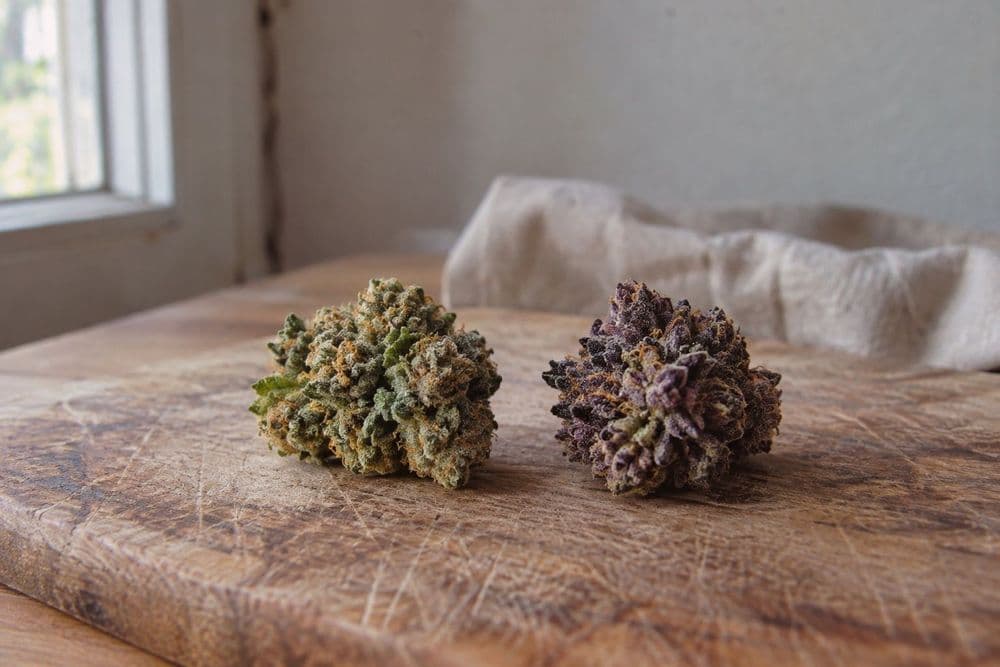
Dense, tight buds photograph well, and many guides treat airy buds as inferior. We searched PubMed on October 2, 2026 for any study of bud density or bud structure against cannabinoid content and found none. How a bud looks depends heavily on how it was grown, lit and trimmed, which is why indoor and outdoor flower can look so different without that difference telling you what is inside. The old rule that indica buds are dense and sativa buds airy rests on labels that, as the next section shows, do not hold up genetically.
Smell is where folk wisdom and measurement part ways most clearly. In a 2018 Colorado study of smell and perceived potency, 61 adult consumers rated 11 strains for potency by smell alone, and their ratings did not match the THC the researchers measured. THC itself has no smell. The study was small, and the first author's company funded the materials. Aroma is not meaningless, though. A 2020 analysis of user reviews for 887 cultivars found that what people said a cultivar tasted like lined up with its measured terpene profile. So your nose may tell you which aroma family a flower belongs to, and a faint or flat smell can mean old flower, since aroma compounds fade with age. It is not a strength gauge. The skunky note itself comes from sulfur compounds, which our explainer on why weed smells like skunk covers.
Texture gets its own folklore. Here is what it can and cannot tell you:
- Slightly tacky when you break a bud: resin, and normal.
- Wet, spongy or squishy: moisture, and a stop sign.
- Turns to powder at a touch: over-dried, and often older, so check any packaging or harvest date on the label.
- The stem snap test and the bounce test: popular advice that we found no study testing against quality.
Why the THC number and the strain name won't settle it
If your eyes are unreliable, the label looks like the fix. It helps less than it seems. In a 2020 JAMA Psychiatry study of regular users, 55 flower users in Colorado were randomly assigned to flower at 16% or 24% THC (the same 121-person study also tested concentrates), and outcomes did not differ measurably by potency within either form. The authors suggest experienced users may self-titrate; the study had no placebo arm and included only regular users. The number itself also moves with the lab that ran it: in Washington's state testing data, median THC for flower ran from 17.6 percent to 23.1 percent depending on which lab did the test. A blinded audit of 178 flower samples from 52 Colorado dispensaries found only 56.7% within 15% of the label figure, with flower more often over-labeled than under-labeled: on average, 22.5% on the label and 20.8% measured. Our guide to whether THC percentage matters walks through these audits, and the 2020 study's comparison of flower with concentrates is in our look at dabs versus flower.
Strain names fare worse. A 2021 Nature Plants study of Sativa and Indica labels that profiled 297 Dutch samples and genotyped 137 found plants sold as Sativa and Indica were genetically indistinct across the genome; the labels tracked a handful of aroma compounds instead. The study was funded by a medical cannabis producer, and two co-authors worked there. Across 89,923 flower samples from six US states, the names on packages did not consistently match the chemistry inside, and 96.5% of the samples were THC-dominant. One of that study's authors worked for a cannabis information company, and the samples were not independent of one another.
“Commercial labels do not consistently align with the observed chemical diversity.”
Shake, trim and pre-ground flower
Small pieces are not automatically worse, but they hide things. Shake is the loose material at the bottom of a bag: broken bits of flower, small leaves and some stem. Stem and leaf dilute what you are buying, while loose trichome heads that break off whole buds collect in that same layer. Pre-ground flower takes away most of the checks above: you cannot see seeds, structure or the inside of a bud, which is exactly where a California lab looks when it inspects flower. Washington's 5 percent limit on thick stems gives a sense of what regulators consider too much. You will also hear "mid", retail slang for middle-grade flower; it has no regulated definition, so judge it like anything else. Our guide to what shake weed is and when it is worth buying covers the trade-offs. Ash color is a separate debate, and we do not grade it here.
What the lab result tells you that your eyes can't
Everything above is a screen. The batch lab result, usually called a certificate of analysis or COA, is the measurement. The US Pharmacopeia's cannabis expert panel set out what a quality specification for flower should cover: identity checks by appearance and by chemical analysis, a chemotype label (THC-dominant, mixed or CBD-dominant), and limits for pesticides, microbes, mold toxins and heavy metals. Pesticides, mold toxins and heavy metals are invisible, and microbes are only sometimes visible. In legal markets, state rules turn that list into tests. California requires that a lab detect none of four disease-causing Aspergillus molds in a one-gram sample of inhalable cannabis before it can be sold, a test no shopper can do by eye.
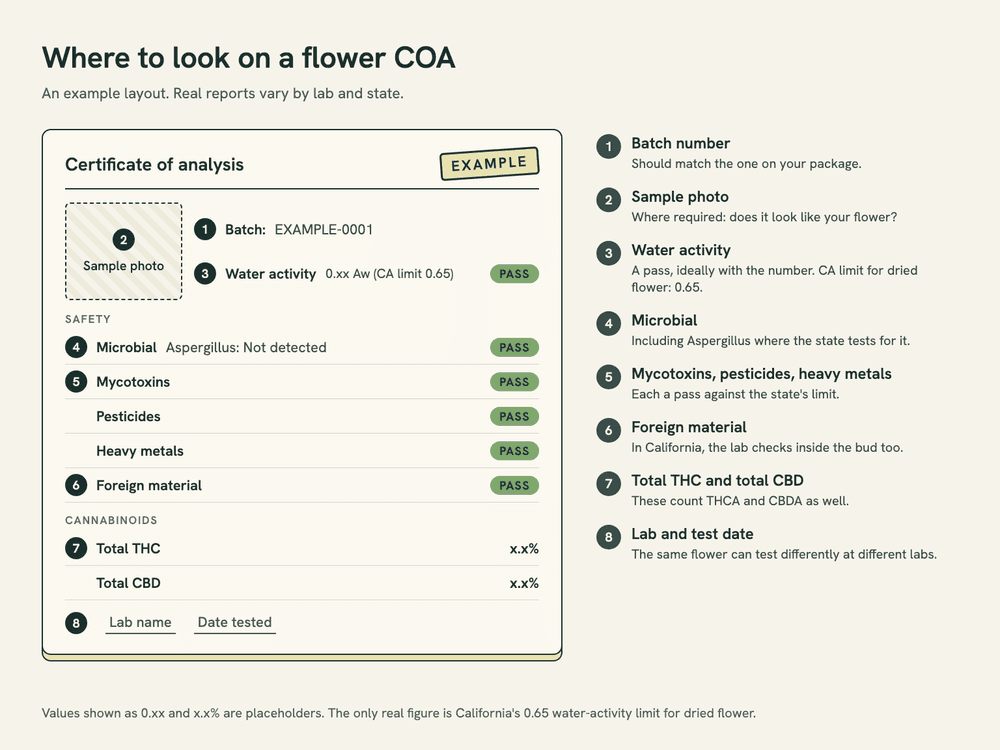
California's regulations on what a certificate must contain add two details worth knowing. The report has to include a photo of the sample and a batch number that matches your package, so you can check that the paper belongs to the jar. And the lab examines dried flower inside and out for foreign material, a visual check that runs alongside the separate microbial test rather than replacing it. Here is what to look for on a flower COA:
- 1Batch number: it should match the one on your package.
- 2Sample photo, where the state requires one: does the flower in the picture look like the flower in your jar?
- 3Water activity: a pass, ideally with the number. California's limit for dried flower is 0.65.
- 4Microbial results, including Aspergillus where the state tests for it.
- 5Mycotoxins, pesticides and heavy metals: each should show a pass against the state's limit.
- 6Foreign material: in California, a pass means the lab examined the inside of the bud as well as the outside.
- 7Total THC and total CBD, which count the acid forms (THCA, CBDA) as well as the neutral ones.
- 8The testing lab and the test date, since the same flower can test differently at different labs.
Two practical notes. A home potency kit tells you about cannabinoids, not about mold, pesticides or metals; our roundup of what home CBD test kits can and cannot measure explains the gap. And if COAs are new to you, our five-minute walkthrough of reading a certificate of analysis shows where each of these results sits on the page. Planntz does not sell flower, but we publish the same kind of document for our tinctures: every batch has a third-party report on our lab results page.
Hemp and CBD flower: same rules, one blind spot
Hemp and marijuana are the same species, and every visual rule above applies to both: mold, damp and seeds mean the same thing in a jar of CBD flower. What no rule can do is tell them apart. An Oregon State team that profiled 91 flower samples found that THC-type and CBD-type flower largely overlapped in smell (the work was industry-funded), and nothing visible separates them either. Whether a flower counts as hemp is decided by its measured THC, and only a lab result shows that. The same number decides whether a given CBD flower is legal where you are; our guide to the legal status of CBD flower covers where that line sits.
What nobody has measured yet
Being clear about the gaps is part of the checklist. These are the places where the evidence runs out:
- Bud density and structure: we found no study that measured whether denser buds carry more cannabinoids (PubMed search, October 2, 2026).
- The snap test, the bounce test and humidity-pack ranges: widely repeated, and we found no study testing them against quality.
- Hair color on dried flower: the 25-genotype study used living plants at harvest at one research site.
- Seeds in retail flower: the pollination study used two varieties in growth chambers and reported its results in figures, not as a single percentage.
- Smell and potency: the main consumer test was one study of 61 people and 11 strains.
- Trichome color and potency: the clear, cloudy and amber charts have no study behind them that measured cannabinoids against color.
Frequently asked questions
Check for stop signs first: mold, a damp or spongy feel, or a musty smell mean you should not use it. Then look for intact frost and no seeds, the two visual cues with chemistry behind them. After that, read the batch lab result for water activity, microbial and contaminant panels, and total THC. Color, density and smell strength are mostly preference.
Trichomes are glassy, round heads on tiny stalks that stand up from the plant and sparkle. Mold looks like grey or white fuzz, fine webbing, or grey to black patches lying over the surface, often with a musty smell. Break a dense bud open, since mold can sit inside. A clean look does not rule out fungi you cannot see.
A few seeds are not a safety problem, but they mean the flowers were pollinated. In a 2021 plant study, pollination substantially lowered the concentration of nearly every cannabinoid. Washington fails licensed flower with more than 2% seeds or other foreign matter.
Light green through deep green, often with purple, are all normal. Purple is an anthocyanin pigment that responds to cold; in a 2025 trial on one purple hemp line, CBD content followed plant maturity, not the purple. The colors that matter are grey or white fuzz and black spots.
A little tackiness when you break a bud is resin, and that is normal. Flower that feels wet, spongy or squishy is holding too much moisture, and moisture is what lets mold grow. California will not allow dried flower to be sold above a water activity of 0.65.
No. In a Colorado study, 61 buyers' smell-based potency ratings did not match the THC that was measured, and THC itself has no smell. Smell can tell you about freshness and about the flower's aroma family, which tracks its terpenes.
Not reliably. Label THC can differ by several points depending on the lab that tested it, and regular users given 16% or 24% flower showed no measurable difference by potency. Mid is retail slang for middle-grade flower and has no regulated definition, so judge it with the same checklist and its lab result.
The short version: check for stop signs, look for seeds and intact frost, treat the rest as taste, and let the lab result have the last word. If you want to get fluent in that last step, start with our guide to reading a certificate of analysis.
Writing about hemp, wellness and the small rituals that keep us balanced.