CBD Test Kits: What a Color Change Can and Cannot Tell You
A home CBD test kit answers a smaller question than the box implies. Here is what color tests, TLC kits and handheld testers can resolve, the published limits sellers do not cite, and the questions only a lab can answer.
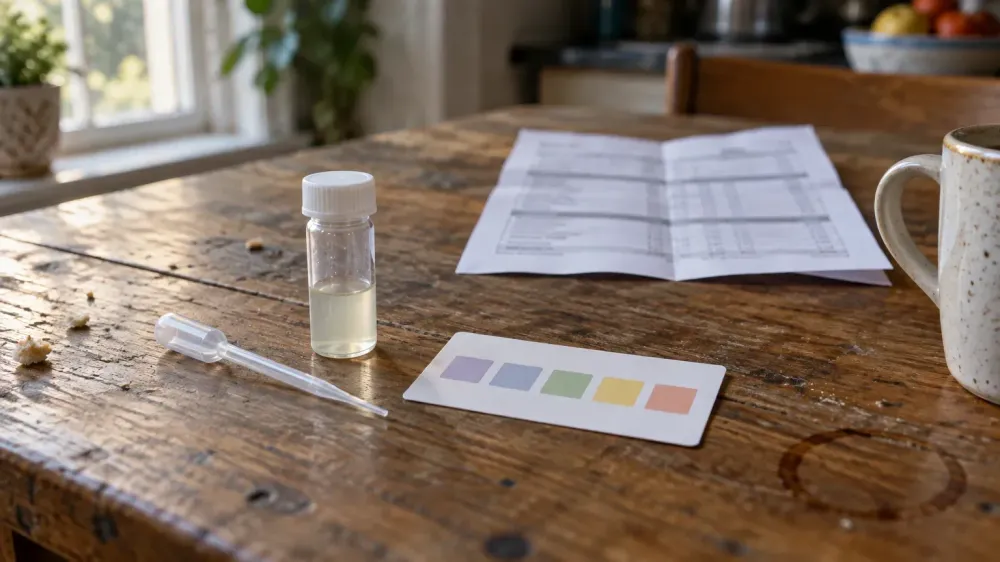
A CBD test kit answers a smaller question than the box implies. Most kits can tell you something about the ratio of THC to CBD, or which cannabinoids show up on a plate. None of them can tell you whether a product is under 0.3% THC, whether it is free of contaminants, or how you would do on a drug test. The forensic chemists who study these tests have published exactly where they stop, and none of the kit sellers we read cites that work.
Here is the short answer. The best-studied color test, the 4-aminophenol test, can sort cannabis plant material into CBD-rich or THC-rich. Its own validation calls the result inconclusive when THC and CBD are within a factor of three of each other, and that validation was done on plant material, not oils. A thin-layer chromatography kit shows which cannabinoids are present, not how many milligrams. A handheld tester reports a number inside the range its maker prints, and on September 13, 2026 we found no peer-reviewed validation study for the three consumer kits we looked at. For a THC percentage, a milligram total or a contaminant panel, you need an accredited lab, and often that lab report already exists for the batch you are holding. If you are still deciding what to buy, our guide to choosing a CBD oil covers the rest of that decision.
Four questions, four tools
Every kit on sale answers one of four questions, and the trouble starts when a box answers one and implies another. Before you look at any product, work out which question you actually have. The table maps each question to the tool built for it, the limit that published research or the seller's own page puts on it, and what that tool cannot tell you.
| Your question | Tool | What it reports | Published limit | What it cannot tell you |
|---|---|---|---|---|
| Is this CBD-rich or THC-rich? | Color test (4-aminophenol, or 4-AP) | Pink or blue: a THC-to-CBD ratio | Inconclusive when THC and CBD are within a factor of three; validated on plant material (2021) | How many milligrams of THC; how it behaves on oils, gummies or tablets |
| Which cannabinoids are present? | Thin-layer chromatography (TLC) kit | Spots on a plate compared with a reference chart | Spot color naming is subjective and not reproducible (2021) | A milligram figure or a percentage you can hold against a limit |
| Roughly how much CBD or THC? | Handheld potency tester | A mg/mL or % reading inside the range the seller prints | No peer-reviewed validation found for tCheck, Plantchek or Alpha-Cat in a PubMed search on September 13, 2026 | Whether a reading outside the printed range means anything; contaminants |
| Is it under 0.3% THC, and free of contaminants? | Accredited laboratory | Total delta-9 THC with measurement uncertainty; contaminant panels | Labs can disagree with each other, and a lab only covers the tests in its scope | Nothing on this list answers this question better |
Notice where the fourth row lands. The questions most people buy a kit for, whether a product is under a legal THC limit, whether it is clean, whether it will show up on a drug test, are the ones no consumer tool here was built or validated to answer. That does not make the first three rows useless. It means you should know which row you are in before you trust a result.
Color tests: what pink and blue actually mean
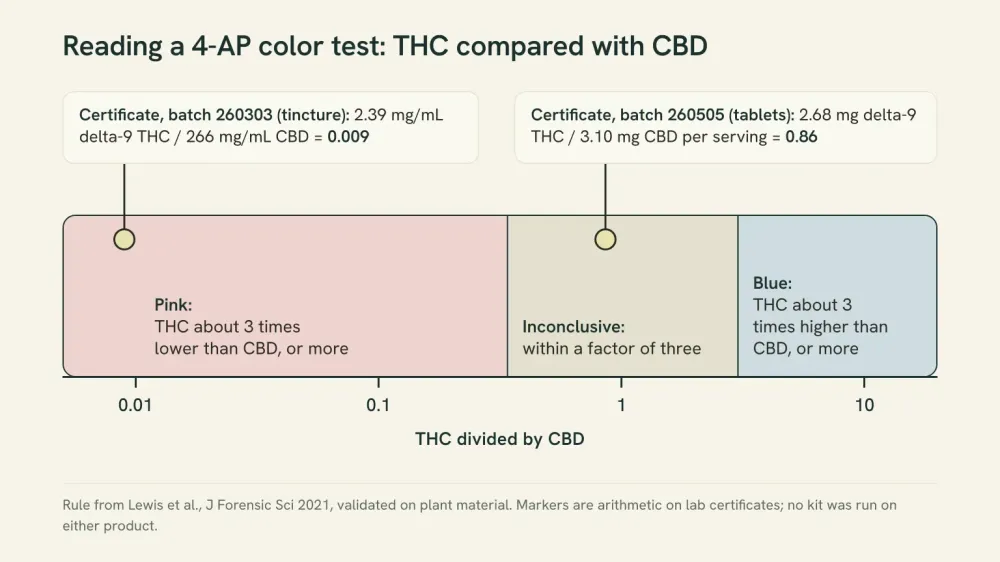
The most studied color test for cannabis uses a reagent called 4-aminophenol, or 4-AP. A small amount of sample goes in with the reagent, and the color that develops points toward THC or toward CBD. A 2021 validation of the 4-AP test in the Journal of Forensic Sciences, by a team that included the DEA's Special Testing and Research Laboratory, Virginia's state forensic lab and Virginia Commonwealth University, set out what the colors mean. The test turned pink when THC was approximately three times lower than CBD, the profile of hemp-type material, and blue when THC was approximately three times higher, the profile of marijuana-type material. Between those, in the authors' words, "Inconclusive results are observed when the levels of THC and CBD are within a factor of three from each other, demonstrating the limitations of the test under those scenarios."
Two more details in that paper matter if you are holding a kit. First, the authors describe color tests as a way to "presumptively identify materials prior to submission to a laboratory for analysis". A presumptive test is a screen that tells an analyst what to send for confirmation. It is not the confirmation. Second, the materials tested were cannabinoid reference standards, household herbs, previously characterized cannabis plant samples and real case samples. We found no oil, tincture, gummy or tablet in the published validation record.
Later work filled in more of the picture. A 2023 re-examination of the 4-AP chemistry from Florida International University, run on cannabis plant samples, and a 2025 paper from Japan's National Research Institute of Police Science add these limits:
- The color does not wait. The original recipe gives a brief window of 5 to 10 minutes before the color turns black. The 2023 team stretched that to about 2 hours with an adjusted recipe in the lab.
- Kitchen herbs can fool it. In the 2023 study, thyme and oregano produced a false blue, the color that is supposed to mean THC.
- Specificity is the weak point. The 2025 authors wrote that existing on-site tests, including 4-AP and the rapid Duquenois-Levine reagent, "have insufficient specificity" for telling delta-9 THC apart from other cannabinoids.
- Their new reagent turned bluish only when delta-9 THC was at least 0.14%, across 58 dried cannabis samples. It is a research reagent, and two of its authors hold a pending patent on it.
- Every result in this section comes from plant material. None of these papers validated a color test on a CBD oil, gummy or tablet.
A cheaper version of the same chemistry points the same way. Researchers in Valencia built a paper-based device that costs about ten euro cents and uses 4-AP to sort plant samples: pink below a THC-to-CBD ratio of 0.3, blue above 3, and, as the authors put it, "any other color is inconclusive". Its results matched GC-MS, a laboratory reference method, after each plant sample was extracted in methanol and diluted fortyfold. That is laboratory sample preparation, which is worth remembering before you read a result off a vial at home.
Two of our own certificates, run through that rule
A rule about ratios is easiest to understand on real numbers, so we took the 2021 paper's ratio rule and applied it to the figures printed on two Planntz certificates of analysis. Be clear about what this is: arithmetic on lab results. We did not run a kit on either product, and as the section above explains, no published validation covers oils or tablets.
Start with the tincture. On the certificate for our Full Spectrum CBD Tincture, Natural, batch 260303, CBD reads 266 mg/mL (28.1% by weight) and delta-9 THC reads 2.39 mg/mL, with a batch result of Pass. CBD is about 111 times delta-9 THC, which puts these certificate numbers far on the pink, CBD-rich side of the paper's rule. The same certificate prints 143 mg of total THC across the bottle. A pink result would describe the ratio correctly and say nothing at all about that milligram figure. Pink describes a ratio, not an amount. A percentage and a milligram total answer different questions too, which our explainer on hemp-derived THC takes apart. This product is currently sold out; we use its certificate here only because its numbers make the point clearly.
Now the tablet. Our Full Spectrum CBD + Delta-9 Tablets are labeled 2.5 mg CBD and 2.5 mg delta-9 THC, and the certificate for batch 260505 measured 3.10 mg CBD and 2.68 mg delta-9 THC per 0.92 g serving. Delta-9 THC divided by CBD comes to 0.86. The two are nowhere near a factor of three apart, so these certificate numbers sit squarely inside the zone the 2021 validation calls inconclusive. Even setting aside that no color test was validated on tablets, the paper's own rule says a color could not settle a ratio this close, on a product that contains delta-9 THC by design. Our row-by-row reading of the tablet certificate covers what else that document does and does not report.
TLC kits: which cannabinoids, not how many milligrams
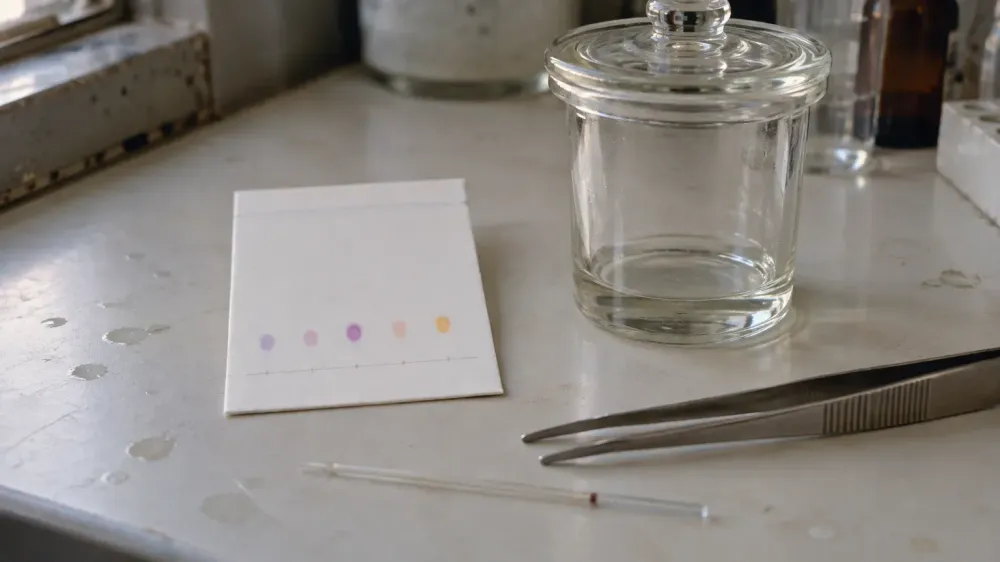
Thin-layer chromatography, or TLC, is the next step up. You dissolve a sample, spot it onto a coated plate and let a solvent climb the plate. Different cannabinoids travel different distances, a stain makes the spots visible, and you end up with a pattern of colored dots to compare against a reference chart. Alpha-Cat, one of the kits sold for this, describes its purpose on its own site (read September 13, 2026) as a way to "identify and estimate the relative strength of the major cannabinoids", and suggests it for "checking extracts before using a full laboratory test". That is a fair description of what TLC does: it shows which cannabinoids are there, and roughly which spot is bigger.
The weak link is your eye. Forensic chemists at a Brazilian public university, the Universidade Federal de São João del-Rei, compared TLC conditions for CBD, delta-9 THC, CBN and CBG in 2021. They got the best separation with a hexane and ethyl ether mix (8:2) and the clearest spots with a stain called Fast Blue RR, and they still wrote that "the designation of the colors observed can be inaccurate and not reproducible", which is why they turned to software to name the colors. Two people can look at the same plate and describe it differently. That study did not validate TLC as a way to measure amounts.
Turning spots into milligrams is possible, but it takes an instrument. A 2026 study in the Journal of Cannabis Research validated high-performance thin-layer chromatography (HPTLC), a laboratory version of the same idea run on a dedicated instrument and validated to ICH Q2(R1), the international guideline for analytical methods. The method was precise, with a coefficient of variation under 2% and recovery of 99% to 102%. The authors then ran it on commercial CBD products bought in Costa Rica in early 2023. Here is what it found in the five oils, one row per bottle:
| Oil sample | Measured CBD, % of label | Within 90% to 110% of label? |
|---|---|---|
| Sample 1 | 139.2% (12.25 mg/mL measured, 8.8 mg/mL labeled) | No, above |
| Sample 2 | 88.6% | No, below |
| Sample 3 | 89.3% | No, below |
| Sample 4 | 102.5% | Yes |
| Sample 5 | 103.4% | Yes |
So 3 of the 5 oils fell outside the 90% to 110% band the authors describe as typically recommended, one of them at 139% of its label. Two cautions keep that in proportion. It is five oils from one country, bought in 2023, so it says nothing about the wider US market, and our guide to spotting fake or mislabeled CBD oil covers that bigger picture. And even this lab method reported THC only tentatively, in certain vape liquids rather than in the oils, by matching where spots landed on the plate; the authors note that definitive confirmation would benefit from mass spectrometry. If a calibrated HPTLC instrument stops at tentative for THC, that is a useful ceiling to keep in mind when you read a spot off a kit plate.
Handheld potency testers: read the spec sheet against a real oil
Handheld testers promise what most people actually want: a number. Without a published comparison to lean on, the fairest way to judge one is to read the maker's own specification against a real certificate. Here is what two sellers print, next to our Full Spectrum CBD Tincture certificate. The seller wording is quoted as a claim, from pages read on September 13, 2026, not as evidence.
| What the page says | tCheck 3 (optical device) | Plantchek CBD (color strip) |
|---|---|---|
| Method, in the seller's words | Calibrated "using 22 oil/cannabinoid combinations at the factory using HPLC certified standards" | "colorimetric strip technology (patent pending)" |
| Range printed | Coconut or MCT oil infusions: 1 to 15 mg/mL | 0 to 24% CBD |
| Tolerance or accuracy printed | Isolate-based infusions: ±2 mg/mL. Flower-based infusions: ±4 mg/mL | "robust, precise and accurate for the intended range", attributed to Chiral Laboratories |
| Published validation cited | None on the page | A named lab's statement, not a published paper |
| Our certificate, batch 260303 | 266 mg/mL CBD: about 18 times the top of the printed range | 28.1% CBD: above the printed range |
Undiluted, that oil sits about 18 times above the top of one device's printed oil range (266 divided by 15 is 17.7), and above the other's CBD ceiling. We have not tested whether diluting a sample brings it into range, and we are not assessing either device's accuracy. The point is simpler: a high-potency oil can fall well outside the range a tester was set up for, and the spec sheet vouches for nothing beyond that range. Check the printed range against the concentration on your label before you trust any number.
Then look for a validation. On September 13, 2026 we searched PubMed, the National Library of Medicine's index of biomedical research, for all three brands named on this page. A search for tCheck returned three records, all unrelated (health insurance, a zoster vaccine and pigeon genetics). Plantchek returned none. Alpha-Cat combined with cannabis or cannabinoids returned none, and a broader search for consumer or at-home cannabis potency testers returned none. That is not a verdict that these kits are inaccurate, and the makers may hold data they have not published. It means their accuracy claims had not been checked in the peer-reviewed literature as of that date.
Portable instruments have been studied, and those studies show what it takes. A 2021 study of cannabis flower found a handheld near-infrared (NIR) device predicted THC within about 1.75 percentage points of lab chromatography, but only after a model was trained on lab results, and the mid-cost system outperformed the low-cost one. A 2023 flower study in the journal Sensors reported 83.1% to 100% accuracy for a handheld device at sorting plants by cannabinoid type, against 99.4% to 100% for a benchtop instrument, again with models built from lab reference data.
Oils have been studied too. A 2026 study of medicinal cannabis oils from Brazil and Italy quantified CBD with benchtop and portable infrared instruments, using calibration models built for those oils. The one instrument-specific error we could verify, 0.03%, belongs to the benchtop NIR on Brazilian oils ranging from non-detected to 0.88% CBD, so we print no accuracy figure for the portable device. And a 2026 paper in Talanta from Brazilian forensic chemists described a portable electrochemical method that agreed with GC-MS on 35 seized samples and 7 cannabis products, run with research electrodes in a strong alkaline solution (0.5 mol/L sodium hydroxide). These are research instruments with custom calibration, operated by chemists. None of them is the retail device on a shopping page, and none of their results transfers to one.
The questions only a lab can answer
Some questions have no home version at all, and the biggest is the 0.3% THC figure. Under the USDA's hemp testing guidelines for laboratories, that number is a laboratory measurement: total delta-9 THC, measured post-decarboxylation or by a similarly reliable method, reported on a dry-weight basis, with a measurement of uncertainty that labs "shall calculate and include". Those guidelines are written for hemp crops tested before harvest, not for finished bottles on a shelf. They still show why no color card can answer the question. A kit gives you a color or a reading. The legal figure is a specific calculation with an error bar attached.
Here is what only a lab report gives you:
- Total THC as a number with its measurement uncertainty, which is what a THC limit is written against.
- A milligram total for the whole package, not just a ratio or a spot.
- Contaminant panels: pesticides, heavy metals, microbes and residual solvents. None of the kits discussed on this page is sold for these.
- A result from a named lab you can look up, tied to one batch number.
If terms on a lab report such as ND, LOD and LOQ are new to you, our complete guide to reading a certificate of analysis walks through every panel, and the explainer on CBD extraction methods covers where residual solvents come from. One honest caveat: labs are not perfect either. Accredited labs can hand back different numbers for the same hemp oil, which our guide to what third-party tested really means walks through with interlaboratory data. A lab result is a measurement with uncertainty, not a guarantee. It is still the only measurement on this page designed to answer these questions.
A product test is not a drug test
Search for a THC test kit and you will find product testers and urine tests in the same results. They measure different things. A product test looks at what is in the bottle. A drug test looks at what is in your body. A 2024 systematic review in the Journal of Cannabis Research covered 89 studies published from 2017 to 2023 on portable technologies for detecting THC in biofluids such as saliva, breath, urine and blood. It found that commercial on-site THC sensing is dominated by immunoassay tests, and that "there is a scarcity of published comparative studies evaluating different test kits" in that field too. One of its authors is an employee of Vectura Fertin Pharma, a disclosed conflict of interest. The lesson for you is narrow: a kit result on your oil predicts nothing about a urine or saliva screen. Our guide to CBD and drug tests covers that separate question, including why no product can guarantee a result.
Before you buy a kit: a five-point checklist
If you still want a kit, and for a ratio or presence question it can be a reasonable screen, run these five checks first.
- 1Name your question: ratio, which cannabinoids, roughly how much, or a legal and safety answer. If it is the last one, skip the kit and go to the lab report.
- 2Find the printed working range and check that your product sits inside it. Compare the mg/mL or percentage on your label with the seller's stated range before you buy.
- 3Ask what sample type the method was validated on. The published color-test validations used plant material. An oil, gummy or tablet is a different matrix.
- 4Look for a published comparison with a lab, not just the words calibrated or HPLC standards. A factory calibration is a claim until someone publishes the comparison.
- 5Decide in advance what you will do with an inconclusive or out-of-range result. If the answer is to send it to a lab, you may be able to start there.
How to get a real answer: read the report, or send a sample
The cheapest real answer is often one you already have access to, because many brands publish a certificate for each batch and reading one takes a few minutes. If you want an independent result of your own, here is the route. There is no vendor to recommend and no price to quote, because both vary. One useful fact before you choose: the USDA guidelines above say hemp testing labs are not required to be ISO accredited, although USDA strongly encourages the ISO/IEC 17025 standard. So accreditation is something you check, not something you assume.
- 1Find the batch or lot number on your package. Every step after this depends on it.
- 2Look for the certificate for that exact batch, and check that the batch number, product name and date on it match your package.
- 3If you want your own test, choose a lab accredited to ISO/IEC 17025 whose scope lists the tests you need.
- 4Ask for potency, and name the panels you care about: pesticides, heavy metals, microbes, residual solvents.
- 5Keep an unopened sample and a photo of the batch number, so the result ties back to one product.
- 6When the report arrives, compare like with like: mg/mL with mg/mL, per serving with per serving, percentage with percentage.
Checking a lab's accreditation and scope is a five-minute job, and the step-by-step lab verification in our third-party testing explainer shows you where to look. Once the report is in your hands, read it the same way you would read any brand's certificate.
CBD test kit questions, answered
For a narrow question, yes. The 4-aminophenol color test sorts cannabis plant material into CBD-rich or THC-rich, and its 2021 validation describes it as a presumptive screen before lab analysis. It is inconclusive when THC and CBD are within a factor of three of each other, and it was validated on plant material, not oils. A PubMed search on September 13, 2026 found no peer-reviewed validation study for tCheck, Plantchek or Alpha-Cat, which is not the same as showing they do not work.
A color or TLC kit may point toward THC, but it cannot give you an amount, and even a calibrated lab version of TLC reported THC only tentatively in a 2026 study. A pink result can sit alongside a real milligram figure: one of our oil certificates reads CBD at about 111 times delta-9 THC and still prints 143 mg of total THC across the bottle. Only a lab report gives you milligrams.
No. Under USDA's hemp testing guidelines, 0.3% is a lab measurement: total delta-9 THC after decarboxylation, on a dry-weight basis, reported with its measurement uncertainty. Those guidelines are written for hemp crops, but no color, spot or handheld reading reproduces that calculation.
For the consumer device, you have the seller's own figures: tCheck's page prints a 1 to 15 mg/mL range for coconut or MCT oil infusions, with tolerances of ±2 mg/mL for isolate-based and ±4 mg/mL for flower-based infusions. We found no peer-reviewed comparison as of September 13, 2026. The research handhelds that have been studied needed models trained on lab data; in a 2021 flower study, a handheld NIR device came within about 1.75 percentage points of lab chromatography.
The published color-test validations we found were done on plant material, and none validated a kit on gummies, tablets or other edibles. Edibles add ingredients those papers did not test. For an edible, the batch certificate is the better source, and if you want your own number, an accredited lab can test the product as a finished edible.
No. A product kit looks at what is in the bottle; a drug test looks for THC or what your body makes from it, in your body, using different technology. Research on portable THC detection in saliva, breath, urine and blood is a separate field. Our CBD drug test guide explains why no product can guarantee a result.
Find the batch number, choose a lab accredited to ISO/IEC 17025 whose scope covers the tests you need, ask for potency plus any contaminant panels you care about, and keep an unopened sample tied to that batch number. Before paying, check whether the brand already publishes a certificate for that exact batch.
A kit asks a question. For the product in your hand, the batch certificate is usually the answer. We post the certificate for each batch we sell, so you can read the lab results for the product you are holding and check them with the method on this page.
Writing about hemp, wellness and the small rituals that keep us balanced.