How to Spot Fake CBD Oil: A 60-Second Verification Check
Most fake CBD is not a counterfeit: it is a real bottle whose potency number does not match the lab. In a 2024 analysis, 149 of 202 US products sat more than 10% from their label. Here is the 60-second check, and how to tell a real lab report from an edited PDF.
Spotting fake CBD oil is mostly not about spotting a counterfeit. In four separate laboratory surveys of the US market, the common failure was a real bottle of real oil whose potency number did not match what a laboratory actually measured. That is invisible on a shelf and obvious on a batch report, which is why the check that works takes about a minute and happens before you pay.
The short version: ask for the certificate of analysis for the exact batch in the bottle, check that the batch number on the report matches the batch number on the package, and check that the potency line reconciles with the milligrams on the label. If any of the three fails, you do not have a verified product, whatever the storefront looks like. Everything below is how to run those three checks, how to tell a genuine lab report from an edited PDF, which of the standard warnings are folklore, and what to do if you already bought something you cannot verify.
The 60-second check, before you pay
Run these three in order. They are ranked by how much they tell you per second spent, and if the first one fails you can stop, because the other two have nothing to work with. Everything else in this article is detail underneath these three questions.
- 1Find a certificate of analysis that names a batch. Not a generic "lab tested" badge, not a report for a different flavor, not a page that wants your email first. A report that names no batch describes no bottle.
- 2Match the batch. The batch or lot number printed on the package should appear on the report. If a seller cannot tell you which report belongs to the bottle you are holding, the report is decoration.
- 3Reconcile the potency. The report's total CBD line should land near the milligrams on the label. Near, not identical: two competent labs testing the same oil rarely print the same number.
What "fake CBD oil" actually means: four failures
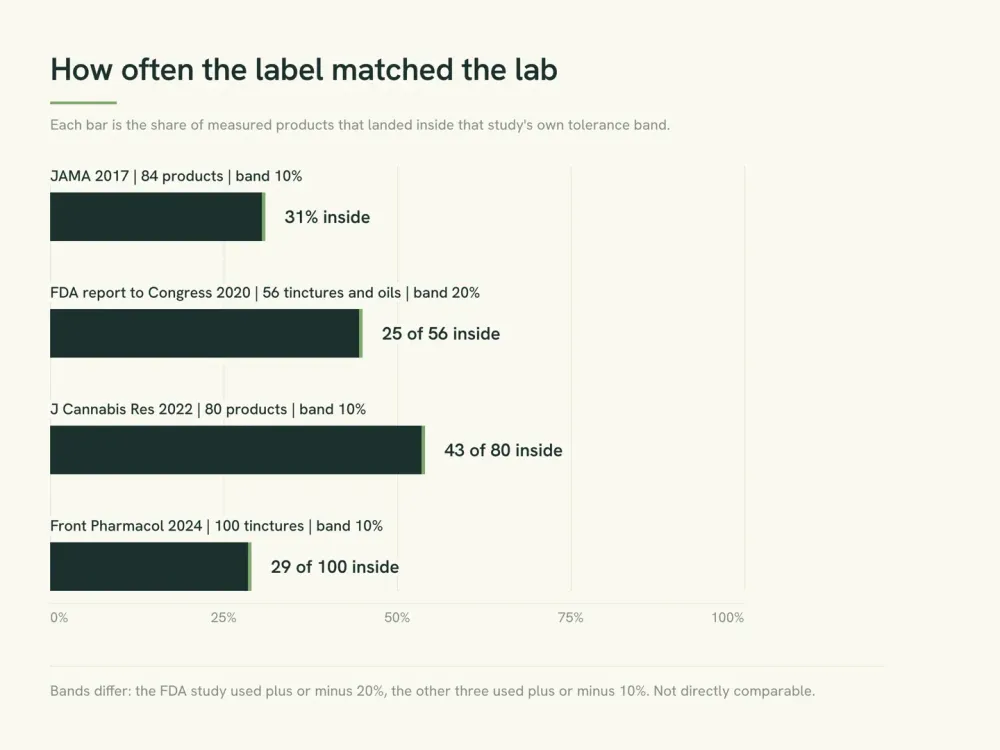
Start with the size of the problem, because almost nobody selling advice on this topic will give you a number. In a 2017 research letter published in JAMA, researchers bought 84 CBD products online from 31 companies and measured them. About 31% were labeled within 10% of what the laboratory found. Roughly 43% contained more CBD than the label claimed and about 26% contained less. THC was detected in 18 of the 84. Oils were the most accurate format in that sample, at 18 of 40. It is a 2017 online snapshot, the market has changed since, and no Planntz batch was in it.
The pattern did not go away. A 2024 analysis in Frontiers in Pharmacology, sponsored by Jazz Pharmaceuticals, which makes the prescription CBD drug Epidiolex, measured 202 US products bought between October and December 2021 and found 149 of them, about 74%, more than 10% away from the label: 93 above 110% of the stated amount and 56 below 90%. Among the 100 tinctures in that set, 53 came in above 110% and 18 below 90%. A 2022 paper in the Journal of Cannabis Research measured 80 products available to residents of central Kentucky and found 37 at least 10% off the labeled concentration, with 43 inside that band.
The FDA has run the same exercise on itself. Its July 2020 report to Congress, the "Sampling Study of the Current Cannabidiol Marketplace to Determine the Extent That Products are Mislabeled or Adulterated", completed cannabinoid testing on 147 products. Of the 82 tinctures and oils, 56 stated a CBD amount; 25 of those landed within 20% of it and 25 came in above 120%. Two caveats travel with that, and the agency supplies the first one itself: "these preliminary data are from a limited sample size and cannot be used to draw conclusions about the marketplace". The second is that its tolerance band is 20%, wider than the 10% band the three peer-reviewed surveys used, so these four datasets sit side by side rather than averaging into one figure.
The far end of the distribution is documented too, in the analytical tables the agency attaches to its warning letters for cannabis-derived products. Re-read on August 8, 2026, those tables include a one-ounce tincture labeled 200 mg of CBD whose laboratory result was 0.0029% CBD, a second one-ounce product labeled 200 mg of cannabinoids with nothing detected above 0.1%, several 2015 samples recorded as negative for cannabinoids altogether, and a product sold as 25.2% CBD that measured hundredths of a milligram per gram of CBD against more than ten milligrams per gram of delta-9 THC. Those samples are roughly a decade old and came from firms the agency was already investigating, so they describe the tail of the market rather than a rate.
The agency's own consumer guidance on cannabis-derived products states the same thing in one line: it has tested the cannabinoid content of some CBD products and "many were found to not contain the levels of CBD they claimed". Read the neighboring sentence carefully, because it is routinely overstated elsewhere: on contaminants the FDA says it is investigating reports of CBD potentially containing unsafe levels of contaminants. That is an open investigation, not a finding, and the tested-and-found language above it applies to CBD levels only.
All of those numbers describe one failure out of four. Here are all four, ranked by how much they cost you.
| Failure | What it looks like | What the evidence says | What it costs you |
|---|---|---|---|
| 1. Potency that does not match | The bottle says 1,500 mg and the laboratory says something else, or there is no laboratory at all | The most common failure in every survey above: 149 of 202 products in 2024, 37 of 80 in 2022, and about 69% of 84 products in 2017 | Money, and a dose you cannot reproduce or adjust |
| 2. Identity swap | "Hemp oil", "hemp extract" or "hemp seed oil" on the front, with no milligrams of CBD anywhere on the package | Hemp seed oil is pressed from seed and is a different product; the front label alone does not tell you there is any CBD in the bottle | You paid for a cannabinoid you never bought |
| 3. Undisclosed THC | A broad-spectrum or THC-free claim with no delta-9 THC line on a batch report | THC was detected in 18 of 84 products in 2017; in the 2024 set, 3 products sold as broad spectrum contained THC and 2 of those were above 0.3% | A drug-test risk nobody disclosed to you |
| 4. Adulteration or counterfeit | No manufacturer, no ingredient list, no batch number, often sold through informal channels | Rare and documented: in Utah in 2017-2018, nine samples of a product sold as CBD contained a synthetic cannabinoid and no CBD | A real health risk, and the reason to keep the bottle |
Two of those rows have longer answers elsewhere. On row two, hemp seed oil is a different product entirely, pressed from the seed rather than extracted from the flower, and the wording that hides the difference is worth learning on its own. On row three, if a trace THC figure on a report is what worries you, how trace THC interacts with a drug test is a longer question than any label can answer.
Red flags on the listing and the label
None of these is proof on its own. Each is a reason to ask for the batch report before you pay, and together they are a pattern. Read them as questions, not verdicts.
- A disease claim. Copy saying a product treats, cures or prevents anything is the loudest signal on this list, because it is the exact basis on which the FDA calls a product an unapproved new drug.
- No batch or lot number anywhere on the package. Without one, no laboratory report can be tied to the bottle in your hand, however impressive the report looks.
- No manufacturer name or physical address. In the Utah poisoning cases, eight of the nine samples tested listed no manufacturer and no ingredients at all.
- "Hemp oil" or "hemp extract" on the front with no milligrams of CBD anywhere on the package. That wording is entirely compatible with a bottle containing no CBD.
- Milligram totals that do not reconcile. Bottle size times concentration should land on the stated total; when those three numbers disagree, at least one of them is decoration.
- No instructions for use and no serving size. A product sold for ingestion that never says how much to take has skipped the part that makes a label a label.
On the fifth flag, the milligram math is worked through step by step in its own guide, including the two places the arithmetic usually goes wrong. On the first flag, disease claims are neither rare nor unmeasured. In a 2022 audit published in the Journal of Pain Research, researchers sampled CBD retailer websites across the ten most populous cities in North Carolina: 39.4% of the retailer websites analyzed carried general medical claims, 35.7% carried health claims, and only 7.1% displayed any safety or health warning. That is one state in 2022, but the pattern travels. A 2023 mapping of the Hungarian online market looked at 16 online CBD stores, found 10 of them (62.5%) presenting health benefits indirectly, collected 30 different purported indications, and reported that 3 of the 12 products the researchers test-purchased in December 2020 arrived with no instructions for use.
Regulators treat this as the primary offense rather than a marketing quirk. In December 2020 the FTC announced enforcement actions against six CBD marketers over unsupported claims that their products treat serious diseases, cancer and Alzheimer's disease among them. The FDA's published list of warning letters for cannabis-derived products, linked earlier, carries per-year tables for every year from 2015 through 2025 and held 130 firm entries when we counted it on August 2, 2026. The legal theory in those letters is almost always the same sentence:
“...intended for use in the diagnosis, cure, mitigation, treatment, or prevention of disease.”
That phrase is doing the work, and it is not the agency's invention. The statutory definition of a drug at 21 U.S.C. 321(g)(1) covers "articles intended for use in the diagnosis, cure, mitigation, treatment, or prevention of disease in man or other animals", which is why the same sentence recurs letter after letter. Under that reading, a seller who tells you what a product does for a disease has told you it is a drug, which makes it an unapproved new drug under section 505(a) of the Food, Drug, and Cosmetic Act, and the letter gives the firm fifteen working days to respond. So a bold medical claim on a product page is not evidence that the product is strong. It is evidence that nobody is checking the copy, and a seller who does not check the copy is unlikely to be checking the batch.
Red flags on the certificate of analysis itself
This is the section the buying guides skip, and it is the one that decides the outcome, because "look for a COA" stops being useful the moment you notice that a COA is a PDF. This page is about whether the document can be trusted at all. If what you want is the panel-by-panel reading of potency, terpenes, pesticides, solvents and microbials, how to read each panel of a lab report covers that in full. Here are the seven things that make a report unusable regardless of what its panels say.
- 1No batch number, or a batch that does not match the package. Nothing else on the report can compensate, because a report tied to no bottle is a brochure.
- 2No report date, or a date long before your purchase. One report reused across years of production tells you about one day of production.
- 3No laboratory name, address or accreditation number. A report that will not say who wrote it cannot be checked by anybody, including you.
- 4A report that exists only on the seller's own server, with no route back to the laboratory: no QR code to a lab-hosted page, no sample ID you could quote to the lab.
- 5A potency-only panel presented as full testing. Cannabinoids, heavy metals, pesticides, residual solvents and microbials are separate tests, and a report can honestly cover just one of them.
- 6Results with no limit of quantification and no measurement uncertainty. "Non-detected" means nothing until you know what the instrument could have detected.
- 7An accreditation symbol used as a product seal, on packaging or in an ad. Accreditation belongs to the laboratory, not to the bottle, and the international policy says so in as many words.
Check five is not theoretical. The same 2024 analysis that measured potency also ran metals: heavy metals were detected 52 times across 44 of the 202 products, and 5 products (about 3%) came in above regulatory limits. A potency-only report is silent about all of that, and it is silent in a way that looks like a clean bill of health.
Some of this is already law somewhere. Florida statute 581.217, as it reads in 2025, requires hemp extract sold in the state to have a certificate of analysis from an independent testing laboratory, and a container bearing a scannable barcode or QR code linked to the certificate of analysis for that batch, the batch number, the website where batch information can be obtained, an expiration date, and the milligrams of each marketed cannabinoid per serving. The same section requires that certificate to state that the batch was tested, that total delta-9 THC did not exceed 0.3%, and that the batch has no contaminants unsafe for human consumption. That is one state and state hemp rules change quickly, but it is a useful picture of what a fully documented package looks like when somebody writes it down.
Checks six and seven come from a real rulebook too. ILAC-P8, the international policy on the use of accreditation symbols, in its November 2023 edition, requires accreditation bodies to have a policy under which any result in an endorsed report that falls outside the laboratory's scope of accreditation is "clearly identified by a disclaimer"; the policy's own example wording is "The conformity assessment activities marked * are not covered by the scope of accreditation." The same document says an accreditation symbol or claim is not to be "affixed to an item or product", or used to imply that an item or product has been certified. That rulebook binds accreditation bodies and the laboratories they accredit rather than the brands that quote them, which is exactly the point: a report that quietly mixes accredited and non-accredited results, or a brand that stamps a laboratory's accreditation mark on its packaging as though it were a seal of approval, sits outside what the laboratory's own policy permits. The constraint applies to us as much as to anyone: a laboratory's accreditation is the laboratory's, not our bottle's, and no brand becomes accredited or approved by publishing a report.
Why the laboratory, not the PDF, is the real check
Forged paperwork is a documented phenomenon rather than a hypothetical one, and the evidence comes from the accreditation bodies themselves. A2LA, one of the larger US accreditation bodies, publishes a public list of organizations making false claims of its accreditation. Read on August 8, 2026, it carried six entries. One organization, added on March 28, 2025, obtained its claim "by fraudulently modifying another A2LA-accredited organization's certificate". Another, added on October 30, 2025, is a supplement seller whose promoted test report "includes the A2LA accreditation symbol without authorization". None of the listed organizations is a CBD brand, and the list covers only A2LA, so it is not a market rate. The useful lesson is narrower than a scare: certificates get copied and symbols get borrowed, so the thing to check is the directory, not the document.
- The laboratory's name, searched in an accreditation body's public directory rather than read off the report. A forged report cannot forge the directory entry it points at.
- A route to the report that does not pass through the seller: a link on the laboratory's own domain, a QR code that resolves to the lab, or a sample ID the lab can confirm.
- A direct question. Laboratories answer "did you issue report X for sample Y", and a seller who reacts badly to you asking has answered a different question.
The free searches are A2LA's directory of accredited organizations, Perry Johnson Laboratory Accreditation's search, and the ILAC signatory list, which tells you whether the accreditation body named on a certificate is internationally recognized at all. ANAB runs another large US program with its own search; it did not answer our automated request on August 8, 2026, so look it up directly if the laboratory you are checking is missing from the first three. A laboratory accredited by one body may be absent from another body's list, so check more than one before you conclude anything from an empty result.
One thing accreditation does not mean: independence. NIST's own laboratory accreditation program states that its services are open to commercial laboratories, manufacturers' in-house laboratories, university laboratories and government laboratories alike. Accreditation certifies technical competence at named methods; it says nothing about who owns the lab or who paid for the test. That distinction is worth the five minutes it takes to understand, and what third-party testing actually guarantees works through it properly, including how to read a scope of accreditation.
Four red flags that are not red flags
Some of the standard advice on this topic is folk heuristic that has never been checked against anything. Following it will make you reject good products and accept bad ones, which is worse than having no rule at all.
| The rule you have heard | What is actually true |
|---|---|
| A high milligram number (2,000 mg, 15,000 mg) means it is fake | It is arithmetic. A 60 mL bottle at 250 mg/mL is 15,000 mg, and a batch report prints whatever the lab measured. The question is whether a report exists, not whether the number is large. |
| A price that is too good to be true means it is fake | No dataset we found links a low price to an inaccurate label. The 2024 and 2022 surveys recorded no price data at all, and the one study that did compare price looked at the milligrams a label claims, which is a value question rather than an accuracy one. Cost per milligram is a good way to compare bottles and a bad way to judge honesty. |
| Amber glass means real, clear or plastic means fake | Packaging affects light exposure and shelf life, not authenticity. It is a storage question. Nothing about the container tells you whether the potency line is true. |
| Anything on a marketplace or at a gas station is fake | The venue is a weak signal and verifiability is a strong one. The test is identical everywhere: can this seller show you a batch-specific report from a named laboratory you can look up. |
Since the price rule is the one people miss most, here is the replacement: the real cost per milligram is a single division that makes two differently sized bottles comparable, and it answers the question people are really asking when they worry that something is suspiciously cheap.
There is a fifth belief worth retiring, and it is subtler: that a genuine report should match the label exactly. It should not. In the first exercise of NIST's Cannabis Quality Assurance Program, reported in NISTIR 8385, 116 laboratories responded to the call for participants and were sent the same hemp oils. On one of those oils, 31 of the 68 laboratories reporting CBD, about 46%, landed outside NIST's range of tolerance; for delta-9 THC on the same oil it was 37 of 65, about 57%. That exercise was deliberately educational and anonymized, it graded nobody, and "outside the range of tolerance" is a strict metrological criterion rather than a verdict on competence: scored instead against the looser community-consensus range, 9 of those same 68 laboratories fell outside for CBD and 10 of the 65 for delta-9 THC. What it means for you is simple. Two competent laboratories handed the same oil will hand you two different numbers, so a batch report that lands exactly on a round label figure every single time is stranger than one that moves.
Here is what that looks like on a real report. Planntz Broad Spectrum is labeled 250 mg/mL and 15,000 mg of CBD in a 60 mL bottle, and those two label figures reconcile with each other. The mango batch 260320 certificate prints a Total CBD line of 16,300 mg per package, 28.8%, plus or minus 0.285%, and 269 mg/mL, against a header reading Package Size: 56.7 g. The label figure and the batch figure are not the same number, and that is the normal condition of an honest report. What makes a label checkable is not that the two agree exactly; it is that the second number exists, belongs to a named batch, and is published where you can read it. The same report set prints non-detected delta-9 THC on the mango and natural batches and 10.7 mg per package (0.0189%) on lemon batch 260321, which is the kind of inconvenient line a real report carries and a decorative one never does.
What to do if you already bought it
First, the non-alarmist part. The most likely thing that happened is that you bought a product whose potency you cannot confirm, which mostly costs money and makes your own experience unreadable, since you cannot judge a dose you never measured. If you feel unwell, that is a different situation and it comes first, before any of the paperwork below.
- 1If you feel unwell, get care first. Contact a clinician, or your local poison control center for symptoms after taking a product. Everything else on this list can wait.
- 2Stop using it until you can verify it. You cannot sensibly adjust a dose that no laboratory has measured.
- 3Keep the bottle, the batch number and whatever is left inside it. That is the evidence, and it is the first thing most people throw away.
- 4Screenshot the listing, the label claims and any lab report the seller showed you, with the date visible. Product pages get quietly edited.
- 5Ask the seller in writing for the certificate of analysis for that specific batch, from a named laboratory. Keep the reply, and keep the silence if there is no reply.
- 6Report it, and dispute the charge with your payment provider if the product was not what was advertised.
The reporting routes are short and free. The FDA takes consumer reports through its report a problem page, which covers the MedWatch form, the Safety Reporting Portal for human foods, and a list of state Consumer Complaint Coordinators. Deceptive marketing, as opposed to a physical reaction, goes to the FTC at its fraud reporting portal. One framing note so the forms do not confuse you: the FDA does not currently treat CBD as a lawful dietary supplement, so what you are doing is reporting a product and a reaction, not filing a supplement complaint. And why keeping the container matters is not a hypothetical, as a 2018 MMWR report from Utah shows.
The verification checklist
Everything above, compressed into something you can keep open in a tab while you shop. A single miss is a question to ask the seller, not a verdict; three or four misses is a pattern.
| Before you pay | On the certificate of analysis |
|---|---|
| A batch or lot number printed on the package | The same batch or lot number printed on the report |
| A report you can reach without handing over an email address | A report date, and one close to the production run you are buying |
| Milligrams of CBD stated per bottle and per serving | A total CBD line that lands near the label figure, not exactly on it |
| A manufacturer name and a physical address | The laboratory's name, address and accreditation number |
| Instructions for use and a serving size | The tests actually run, named: cannabinoids, heavy metals, pesticides, solvents, microbials |
| No claim that the product treats, cures or prevents a disease | Limits of quantification, so that "non-detected" carries a meaning |
| The spectrum stated: full spectrum, broad spectrum or isolate | A delta-9 THC result consistent with the spectrum claim on the label |
| A price you can convert into a cost per milligram | A route back to the lab: a QR code, a lab-hosted page or a quotable sample ID |
| The laboratory named somewhere, so you can search it | That laboratory present in a public accreditation directory, with a live certificate |
If you are earlier in the process than this and still deciding what to buy, the full buyer's checklist covers spectrum, concentration, carrier oil and price before any of the paperwork comes into it.
What none of this can tell you
A verification routine that oversells itself is the same failure in a different coat, so here are the limits plainly. A clean batch report is one batch, tested on one day, at one laboratory, on a sample that somebody chose and sent. It does not describe the next batch, it does not describe the bottle that sat in a hot car for a week, and it is not a safety verdict. Passing every check on this page means the label is credible. It does not mean the product is right for you, and it says nothing about what CBD does or does not do, which is a separate question with its own evidence and its own limits.
It is also worth knowing how little of this is actually required. Federal hemp rules aim at the field, not the bottle: under 7 CFR part 990, samples are collected within 30 days before the anticipated harvest and, after December 31, 2022, only laboratories registered with the DEA may run that testing. Nothing in that rule covers a finished consumer product. That is the structural reason finished-product testing is voluntary at the federal level, why the quality of brand paperwork varies as wildly as it does, and why a check you can run yourself in sixty seconds is worth learning.
Yes, and the falsification of accreditation paperwork is documented rather than hypothetical. A2LA publishes a public list of organizations making false claims of its accreditation. Read on August 8, 2026, it carried six entries, including one organization that obtained its claim by fraudulently modifying another accredited organization's certificate (added March 2025), and a supplement seller listed for promoting a test report that carried A2LA's accreditation symbol without authorization (added October 2025). Neither is a CBD brand and the list covers only one accreditation body, so it is not a market rate. It is enough to make the point: a PDF is editable, and the checks that survive an edit all leave the file. Search the laboratory in a public directory, reach the report through the laboratory's own domain, or email the lab with the sample ID and ask whether they issued it.
No, and expecting an exact match is its own mistake. NIST sent the same hemp oils to the 116 laboratories that signed up for the first exercise of its Cannabis Quality Assurance Program. On one of those oils, 31 of the 68 laboratories reporting CBD landed outside NIST's range of tolerance, and 37 of 65 did for delta-9 THC. That exercise was educational and anonymized and graded nobody, and scored against the looser community-consensus range the same oil put 9 of those 68 laboratories outside for CBD, so the strict criterion is doing a lot of the work in those first numbers. What you want from a batch report is a figure that is close, plausible, and attached to your batch. A report that hits a round label number exactly, on every batch, is odder than one that varies.
No. It is arithmetic, not a warning sign. A 60 mL bottle at 250 mg/mL holds 15,000 mg, and a batch report simply prints what the laboratory measured. For example, the Planntz Broad Spectrum mango batch 260320 report prints a Total CBD line of 16,300 mg per package against a Package Size header of 56.7 g. The question to ask is never whether the number is big. It is whether a named laboratory measured it, on the batch you are buying, in a document you can open.
It depends entirely on which of the four failures it was. Most mislabeled products are simply the wrong strength, which wastes money and makes your own dosing unreadable, since you cannot adjust an amount nobody measured. Undisclosed THC is a different problem and it can matter for a drug test. The rare and serious case is adulteration: in Utah in 2017 and 2018, 52 people were poisoned by a product sold as CBD that laboratory testing found contained a synthetic cannabinoid and no CBD at all, and about 60% of those cases were seen at an emergency department. If you feel unwell after taking any product, get medical advice first and sort out the paperwork afterwards.
The venue is a weak signal and verifiability is a strong one. We could not verify the widely repeated claim that a particular marketplace bans CBD outright, and it would not settle the question even if it did, because the test is identical everywhere: can this seller show you a batch-specific report from a named laboratory you can look up. Informal channels do carry one extra risk that is visible before you buy. In the Utah cases, eight of the nine samples tested listed no manufacturer and no ingredients, which is a packaging failure you can spot in the shop.
Mislabeled potency is one possible reason among several, and it is the one you can check first and cheapest. Before drawing any conclusion about CBD itself, find the batch report and compare its total CBD line with the label, so that you at least know what you took. Timing, whether you took it with food, how long you held it under the tongue and how long you have been taking it all change the answer too, and each of those has a longer treatment elsewhere on this site. What you should not do is increase the amount you take to compensate for a number you have not verified.
If you want to run this checklist against something concrete, our per-batch lab results are published with the batch number, the laboratory and the report date on each one, including the lines that are less flattering. Run the same checks on us that you would run on anybody else. A verification method that a brand teaches and cannot survive was never a method.
See the report for the batch you would buy
Every Planntz batch has its own certificate of analysis, published with the batch number, the laboratory and the date, and reachable without an email address.
See our lab resultsWriting about hemp, wellness and the small rituals that keep us balanced.