CBD on Amazon, Walmart's Shelf, and the Question No Counter Can Answer
Amazon's policy prohibits CBD listings, with a carve-out almost nobody quotes. Walmart's marketplace bans cannabinoids outright. We quote both documents with the date we read them, count what is actually listed, and give you four questions that work on any seller, including us.
Search Amazon for CBD oil and you get a full page of results, almost none of which are sold as CBD. That is not a glitch and it is not a loophole. CBD on Amazon is prohibited by a rule the company publishes itself, and what you are looking at is that rule working exactly as written. This article quotes the policy from Amazon's own help pages, prints the date of every read, counts what is actually listed on a named day, and then asks the same question of Walmart's shelf and a convenience-store counter. Everything here is dated and checkable, which matters more than usual here, because we sell CBD and you should not simply take our word for any of it.
So here is the conflict, first, in plain words. Planntz sells CBD tinctures direct from its own website. We do not sell on Amazon, we are not stocked by Walmart, and we are not on any convenience-store counter. An article concluding that those three channels cannot hand you a particular document is therefore convenient for us, and you should read it with that in mind. Two things follow from it. Every load-bearing sentence below names the document it came from and links to it, so you can open the thing yourself instead of trusting the summary. And the final section runs the same four questions against us, including the place where our own answer is imperfect. This page does not tell you where to buy. It gives you a test.
Can you buy CBD on Amazon? What the policy actually says
No, not as a CBD product, and the policy says so in a single sentence. The rule lives on Amazon's Drugs and Drug Paraphernalia page in Seller Central. The live page answered when we requested it on August 20, 2026 and returned no policy text at all: about 171 KB of markup containing zero occurrences of the word cannabidiol, because the page is a JavaScript application shell that only assembles itself inside a browser. A response code of 200 from that address is not evidence that anybody read the policy. So we read the archive instead. The most recent capture in which the policy text is machine readable was taken on June 4, 2022, and we reopened it on August 20, 2026. Every Amazon quotation on this page comes from that capture or from one other, and each carries both dates where it appears.
“Listings for products containing cannabidiol (CBD) are prohibited, including but not limited to: Full spectrum hemp oil; Rich hemp oil; Products that have been identified as containing CBD by LegitScript”
Read the last line again, because it is the one doing the interesting work. The policy does not define which products contain CBD. It delegates that determination to LegitScript, a private certification company, and the same capture points sellers at LegitScript's searchable database as a resource for working out whether a supplement includes a prohibited ingredient. LegitScript is not a regulator. Its certification is a commercial service, not a legal status, and a product being uncertified is not a finding about that product. That delegation is also only as good as the words a seller types, and the vocabulary those listings use instead of the word CBD is a problem of its own.
One Amazon policy surface does render to an ordinary read, and it is worth knowing about, because it shows the company treats this category in more than one rulebook. The advertising policy for Stores has a section numbered 5.6 and titled Hemp, which we read live on August 20, 2026. It says that stores for hemp-based products must not be associated with or encourage the consumption of illicit drugs, including the use of marijuana or cannabis imagery, and a locale note adds that consumable hemp products are prohibited in India. That rule is about imagery, not ingredients, and it says nothing at all about CBD. It is here so you can open one first-party page yourself with no archive in the way.
The reason in the policy, and the reason in the statute
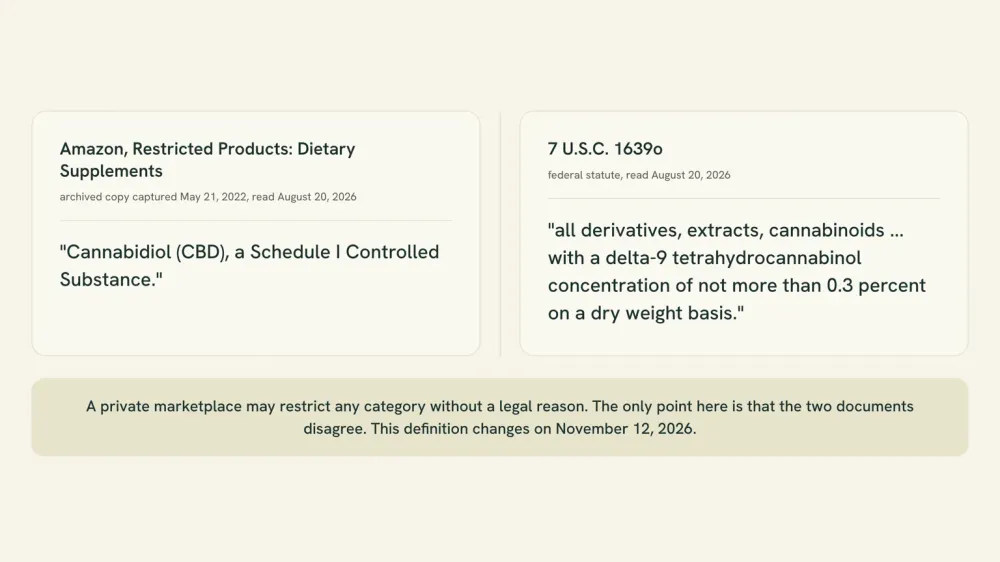
Amazon keeps a separate restricted-products page for dietary supplements, and that is where a stated reason appears. In the copy we could read, captured on May 21, 2022 and reopened by us on August 20, 2026, the page lists what supplements must not contain and writes, in full: "Cannabidiol (CBD), a Schedule I Controlled Substance." The live version of that page serves the same application shell as the drugs page, so we could not read it either, and no update stamp is visible in the capture, which is why none is printed here.
That classification is not the position in federal law. 7 U.S.C. 1639o defines hemp as the plant Cannabis sativa L. and any part of that plant, including its derivatives, extracts and cannabinoids, with a delta-9 tetrahydrocannabinol concentration of not more than 0.3 percent on a dry weight basis, and the Controlled Substances Act's definition of marijuana excludes hemp by reference to it. So hemp-derived cannabidiol inside that limit is not a Schedule I controlled substance. That is the law as it stood on August 20, 2026, and the definition itself is rewritten on November 12, 2026. Our page on where the hemp and marijuana line actually sits carries the statutory detail, the total-THC arithmetic and what changes on that date, and this page does not restate any of it.
The better-documented reason page one skips
There is a second reason the restriction exists, it reaches well beyond any one company, and almost nothing on page one mentions it. Under the FDA's current position, CBD is not a lawful dietary supplement ingredient, and the agency has issued warning letters over CBD products and the claims made for them. That posture, in the agency's own wording and with its limits, is covered in full in our summary of what the FDA actually says about CBD. This page does not re-derive it. What matters here is only that a restriction with a federal paper trail behind it is not one retailer's private idea.
And the paper trail is countable, which is the useful part. The FDA maintains a public list of warning letters for cannabis-derived products, broken out by year. We counted the firm entries in its own per-year tables on August 20, 2026.
Three limits belong next to those three numbers. We counted only the years that sit in a single clean table each: the 2015 and 2016 sections interleave a warning-letter list with an analytical table, so nothing here is counted across them. This is the agency's curated list for one product category, not its full warning-letter database. And the page held no 2026 entries at all when we read it, on a page stamped current as of September 3, 2025, which tells you the page has not been refreshed rather than that no letters issued.
So what are those hemp listings? We counted them
If CBD listings are prohibited, what is filling a whole page of results for a CBD oil search? We went and counted. On August 20, 2026, from a US locale with no account signed in, we fetched the marketplace's search results page for the query "cbd oil" and parsed every product title on the first page. Here is the count. It takes about a minute to repeat and you should.
Forty-nine product titles. The word CBD appeared in none of them. The word cannabidiol appeared in none of them. The word hemp appeared in 47. The exact phrase "hemp seed oil" appeared in 13, and the word "extract" in 16. That is one search, on one day, from one machine, and marketplace results are personalised and change constantly, so treat those numbers as a dated observation rather than a market statistic. What they show is the policy doing precisely what it says it does. Hemp seed oil is pressed from the seed, and getting the difference between seed oil and CBD oil straight is the single most useful thing you can do before reading any of those pages. Hemp extract is a different problem: the term has no fixed definition, which is exactly why it can sit on a label without telling you anything.
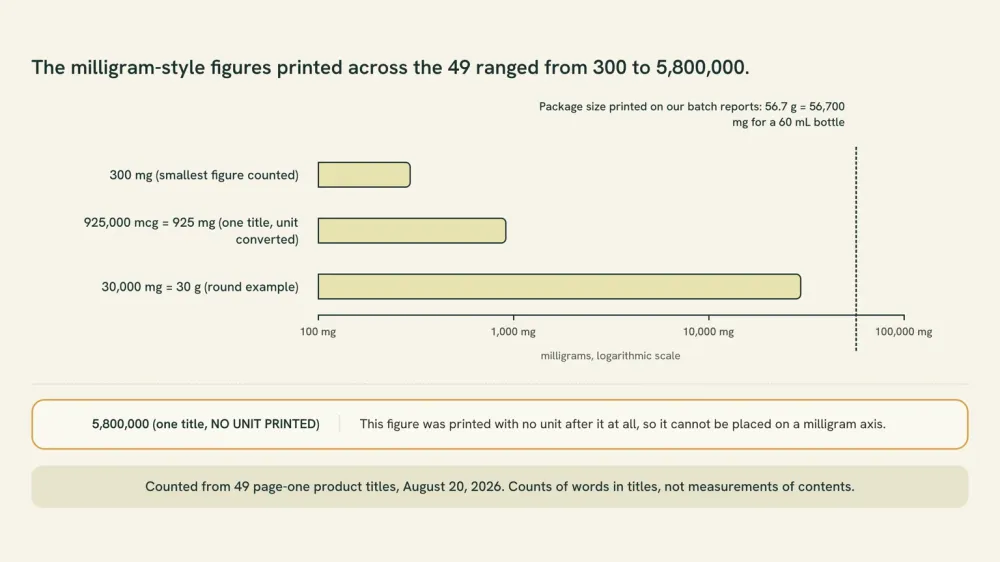
Then there are the numbers on those titles. The milligram-style figures printed across the 49 ranged from 300 to 5,800,000. One title printed a figure of 925,000 mcg, which is 925 mg. One printed 5,800,000 with no unit after it at all, and another printed 1,000,000, also with no unit. Take a round example rather than any particular listing: 30,000 mg is 30 grams. For scale, our own batch reports print a package size of 56.7 g for a 60 mL bottle, and that is the weight of everything in it, oil included. So a figure in the tens of thousands of milligrams is already in the same range as the entire contents of a bottle, and a figure of 5,800,000 would be 5.8 kilograms if it were milligrams at all. A milligram number is not information until you know what it is a figure of, which is most of what reading a CBD label comes down to, and it is why an enormous milligram figure at a very low price is arithmetic rather than a bargain.
| What the number might count | What that would mean | How you would know |
|---|---|---|
| The total weight of what is in the bottle | A figure in the tens of thousands of milligrams for a normal-sized bottle. It says nothing about any cannabinoid. | The page states a net weight or a volume, and the figure is consistent with it. |
| The weight of an extract of unstated composition | The extract could be almost anything, because the word extract names neither a compound nor a concentration. | The page names the plant part and the cannabinoid content of the extract, in mg or in percent. |
| A cannabinoid total | The only version of the number that is about active content. | A batch certificate names the cannabinoid and its amount, and its lot number matches the unit shipped. |
| Nothing stated at all | A figure printed with no unit, or in micrograms, is not comparable to anything until you convert it or ask. | The unit is printed next to the number. If it is not, the number cannot be checked at all. |
Four questions to ask any listing
None of the above is an accusation and it is not meant to become one. It is a reason to have a procedure. These four questions work on any listing, on any marketplace, in any country, and on this website too. Ask them in order and stop at the first one with no answer.
- 1What does the milligram number count, and does the page say so? A good answer names a compound and an amount, for example 15,000 mg of CBD in a 60 mL bottle at 250 mg/mL. A number with no noun attached to it is not an answer.
- 2Is there a batch-specific certificate of analysis for the unit in the box? A good answer is a lab report you can open before you pay, not a generic lab-tested badge and not a certificate belonging to some other batch.
- 3Who ran the test, and are they independent of the seller? A good answer names the laboratory so you can check it on its own terms. A claim on the packaging that testing happened is not the same object as the report.
- 4Does the listing print a lot or batch number you can match to that certificate? A good answer lets you match the number on the bottle in your hand to the number on the report. Without the match, the report describes a different batch.
Question 3 looks obvious and is not, and there is a measurement behind it. A 2025 analysis in Cannabis and Cannabinoid Research bought 97 hemp haircare, cosmetic and food or drink products, 35 of them in retail stores in one metropolitan area in July 2020 and 62 online the month after, and measured them by gas chromatography-mass spectrometry. Of the 71 products that printed a specific total CBD amount, only 9 came back within ten percent of it: 35 held more CBD than the label claimed and 27 held less. Ten of the 97 contained no CBD at all. And here is the finding that makes question 3 worth asking properly: label accuracy did not differ significantly between the products whose labels carried an external-testing claim and those that did not, which the paper reports as a t of 0.23 on 40 degrees of freedom and a p of 0.82. Read that carefully, because it is a statement about a claim printed on packaging, not about certificates. The claim on the box is not the document. A batch report you can read yourself is the document, and what laboratory independence actually means is the other half of it. The limits are real and worth stating: 2020 purchases, one metro area plus online, and small samples within each product category. If you already own a bottle and want to work backwards, our checklist for spotting a fake CBD oil runs the same checks on what is in front of you.
Does Walmart sell CBD?
Not through its marketplace, and the company's own policy says so in one line. Whether the chain stocks any CBD product on a physical shelf is a different question with a much thinner paper trail, and we get to that in a moment. Walmart's Marketplace prohibited-products policy for drugs and drug paraphernalia rendered normally when we read it on August 20, 2026, and the page itself prints "Last updated on Dec 11, 2025" in its own body text, which is why that date appears here and no Amazon date does. In the prohibited column, under a sub-list headed as other prohibited drug or drug-related products, it reads: "Products containing hemp, CBD, THC, and any other cannabinoids."
Two things about the scope of that rule, because both get stretched. It governs third-party sellers on walmart.com, which is not the same thing as what the company chooses to stock itself. And the same list prohibits products containing controlled substances and DEA List I chemicals as a separate bullet, so the cannabinoid line is doing its own work rather than resting on a controlled-substance classification. Notice also that the bullet says hemp, which is broader than CBD. We are not going to stretch that word into a claim about what may or may not sit in an aisle, because a marketplace policy simply does not govern the chain's own shelves.
One primary document does speak to the shelf, and whose document it is turns out to matter. In a news release filed with the SEC on November 14, 2024, a publicly traded hemp company told investors that it had rolled out its CBD topical isolates to more than 800 of that chain's retail locations earlier in 2024, and its chief executive separately described a new partnership bringing the company's CBD topicals to another 827 stores. Those are two statements inside one release and we are not adding them together into a single number. More to the point, they are the supplier's account of its own distribution, in a filing it is legally accountable for. They are not the retailer's policy, they are dated November 2024, and they are about topicals. We are not naming the company here; the link carries the name if you want it.
In practice, most of what sits in the hemp section of a general retailer is hemp seed oil, sold as a food. It is pressed from the seed, it is not a cannabinoid product, and that is the exact confusion the seed oil comparison was written to clear up. A bottle labeled hemp extract with no cannabinoid figure printed anywhere on it is the same vocabulary problem rather than a CBD purchase, and it is the reason so many people arrive at this question convinced that they already bought CBD in a supermarket.
What about gas stations and smoke shops?
Start with what we are not going to say. We are not going to tell you that convenience-store or smoke-shop CBD is fake, counterfeit or dangerous, because we have no evidence for that, and neither does anyone else answering this question on the first page of results. Every informational result we read on that query was published by a company that sells CBD, ourselves included, and the framing is uniformly that the channel is dangerous and you should buy elsewhere. What exists instead of adjectives is measurement, and the measurement does not point where the marketing points.
A 2022 case series in JAMA Network Open bought 105 hemp topical products, 45 of them off physical shelves in pharmacies, grocery stores and cosmetic or beauty stores in one city, and 60 of them online, then measured every one by gas chromatography-mass spectrometry. Of the 89 products that printed a total CBD amount on the label, 21 came back within ten percent of it, 52 held more CBD than the label claimed and 16 held less. THC turned up in 37 of the 105, all of it below 0.3 percent, and four of those 37 were labeled THC free. Now notice which way the comparison runs, because it is the opposite of the story the channel usually gets: the median deviation from the label was 21 percent for the in-store products against 10 percent for the online ones, and the deviation ran mostly in the direction of more CBD, not less. The limits matter. The paper names no retailer anywhere in it, so it cannot be attached to one, and the stores were in a single city. The work was supported by the Substance Abuse and Mental Health Services Administration, and the authors state that the funder had no role in the design and conduct of the study, in the collection, management, analysis and interpretation of the data, in the preparation, review or approval of the manuscript, or in the decision to submit it for publication. Several of the authors declare paid consulting relationships with cannabis companies.
The online half of the market has been measured too, and it is not clean either. A 2017 analysis in JAMA bought 84 CBD products online from 31 companies and found 26 of them within ten percent of their labeled CBD, 36 holding more than the label claimed and 22 holding less, with THC detected in 18 of the 84. That is a 2017 sample of products bought online, not a statement about anything on sale today, and no Planntz batch was in it. It is here because the honest reading of the three analyses side by side is that a label problem is a label problem. It is not a channel problem, and anybody selling you a channel is selling you something.
The FDA has published its own laboratory results alongside enforcement, and one row on that page is worth naming exactly rather than summarising. In the 2015 warning-letter and analytical tables, a capsule product whose label claimed 500 mg of CBD across ten capsules has a result column that reads, in full, negative for cannabinoids. Three limits belong in the same breath as that sentence. It is a single row from 2015, roughly a decade old now. The firm was already an enforcement target when the agency bought the product, so this is not a random draw from the market and the row is not a prevalence rate. And the sample counts in those tables are tiny. It is a warning about what a printed label can be worth, not a measurement of anything currently on a shelf, and we are not naming the firm.
So what is actually different at a counter? Not fraud, and not the channel. It is a missing document. On a marketplace listing you can at least go looking for a certificate of analysis, and the absence of one is itself a piece of information you can act on. At a physical counter, nobody standing there can produce a batch certificate whose lot number matches the box in your hand, and there is no listing page to check it on either. That is a structural fact about the transaction rather than a judgement about the person selling to you, and it is why the same four questions get harder in a shop, not why you should assume the worst about one.
- 1Read the package for a compound and an amount, not a strength word. If the front says maximum strength and nothing anywhere on it names a cannabinoid in milligrams, you cannot tell what you are being sold.
- 2Look for a batch or lot number on the unit itself, then for a route to the report for that number: a QR code, a printed URL, a batch lookup. A brand name on its own will not get you there.
- 3Ask whether anyone can show you the certificate for that specific lot. It is a fair question and the answer is informative either way. Most counters cannot, and that is the structural point rather than a criticism of anyone.
- 4If you cannot match a lot number to a report, treat the milligram number on the front as a marketing figure rather than a measurement, and decide what the product is worth to you on that basis.
Those are the same four questions from the listing section, applied to a shelf. Each one has its own detail elsewhere: how to read a certificate line by line covers what a real report contains, and the red flags that separate a document from a badge covers what to do when it does not.
Now apply all of that to us
Before the test comes back around, here is what marketplace and in-store buying genuinely give you, and it is not nothing. A large marketplace gives you a returns process, a dispute-resolution system run by a company big enough that complaining to it is worth your time, and delivery in a day or two. A physical store lets you pick the box up, read the panel, put it back, and walk out with it; it gives you a receipt and a counter you can return to with a human being behind it. Those are real advantages, they are the reason both channels exist, and this page is not pretending otherwise. What neither can structurally hand you is a batch certificate matched to the unit you were shipped or sold, because a listing is text typed by a seller into a form and a shelf has no page attached to it at all. That is a property of the transaction rather than a claim about anybody's honesty, and it is the only reason this article exists.
Now us. Planntz sells four tinctures, all 60 mL in coconut MCT oil, and the two flagship products are labeled 15,000 mg of CBD at 250 mg/mL for $80. Run question 1 and the label answers it: a compound and an amount, not a strength word. Run question 2 and there is a batch report for each flavor. Open that report and it gets more interesting, because the label and the batch report do not print the same numbers.
| What it is | What the label prints | What the batch report prints |
|---|---|---|
| Total CBD in the package | 15,000 mg | 16,300 mg per package |
| CBD concentration | 250 mg/mL | 269 mg/mL |
| Total CBD by weight | Not printed on the label | 28.8%, with a stated measurement uncertainty of 0.285 percentage points |
| Total THC | Broad spectrum, THC removed | 0.000 mg per package on this batch |
Three things to take from that table, and one from a different batch. First, the label figure and the lab figure are two numbers from two documents, and we are deliberately not printing a single percentage across them, because 269 against 250 and 16,300 against 15,000 do not produce the same one and a fused percentage would be a made-up number. Second, when you work out cost per milligram, the number to divide by is the lab figure and not the label figure, which is a rule about arithmetic rather than a claim about generosity. Third, the batch number is on the certificate for a reason: 260320 is the unit that was measured, and a certificate for a different batch tells you about a different bottle. And the honest fourth: a different broad-spectrum batch, Lemon & Raspberry 260321, reports total THC at 10.7 mg per package, which is 0.0189 percent. That is a trace, it is far below the federal limit, and it is also not zero. "Non-detected on this batch's certificate" is a sentence we can defend. "THC free" is not, and we do not use it.
So where do we fail our own test? Question 3, partly, and it is worth saying plainly. We publish batch certificates from an independent laboratory, and you are still reading them on our website, which is the structural weakness every direct seller has: the report reaches you through the party it describes. The honest mitigation is that the laboratory, the batch number and the accreditation are all named on the certificate itself, so you can check the lab independently of us rather than taking our framing of it. Question 4 has a similar catch: it only works if the batch number on the bottle that arrives matches the certificate you read before you ordered, and the only way you find that out is by looking at the bottle when it lands. If it does not match, that is a complaint worth making, to us or to anyone else. If you want the long version of this test applied across sellers rather than to one, our guide to choosing a CBD oil is where it lives.
Not as a CBD product. In the most recent copy of its Drugs and Drug Paraphernalia policy that we could actually read, captured on June 4, 2022 and reopened by us on August 20, 2026, listings for products containing cannabidiol are prohibited, and the policy names full spectrum hemp oil and rich hemp oil as examples, plus anything LegitScript has identified as containing CBD. A note on the same page carves out certain verified CBD topical products in Amazon Fresh and Whole Foods Market, subject to geographic sales restrictions. The live policy page will not render to an automated read, which is why every quotation here is dated to its capture rather than to today.
Hemp listings. We counted every product title on the first page of that search on August 20, 2026, from a US locale with no account signed in: 49 titles, none containing the word CBD, none containing the word cannabidiol, 47 containing the word hemp and 13 saying hemp seed oil outright. Hemp seed oil is pressed from the seed and is not a cannabinoid product. That is one search on one day, and marketplace results are personalised, so run it yourself: the counts above are a dated observation, not a market statistic, and they are counts of words in titles rather than measurements of what is in any bottle.
On its own, nothing you can act on. A milligram figure only means something once you know what it is a figure of. Thirty thousand milligrams is 30 grams, and for scale our own batch reports print a package size of 56.7 g for a whole 60 mL bottle, contents included. So a number that size can easily be describing everything in the container rather than a cannabinoid. Two things to look for: the name of a compound sitting next to the number, and a batch certificate that measures that compound in that batch. Without both, the figure is a marketing number.
Not through its marketplace. Walmart's Marketplace prohibited-products policy for drugs, which we read on August 20, 2026 and which prints "Last updated on Dec 11, 2025" in its own body text, lists products containing hemp, CBD, THC and any other cannabinoids among prohibited items. That rule governs third-party sellers on walmart.com and says nothing about what the chain stocks in its own stores. On the shelf question the only primary document we found is a supplier's news release filed with the SEC in November 2024, describing CBD topical isolates in more than 800 of the chain's retail locations and separately quoting its chief executive on another 827 stores. Those are two statements we are not adding together, and both are the supplier's account rather than the retailer's. No public retailer document we could find describes in-store assortment.
There are two candidate answers and only one of them is in Amazon's own documents. Amazon's separate dietary-supplements policy, in the copy captured on May 21, 2022, lists what supplements must not contain and describes cannabidiol as a Schedule I controlled substance. That classification does not match 7 U.S.C. 1639o as the statute stood on August 20, 2026. The second answer has a federal paper trail behind it: under the FDA's current position CBD is not a lawful dietary supplement ingredient, and the agency publishes warning letters for cannabis-derived products year by year. A private marketplace does not need a legal reason to restrict a category, so treat both of those as context rather than as an official rationale.
We have no evidence for that and we are not going to say it. The measured evidence on physical retail is a 2022 JAMA Network Open case series of 105 hemp topical products, 45 of them bought in stores, in which the in-store products deviated further from their labels than the online ones, at a median of 21 percent against 10 percent, and mostly in the direction of more CBD rather than less. That paper names no retailer anywhere, so it cannot be attached to any chain, and its purchases were made in a single city. The real difference at a counter is documentary rather than moral: nobody standing there can produce a batch certificate whose lot number matches the box in your hand.
Hemp-derived CBD is not, as of August 20, 2026. Federal law at 7 U.S.C. 1639o defines hemp to include the plant's derivatives, extracts and cannabinoids at or below 0.3 percent delta-9 THC on a dry weight basis, and the Controlled Substances Act excludes hemp from its definition of marijuana by that reference. Amazon's dietary-supplements policy, in the copy captured on May 21, 2022, describes cannabidiol as a Schedule I controlled substance, which is a fact about that document rather than about the statute. The statutory definition itself is rewritten on November 12, 2026, and our page on hemp versus marijuana carries what changes.
Writing about hemp, wellness and the small rituals that keep us balanced.