Delta 8 and Drug Tests: What the Screen Sees and What the Confirmation Names
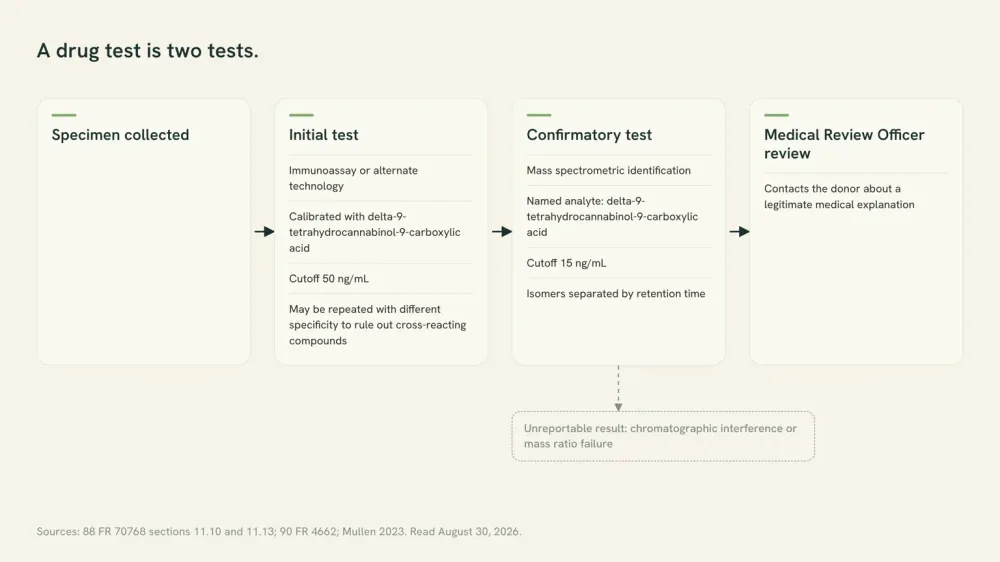
A drug test is two tests. The first is an antibody screen calibrated against a delta-9 molecule. The second identifies one named analyte by mass spectrometry. Delta-8 leaves a positional isomer of the delta-9 acid, and that difference decides what each stage can see.
You took delta-8, you have a drug test coming, and every page you open tells you something slightly different. Start with a correction: what you are being given is almost certainly not a delta 8 drug test. It is the ordinary cannabis panel, and the real question is what that panel does with delta-8's metabolites. The short answer has two parts, because a drug test has two parts. The first test is an antibody screen that was calibrated against a delta-9 molecule and mostly cannot separate delta-8's metabolites from it. The second test, the confirmation, is a mass spectrometry identification of one specifically named molecule, and delta-8 leaves behind a different one: 11-nor-9-carboxy-delta-8-THC, a positional isomer of the delta-9 acid. This page explains both stages out of the federal documents and the published measurements. It contains nothing at all about affecting a test result, and it cannot tell you what yours will say.
Does delta 8 show up on a drug test? Start with what the screen is looking for
A urine drug test is two tests, run in order, and almost every argument about delta-8 collapses if you treat them as one. The first is called the initial test, and in federal workplace testing it is governed by the Mandatory Guidelines for Federal Workplace Drug Testing Programs using Urine, published at 88 FR 70768 on October 12, 2023 and effective February 1, 2024. Section 11.10(a) of the rule that governs urine testing for federal agencies reads, in full: "An initial drug test may be: (1) An immunoassay; or (2) An alternate technology (e.g., spectrometry, spectroscopy)." An immunoassay is an antibody test. It does not identify molecules. It reports how strongly a sample's contents bind to an antibody that was raised against a particular shape, and then compares that response to a threshold.
The shape matters, because the government names it. That rule carries the drug testing panel as a table, and the footnote attached to its marijuana row says: "An immunoassay must be calibrated with the target analyte, Δ-9-tetrahydrocannabinol-9-carboxylic acid." That is the terminal metabolite of delta-9-THC, usually written THC-COOH. So the screen is not calibrated against "THC" in general, and it is certainly not calibrated against delta-8. It is calibrated against one specific delta-9 breakdown product, and everything else it responds to, it responds to by resemblance.
The same rule contains the sentence that tells you a screen result is provisional. Section 11.10(d): "An HHS-certified laboratory may conduct a second initial drug test using a method with different specificity, to rule out cross-reacting compounds." Read the verb. It is may, not must. The federal system knows the initial test picks up things that are not the target analyte, and it permits, without requiring, a second look before the specimen goes on to confirmation. Note also the scope of all of this: these Guidelines bind federal agency testing. A private, non-regulated employer sets its own panel and its own cutoffs and is not bound by them. If you are here about CBD rather than delta-8, the trace-THC version of this question is answered on our page about CBD and workplace drug testing, which owns that pathway and the wider procedure.
The molecule almost nobody names: 11-nor-9-carboxy-delta-8-THC
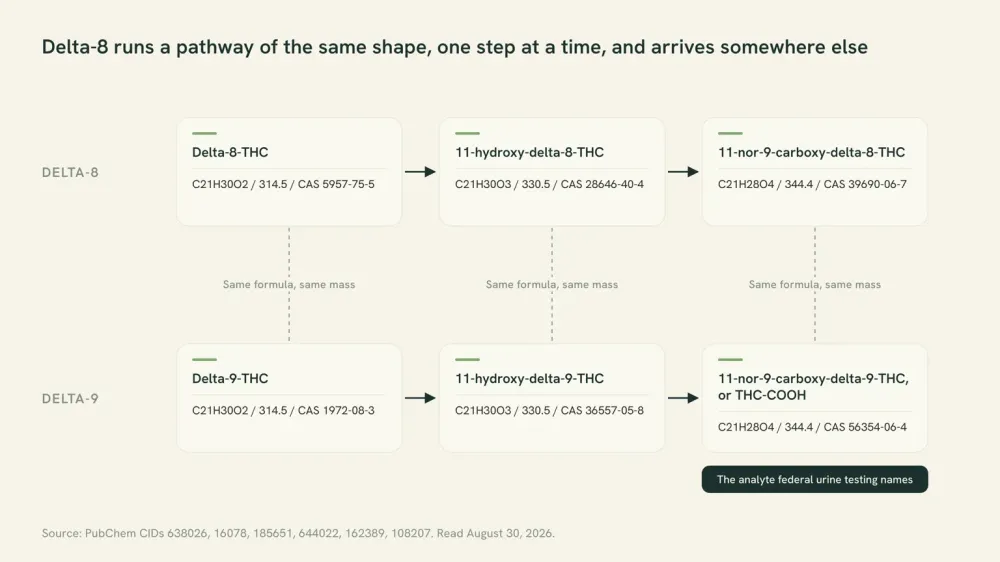
Here is the correction the rest of this page rests on. Delta-9-THC is metabolized in the body in two main steps: first to 11-hydroxy-delta-9-THC, then to 11-nor-9-carboxy-delta-9-THC, the acid that urine testing actually targets. Delta-8 runs a pathway of the same shape, one step at a time, and arrives somewhere else: delta-8-THC to 11-hydroxy-delta-8-THC to 11-nor-9-carboxy-delta-8-THC. The two end points are not the same molecule. They are also not different formulas. They are positional isomers, and that single fact explains why one stage of the test struggles and the other one can succeed.
A positional isomer is a molecule built from exactly the same atoms in exactly the same numbers, with one feature sitting in a different place. Here the feature is a double bond, and the difference between delta-8 and delta-9 is where it sits, which is what the 8 and the 9 in their names mean. That similarity is carried all the way down the metabolic chain. In PubChem's own systematic naming the two parent molecules are identical strings except for one pair of locants, 6a,7,10,10a for delta-8 against 6a,7,8,10a for delta-9. At the end of the chain, the delta-9 acid that federal testing is written around carries CAS number 56354-06-4 while the delta-8 acid carries 39690-06-7. Same formula, same mass, two separate database records, two separate compounds.
| Compound | Molecular formula | Molecular weight | CAS number | PubChem CID |
|---|---|---|---|---|
| Delta-8-THC (the parent) | C21H30O2 | 314.5 | 5957-75-5 | 638026 |
| Delta-9-THC (the parent) | C21H30O2 | 314.5 | 1972-08-3 | 16078 |
| 11-hydroxy-delta-8-THC (first metabolite) | C21H30O3 | 330.5 | 28646-40-4 | 185651 |
| 11-hydroxy-delta-9-THC (first metabolite) | C21H30O3 | 330.5 | 36557-05-8 | 644022 |
| 11-nor-9-carboxy-delta-8-THC (the acid) | C21H28O4 | 344.4 | 39690-06-7 | 162389 |
| 11-nor-9-carboxy-delta-9-THC, or THC-COOH (the acid) | C21H28O4 | 344.4 | 56354-06-4 | 108207 |
That the pathway runs this way in people, and not only on paper, has been shown in real specimens. A 2025 method validation from the University of Florida, published in Analytical and Bioanalytical Chemistry, built an assay that quantifies delta-8-THC, delta-9-THC, both 11-hydroxy metabolites, both carboxy acids, CBD, 7-COOH-CBD, CBG and CBN separately in urine, and then ran it on authentic specimens from 69 patients. The paper reports that the delta-8 and delta-9 isomers were chromatographically resolved and successfully separated, with a lower limit of quantitation of 10 ng/mL. The delta-8 acid turned up in 3 of the 69 at a median of 25.5 ng/mL; the delta-9 acid was the most frequent finding, in 38, at a median of 278 ng/mL. The limits are real ones: this was an obstetric cohort with self-reported, uncontrolled exposures and no administered dose, in a single laboratory, so it establishes that the molecules can be told apart in real urine, and nothing about how much of anything anyone took.
Now put the isomer in front of each of the two tests in turn. An antibody responds to shape, and these shapes are nearly the same shape, so the screen has a hard problem. A mass spectrometer sorts by mass, and both acids weigh 344.4, so mass alone has the same problem. What separates them is chromatography: the two compounds travel through the analytical column at slightly different speeds and come off it at slightly different times. That is the whole mechanism, and the rest of this article is what happens when you apply it.
Why the screen usually says yes, with the devices and the cutoffs named
You will see cross-reactivity for delta-8 quoted as a bare percentage, usually something close to 100%, with no antibody, no device and no cutoff attached. A bare percentage is not a finding, because cross-reactivity is a property of a specific reagent at a specific threshold. The good news is that the measurement exists. In a 2023 study in the Journal of Analytical Toxicology, run at RTI International, an independent non-profit research institute, and co-authored by staff of the federal office that administers workplace drug testing, urine was fortified with 11-nor-9-carboxy-delta-8-THC at 10 to 120 ng/mL and run against cannabinoid immunoassay reagents from three manufacturers, at cutoffs of 20, 50 and 100 ng/mL. At the 50 ng/mL cutoff, cross-reactivity ranged from 87% to 112%. The limit worth stating: these were fortified specimens rather than donor specimens, and the abstract does not name the three manufacturers individually.
A second 2023 study, from Virginia Commonwealth University and funded by the National Institute of Justice, does name them. It ran six commercial homogeneous urine immunoassays on a single analyzer, an Abbott Architect Plus c4000: Abbott Cannabinoids, LZI Cannabinoids cTHC from Lin-Zhi International, the DRI Cannabinoid Assay and CEDIA THC from Thermo Fisher Scientific, ONLINE DAT Cannabinoid II from Roche Diagnostics, and Syva EMIT II Plus from Siemens Healthineers. Each was run at two cutoffs, 50 ng/mL and either 20 or 25 ng/mL depending on the assay. All six detected 11-hydroxy-delta-8-THC and 11-nor-9-carboxy-delta-8-THC at 100 ng/mL against the 50 ng/mL cutoff, and at 50 ng/mL against the lower cutoff. Note what is being reported there: a decision point in ng/mL, the lowest concentration tested at which the assay read positive, not a percentage. The authors also note that delta-8 cross-reactivity data were already present in all six manufacturers' information sheets, and that their measurements were consistent with them. The information was not hidden. It was sitting in the manufacturers' own documentation the whole time.
The same study is a useful control on a claim in the other direction. Against the same 50 ng/mL cutoff, none of those six assays detected CBD itself, and none detected 7-COOH-CBD, abnormal CBD, CBDA-A or olivetolic acid, even at 1,000 ng/mL. CBD does not look like the delta-9 acid to a cannabinoid antibody. Delta-8's metabolites do. A third 2023 evaluation, at Children's Mercy Hospital in Kansas City, reported the same behavior on the EMIT II Plus assay: set to a 20 ng/mL cutoff, it read positive for the delta-8 acid at 30 ng/mL and above.
One more property of screening chemistry is worth knowing, purely as background on why laboratories care about specimen handling. In a 2023 stability study using drug-free urine held at three pH values and three temperatures, the parent analogs were no longer detected after a single day at 45 degrees Celsius at any pH, and the acid metabolites gave a lower response at acidic pH than at neutral or basic pH. That is a laboratory logistics finding about specimens in transit, in a fortified sample set on one kit. It is not a variable anyone controls, and it is not on this page as one.
Delta 8 vs delta 9 on the confirmation: the panel names one molecule
If a specimen is at or above the initial cutoff, it goes to a confirmatory test, and section 11.13(a) of the same Guidelines says that the analytical method "must use mass spectrometric identification", giving gas chromatography-mass spectrometry, liquid chromatography-mass spectrometry, GC-MS/MS and LC-MS/MS as its examples, "or equivalent". This is where the question stops being about resemblance and starts being about identity. And federal workplace testing does not confirm against "THC". It confirms against one named analyte. In the drug testing panel HHS published on January 16, 2025, at 90 FR 4662 and effective July 7, 2025, the urine row reads: marijuana metabolite, abbreviated Δ9THCC, initial test cutoff 50 ng/mL, confirmatory test analyte Δ9THCC, confirmatory cutoff 15 ng/mL. The document's own nomenclature table defines Δ9THCC as delta-9-tetrahydrocannabinol-9-carboxylic acid. HHS republished those same panels with no revisions on March 13, 2026, at 91 FR 12308.
The abbreviation is new, and the reason it is new is the reason you are reading this page. Until that rule, HHS wrote THC and THCA. In the same document, under the heading Nomenclature, the Department explained the change in a passage that names delta-8 out loud.
“The Department previously used the abbreviation THC for Δ-9-tetrahydrocannabinol and THCA for Δ-9-tetrahydrocannabinol-9-carboxylic acid. The new abbreviations are Δ9THC in place of THC and Δ9THCC in place of THCA. Including "Δ9" in these abbreviations distinguishes them from other compounds (e.g., Δ-8-tetrahydrocannabinol-9-carboxylic acid and Δ-8-tetrahydrocannabinol).”
That sentence settles whether this isomer is a chemistry-class footnote or an operational problem: the federal workplace drug testing program renamed its own analyte, in part, so that the name could not be confused with delta-8's. Be careful about what a renaming does, though. It changes what a report must be called and what a panel is written against. It does not change what any particular laboratory's validated method is able to resolve, and those are different questions with different answers.
The second question has been tested directly, and the answer matches neither of the confident versions in circulation. In the same 2023 study that produced the 87% to 112% figure, specimens containing both acids were fortified by the National Laboratory Certification Program and sent to HHS-certified laboratories. Some results came back unreportable for the delta-9 acid, because of chromatographic interference or mass ratio failures. And there were no false-positive delta-9 reports from any HHS-certified laboratory. Interference in that system produced a result that could not be reported, rather than somebody else's positive. That is a finding about HHS-certified laboratories working with fortified proficiency specimens; it says nothing about a laboratory outside that program, and nothing at all about a point-of-collection device.
The mechanism behind that result is retention time, exactly as the chemistry predicts. The Children's Mercy evaluation cited above found that many of the mass spectrometry ion fragments overlap between the two acids, and reported that its GC-MS method nonetheless "separated the 2 compounds sufficiently to identify them independently by relative retention time". A working laboratory found the same thing the hard way. From April 2020 the Karolinska University Laboratory in Stockholm began seeing an unexplained peak in its confirmation runs, with the same exact mass and most abundant fragments as delta-9-THC-COOH but a slightly shorter retention time, "thereby not fulfilling all requirements for a positive identification". It was identified as the double bond isomer, the delta-8 acid. At its peak in June 2020 it appeared in 5.3% of that laboratory's THC-COOH-positive samples, later falling back to occasional findings. That is one laboratory's casework in Sweden, under a legal framework that is not the American one, and it is a clean picture of a confirmation refusing to call something a positive because the retention time was wrong.
One 2023 case series in the Journal of Medical Toxicology shows the entire two-stage split on a single page. It covers four pediatric patients who had taken delta-8 products bought at retail shops between June and September 2021. Basic urine drug screens were positive for cannabinoids in all four. Confirmatory analysis then named 11-nor-9-carboxy-delta-8-THC, and delta-9-THC and its metabolites were not detected on confirmatory testing in any of the four cases. Four cases, in children, in an emergency setting, is not a workplace study and is not evidence about anything an adult should expect. It is the split, on paper: the screen says cannabinoids, the confirmation says which one.
| What differs | The initial (screening) test | The confirmatory test |
|---|---|---|
| Technology | An immunoassay, or an alternate technology (UrMG section 11.10(a)) | Mass spectrometric identification: GC-MS, LC-MS, GC-MS/MS, LC-MS/MS or equivalent (section 11.13(a)) |
| What it is aimed at | Calibrated with the target analyte, delta-9-tetrahydrocannabinol-9-carboxylic acid | Quantifies the named analyte Δ9THCC, delta-9-tetrahydrocannabinol-9-carboxylic acid |
| Federal urine cutoff | 50 ng/mL | 15 ng/mL |
| What a result at or above the cutoff means | A response above a threshold on an antibody test; the laboratory may run a second initial test with different specificity to rule out cross-reacting compounds | An identification of a specific named molecule at or above the cutoff |
| What the delta-8 acid did when it was tested | Cross-reacted at 87% to 112% at the 50 ng/mL cutoff on three manufacturers' reagents; detected by six of six named commercial kits | In HHS-certified laboratories, produced unreportable delta-9 results from chromatographic interference or mass ratio failures, with no false-positive delta-9 reports |
"I only took delta-8" is often not what is in the specimen
Everything above assumes a clean premise: that the only cannabinoid in the specimen came from delta-8. In real casework that premise usually fails. A 2026 retrospective analysis from the University of Miami looked at 127 forensic human-performance urine specimens from Broward and Miami-Dade Counties, collected between January 2023 and January 2024 and analyzed by GC-MS. 52 contained only the delta-9 acid. 70 contained both acids. 3 contained the delta-8 acid alone. A further 5 contained 7-COOH-CBD alongside the delta-9 acid. Read the delta-8 side by itself: of the 73 specimens that contained 11-nor-9-carboxy-delta-8-THC, 70 also contained the delta-9 acid. The study does not establish why, and it does not try to: co-use of two products and the composition of one product would both look exactly like that in a urine specimen.
The pattern repeats wherever a laboratory goes looking for it with a method that can separate the isomers. A 2024 prevalence survey at the Sports Medicine Research and Testing Laboratory took 1,000 urine samples that had already returned a presumptive delta-9 carboxy finding in routine screening and re-ran them on an isomer-resolving LC-MS/MS method. Approximately 12% of them contained the delta-8 acid, at relative abundances between 5% and 100% of the total carboxy-THC present. That was an anti-doping sample set, self-selected by a prior presumptive positive, so it is an analytical prevalence figure and not a population estimate. Set it beside the 5.3% peak in Stockholm and one thing is clear: once methods could see the isomer, they started seeing it, and mostly next to the other one.
What was actually in the jar is its own question, and this blog answers it elsewhere rather than here. Independent analyses of retail delta-8 products repeatedly find delta-9 THC and reaction by-products that the label does not declare, which is covered in detail in our page on delta-8 and CBD, including what laboratory analysis finds in delta-8 products. The FDA's consumer update on the cannabinoid puts the regulatory position plainly: delta-8 products have not been evaluated or approved by the FDA for safe use in any context. The practical consequence for this page is narrow and important: "I only took delta-8" is frequently not a testable premise, whatever the chemistry says. And if your question is about a different hemp molecule, THCA, its own detection story is told on our THCA and CBD comparison, which owns that ground.
Why this page has no detection-window table
You have seen the tables: urine so many days, blood so many hours, saliva so many days, hair 90 days. Look underneath one of them for a delta-8 study and you will not find it. Rather than assert that, here is the search, so you can run it yourself and get a number to argue with. These are literal PubMed queries, run against the National Library of Medicine's database through its public search interface on August 30, 2026, with the counts they returned that day.
| PubMed query, exactly as run | Records | What is in them |
|---|---|---|
| delta-8-tetrahydrocannabinol AND urine | 14 | The entire human urine literature for this molecule, on that date |
| "11-nor-9-carboxy-delta-8-THC" | 1 | One record, the 2023 case series described earlier in this article |
| delta-8-tetrahydrocannabinol AND (immunoassay OR "workplace") | 10 | The screening and workplace-testing literature for this molecule |
| delta-8-tetrahydrocannabinol AND urine AND (administration OR dosing OR "controlled") AND humans[mh] | 2 | Both are pediatric case reports, not controlled adult administration |
| delta-8-tetrahydrocannabinol AND (excretion OR elimination OR "detection window" OR "detection time") | 10 | Read record by record: not one is a human delta-8 urinary excretion time course |
Read the 14 records in the first row and the conclusion is the same one the table already implies: on that date, on that database, there is no study that gave adults a known dose of delta-8 and then measured how long its metabolite stayed detectable in urine. That is a statement about a database on a day, not a law of nature, and it cuts both ways: the absence of the study is not evidence that windows are short, and it is not evidence that they are long. It is why the day-count tables are delta-9 numbers with the molecule's name swapped, and why nobody who publishes one cites a source for it.
This is not because nobody has ever dosed anyone with delta-8 under controlled conditions. Two double-blind, within-subject crossover trials were published in 2025, one oral in 19 healthy adults and a companion vaporized trial in 20, with co-authors from the federal workplace drug testing office. They measured whole blood cannabinoid concentrations, which peaked two to four hours after an oral dose and rose in an orderly way with dose. Neither trial reported urine, and urine is the specimen almost every workplace program collects. So controlled delta-8 data does exist. It just answers a different question from the one everybody is asking.
For contrast, here is what a controlled urine study looks like when someone runs one. A 2026 trial in Türkiye gave 15 volunteers, five per arm, oral hemp oil, dermal hemp oil or hemp seed food, and sampled urine serially over ten days with an isomer-specific LC-MS/MS method. In the oral hemp oil arm, total THC-COOH was detectable in 72 of 77 samples, or 93.5%, with a highest median of 3.91 ng/mL and a maximum observed value of 4.52 ng/mL. Every one of those concentrations is below the 15 ng/mL federal confirmatory cutoff and far below the 50 ng/mL initial cutoff. Interestingly, the delta-8 acid predominated over the delta-9 acid in those samples, at ratios of 1.92 to 8.83. That study is about hemp seed food products, in a small sample, on one market, and not about delta-8 products at all. That is exactly why it is here: it is the shape of the study that does not exist for delta-8.
Urine is where this question lives, because urine is what workplace programs collect, so the other specimen types get one line each. The federal oral fluid panel targets the parent molecule, delta-9-THC, at 4 ng/mL initial and 2 ng/mL confirmatory, which is a different target from urine's metabolite. Published delta-8 blood concentrations come almost entirely from postmortem forensic casework, where a 2026 University of Florida series of 107 cases found 39.3% positive for both delta-8 and delta-9 analytes, 25.2% for delta-8-related analytes only and 14.0% for delta-9 only. And the August 2026 searches above returned no delta-8 hair testing study at all, which is a plain statement of what the search found rather than an estimate. If your question is really about CBD rather than delta-8, our page on how long CBD stays in your system handles the different clocks for that molecule.
The MRO step, and what it is and is not for
There is a step between the laboratory and the employer that most people have never heard of, and it decides what the employer is actually told. In regulated testing, a laboratory result goes to a Medical Review Officer, a licensed physician who reviews it. Section 13.5(d) of the federal Guidelines says that on a laboratory positive the MRO "must contact the donor to determine if there is any legitimate medical explanation". It is worth knowing what that phrase excludes, because it is narrower than it sounds. Section 13.5(d)(2)(ii): "Ingestion of food products containing a drug ... is not a legitimate medical explanation for a positive urine drug test result." Section 13.5(d)(2)(iii): a physician's authorization or medical recommendation for a Schedule I controlled substance is not a legitimate medical explanation either.
Testing in DOT-regulated, safety-sensitive jobs runs under a different rule, 49 CFR Part 40, and that one addresses hemp products by name. Section 40.151 lists the things an MRO must not do, and paragraph (f) says, in part:
“You must not accept an assertion of consumption or other use of a hemp or other non-prescription marijuana-related product as a basis for verifying a marijuana test negative ... Consuming or using such a product is not a legitimate medical explanation.”
Two things follow from that, and both are worth carrying out of this article. First, legality and testability are unrelated questions. A product can be lawfully sold where you live and still produce a result a program reports, because a drug test measures molecules and a statute regulates commerce; those systems do not consult each other. That is why this article makes no claim about whether delta-8 is legal, and hands that half of the topic to our guide to CBD and federal hemp law and to the page on what a hemp label's milligram arithmetic actually proves. Second, the scope of these rules is specific: the federal Guidelines bind federal agency testing, 49 CFR Part 40 binds DOT-regulated safety-sensitive testing, and a private, non-regulated employer is bound by neither and writes its own program. None of this is legal advice, and a question about your own employment is a question for a lawyer licensed where you live.
What to ask before a delta 8 drug test, and what to check
Nothing in this section is about changing an outcome. It is about understanding the one you are in, which is the part that is genuinely knowable in advance. Most testing programs will tell you these things if you ask, and several of them are printed in the policy document you were given when you were hired.
- 1Which specimen the program collects. Urine is what most workplace programs use, and urine is the specimen every measurement in this article was made in. A different specimen means different targets and different cutoffs.
- 2Whether the panel is the federal panel or the employer's own. The federal cutoffs in this article apply to federal agency testing; a private employer sets its own panel and thresholds.
- 3Which analyte the confirmation quantifies, by name. "THC" is not an analyte. On the federal urine panel the answer is delta-9-tetrahydrocannabinol-9-carboxylic acid, at 15 ng/mL.
- 4What the initial cutoff is. A cross-reactivity figure without a cutoff is meaningless: the 87% to 112% range measured in 2023 belongs to the 50 ng/mL cutoff and to no other.
- 5Whether the laboratory is HHS-certified. The interference results described above came from HHS-certified laboratories and say nothing about any other laboratory, and nothing about a point-of-collection screening device.
- 6Whether the confirmation method resolves positional isomers. That is a question about one laboratory's validated method rather than about chemistry in general, and it has an answer.
- 7Whether a Medical Review Officer reviews a laboratory positive before the employer is told, and what that officer is and is not permitted to accept as an explanation.
- 8What was actually in the product that was consumed. Only a certificate of analysis for that specific batch answers it, and label text is not that document.
The last one is the item people skip, and it is the one that most often changes the answer, because the premise of the whole question is what the product contained. Reading a certificate is a learnable skill: which cannabinoids were quantified, which were reported as non-detected, what the limit of quantitation was, and whether the batch number on the certificate matches the batch in your hand. Our walkthrough on how to read a certificate of analysis covers it line by line, for any hemp product.
What this page cannot tell you
The honest limits are large enough to state plainly. This article cannot tell you what your result will be, and no article and no product can. The federal documents quoted here bind federal agency testing and DOT-regulated testing, which leaves most private employment governed by policies this page has never seen. The measured cross-reactivity figures come from fortified urine rather than donor specimens. The prevalence figures come from forensic human-performance casework, anti-doping samples and one Swedish laboratory's routine work, each a selected population and none of them a workplace. Two of the records this article leans on hardest are a series of four children and a series of 107 postmortem cases, neither of which is a population you can reason from. And the searches above turned up no delta-8 hair testing study, and no controlled adult delta-8 urinary excretion study either.
There is also a point about interpretation that the analysts make themselves, and it is worth carrying away from here. The 2026 postmortem series cited above concludes that a detection should be interpreted as "evidence of cannabinoid exposure, and not as definitive evidence of impairment, intoxication, or contribution to death" without additional case context. A test measures a molecule. Everything else people read into the result is inference, and often somebody else's inference. The road version of that distinction, where the law sometimes disagrees with the pharmacology, is covered on our page about CBD, THC and driving laws.
One disclosure, because it belongs on a page like this one. Delta-8-THC is an intoxicant. Planntz does not sell it, does not sell any intoxicating cannabinoid, and has nothing to offer as a response to a drug test. We make CBD tinctures, and even about those the honest sentence is the one we print everywhere else: no product can guarantee a drug-test outcome. This article exists because the question is asked constantly and answered badly, not because there is something at the end of it to buy.
That question has to be answered about the test rather than about the person, because no article can know a specimen, a panel or a laboratory method. What is known: the initial screen is an antibody test calibrated with the delta-9 acid, and in a 2023 study the delta-8 acid cross-reacted at 87% to 112% at the 50 ng/mL cutoff on reagents from three manufacturers, while six of six named commercial urine kits in a separate study detected delta-8's metabolites. The confirmatory test is different in kind: federal workplace testing quantifies one named analyte, delta-9-tetrahydrocannabinol-9-carboxylic acid, at 15 ng/mL, and published methods separate the delta-8 isomer from it by retention time. So the two stages behave differently, and neither this page nor any product can tell an individual what their result will be.
This is two questions with two different answers. The screen: essentially no, and by design, because an antibody responds to shape and the shapes are nearly identical. The confirmation: it depends on the method, and the federal panel is at least written against a named isomer. Mass alone does not do it, since both acids share the formula C21H28O4 and a molecular weight of 344.4 and many of their mass spectrometry fragments overlap. Chromatography does it, because the two compounds come off the analytical column at slightly different times. Published GC-MS and LC-MS/MS methods resolve them, and one Stockholm laboratory identified the delta-8 acid precisely because its retention time was slightly short. Whether the laboratory handling a given specimen runs a method like that is a property of that laboratory's validated method, and it is a fair thing to ask about.
Panel size counts drug classes, not molecules. A 5-panel and a 10-panel both include a cannabis line, and the larger panel adds further drug classes rather than further cannabinoids. What matters is what that one cannabis line is. On the federal urine panel it is a single analyte, marijuana metabolite, at a 50 ng/mL initial cutoff and a 15 ng/mL confirmatory cutoff against delta-9-tetrahydrocannabinol-9-carboxylic acid. Every panel that includes cannabis includes some version of that line, so the useful question is never how many panels there are, it is which analyte the confirmation names and at what cutoff.
The honest answer is that nobody has published the study that would answer it. A PubMed search on August 30, 2026 for delta-8-tetrahydrocannabinol and urine returns 14 records in total, and none of them administered a known dose of delta-8 to adults and then followed its metabolite in urine over time; the two records that combine controlled administration with urine are both pediatric case reports. The 2025 controlled crossover trials measured whole blood, where concentrations peaked two to four hours after an oral dose, and did not report urine at all. So the day-count tables in circulation are delta-9 numbers with a different molecule's name written above them. That also disposes of the related question about metabolizing delta-8 faster: this article publishes no timing guidance of any kind, and there is no evidence base from which anyone could responsibly write one.
Legality and detectability are separate systems that do not consult each other. A laboratory measures molecules against a cutoff; a statute regulates what may be sold. In DOT-regulated testing the point is explicit in the regulation: a Medical Review Officer must not accept an assertion of consumption or other use of a hemp or other non-prescription marijuana-related product as a basis for verifying a marijuana test negative, and consuming such a product is not a legitimate medical explanation. The federal Guidelines likewise exclude ingestion of food products containing a drug, and a physician's recommendation for a Schedule I substance, from what counts as a legitimate medical explanation. This is a description of two federal rules, not legal advice, and the legal half of the topic lives on our federal hemp law page.
Yes, and several published methods do exactly that. A 2025 University of Florida assay quantifies delta-8-THC, delta-9-THC, both 11-hydroxy metabolites and both carboxy acids separately in authentic urine, with the isomers chromatographically resolved. Isomer-resolving LC-MS/MS is what produced the prevalence figures in this article: about 12% of 1,000 presumptively positive samples in one 2024 survey, and the 52 / 70 / 3 split across 127 forensic specimens in a 2026 casework analysis. So the capability exists and is documented. Whether the laboratory handling a particular specimen runs such a method, and whether its program asks it to, is a separate question about that laboratory and that program.
If you came here for a number of days, we understand why, and the most useful thing this page can do is tell you that the number does not exist and hand you the search it comes from. What does exist is a chemistry that explains why a screen and a confirmation behave differently, a federal panel that names one molecule, and a set of questions you can ask about your own program. For the CBD version of this question, including where trace THC in a full-spectrum product comes from, start with our workplace testing guide for CBD users. For the underlying federal law, our hemp and CBD legality explainer is the hub for that side of the topic.
Writing about hemp, wellness and the small rituals that keep us balanced.