Can You Get Fired for Failing a Drug Test? What a Positive THC Result Proves, and Which States Limit It
Often, yes. But a urine screen detects an inactive THC metabolite, not impairment, and several states now write their laws around that difference. The statutes, their start dates, the jobs they leave out, and the questions to ask next. Not legal advice.

Can you get fired for failing a drug test? Often, yes. The exceptions are real but narrow: a few states now limit what an employer may do with a THC result, mostly because a standard urine screen detects an inactive metabolite that shows past use, not impairment at work. Those laws have citations and start dates, and federally regulated jobs, such as DOT safety-sensitive work, run on federal testing rules of their own. This is general information about US law as we read it on September 22, 2026. It is not legal advice.
What a positive THC test actually found
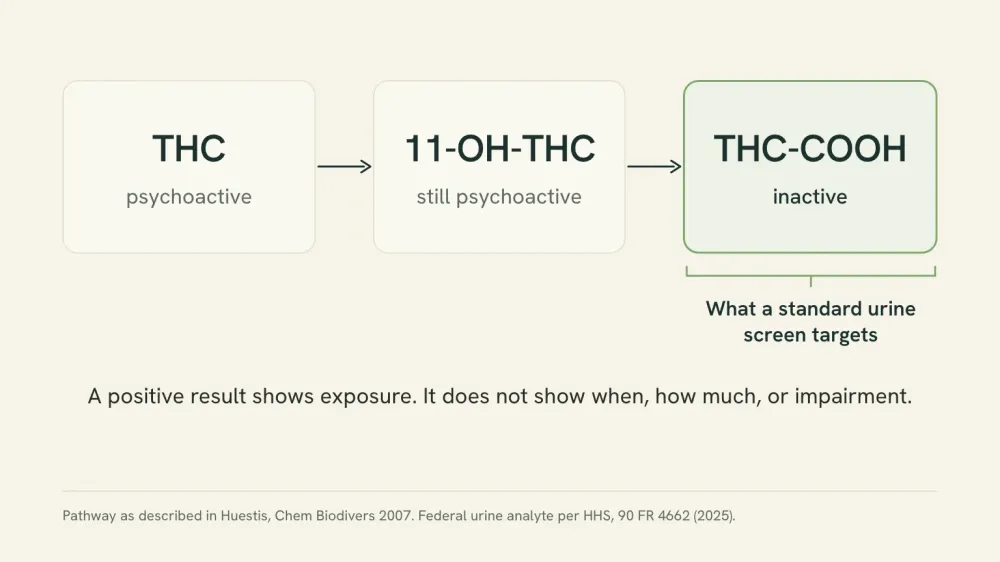
Start with the chemistry, because it is the part the law-firm pages that rank for this question skip. When THC enters the body, the liver breaks it down in steps. A 2007 review of human cannabinoid pharmacokinetics, written by a scientist at the National Institute on Drug Abuse, describes the pathway: the liver turns THC into 11-OH-THC, which is still psychoactive, and then into THC-COOH, which is inactive. THC-COOH is the compound a standard urine screen is built to find. It is a trace of past use, not a reading of what your brain is doing at the moment the sample is taken. The review states the limit in one sentence that is worth reading slowly.
“A positive urine test for cannabinoids indicates only that drug exposure has occurred. The result does not provide information on the route of administration, the amount of drug exposure, when drug exposure occurred, or the degree of impairment.”
Federal workplace testing is designed the same way. The HHS Mandatory Guidelines for federal workplace urine testing, published January 16, 2025 and effective July 7, 2025, do not list THC itself as the urine target. They name one analyte, a THC metabolite the rule abbreviates delta9THCC. Those guidelines bind federal agency programs, but they show what the test is built to see. We are deliberately not printing cutoff numbers or how long anything stays detectable. Those belong on our guide to CBD and drug tests and on how long CBD and THC stay in your system, which cover detection in detail. This page is about what happens after the result.
Why that distinction is now written into law
Several legislatures have taken that chemistry and built a rule on it. California did it most explicitly. Assembly Bill 2188, approved September 18, 2022, opens with legislative findings, and one of them says that when most cannabis tests are run, "the results only show the presence of the nonpsychoactive cannabis metabolite and have no correlation to impairment on the job." That is a legislative finding, not a scientific paper, but it tells you what the statute that followed is aimed at. The target is not testing as such. It is acting on a result that can only show past use.
New York's labor department reached the same place in guidance. Its FAQ on adult-use cannabis and the workplace, dated October 2021, takes the question head on: "No, a test for cannabis usage cannot serve as a basis for an employer's conclusion that an employee was impaired by the use of cannabis, since such tests do not currently demonstrate impairment." The same document adds that "The smell of cannabis, on its own, is not evidence of articulable symptoms of impairment" under section 201-D. That guidance applies to people employed in New York, and it is from 2021, but it is the clearest statement by a state agency we found.
The federal floor, and what Schedule III did not change
Most of the state statutes on this page say in their own text that they give way to federal requirements: California's, Washington's, New York's, Minnesota's and Arizona's all do. That matters because federal rules reach a lot of workers directly. If you work for the federal government, the baseline is Executive Order 12564, signed September 15, 1986. Section 1 says federal employees are required to refrain from the use of illegal drugs, and that "The use of illegal drugs by Federal employees, whether on duty or off duty, is contrary to the efficiency of the service." Section 5 says agencies "shall initiate action to discipline any employee who is found to use illegal drugs", with an exception for employees who come forward on their own before being identified, complete counseling or rehabilitation, and stop using. None of the sources we read addresses how agencies treat the two marijuana categories that moved to Schedule III in 2026, so we make no claim about it.
If your employer holds federal contracts, the Drug-Free Workplace Act at 41 U.S.C. 8102 requires contractors above the simplified acquisition threshold to publish a statement that unlawful "use of a controlled substance is prohibited in the person's workplace" and to spell out the actions taken against violators. That is a rule about workplace conduct. New York's labor department, citing a U.S. Department of Labor notice (TEIN 15-90), says in the same 2021 FAQ that neither the Act nor the rules adopted under it authorizes drug testing of employees.
Then there is the change many people assume fixed all this. The April 28, 2026 rescheduling order moved two narrow categories of marijuana to Schedule III: marijuana in FDA-approved drug products, and marijuana subject to a state medical license. Every other form of marijuana stayed in Schedule I. We read the full text. It does not mention workplaces or drug testing, and it never refers to the Department of Transportation. As of September 22, 2026, no final rule moving all marijuana to Schedule III had been published, and no DOT testing rule responding to the order had appeared in the Federal Register. The event itself is covered in our report on the Schedule III ruling. The point here is narrower: nothing in the order's text creates an employment right.
Three neighboring systems run on their own rules, and this page does not cover them. Sports testing under WADA and the NCAA works under different rules and consequences, which we cover in our guide to CBD in sports. Uniformed service members answer to military rules, which are a separate system again. And roadside testing and impaired-driving law are a different question from workplace testing, handled in our page on CBD and driving.
Can you get fired for failing a drug test? The state laws that limit it
This is where the answer actually changes. We read each statute below on September 22, 2026, from the legislature's own text (for New Jersey and Illinois, from archived copies of the legislatures' own pages), and we dropped any state we could not verify that day rather than describing it from memory or from a law-firm summary. That is why this is not a fifty-state list. It is the set of rules we can put a citation and a date on, grouped in the next section by the kind of rule each one is.
| State | Law | Key date | What it limits | What it leaves open |
|---|---|---|---|---|
| California | Gov. Code sec. 12954 (AB 2188 of 2022, amended by SB 700 of 2023) | In force January 1, 2024 | Penalizing off-the-job cannabis use, or acting on a test that found only nonpsychoactive metabolites; asking applicants about past use | Building and construction trades; federal background-check and clearance jobs; testing required for federal funding, licensing benefits or contracts; use or impairment on the job |
| Washington | RCW 49.44.240 (2023 c 359) | In force January 1, 2024 | Rejecting an applicant at initial hiring over off-job use or a metabolite-only pre-employment test | Everyone already employed, including post-accident and suspicion testing; airline and aerospace, law enforcement, fire, first responders, corrections and other listed roles |
| New York | Labor Law sec. 201-d, amended by the 2021 adult-use law | Amended 2021 | Penalizing legal cannabis use outside work hours and off the employer's premises | Specific, articulable symptoms of impairment while working; conflicts with federal law, a federal contract or federal funding |
| New Jersey | N.J.S.A. 24:6I-52 (P.L.2021, c.16, s.48) | Approved February 22, 2021 | Adverse action based solely on cannabinoid metabolites from lawful use | Random, pre-employment, reasonable-suspicion and post-accident testing; the state regulator says a test plus documented impairment may be enough |
| Minnesota | Minn. Stat. 181.938 and 181.951 (Laws 2023, ch. 63) | Rewritten by a law signed May 30, 2023 | Punishing off-duty use of cannabis and hemp-derived products; requiring a cannabis test before hiring unless law requires one | Use or impairment at work; safety-sensitive, police, fire, caregiving, commercial driving and federally funded roles |
| Minnesota (medical) | Minn. Stat. 342.57, subd. 5 and 5a | 2023 law, amended 2024 and 2025 | Penalizing an enrolled patient for a positive test alone; acting on federal-law grounds without 14 days' written notice | Use, possession or impairment at work; cases where not acting would violate federal or state law |
| Arizona (medical) | A.R.S. 36-2813(B) | Not stated here (we could not verify the enactment date) | Penalizing a registered patient for cardholder status or a positive test alone | Use, possession or impairment on the premises or during work hours; loss of a federal monetary or licensing benefit |
| Illinois | 820 ILCS 55/5 and 410 ILCS 705/10-50 | Amended 2019 | Refusing to hire or firing over off-duty use of lawful products | Reasonable zero-tolerance and drug-testing policies applied without discrimination; no lawsuit over a failed test under such a policy |
| Colorado | Coats v. Dish Network, 2015 CO 44 (a court ruling) | Decided June 15, 2015 | Nothing, in that case: medical use illegal under federal law was held not to be a lawful activity | Whether the holding still governs after later changes is not addressed here |
Two notes on the table. New Jersey's and Illinois' legislature websites refused connections on the day we wrote this, so we read their text from Internet Archive copies of the official legislature pages: New Jersey's enacted law as captured April 21, 2026, and Illinois' codified text as captured in March and May 2025. We describe only what that text says and make no claim about later amendments. And Nevada, Pennsylvania and several other states are left out because we could not verify their current text on September 22, 2026, not because they have no law.

Reading the table: three kinds of state rule
Off-duty use and metabolite-only results
California has the most detailed version. Since January 1, 2024, Government Code section 12954 has made it unlawful for an employer to discriminate in hiring, termination or any term of employment, or otherwise penalize someone, based on the person's "use of cannabis off the job and away from the workplace", or on an employer-required test that found only "nonpsychoactive cannabis metabolites". The statute does not ban testing. It expressly allows "scientifically valid preemployment drug screening conducted through methods that do not screen for nonpsychoactive cannabis metabolites", so a test that looks for something other than the inactive metabolite is outside that protection. Senate Bill 700, approved October 7, 2023, added a second rule: an employer may not "request information from an applicant for employment relating to the applicant's prior use of cannabis", subject to a carve-out for criminal history. The exceptions are specific. The section "does not apply to an employee in the building and construction trades"; it does not permit anyone to possess, be impaired by or use cannabis on the job; it yields to laws that require testing as a condition of federal funding, federal licensing-related benefits or a federal contract; and it excludes jobs that require a federal background investigation or security clearance.
Washington covers a narrower moment. RCW 49.44.240, in force since January 1, 2024, makes it unlawful to discriminate against a person "in the initial hiring for employment" over off-job cannabis use or a pre-employment test that found nonpsychoactive metabolites. It says outright that it does not apply "to testing for controlled substances other than preemployment, such as postaccident testing or testing because of a suspicion of impairment". If you already work there, this statute is not about your situation. It also excludes a long list of roles: jobs requiring a federal background check or clearance, law enforcement, fire departments, first responders including 911 dispatch and emergency medical services, corrections, the airline and aerospace industries, and safety-sensitive positions the employer identified before you applied.
New York protects the use itself. Labor Law section 201-d, amended by the state's 2021 adult-use law, protects adults' legal cannabis use "prior to the beginning or after the conclusion of the employee's work hours" and legal recreational activity "outside work hours, off of the employer's premises". (We cite that section in plain text because the state senate's site blocks automated reading; the labor department FAQ linked above is its readable companion.) The exceptions are the heart of it. An employer may act when the employee "manifests specific articulable symptoms while working" that lessen performance, or when not acting would put the employer in violation of federal law or cost it a federal contract or federal funding. The labor department also says an employer cannot test for cannabis merely because federal law does not prohibit it, but can where federal or state law requires it, and gives commercial drivers under 49 CFR Part 382 as the example.
New Jersey puts both halves in one paragraph. Its 2021 legalization law, P.L.2021, chapter 16, approved February 22, 2021 and codified at N.J.S.A. 24:6I-52, says an employee shall not be subject to adverse action "solely due to the presence of cannabinoid metabolites in the employee's bodily fluid" from lawful conduct. In the same passage it lets employers test on reasonable suspicion, after a work-related accident, at random or before hiring, and says "The employer may use the results of the drug test when determining the appropriate employment action". The state's Cannabis Regulatory Commission explained how those fit together in guidance on workplace impairment issued September 9, 2022: "A scientifically reliable objective testing method that indicates the presence of cannabinoid metabolites in the employee's bodily fluid alone is insufficient to support an adverse employment action." The next sentence is the other half: such a test combined with documented physical signs or other evidence of impairment during work hours "may be sufficient". The commission says the guidance applies until it approves standards for certifying workplace impairment experts, and that it "does not establish additional rights". The same guidance points to a provision of the law, N.J.S.A. 24:6I-52b(1)(b), that lets an employer bound by a federal contract bring its rules in line with federal law. The statute text here is as read September 22, 2026, from an archived copy of the legislature's page.
Minnesota goes further than the others we read, in two ways. Minnesota Statutes section 181.938, rewritten by the state's 2023 legalization act (signed May 30, 2023), treats cannabis flower, cannabis products, lower-potency hemp edibles and hemp-derived consumer products as "lawful consumable products", and says an employer may not refuse to hire, discipline or discharge someone for using them "off the premises of the employer during nonworking hours", whatever federal law says about cannabis. It still allows action on use or impairment during working hours, on work premises or while operating the employer's vehicle, machinery or equipment, and where federal or state law or a federal benefit requires it. Separately, section 181.951 says an employer "must not request or require a job applicant to undergo cannabis testing as a condition of employment unless otherwise required by state or federal law", and may not refuse to hire solely because a cannabis test came back positive. Its exception list is long: safety-sensitive positions, peace officers, firefighters, jobs involving face-to-face care of children, vulnerable adults or patients, positions requiring a commercial driver's license, positions funded by a federal grant, and any other position where state or federal law requires testing.
Protections for registered medical patients
A second kind of rule protects registered medical patients rather than everyone. Arizona's medical marijuana law, at A.R.S. 36-2813(B), says an employer may not discriminate in hiring or termination, or otherwise penalize a person, based on cardholder status or on a registered patient's positive test for marijuana components or metabolites, unless the patient used, possessed or was impaired by marijuana on the premises or during working hours. It also gives way where compliance would cost the employer a monetary or licensing-related benefit under federal law. (We cite it in plain text, without a date, because we could not verify its enactment date.) Minnesota's medical program, at section 342.57 (a 2023 law the state revisor lists as amended in 2024 and 2025), has a similar positive-test protection for enrolled patients and adds a procedural rule we did not find in the other states we read: before acting against a patient on federal-law grounds, the employer must give written notice "at least 14 days before" the action, citing "the specific federal law or regulation" it relies on.
States that keep zero-tolerance policies
The third kind of rule shows a protection and its limit sitting side by side. Illinois' Right to Privacy in the Workplace Act, as amended in 2019, makes it unlawful to refuse to hire or to discharge someone because they use lawful products off the employer's premises during nonworking and non-call hours. But it opens with "Except as otherwise specifically provided by law" and names section 10-50 of the Cannabis Regulation and Tax Act, which says nothing in that act stops an employer from adopting "reasonable zero tolerance or drug free workplace policies", or drug-testing policies, provided they are applied in a nondiscriminatory manner. The same section says there is no cause of action for discipline, termination or a withdrawn job offer "due to a failure of a drug test" under a reasonable workplace drug policy, and it describes impairment in terms of "specific, articulable symptoms". This text is as read September 22, 2026, from 2025 archived copies of the legislature's pages, and we are not characterizing any Illinois court decisions.
Colorado shows the older, harsher reading. In Coats v. Dish Network, decided June 15, 2015, the state supreme court ruled against a quadriplegic customer-service worker who was a registered medical patient, tested positive for THC on a random test in May 2010 and was fired that June. The court held that "an activity such as medical marijuana use that is unlawful under federal law is not a 'lawful' activity" under the state's off-duty statute. That was a 2015 ruling about the law as it stood then. We are not saying whether it would come out the same way today.
Across all three kinds, one thing holds. None of these laws protects using cannabis at work or being impaired at work, and most of them say in their own text that federal requirements come first. The newest ones are rules about which evidence an employer may act on, and for whom. The protection is real, and it is narrower than headlines suggest.
Who these state protections leave out
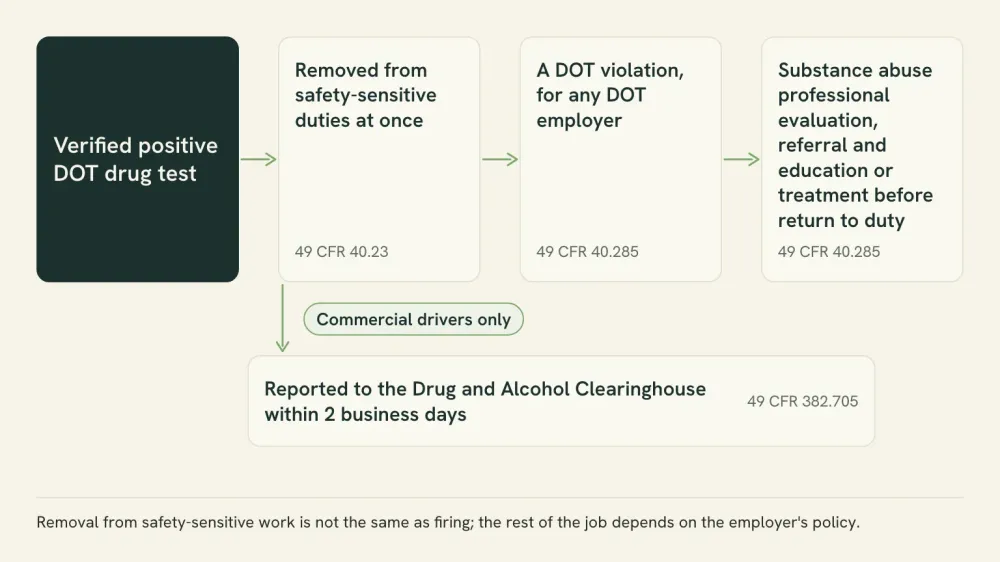
If you work in a safety-sensitive transportation job, federal rules come first. The Department of Transportation's testing rule, 49 CFR Part 40, covers transportation employers and safety-sensitive transportation employees, including self-employed people, contractors and volunteers where the agency rules cover them. After a verified positive, 49 CFR 40.23 says the employer "must immediately remove the employee involved from performing safety-sensitive functions", and adds: "Do not wait to receive the written report or the result of a split specimen test." Removal from safety-sensitive work is not the same thing as firing; what happens to the rest of the job depends on the employer's policy. What follows is the part the page-one results leave out. Under 49 CFR 40.285, a verified positive is a DOT violation, and the worker "cannot again perform any DOT safety-sensitive duties for any employer" until a substance abuse professional's evaluation, referral and education or treatment process is complete. For commercial drivers, 49 CFR 382.705 requires the medical review officer to report a verified positive to the federal Drug and Alcohol Clearinghouse within 2 business days.
One more DOT detail matters in 2026. The rule that governs the reviewing doctor, 49 CFR 40.151, still says the doctor must not verify a test negative because a physician recommended "a drug listed in Schedule I of the Controlled Substances Act", and it gives state medical marijuana laws as the example. Federal records show that section has not been amended since May 2023, and no DOT rule about the April 2026 order had been published in the Federal Register as of September 22, 2026. Do not read the April order as a change to DOT testing.
- DOT-regulated safety-sensitive workers, including commercial drivers, whose testing runs on federal rules. New York's labor department gives commercial drivers as its example of testing that federal law requires.
- Federal employees, under Executive Order 12564, whether the use is on duty or off duty.
- Workers whose employer's federal contract, grant or funding conditions apply. California, New York and Minnesota all name federal contracts, funding or benefits as an exception.
- Jobs that require a federal background investigation or security clearance, which California and Washington both exclude by name.
- In California, the building and construction trades. In Washington, airline and aerospace jobs, law enforcement, fire, first responders including 911 dispatch, corrections, and pre-identified safety-sensitive roles.
- In Minnesota, the pre-hire testing limit does not cover safety-sensitive roles, peace officers, firefighters, caregiving roles with children, vulnerable adults or patients, commercial driver's license jobs or federal-grant-funded positions.
- Anything tied to use, possession or impairment on the job. None of the laws we read protects that.
The hemp trap: a legal purchase, a positive result
This is the part none of the page-one results we read touches. You can buy a product that is legal where you live and still test positive. Full-spectrum CBD contains trace THC below 0.3%, and a positive result does not tell the employer what you bought. How that happens, product by product, is covered in our detection guide for CBD users, in the gummies version of that question, and in whether THCA flower shows up on a test.
Buying a legal product does not by itself protect a job. Whether it matters depends on the state statute and on whether the job is federally regulated. In DOT testing it does not: the same section 40.151 tells the reviewing doctor not to accept hemp or CBD use as an explanation for a marijuana positive. Our hemp seed oil guide quotes the rule's wording, and the delta-8 testing page walks through how the medical review step works. Among the states covered here, Minnesota is the only one whose off-duty statute names hemp-derived consumer products alongside cannabis as lawful consumable products.
The next 48 hours: questions to ask
If you have just failed a test, or been told you did, the most useful thing you can do quickly is collect facts. The list below is a set of questions, not a legal strategy, and it is not a way to beat or challenge a result. It is what a lawyer or a state agency will want to know when you talk to them, and several items map directly onto the statutes above.
- 1Ask for the written drug and alcohol policy you were tested under, and note its date. Illinois and New Jersey both refer to the employer's policy or its use of results.
- 2Ask what kind of test it was: pre-employment, random, reasonable suspicion or post-accident. Washington's law covers only pre-employment testing, and New Jersey's names each type.
- 3Ask what the test looked for. California's statute treats a result showing only nonpsychoactive metabolites differently from a test that screens for something else.
- 4Ask whether a laboratory confirmation test was run and whether a medical review officer (the doctor who reviews results) will contact you. In DOT testing, 49 CFR 40.131 requires that doctor to actually talk to the employee.
- 5If you are an enrolled medical patient in Minnesota or a registered cardholder in Arizona, have your registration details at hand, since both statutes turn on that status.
- 6Write down dates, times, who said what, and what you were given in writing, while it is fresh.
- 7Talk to a licensed employment attorney in your state, or your state's labor department, before signing anything you are handed. For questions about unemployment benefits, ask your state unemployment agency directly.
New Jersey's cannabis regulator gives the same routing on its workplace and DUI laws page, read September 22, 2026: "Questions about your employer's policies on drug testing and how they apply to you should be directed to your human resources department and/or a lawyer specializing in employment law." That holds in any state. We did not verify how a failed test affects unemployment eligibility anywhere, which is why the list above sends that question to the agency that decides it.

What this page cannot tell you
It cannot tell you whether your own firing was lawful. It does not know your contract, a union agreement, your employer's written policy, a city or county ordinance, or the facts of your test. It covers only the states whose text we read on September 22, 2026, and says nothing about the rest. It does not characterize court decisions beyond the one Colorado ruling it names, and it makes no prediction about how a court would apply any of these statutes to you. Statutes change, and two of them (New Jersey's and Illinois') were read from archived copies of the official legislature pages, so we have not described any later amendment. Finally, it does not tell you how long anything stays detectable or how to change a result. The detection pages linked above cover the first question, and the second is not something we will help with.
Often, yes. Whether an employer may act on a positive THC result depends on your state, your job and the kind of test. A few states limit it: California (since January 1, 2024) bars penalizing off-job use or a test showing only nonpsychoactive metabolites; New York protects legal off-duty use; New Jersey bars action based solely on metabolites from lawful use; Minnesota protects off-duty use of cannabis and hemp-derived products; Washington protects applicants at hiring only. Federally regulated jobs, such as DOT safety-sensitive work, follow federal rules. This is general information, not legal advice, and a licensed employment attorney in your state can apply it to your facts.
Legal to buy is not the same as protected at work. Some states protect off-duty use in their employment law (California, New York, New Jersey and Minnesota, each in a different way). Washington protects only the hiring decision. Illinois protects off-duty use of lawful products but lets employers keep reasonable zero-tolerance and drug-testing policies. Every one of those laws still allows action on use or impairment at work, and federally regulated jobs follow federal testing rules.
It depends on the state. Arizona and Minnesota both say a registered patient's positive test alone is not a basis for penalizing them, unless the patient used, possessed or was impaired at work, and Minnesota requires 14 days' written notice before an employer acts on federal-law grounds. A card is not a universal shield. In 2015, Colorado's Supreme Court ruled against a registered patient fired after a random test, holding that medical use illegal under federal law was not a lawful activity under the state's off-duty statute. In DOT testing, the reviewing doctor's rule still says a physician's recommendation to use a Schedule I drug is not a basis to verify a test negative.
It can. Full-spectrum CBD contains trace THC below 0.3%, and a positive result does not tell your employer what you bought; our CBD drug test guide explains how that happens. In DOT testing, the rule tells the reviewing doctor not to accept hemp or CBD use as an explanation. Among the states covered here, only Minnesota's off-duty statute names hemp-derived consumer products. The only way to remove the risk is not to use the product.
No. The April 28, 2026 order moved two narrow categories to Schedule III, marijuana in FDA-approved drug products and marijuana subject to a state medical license, and left every other form of marijuana in Schedule I. Its text does not mention workplaces or drug testing. As of September 22, 2026, no final rule moving all marijuana to Schedule III had been published, and DOT's reviewing-doctor rule still refers to Schedule I.
Within DOT-regulated work, yes. A verified positive is a DOT violation, and under 49 CFR 40.285 the worker cannot again perform DOT safety-sensitive duties for any employer until a substance abuse professional's evaluation, referral and education or treatment process is complete. For commercial drivers, the medical review officer must report a verified positive to the federal Drug and Alcohol Clearinghouse within 2 business days.
Yes. California's statute does not stop testing. It bars acting on a result that shows only nonpsychoactive cannabis metabolites, and it allows scientifically valid pre-employment screening by methods that do not screen for them. It does not apply to the building and construction trades or to jobs requiring a federal background investigation or security clearance, and it gives way to laws requiring testing for federal funding, federal licensing-related benefits or federal contracts.
If your question is really about the test rather than the job, the next page to read is how CBD, hemp and THC show up on a drug test, which covers the detection side this page deliberately leaves out. For the wider federal and state picture behind everything above, start with our overview of whether CBD is legal. And for anything that touches your own job, the right next step is a licensed employment attorney in your state.
Writing about hemp, wellness and the small rituals that keep us balanced.