
Can You Fly With Weed? TSA, Federal Law and the Airport
TSA's medical marijuana page has read 'Yes (Special Instructions)' since at least October 2024. What changed in the update dated April 27, 2026 is the text beneath it. Here is what TSA, federal law and three airports each say, with dates.
Can you fly with weed? Three authorities answer that question, and they do not agree. TSA's item page for medical marijuana says "Yes (Special Instructions)". Federal law still treats marijuana as a controlled substance, and everything outside two narrow categories remains Schedule I. And your departure airport may ban marijuana on its property even in a state where it is legal. TSA's "Yes" tells you the least of the three, and in an update dated April 27, 2026, TSA removed the paragraph on that page that explained federal law.
This page reflects the records we read on September 15, 2026. It is general information for adults 21 and over, not legal advice, and it does not say that any product or trip is legal. Planntz sells hemp-derived products, including a full-spectrum CBD and delta-9 THC tablet; nothing here is a recommendation to travel with any of them.
What TSA's page actually says
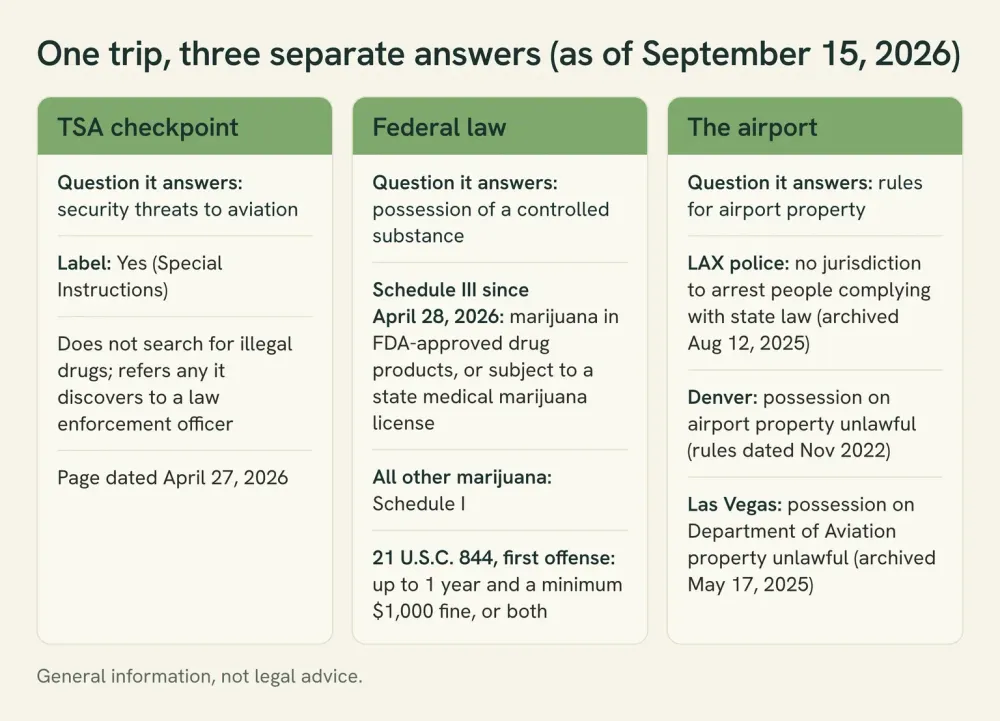
The primary record is TSA's "Medical Marijuana" item page. Read on September 15, 2026, it shows "Carry On Bags: Yes (Special Instructions)" and "Checked Bags: Yes (Special Instructions)", with a date line reading "Last Updated on April 27, 2026". Beneath the label, the page says:
“TSA's screening procedures are focused on security and are designed to detect potential threats to aviation and passengers. Accordingly, TSA security officers do not search for illegal drugs, but if any illegal substance or evidence of criminal activity is discovered during security screening, TSA will refer the matter to a law enforcement officer.”
It adds that "The final decision rests with the TSA officer on whether an item is allowed through the checkpoint." So the label is about the checkpoint, and the checkpoint is about threats to aviation. Whether you may lawfully possess marijuana is a question for other laws and other officers, which is why this "Yes" cannot answer it. The page also does not state:
- Any quantity limit.
- Which products it covers. It draws no line between flower, vapes, concentrates and edibles.
- Whether a medical card or any other document is needed.
- What the special instructions are.
- Anything about state law, hemp, CBD or the 0.3 percent THC line.
The label is old. The deletion is new.
Several reports this spring described April 2026 as the moment TSA added medical marijuana or began allowing it. The archive does not support that. An archived copy of the same TSA page from October 20, 2024 already shows "Yes (Special Instructions)" for carry-on and checked bags. What changed is the text under the label. Here is the last archived copy before the edit, captured April 22, 2026, beside the live page.
| Part of the page | Archived copy, April 22, 2026 | Live page, read September 15, 2026 |
|---|---|---|
| Bag labels | "Yes (Special Instructions)" for carry-on and checked bags | Unchanged |
| Federal law paragraph | "Marijuana and certain cannabis infused products, including some Cannabidiol (CBD) oil, remain illegal under federal law except for products that contain no more than 0.3 percent THC on a dry weight basis or that are approved by FDA." | Deleted |
| Reporting sentence | "TSA officers are required to report any suspected violations of law to local, state or federal authorities." | Deleted |
| What officers do not search for | "marijuana or other illegal drugs" | "illegal drugs" |
| What TSA refers to law enforcement | "any illegal substance" | "any illegal substance or evidence of criminal activity" |
| Date line | "Last Updated on June 5, 2019" | "Last Updated on April 27, 2026" |
If you have read that TSA allows hemp CBD under 0.3 percent THC, the closest TSA wording we found is that deleted paragraph, and it framed 0.3 percent as an exception to federal illegality, not as a TSA permission. The live page no longer mentions CBD, hemp or 0.3 percent, and the TSA item addresses we tried for CBD and marijuana returned not-found errors on September 15, 2026.
Federal law after April 28, 2026: what moved and what did not
Federal law is the second answer, and TSA's page no longer summarizes it. The final rule published and effective April 28, 2026, at 91 FR 22714, says that in general it applies to marijuana, marijuana extracts, and delta-9 THC and other compounds from the marijuana plant "that falls outside the definition of hemp", "to the extent that any of these are included in an FDA-approved drug product or are subject to a state-issued license to manufacture, distribute, and/or dispense marijuana or products containing marijuana for medical purposes". In the rule's words, "any form of marijuana other than in an FDA-approved drug product or marijuana subject to a state medical marijuana license remains a schedule I controlled substance", along with the controls and sanctions that apply to that schedule. When we searched the rule's text on September 15, 2026, the words recreational and adult did not appear, and neither of its two categories describes a purchase under a state adult-use law.
Two notices from the same day are easy to misread. One withdrew the August 29, 2024 notice of hearing and terminated those hearing proceedings; it did not withdraw rescheduling. The other announced a new hearing, beginning June 29, 2026, on the broader proposal to move marijuana to Schedule III. As of September 15, 2026, no final rule on that broader proposal had been published. The April order is also being challenged in court, a case our explainer on the Schedule III ruling follows.
Schedule III is still a schedule of controlled substances, and 21 U.S.C. 844, the federal simple-possession statute, makes it unlawful "knowingly or intentionally to possess a controlled substance unless such substance was obtained directly, or pursuant to a valid prescription or order, from a practitioner", or as the federal drug laws otherwise authorize. For a first offense it provides "a term of imprisonment of not more than 1 year, and shall be fined a minimum of $1,000, or both". After one prior drug conviction the range is 15 days to 2 years and a minimum $2,500 fine; after two or more, 90 days to 3 years and a minimum $5,000. These are the ranges the statute sets, not typical outcomes. We found no official data on how often an airport referral leads to a federal charge.
Why "federal airspace" is not the reason
You may have heard that federal law applies on a plane because planes fly in federal airspace. That gets the reason wrong: section 844 applies on the ground in every state. 49 U.S.C. 46506, the statute that extends certain federal crimes to acts aboard aircraft, covers offenses such as assault, theft, murder, robbery and sexual abuse. Drug possession is not among them. Separately, the FAA rule at 14 CFR 91.19 says no person may operate a civil aircraft in the United States "with knowledge that narcotic drugs, marihuana, and depressant or stimulant drugs or substances as defined in Federal or State statutes are carried in the aircraft". It is addressed to whoever operates the aircraft, and it has an exception for authorized carriage that we do not interpret.
Three legal states, three airport answers
TSA's page says it refers what it finds to "a law enforcement officer" without naming an agency, and airports also make rules for their own property. We read three airport texts from states with legal adult-use marijuana: LAX's airport police marijuana policy page, archived August 12, 2025, Denver International Airport's rules on conduct, dated November 2022 and archived December 1, 2023, and Harry Reid International Airport's marijuana page in Las Vegas, archived May 17, 2025. We link archived copies because on September 15, 2026 the LAX and Denver sites blocked our automated check and the Las Vegas page returned not found.
| Airport | What its own text says | Copy we read |
|---|---|---|
| Los Angeles (LAX) | Says California law allows people 21 or older to possess up to 28.5 grams of marijuana and 8 grams of concentrated marijuana. Airport police officers "have no jurisdiction to arrest individuals if they are complying with state law." TSA "screening stations are under federal jurisdiction." | Airport police policy page, archived August 12, 2025 |
| Denver (DEN) | Unlawful to "Possess, consume, use, display, transfer, distribute, sell" marijuana, among other acts, on property or facilities owned by the airport, including terminals and parking. We found no medical exception in the text we read. | Rules and Regulations Part 30, section 30.16, dated November 2022, archived December 1, 2023 |
| Las Vegas (LAS) | "Pursuant to Clark County Code 20.04.090, it is unlawful to possess or advertise Marijuana/Cannabis/THC on Clark County Department of Aviation (DOA) owned property." | Airport marijuana page, archived May 17, 2025 |
Read these with care. LAX's statement concerns arrests by airport police under state law; it does not say marijuana is allowed on a plane, and it points you back to federal jurisdiction at the checkpoint. Denver's rules date from 2022, and Hoodline reported on May 21, 2026, in a story about TSA's April update, that airport officials told Denver7 they plan to keep enforcing the ban. Chicago took a different approach. The Chicago Sun-Times reported in January 2020 that O'Hare and Midway had cannabis amnesty boxes which, according to a Chicago police spokesperson, are "owned by the Department of Aviation, but serviced by the Chicago Police Department", and reported in April 2022 that logs showed only 34 collections from January 2020 through March 20, 2022. The boxes are a way to dispose of cannabis before flying, and we could not confirm their current status.
Can you bring edibles on a plane?
A gummy or a brownie is often assumed to be a different case from flower. TSA's page draws no line by product form, and under the April rule a marijuana edible is a form of marijuana: outside the rule's two categories, it remains Schedule I. The Las Vegas airport text names "Marijuana/Cannabis/THC" without distinguishing product types. Products that meet the federal hemp definition are a separate legal category, and the rule says it "does not affect the status of hemp (as defined in 7 U.S.C. 1639o), because hemp is excluded from the definition of marijuana." What a hemp-derived delta-9 label does and does not establish is covered in our explainer on hemp-derived THC, and the hemp definition itself changes on dates tracked in our item on the November 12 and December 11, 2026 hemp deadlines. If the difference between the two molecules is new to you, start with how CBD and THC differ. Hemp CBD on its own is a different question again, handled in our guide to where CBD stands under federal and state law.
Medical marijuana cards at the airport
None of the records we quote on this page says what a state medical card allows at an airport. TSA's page does not mention cards. The April rule's medical category is written around a state-issued license "to manufacture, distribute, and/or dispense" marijuana for medical purposes, and when we searched the rule's text on September 15, 2026 for travel, transport, aircraft and interstate, we found no matches. We found no medical exception in the Denver and Las Vegas airport texts we read, and LAX's statement is about California law. Whether a state card fits section 844's prescription exception is a legal question we do not answer. If you are a patient planning a trip, ask a lawyer licensed in the states you are leaving and landing in.
Crossing a border is a different agency
International travel adds U.S. Customs and Border Protection and the law of the country where you land. CBP's reminder to travelers from Canada, last modified August 23, 2023, says the sale, possession, production and distribution of "both medical and recreational marijuana remains illegal under U.S. federal law", and that crossing the border or arriving at a U.S. port of entry with marijuana "may result in seizure, fines, and/or arrest, and may impact admissibility." A 2017 CBP travel advisory from International Falls, Minnesota said "crossing with a valid medical marijuana prescription is prohibited". Both predate the April 2026 order, which adds the rescheduled drugs "to the list of substances that may only be imported or exported pursuant to a permit". Canada's border agency puts its side plainly: "Don't bring it in. Don't take it out." For customs detail on CBD, see our guide to taking CBD on a cruise.

A pre-trip checklist, and what this page cannot tell you
None of these steps is about carrying anything. They are the questions to settle, in order, before you decide whether to travel with a product at all.
- 1Is the trip international? If so, CBP and the destination country's law come first.
- 2What is the product, legally? A state-licensed marijuana product is marijuana under federal law; a hemp-labeled product is a separate category that TSA's current page does not mention.
- 3Is it in one of the two Schedule III categories: an FDA-approved drug product, or marijuana subject to a state medical marijuana license? If not, it is Schedule I.
- 4What does your departure airport's own rule say? Read the airport authority's page and note its date.
- 5What does state law say where you land?
- 6How current is each source, this page included? TSA's page changed in April 2026, and the April order is being challenged in court.
- 7For a real decision about a specific trip, ask a lawyer licensed in the states involved.
Some gaps remain. The airport texts are archived copies from 2023 and 2025, and an airport can change its rules without an archive catching it. We found no official data on what usually follows a TSA referral, so we give you statutory ranges, not likely outcomes. The April order is in litigation and the broader rescheduling proposal is unresolved. We did not research airline policies, and we mention one foreign country only as an example. State laws change often. When a trip carries real stakes, a lawyer licensed in the relevant states can answer what this page cannot.
Can you fly with weed? Questions people ask
TSA's medical marijuana page draws no line by product form. Under the April 2026 rule, a marijuana edible that is not in an FDA-approved drug product or subject to a state medical marijuana license remains Schedule I. Products that meet the federal hemp definition are a separate category, which TSA's current page does not mention. Airport rules still apply, and the Las Vegas airport's text names THC directly.
TSA's page says its screening procedures "are focused on security and are designed to detect potential threats to aviation and passengers", and that "TSA security officers do not search for illegal drugs, but if any illegal substance or evidence of criminal activity is discovered during security screening, TSA will refer the matter to a law enforcement officer."
TSA's page says it will refer the matter to a law enforcement officer. What follows depends on that officer's jurisdiction, the airport's rules and state law. Under 21 U.S.C. 844, a first federal possession offense carries up to 1 year of imprisonment and a minimum $1,000 fine, or both. Those are statutory ranges, and we found no official data on typical outcomes.
None of the records we quote on this page addresses card holders flying with marijuana. TSA's page does not mention cards, the April 2026 rule's text does not mention travel or aircraft, and we found no medical exception in the Denver and Las Vegas airport texts we read. Ask a lawyer licensed in your departure and arrival states about a specific trip.
The label is the same one shown on an archived copy from October 2024: "Yes (Special Instructions)". The text beneath it changed. In the update dated April 27, 2026, TSA deleted the paragraph on federal illegality and the sentence saying officers are required to report suspected violations, changed "do not search for marijuana or other illegal drugs" to "do not search for illegal drugs", and added "or evidence of criminal activity" to what it refers to law enforcement.
CBP's travel page, last modified in August 2023, says medical and recreational marijuana remain illegal under U.S. federal law, and that arriving at a U.S. port of entry with marijuana may result in seizure, fines or arrest, and may affect admissibility. Canada's border agency says: "Don't bring it in. Don't take it out." Other countries' laws are not covered here.
If what you really want to know is how hemp-derived CBD is treated, the federal and state picture differs from everything above. Start with our hub on whether CBD is legal, which covers the federal hemp rule and the state exceptions.
Writing about hemp, wellness and the small rituals that keep us balanced.